CLASS 11-PCB . BIOLOGY . BIOLOGY . BREATHING AND-EXCHANGE-OF-GASES
Chapter 14 : Breathing And Exchange Of Gases
Ch 14
BIOLOGY
CLASS 11-PCB
Mechanism of Breathing
Respiratory Organs in Animals
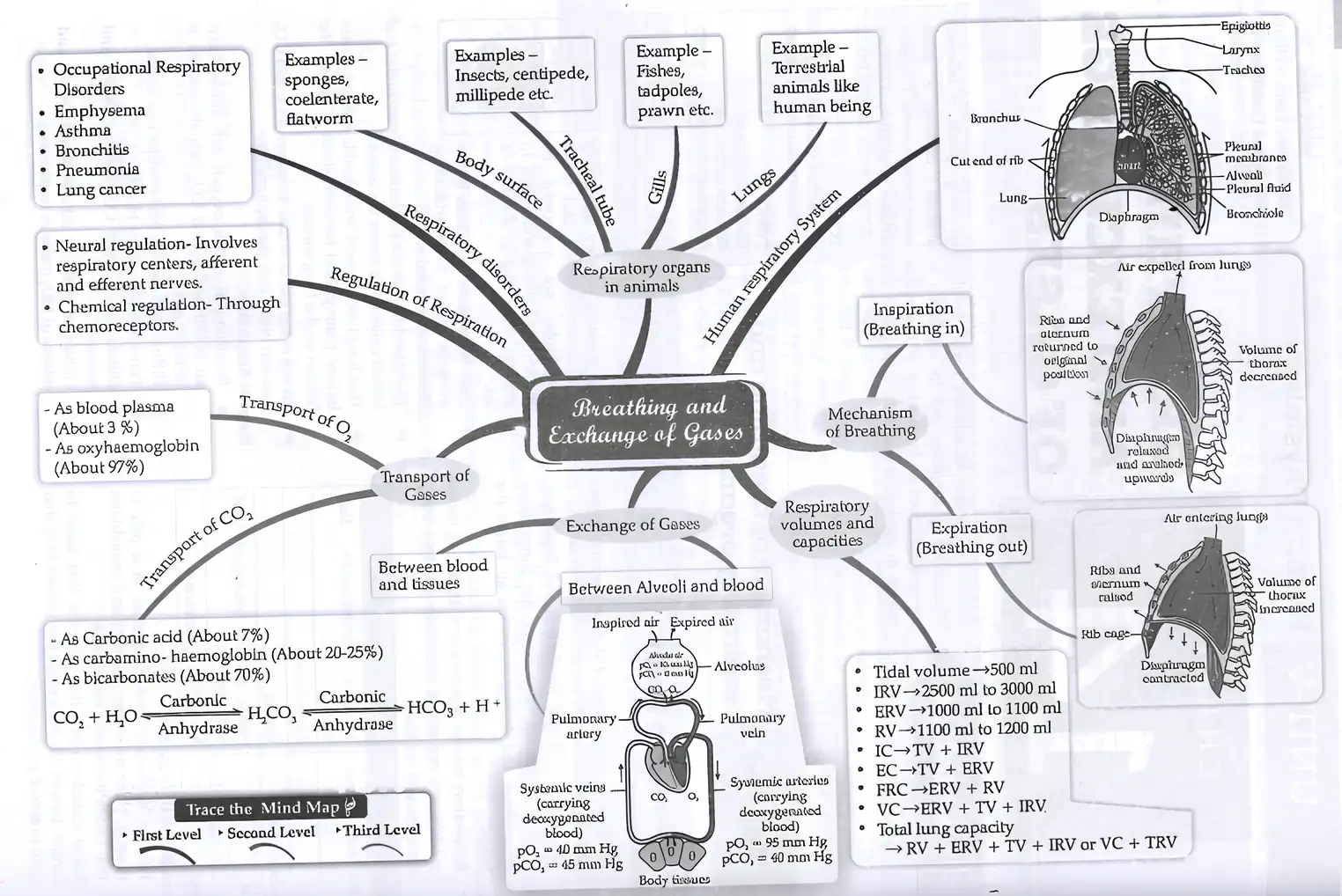
Different animals have adapted various respiratory organs based on their body structure and habitat. Some breathe through their entire body surface, such as sponges and flatworms. Earthworms respire through their skin. Insects use a tracheal system consisting of tubes that deliver air directly to tissues. Aquatic animals like fish and mollusks use gills to extract oxygen from water. Amphibians and mammals breathe using lungs.
Human Respiratory System
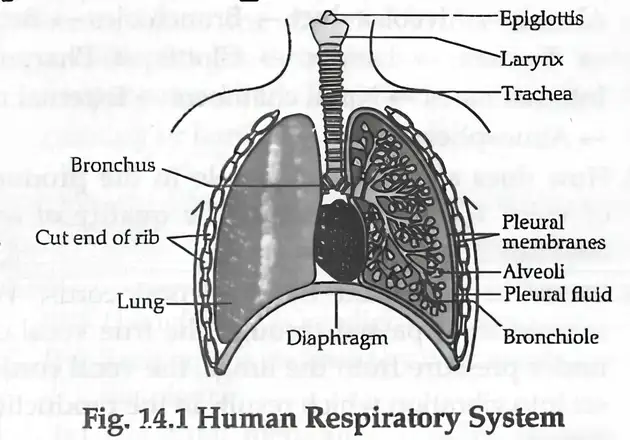
The human respiratory system includes nostrils, nasal cavity, pharynx, larynx, trachea, bronchi, bronchioles, and alveoli. Air enters through the nostrils, passes through the nasal chamber into the pharynx, then through the larynx which contains the voice box. The trachea divides into primary, secondary, and tertiary bronchi, which further branch into bronchioles ending in alveoli. The lungs are covered by a double-layered pleura with pleural fluid to reduce friction during breathing.
Mechanism of Breathing
Breathing consists of two phases: inspiration (inhaling) and expiration (exhaling). During inspiration, the diaphragm contracts and moves downward while the external intercostal muscles contract to lift the ribs and sternum, increasing the thoracic cavity volume. This reduces the pressure inside the lungs below atmospheric pressure, causing air to flow in. During expiration, the diaphragm and intercostal muscles relax, decreasing thoracic volume and increasing pressure inside the lungs, pushing air out. This process is driven by pressure gradients created by changes in lung volume.
Solved Examples
Example 1: Explain how the diaphragm and intercostal muscles contribute to breathing.
Solution: During inspiration, the diaphragm contracts and moves downward, increasing the vertical dimension of the thoracic cavity. Simultaneously, the external intercostal muscles contract, lifting the ribs and sternum, increasing the lateral and anteroposterior dimensions. This combined increase in thoracic volume lowers the pressure inside the lungs below atmospheric pressure, causing air to enter. During expiration, these muscles relax, reducing thoracic volume and increasing pressure, forcing air out.
Example 2: Describe the path of air from the nostrils to the alveoli.
Solution: Air enters through the nostrils, passes through the nasal cavity where it is filtered and warmed, then moves into the pharynx. From the pharynx, air passes through the larynx (voice box), then into the trachea. The trachea divides into two primary bronchi, each entering a lung. These bronchi branch into secondary and tertiary bronchi, which further divide into bronchioles. Bronchioles end in alveolar sacs containing alveoli where gas exchange occurs.
Practice Set
- Level 1 (Easy): Name the respiratory organ used by insects for breathing.
- Level 2 (Moderate): Explain how the diaphragm's movement affects lung volume during breathing.
- Level 3 (Challenging): Describe the sequence of events that occur during one complete cycle of breathing in humans.
Answer Key
- Level 1: Insects use a tracheal system for breathing.
- Level 2: When the diaphragm contracts, it moves downward, increasing the volume of the thoracic cavity and lungs, which decreases the pressure inside the lungs causing air to flow in. When it relaxes, it moves upward, decreasing lung volume and increasing pressure, pushing air out.
- Level 3: During inspiration, the diaphragm contracts and moves down, external intercostal muscles contract lifting ribs, increasing thoracic volume and decreasing pressure, drawing air into lungs. During expiration, diaphragm and intercostal muscles relax, thoracic volume decreases, pressure increases, and air is expelled.
Exchange of Gases
Respiratory Volumes and Capacities
Respiratory volumes measure the amount of air involved in different phases of breathing. Tidal volume (TV) is the air inhaled or exhaled during normal breathing (~500 mL). Inspiratory reserve volume (IRV) is the extra air inhaled forcefully (~2500-3000 mL). Expiratory reserve volume (ERV) is the extra air exhaled forcefully (~1000-1100 mL). Residual volume (RV) is the air remaining in lungs after forceful exhalation (~1100-1200 mL). Capacities are combinations of volumes, such as inspiratory capacity (TV + IRV), expiratory capacity (TV + ERV), functional residual capacity (ERV + RV), vital capacity (maximum air exhaled after maximum inhalation), and total lung capacity (sum of all volumes).
Gas Exchange Process
Gas exchange occurs at two sites: between alveoli and blood, and between blood and body tissues. It happens by simple diffusion driven by partial pressure gradients of oxygen and carbon dioxide. Oxygen moves from alveoli (high pO₂) to blood (low pO₂), and carbon dioxide moves from blood (high pCO₂) to alveoli (low pCO₂). The diffusion membrane consists of alveolar epithelium, capillary endothelium, and basement membrane. Carbon dioxide is more soluble than oxygen, facilitating faster diffusion.
Transport of Gases in Blood
Oxygen is transported mainly bound to hemoglobin in red blood cells (about 97%), forming oxyhemoglobin. The binding depends on partial pressures, pH, and temperature, represented by the oxygen dissociation curve. Carbon dioxide is transported in three forms: dissolved in plasma (~7%), bound to hemoglobin as carbaminohemoglobin (~20-25%), and as bicarbonate ions (~70%) formed by the enzyme carbonic anhydrase catalyzing the reaction between CO₂ and water.
Solved Examples
Example 1: Define tidal volume and inspiratory reserve volume with typical values.
Solution: Tidal volume is the volume of air inhaled or exhaled during normal breathing, approximately 500 mL in a healthy adult. Inspiratory reserve volume is the additional volume of air that can be inhaled forcefully after a normal inspiration, about 2500 to 3000 mL.
Example 2: Explain how carbon dioxide is transported in the blood.
Solution: Carbon dioxide is transported in blood in three ways: about 7% dissolved in plasma, 20-25% bound to hemoglobin as carbaminohemoglobin, and approximately 70% as bicarbonate ions formed by the reaction of CO₂ with water catalyzed by carbonic anhydrase.
Practice Set
- Level 1 (Easy): What is the site of gas exchange in the lungs?
- Level 2 (Moderate): Describe the role of carbonic anhydrase in carbon dioxide transport.
- Level 3 (Challenging): Calculate the vital capacity if tidal volume is 500 mL, inspiratory reserve volume is 3000 mL, and expiratory reserve volume is 1100 mL.
Answer Key
- Level 1: The alveoli are the site of gas exchange in the lungs.
- Level 2: Carbonic anhydrase catalyzes the reversible reaction between carbon dioxide and water to form carbonic acid, which dissociates into bicarbonate and hydrogen ions, facilitating CO₂ transport in blood.
- Level 3: Vital capacity = TV + IRV + ERV = 500 mL + 3000 mL + 1100 mL = 4600 mL.
Respiratory Disorders
Common Respiratory Diseases
Asthma is an allergic reaction causing inflammation and excess mucus in the respiratory tract, leading to coughing, wheezing, and difficulty breathing. Emphysema involves destruction of alveolar walls, causing difficulty in exhalation and lung inflation, often due to smoking. Occupational respiratory disorders like silicosis and asbestosis result from inhaling dust or fibers at workplaces, causing lung inflammation and fibrosis. Pneumonia is an acute infection of alveoli caused by Streptococcus pneumoniae, leading to fluid-filled alveoli and impaired gas exchange.
Mountain Sickness
Mountain sickness occurs due to hypoxia at high altitudes, causing symptoms like loss of appetite, nausea, breathlessness, headache, fatigue, and disorientation. It results from reduced oxygen availability in the atmosphere.
Solved Examples
Example 1: What causes asthma and what are its symptoms?
Solution: Asthma is caused by allergic reactions to foreign particles affecting the respiratory tract. Symptoms include coughing, wheezing, and difficulty in breathing due to excess mucus production.
Example 2: Explain the effect of emphysema on lung function.
Solution: Emphysema destroys the septa between alveoli, reducing surface area for gas exchange and causing difficulty in exhalation. The lungs remain inflated, impairing normal breathing.
Practice Set
- Level 1 (Easy): Name the bacterium responsible for pneumonia.
- Level 2 (Moderate): Describe the cause and effect of occupational respiratory disorders.
- Level 3 (Challenging): Explain why mountain sickness occurs at high altitudes.
Answer Key
- Level 1: Streptococcus pneumoniae causes pneumonia.
- Level 2: Occupational respiratory disorders are caused by inhalation of dust, gases, or fibers like silica and asbestos at workplaces, leading to lung inflammation and fibrosis, impairing respiratory function.
- Level 3: Mountain sickness occurs due to hypoxia caused by lower oxygen pressure at high altitudes, leading to insufficient oxygen supply to body tissues.
Quick Reference Table
Respiratory Organs: Body surface, tracheal tubes, gills, lungs.
Human Respiratory System Parts: Nostrils, nasal cavity, pharynx, larynx, trachea, bronchi, bronchioles, alveoli.
Respiratory Volumes: Tidal volume (500 mL), Inspiratory reserve volume (2500-3000 mL), Expiratory reserve volume (1000-1100 mL), Residual volume (1100-1200 mL).
Gas Transport: Oxygen mostly bound to hemoglobin; carbon dioxide transported as bicarbonate, carbaminohemoglobin, and dissolved CO₂.
Respiratory Disorders: Asthma, emphysema, occupational disorders, pneumonia.
Common Mistakes and Misconceptions
1. Confusing breathing with cellular respiration; breathing is the physical process of air movement, while cellular respiration is the biochemical process inside cells.
2. Assuming oxygen is transported only dissolved in blood plasma; actually, most oxygen binds to hemoglobin.
3. Believing carbon dioxide is transported only as dissolved gas; majority is transported as bicarbonate ions.
4. Thinking expiration is always an active process; normal expiration is passive due to muscle relaxation.
Glossary
Alveoli: Tiny air sacs in lungs where gas exchange occurs.
Diaphragm: Dome-shaped muscle that aids in breathing by changing thoracic volume.
Hemoglobin: Protein in red blood cells that binds oxygen.
Inspiration: Process of inhaling air into lungs.
Expiration: Process of exhaling air out of lungs.
Respiration: Exchange of oxygen and carbon dioxide between organism and environment.
Trachea: Windpipe that connects larynx to bronchi.