CLASS 11-PCB . BIOLOGY . BIOLOGY . RESPIRATION IN-PLANTS
Chapter 12 : Respiration In Plants
Ch 12
BIOLOGY
CLASS 11-PCB
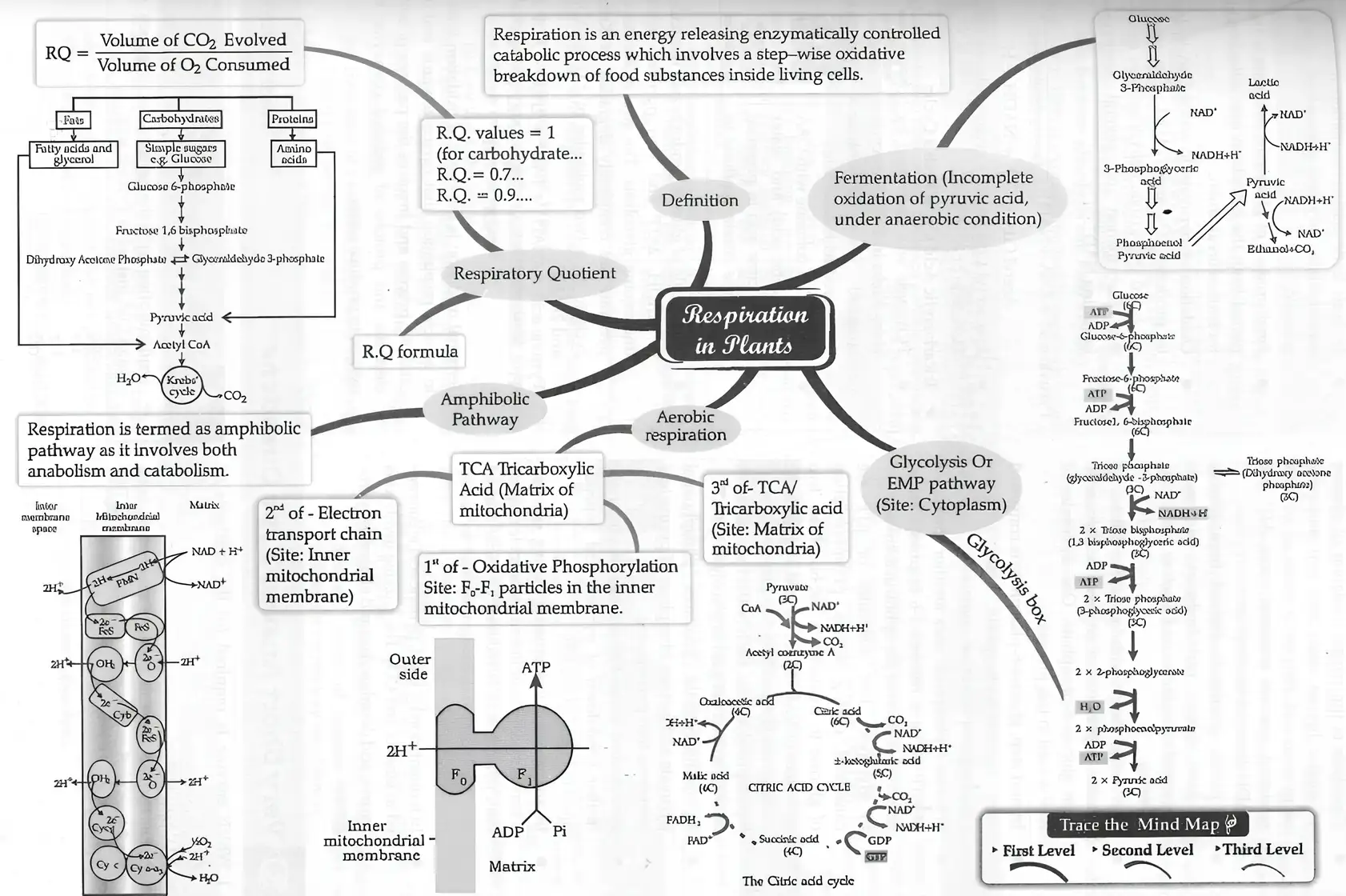
Cellular Respiration
Definition and Importance
Cellular respiration is an enzymatically controlled catabolic process in which food substances are broken down stepwise inside living cells to release energy. This energy is essential for various life activities such as absorption, movement, reproduction, and breathing.
Process Overview
Respiration involves the oxidation of glucose (or other respiratory substrates) to produce carbon dioxide, water, and energy. The general equation for aerobic respiration is:
C₆H₁₂O₆ + 6O₂ →1 6CO₂ + 6H₂O + Energy
The energy released is not used directly but is stored in the form of ATP (adenosine triphosphate), which acts as the energy currency of the cell.
Respiration in Plants
Plants do not have specialized respiratory organs. Instead, gas exchange occurs through stomata, lenticels, and root hairs. Each plant part manages its own gas exchange, aided by the loose packing of parenchyma cells and air spaces. Oxygen produced during photosynthesis also diffuses within the plant to support respiration.
Glycolysis
Pathway and Location
Glycolysis, also known as the Embden-Meyerhof-Parnas (EMP) pathway, is the partial oxidation of glucose into two molecules of pyruvic acid. This process occurs in the cytoplasm and involves a series of enzyme-mediated reactions.
Steps of Glycolysis
Glucose is phosphorylated by hexokinase to form glucose-6-phosphate, consuming one ATP molecule.
Glucose-6-phosphate is converted into fructose-6-phosphate by phosphohexose isomerase.
Fructose-6-phosphate is further phosphorylated by phosphofructokinase to fructose-1,6-bisphosphate, consuming another ATP.
Fructose-1,6-bisphosphate is split into glyceraldehyde-3-phosphate and dihydroxyacetone phosphate.
Glyceraldehyde-3-phosphate is oxidized to 1,3-bisphosphoglycerate, producing NADH.
Subsequent steps lead to the formation of pyruvic acid and the generation of ATP.
Energy Yield
Net gain from glycolysis includes 2 ATP molecules and 2 NADH molecules (equivalent to 6 ATP), totaling approximately 8 ATP molecules.
Fate of Pyruvic Acid
Depending on oxygen availability, pyruvic acid undergoes different pathways:
Under aerobic conditions, pyruvate enters mitochondria for further oxidation.
Under anaerobic conditions, pyruvate is converted to lactic acid in animal cells or ethanol and CO2 in yeast through fermentation.
Tricarboxylic Acid Cycle
Introduction
Also known as the Krebs cycle, the TCA cycle occurs in the mitochondrial matrix and was discovered by Hans Krebs. It is a cyclic pathway where acetyl CoA combines with oxaloacetic acid to form citric acid.
Steps of the Cycle
Acetyl CoA combines with oxaloacetic acid (OAA) and water to form citric acid, catalyzed by citrate synthase.
Citric acid undergoes a series of transformations, releasing CO2 and producing NADH, FADH2, and ATP.
The cycle regenerates oxaloacetic acid to continue the process.
Energy Yield
From one glucose molecule, two pyruvate molecules enter the TCA cycle, producing 8 NADH, 2 FADH2, and 2 ATP molecules.
Electron Transport Chain
Function and Location
The electron transport chain (ETC) is a series of protein complexes located in the inner mitochondrial membrane. It transfers electrons from NADH and FADH2 to oxygen, the terminal electron acceptor, producing water.
Process
Electrons from NADH are transferred to NADH dehydrogenase and then to ubiquinone.
Electrons from FADH2 also enter the chain via ubiquinone.
Electrons pass through cytochrome bc\u00019 complex and cytochrome c to oxygen.
The energy released pumps protons across the membrane, creating an electrochemical gradient.
ATP synthase uses this gradient to synthesize ATP from ADP and inorganic phosphate.
ATP Yield
Oxidation of one NADH produces approximately 3 ATP molecules, while one FADH2 yields about 2 ATP molecules.
Respiratory Quotient
Definition
Respiratory quotient (RQ) is the ratio of the volume of carbon dioxide produced to the volume of oxygen consumed during respiration.
Significance
RQ varies with the type of respiratory substrate:
Carbohydrates have an RQ of 1.
Proteins and fats have RQ values less than 1.
Amphibolic Pathways
Concept
Respiration is an amphibolic pathway, meaning it involves both catabolic (breakdown) and anabolic (synthesis) processes.
Substrate Utilization
Carbohydrates are converted into glucose before respiration.
Fats are broken down into glycerol and fatty acids; fatty acids are converted into acetyl CoA.
Proteins are broken into amino acids, which enter the Krebs cycle.
Solved Examples
Example 1: Calculate the total ATP yield from one molecule of glucose during aerobic respiration.
Solution:
Glycolysis produces 2 ATP and 2 NADH (equivalent to 6 ATP).
Pyruvate oxidation produces 2 NADH (equivalent to 6 ATP).
Krebs cycle produces 2 ATP, 6 NADH (equivalent to 18 ATP), and 2 FADH2 (equivalent to 4 ATP).
Total ATP = 2 + 6 + 6 + 2 + 18 + 4 = 38 ATP molecules.
Example 2: Explain why ATP is called the energy currency of the cell.
Solution: ATP stores energy released during respiration in its high-energy phosphate bonds. When ATP is hydrolyzed to ADP and inorganic phosphate, energy is released to power cellular activities. This makes ATP a universal energy carrier.
Practice Set
Level 1 (Easy): Define cellular respiration and write its general equation.
Level 2 (Moderate): Describe the role of mitochondria in cellular respiration.
Level 3 (Challenging): Explain the significance of the respiratory quotient and how it varies with different substrates.
Answer Key
Level 1: Cellular respiration is the enzymatic breakdown of food inside cells to release energy. General equation: C₆H₁₂O₆ + 6O₂ →1 6CO₂ + 6H₂O + Energy.
Level 2: Mitochondria are the site of the Krebs cycle and electron transport chain, where most ATP is produced during respiration.
Level 3: Respiratory quotient (RQ) is the ratio of CO2 produced to O2 consumed. It is 1 for carbohydrates, less than 1 for proteins and fats, indicating different metabolic pathways.
Quick Reference Table
Cellular Respiration: Breakdown of glucose to release energy.
Glycolysis: Cytoplasmic process converting glucose to pyruvate, yielding 2 ATP and 2 NADH.
TCA Cycle: Mitochondrial cycle producing NADH, FADH2, and ATP.
Electron Transport Chain: Inner mitochondrial membrane process producing ATP via oxidative phosphorylation.
Respiratory Quotient: Ratio of CO2 produced to O2 consumed; indicates substrate type.
ATP: Energy currency of the cell.
Common Mistakes and Misconceptions
Confusing photosynthesis with respiration; respiration occurs in all living cells, not just plants.
Assuming oxygen is not required for respiration; aerobic respiration requires oxygen.
Believing fermentation produces as much energy as aerobic respiration; fermentation yields much less ATP.
Thinking ATP is energy itself; ATP stores and transfers energy but is not energy.
Glossary
ATP (Adenosine Triphosphate): Molecule that stores and transfers energy in cells.
Glycolysis: The breakdown of glucose into pyruvate in the cytoplasm.
Krebs Cycle: Also called TCA cycle; a series of reactions producing energy carriers in mitochondria.
Electron Transport Chain: A sequence of electron carriers in mitochondria that produce ATP.
Respiratory Quotient (RQ): Ratio of CO2 produced to O2 consumed during respiration.
Fermentation: Anaerobic process converting pyruvate into lactic acid or ethanol.