CLASS 11-PCB . BIOLOGY . BIOLOGY . BODY FLUIDS-AND-CIRCULATION
Chapter 15 : Body Fluids And Circulation
Ch 15
BIOLOGY
CLASS 11-PCB
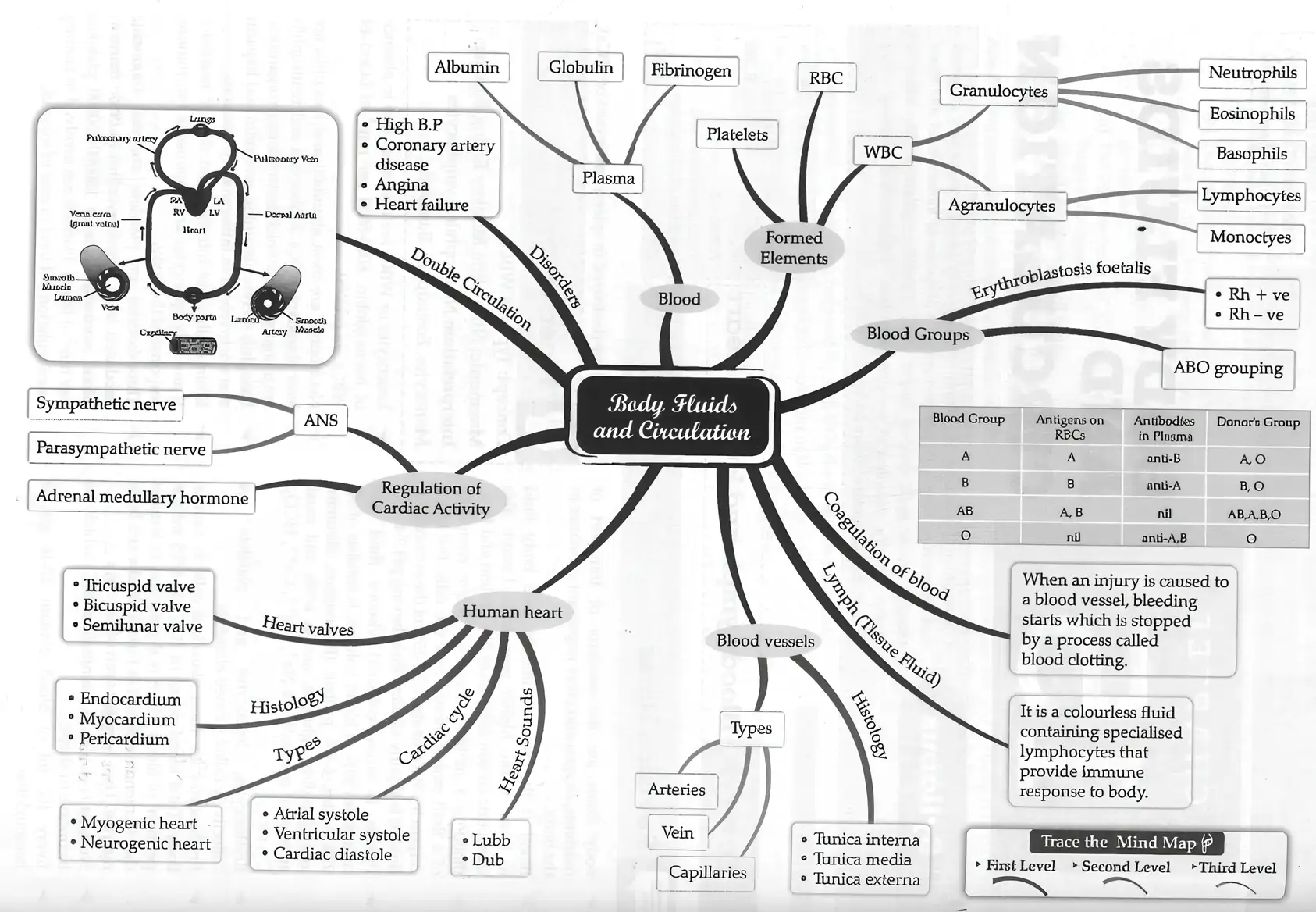
Blood Lymph Human Heart
Blood Composition
Blood is a mobile connective tissue composed of plasma and formed elements. Plasma is a straw-coloured viscous fluid constituting 55% of blood volume, containing 90-92% water, proteins like fibrinogen, albumin, globulin, glucose, amino acids, and minerals such as Na⁺, Mg⁺⁺, Ca⁺⁺, HCO₃⁻, and Cl⁻. Formed elements include erythrocytes (red blood cells), leucocytes (white blood cells), and platelets.
Red Blood Cells
Erythrocytes are the most abundant cells, numbering 4-5.5 million per mm³ of blood. They are biconcave, lack a nucleus, and have a lifespan of about 120 days. Haemoglobin content is 12-16 gm per 100 ml of blood. RBCs are produced in red bone marrow and destroyed in the spleen.
White Blood Cells
Leucocytes are colourless cells without haemoglobin, present at 6000-8000 per mm³. They are divided into granulocytes (neutrophils, eosinophils, basophils) and agranulocytes (lymphocytes, monocytes). Neutrophils are most abundant; basophils least. Monocytes and neutrophils are phagocytic. Basophils secrete histamine, serotonin, and heparin. Eosinophils combat infections and allergies. B and T lymphocytes mediate immune responses.
Platelets and Blood Clotting
Platelets, or thrombocytes, are cell fragments from megakaryocytes, numbering 150,000-350,000 per mm³. They play a key role in blood clotting by releasing factors that initiate coagulation. Calcium and vitamin K are essential for this process.
Blood Groups
Human blood groups are classified mainly by the ABO system and Rh factor. ABO groups depend on antigens A and B on RBC surfaces and corresponding antibodies in plasma. Group A has A antigens and anti-B antibodies; B has B antigens and anti-A antibodies; AB has both antigens and no antibodies; O has no antigens but both antibodies. Rh factor presence defines Rh-positive or Rh-negative blood. Rh incompatibility can cause erythroblastosis foetalis in newborns.
Lymph
Lymph is a clear fluid derived from interstitial fluid, containing lymphocytes that provide immune defense. It transports proteins, fats, oxygen, hormones, and nutrients.
Blood Vessels
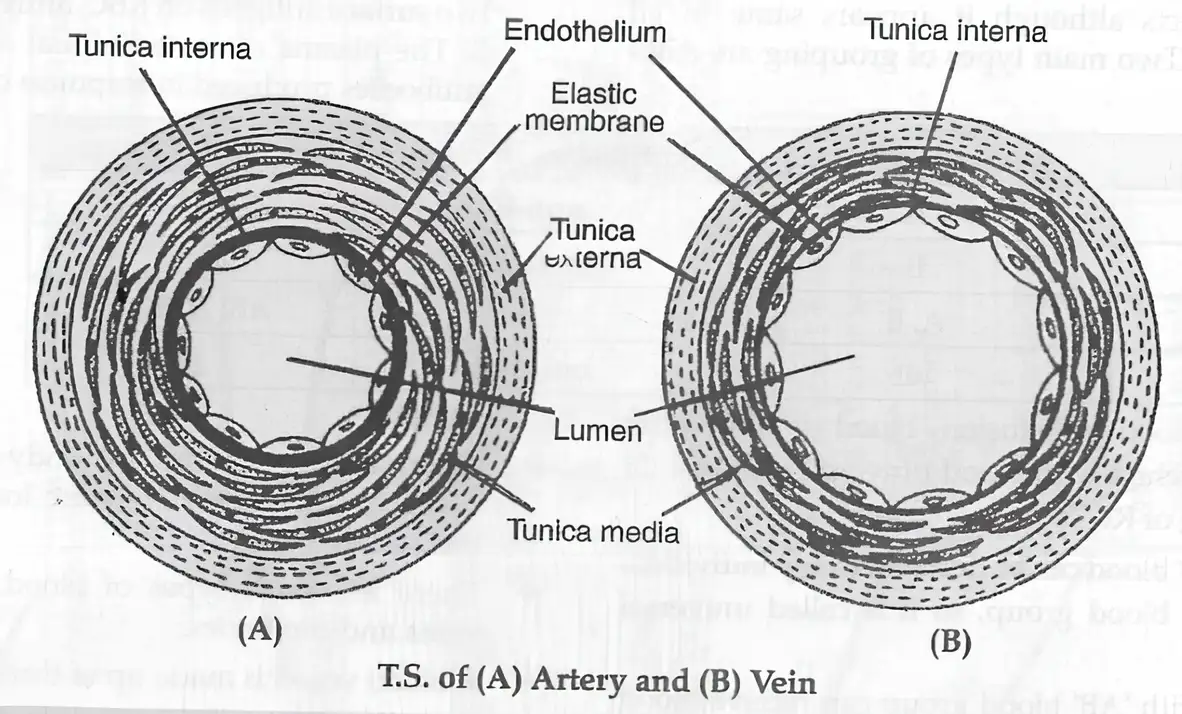
Blood vessels include arteries, veins, and capillaries. Each vessel has three layers: tunica interna (inner), tunica media (middle muscular layer), and tunica externa (outer). Arteries have thicker tunica media and elastic membranes to withstand high pressure; veins have thinner walls and larger lumens.
Human Heart Structure
The heart is a muscular organ with four chambers: two atria and two ventricles, separated by septa. Valves include tricuspid (right atrium to ventricle), bicuspid/mitral (left atrium to ventricle), and semilunar valves (ventricles to arteries). The heart wall has three layers: endocardium, myocardium, and pericardium. The sino-atrial node (SAN) acts as the pacemaker, generating rhythmic contractions.
Cardiac Cycle and Circulation
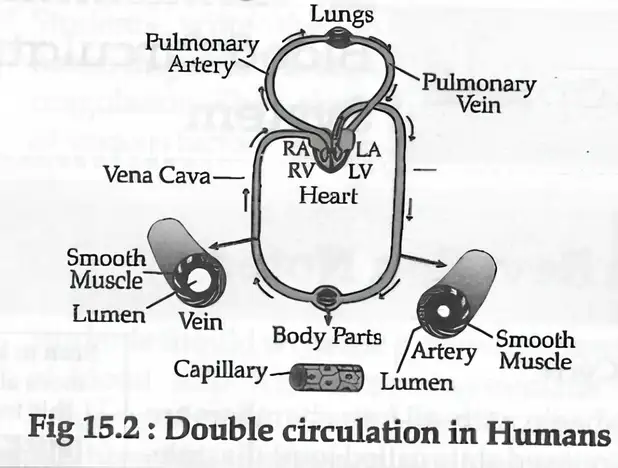
The cardiac cycle includes atrial systole, ventricular systole, and diastole phases, coordinating blood flow through the heart and vessels. Blood circulates via double circulation: pulmonary (heart to lungs and back) and systemic (heart to body and back). The heart produces two sounds during valve closures: 'lub' and 'dub'.
Regulation of Cardiac Activity
Heart activity is regulated by nodal tissues (SAN and AVN) and controlled by the autonomic nervous system. Sympathetic nerves increase heart rate; parasympathetic nerves decrease it. Hormones like adrenaline also influence cardiac output.
Disorders of Circulatory System
Common disorders include hypertension (high blood pressure), coronary artery disease (atherosclerosis), angina pectoris (chest pain due to reduced oxygen supply), and heart failure (inadequate blood pumping). These conditions affect heart function and overall health.
Solved Examples
Example 1: Calculate the total number of red blood cells in 5 mm³ of blood if the RBC count is 5 million per mm³.
Solution: Total RBCs = RBC count × volume = 5,000,000 × 5 = 25,000,000 RBCs.
Example 2: Explain why group O blood is called the universal donor.
Solution: Group O blood has no A or B antigens on RBCs, so it does not trigger immune reactions in recipients with different blood groups. Therefore, it can be donated to any blood group safely.
Example 3: Describe the sequence of events in the cardiac cycle.
Solution: The cardiac cycle starts with joint diastole where all chambers relax and fill with blood. Then atrial systole contracts atria pushing blood into ventricles. Ventricular systole follows, contracting ventricles to pump blood into arteries. Valves open and close to prevent backflow, producing heart sounds.
Practice Set
- Level 1: What are the main components of blood?
- Level 2: Explain the role of platelets in blood clotting.
- Level 3: Describe the process and significance of double circulation in humans.
Answer Key
- Level 1: Blood consists of plasma and formed elements: red blood cells, white blood cells, and platelets.
- Level 2: Platelets release clotting factors upon injury, initiating coagulation to stop bleeding. Calcium and vitamin K are essential in this process.
- Level 3: Double circulation involves blood passing twice through the heart: pulmonary circulation carries deoxygenated blood to lungs and back oxygenated; systemic circulation carries oxygenated blood to body and returns deoxygenated blood. This separation prevents mixing and ensures efficient oxygen delivery.
Quick Reference Table
- Blood: Connective tissue with plasma and formed elements.
- Plasma: 55% of blood volume; contains water, proteins, glucose, minerals.
- RBCs: Biconcave, no nucleus, 4-5.5 million/mm³, lifespan 120 days.
- WBCs: Immune cells; granulocytes and agranulocytes.
- Platelets: Cell fragments aiding blood clotting.
- Blood Groups: ABO system and Rh factor determine compatibility.
- Heart: Four chambers, valves, pacemaker (SAN).
- Cardiac Cycle: Sequence of heart contractions and relaxations.
- Double Circulation: Pulmonary and systemic circuits.
- Disorders: Hypertension, coronary artery disease, angina, heart failure.
Common Mistakes and Misconceptions
- Confusing blood plasma with lymph; plasma is part of blood, lymph is interstitial fluid with immune cells.
- Assuming all white blood cells have nuclei; platelets do not have nuclei but are not WBCs.
- Believing group AB blood can donate to all; it is the universal recipient, not donor.
- Mixing up pulmonary and systemic circulation; pulmonary is heart-lungs, systemic is heart-body.
- Thinking heart failure and heart attack are the same; heart failure is inadequate pumping, heart attack is muscle damage.
Glossary
- Plasma: Fluid part of blood carrying cells and nutrients.
- Erythrocytes: Red blood cells transporting oxygen.
- Leucocytes: White blood cells involved in immunity.
- Platelets: Cell fragments aiding clotting.
- Antigen: Molecule on RBC surface determining blood group.
- Antibody: Protein in plasma targeting foreign antigens.
- Cardiac Cycle: Complete heartbeat sequence.
- Double Circulation: Two-part blood flow through heart and body.
- Hypertension: High blood pressure condition.
- Coronary Artery Disease: Narrowing of heart arteries.