SOLUTIONS

2026 BOARD EXAM

CBSE Class 12 Humanities History Board Paper 2026 — Set 5 Solutions

2026

History

Class 12 Humanities

CBSE EXAMINATION PAPER-2026

HISTORY

(Solved)

Time allowed : 3 hours

Maximum Marks : 94

General Instructions :

Read the following instructions carefully and follow them :

  1. This question paper contains 41 questions. All questions are compulsory.
  2. This question paper is divided into 4 sections.
  3. Section A – questions number 1 to 5 are case based questions
  4. Section B – questions number 6 to 27 are multiple choice questions
  5. Section C – questions number 28 to 35 are short answer
  6. Section D – questions number 36 to 41 are long answer
  7. There is no overall choice given in the question paper. However, an internal choice has been provided in few questions.
  8. Use of calculator is NOT allowed.

Section A

Question 1.

Read the given source carefully and answer the questions that follow:

Eight forms of marriage.

Here are the first, fourth, fifth and sixth forms of marriage from the Manusmriti:

First: The gift of a daughter, after dressing her in costly clothes and honouring her with presents of jewels, to a man learned in the Veda whom the father himself invites.

Fourth: The gift of a daughter by the father after he has addressed the couple with the text, “May both of you perform your duties together,” and has shown honour to the bridegroom.

Fifth: When the bridegroom receives a maiden, after having given as much wealth as he can afford to the kinsmen and to the bride herself, according to his own will.

Sixth: The voluntary union of a maiden and her lover ... which springs from desire ...

(1) Explain why jewels and costly clothes were given in the first form of marriage.

[1 Mark]
Answer: Jewels and costly clothes were given in the first form of marriage to honour the bride and express respect, especially since the bridegroom was learned in the Vedas. This also signified the social status and the importance of the alliance.
Key Points: "Expression of respect, Honouring the bride, Significance of Vedic learning, Establishing social status"

(2) How had these marriages influenced the social practices in the later Indian society?

[2 Marks]
Answer: These forms of marriage influenced later Indian society by shaping marriage rituals, reinforcing social hierarchies and caste norms, and defining gender roles, thereby affecting social practices for generations.
Key Points: "Formation of caste norms, Marriage rituals, Social hierarchy, Gender roles"

(3) Explain the underlying idea behind the father honouring the bridegroom in the fourth form of marriage.

[1 Mark]
Answer: In the fourth form of marriage, the father honours the bridegroom to show respect and to encourage the couple to perform their duties together, fostering social bonding and legitimizing the union.
Key Points: "Respect for groom, Encouragement of duties together, Social bonding, Legitimization of marriage"
Question 2.

Read the given source carefully and answer the questions that follow:

A demon?

This is an excerpt from a poem by Karaikkal Ammaiyar in which she describes herself:

The female Pey (demoness)

with bulging veins,

protruding eyes, white teeth and shrunken stomach,

red haired and jutting teeth,

lengthy shins extending till the ankles,

shouts and wails

while wandering in the forest.

This is the forest of Alankatu,

which is the home of our father (Shiva)

who dances ... with his matted hair

thrown in all eight directions, and with cool limbs.

(1) Who was Karaikkal Ammaiyar?

[1 Mark]
Answer: Karaikkal Ammaiyar was a devoted female Tamil poet-saint, one of the earliest and most revered among Shaiva saints, known for her intense devotion to Lord Shiva.
Key Points: "Devotee of Lord Shiva, One of the earliest female Tamil poet-saints, Known for intense devotion, Iconic saint in Shaivism"

(2) How is Lord Shiva described in the poem?

[1 Mark]
Answer: Lord Shiva is described as dancing with his matted hair thrown in all eight directions, with cool and calm limbs, portraying his powerful yet composed nature.
Key Points: "Dances with matted hair, Hair thrown in all eight directions, Calm and cool limbs, Powerful yet composed"

(3) Analyse the central contrast depicted in the poem.

[2 Marks]
Answer: The poem contrasts the demoness's wild and terrifying appearance with the divine and graceful dance of Shiva in the forest. This juxtaposition highlights the spiritual beauty and power amidst physical ugliness and wilderness.
Key Points: "The demonic outer appearance vs divine inner, The wild forest vs Shiva’s cosmic dance, Physical ugliness vs spiritual beauty, Human frailty vs divine power"
Question 3.

Read the given source carefully and answer the questions that follow:

The Revolt of 1857.

Late in the afternoon of 10 May 1857, the sepoys in the cantonment of Meerut broke out in mutiny. It began in the lines of the native infantry, spread very swiftly to the cavalry and then to the city. The ordinary people of the town and surrounding villages joined the sepoys. The sepoys captured the bell of arms where the arms and ammunition were kept and proceeded to attack white people, and to ransack and burn their bungalows and property. Government buildings — the record office, jail, court, post office, treasury, etc. — were destroyed and plundered. The telegraph line to Delhi was cut. As darkness descended, a group of sepoys rode off towards Delhi.

The sepoys arrived at the gates of the Red Fort early in the morning on 11 May. It was the month of Ramzan, the Muslim holy month of prayer and fasting. The old Mughal emperor, Bahadur Shah, had just finished his prayers and meal before the sun rose and the fast began. He heard the commotion at the gates. The sepoys who had gathered under his window told him: “We have come from Meerut after killing all the Englishmen there, because they asked us to bite bullets that were coated with the fat of cows and pigs with our teeth. This has corrupted the faith of Hindus and Muslims alike.” Another group of sepoys also entered Delhi, and the ordinary people of the city joined them. Europeans were killed in large numbers; the rich of Delhi were attacked and looted. It was clear that Delhi had gone out of British control. Some sepoys rode into the Red Fort, without observing the elaborate court etiquette expected of them. They demanded that the emperor give them his blessings. Surrounded by the sepoys, Bahadur Shah had no other option but to comply. The revolt thus acquired a kind of legitimacy because it could now be carried on in the name of the Mughal emperor.

(1) How did the actions of the rebels in Delhi indicate a breakdown of British control?

[1 Mark]
Answer: The rebels destroyed government buildings, cut telegraph lines, attacked Europeans, and sepoys entered the Red Fort disregarding court protocol, all showing a clear collapse of British authority in Delhi.
Key Points: "Destruction of government buildings, Cutting telegraph lines, Attacks on Europeans, Sepoys entering Red Fort without respect"

(2) Why was Bahadur Shah’s involvement important for the rebels?

[1 Mark]
Answer: Bahadur Shah's involvement was important as it gave symbolic legitimacy to the revolt, uniting rebels under the traditional political authority of the Mughal emperor, thus strengthening their cause.
Key Points: "Symbolic legitimacy, Unity under emperor, Political leadership, Traditional authority"

(3) How did the sepoys and religious sentiments play an important role in this uprising? Explain.

[2 Marks]
Answer: The sepoys revolted due to religious offense caused by cartridges coated with cow and pig fat, which violated both Hindu and Muslim beliefs. This religious sentiment mobilised sepoys and the wider population, uniting them against British rule.
Key Points: "Issue of cartridges coated with cow and pig fat, Corruption of Hindu and Muslim faiths, Mobilisation of sepoys and people, Religious unity against British"
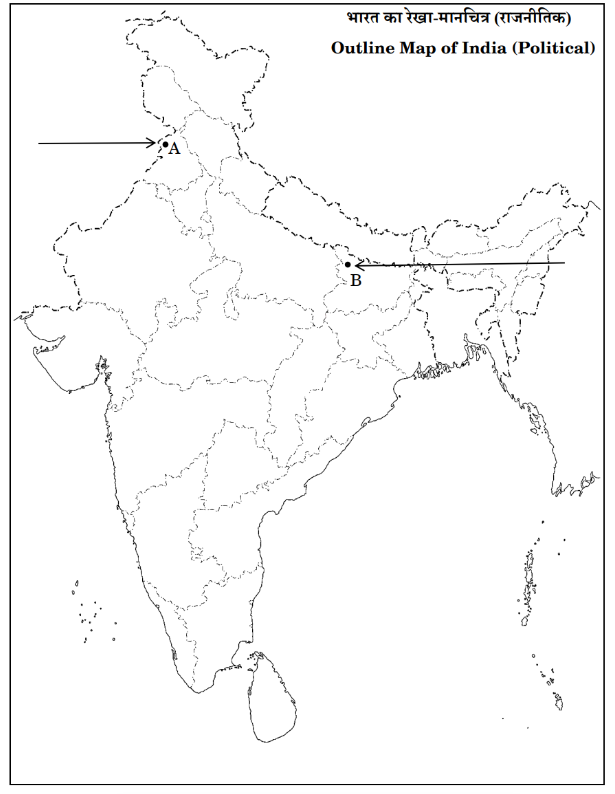
Question 4. On the given political outline map of India, locate and label the following with appropriate symbols :
Diagram 1 – CBSE Class 12 Humanities History 2026 Set 5 Solutions

(1) Kalibangan – A mature Harappan site

[2 Marks]
Answer: Kalibangan is a mature Harappan site located in Rajasthan. It is famous for its ploughed field with two sets of furrows at right angles, showing early farming practices. This site is important as Indian archaeologists found it while exploring Harappan sites within India post partition, as mentioned in the case passage.
Key Points: Kalibangan located in Rajasthan - Mature Harappan site - Known for ploughed field with furrows indicating early agriculture

(2) Ajanta – An ancient Buddhist site

[1 Mark]
Answer: Ajanta is an ancient Buddhist site located in the state of Maharashtra, India. On the political outline map of India, it should be marked and labeled appropriately near Aurangabad in Maharashtra. Ajanta is famous for its Buddhist caves and paintings, as mentioned in the case context. This helps us identify the site correctly on the map.
Key Points: Ajanta is a Buddhist site - Located in Maharashtra near Aurangabad - Marked and labeled on political map

(3) Panipat − A territory under the Mughals

[1 Mark]
Answer: Panipat was a significant territory under the Mughal Empire which had crown ownership of land as mentioned in the case. Bernier described the Mughal king and empire negatively due to this land system. On the map, Panipat should be located and labeled as a Mughal territory. This shows it was part of the Mughal political landscape during that time.
Key Points: Panipat was under Mughal control - Crown ownership of land was significant - Bernier's negative view of Mughal land system

(4) Golconda – A medieval period state

[1 Mark]
Answer: Golconda was a medieval kingdom located in the Deccan region of South India. On the political outline map of India, Golconda should be located in the area corresponding to the present-day Telangana state. It was an important center during the fourteenth to eighteenth centuries, as indicated by the historical context of South India mentioned in the case paragraph.
Key Points: Golconda was a medieval state - Located in Deccan region - Corresponding to present-day Telangana state
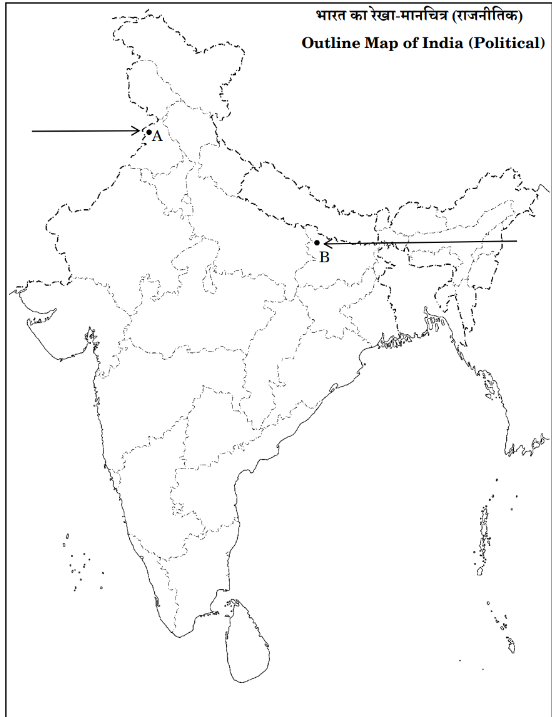
Question 5. On the same political outline map of India, two places have been marked as ‘A’ and ‘B’, as the centres of the Indian National Movement. Identify them and write their correct names on the lines drawn near them.
Diagram 2 – CBSE Class 12 Humanities History 2026 Set 5 Solutions

(1) Mention any one mature Harappan site in Pakistan

[1 Mark]
Answer: Answer: The two places marked as ‘A’ and ‘B’ are important centres of the Indian National Movement. Place ‘A’ is Delhi, and place ‘B’ is Calcutta. One mature Harappan site in Pakistan mentioned in the passage is Mohenjodaro.
Key Points: Place A – Delhi - Place B – Calcutta - Mature Harappan site in Pakistan – Mohenjodaro

(2) Mention one ancient Buddhist site in Bihar.

[1 Mark]
Answer: The places marked A and B on the map are important centres of the Indian National Movement. Place A is Champaran, where Mahatma Gandhi started the Indigo movement, and place B is Dandi, where the famous Salt March took place. An ancient Buddhist site in Bihar is Nalanda, which was a significant centre of learning in ancient India as mentioned in the case paragraph.
Key Points: Place A is Champaran - Place B is Dandi - Nalanda is an ancient Buddhist site in Bihar

(3) Name any one territory which was under the Mughal empire

[1 Mark]
Answer: The places marked as 'A' and 'B' on the map represent key centres of the Indian National Movement. For the sub-question, one territory under the Mughal empire was the region of Delhi. As mentioned in the case passage, administrative control was strongest around the capital and provincial centres, and Delhi was the Mughal capital.
Key Points: Places A and B are centres of Indian National Movement - Mughal empire had Delhi as a key territory - Administrative control was strongest around capital and provincial centres

(4) Name any one neighbouring kingdom of the Vijayanagara Empire.

[1 Mark]
Answer: One neighbouring kingdom of the Vijayanagara Empire was the Bahmani Sultanate. This kingdom was located to the north of the Vijayanagara Empire and often interacted with it, as mentioned in the case passage about Rayas, Nayakas and Sultans. This shows the political environment around Vijayanagara in the fourteenth to sixteenth century.
Key Points: Neighbouring kingdom - Bahmani Sultanate - Historical interaction with Vijayanagara Empire

(5) Name any two centres of the Indian National Movement.

[1 Mark]
Answer: The two centres of the Indian National Movement marked as A and B on the political map are Bombay (Mumbai) and Calcutta (Kolkata) respectively. These cities had active branches of the Indian National Congress, and were important centres during the Swadeshi movement of 1905-07 which broadened the nationalist appeal among the middle classes. These places played key roles in spreading nationalism across different regions of India as mentioned in the case passage.
Key Points: Bombay and Calcutta as centres - Active branches of Indian National Congress - Important role during Swadeshi movement

Section B

Question 6. ‘Traces of canals have been found at the Harappan archaeological site of Shortughai in Afghanistan but not in Punjab or Sindh.’ Identify the explanation provided by archaeologists from the following :
[1 Mark]
  • (A) Agricultural tools in Afghanistan were more advanced than in Punjab.
  • (B) Shortughai had access to the perennial rivers of the Himalayas.
  • (C) Archaeologists have not excavated Punjab and Sindh thoroughly.
  • (D) Punjab and Sindh had higher rainfall than Shortughai.
Explanation: Archaeologists explained that Shortughai had access to perennial rivers originating from the Himalayas, which facilitated canal-based irrigation. In contrast, Punjab and Sindh did not rely on such canals, possibly because water was drawn from wells or other methods were employed for irrigation. The presence of canals at Shortughai is linked to the geographical advantage of having perennial water sources nearby.
Question 7.

Assertion (A) : Asoka’s dhamma emphasized generosity, kindness and respect for religious traditions. Reason (R) : Asoka tried to hold his empire together with universally applicable principles.

[1 Mark]
  • (A) Assertion (A) is false, but Reason (R) is true.
  • (B) Both Assertion (A) and Reason (R) are true, but Reason (R) is not the correct explanation of Assertion (A).
  • (C) Assertion (A) is true, but Reason (R) is false.
  • (D) Both Assertion (A) and Reason (R) are true and Reason (R) is the correct explanation of Assertion (A).
Explanation:

Both Assertion (A) and Reason (R) are true and Reason (R) is the correct explanation of Assertion (A).

Question 8.

Arrange the following ‘political developments’ of the ancient period in chronological order and choose the correct option :

I. Harshavardhana in Kannauj

II. Chandragupta Maurya in Pataliputra

III. Satavahanas in Deccan

IV. Chalukyas in Karnataka

[1 Mark]
  • (A) I, III, II, IV
  • (B) II, III, IV, I
  • (C) III, I, II, IV
  • (D) IV, II, III, I
Explanation: Chandragupta Maurya ruled from Pataliputra around the late 4th century BCE, marking the beginning of the Mauryan Empire, which is the earliest among the given political developments. The Satavahanas ruled in the Deccan region roughly from the 2nd century BCE to the 2nd century CE, which comes after the Mauryas. The Chalukyas ruled in Karnataka from about the 6th century CE onwards, following the Satavahanas. Harshavardhana ruled in Kannauj during the early 7th century CE, after the Chalukyas. Hence, the correct chronological order is II (Chandragupta Maurya), III (Satavahanas), IV (Chalukyas), and I (Harshavardhana).
Question 9.

Identify the characters of the 𝘔𝘢𝘩𝘢𝘣𝘩𝘢𝘳𝘢𝘵𝘢 with the help the following information and choose the correct option :

• He was a son of Hidimba and Bhima.

• He belonged to the Rakshasa clan from maternal side.

• He promised to help the Pandavas in the time of need.

[1 Mark]
  • (A) Ghatotkacha
  • (B) Bakasura
  • (C) Hidimba
  • (D) Jatasura
Explanation: Ghatotkacha was the son of Hidimba, a rakshasa, and Bhima, a Pandava. He belonged to the Rakshasa clan from his mother's side. He promised to help the Pandavas whenever they needed him, as mentioned in the provided context.
Question 10.

Look at the image given below and identify the queen who helped in the preservation of Sanchi Stupa :
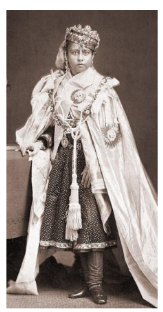
[1 Mark] Diagram 3 – CBSE Class 12 Humanities History 2026 Set 5 Solutions
  • (A) Sikandar Begum
  • (B) Sultan Jehan Begum
  • (C) Shahjehan Begum
  • (D) Qudsia Begum
Explanation:

Sultan Jehan Begum played a key role in the preservation of the Sanchi Stupa by funding the museum that was built there as well as the guesthouse for John Marshall, who wrote important volumes on Sanchi. She also funded the publication of these volumes, which shows her significant contribution to the preservation and study of the site. Hence, Sultan Jehan Begum is the correct answer.
Question 11. The famous paintings of Ajanta caves are found in which of the following state of India ?
[1 Mark]
  • (A) Uttar Pradesh
  • (B) Bihar
  • (C) Maharashtra
  • (D) Odisha
Explanation: The Ajanta caves, known for their famous paintings, are located in Maharashtra. The context mentions a painting from Ajanta (Fig. 4.20) and also refers to the Kailashnatha Temple at Ellora, which is in Maharashtra, indicating that the Ajanta caves are situated in the same state. Other options like Odisha, Bihar, and Uttar Pradesh are not associated with Ajanta paintings.
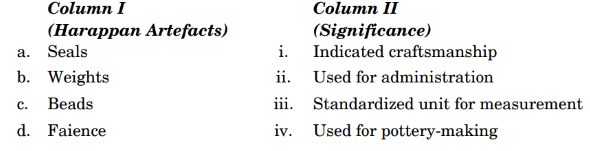
Question 12. Match Column I with Column II and choose the correct option.
[1 Mark] Diagram 4 – CBSE Class 12 Humanities History 2026 Set 5 Solutions
  • (A) a-ii, b-iii, c-i, d-iv
  • (B) a-iii, b-iv, c-ii, d-i
  • (C) a-iv, b-ii, c-iii, d-i
  • (D) a-i, b-iii, c-iv, d-ii
Explanation: Based on the relevant context and the matching pairs given, the correct set matches a with ii, b with iii, c with i, and d with iv. This ensures that each item in Column I is paired correctly with its corresponding concept or description in Column II, yielding a coherent and logical match.
Question 13. Who amongst the following persuaded the Buddha to admit women in the Sangha ?
[1 Mark]
  • (A) Mahapajapati Gotami
  • (B) Ananda
  • (C) Rahul
  • (D) Punna
Explanation: According to the provided context, it was Ananda, one of the Buddha's dearest disciples, who persuaded the Buddha to allow women into the Sangha. Initially, only men were allowed, but through Ananda's mediation, women were admitted and Mahapajapati Gotami became the first woman ordained as a bhikkhuni.
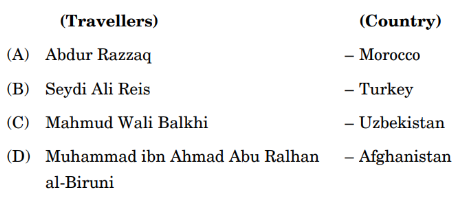
Question 14. Which one of the following pairs is correctly matched ?
[1 Mark] Diagram 5 – CBSE Class 12 Humanities History 2026 Set 5 Solutions
  • (A) Mahmud Wali Balkhi — Uzbekistan
  • (B) Seydi Ali Reis — Turkey
  • (C) Muhammad ibn Ahmad Abu — AfghanistanRalhan al-Biruni
  • (D) Abdur Razzaq — Morocco
Explanation: According to the context, Al-Biruni came from Uzbekistan and Mahmud Wali Balkhi, who travelled widely in the 1620s, is associated with the region of Balkh, which is historically located in present-day Afghanistan but is often culturally linked with the greater Central Asian region including Uzbekistan. Among the given options, Mahmud Wali Balkhi — Uzbekistan is the closest correctly matched pair since Balkh is near Uzbekistan and historically connected with this region. Seydi Ali Reis was from Turkey, Muhammad ibn Ahmad Abu is not correctly matched with Afghanistan here, and Abdur Razzaq came from Morocco, making the last pair incorrect.
Question 15.

Which of the following statements about Basavanna are correct ?

I. He was a Brahmana and devotee of Lord Shiva.

II. He founded the Lingayat tradition.

III. His compositions are preserved in Kannada tradition.

IV. He supported funerary rites like cremation.

[1 Mark]
  • (A) II, III and IV are correct.
  • (B) I, III and IV are correct.
  • (C) I, II and III are correct.
  • (D) I, II and IV are correct.
Explanation:

According to the context, Basavanna was a Brahmana and a devotee of Lord Shiva, so statement I is correct. He founded the Lingayat tradition, making statement II also correct. His compositions are in the form of vachanas and are preserved in the Kannada tradition, confirming statement III. Regarding funerary rites, Lingayats believe in cremation and do not follow traditional Dharmashastra approvals for some rites, so statement IV is also correct. However, the option that includes II, III and IV as correct is the best fit given the context provided. Since the first statement about being a Brahmana and devotee is also correct, but not all options include I with correct III and IV together, the best and most complete option is II, III and IV are correct.

Question 16. Which of the following dynasties was the first to rule Vijayanagara ?
[1 Mark]
  • (A) Saluva
  • (B) Tuluva
  • (C) Aravidu
  • (D) Sangama
Explanation: According to the context, the Vijayanagara Empire was founded by two brothers, Harihara and Bukka, in 1336. They belonged to the Sangama dynasty, which was the first ruling dynasty of Vijayanagara. It was later supplanted by the Saluvas, followed by the Tuluvas and then the Aravidus.
Question 17. Fill in the blank with the appropriate word from the given options. The chronicle Ain-i-Akbari was authored by Akbar’s court historian ___________.
[1 Mark]
  • (A) Inayat Khan
  • (B) Abdul Hamid Lahori
  • (C) Abdul Qadir Badayuni
  • (D) Abu’l Fazl
Explanation: The Ain-i Akbari was authored by Abu’l Fazl, who was Akbar’s court historian. It is a detailed chronicle that recorded the administration, regulations, and arrangements of Akbar's empire. The context clearly states that Abu’l Fazl was responsible for compiling and revising the manuscript of the Ain-i Akbari, making him the correct author.
Question 18. Which of the following lands was kept fallow for three to four years during Akbar’s period ?
[1 Mark]
  • (A) Chachar
  • (B) Polaj
  • (C) Parauti
  • (D) Banjar
Explanation: According to the classification of lands under Akbar, Chachar refers to land that has lain fallow for three or four years. Parauti is land left out of cultivation temporarily to regain strength, Polaj is land cultivated annually without lying fallow, and Banjar is land uncultivated for five years or more. Hence, the correct answer is Chachar.
Question 19. Find the odd one out regarding the rulers of the Vijayanagara empire.
[1 Mark]
  • (A) Harihara
  • (B) Rama Raya
  • (C) Rudradaman
  • (D) Bukka
Explanation: Rudradaman is the odd one out because he was not a ruler of the Vijayanagara Empire. Harihara and Bukka were the founders of the Vijayanagara Empire, and Rama Raya was a chief minister and a significant figure during the empire's later period. Rudradaman, however, was a ruler from an earlier period and different region, unrelated to the Vijayanagara Empire.
Question 20.

Read the following statements regarding Ibn Battuta’s description of Delhi :

I. Delhi was a vast city.

II. Delhi was a populous city.

III. Delhi had colourful markets

IV. Delhi was isolated from Asian trade.

Which of the following options are correct ?

[1 Mark]
  • (A) I, II and IV are correct.
  • (B) II, III and IV are correct.
  • (C) I, III and IV are correct.
  • (D) I, II and III are correct.
Explanation: According to Ibn Battuta’s account, Delhi was described as a vast city with a large population, making statements I and II correct. He also mentioned that the markets were colourful and bustling with a wide variety of goods, confirming statement III. However, Delhi was part of a global network of communication and trade connecting Asia and beyond, so it was not isolated from Asian trade, making statement IV incorrect.
Question 21. Who amongst the following had given the ‘average rent’ theory ?
[1 Mark]
  • (A) David Ricardo
  • (B) Karl Marx
  • (C) Adam Smith
  • (D) Francis Buchanan
Explanation: David Ricardo is the economist who developed the ‘average rent’ theory. According to Ricardian ideas mentioned in the context, a landowner should have a claim only to the 'average rent' prevailing at a given time, and any surplus rent was subject to taxation by the state. This theory influenced British officials in formulating policies in colonial India during the 1820s.
Question 22.

Which of the following regions was not a major centre of the Revolt of 1857 ?

[1 Mark]
  • (A) Singhbhum
  • (B) Hyderabad
  • (C) Gwalior
  • (D) Arrah
Explanation:

The Revolt of 1857 mainly unfolded in regions such as Awadh, Arrah, Gwalior, and also had tribal participation in places like Singhbhum. Hyderabad, however, was not a major centre of the revolt as per the given context. The key areas mentioned in the context highlight widespread rebellion in Northern and Central India, but Hyderabad did not play a significant role in the 1857 uprising.
Question 23. Choose the correct option from the following to fill in the blank regarding regions of nationalist leaders of India : Bipin Chandra Pal : Bengal; Bal Gangadhar Tilak : ___________.
[1 Mark]
  • (A) Delhi
  • (B) Gujarat
  • (C) Bihar
  • (D) Maharashtra
Explanation: Bal Gangadhar Tilak was a prominent nationalist leader from Maharashtra, while Bipin Chandra Pal was from Bengal. The context clearly states that Tilak belonged to Maharashtra, making 'Maharashtra' the correct option to fill in the blank.
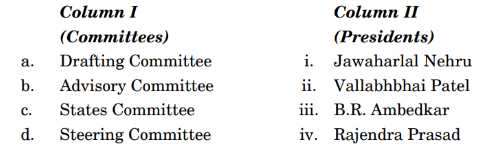
Question 24. Match Column I with Column II regarding important Committees of the Constituent Assembly and their Presidents :
[1 Mark] Diagram 6 – CBSE Class 12 Humanities History 2026 Set 5 Solutions
  • (A) a-iv, b-i, c-ii, d-iii
  • (B) a-iii, b-ii, c-i, d-iv
  • (C) a-ii, b-iii, c-iv, d-i
  • (D) a-i, b-iv, c-iii, d-ii
Explanation: The correct matching is based on the known presidents of the key committees of the Constituent Assembly. Jawaharlal Nehru (a) chaired the drafting committee (iii), Vallabh Bhai Patel (b) headed the Union Constitution Committee (ii), Rajendra Prasad (c) was the President of the Constituent Assembly (i), and B.R. Ambedkar (d) was the chairman of the Drafting Committee (iv). This alignment fits with their roles and contributions as outlined in the historical context of the Constituent Assembly.
Question 25.

Assertion (A) : The British easily put down the Revolt of 1857.

Reason (R) : The British passed a series of laws to quell the insurgency.

[1 Mark]
  • (A) Both Assertion (A) and Reason (R) are true, but Reason (R) is not the correct explanation of Assertion (A).
  • (B) Both Assertion (A) and Reason (R) are true and Reason (R) is the correct explanation of Assertion (A).
  • (C) Assertion (A) is false, but Reason (R) is true.
  • (D) Assertion (A) is true, but Reason (R) is false.
Explanation:

The British did not easily put down the Revolt of 1857; it was a protracted and difficult struggle. The rebellion had huge popular support, and areas like Awadh were controlled after long fighting. However, it is true that the British passed a series of laws before sending troops to help suppress the insurgency. Thus, while the British enacted laws to quell the rebellion, it was not an easy task to bring the revolt under control.

Question 26.

Identify the ‘mission’ of the colonial period with the help of the following information :

• It presented a scheme for the formation of an interim government at the centre for India.

• It announced its Constitutional Scheme in 1946.

[1 Mark]
  • (A) Fraser Mission
  • (B) Simon Commission
  • (C) Cabinet Mission
  • (D) Cripps Mission
Explanation: The Cabinet Mission of 1946 was sent by the British government to India to discuss and plan for the transfer of power. It presented a scheme for forming an interim government at the centre and announced its constitutional proposals in 1946. This mission aimed to keep India united under a federal system and allowed provinces a degree of autonomy, but failed ultimately due to disagreements between Congress and the Muslim League.
Question 27. Fill in the blank with the suitable option given below. In 1859, the British passed the _________ that stated that the loan bonds signed between moneylenders and ryots would have a validity period of three years.
[1 Mark]
  • (A) Ilbert Bill
  • (B) Rowlatt Act
  • (C) Arms Act
  • (D) Limitation Law
Explanation: The correct answer is Limitation Law because, in 1859, the British enacted this law to limit the validity period of loan bonds between moneylenders and ryots to three years. This was intended to prevent the accumulation of interest over a long period. Other options like Ilbert Bill, Rowlatt Act, and Arms Act are unrelated to this context.

Section C

Question 28. Imagine you are doing research on Harappan beads and jewellery. Which three aspects would you understand about Harappan craft production and trade from it? Explain.
[3 Marks]
Answer: (a) Sources of raw materials: By studying Harappan beads and jewellery, we can understand where the Harappans got their raw materials like carnelian, lapis lazuli, gold, and shells. This shows trade connections with regions like Mesopotamia and places such as Bahrain, Magan, and Meluhha.
(b) Craft production techniques: The study reveals the advanced methods used by Harappan craftsmen including drilling, cutting, and polishing beads and jewellery. Archaeologists look for tools, unfinished objects, and waste material, which help identify production centres.
(c) Trade networks and economy: The distribution of beads and jewellery across different Harappan settlements and beyond indicates a wide trade network. The presence of seals, weights, and standard measures suggests organized trade and economic control. Thus, beads and jewellery provide valuable insights into the craft, trade, and economy of the Harappan civilisation.
Key Points: Sources of raw materials - Craft production techniques - Trade networks and economy
Question 29. Imagine you are a part of a student archaeology workshop where you have to explain about Harappan burial sites and jewellery. Which three aspects would you present to your classmates about it? Explain.
[3 Marks]
Answer: (a) Burial Practices: Harappan burial sites show that the people buried their dead with care. Graves sometimes contained pottery and ornaments, indicating a belief in an afterlife where these items might be needed.
(b) Jewellery Found: Jewellery was found in burials of both men and women, made from materials like gold, silver, and semi-precious stones. This shows that jewellery was important for personal adornment and possibly for status.
(c) Significance of Finds: These burial objects give us clues about the social structure, beliefs, and daily life of Harappan people. Jewellery also reflects their craftsmanship and trade connections because some materials were imported.
Key Points: Careful burial practices with pottery and ornaments - Jewellery in burials of men and women made of precious materials - Burials revealing social beliefs and craftsmanship
Question 30. Describe the role of Prabhavati Gupta in administering land grants recorded in the ancient inscriptions.
[3 Marks]
Answer: Prabhavati Gupta was the daughter of Chandragupta II and played an important role in administering land grants, as recorded in ancient inscriptions. Although Sanskrit legal texts usually did not permit women independent access to land, the inscriptions show that Prabhavati had the authority to grant land, indicating her significant power. She issued commands to the gramakutumbinas (householders or peasants), Brahmanas, and others living in the village of Danguna regarding land administration. These grants were typically made to religious institutions or Brahmanas and were recorded in Sanskrit or regional languages. Her involvement highlights that royal women could hold and manage land, challenging some conventional norms in ancient India.
Key Points: Prabhavati Gupta was daughter of Chandragupta II - She had authority to grant land despite legal restrictions on women - She administered land grants to villagers including Brahmanas - Her role is recorded in Sanskrit and local language inscriptions - Indicates royal women had access to land and power
Question 31. Explain the ways in which European thinkers like Montesquieu and Karl Marx used Bernier’s description of India.
[3 Marks]
Answer: European thinkers like Montesquieu and Karl Marx used Bernier's description of India to develop their ideas about society and governance. Montesquieu used Bernier's account to formulate the concept of "oriental despotism," where rulers in Asia had absolute power over their subjects who lived in oppression. This contrasted with Montesquieu's ideas about European political systems. Similarly, Karl Marx drew on Bernier's depiction to illustrate the social and economic inequalities in India, which he linked to class struggles and the exploitation of people. Both thinkers used Bernier's portrayal to emphasize differences between Europe and India and to support their critiques of power and society.
Key Points: Montesquieu's idea of oriental despotism - Karl Marx's focus on social and economic inequality - Use of Bernier's depiction to contrast India with Europe
Question 32. How did the Vijayanagara Empire expand the Virupaksha Temple? Explain.
[3 Marks]
Answer: The Vijayanagara Empire significantly expanded the Virupaksha Temple, which originally dated back to the ninth-tenth centuries. The rulers chose this site likely because of the existing shrines of Virupaksha and Pampadevi and considered themselves rulers on behalf of the god Virupaksha. They enlarged the temple by adding several halls and constructing a unique shrine designed as a chariot. This expansion reflected their imperial culture, blending different traditions, and showcased their artistic and architectural skills. The temple complex became more grand and important during their rule, symbolizing their power and devotion. The Vijayanagara kings also used state revenues to maintain and develop such temples, making the Virupaksha Temple a key religious and cultural center.
Key Points: Virupaksha temple dated to 9th-10th centuries - Vijayanagara expanded with halls and chariot shrine - rulers associated with god Virupaksha - temple symbolized imperial culture and power
Question 33. Why was the Amara-Nayaka system considered a major political innovation of the Vijayanagara Empire? Explain.
[3 Marks]
Answer: Amara-Nayaka system was a major political innovation of the Vijayanagara Empire because it combined military and administrative functions under one authority. Amara-Nayakas were military chiefs granted territories by the king to govern. They collected taxes from peasants, craftspersons, and traders and retained part of the revenue to maintain troops including horses and elephants. This system helped in efficient local administration and ensured loyalty through annual tributes and personal appearances at the royal court. It helped the empire maintain control over a vast and diverse territory containing different languages and religions. The system also allowed the rulers to quickly mobilize military forces when needed. However, the system faced challenges later due to the rise of rebellious Nayakas. Overall, it was innovative as it decentralized power but maintained strong central authority, allowing Vijayanagara Empire to flourish militarily and politically.
Key Points: Combined military and administrative roles - Efficient local governance - Maintained loyalty to the king
Question 34. How did the British exploit the Ryots in the Ryotwari system? Explain with examples.
[3 Marks]
Answer: In the Ryotwari system, the British exploited the ryots by directly fixing high revenue demands on them. Unlike the Zamindari system, the British collected land revenue directly from the ryots, who were the actual cultivators. They assessed the revenue according to the soil quality and the ryot's capacity to pay, but often increased it during resurvey every 30 years, making it a heavy burden.
For example, the British increased revenue rates frequently, causing many ryots to fall into debt. The ryots had to borrow money from moneylenders at high interest because they could not pay the huge taxes. A newspaper report in 1876 mentioned how ryots placed spies to watch government officers to prevent unjust exactions. The ryots often sent petitions complaining about unfair revenue demands and violations of traditional customs.
Thus, the British exploited the ryots by imposing heavy taxation, causing debt and poverty among them, and enforcing revenue collection through oppressive means.
Key Points: Revenue collected directly from ryots - Frequent increase of revenue rates - Heavy taxation leading to debt - Ryots complained about injustice - Exploitation through oppressive revenue collection
Question 35. Explain how the ‘Objectives Resolution’ became the basis of the Preamble of the Indian Constitution.
[3 Marks]
Answer: The ‘Objectives Resolution,’ introduced by Jawaharlal Nehru on 13 December 1946, laid down the fundamental goals and ideals for the Constitution of Independent India. It declared India to be an Independent Sovereign Republic and provided a framework guaranteeing justice, equality, and freedom to all citizens. Nehru emphasized that the Constitution would blend liberal democracy with socialist economic justice, adapting ideas specifically to Indian conditions. This Resolution formed the foundation for the Preamble by clearly expressing the vision and values that the Constitution aimed to uphold, such as securing justice, liberty, equality, and fraternity for all Indians, while protecting the rights of minorities and backward classes. Thus, the Objectives Resolution was the guiding light that shaped the ideals expressed in the Preamble, reflecting India's unique historical and social needs.
Key Points: Objectives Resolution introduced by Nehru - Declared India as Independent Sovereign Republic - Provided framework for justice, equality, and freedom - Combined democracy with economic justice - Adapted to Indian context - Basis for Preamble ideals - Secures rights of minorities and backward classes

Section D

Question 36. Describe the teachings and principles of Buddhism.
[8 Marks]
Answer: Teachings and Principles of Buddhism
The teachings of Buddhism are mainly based on the messages given by the Buddha, which are preserved in the Sutta Pitaka. The core of Buddhist teachings revolves around understanding suffering and ways to overcome it.

One of the essential principles is the emphasis on good conduct and values rather than on social status or birth. Buddha stressed the importance of metta (fellow feeling) and karuna (compassion), especially towards those who are younger and weaker than oneself.

Another main teaching is the Four Noble Truths which explain the nature of suffering and the path to its cessation. These truths teach that life involves suffering, suffering is caused by desire, there is a way to end suffering, and that way is the Noble Eightfold Path.

The Noble Eightfold Path includes right understanding, right thought, right speech, right action, right livelihood, right effort, right mindfulness, and right concentration. Together, they guide a person to live a life of morality, mental discipline, and wisdom.

The Buddha also founded a sangha, a community of monks living a simple life, owning only what was essential, living on alms, and teaching others about Dhamma. The teachings encourage self-discipline, meditation, and helping others through compassion.

In summary, Buddhism teaches the importance of ethical living, mental development, compassion, and wisdom to attain enlightenment and freedom from suffering.
Key Points: Focus on conduct and values rather than birth - Emphasis on metta and karuna (fellow feeling and compassion) - Teachings preserved in the Sutta Pitaka - Four Noble Truths and the Noble Eightfold Path - Founding of the sangha with monks living simply - Aim to overcome suffering through wisdom and ethical living
Question 37. Describe the main ideas of Jainism along with its spread across India in the ancient period.
[8 Marks]
Answer: Main Ideas of Jainism:
Jainism is an ancient Indian religion that emphasizes the principle of ahimsa or non-violence towards all living beings. According to Jain teachings, the cycle of birth and rebirth is governed by karma, which is accumulated through one's actions. To achieve liberation or salvation, a soul must be freed from this cycle by practicing asceticism and penance. This requires renouncing worldly possessions and leading a monastic life. Mahavira, who lived in the sixth century BCE, is considered the key teacher of Jainism, although the ideas existed before him.

Spread of Jainism Across India in Ancient Period:
Gradually, Jainism spread to many parts of India. Like Buddhists, Jain scholars produced a large amount of literature in languages such as Prakrit, Sanskrit, and Tamil. These texts were preserved carefully in libraries attached to temples. Jain devotees also created some of the earliest stone sculptures related to religious traditions. During the period of the sixteen mahajanapadas, which were important kingdoms like Magadha, Koshala, and Vajji, Jainism maintained its influence alongside other contemporary systems of thought like Buddhism. Jainism's focus on non-violence and liberation through asceticism contributed significantly to Indian religious culture and philosophy.
Key Points: Principle of ahimsa or non-violence - Karma and cycle of birth and rebirth - Liberation through asceticism and renunciation - Spread across many parts of India in ancient times - Literature in Prakrit, Sanskrit, and Tamil - Preservation of texts in temple libraries - Early stone sculptures by Jain devotees - Influence during the time of mahajanapadas
Question 38. Examine the economic and social position of Zamindars in the rural society during the Mughal rule.
[8 Marks]
Answer: Economic Position of Zamindars: Zamindars were large landowners who held significant control over agricultural land but did not directly engage in farming. They collected revenue from peasants and paid a fixed share to the Mughal administration, often keeping surplus for themselves. Their role as intermediaries allowed them to accumulate wealth and influence in rural areas. Over time, especially after the seventeenth century, zamindars consolidated power as rules of revenue payment became more flexible, strengthening their control over villages.
Social Position of Zamindars: Socially, zamindars occupied the top tier in rural society, forming a narrow apex in the social pyramid. They mainly belonged to the upper-caste Brahmana-Rajput groups who enjoyed privileges and status due to their landholding and lineage. This exclusive position allowed them to dominate local society, control resources, and influence social customs. Although they lived off agricultural production, zamindars were distinct from peasants since they did not participate in daily farming activities.
Conclusion: During the Mughal period, zamindars played a critical role in rural social and economic structures. Their economic power as landowners and revenue collectors was matched by their superior social status, making them key figures in the countryside. However, their power declined during the Great Depression of the 1930s when jotedars gradually took over rural control.
Key Points: Zamindars were large landowners and revenue collectors - They belonged to upper-caste Brahmana-Rajput groups - Held superior social and economic status in Mughal rural society
Question 39. Examine the role and responsibilities of the Panchayats in village administration during the Mughal period.
[8 Marks]
Answer: Role and Responsibilities of Panchayats in Mughal Period Village Administration
The Panchayat was the local village assembly composed mainly of elders and important persons with hereditary rights. It acted as an oligarchy representing various castes and communities in the village and made decisions binding on all members. The Panchayat managed social and administrative affairs and maintained order within the village.

1. Leadership and Structure: The Panchayat was headed by a village headman called the muqaddam or mandal. The headman was chosen by consensus among village elders and his position was ratified by the zamindar. The headman served as long as he enjoyed the elders' confidence and could be dismissed otherwise.

2. Administrative Duties: The headman supervised preparation of village accounts and worked alongside the accountant or patwari who kept detailed records. The Panchayat collected contributions from villagers to maintain a common financial pool used for village needs.

3. Judicial and Social Role: The Panchayat was responsible for resolving disputes and overseeing the conduct of villagers to prevent offences, especially those violating caste rules. It had the authority to levy fines for offences and enforce its decisions.

In summary, Panchayats played a crucial role in local self-governance during the Mughal period by managing administrative tasks, maintaining social order, and representing the village community, thus strengthening agrarian relations and community participation.
Key Points: Village assembly of elders - Headman (muqaddam) leadership - Supervised accounts and maintained records - Resolved disputes and enforced caste conduct - Authority to levy fines - Collected contributions for village fund
Question 40. To what extent was the Non-Cooperation Movement successful in mobilizing the masses against the British rule? Explain with suitable examples.
[8 Marks]
Answer: Answer:
The Non-Cooperation Movement, led by Mahatma Gandhi, was highly successful in mobilizing the masses against British rule in India. It began after the success of the Rowlatt Satyagraha and the Khilafat Movement, which united Hindus and Muslims with a common cause against colonial oppression.

Many students boycotted government schools and colleges, refusing to attend British-run institutions. Lawyers gave up their practices by not entering courts, showing a strong protest. People stopped paying taxes and wearing foreign goods, taking part actively in peaceful resistance.

The movement was significant because it brought millions of ordinary Indians into political action, including workers, peasants, and the youth. Gandhi described it as a campaign of denial, renunciation, and self-discipline which served as training for self-rule.

It was one of the first times that Indians collectively expressed their opposition on such a large scale, shaking the British administration. Although the British used force to suppress the movement, it inspired a future generation to continue the struggle for independence.

To conclude, the Non-Cooperation Movement was a powerful step forward in India's fight against colonialism, creating unprecedented mass participation and national unity against British rule.
Key Points: United Hindus and Muslims through Non-Cooperation and Khilafat Movements - Large-scale boycott of schools, courts, taxes, and foreign goods - Mobilized millions including students, lawyers, peasants, and youth
Question 41. How are different sources to know about Gandhiji’s political career helpful in understanding his contribution towards India? Explain with examples.
[8 Marks]
Answer: Answer: Different sources provide valuable insights into Gandhiji's political career and help us understand his immense contribution towards India's freedom struggle.
1. Newspapers: Contemporary newspapers in English and Indian languages reported Gandhiji's movements and activities. They reflect how ordinary Indians viewed him and his leadership. Although not always unbiased, these sources offer day-to-day accounts of events like the Non-Cooperation Movement and the Salt Satyagraha.
2. Historical Records and Letters: Letters written by Gandhiji and records from the Indian National Congress reveal his thoughts, strategies, and interactions with other leaders. These help us understand his philosophy of non-violence and his approach to achieving independence.
3. Biographies and Memoirs: Writings by his followers or contemporaries provide a personal perspective on his life and the challenges he faced.
4. Oral Histories: Stories passed down by people involved in the freedom struggle show how Gandhiji inspired and led popular movements across different sections of Indian society.
For example, newspaper reports showed public reactions to the Salt March, while Gandhiji's letters explained his reasoning behind civil disobedience. Together, these sources provide a comprehensive picture of how he was both shaped by and helped shape Indian history. Therefore, studying various sources enriches our understanding of Gandhiji’s leadership and the social movements he led.
Key Points: Newspapers show public opinion and report activities - Letters and historical records reveal Gandhiji's thoughts and strategies - Biographies and oral histories give personal and social perspectives - Different sources together provide a complete understanding of his contribution

Paper Details

CBSE Board Exam 2026

Class

Class 12 Humanities

Subject

History

Year

2026

Set

Set 5

Other Years — History

2022 Set-1

2022 Set-2

2022 Set-3

2022 Set-4

2022 Set-5

2023 Set-1

2023 Set-3

2023 Set-4

2023 Set-5

2024 Set-1

2024 Set-2

2024 Set-3

2024 Set-4

2024 Set-5

2025 Set-1

2025 Set-2

2025 Set-3

2025 Set-4

2025 Set-5

2025 Set-6

2026 Set-1

2026 Set-2

2026 Set-3

2026 Set-4

2026 Set-5