SOLUTIONS

2026 BOARD EXAM

CBSE Class 12 Humanities History Board Paper 2026 — Set 1 Solutions

2026

History

Class 12 Humanities

CBSE EXAMINATION PAPER-2026

HISTORY

(Solved)

Time allowed : 3 hours

Maximum Marks : 94

General Instructions :

Read the following instructions carefully and follow them :

  1. This question paper contains 41 questions. All questions are compulsory.
  2. This question paper is divided into 4 sections.
  3. Section A – questions number 1 to 5 are case based questions
  4. Section B – questions number 6 to 27 are multiple choice questions
  5. Section C – questions number 28 to 35 are short answer
  6. Section D – questions number 36 to 41 are long answer
  7. There is no overall choice given in the question paper. However, an internal choice has been provided in few questions.
  8. Use of calculator is NOT allowed.

Section A

Question 1.

Read the given passage carefully and answer the questions that follow :

A Mother’s Advice

The Mahabharata describes how, when war between the Kauravas and the Pandavas became almost inevitable, Gandhari made one last appeal to her eldest son Duryodhana.

By making peace you honour your father and me, as well as your well-wishers... it is the wise man in control of his senses who guards his kingdom. Greed and anger drag a man away from his profits; by defeating these two enemies a king conquers the earth... You will happily enjoy the earth, my son, along with the wise and heroic Pandavas.... There is no good in a war, no law (dharma) and profit (artha), let alone happiness; nor is there (necessarily) victory in the end – don’t set your mind on war...

Duryodhana did not listen to this advice and fought and lost the war.

(1) Explain the main cause of conflict between Kauravas and Pandavas.

[1 Mark]
Answer: The main cause of conflict between the Kauravas and the Pandavas was the struggle for power and control over the kingdom of the Kurus. Both were cousins belonging to the same family lineage but had competing claims to the throne. Gandhari, the mother of the Kauravas, advised her son Duryodhana that greed and anger led to ruin and urged him to make peace instead of war. However, Duryodhana ignored this wise advice and chose to fight, which resulted in a war. Thus, the conflict arose out of greed, anger, and desire for control over the kingdom, as described in the Mahabharata passage.
Key Points: Conflict due to struggle for power over kingdom - Kauravas and Pandavas were cousins from same family - Gandhari advised peace against greed and anger - Duryodhana ignored advice and chose war - Conflict rooted in ambition and desire for control

(2) Why did Gandhari advice Duryodhana not to fight?

[1 Mark]
Answer: Gandhari advised Duryodhana not to fight because she believed making peace would honour his father, herself, and all well-wishers. She explained that a wise king controls his senses like greed and anger, which lead a man away from true gains. Defeating these emotions helps a king rule successfully. Gandhari also said that war brings no real good, dharma, artha, or happiness, and victory is not guaranteed. Therefore, she wanted Duryodhana to avoid war and coexist peacefully with the Pandavas, but unfortunately he ignored her advice and lost the war.
Key Points: Gandhari advised peace to honour family and well-wishers - Wisdom is controlling senses like greed and anger - War brings no true good, dharma, artha, or happiness - Victory in war is not certain - Duryodhana ignored advice leading to loss

(3) Why did Duryodhana not listen to the advice of his mother, Gandhari?

[2 Marks]
Answer: Duryodhana did not listen to his mother Gandhari's advice because of his jealousy and anger towards the Pandavas. Even though Gandhari advised peace and control over greed and anger, Duryodhana was driven by his desire for the throne and fear of losing power. He believed war was necessary to protect his kingdom and denied the wise counsel given to him. This led him to fight the war, which he ultimately lost, showing how his emotions overpowered his reason.
Key Points: Duryodhana was jealous of the Pandavas - He was driven by greed and anger - He ignored Gandhari's wise advice - He wanted to protect his power and kingdom - His emotions controlled his decisions
Question 2.

Read the following passage carefully and answer the questions that follows :

Declining a Royal Gift

This excerpt from a Sufi text describes the proceedings at Shaikh Nizamuddin Auliya’s hospice in 1313 :

I (the author, Amir Hasan Sijzi) has the good fortune of kissing his (Shaikh Nizamuddin Auliya’s) feet... At this time a local ruler had sent him the deed of ownership to two gardens and much land, along with the provisions and tools for their maintenance. The ruler had also made it clear that he was relinquishing all his rights to both the gardens and land. The master...had not accepted that gift. Instead, he had lamented : “What have I to do with gardens and fields and lands ?... None of .... our spiritual masters had engaged in such activity.

” Then he told an appropriate story : “.... Sultan Ghiyasuddhin, who at that time was still known as Ulugh Khan, came to visit Shaikh Fariduddin (and) offered some money and ownership deeds for four villages to the Shaikh, the money being for the benefit of the dervishes (Sufis), and the land of his use. Smiling, Shaikh al Islam (Fariduddin) said : Give me the money. I will dispense it to the dervishes. But as for those land deeds, keep them. There are many who long for them. Give them away to such persons.”

(1) What was the reaction of Sufi saint on the offerings?

[1 Mark]
Answer: The Sufi saint, Shaikh Nizamuddin Auliya, did not accept the royal gift of land and gardens sent by the local ruler. He felt that owning property and land was not suitable for a spiritual master, as none of their spiritual predecessors engaged in such worldly activities. He expressed his disinterest by saying that he had nothing to do with gardens, fields, and lands. To explain this, he narrated a story of Shaikh Fariduddin who accepted money for the benefit of dervishes but refused ownership of villages, suggesting such worldly possessions be given to others who desired them. This shows the Sufi saint’s commitment to spiritual values rather than material wealth.
Key Points: Sufi saint declined the land and gardens offered - Believed spiritual masters should not engage in worldly possessions - Emphasized spiritual values over material wealth

(2) Mention the offering by the local ruler to Sufi saint.

[1 Mark]
Answer: The local ruler offered Shaikh Nizamuddin Auliya the deed of ownership to two gardens and much land, along with provisions and tools for their maintenance. The ruler also relinquished all his rights to the gardens and land, attempting to gift them to the saint. However, Shaikh Nizamuddin Auliya did not accept this gift, as mentioned in the passage, because he felt that such material possessions were not what spiritual masters typically engaged with.
Key Points: Deed of ownership to two gardens and much land - Provisions and tools for maintenance - Ruler relinquished all rights to properties

(3) Why did Sufi saint accept money? Explain.

[2 Marks]
Answer: The Sufi saint accepted the money because it was meant for the benefit of the dervishes (Sufis) and could be used immediately to meet their needs such as food, clothes, and living quarters. However, he declined to accept the ownership deeds of land or gardens, as accumulating such property was against the practice of previous spiritual masters. The saint believed in living simply and used donations for immediate requirements rather than owning land. This is explained in the passage where Shaikh Fariduddin says he would dispense the money to the dervishes but refused the land deeds, advising to give them to those who long for such possessions. Hence, accepting money supported the spiritual community, while refusing land maintained their detachment from worldly possessions.
Key Points: Accepted money to support dervishes - Used money for immediate needs like food and clothes - Refused land deeds to avoid worldly attachment - Followed teachings of previous spiritual masters - Maintained simplicity and detachment from ownership
Question 3.

Read the given passage carefully and answer the following questions :

What taluqdars thought The attitude of the taluqdars was best expressed by Hanwant Singh, the Raja of Kalakankar, near Rae Bareli. During the mutiny, Hanwant Singh had given shelter to a British officer, and conveyed him to safety. While taking leave of the officer, Hanwant Singh told him :

Sahib, your countrymen came into this country. You sent your officers round the districts to examine the titles to the estates. At one blow you took from me lands which from time immemorial had been in my family. I submitted. Suddenly misfortune fell upon you. The people of the land rose against you. You came to me whom you had despoiled. I have saved you. But now – now I march at the head of my retainers to Lucknow to try and drive you from the country.

(1) Explain the anguish of Hanwant Singh for the British officer.

[1 Mark]
Answer: Answer: Hanwant Singh felt deep anguish because the British officers had seized his ancestral lands unfairly by examining land titles and taking them away, breaking his family's long-held rights. Despite this, when the British officer was in danger during the mutiny, Hanwant Singh helped him escape safely, showing a complex loyalty. However, he was honest in expressing his pain and anger, telling the officer that now he would lead his followers against the British to drive them away, illustrating his conflicted feelings of duty and hurt. This shows how the British policies had deeply disturbed the taluqdars' social and political position.
Key Points: British seized ancestral lands of taluqdars - Hanwant Singh helped British officer despite grievances - He expressed pain and planned to oppose British rule

(2) How were Taluqdars facilitated by the rulers?

[1 Mark]
Answer: The taluqdars were initially powerful landholders who controlled large estates and had forts, armed retainers, and authority over the countryside, as seen in the passage about Hanwant Singh. However, after the British annexed Awadh, the rulers did not facilitate but rather weakened the taluqdars by disarming them, destroying their forts, and taking away much of their land. The British land revenue policy reduced the taluqdars' power and disrupted the old social order where peasants owed loyalty to taluqdars. Despite this, taluqdars sometimes helped the British, like Hanwant Singh did by saving a British officer during the mutiny. Thus, the taluqdars were not facilitated but rather marginalized by the British rulers, who aimed to take control of the land and its revenue.
Key Points: Taluqdars were once powerful landholders - British disarmed and destroyed their forts - British land revenue policy reduced their power - Social order around taluqdars was broken - Taluqdars helped British in mutiny but were marginalized

(3) Explain any two causes of dissatisfaction of Taluqdars from British rule.

[2 Marks]
Answer: Two causes of dissatisfaction of taluqdars from British rule are:
Firstly, the British annexation and land revenue policies dispossessed taluqdars of their hereditary lands, as officers examined titles and took away lands which had been in taluqdars’ families from time immemorial. This caused great resentment as their power and property were undermined.
Secondly, taluqdars were disarmed and their forts destroyed, which destroyed their social order and authority. The ties of loyalty and patronage between taluqdars and peasants broke down, reducing the taluqdars' control over their estates. Many taluqdars, especially in southern Awadh, lost more than half of their villages. This loss of power and respect made taluqdars deeply unhappy with British rule, as illustrated by Hanwant Singh of Kalakankar in the passage.
Key Points: Dispossession of taluqdars - Destruction of forts and disarming taluqdars - Breakdown of social order and loss of authority
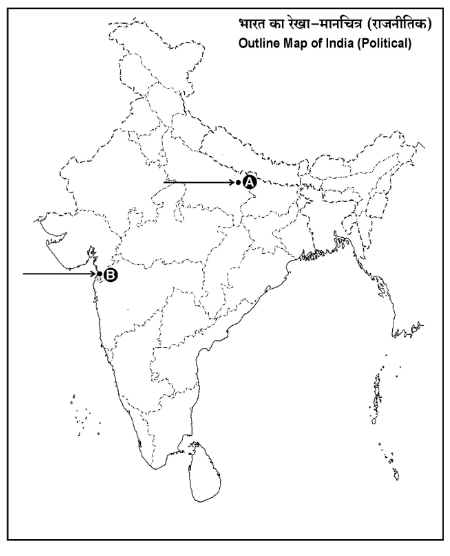
Question 4. On the given political outline map of India, locate and label the following with appropriate signs or symbols :
Diagram 1 – CBSE Class 12 Humanities History 2026 Set 1 Solutions

(1) Nageshwar - a mature Harappan site

[2 Marks]
Answer: Nageshwar is an important mature Harappan site located near the coast in the Kutch region of Gujarat. According to the case passage, it is one of the Harappan settlements discovered in India after the partition when many known sites became part of Pakistan. Nageshwar is marked on the map using the symbol for mature Harappan sites as shown in Map 1. Its location near the coast, along with Balakot, highlights the maritime nature of Harappan civilization in these areas. Its discovery helps in understanding Harappan settlements within modern India boundaries as explained in the passage.
Key Points: Nageshwar is a mature Harappan site - Located near the Kutch coast in Gujarat - Marked with appropriate symbol on the map as per Map 1 in the case study

(2) Goa - an area under Aurangzeb

[1 Mark]
Answer: Answer: Goa was part of the areas under Aurangzeb's control during his rule as part of the Mughal empire. According to the context given, the Mughal empire included diverse regions with administrative control strongest around capitals and provincial centres. Goa, located on the western coast of India, came under Aurangzeb's control and should be marked on the map with an appropriate symbol indicating Mughal rule. This reflects the empire's reach to coastal regions, showing the vastness and diversity of Aurangzeb's administration.
Key Points: Goa was under Aurangzeb - Part of Mughal empire's diverse regions - Mark Goa with Mughal symbol on the map

(3) Kashi - early state.

[1 Mark]
Answer: Kashi was one of the important early states known as mahajanapadas mentioned in Buddhist and Jaina texts. It was located in the region of present-day Uttar Pradesh along the Ganges River.
On the political outline map of India, Kashi should be marked in the eastern part of Uttar Pradesh near the Ganges.
This area was significant as a centre of culture and religious activities during early times.
Kashi, like other mahajanapadas such as Magadha and Kosala, played a crucial role in the political and cultural history of ancient India.
Marking Kashi correctly on the map reflects its historical importance as described in the earliest states section of the passage.
Key Points: Kashi was an early mahajanapada - Located in present Uttar Pradesh near the Ganges - Important cultural and religious centre - Mentioned in Buddhist and Jaina texts - Should be labelled on the political outline map accordingly

(4) Thanjavur – a medieval town.

[1 Mark]
Answer: Thanjavur was a significant medieval town in South India, known for its cultural and architectural contributions during the period c. fourteenth to eighteenth century. It was an important center under the Chola rulers who built the famous Brihadishvara temple, notable for its grand gopuram or gateway as shown in Fig. 7.3. The town was also associated with celebrations of divine weddings in structures like the kalyana mandapa (Fig. 7.22). Hence, on the political outline map, Thanjavur should be located in Tamil Nadu and labelled as a medieval town famous for its temple architecture and cultural heritage, as highlighted in the case passage.
Key Points: Thanjavur located in Tamil Nadu - Known for Brihadishvara temple and temple architecture - Important cultural and medieval town
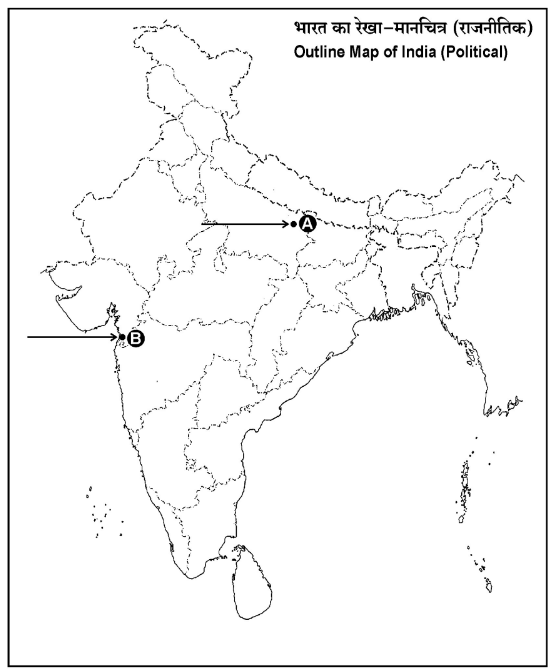
Question 5. On the same map two places have been marked as centres of Indian national movement as A and B. Identify them and write their correct names on the lines drawn near them.
Diagram 2 – CBSE Class 12 Humanities History 2026 Set 1 Solutions

(1) Name the capital of Vijayanagara Empire.

[1 Mark]
Answer: The capital of the Vijayanagara Empire was Vijayanagara, also known as Hampi. It was founded in the fourteenth century by the brothers Harihara and Bukka. The city was famous for its unique layout and monuments.
This information is based on the passage which describes Vijayanagara as the empire's capital.
Key Points: Capital was Vijayanagara - Founded by Harihara and Bukka - Also known as Hampi

(2) Name any two important capitals of the early states.

[2 Marks]
Answer: Answer: Two important capitals of the early states were Pataliputra and Taxila. Pataliputra was the capital of a major empire and located on riverine routes, making it an important political centre. Taxila was one of the provincial centres mentioned in Asokan inscriptions. These cities were significant urban centres in the subcontinent from around the sixth century BCE as stated in the passage.
Key Points: Pataliputra was a major capital - Taxila was an important provincial centre - Both cities are mentioned in Asokan inscriptions

(3) Name one area which was under the rule of Aurangzeb.

[1 Mark]
Answer: Answer: One area that was under the rule of Aurangzeb was the Punjab. This is supported by the context which mentions Punjab as one of the regions included within the empire, showing the vastness of Mughal rule during Aurangzeb's time.
Key Points: Aurangzeb ruled Punjab - Punjab was part of the Mughal empire - The empire included diverse regions

(4) Mention any two main centres of Indian National Movement

[1 Mark]
Answer: Main centres of Indian National Movement were places like Champaran and Ahmedabad. According to the passage, Champaran was one of the local struggles led by Gandhiji showing his sympathy for the poor, and Ahmedabad was another important centre where similar movements took place.
These places became important centres in the larger national movement against British rule.
Key Points: Champaran as a main centre - Ahmedabad as a main centre - Both linked to Gandhiji and local struggles

Section B

Question 6.

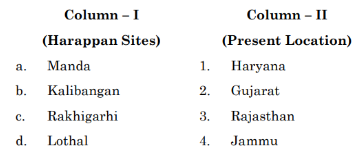
Match the Column – I with Column – II and choose the correct option :
[1 Mark] Diagram 3 – CBSE Class 12 Humanities History 2026 Set 1 Solutions
  • (A) 1, 2, 3, 4
  • (B) 2, 3, 4, 1
  • (C) 4, 3, 1, 2
  • (D) 3, 4, 2, 1
Explanation: The correct matching of the pairs is represented by the sequence 1, 2, 3, 4. Each item in Column I correctly corresponds to its related item in Column II in this order. The other sequences do not maintain this proper pairing according to the given context.
Question 7.

Arrange the following in correct chronological order:

I. Chalcolithic Age

II. Mesolithic Age

III. Neolithic Age

IV. Paleolithic Age

[1 Mark]
  • (A) I, IV, III, II
  • (B) IV, II, III, I
  • (C) II, III, I, IV
  • (D) III, I, IV, II
Explanation: The correct chronological order of these prehistoric ages starts with the Paleolithic Age (IV), which is the earliest phase characterized by the use of stone tools. It is followed by the Mesolithic Age (II), a transitional phase with more advanced tools. Next comes the Neolithic Age (III), marked by the development of agriculture and settled life. Finally, the Chalcolithic Age (I), or Copper Age, represents the period when copper tools started to be used alongside stone tools.
Question 8. Which one of the following is a work of Panini on Sanskrit grammar?
[1 Mark]
  • (A) Natyashastra
  • (B) Ashtadhyayi
  • (C) Abhigyanshakuntalam
  • (D) Sushrut Samhita
Explanation: Panini is renowned for his work on Sanskrit grammar known as 'Ashtadhyayi'. It is a foundational text in the study of Sanskrit grammar and linguistics, consisting of eight chapters and systematic rules governing Sanskrit language structure. The other options, such as Natyashastra (a treatise on performing arts), Abhigyanshakuntalam (a classical Sanskrit play by Kalidasa), and Sushrut Samhita (an ancient Sanskrit text on medicine and surgery), are unrelated to Panini's grammatical work.
Question 9.

Which of the following pairs is correctly matched?

(Ancient Dynasties) — (Lineage)

(A) Kanvas — Successors of Mauryas

(B) Mauryas — Successors of Mahapadmananda

(C) Satvahanas — Successors of Kushanas

(D) Shakas — Successors of Chalukyas

[1 Mark]
  • (A) Kanvas — Successors of Mauryas
  • (B) Shakas — Successors of Chalukyas
  • (C) Satvahanas — Successors of Kushanas
  • (D) Mauryas — Successors of Mahapadmananda
Explanation: The Kanvas were the immediate successors of the Mauryas, as mentioned in the context. The Mauryas did not succeed the Mahapadmanandas as a direct lineage, and the Satvahanas were not successors of the Kushanas. Similarly, the Shakas were not successors of the Chalukyas. Therefore, only the pair 'Kanvas — Successors of Mauryas' is correctly matched.
Question 10. Fill in the blank with the appropriate option given below: In the ancient period, each city had a history of its own, ________ began as a village but in fifth century B.C.E the Magadhan rulers shifted their capital from Rajagaha to this settlement.
[1 Mark]
  • (A) Vidisha
  • (B) Taxila
  • (C) Ujjain
  • (D) Pataliputra
Explanation: According to the context, initially Rajagaha was the capital of Magadha. Later, in the fourth century BCE, the capital was shifted to Pataliputra (present-day Patna). Therefore, the correct answer to fill in the blank is Pataliputra, as it began as a village and became the capital after Rajagaha.
Question 11.

Which of the following statements regarding Jainism is correct?

I. Vardhaman Mahavira was born in 5th Century CE.

II. Mahavira was the 24th Tirthankara.

III. Jains worship Lord Shiva as Mahavira.

IV. The principle of Ahimsa is emphasised in Jainism. Options:
[1 Mark]
  • (A) Only II and IV are correct.
  • (B) Only III and IV are correct.
  • (C) Only II and III are correct.
  • (D) Only I and II are correct.
Explanation: According to the provided context, Mahavira was born in the 6th century BCE, not the 5th century CE, so statement I is incorrect. Mahavira was indeed the 24th Tirthankara, making statement II correct. Jains do not worship Lord Shiva as Mahavira; rather, Mahavira is worshipped as the 24th Tirthankara, thus statement III is incorrect. The principle of Ahimsa (non-violence) is central and emphasised in Jainism, so statement IV is correct.
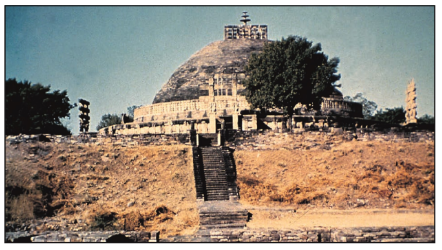
Question 12. Identify the following structure from the options given below:
[1 Mark] Diagram 4 – CBSE Class 12 Humanities History 2026 Set 1 Solutions
  • (A) Sanchi Stupa
  • (B) Amravati Stupa
  • (C) Barhut Stupa
  • (D) Sarnath Stupa
Explanation: The description references features such as the Great Stupa at Sanchi, including its plan and elevation, and highlights details like the stone railings resembling bamboo or wooden fences and richly carved gateways at the four cardinal points. These characteristics are specific to the Sanchi Stupa, making it the correct identification. Additionally, the inscriptions and historical context mentioned align with Sanchi rather than the other stupas listed.
Question 13.

In which of the following modern states of India is Sanchi Stupa located?

[1 Mark]
  • (A) Uttar Pradesh
  • (B) Tamil Nadu
  • (C) Madhya Pradesh
  • (D) Maharashtra
Explanation: The Sanchi Stupa is located near Bhopal. As Bhopal is the capital city of Madhya Pradesh, the stupa is therefore situated in the modern state of Madhya Pradesh. The context mentions travelling from Delhi to Bhopal and stopping at the Sanchi station, confirming its location in Madhya Pradesh.
Question 14.

Which of the following chronicles was authored by Abul-Fazl?

[1 Mark]
  • (A) Babur-Nama
  • (B) Humayun-Nama
  • (C) Akbar-Nama
  • (D) Padshah-Nama
Explanation: Abu'l Fazl was the court historian of Emperor Akbar and authored the Akbar Nama, which comprised three books including historical narratives and the Ain-i Akbari. The Ain-i Akbari was part of the larger Akbar Nama project and recorded detailed administrative and imperial regulations of Akbar's empire.
Question 15. The battle at Talikota (Rakshasi Tangri) was fought between which two of the following groups?
[1 Mark]
  • (A) Between Rama Raya and rulers of Bijapur, Gingee and Bidar
  • (B) Between Krishnadeva Raya and rulers of Madurai, Ikkeri and Mysore
  • (C) Between Rama Raya and rulers of Bijapur, Golconda and Ahmednagar
  • (D) Between Krishnadeva Raya and rulers of Golconda, Kolar and Chandragiri
Explanation: The battle at Talikota (Rakshasi Tangri) in 1565 was fought between the forces led by Rama Raya, the chief minister of Vijayanagara, and the combined armies of the Deccan Sultanates of Bijapur, Golconda, and Ahmadnagar. Rama Raya's policies led to the Sultans forming an alliance, which defeated Vijayanagara's forces and caused the destruction of the Vijayanagara city.
Question 16. Which of the following temples at Vijayanagara was meant to be used only by the king and his family?
[1 Mark]
  • (A) Vittala temple
  • (B) Chidambaram temple
  • (C) Hazara Ram temple
  • (D) Virupaksha temple
Explanation: The Hazara Rama temple was probably meant to be used only by the king and his family, as stated in the provided context. The temple features sculpted panels with scenes from the Ramayana and was a private shrine for the royal family, unlike the other temples such as the Virupaksha and Vittala temples, which were more public and served broader religious and cultural functions.
Question 17.

Identify the foreign traveller with the help of the following information:

• He was a Moroccan traveller of the 14th century.

• He had expertise in Islamic religion law

• He was appointed Qazi of Delhi by Muhammad bin Tughlaq.

[1 Mark]
  • (A) Seydi Ali Reis
  • (B) Al-Biruni
  • (C) Ibn Batuta
  • (D) Mahmud Ali Balkhi
Explanation:

Ibn Battuta was a Moroccan traveller in the 14th century, known for his expertise in Islamic religious law. He was appointed as the Qazi (judge) of Delhi by Sultan Muhammad bin Tughlaq. This information matches the details provided in the context, confirming Ibn Battuta as the correct answer.
Question 18. Who among the following is the author of the book of travels called ‘Travels in the Mughal Empire’?
[1 Mark]
  • (A) Francois Bernier
  • (B) Roberto Nobili
  • (C) Duarte Barbosa
  • (D) Marco Polo
Explanation: François Bernier, a French doctor, political philosopher, and historian, wrote detailed observations in his book 'Travels in the Mughal Empire'. His account includes critical insights and reflections on the Mughal Empire, comparing it with contemporary Europe. The context clearly states that Bernier is the author of this travelogue.
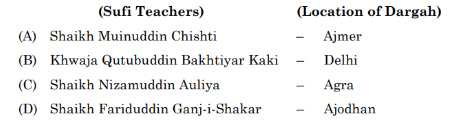
Question 19. Find the odd one out from the following :
[1 Mark] Diagram 5 – CBSE Class 12 Humanities History 2026 Set 1 Solutions
  • (A) Shaikh Muinuddin Chishti — Ajmer
  • (B) Khwaja Qutbuddin Bakhtiyar Kaki — Delhi
  • (C) Shaikh Nizamuddin Auliya — Agra
  • (D) Shaikh Fariduddin Ganj-i-Shakar — Ajodhan
Explanation: The odd one out is 'Shaikh Nizamuddin Auliya — Agra' because Shaikh Nizamuddin Auliya is actually associated with Delhi, not Agra. The other Shaikhs are correctly matched with their locations: Shaikh Muinuddin Chishti with Ajmer, Khwaja Qutbuddin Bakhtiyar Kaki with Delhi, and Shaikh Fariduddin Ganj-i-Shakar with Ajodhan. Therefore, the mismatch in location makes Shaikh Nizamuddin Auliya — Agra the odd one.
Question 20.

Assertion (A): Baba Guru Nanak Devji advocated Nirguna Bhakti.

Reason (R): For Baba Guru Nanak, the absolute or ‘rab’ had no gender or form.

[1 Mark]
  • (A) Assertion (A) is correct and Reason (R) is the correct explanation of Assertion (A).
  • (B) Assertion (A) is incorrect, but Reason (R) is correct.
  • (C) Assertion (A) is correct, but Reason (R) is not the correct explanation of Assertion (A).
  • (D) Assertion (A) is correct, but Reason (R) is incorrect.
Explanation:

Baba Guru Nanak Devji advocated Nirguna Bhakti, which means devotion to a formless, attribute-less Divine. The reason is that for Baba Guru Nanak, the Absolute or 'rab' had no gender or form, which aligns perfectly with the concept of Nirguna Bhakti. Therefore, both the assertion and the reason are correct and the reason correctly explains the assertion.

Question 21.

Which of the following statements accurately describe the conditions of Bombay-Deccan from 1840 to 1850?

I. There was significant agrarian expansion during this period.

II. Prices of agricultural products were rising steadily. III. There were frequent peasant uprisings due to economic distress.

IV. The agrarian landscape largely remained progressive. Options:

[1 Mark]
  • (A) Only III and IV are correct.
  • (B) Only I and III are correct.
  • (C) Only II and IV are correct.
  • (D) Only I and II are correct.
Explanation: During 1840 to 1850 in the Bombay-Deccan region, there was significant agrarian expansion, particularly in cotton cultivation, indicating statement I is correct. However, this expansion led to heavier debt for the majority of peasants causing economic distress, which in turn triggered frequent peasant uprisings, making statement III correct as well. The prices of agricultural products were not rising steadily; rather, prices were often depressed making it difficult for peasants to pay revenue demands, so statement II is incorrect. Moreover, the agrarian landscape did not remain largely progressive but faced high revenue demands and economic hardships, hence statement IV is incorrect.
Question 22. Identify the major long-term consequence of the Permanent Settlement for the Indian peasantry:
[1 Mark]
  • (A) Increased ownership of land among farmers.
  • (B) Investment in agricultural technology.
  • (C) Increased exploitation and indebtedness.
  • (D) Abolition of all kinds of landlordism.
Explanation: The Permanent Settlement fixed revenue demands in perpetuity but led to the oppression of peasants and a decline in their living standards. The zamindars, who were made landowners, often exploited peasants, as they sought to maximize their income despite fixed revenue payments. This resulted in increased exploitation and indebtedness among the peasantry, rather than increased ownership of land, investment in agricultural technology, or abolition of landlordism.
Question 23. Who amongst the following American Presidents played a decisive role in the American War of Independence?
[1 Mark]
  • (A) Abraham Lincoln
  • (B) Thomas Jefferson
  • (C) John F. Kennedy
  • (D) George Washington
Explanation: George Washington played a decisive role in the American War of Independence as he was the commander of the American forces fighting against the British. The context mentions the struggle for independence in the 1770s and highlights leadership as crucial to fighting the British. Washington's leadership was instrumental in the success of the American Revolution. The other options were either not alive at the time (John F. Kennedy) or did not play a decisive role in the war (Abraham Lincoln was involved in a later conflict, the American Civil War, and Thomas Jefferson was important as a founding figure but less directly as a military leader).
Question 24.

Why was the Revolt of 1857 viewed as a serious threat by the British?

[1 Mark]
  • (A) It united all the sections of Indian Society.
  • (B) It shook the entire colonial system of the world.
  • (C) It has hurt their global trade.
  • (D) It led to their defeat in South India.
Explanation:

The Revolt of 1857 was seen as a serious threat by the British because it brought together various sections of Indian society against colonial rule. This united resistance challenged the British authority significantly, making it difficult for them to suppress the rebellion quickly. The revolt shook the British colonial system as it was a large-scale uprising involving many ordinary Indians, which created uncertainty and fear among the British rulers.

Question 25.

Choose the correct pair regarding the local leaders during the Revolt of 1857.

List – I (Local Leader) — List – II (Region)

(A) Gonoa — Chotanagpur

(B) Shahmal — Hyderabad

(C) Kunwar Singh — Kanpur

(D) Maulavi Ahmadullah Shah — Arrah

[1 Mark]
  • (A) Gonoa — Chotanagpur
  • (B) Kunwar Singh — Kanpur
  • (C) Maulavi Ahmadullah Shah — Arrah
  • (D) Shahmal — Hyderabad
Explanation:

According to the context, Gonoa was a tribal cultivator and rebel leader of the Kol tribals in Singhbhum, Chotanagpur. Shah Mal mobilised villagers in Barout, Uttar Pradesh (not Hyderabad). Kunwar Singh was a zamindar in Arrah, Bihar (not Kanpur). Maulavi Ahmadullah Shah was associated with the region around Jhansi, not Arrah. Therefore, the correct pair is Gonoa — Chotanagpur.

Question 26.

Identify the Indian Political Leader with the help of the following information:

I. He moved the Objectives Resolution in the Constituent Assembly.

II. He moved the resolution proposing that the National Flag be a horizontal tricolour of saffron, white and dark green in equal proportions with a wheel of navy blue colour in the centre.

[1 Mark]
  • (A) Dr. Radhakrishnan
  • (B) Dr. Rajendra Prasad
  • (C) Pt. Jawaharlal Nehru
  • (D) Sardar Patel
Explanation:

Pt. Jawaharlal Nehru was the Indian political leader who moved the Objectives Resolution in the Constituent Assembly on 13 December 1946. He also moved the resolution proposing the design of the National Flag as a horizontal tricolour of saffron, white, and dark green in equal proportions with a navy blue wheel in the centre. This is confirmed by the context, which states that Nehru played these key roles, while Sardar Patel worked mainly behind the scenes.
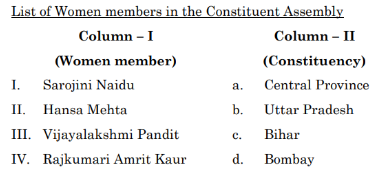
Question 27. Match Column I with Column II and choose the correct option
[1 Mark] Diagram 6 – CBSE Class 12 Humanities History 2026 Set 1 Solutions
  • (A) I → d, II → b, III → a, IV → c
  • (B) I → b, II → a, III → c, IV → d
  • (C) I → a, II → c, III → b, IV → d
  • (D) I → d, II → b, III → a, IV → c
Explanation: The correct match is I → d, II → b, III → a, IV → c because based on the context given, which discusses the use of textual traditions to interpret sculptures and how this is more effective than unjustified comparisons, the pairs correspond logically to this approach. The option correctly aligns the items from Column I with their appropriate descriptions or related concepts in Column II, reflecting the strategies and outcomes of understanding sculptures through texts rather than mismatched comparisons.

Section C

Question 28. Examine the major contribution of John Marshall as Director General of Archaeological Survey of India.
[3 Marks]
Answer: John Marshall's major contribution as Director General of the Archaeological Survey of India (ASI) was his pioneering excavation and discovery of the Indus Valley Civilization sites like Mohenjodaro and Harappa. He was the first professional archaeologist in India who brought scientific methods from his experience in Greece and Crete. Unlike his predecessors, Marshall explored not only spectacular finds but also everyday life patterns by careful excavation of similar seals and artifacts. In 1924, based on these discoveries, he established that these sites belonged to a single ancient civilization contemporaneous with Mesopotamia. His efforts fundamentally changed the understanding of Indian archaeology and revealed a previously unknown advanced urban culture in ancient India. He also contributed by documenting and publishing detailed volumes on these findings and promoting museum and site conservation, supported by patrons like Sultan Jehan. Overall, Marshall's work laid the foundation for modern archaeology in India and greatly enriched knowledge of its ancient past.
Key Points: Discovered Indus Valley Civilization sites - Introduced scientific excavation methods - Established a unified ancient civilization - Documented and published research - Promoted conservation and museum development
Question 29. Explain the causes of the ruin of Stupa at Amravati.
[3 Marks]
Answer: Causes of the ruin of Stupa at Amravati:
The Stupa at Amravati fell into ruin mainly because it was discovered before scholars realized its importance and the need to preserve it properly. In the 1850s, many slabs and sculptures from the stupa were removed and taken to various places like Calcutta, Madras, and even London. British administrators sometimes used these sculptures to decorate their gardens. As a result, the stupa lost much of its original structure and artistic beauty. Unlike Sanchi, where preservation efforts were better, Amravati did not receive adequate protection, leading to its decay and ruin.
This careless removal and lack of conservation were the main reasons the Stupa at Amravati was damaged and did not survive well over time.
Key Points: Early discovery before preservation awareness - Removal of slabs and sculptures to various places - Lack of protection and conservation - Usage of sculptures for decoration by British administrators
Question 30. Explain the significance of Pauranic Hinduism of the ancient India.
[3 Marks]
Answer: Significance of Pauranic Hinduism in Ancient India:
Pauranic Hinduism marked a major development in the religious landscape of ancient India by making religious knowledge and practices more accessible to all sections of society, including women and Shudras, who were traditionally excluded from Vedic learning.
It introduced the worship of popular deities like Vishnu and Shiva, shifting focus from earlier Vedic gods such as Agni, Indra, and Soma. This helped integrate various local and regional cults into a more unified Hindu tradition.
The Puranas contained stories and teachings in simple Sanskrit verses meant to be read aloud, thus spreading Brahmanical ideas widely and promoting devotion (bhakti) towards chosen deities.
Moreover, Pauranic Hinduism emphasized the roles of avatars or saviors and introduced theological concepts that appealed to the masses, facilitating greater religious participation and cohesion over time.
This tradition contributed to shaping the identity of Hinduism by blending diverse beliefs and practices into one organized framework, thereby influencing Indian culture, art, and society profoundly during and after the first millennium CE.
Key Points: Made religious knowledge accessible to all - Popularized worship of Vishnu and Shiva - Integrated regional cults into Hinduism - Spread Brahmanical ideas through Puranas - Promoted devotion and religious participation
Question 31. “Ibn Batuta was amazed by the efficiency of Indian postal system.” Explain the statement with examples.
[3 Marks]
Answer: Ibn Batuta praised the Indian postal system for its remarkable speed and organization. The system had two kinds: the horse-post called uluq with royal horses stationed every four miles, and the foot-post called dawa with three stations per mile. This allowed quick transmission of information; for example, it took fifty days to send news from Sind to Delhi but spy reports could reach the Sultan in just five days. The postal system also helped merchants send information, remit credit, and dispatch goods quickly along well-supplied trade routes with inns and guest houses. This efficient courier system enabled the Sultanate to maintain control and support business effectively.
Key Points: Two types of postal system - Horse-post uluq and foot-post dawa - Message speed: 50 days vs 5 days for important news - Supported merchants with communication and goods delivery
Question 32. Describe the significance of Kamalpuram tank and Hiriya Canal as sources of water for the Vijayanagara.
[3 Marks]
Answer: Kamalapuram Tank: Built in the early fifteenth century, the Kamalapuram tank was a crucial water source for Vijayanagara. It supplied water for irrigating nearby agricultural fields, which supported farming and food production. Additionally, water from the tank was channeled to the "royal centre," ensuring a steady water supply for the palace and administration.
Hiriya Canal: Constructed by the kings of the Sangama dynasty, the Hiriya canal was an important irrigation work that drew water from a dam across the Tungabhadra river. It irrigated the cultivated valley located between the "sacred centre" and the "urban core" of the city. This canal helped in maintaining agriculture and greenery in the vital area, contributing to the city's sustainability.
Overall significance: Both Kamalapuram tank and Hiriya canal played vital roles in supporting agriculture, providing water for the royal and urban areas, and enabling the flourishing of Vijayanagara as a prosperous and well-organized city.
Key Points: Kamalapuram tank irrigated fields and supplied royal centre - Hiriya canal drew water from Tungabhadra for valley irrigation - Both ensured water supply for agriculture and urban needs in Vijayanagara
Question 33. Describe the views of Dominingo Paes on the city of Vijayanagara.
[3 Marks]
Answer: Dominingo Paes described Vijayanagara as a vast and sprawling city that could not be seen entirely from a single spot because it was spread over an extensive area and surrounded by several ranges of hills. He climbed a hill from where he could see a large part of the city and compared its size to that of Rome, indicating its grandeur and magnificence. This description highlights Vijayanagara's impressive scale and strategic location amidst hills, showcasing it as a powerful and well-planned urban center during its time.
Key Points: Vijayanagara was a sprawling city - Could not be seen completely from one spot - Compared in size to Rome
Question 34. Analyse the measures taken by the British to suppress the riots of Bombay-Deccan in 1875.
[3 Marks]
Answer: Measures taken by the British to suppress the Bombay-Deccan riots in 1875:
The British Government of Bombay initially did not take the riots seriously but was pressured by the Government of India to act due to fears of a wider rebellion like in 1857.
1. The British set up the Deccan Riots Commission in 1875 to investigate the causes of the riots by collecting statements from ryots, sahukars, eyewitnesses, and gathering statistical data.
2. They passed special laws to suppress the rebellion effectively and maintain law and order.
3. Troops were sent to the affected districts to quell the unrest.
4. The British used the intelligence gathered by the commission and military action to restore peace and control the situation.
Thus, the British combined enquiry, legislation, and military force to suppress the riots and regain control over the region.
Key Points: Formation of Deccan Riots Commission - Enquiry into causes of riots - Passing special laws - Deployment of troops to suppress riots
Question 35. Explain the main provisions of the Government of India Act, 1935.
[3 Marks]
Answer: Main Provisions of the Government of India Act, 1935
1. Provincial Autonomy: The Act gave autonomy to the provinces and abolished the system of dyarchy introduced by the 1919 Act. Provincial governments were made responsible to the provincial legislatures.
2. Federal Structure: It proposed a federal system with provinces and princely states as units, although the federation never came into existence.
3. Separate Electorates: The Act continued separate electorates for minorities like Muslims, Sikhs, and others.
4. Governor's Powers: The Governor retained significant power including control over finance and law and order, and had authority to override the ministers.
5. Establishment of Federal Court: It provided for the establishment of a Federal Court to adjudicate disputes between provinces and centre.
6. Franchise: It expanded the franchise but it was still limited and based on property, tax, and education qualifications.
7. Executive Council: At the central level, the Act proposed a Governor-General's executive council with responsible ministers.
Overall, the Act was an important step towards self-governance but retained strong British control and was not satisfactory to Indian leaders.
Key Points: Provincial autonomy - Federal structure proposed - Governor's extensive powers

Section D

Question 36. Although epigraphy is an important source of reconstructing history yet there are limits to what it can reveal. Justify the statement with suitable arguments.
[8 Marks]
Answer: Epigraphy or the study of inscriptions is indeed a vital source for reconstructing history, but it has certain limitations that restrict the amount of information it can provide.

1. Physical Damage and Wear: Many inscriptions are old and suffer from damage due to weather, human interference, or natural wear and tear. This can make letters faint or missing, leading to difficulties in reading and interpreting them accurately.

2. Technical Limitations: Sometimes, the inscriptions are faintly engraved or incomplete, which results in uncertain reconstructions. Scholars often debate over alternative readings of the same inscription, showing that epigraphy is not always definitive.

3. Interpretation Challenges: The exact meaning of certain words or phrases used in inscriptions can be unclear. Some words may be specific to a particular time or region, and modern historians need to interpret them carefully. Sometimes, words are added within brackets by epigraphists to clarify meaning, but these interpretations might not always be fully accurate.

4. Historical Biases: Inscriptions often present the perspective of rulers or elites who commissioned them. They may exaggerate achievements or omit negative information, so historians need to critically assess the truthfulness and plausibility of the statements.

5. Limited Scope: While inscriptions offer valuable political, religious, or social information, they cannot provide a complete picture of history on their own. They need to be corroborated with other sources like literary texts, archaeological finds, and oral traditions.

In conclusion, while epigraphical evidence is indispensable for understanding the past, its limitations require historians to use it carefully and in conjunction with other sources to reconstruct a fuller and more accurate history.
Key Points: physical damage and wear - technical limitations in reading - challenges in interpretation - historical biases and exaggerations - limited scope requiring corroboration
Question 37. Historians have used a variety of sources to reconstruct the history of the Mauryan empire and also explained the ways of their administration. Justify the statement with suitable arguments.
[8 Marks]
Answer: Answer:
Historians have indeed used various sources to reconstruct the history of the Mauryan Empire and understand its administration. First, archaeological evidence such as stone sculptures, monuments, and especially inscriptions like those of Emperor Asoka have provided valuable information. The inscriptions reveal Asoka's policies, his messages on dhamma (moral law), and his efforts to govern with justice and compassion.
Second, literary sources like the accounts of Megasthenes, the Greek ambassador to Chandragupta Maurya's court, offer insights into the empire's size, structure, and administration. Although Megasthenes' work survives only in fragments, it helps historians understand aspects such as the central administration and the Mauryan army.
Third, religious texts from Buddhist, Jaina, and Brahmanical traditions provide context about the society, culture, and governance during the Mauryan period. For example, the Buddhist texts highlight Asoka's conversion and support for Buddhism.
Finally, monuments such as the Great Stupa at Sanchi illustrate the empire's patronage of art and religion, helping understand the cultural life under the Mauryas.
Together, these diverse sources have allowed historians to assemble a comprehensive picture of the Mauryan Empire's history and administration, confirming the empire's significance in ancient Indian history.
Key Points: Use of archaeological evidence including inscriptions - Accounts of Megasthenes provide contemporary written sources - Religious texts (Buddhist, Jaina, Brahmanical) offer cultural and social insights - Monuments like Sanchi Stupa reflect patronage and art - Combination of sources helps reconstruct history and administration
Question 38. Explain the development of agriculture during Mughal period.
[8 Marks]
Answer: Development of Agriculture during Mughal Period:
The Mughal period witnessed significant development in agriculture due to various factors. The Mughal state played an active role in encouraging the cultivation of diverse crops, including staples and cash crops such as cotton, sugarcane, and oilseeds like mustard.
The agricultural land was fertile in many regions, with some areas producing two crops a year (do-fasla), and others with better rainfall or irrigation producing three crops annually. This led to a wide variety of produce; for example, Agra produced 39 varieties of crops and Delhi 43 varieties over two seasons, while Bengal was famous for producing 50 varieties of rice alone.
The state administration, including revenue officials and record keepers, closely supervised agriculture. The diwan's office managed the fiscal system, ensuring proper revenue collection based on agricultural output. This involvement helped shape agrarian relations, as peasants were motivated to grow jins-i kamil or 'perfect crops' that yielded better revenue.
Additionally, the expansion in agricultural production was supported by the initiative of peasants and the village community. The Mughal rulers encouraged peasants to cultivate crops that provided higher revenue, supporting both the economy of the empire and agricultural growth. Thus, agriculture during the Mughal period became more diversified, intensive, and closely linked with the state’s revenue policies, leading to considerable progress in the agrarian sector.
Key Points: Diverse and intensive crop cultivation - State encouragement of cash crops like cotton and sugarcane - Close supervision of revenue and agrarian relations by Mughal officials
Question 39. Explain the role of women in the Agrarian society during 16th and 17th centuries.
[8 Marks]
Answer: Role of Women in Agrarian Society during 16th and 17th Centuries
In the agrarian society of the 16th and 17th centuries, women played a crucial role in agricultural production alongside men. While men were primarily responsible for tilling and ploughing the fields, women took care of other essential tasks such as sowing seeds, weeding the crops, threshing the grains, and winnowing the harvested produce. This division of labor showed the complementary roles of men and women in farming.

With the growth of nucleated villages and the expansion of individuated peasant farming, the entire household contributed to agricultural activities. Women’s labor was vital not only in the fields but also in other economic activities. As agriculture became more commercialised, the demand for women’s work increased significantly.

Besides working in the fields, women also engaged in peasant and artisan work. They sometimes visited the houses of their employers or markets to carry out their duties. Their contribution was highly valued as they were considered an important resource in the rural economy.

Historical sources like Mughal court chronicles provide much of our knowledge about these roles, since peasants themselves rarely recorded their experiences. Overall, women’s labor was indispensable for sustaining agrarian life and supporting the rural economy during this period.
Key Points: Women carried out sowing, weeding, threshing, winnowing - Men tilled and ploughed the fields - Women’s labor increased with commercialised agriculture - Women worked in fields, artisan roles, and markets - Entire household labor was important for agrarian production
Question 40. Non-Cooperation Movement became an epoch in the life of Mahatma Gandhi and that of India. Explain the statement of Louis Fisher with examples.
[8 Marks]
Answer: Explanation of Louis Fisher's Statement on Non-Cooperation Movement
Louis Fisher described the Non-Cooperation Movement as an epoch in the life of Mahatma Gandhi and India because it marked a significant turning point in India's struggle for freedom. The movement was "negative enough to be peaceful but positive enough to be effective," meaning it was based on peaceful resistance while firmly opposing British rule.

Key Features:
1. Denial and Renunciation: Indians refused to cooperate with the British government by boycotting foreign goods, schools, courts, and elections. This was a form of denial rejecting British authority.
2. Self-Discipline and Training for Self-Rule: The movement encouraged Indians to develop self-reliance and unity, essential for governing themselves.

Examples:
- Students left government schools and colleges, showing their non-acceptance of British education policies.
- Lawyers stopped attending British courts, disrupting the colonial legal system.
- People boycotted foreign clothes and started using khadi, promoting Indian industries.

This movement shook the British Raj deeply as it involved millions and spread nationwide. It showed the power of peaceful mass protest and prepared Indians for future struggles. Gandhi's call for non-cooperation united different communities and social groups, linking it also with the Khilafat Movement, which aimed to unite Hindus and Muslims.

Thus, Louis Fischer's statement highlights how the Non-Cooperation Movement was both a strategic and moral campaign that redefined India's freedom fight and Gandhi's leadership, making it an unforgettable epoch in history.
Key Points: Peaceful resistance - Boycott of British goods and institutions - Promoted self-rule and Indian unity
Question 41. Gandhiji started the Salt March for various reasons and it resulted in a significant movement. Explain the statement with examples.
[8 Marks]
Answer: Gandhiji started the Salt March for various important reasons and it became a significant movement in India’s struggle for freedom.
First, the Salt March was a protest against the British salt tax and monopoly, which was a law that forbade Indians from making or selling salt independently. Since salt is an essential item in every Indian household, this law affected all Indians, reflecting the unjust nature of British rule.
Second, Gandhiji chose salt as a symbol of protest because it was simple yet powerful. By breaking the salt law openly, he challenged British authority in a non-violent way, showing that even ordinary people could resist oppression.
Gandhiji announced his plan publicly by informing the Viceroy, Lord Irwin, but the British failed to understand the seriousness of the march.
He started his march on 12 March 1930 from Sabarmati Ashram and walked about 240 miles to the sea at Dandi, reaching it after three weeks. There, he made salt from sea water, deliberately breaking the law and making himself a criminal in British eyes.
This act inspired thousands across the country to break the salt law and join the civil disobedience movement. Women also participated actively, which was significant as it involved new sections of society in the freedom struggle.
The British responded by arresting nearly 60,000 people, including Gandhiji, but the movement brought worldwide attention to India’s freedom struggle through extensive press coverage.
Thus, the Salt March was a turning point as it united Indians in a peaceful yet powerful fight against colonial rule and highlighted Gandhiji’s strategy of non-violent resistance effectively.
Key Points: Protest against British salt tax and monopoly - Salt as a symbol of resistance - Non-violent civil disobedience movement - Involvement of women and common people - Mass arrests highlighting British repression - International attention to Indian freedom struggle

Paper Details

CBSE Board Exam 2026

Class

Class 12 Humanities

Subject

History

Year

2026

Set

Set 1

Other Years — History

2022 Set-1

2022 Set-2

2022 Set-3

2022 Set-4

2022 Set-5

2023 Set-1

2023 Set-3

2023 Set-4

2023 Set-5

2024 Set-1

2024 Set-2

2024 Set-3

2024 Set-4

2024 Set-5

2025 Set-1

2025 Set-2

2025 Set-3

2025 Set-4

2025 Set-5

2025 Set-6

2026 Set-1

2026 Set-2

2026 Set-3

2026 Set-4

2026 Set-5