SOLUTIONS
2026 BOARD EXAM
CBSE Class 12 Humanities History Board Paper 2026 — Set 3 Solutions
2026
History
Class 12 Humanities
CBSE EXAMINATION PAPER-2026
HISTORY
(Solved)
General Instructions :
Read the following instructions carefully and follow them :
- This question paper contains 41 questions. All questions are compulsory.
- This question paper is divided into 4 sections.
- Section A – questions number 1 to 5 are case based questions
- Section B – questions number 6 to 27 are multiple choice questions
- Section C – questions number 28 to 35 are short answer
- Section D – questions number 36 to 41 are long answer
- There is no overall choice given in the question paper. However, an internal choice has been provided in few questions.
- Use of calculator is NOT allowed.
Section A
Read the given source carefully and answer the questions thatfollow :
Verses from the Upanishads
Here are two verses from the Chhandogya Upanishad, a text composed in Sanskrit c. sixth century BCE:
The nature of the self
This self of mine within the heart, is smaller than paddy or barley or mustard or millet or the kernel of a seed of millet. This self of mine within the heart is greater than the earth, greater than the intermediate space, greater than heaven, greater than these worlds.
The true sacrifice
This one (the wind) that blows, this is surely a sacrifice ... While moving, it sanctifies all this; therefore it is indeed a sacrifice.
(1) Where does the soul reside according to the verse?
[1 Mark](2) How is the soul described in terms of size?
[1 Mark](3) What happens when a person truly knows the self (soul) according to the Chhandogya Upanishad?
[2 Marks]Read the given source carefully and answer the questions that
follow :
How Silver Came to India
This excerpt from Giovanni Careri’s account (based on Bernier’s account) gives an idea of the enormous amount of wealth that found its way into the Mughal Empire:
That the Reader may form some idea of the Wealth of this (Mughal) Empire, he is to observe that all the Gold and Silver, which circulates throughout the World at last Centres here. It is well known that as much of it comes out of America, after running through several Kingdoms of Europe, goes partly into Turkey, for several sorts of Commodities; and part into Persia, by the way of Smirna for Silk. Now the Turks not being able to abstain from Coffee, which comes from Hyeman (Oman), and Arabia ... nor Persia, Arabia, and the Turks themselves to go without the commodities of India, send vast quantities of Money to Moka (Mocha) on the Red Sea, near Babel Mandel; to Bassora (Basra) at the bottom of the Persian Gulf; ... which is afterwards sent over in Ships to Indostan (Hindustan). Besides the Indian, Dutch, English, and Portuguese Ships, that every Year carry the Commodities of Indostan to Pegu, Tanasserri (parts of Myanmar), Siam (Thailand), Ceylon (Sri Lanka) ... the Maldive Islands, Mozambique and other Places, must of necessity convey much Gold and Silver thither, from those Countries. All that the Dutch fetch from the Mines in Japan, sooner or later, goes to Indostan; and the goods carry’d hence into Europe, whether to France, England, or Portugal, are all purchas’d for ready Money, which remains there.
(1) How did ships contribute to the flow of silver and gold to India?
[1 Mark](2) How did silver and gold from America reach India?
[1 Mark](3) How did India benefit from global trade networks in the 17th century?
[2 Marks]Read the given source carefully and answer the questions that follow :
Framing the Constitution
The Indian Constitution, which came into effect on 26 January, 1950, has the dubious distinction of being the longest in the world. But its length and complexity are perhaps understandable when one considers the country’s size and diversity. At Independence, India was not merely large and diverse, but also deeply divided. A Constitution designed to keep the country together, and to take it forward, had necessarily to be an elaborate, carefully-worked-out, and painstakingly drafted document. For one thing, it sought to heal wounds of the past and the present, to make Indians of different classes, castes and communities come together in a shared political experiment. For another, it sought to nurture democratic institutions in what had long been a culture of hierarchy and deference.
The Constitution of India was framed between December 1946 and November 1949. During this time, its drafts were discussed clause-by-clause in the Constituent Assembly of India.
(1) Why is the Indian Constitution regarded as the longest in the world?
[1 Mark](2) Why was the Constitution seen as essential at the time of Independence?
[1 Mark](3) How did the Constitution seek to nurture democracy in India?
[2 Marks]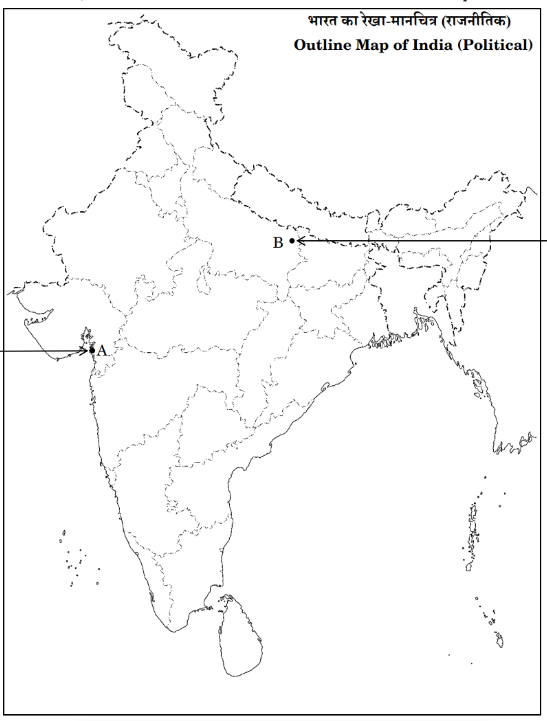
(1) Lothal − A mature Harappan site
[1 Mark](2) Amaravati − A Buddhist site
[1 Mark](3) Delhi − A territory under Mughals
[1 Mark](4) Vijayanagara − A medieval period kingdom
[2 Marks]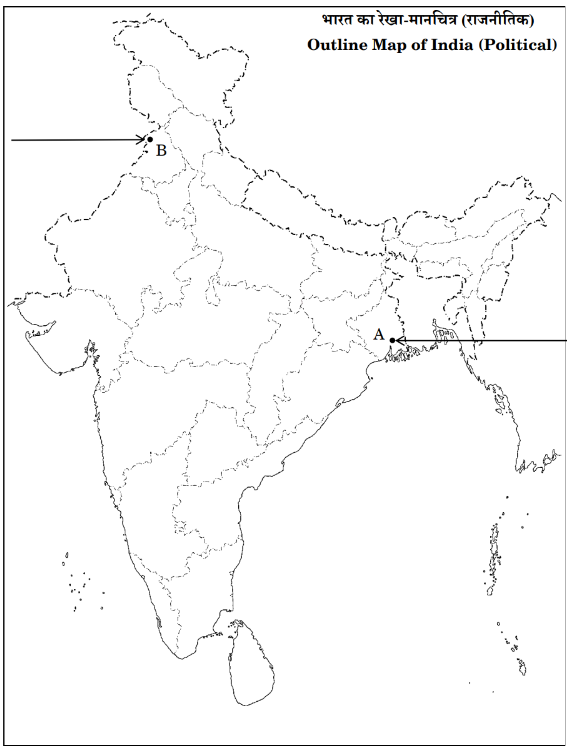
(1) Mention any one mature Harappan site in Western India.
[1 Mark](2) Name any one territory which was under the Mughals.
[1 Mark](3) Mention any one ancient Buddhist site in South Indi
[1 Mark]It is mentioned as a major Buddhist site in the context and is located in South India.
(4) Name any one neighbouring kingdom of the VijayanagaraEmpire.
[1 Mark]Reference: The case passage states that Vijayanagara Empire included areas with different peoples and neighbors, indicating its proximity to kingdoms like the Bahmani Sultanate.
(5) Name any two centres of the Indian National Movement.
[1 Mark]Section B
Which of the following statements about the Harappan economy are correct ?
I. Urban centres provide remains of organized craft production.
II. Use of iron tools for agriculture was common.
III. Evidence of seals indicates long distance trade.
IV. Standardised weights point towards regulated trade contacts.
Assertion (A) : Most Asokan inscriptions were in the Prakrit language.
Reason (R) : The use of Prakrit shows his attempt to spread the message amongst the common people.
Most Asokan inscriptions were indeed in Prakrit, which was the language spoken by ordinary people at that time. The use of Prakrit instead of Sanskrit, which was reserved for priests and elites, reflects Asoka's intention to spread his messages to the common people effectively. Hence, both the assertion and reason are true, and the reason explains the assertion correctly.
Arrange the following rulers in chronological order:
I. Kanishka
II. Mahapadma Nanda
III. Samudragupta
IV. Chandragupta Maurya
The correct chronological order of the rulers is Chandragupta Maurya (c. 321 BCE) followed by Mahapadma Nanda, then Samudragupta, and finally Kanishka. Chandragupta Maurya founded the Mauryan Empire in the 4th century BCE. Mahapadma Nanda was an important king of Magadha and preceded the Mauryas. Samudragupta was a prominent Gupta emperor later than the Mauryas and Nandas. Kanishka ruled the Kushan empire, which came after the Gupta period. Hence, the order IV (Chandragupta Maurya), II (Mahapadma Nanda), III (Samudragupta), I (Kanishka) is correct.
Identify the character from the Mahabharata:
• He was the elder brother of Pandu.
• He was the king of Hastinapur.
• He was the husband of Gandhari.
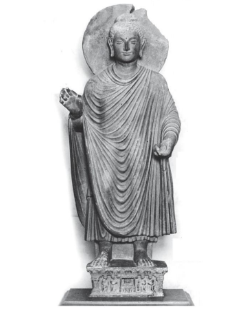
Who amongst the following rulers of Bhopal provided money for the preservation of Sanchi ?
Match Column A with Column B and choose the correct option :
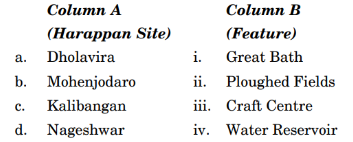
The correct matching is a-i, b-iii, c-iv, d-ii because this pairing aligns logically based on the given context 'yield interesting results in the future.' This shows a, indicating a cause-effect relationship that fits best with the first option. The other options do not maintain this logical consistency when matching Column A with Column B.
Which one of the following pairs is correctly matched?
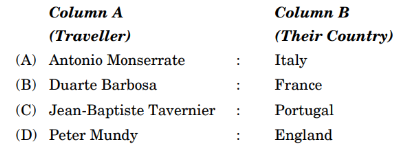
Duarte Barbosa was a Portuguese writer known for his detailed account of trade and society in South India, as mentioned in the context. Jean-Baptiste Tavernier was French, not Portuguese; Antonio Monserrate was Spanish, not Italian; and Duarte Barbosa was Portuguese, not from any other country. Hence, the correctly matched pair is Duarte Barbosa — Portugal.
Which of the following statements accurately describes Amir Khusrau ?
I. He was a great poet and musician.
II. He introduced the qaul in Chishti Sama.
III. He was a disciple of Shaikh Muinuddin Sijzi.
IV. He laid the foundation of qawwali tradition.
Which of the following battles in 1565 led to the decline of the Vijayanagara Empire?
The Battle of Talikota in 1565 was a decisive conflict where the combined armies of the Sultanates of Bijapur, Ahmadnagar, and Golconda defeated the Vijayanagara Empire led by Rama Raya. This defeat resulted in the sacking and eventual abandonment of the city of Vijayanagara, leading to the decline of the empire.
Fill in the blank with the appropriate word: The Shah Nahar Canal in Punjab was repaired during the reign of ________.
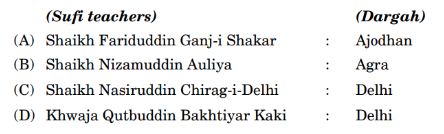
Read the following statements carefully regarding Al-Biruni’s ‘‘Kitab-ul-Hind’’ and choose the correct option :
I. It is a voluminous text of eighty chapters.
II. It is written in Arabic, Urdu and Hindavi.
III. Each of its chapters begins with a question.
IV. It covers many subjects like astronomy, festivals, etc.
Which of the following was not a major centre of the Revolt of 1857 ?
Bombay was not a major centre of the Revolt of 1857. The revolt was significant in places like Delhi, Jhansi, and Arrah where sepoys and ordinary people actively participated. The Government of Bombay initially did not consider the revolt serious, indicating limited activity in Bombay compared to the other listed centres which witnessed major uprisings.
Choose the correct option from the following to fill in the blank regarding the regions of nationalist leaders of India : Bipin Chandra Pal : Bengal; Lala Lajpat Rai : ____________
According to the provided context, Lala Lajpat Rai was a prominent nationalist leader from Punjab. The context identifies the trio 'Lal, Bal and Pal' representing Lala Lajpat Rai of Punjab, Bipin Chandra Pal of Bengal, and Bal Gangadhar Tilak of Maharashtra. Therefore, the correct region to fill in the blank for Lala Lajpat Rai is Punjab.
Match Column A with Column B regarding important Committees of the Constituent Assembly and its Presidents and choose the correct option :
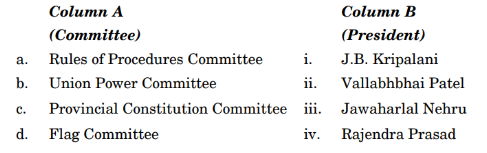
The correct matching of important Committees of the Constituent Assembly and their Presidents is based on historical records. Although the provided context does not explicitly list the committees and their presidents, the known standard matches are: a (Drafting Committee) - i (Dr. B.R. Ambedkar), b (Union Powers Committee) - ii (Jawaharlal Nehru), c (Provincial Constitution Committee) - iii (Sardar Vallabhbhai Patel), and d (Advisory Committee on Fundamental Rights) - iv (Rajendra Prasad). This matching is consistent with the major roles these leaders played in framing the Constitution and the committees they led.
Assertion (A) : The Sepoys proclaimed Bahadur Shah Zafar as their leader in the Revolt of 1857.
Reason (R) : Bahadur Shah Zafar’s acceptance gave legitimacy to the Revolt of 1857.
Identify the Indian social reformer of the nineteenth century with the help of the following information and choose the correct option :
• Opposed child marriage
• Advocated for social justice
• Campaigned for reform of Hinduism
• Known for Vedantic theory
Swami Vivekananda is the correct answer because he is well known for campaigning for reform of Hinduism and was a proponent of the Vedantic theory. He advocated for social justice and emphasized removing social evils such as child marriage and untouchability. The description in the context matches his work and philosophy.
Fill in the blank with the appropriate word from the options given below :
The Deccan Riots Commission produced a report that was presented to the __________ Parliament in 1878.
Section C
(b) The seals contained animal motifs and signs from an undeciphered script, which probably conveyed information about the goods or the trader, serving as a communication tool in trade and administration.
(c) These seals acted as control tools in administration and trade for recording transactions or sealing goods to prevent tampering, ensuring proper management of resources and trade activities.
(a) The Harappan civilisation had skilled artisans who could create detailed and sophisticated sculptures, indicating advanced craftsmanship.
(b) The presence of a figure termed as "priest-king" suggests there might have been some form of leadership or elite group, although the exact political or religious role remains unclear.
(c) The statue shows that the society possibly had social hierarchy or distinctions, as the carefully designed dress and features indicate status.
Therefore, the artefact hints at the existence of social complexity, some organized form of governance or ritual leadership, and advanced artistic skills in the Harappan civilisation.
(a) Archaeological Finds: Monuments, sculptures, and inscriptions like those found at the Sanchi Stupa provide important information about the Mauryan period including art, architecture, and religious beliefs.
(b) Contemporary Accounts: The writings of Megasthenes, a Greek ambassador to Chandragupta Maurya's court, give valuable descriptions of the Mauryan administration, society, and economy.
(c) Ancient Texts and Literature: Buddhist, Jaina, and Brahmanical texts, as well as literature in Sanskrit and regional languages like Tamil, Kannada, and Telugu, help us understand the cultural and social aspects of the Mauryan Empire.
Kabir belonged to the Nirguna Bhakti tradition which focused on devotion to a formless and attribute-less Divine. He expressed his spiritual ideas through simple yet profound poems composed in the special language called sant bhasha, making deep philosophical concepts accessible to all. Kabir questioned rigid religious and social norms, rejecting caste distinctions and rituals to emphasize a direct personal experience of God. His verses often use ulatbansi or upside-down sayings which challenged conventional thinking. The legacy of Kabir is preserved in various compilations like Kabir Bijak and Kabir Granthavali and is respected across different communities. Thus, Kabir stands out as a great poet-saint who inspired generations to seek the Divine beyond external forms and social barriers.
However, the report must be read critically. It was written by officials with their own interests, so some arguments and evidence may be biased or incomplete. Recent research using local Bengal zamindar archives and district records shows that the Fifth Report's portrayal of colonial impact is not fully accurate or comprehensive. Therefore, while the report greatly shaped our historical understanding, it should be supplemented with other sources to get a balanced view of colonial rule in rural Bengal.
In summary, the Fifth Report is invaluable but must be studied critically, considering who wrote it and why, and comparing it with local records and research from different perspectives.
Artists and writers portrayed the leaders of the revolt as heroic figures who inspired the people to rise against oppression.
The revolt was shown as a symbol of national pride and resistance, highlighting the sacrifices made by the rebels.
Literary works and paintings helped keep the memory of 1857 alive by focusing on themes of patriotism and valor.
These portrayals infused a spirit of nationalism in the later freedom movement, connecting it with the earlier fight in 1857.
Thus, art and literature played a vital role in shaping the narrative of the revolt not just as a military event but as India’s first collective fight for independence from colonial rule.
Section D
The Mahabharata is called a dynamic text because it has continuously evolved over time and adapted to different contexts and audiences. It did not remain a fixed or static story. Instead, it grew beyond its original Sanskrit version through an ongoing process of retelling, rewriting, and translation into various regional languages. Different communities and regions contributed their own versions and interpretations, adding new stories and sometimes changing existing ones.
For example, the stories of characters like Karna and Draupadi have been narrated differently in various versions, highlighting different virtues or struggles based on the cultural context of the people telling the story. The inclusion of moral and philosophical discourses such as the Bhagavad Gita is another aspect that was added later to the epic, showing the text’s fluid nature.
Moreover, the Mahabharata is described as an "itihasa," meaning "thus it was," which suggests it was intended to be a historical as well as a moral and spiritual guide. Its narratives reflect the social, political, and religious attitudes of different times and places, helping historians understand the social histories of those eras.
In summary, the dynamic quality of the Mahabharata lies in its constant growth and transformation, influenced by dialogue between peoples and communities over centuries. This makes it not just a story but a living tradition that continues to inspire and teach.
The Mahabharata strongly reinforces familial values by focusing on the complex relationships within a royal family, particularly between the Kauravas and the Pandavas, who were cousins belonging to the Kuru lineage. The central story revolves around a family feud over land and power, highlighting the importance of kinship ties.
First, the epic shows how familial bonds shape characters' duties and actions. For example, the Pandavas and Kauravas fought fiercely but were still bound by their family loyalty. Despite conflicts, family ties influenced decisions such as alliances and loyalty.
Second, after the great battle at Kurukshetra, patrilineal succession was established, emphasizing the importance of inheritance within family lines and the continuity of the lineage.
Third, the Mahabharata promotes the idea of marriage as a key element of family structure and social order. Marriages connected families and helped preserve social hierarchy, reflecting the norms of the time.
Finally, the epic serves as a didactic tool by advising kings and people to maintain these familial norms for social stability, thus reinforcing the status determined by birth and kinship.
In summary, the Mahabharata uses stories of family conflict and resolution to emphasize loyalty, duty, inheritance, and social hierarchy within families, thereby reinforcing the ideas of familial values in ancient Indian society.
Ceremonial Features: The Mahanavami Dibba is associated with the Mahanavami festival, an important celebration in the Vijayanagara Empire during which the king would perform rituals and receive tribute. The platform was likely used for royal ceremonies, including public displays of power such as military parades, religious offerings, and cultural performances. Though some scholars debate the scale of processions held here due to limited surrounding space, the reliefs suggest the significance of the site in the empire's ritual life. It symbolized the king's authority and the empire's unity by integrating religious and political traditions.
In conclusion, the Mahanavami Dibba combined impressive architectural elements with important ceremonial uses. It reflected the Vijayanagara rulers' efforts to create a grand imperial culture that blended diverse traditions through both its form and function.
The fortifications of Vijayanagara were remarkable for their scale, design, and strategic planning, demonstrating the empire's power and preparedness.
1. Multiple Lines of Defense: Vijayanagara had several lines of fortifications. There was an outer fortification wall protecting the entire city, a second line around the inner urban core, and a third enclosur around the royal centre. This multilayered defense made invasion difficult.
2. Massive Stone Walls and Strong Gateways: The fort walls were built with large stones, making them strong and durable. The gateways, such as the ones shown in Fig. 7.6, were heavily fortified entry points controlling access.
3. Protection of Agricultural Belts: Instead of only stockpiling grains inside the forts, Vijayanagara rulers protected the agricultural lands themselves with defensive structures, ensuring food security in times of siege.
4. Water Management and Aqueducts: The presence of aqueducts, like the one shown in Fig. 7.5, brought water into fortified areas, ensuring a stable supply during conflicts.
5. Integration of Different Traditions: The architecture of the fortifications incorporated diverse cultural and technological influences, representing the imperial culture and strength.
In summary, Vijayanagara's fortifications combined strategic planning, strong construction, and resource protection, reflecting the empire's military and administrative strength.
Arguments to justify: 1. Mass Participation: The movement attracted millions of Indians including students, lawyers, peasants, workers, and women who actively participated by boycotting British institutions like schools, colleges, courts, and government services.
2. Unity between Hindus and Muslims: By associating the Khilafat Movement with the Non-Cooperation Movement, Gandhi successfully brought together the two major religious communities in India, fostering communal harmony against colonial rule.
3. Peaceful yet Effective Protest: The movement was based on peaceful non-violence involving denial, renunciation, and self-discipline which made it a strong moral force that unsettled British authority.
4. Economic Impact: Indians stopped paying taxes and boycotted foreign goods and institutions, which hurt British economic interests.
5. Political Awakening and Nationalism: The movement created a sense of political consciousness and national pride among Indians, training them for self-rule.
Conclusion: Due to its wide participation, communal unity, peaceful nature, and significant impact on British rule, the Non-Cooperation Movement became a landmark popular movement in India’s freedom struggle.
Firstly, salt was an essential commodity used by every Indian household, making it a symbol that affected all sections of society. The British had imposed a monopoly on salt production and sale, forcing Indians to buy expensive salt and criminalizing their traditional right to collect or produce salt. This was deeply resented by the people.
Secondly, Mahatma Gandhi wisely chose salt as the focus of protest because of its universal importance and the unpopularity of the salt laws. His decision to lead the Dandi March to produce salt directly challenged the British monopoly, showcasing a direct act of civil disobedience.
Thirdly, the Salt Satyagraha mobilized millions of Indians across the country to participate in acts of non-violent resistance, such as making salt illegally, refusing to buy salt from British sources, and organizing protests.
Moreover, the campaign exposed the injustice of colonial economic policies and evoked widespread sympathy and support for the freedom movement, both within India and internationally.
Thus, the Salt Satyagraha was truly an all-India campaign because it engaged diverse groups in a united struggle, highlighted the oppressive nature of colonial laws, and demonstrated the power of non-violent mass resistance against British rule.
Other Years — History