SOLUTIONS
2026 BOARD EXAM
CBSE Class 12 Humanities History Board Paper 2026 — Set 4 Solutions
2026
History
Class 12 Humanities
CBSE EXAMINATION PAPER-2026
HISTORY
(Solved)
General Instructions :
Read the following instructions carefully and follow them :
- This question paper contains 41 questions. All questions are compulsory.
- This question paper is divided into 4 sections.
- Section A – questions number 1 to 5 are case based questions
- Section B – questions number 6 to 27 are multiple choice questions
- Section C – questions number 28 to 35 are short answer
- Section D – questions number 36 to 41 are long answer
- There is no overall choice given in the question paper. However, an internal choice has been provided in few questions.
- Use of calculator is NOT allowed.
Section A
Read the given source carefully and answer the questions that follow :
How Buddhist texts were prepared and preserved.
The Buddha (and other teachers) taught orally – through discussion and debate. Men and women (perhaps children as well) attended these discourses and discussed what they heard. None of the Buddha’s speeches were written down during his lifetime. After his death (c. fifth-fourth century BCE) his teachings were compiled by his disciples at a council of 'elders' or senior monks at Vesali (Pali for Vaishali in present-day Bihar). These compilations were known as Tipitaka – literally, three baskets to hold different types of texts. They were first transmitted orally and then written and classified according to length as well as subject matter.
The Vinaya Pitaka included rules and regulations for those who joined the sangha or monastic order; the Buddha’s teachings were included in the Sutta Pitaka; and the Abhidhamma Pitaka dealt with philosophical matters. Each pitaka comprised a number of individual texts. Later, commentaries were written on these texts by Buddhist scholars.
As Buddhism travelled to new regions such as Sri Lanka, other texts such as the Dipavamsa (literally, the chronicle of the island) and Mahavamsa (the great chronicle) were written, containing regional histories of Buddhism. Many of these works contained biographies of the Buddha. Some of the oldest texts are in Pali, while later compositions are in Sanskrit.
When Buddhism spread to East Asia, pilgrims such as Fa Xian and Xuan Zang travelled all the way from China to India in search of texts. These they took back to their own country, where they were translated by scholars. Indian Buddhist teachers also travelled to faraway places, carrying texts to disseminate the teachings of the Buddha.
Buddhist texts were preserved in manuscripts for several centuries in monasteries in different parts of Asia. Modern translations have been prepared from Pali, Sanskrit, Chinese and Tibetan texts.
(1) Explain why Buddha’s speeches were not written down during his lifetime.
[1 Mark](2) Assess the impact of orally transmitting texts before writing them down for preservation.
[1 Mark](3) Explain the differences between the Vinaya Pitaka and Sutta Pitaka.
[2 Marks]Read the given source carefully and answer the questions that follow:
Trade between the hill tribes and the plains, c. 1595.
This is how Abu’l Fazl describes the transactions between the hill tribes and the plains in the suba of Awadh (part of present-day Uttar Pradesh):
From the northern mountains quantities of goods are carried on the backs of men, of stout ponies and of goats, such as gold, copper, lead, musk, tails of the kutas cow (the yak), honey, chuk (an acid composed of orange juice and lemon boiled together), pomegranate seed, ginger, long pepper, majith (a plant producing a red dye) root, borax, zedoary (a root resembling turmeric), wax, woollen stuffs, wooden ware, hawks, falcons, black falcons, merlins (a kind of bird), and other articles. In exchange they carry back white and coloured clothes, amber, salt, asafoetida, ornaments, glass and earthen ware.
(1) Why was trade between the mountains and plains important for the Mughal economy?
[1 Mark](2) How did the people of the plains benefit from trade with the hill tribes?
[1 Mark](3) How did Abu’l Fazl describe the variety of goods carried by the hill tribes?
[2 Marks]Read the given source carefully and answer the questions that follow:
What the sepoys thought.
This is one of the arzis (petition or application) of rebel sepoys that have survived. A century ago the British arrived in Hindostan and gradually entertained troops in their service, and became masters of every state. Our forefathers have always served them, and we also entered their service ... By the mercy of God and with our assistance the British also conquered every place they liked, in which thousands of us, Hindostani men were sacrificed, but we never made any excuses or pretences nor revolted ...
But in the year eighteen fifty seven the British issued an order that new cartridges and muskets which had arrived from England were to be issued; in the former of which the fats of cows and pigs were mixed; and also that attah of wheat mixed with powdered bones was to be eaten; and even distributed them in every Regiment of infantry, cavalry and artillery ...
They gave these cartridges to the sowars (mounted soldiers) of the 3rd Light Cavalry, and ordered them to bite them; the troopers objected to it, and said that they would never bite them, for if they did, their religion and faith would be destroyed ... upon this the British officers paraded the men of the 3 Regiments and having prepared 1,400 English soldiers, and other Battalions of European troops and Horse Artillery, surrounded them, and placing six guns before each of the infantry regiments, loaded the guns with grape and made 84 new troopers prisoners, and put them in jail with irons on them ... The reason that the sowars of the Cantonment were put into jail was that we should be frightened into biting the new cartridges. On this account we and all our country-men having united together, have fought the British for the preservation of our faith ... we have been compelled to make war for two years and the Rajahs and Chiefs who are with us in faith and religion, are still so, and have undergone all sorts of trouble; we have fought for two years in order that our faith and religion may not be polluted. If the religion of a Hindoo or Mussalman is lost, what remains in the world?
(1) How did the sepoys justify their rebellion in the ‘arzi’?
[1 Mark](2) How did the British introduce the new cartridges?
[1 Mark](3) Why did the sepoys and Indian chiefs work together?
[2 Marks]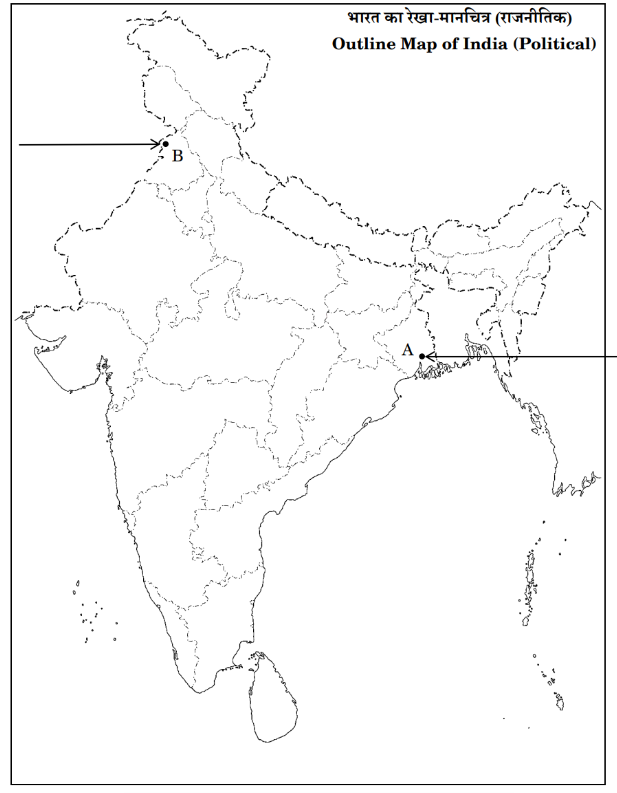
(1) Nagarjunakonda − An Ancient Buddhist site
[2 Marks](2) Dholavira − A mature Harappan site
[1 Mark](3) Agra − A territory under the Mughals
[1 Mark](4) Bijapur − A medieval period state
[1 Mark]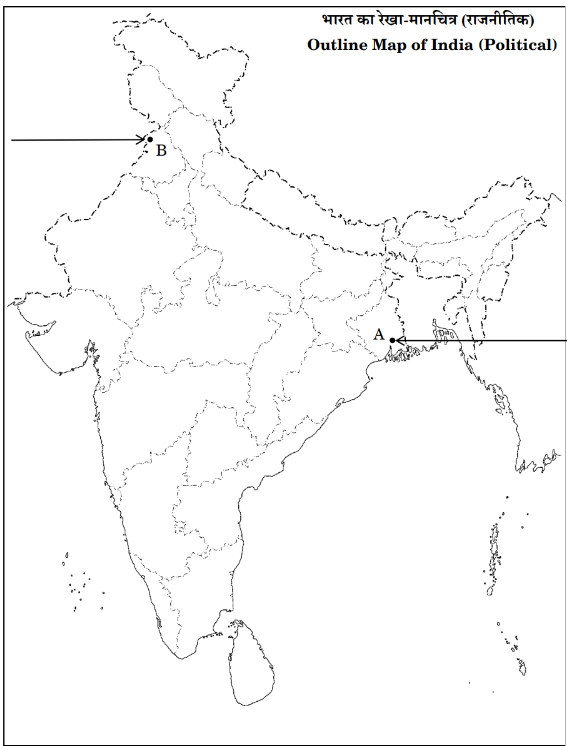
(1) Mention any one mature Harappan site in present Pakistan
[1 Mark](2) Name any one territory which was under the Mughals.
[1 Mark](3) Mention one ancient Buddhist site in Eastern India
[1 Mark](4) Name any one neighbouring kingdom of the Vijayanagara empire.
[1 Mark](5) Name any two centres of the Indian National Movement.
[1 Mark]This relates to the case passage mentioning the evolving political landscape and nationalist movements in different regions of India.
Section B
Assertion (A) : Asoka was the first ruler who inscribed his messages to his subjects on stone surfaces and pillars.
Reason (R) : Asoka ensured that the message of dhamma reached as many people as possible.
Arrange the following literary compositions in chronological order and choose the correct option :
I. Ashtadhyayi of Panini
II. Harshcharita of Banabhatta
III. Arthashastra of Kautilya
IV. Natyashastra of Bharata
The correct chronological order is Arthashastra of Kautilya (III), Ashtadhyayi of Panini (I), Natyashastra of Bharata (IV), and Harshcharita of Banabhatta (II). Arthashastra dates back to the Mauryan period (around 4th century BCE), followed by Panini's Ashtadhyayi (around 4th century BCE), then Bharata's Natyashastra (roughly between 200 BCE and 200 CE), and finally Banabhatta's Harshcharita, composed during the 7th century CE. This sequence aligns with historical sources and the timelines of the respective authors.
Identify this character of Mahabharata with the help of the following information and choose the correct option :
• He considered himself as a disciple of Dronacharya.
• He honoured his guru by giving his right hand thumb as Gurudakshina.
• He mastered archery through self-practice.
The character described is Ekalavya. According to the context, Ekalavya considered Dronacharya as his guru, although Drona did not officially accept him as a disciple. Ekalavya honored Drona by giving his right hand thumb as gurudakshina (a teacher's fee) after Drona demanded it. He mastered archery through self-practice by creating a clay image of Drona and practicing in the forest. This is a unique story distinguishing Ekalavya from other characters like Nakul, Arjuna, and Karna.
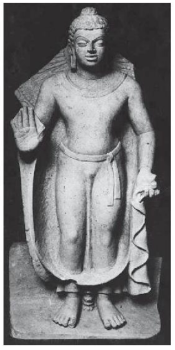
Which of the following is another name for Hinayana Buddhism ?
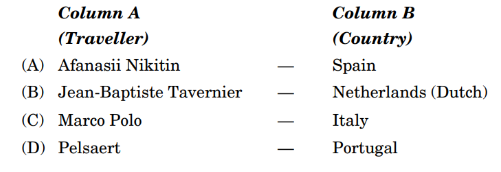
Match Column A with Column B and choose the correct option :
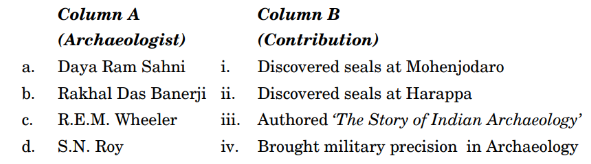
The correct matching is based on the context illustrating a critical edition of a manuscript. The main text is printed in large bold letters, whereas variations in the manuscripts are listed in smaller print. This corresponds to option a-iv (main text in bold), b-iii (variations catalogued), c-ii, and d-i matching the respective descriptions appropriately.
Which of the following statements about Mirabai are correct ?
I. She was married into Sisodia clan of Mewar.
II. She considered Krishna her divine lover.
III. Her spiritual guru was Ramanand.
IV. She founded a sect with a group of followers.
According to the provided context, Mirabai was a Rajput princess from Merta in Marwar who was married against her wishes to a prince of the Sisodia clan of Mewar, Rajasthan, so statement I is correct. She considered Krishna, the avatar of Vishnu, as her divine lover, so statement II is also correct. The context does not mention Ramanand as her spiritual guru, and it clearly states that Mirabai did not attract a sect or group of followers, so statements III and IV are incorrect.
Read the following statements regarding Ibn Battuta’s travel experiences and choose the correct option : I. His travel was unsafe as he was looted many times.
II. He travelled in caravans along with companions.
III. His journey took months due to vast distances.
IV. He has written his travelling experiences in Persian.
Assertion (A) : In the 1850’s Awadh was called the ‘nursery of the Bengal Army’.
Reason (R) : Here a large number of sepoys were recruited from entire India.
Identify the Indian social reformer of the nineteenth century with the help of the following information and choose the correct option :
• He was from Maharashtra
. • He pointed to the suffering of the depressed classes.
• He demanded economic and social justice.
Jyotiba Phule was a social reformer from Maharashtra in the nineteenth century who highlighted the suffering of the depressed classes and demanded economic and social justice for them. The context clearly states that he pointed to the suffering of the depressed castes and advocated for social and economic justice, which matches the given clues.
Section C
1. Tools: Stone blades set in wooden handles and metal tools have been found, indicating the types of tools used for harvesting crops.
2. Irrigation remains: Traces of canals and water management systems found at sites suggest that Harappans practiced irrigation to support agriculture in semi-arid regions.
3. Seeds and pottery: Archaeologists have discovered seeds of wheat and barley as well as pottery used to store grains, showing what crops were grown and stored by Harappan people.
(a) The script consists of symbols and signs found mainly on seals made of steatite. These signs are generally short inscriptions with the longest having about 26 symbols.
(b) The script has not been deciphered yet, so we do not fully understand what the signs mean. It is believed that the inscriptions may include the name and title of the owner of the seal.
(c) The script was probably used for administrative and trade purposes, as it appears on seals and pottery, and it was an important element of the Harappan civilisation's communication system, though not enough is known about it compared to other material remains.
(a) Centralized Bureaucracy: The Mauryan empire had a strong and well-organized centralized government headed by the emperor. Various officials were appointed to manage different departments of the state.
(b) Efficient Revenue System: The office of the Diwan supervised the fiscal system. Revenue officials and record keepers ensured proper collection of taxes from agriculture and other sources, which helped in maintaining the empire's economy.
(c) Administrative Divisions: The empire was divided into provinces and districts, each administered by governors and officials who reported to the central government, ensuring smooth governance throughout the vast empire.
Al-Biruni faced several barriers in understanding Indian society. The first barrier was language. Sanskrit was very different from Arabic and Persian, making it hard to translate ideas and concepts accurately. The second barrier was the difference in religious beliefs and practices, which made it difficult for him to fully grasp the worldview and customs of Indians. The third barrier was the self-absorption and insularity of the local population, meaning that Indians were often inward-looking and not open to outsiders, which restricted his access to information. Despite these difficulties, Al-Biruni spent years learning Sanskrit and studying works such as the Vedas, Puranas, Bhagavad Gita, Patanjali, and Manusmriti. He depended mainly on Brahmana scholars to understand Indian society, which shows his efforts to overcome these barriers but also highlights the challenges he faced in presenting a complete picture.
Guru Gobind Singh was the tenth Guru of the Sikhs who played a crucial role in shaping Sikhism as a distinct religion and community. He laid the foundation of the Khalsa Panth in 1699, which means the 'army of the pure'. This was a collective body of initiated Sikhs who followed strict moral and spiritual discipline. He introduced the five symbols, called the Five Ks, which are uncut hair (kesh), a wooden comb (kangha), a steel bangle (kara), a pair of shorts (kachera), and a small sword or dagger (kirpan). These symbols became a source of identity and unity for Sikhs. Guru Gobind Singh also compiled the final version of the Sikh scripture, the Guru Granth Sahib, declaring it the eternal Guru after him. Under his leadership, the Sikh community became a socio-religious and military force, defending their faith and fighting against oppression. His contributions ensured that Sikhism remained dynamic and united in the face of adversity.
The British exploited the Paharias of Rajmahal hills by trying to control and subdue these hill folk, who were originally skilled shifting cultivators using the hoe. The Paharias lived in the difficult terrain of Rajmahal hills, which was impenetrable and dangerous, making them hostile and apprehensive towards officials. The British wanted to extend their control and extract revenue, but the Paharias resisted this by retreating deeper into the hills. The British also encouraged Santhal settlers to move into the lower slopes of the hills; these settlers used the plough and cleared forests to establish agricultural land. This lead to displacement and weakening of the Paharias, effectively exploiting them by undermining their traditional lifestyle and land. Thus, the British used forest clearing and settlement policies as means to control the Paharias indirectly.
Example: The Santhals, supported or allowed by the British, settled in the lower Rajmahal hills, forcing the Paharias further back and disrupting their shifting cultivation way of life. This was a direct method by which the British undermined the Paharias and exploited the region.
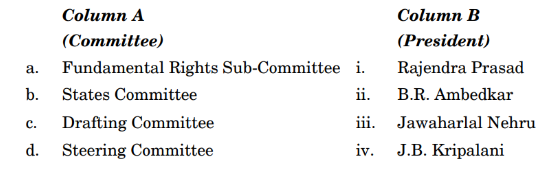
The Constituent Assembly extensively debated the issue of federalism, focusing on the division of powers between the Central Government and the states. There was a strong inclination towards a centralized system mainly due to the need for unity after partition and to prevent chaos. Leaders like Jawaharlal Nehru supported a strong Centre to ensure stability and economic planning. The colonial legacy of a unitary system also influenced this tendency. Although states had some powers, the Union was given greater authority to maintain the nation’s integrity and manage communal diversity. The debates reflected contrasting views but ultimately resulted in a federal structure with a strong central government to safeguard national interests and facilitate smooth governance.
Section D
During the early historical period in India, Brahmanical ideas on kinship, marriage and ruling lineage were not universally accepted or practiced. One clear example is the practice of endogamy prevalent in several South Indian communities, where marriage took place within the kin group, such as cousins, instead of the exogamous system or marriage outside the kin group, which Brahmanical texts recommended. This ensured a close-knit community and shows an alternative social practice.
In North India, during this period, several Rajput states emerged. Though Brahmanas held important ritual and secular roles and claimed to uphold the fourfold varna system, they often formed marriage alliances with groups traditionally considered outside the Brahmanical system. This indicates a flexibility and deviation from strict Brahmanical codes regarding marriage and lineage.
Furthermore, these practices led to challenges to the existing beliefs and practices advocated by Brahmanas, who responded by formulating detailed social behavior codes to be followed by Brahmanas and the society.
Lastly, the classification of people into gotras named after Vedic seers, which became prominent around 1000 BCE, mainly applied to Brahmanas and served to regulate marriage and kinship rules within that group, but was not universally adopted across all communities.
Hence, the examples from South Indian endogamous marriages and Rajput marriage alliances show that Brahmanical ideas on kinship, marriage and lineage were not accepted as universal norms during this period.
‘The temple architecture of the Vijayanagara empire was distinctive and unique.’’ Explain the statement with examples.
One key example is the Virupaksha temple which has towering gopurams or gateways, known as raya gopurams, that mark the entrance to the temple. These gopurams were tall and richly decorated, reflecting the grandeur of the empire. The temple also has pillared corridors and mandapas or pavilions that surround the shrine, allowing devotees to move around easily.
Another famous example is the Vitthala temple known for its unique architectural features such as the stone chariot designed as a shrine, which is a distinctive landmark showing creativity in temple design. The temple also has long pillared halls used for cultural activities and religious gatherings.
The architecture of Vijayanagara temples reflected imperial authority with massive scale and detailed sculptures, combining religious significance with aesthetic beauty. Foreign traveler Abdur Razzaq Samarqandi, who visited the city in the 15th century, described these temples and their grand layout, which impressed visitors because of their distinctive style and scale. Hence, the temples of Vijayanagara empire stand out for their monumental size, artistic carvings, and the blending of architectural features to form an imperial culture.
The rulers of Vijayanagara drew from different architectural traditions to create an imperial culture visible in their constructions. For example, the royal centre included imposing gateways and fortification walls that emphasized security and grandeur. The aqueducts that brought water to the centre highlighted advanced engineering skills.
Temple complexes at the royal centre were beautifully designed with multiple halls and unique shrines. One special example is a temple designed as a chariot, which symbolized strength and religious devotion.
Descriptions from travelers like Abdur Razzaq Samarqandi, a fifteenth-century diplomat from Herat, illustrate the city's splendor and well-planned layout.
Even though many structures were destroyed during the city’s sack, the palatial style was carried on by the Nayakas, whose buildings still stand as testimony to Vijayanagara’s architectural legacy.
Thus, the variety of buildings, including temples, fortifications, gateways, and water structures, together reflect the empire's prestige, power, and artistic achievement.
The Quit India Movement was launched in August 1942 by Mahatma Gandhi after the failure of the Cripps Mission, which was an attempt by the British government to secure Indian support in World War II by promising post-war self-government. The mission’s rejection by Indian leaders created widespread disappointment and anger. Indians demanded complete independence, not just promises for the future. The growing frustration against British colonial rule, the desire for freedom, and the harsh conditions during the war led to the demand for the British to leave India immediately.
Events of the Quit India Movement:
After the call for Quit India was given by Gandhi, he and other leaders were arrested promptly by the British. Despite this, the movement spread rapidly across the country as younger activists organised strikes, protests, and acts of sabotage against government establishments. The movement became a mass agitation involving hundreds of thousands of Indians from different walks of life, especially energising the youth who left their studies to join the struggle. The British responded with severe repression and force, arresting thousands and banning public meetings. However, the movement could not be fully suppressed for more than a year.
The Quit India Movement was one of the most widespread movements against British rule and laid the foundation for India’s eventual independence on 15 August 1947. Though it faced brutal suppression, it demonstrated the firm resolve of Indians to gain freedom. The memory of this movement remains a significant part of India’s national struggle for independence.
1. Rowlatt Act (1919): These laws allowed the government to imprison any political activists without trial, which angered many Indians.
2. Jallianwala Bagh Massacre: In 1919, British troops killed hundreds of unarmed Indians who were peacefully protesting in Amritsar.
3. Khilafat Movement: It was started by Indian Muslims to protect the Ottoman Caliphate, which gained support from Mahatma Gandhi.
4. Desire for Self-Rule: Indians wanted to end British rule and achieve swaraj or self-government.
Events of the Non-Cooperation Movement:
1. Launch in 1920: Mahatma Gandhi called for Indians to refuse cooperation with the British government.
2. Civil Disobedience: People stopped attending government schools and colleges, refused to pay taxes, and boycotted British goods.
3. Boycott of Courts and Elections: Lawyers stopped practicing in British courts, and people refused to vote in government elections.
4. Khadi and Swadeshi Movement: Indians started wearing homespun cloth and boycotted foreign clothes to promote self-reliance.
5. Mass Participation: Students, peasants, workers, and traders actively participated in the movement.
6. Withdrawal in 1922: The movement was called off after the violent incident at Chauri Chaura where protesters clashed with the police, resulting in deaths.
The Non-Cooperation Movement marked a significant phase in India’s freedom struggle as it united people across different communities and regions in a peaceful fight against colonial rule. However, it also taught the leaders the importance of discipline in mass movements.
Other Years — History