QUESTION PAPER

2026 BOARD EXAM

CBSE Class 12 Humanities History Board Paper 2026 — Set 5

2026

History

Class 12 Humanities

CBSE EXAMINATION PAPER-2026

HISTORY

(Solved)

Time allowed : 3 hours

Maximum Marks : 94

General Instructions :

Read the following instructions carefully and follow them :

  1. This question paper contains 41 questions. All questions are compulsory.
  2. This question paper is divided into 4 sections.
  3. Section A – questions number 1 to 5 are case based questions
  4. Section B – questions number 6 to 27 are multiple choice questions
  5. Section C – questions number 28 to 35 are short answer
  6. Section D – questions number 36 to 41 are long answer
  7. There is no overall choice given in the question paper. However, an internal choice has been provided in few questions.
  8. Use of calculator is NOT allowed.

Section A

Question 1.

Read the given source carefully and answer the questions that follow:

Eight forms of marriage.

Here are the first, fourth, fifth and sixth forms of marriage from the Manusmriti:

First: The gift of a daughter, after dressing her in costly clothes and honouring her with presents of jewels, to a man learned in the Veda whom the father himself invites.

Fourth: The gift of a daughter by the father after he has addressed the couple with the text, “May both of you perform your duties together,” and has shown honour to the bridegroom.

Fifth: When the bridegroom receives a maiden, after having given as much wealth as he can afford to the kinsmen and to the bride herself, according to his own will.

Sixth: The voluntary union of a maiden and her lover ... which springs from desire ...

(1) Explain why jewels and costly clothes were given in the first form of marriage.

[1 Mark]

(2) How had these marriages influenced the social practices in the later Indian society?

[2 Marks]

(3) Explain the underlying idea behind the father honouring the bridegroom in the fourth form of marriage.

[1 Mark]
Question 2.

Read the given source carefully and answer the questions that follow:

A demon?

This is an excerpt from a poem by Karaikkal Ammaiyar in which she describes herself:

The female Pey (demoness)

with bulging veins,

protruding eyes, white teeth and shrunken stomach,

red haired and jutting teeth,

lengthy shins extending till the ankles,

shouts and wails

while wandering in the forest.

This is the forest of Alankatu,

which is the home of our father (Shiva)

who dances ... with his matted hair

thrown in all eight directions, and with cool limbs.

(1) Who was Karaikkal Ammaiyar?

[1 Mark]

(2) How is Lord Shiva described in the poem?

[1 Mark]

(3) Analyse the central contrast depicted in the poem.

[2 Marks]
Question 3.

Read the given source carefully and answer the questions that follow:

The Revolt of 1857.

Late in the afternoon of 10 May 1857, the sepoys in the cantonment of Meerut broke out in mutiny. It began in the lines of the native infantry, spread very swiftly to the cavalry and then to the city. The ordinary people of the town and surrounding villages joined the sepoys. The sepoys captured the bell of arms where the arms and ammunition were kept and proceeded to attack white people, and to ransack and burn their bungalows and property. Government buildings — the record office, jail, court, post office, treasury, etc. — were destroyed and plundered. The telegraph line to Delhi was cut. As darkness descended, a group of sepoys rode off towards Delhi.

The sepoys arrived at the gates of the Red Fort early in the morning on 11 May. It was the month of Ramzan, the Muslim holy month of prayer and fasting. The old Mughal emperor, Bahadur Shah, had just finished his prayers and meal before the sun rose and the fast began. He heard the commotion at the gates. The sepoys who had gathered under his window told him: “We have come from Meerut after killing all the Englishmen there, because they asked us to bite bullets that were coated with the fat of cows and pigs with our teeth. This has corrupted the faith of Hindus and Muslims alike.” Another group of sepoys also entered Delhi, and the ordinary people of the city joined them. Europeans were killed in large numbers; the rich of Delhi were attacked and looted. It was clear that Delhi had gone out of British control. Some sepoys rode into the Red Fort, without observing the elaborate court etiquette expected of them. They demanded that the emperor give them his blessings. Surrounded by the sepoys, Bahadur Shah had no other option but to comply. The revolt thus acquired a kind of legitimacy because it could now be carried on in the name of the Mughal emperor.

(1) How did the actions of the rebels in Delhi indicate a breakdown of British control?

[1 Mark]

(2) Why was Bahadur Shah’s involvement important for the rebels?

[1 Mark]

(3) How did the sepoys and religious sentiments play an important role in this uprising? Explain.

[2 Marks]
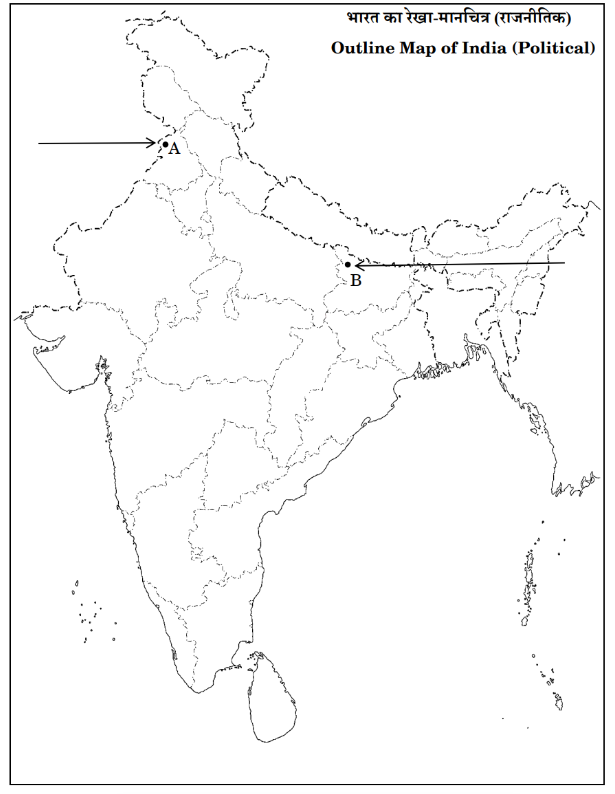
Question 4. On the given political outline map of India, locate and label the following with appropriate symbols :
Diagram 1 – CBSE Class 12 Humanities History 2026 Set 5

(1) Kalibangan – A mature Harappan site

[2 Marks]

(2) Ajanta – An ancient Buddhist site

[1 Mark]

(3) Panipat − A territory under the Mughals

[1 Mark]

(4) Golconda – A medieval period state

[1 Mark]
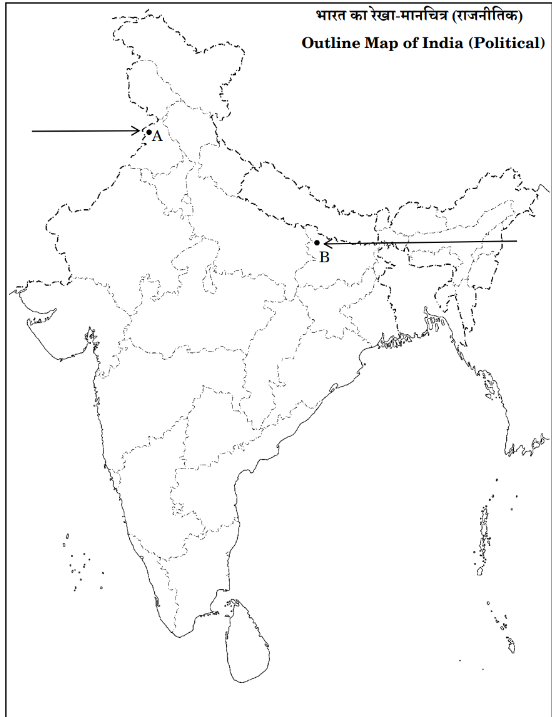
Question 5. On the same political outline map of India, two places have been marked as ‘A’ and ‘B’, as the centres of the Indian National Movement. Identify them and write their correct names on the lines drawn near them.
Diagram 2 – CBSE Class 12 Humanities History 2026 Set 5

(1) Mention any one mature Harappan site in Pakistan

[1 Mark]

(2) Mention one ancient Buddhist site in Bihar.

[1 Mark]

(3) Name any one territory which was under the Mughal empire

[1 Mark]

(4) Name any one neighbouring kingdom of the Vijayanagara Empire.

[1 Mark]

(5) Name any two centres of the Indian National Movement.

[1 Mark]

Section B

Question 6. ‘Traces of canals have been found at the Harappan archaeological site of Shortughai in Afghanistan but not in Punjab or Sindh.’ Identify the explanation provided by archaeologists from the following :
[1 Mark]
  • (A) Agricultural tools in Afghanistan were more advanced than in Punjab.
  • (B) Shortughai had access to the perennial rivers of the Himalayas.
  • (C) Archaeologists have not excavated Punjab and Sindh thoroughly.
  • (D) Punjab and Sindh had higher rainfall than Shortughai.
Question 7.

Assertion (A) : Asoka’s dhamma emphasized generosity, kindness and respect for religious traditions. Reason (R) : Asoka tried to hold his empire together with universally applicable principles.

[1 Mark]
  • (A) Assertion (A) is false, but Reason (R) is true.
  • (B) Both Assertion (A) and Reason (R) are true, but Reason (R) is not the correct explanation of Assertion (A).
  • (C) Assertion (A) is true, but Reason (R) is false.
  • (D) Both Assertion (A) and Reason (R) are true and Reason (R) is the correct explanation of Assertion (A).
Question 8.

Arrange the following ‘political developments’ of the ancient period in chronological order and choose the correct option :

I. Harshavardhana in Kannauj

II. Chandragupta Maurya in Pataliputra

III. Satavahanas in Deccan

IV. Chalukyas in Karnataka

[1 Mark]
  • (A) I, III, II, IV
  • (B) II, III, IV, I
  • (C) III, I, II, IV
  • (D) IV, II, III, I
Question 9.

Identify the characters of the 𝘔𝘢𝘩𝘢𝘣𝘩𝘢𝘳𝘢𝘵𝘢 with the help the following information and choose the correct option :

• He was a son of Hidimba and Bhima.

• He belonged to the Rakshasa clan from maternal side.

• He promised to help the Pandavas in the time of need.

[1 Mark]
  • (A) Ghatotkacha
  • (B) Bakasura
  • (C) Hidimba
  • (D) Jatasura
Question 10.

Look at the image given below and identify the queen who helped in the preservation of Sanchi Stupa :
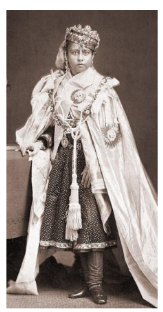
[1 Mark] Diagram 3 – CBSE Class 12 Humanities History 2026 Set 5
  • (A) Sikandar Begum
  • (B) Sultan Jehan Begum
  • (C) Shahjehan Begum
  • (D) Qudsia Begum
Question 11. The famous paintings of Ajanta caves are found in which of the following state of India ?
[1 Mark]
  • (A) Uttar Pradesh
  • (B) Bihar
  • (C) Maharashtra
  • (D) Odisha
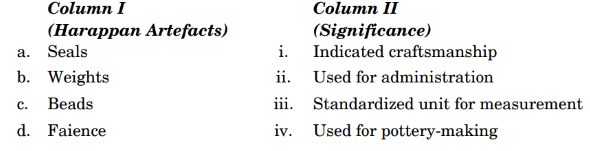
Question 12. Match Column I with Column II and choose the correct option.
[1 Mark] Diagram 4 – CBSE Class 12 Humanities History 2026 Set 5
  • (A) a-ii, b-iii, c-i, d-iv
  • (B) a-iii, b-iv, c-ii, d-i
  • (C) a-iv, b-ii, c-iii, d-i
  • (D) a-i, b-iii, c-iv, d-ii
Question 13. Who amongst the following persuaded the Buddha to admit women in the Sangha ?
[1 Mark]
  • (A) Mahapajapati Gotami
  • (B) Ananda
  • (C) Rahul
  • (D) Punna
Question 14. Which one of the following pairs is correctly matched ?
[1 Mark] Diagram 5 – CBSE Class 12 Humanities History 2026 Set 5
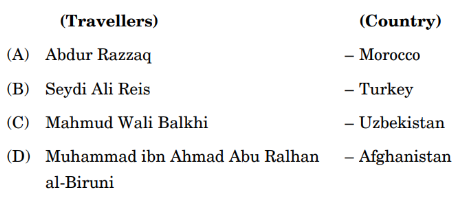
  • (A) Mahmud Wali Balkhi — Uzbekistan
  • (B) Seydi Ali Reis — Turkey
  • (C) Muhammad ibn Ahmad Abu — AfghanistanRalhan al-Biruni
  • (D) Abdur Razzaq — Morocco
Question 15.

Which of the following statements about Basavanna are correct ?

I. He was a Brahmana and devotee of Lord Shiva.

II. He founded the Lingayat tradition.

III. His compositions are preserved in Kannada tradition.

IV. He supported funerary rites like cremation.

[1 Mark]
  • (A) II, III and IV are correct.
  • (B) I, III and IV are correct.
  • (C) I, II and III are correct.
  • (D) I, II and IV are correct.
Question 16. Which of the following dynasties was the first to rule Vijayanagara ?
[1 Mark]
  • (A) Saluva
  • (B) Tuluva
  • (C) Aravidu
  • (D) Sangama
Question 17. Fill in the blank with the appropriate word from the given options. The chronicle Ain-i-Akbari was authored by Akbar’s court historian ___________.
[1 Mark]
  • (A) Inayat Khan
  • (B) Abdul Hamid Lahori
  • (C) Abdul Qadir Badayuni
  • (D) Abu’l Fazl
Question 18. Which of the following lands was kept fallow for three to four years during Akbar’s period ?
[1 Mark]
  • (A) Chachar
  • (B) Polaj
  • (C) Parauti
  • (D) Banjar
Question 19. Find the odd one out regarding the rulers of the Vijayanagara empire.
[1 Mark]
  • (A) Harihara
  • (B) Rama Raya
  • (C) Rudradaman
  • (D) Bukka
Question 20.

Read the following statements regarding Ibn Battuta’s description of Delhi :

I. Delhi was a vast city.

II. Delhi was a populous city.

III. Delhi had colourful markets

IV. Delhi was isolated from Asian trade.

Which of the following options are correct ?

[1 Mark]
  • (A) I, II and IV are correct.
  • (B) II, III and IV are correct.
  • (C) I, III and IV are correct.
  • (D) I, II and III are correct.
Question 21. Who amongst the following had given the ‘average rent’ theory ?
[1 Mark]
  • (A) David Ricardo
  • (B) Karl Marx
  • (C) Adam Smith
  • (D) Francis Buchanan
Question 22.

Which of the following regions was not a major centre of the Revolt of 1857 ?
[1 Mark]
  • (A) Singhbhum
  • (B) Hyderabad
  • (C) Gwalior
  • (D) Arrah
Question 23. Choose the correct option from the following to fill in the blank regarding regions of nationalist leaders of India : Bipin Chandra Pal : Bengal; Bal Gangadhar Tilak : ___________.
[1 Mark]
  • (A) Delhi
  • (B) Gujarat
  • (C) Bihar
  • (D) Maharashtra
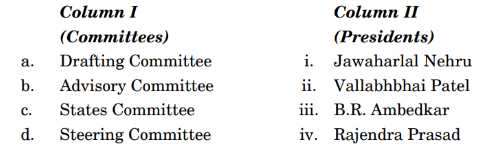
Question 24. Match Column I with Column II regarding important Committees of the Constituent Assembly and their Presidents :
[1 Mark] Diagram 6 – CBSE Class 12 Humanities History 2026 Set 5
  • (A) a-iv, b-i, c-ii, d-iii
  • (B) a-iii, b-ii, c-i, d-iv
  • (C) a-ii, b-iii, c-iv, d-i
  • (D) a-i, b-iv, c-iii, d-ii
Question 25.

Assertion (A) : The British easily put down the Revolt of 1857.

Reason (R) : The British passed a series of laws to quell the insurgency.

[1 Mark]
  • (A) Both Assertion (A) and Reason (R) are true, but Reason (R) is not the correct explanation of Assertion (A).
  • (B) Both Assertion (A) and Reason (R) are true and Reason (R) is the correct explanation of Assertion (A).
  • (C) Assertion (A) is false, but Reason (R) is true.
  • (D) Assertion (A) is true, but Reason (R) is false.
Question 26.

Identify the ‘mission’ of the colonial period with the help of the following information :

• It presented a scheme for the formation of an interim government at the centre for India.

• It announced its Constitutional Scheme in 1946.

[1 Mark]
  • (A) Fraser Mission
  • (B) Simon Commission
  • (C) Cabinet Mission
  • (D) Cripps Mission
Question 27. Fill in the blank with the suitable option given below. In 1859, the British passed the _________ that stated that the loan bonds signed between moneylenders and ryots would have a validity period of three years.
[1 Mark]
  • (A) Ilbert Bill
  • (B) Rowlatt Act
  • (C) Arms Act
  • (D) Limitation Law

Section C

Question 28. Imagine you are doing research on Harappan beads and jewellery. Which three aspects would you understand about Harappan craft production and trade from it? Explain.
[3 Marks]
Question 29. Imagine you are a part of a student archaeology workshop where you have to explain about Harappan burial sites and jewellery. Which three aspects would you present to your classmates about it? Explain.
[3 Marks]
Question 30. Describe the role of Prabhavati Gupta in administering land grants recorded in the ancient inscriptions.
[3 Marks]
Question 31. Explain the ways in which European thinkers like Montesquieu and Karl Marx used Bernier’s description of India.
[3 Marks]
Question 32. How did the Vijayanagara Empire expand the Virupaksha Temple? Explain.
[3 Marks]
Question 33. Why was the Amara-Nayaka system considered a major political innovation of the Vijayanagara Empire? Explain.
[3 Marks]
Question 34. How did the British exploit the Ryots in the Ryotwari system? Explain with examples.
[3 Marks]
Question 35. Explain how the ‘Objectives Resolution’ became the basis of the Preamble of the Indian Constitution.
[3 Marks]

Section D

Question 36. Describe the teachings and principles of Buddhism.
[8 Marks]
Question 37. Describe the main ideas of Jainism along with its spread across India in the ancient period.
[8 Marks]
Question 38. Examine the economic and social position of Zamindars in the rural society during the Mughal rule.
[8 Marks]
Question 39. Examine the role and responsibilities of the Panchayats in village administration during the Mughal period.
[8 Marks]
Question 40. To what extent was the Non-Cooperation Movement successful in mobilizing the masses against the British rule? Explain with suitable examples.
[8 Marks]
Question 41. How are different sources to know about Gandhiji’s political career helpful in understanding his contribution towards India? Explain with examples.
[8 Marks]

Paper Details

CBSE Board Exam 2026

Class

Class 12 Humanities

Subject

History

Year

2026

Set

Set 5

Other Years — History

2022 Set-1

2022 Set-2

2022 Set-3

2022 Set-4

2022 Set-5

2023 Set-1

2023 Set-3

2023 Set-4

2023 Set-5

2024 Set-1

2024 Set-2

2024 Set-3

2024 Set-4

2024 Set-5

2025 Set-1

2025 Set-2

2025 Set-3

2025 Set-4

2025 Set-5

2025 Set-6

2026 Set-1

2026 Set-2

2026 Set-3

2026 Set-4

2026 Set-5