SOLUTIONS

2026 BOARD EXAM

CBSE Class 12 Humanities History Board Paper 2026 — Set 2 Solutions

2026

History

Class 12 Humanities

CBSE EXAMINATION PAPER-2026

HISTORY

(Solved)

Time allowed : 3 hours

Maximum Marks : 95

General Instructions :

Read the following instructions carefully and follow them :

  1. This question paper contains 42 questions. All questions are compulsory.
  2. This question paper is divided into 4 sections.
  3. Section A – questions number 1 to 5 are case based questions
  4. Section B – questions number 6 to 28 are multiple choice questions
  5. Section C – questions number 29 to 36 are short answer
  6. Section D – questions number 37 to 42 are long answer
  7. There is no overall choice given in the question paper. However, an internal choice has been provided in few questions.
  8. Use of calculator is NOT allowed.

Section A

Question 1.

Read the source given below carefully and answer the questions that follow:

The Malabar Coast (Present-day Kerala)

Here is an excerpt from Periplus of the Erythraean Sea, composed by an anonymous Greek sailor (First century CE): They (i.e. traders from abroad) send large ships to these market-towns on account of the great quantity and bulk of pepper and malabathrum (possibly cinnamon, produced in these regions). There are imported here, in the first place, a great quantity of coin; topaz... antimony (a mineral used as a colouring substance), coral, crude glass, copper, tin, lead ... There is exported pepper, which is produced in quantity in only one region near these markets.... Besides this there are exported great quantities of fine pearls, ivory, silk cloth, .... transparent stones of all kinds, diamonds and sapphires, and tortoise shell.

Archaeological evidence of a bead-making industry, using precious and semi-precious stones, has been found in Kodumanal (Tamil Nadu). It is likely that local traders brought the stones mentioned in the Periplus from sites such as these to the coastal ports.

(1) Mention the role of rivers in the promotion of trade.

[1 Mark]
Answer: Rivers played a key role in promoting trade by serving as natural transport routes that facilitated the movement of goods from inland areas to coastal ports, thus enabling increased commerce.
Key Points: "Rivers provided transport routes, Facilitated movement of goods, Connected inland areas to ports"

(2) Why were large number of goods traded between India and other countries?

[1 Mark]
Answer: India traded large quantities of goods because it produced valuable spices like pepper and malabathrum and other commodities that had high demand abroad, with strategic market towns facilitating this trade.
Key Points: "India produced valuable spices and materials, Demand for exotic goods abroad, Strategic coastal market towns"

(3) Give reasons for the development of bead-making industry at Kodumanal.

[2 Marks]
Answer: The bead-making industry at Kodumanal developed due to the availability of precious and semi-precious stones in the region, the presence of skilled local artisans, and the demand for such beads in trade markets.
Key Points: "Availability of precious and semi-precious stones, Skilled local artisans, Demand for beads in trade"
Question 2.

Read the given source carefully and answer the questions that follow:

A warning for Europe

Bernier warned that if European kings followed the Mughal model:

Their kingdoms would be very far from being well cultivated and peopled, so well built, so rich, so polite and flourishing as we see them. Our kings are otherwise rich and powerful; and we must avow that they are much better and more royally served. They would soon be kings of deserts and solitudes, of beggars and barbarians [...] We should find the great Cities and the great Burroughs rendered uninhabitable because of ill air, and to fall to ruin without anybody taking care of repairing them; the hillocks abandoned, and the fields overspread with bushes, or filled with pestilential marshes, as hath been already intimated.

(1) Why did Bernier warn the European kings against following the Mughal model of kingship?

[1 Mark]
Answer: Bernier warned European kings against following the Mughal model because the Mughals neglected agriculture, urban maintenance, and governance which led to decline in prosperity, empty cities, and poor management.
Key Points: "Mughal kingdoms were poorly managed, Neglect of agriculture and urban upkeep, Decline in prosperity and population"

(2) Mention any one difference between Mughal and European land-ownership.

[1 Mark]
Answer: One difference is that the Mughal system was based on centralized land revenue collection by the state, whereas European land ownership was more private and decentralized.
Key Points: "Mughals had centralized land revenue system, Europeans preferred private land ownership, Land management practices differed"

(3)

How did Bernier’s description influence western theorists from the 18th century onwards? Explain.

[2 Marks]
Answer: Bernier’s description highlighted the negative effects of despotic rule and neglect on prosperity and governance, influencing western theorists to advocate for better governance principles and policies, impacting colonial reforms.
Key Points: "Highlighted problems of despotic rule, Encouraged ideas of good governance, Influenced colonial policies and reforms"
Question 3.

Read the given source carefully and answer the questions that follow:

On clearance and settled cultivation

Passing through one village in the lower Rajmahal hills, Buchanan wrote: The view of the country is exceedingly fine, the cultivation especially in the narrow valleys of rice winding in all directions, the cleared lands with scattered trees, and the rocky hills are in perfection; all that is wanted is some appearance of progress and a vastly extended and improved cultivation. Plantations of Asan and Palas, for Tessar (Tassar silk worms) and Lac, should occupy the place of woods to as great an extent as demand will admit; the remainder might be all cleared, and the greater part cultivated, while what is not fit for the purpose, might rear Palmyra and Mahua.

(1) How was the landscape described regarding cultivation?

[1 Mark]
Answer: The landscape was described as having fine scenery with rice cultivation in narrow valleys, cleared lands with scattered trees, and rocky hills, showing a good but improvable agricultural set-up.
Key Points: "Fine scenery with well-cultivated rice valleys, Cleared lands with scattered trees, Rocky hills present"

(2) Which crops were recommended for expanding agriculture?

[1 Mark]
Answer: Asan and Palas were recommended for plantations to support Tassar silk worms and Lac production, while Palmyra and Mahua trees were suggested for less arable lands.
Key Points: "Asan and Palas for Tassar silk worms, Lac plantations, Palmyra and Mahua in less fertile areas"

(3) Explain the proposal given by Buchanan for utilizing the land for economic development.

[2 Marks]
Answer: Buchanan proposed that the cleared lands be used extensively for cultivation, woods be replaced by plantations of Asan and Palas for silk and Lac production to meet demand, and lands unsuitable for farming be used to grow Palmyra and Mahua, thereby boosting the local economy.
Key Points: "Expand cultivation in cleared lands, Replace woods with plantations for silk and Lac, Use unsuitable lands for Palmyra and Mahua trees"
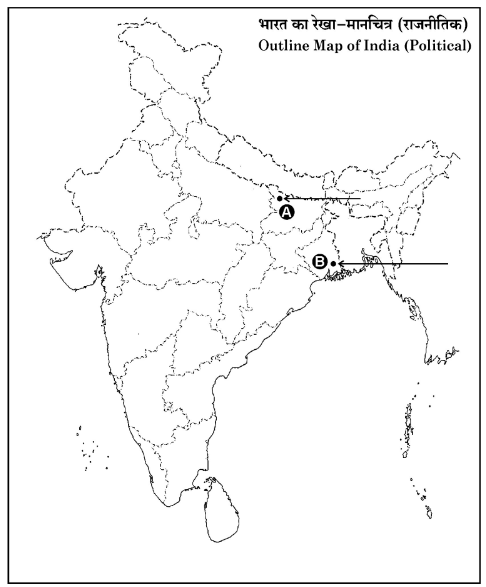
Question 4. On the given political outline map of India, locate and label the following places with appropriate signs or symbols :
Diagram 1 – CBSE Class 12 Humanities History 2026 Set 2 Solutions

(1) Banawali – a mature Harappan site

[2 Marks]
Answer: Banawali is a mature Harappan site located in Haryana which can be marked on the map as per Map 1. It is one of the important Harappan settlements discovered within India after partition, showing the spread of Harappan culture beyond Pakistan. This site helps understand the mature Harappan phase and its subsistence strategies as mentioned in the passage.
Key Points: Banawali located in Haryana - Mature Harappan site - Discovered in India post-partition

(2) Kannauj – An important town from early states

[1 Mark]
Answer: Kannauj was an important town in early Indian states known for its political and cultural significance. According to the context, many major towns like Pataliputra were located along routes of communication, so Kannauj was likely situated similarly as a key urban centre. Mark Kannauj correctly on the map with a suitable symbol to show its importance as a political centre.
Key Points: Kannauj was an important early town - located along communication routes - mark appropriately on the map

(3) Ajmer – A city under Mughals

[1 Mark]
Answer: Ajmer was an important city under the Mughals as mentioned in the case passage. It was a popular pilgrimage site attracting many travellers due to its location on the route linking Delhi and Gujarat. Emperor Akbar visited Ajmer fourteen times, showing its significance in the Mughal period. On the political outline map of India, Ajmer should be located in Rajasthan and labeled as a Mughal city.
Key Points: Ajmer was under the Mughal Empire - It was a popular pilgrimage site - Akbar visited Ajmer fourteen times - Located on the Delhi-Gujarat route

(4) Bidar – A medieval town

[1 Mark]
Answer: Bidar is a medieval town located in Karnataka on the map. It can be marked with an appropriate symbol as a historic place. The town is part of the Deccan Plateau mentioned in the passage, known for its architectural monuments from medieval times. Locating Bidar helps in understanding the cultural and political geography of South India between the fourteenth and eighteenth centuries as described.
Key Points: Locate Bidar in Karnataka - Mark as medieval town - Reference to Deccan Plateau and architectural importance
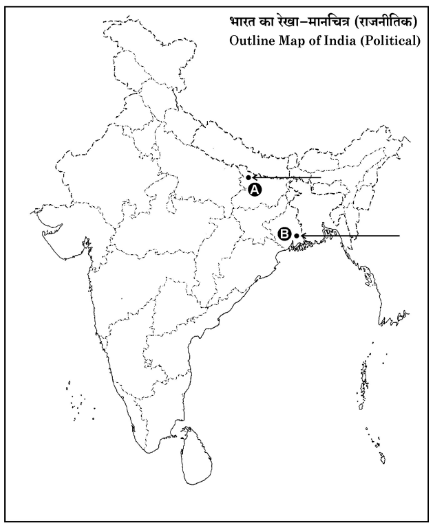
Question 5. On the same political map of India, two places have been marked as A and B as the centres of Indian National Movement. Identify them and write their correct names on the lines drawn near them.
Diagram 2 – CBSE Class 12 Humanities History 2026 Set 2 Solutions

(1) Name any one town which was under the rule of Babur

[1 Mark]
Answer: The two places marked as A and B on the political map as centres of the Indian National Movement are Bombay and Calcutta. These cities were important political centres during the freedom struggle, as mentioned in the passage where it says the Indian National Congress had branches in most major cities and towns. Babur ruled over Agra, so Agra is one town which was under the rule of Babur.
Key Points: A and B are centres of Indian National Movement - Bombay and Calcutta were major political centres - Agra was ruled by Babur

(2) Mention any one Harappan site from the present state of Haryana.

[1 Mark]
Answer: The two centres of the Indian National Movement marked as A and B are likely important places like Lahore and Amritsar. One Harappan site in Haryana is Rakhigarhi, which is a well-known Harappan settlement mentioned in the context. This site is important as many Harappan sites are found in Haryana as per the passage.
Key Points: Indian National Movement centres on map - Harappan site in Haryana - Rakhigarhi is a major Harappan site

(3) Mention any one medieval town.

[1 Mark]
Answer: The two places marked as A and B on the map represent important centres of the Indian National Movement. Place A is Bombay and Place B is Calcutta, which were significant cities during the movement. One medieval town mentioned in the case is Ujjayini, known as a major provincial centre in ancient India, as per Asokan inscriptions (case passage).
Key Points: Place A is Bombay - Place B is Calcutta - Medieval town mentioned is Ujjayini

(4) Name any two centres of Indian National Movement.

[2 Marks]
Answer: Two important centres of the Indian National Movement were Mumbai and Kolkata.
Mumbai was a major centre because leaders like Bal Gangadhar Tilak were active there, inspiring many with their radical ideas.
Kolkata was also a key centre where Bipin Chandra Pal and other leaders worked to spread the Swadeshi movement of 1905-07, broadening the appeal of the movement among the middle classes.
These centres played a crucial role in uniting people and promoting nationalist ideas during the struggle against British rule, as mentioned in the case passage.
Key Points: Mumbai and Kolkata were centres of Indian National Movement - Leaders like Bal Gangadhar Tilak and Bipin Chandra Pal were active there - Swadeshi movement helped spread nationalism

Section B

Question 6. Who among the following rulers issued the first gold coins?
[1 Mark]
  • (A) Kushana rulers
  • (B) Mauryan rulers
  • (C) Gupta rulers
  • (D) Vakataka rulers
Explanation: The Kushana rulers issued the first gold coins around the first century CE. Although coinage existed before them, the Kushanas were notable for issuing large hoards of gold coins. The Gupta rulers later issued some of the most spectacular gold coins, but they came after the Kushanas. Mauryan and Vakataka rulers did not issue gold coins before the Kushanas.
Question 7. Which one of the following statements is correct regarding Raja Gotmi Puta Siri Satakani?
[1 Mark]
  • (A) He was the best known Raja of Shaka dynasty.
  • (B) He ensured no intermarriage amongst members of the four varnas.
  • (C) He himself entered into marriage alliance with the king of Gupta rulers.
  • (D) He rebuilt Sudarshan and Sambhar lakes.
Explanation: The context states that Gotami-puta Siri-Satakani claimed to have ensured that there was no intermarriage amongst members of the four varnas. This highlights his role in maintaining the social order based on varna distinctions. The other options either refer to different rulers or achievements not attributed to him in the given context.
Question 8.

Assertion (A): Like Buddhism, Jainism also spread to many parts of India.

Reason (R): Jaina scholars produced literature in various languages like Tamil, Prakrit and Sanskrit etc.

[1 Mark]
  • (A) Both (A) and (R) are correct and (R) is the correct explanation of (A).
  • (B) Both (A) and (R) are correct, but (R) is not the correct explanation of (A).
  • (C) (A) is not correct but (R) is correct.
  • (D) (A) is correct but (R) is not correct.
Explanation:

Both (A) and (R) are correct and (R) is the correct explanation of (A).

Question 9.

Read the following statements regarding Buddhism teaching and choose the correct option:

I. The world is transient and constantly changing.

II. It is soulless and there is nothing eternal in it.

III. Sorrows and sufferings are intrinsic to human existence.

IV. Renouncing the world is essential for living. Codes:

[1 Mark]
  • (A) I, II, III are correct.
  • (B) II, III, IV are correct.
  • (C) I, III, IV are correct.
  • (D) I, II, IV are correct.
Explanation: According to the Buddhist teachings, the world is transient and constantly changing (anicca), and it is soulless (anatta) with nothing permanent or eternal in it. Additionally, sorrows and sufferings (dukkha) are intrinsic to human existence. However, renouncing the world is not necessarily essential for living. Buddhism teaches following the middle path between severe penance and self-indulgence rather than strict renunciation. Therefore, statements I, II, and III are correct, but IV is not entirely accurate.
Question 10. Which of the following is a correct statement regarding Eklavya?
[1 Mark]
  • (A) Eklavya was the favourite student of Drona.
  • (B) Eklavya was a co-student and friend of Arjuna.
  • (C) Eklavya offered his right thumb to Drona as Guru Dakshina.
  • (D) Eklavya belonged to Kuru lineage.
Explanation: According to the provided context, Eklavya treated a clay image of Drona as his teacher and learned archery on his own. When Drona demanded Eklavya's right thumb as Guru Dakshina (teacher's fee), Eklavya unhesitatingly cut it off and offered it. This act is well-known and shows Eklavya's dedication and respect for Drona. The other options are incorrect because Eklavya was not Drona's favourite student, was not a co-student or friend of Arjuna, and did not belong to the Kuru lineage. He belonged to the nishada community, which was different from the Kuru princes.
Question 11.

Look at the given image and identify the ancient sculptural panel from the options:
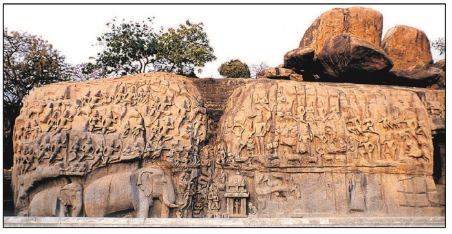
[1 Mark] Diagram 3 – CBSE Class 12 Humanities History 2026 Set 2 Solutions
  • (A) A sculpture in Brihideshwa
  • (B) A sculpture in Sanchi
  • (C) A sculpture in Amravati
  • (D) A sculpture from Mahabalipuram
Explanation:

The context mentions a rock-cut sculptural panel at Mahabalipuram , distinguishing it from sculptures at Brihadeshwa, Sanchi, or Amravati. Mahabalipuram is famous for its distinct rock-cut sculptures dating back to ancient times, which is why this option correctly identifies the ancient sculptural panel.

Question 12.

In which of the following states Mahabalipuram temple is located ?

[1 Mark]
  • (A) Kerala
  • (B) Maharashtra
  • (C) Tamil Nadu
  • (D) Madhya Pradesh
Explanation:

Mahabalipuram temple is located in Tamil Nadu. The context mentions the Cholas in Tamil Nadu who extended patronage to elaborate temples, indicating the association of such magnificent temple architecture with Tamil Nadu. Mahabalipuram is famous for its rock-cut temples and sculptures in Tamil Nadu.

Question 13.

Who among the following was appointed Qazi or Judge of Delhi by Sultan Mohd. Bin Tughlaq ?

[1 Mark]
  • (A) Seydi Ali Reis
  • (B) Al-Biruni
  • (C) Mahmud Ali Balkhi
  • (D) Ibn Batuta
Explanation:

Ibn Battuta traveled to Delhi in 1333 and was appointed as the qazi or judge of Delhi by Sultan Muhammad bin Tughlaq. The Sultan was impressed by Ibn Battuta's scholarship, which led to his appointment. None of the other options were mentioned as being appointed to this position by Muhammad bin Tughlaq in the provided context.

Question 14.

Identify the correct statements regarding the early Bhakti movement in South India:

I. Alvars and Nayanars travelled from place to place singing hymns in Tamil.

II. One of the major anthologies of compositions by the Alvars, "Amuktamalyada", is described as Tamil Veda

III. Karaikkal Ammaiyar and Andal were the women devotees of Nayanara and Alvar Tradition.

IV. Both Nayanars and Alvar saints were revered by the Vellala peasants.

[1 Mark]
  • (A) II, III and IV are correct.
  • (B) I, II and III are correct.
  • (C) I, III and IV are correct.
  • (D) I, II and IV are correct.
Explanation: Statements I, III, and IV are correct based on the context provided. The Alvars and Nayanars indeed travelled singing hymns in Tamil (I). Karaikkal Ammaiyar and Andal were prominent women devotees from the Nayanar and Alvar traditions respectively (III). Also, both the Nayanars and Alvar saints were revered by the common people including Vellala peasants (IV). Statement II is incorrect because the major anthology of the Alvars is called the Nalayira Divyaprabandham, not 'Amuktamalyada'. 'Amuktamalyada' is a separate work, hence II is false.
Question 15.

Arrange the following dynasties in chronological order:

I. Saluva dynasty

II. Sangama dynasty

III. Aravidu dynasty

IV. Tuluva dynasty

[1 Mark]
  • (A) II, I, IV, III
  • (B) II, I, III, IV
  • (C) IV, III, I, II
  • (D) I, II, IV, III
Explanation:

The Sangama dynasty was the earliest and ruled until 1485. They were supplanted by the Saluva dynasty, which remained in power until 1503. Then the Tuluva dynasty took over, under whom Krishnadeva Raya ruled. Finally, the Aravidu dynasty came last. Therefore, the correct chronological order is Sangama (II), Saluva (I), Tuluva (IV), Aravidu (III).

Question 16.

Identify the Sufi Saint with the help of the following information:

• His Hospice was on the bank of river Yamuna in Delhi.

• His disciple was Amir Khusro.

• His disciples addressed him as Sultan-ul-Mashaikh.
[1 Mark]
  • (A) Shaikh Nizamuddin Auliya
  • (B) Shaikh Nasiruddin Chirag-i-Delhi
  • (C) Shaikh Muinuddin Chishti
  • (D) Shaikh Qutubuddin Bakhtiyar Kaki
Explanation: The correct answer is Shaikh Nizamuddin Auliya because his hospice was located on the bank of the river Yamuna in Delhi. Additionally, Amir Khusro was his famous disciple, and his disciples referred to him with the high-sounding title Sultan-ul-Mashaikh, which means 'Sultan among Shaikhs'. This matches the given clues perfectly, as noted in the context.
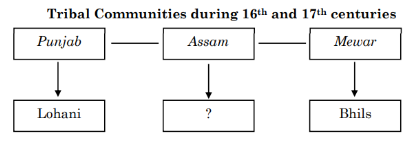
Question 17. Choose the correct option to fill the blank :
[1 Mark] Diagram 4 – CBSE Class 12 Humanities History 2026 Set 2 Solutions
  • (A) Ahoms
  • (B) Gonds
  • (C) Meenas
  • (D) Khasis
Explanation: The context refers to the Ahom kings in Assam who had their paiks, people obliged to render military service in exchange for land. This indicates that the Ahoms had a system involving military service and land, making 'Ahoms' the correct option to fill the blank.
Question 18.

Which one of the following pairs is correctly matched? Travellers of Medieval Period — Native Region

(A) Peter Mundi — Spain

(B) Antonio Monserrate — Portugal

(C) Abdal-Razzaq — Morocco

(D) Marco Polo — Italy

[1 Mark]
  • (A) Antonio Monserrate — Portugal
  • (B) Abdal-Razzaq — Morocco
  • (C) Marco Polo — Italy
  • (D) Peter Mundi — Spain
Explanation:

Marco Polo was a famous medieval traveller from Venice, Italy, who is known for his travels to Asia including China and India. The context mentions Marco Polo visiting from his home base in Venice in the late thirteenth century. Other options are not correct as per historical records: Antonio Monserrate was Spanish, not Portuguese; Ibn Battuta was from Morocco but Abdal-Razzaq is not mentioned as being Moroccan; Peter Mundi is not a well-known traveller associated with Spain.

Question 19. Which among the following was not the major factor for the development of agriculture during Mughal India?
[1 Mark]
  • (A) Availability of land in abundance
  • (B) Availability of cheap labour
  • (C) Mobility among the peasants
  • (D) Availability of tube-wells for irrigation
Explanation: The context explains that the major factors for the development of agriculture during Mughal India were the abundance of land, availability of cheap labour, and mobility among the peasants. Availability of tube-wells for irrigation was not mentioned as a factor, and in fact, tube-wells were not used during the Mughal period as the technology was introduced much later.
Question 20.

How did the arrival of Santhals in the Raj Mahal hills affect the Paharias ?

[1 Mark]
  • (A) The Santhals and Paharias collaborated against the British.
  • (B) The Paharias were displaced and moved to the upper hills.
  • (C) The Paharias spread into the Damin-i-Koh to avoid conflict with the Santhals.
  • (D) The Santhals helped the Paharias in expanding agriculture.
Explanation: The arrival of the Santhals, who were settled agriculturists using the plough, led them to take over the lower hills of the Rajmahal region. The Paharias, who practiced shifting cultivation with the hoe and resisted plough agriculture, were displaced by the Santhals and receded deeper into the Rajmahal hills. This shows that the Paharias moved to the upper hills to avoid conflict and displacement caused by the Santhal settlements.
Question 21.

Arrange the following historical events in chronological order:

I. Champaran Satyagraha

II. Kheda Satyagraha

III. Jallianwala Bagh Incident

IV. Rowlatt Act

[1 Mark]
  • (A) I, II, IV, III
  • (B) II, III, I, I
  • (C) II, IV, III, I
  • (D) I, II, IV, II
Explanation: The Champaran Satyagraha was Gandhi's first satyagraha in 1917, followed by the Kheda Satyagraha in 1918. The Rowlatt Act was passed in 1919, and the Jallianwala Bagh Incident occurred later the same year in 1919. Thus, the correct chronological order is Champaran Satyagraha, Kheda Satyagraha, Rowlatt Act, and then Jallianwala Bagh Incident.
Question 22.

Find the odd one out from the following:

(British Officers) — (Policy)

(A) Dalhousie — Doctrine of Lapse

(B) Cornwallis — Permanent Settlement

(C) Wellesley — Western Education

(D) Hardinge — Enfield rifles for soldiers

[1 Mark]
  • (A) Dalhousie — Doctrine of Lapse
  • (B) Cornwallis — Permanent Settlement
  • (C) Hardinge — Enfield rifles for soldiers
  • (D) Wellesley — Western Education
Explanation: Wellesley was a British officer but is not associated with the policy of Western Education. Western Education policies were introduced under Lord William Bentinck, not Wellesley. The other options correctly pair British Officers with the policies they implemented: Dalhousie with the Doctrine of Lapse, Cornwallis with Permanent Settlement, and Hardinge with the introduction of Enfield rifles to the army.
Question 23. Who amongst the following leaders struggled to free Vietnam from the imperialist control?
[1 Mark]
  • (A) Nguyen Hue
  • (B) Qin Shi Huang
  • (C) Ho-Chi-Minh
  • (D) Mao-Ze-Dang
Explanation: Ho-Chi-Minh was the leader who struggled to free Vietnam from imperialist control. The other leaders mentioned belong to different historical contexts and countries: Qin Shi Huang was a Chinese emperor, Nguyen Hue was a Vietnamese emperor but not primarily known for anti-imperialist struggle against colonialism as Ho-Chi-Minh was, and Mao Zedong was a Chinese communist leader. Ho-Chi-Minh led the Vietnamese independence movement against French colonial rule and later against American intervention.
Question 24.

Which of the following statements regarding Nana Saheb are correct ?

I. Nana Saheb was the successor of Peshwa Baji Rao-II.

II. Nana Saheb joined the revolt of 1857 from Kanpur.

III. His rebellion collapsed in the beginning of 1857.

IV. Nana Saheb went to Nepal in 1857.

[1 Mark]
  • (A) Only II and IV are correct.
  • (B) Only I and III are correct.
  • (C) Only I and II are correct.
  • (D) Only III and IV are correct.
Explanation: Nana Saheb was indeed the successor of Peshwa Baji Rao-II, and he joined the revolt of 1857 from Kanpur as their leader. The rebellion led by him did not collapse at the beginning of 1857; rather, it collapsed at the end of 1858. Also, Nana Saheb escaped to Nepal after the rebellion, but this happened at the end of 1858, not in 1857. Therefore, statements I and II are correct, while III and IV are incorrect.
Question 25.

Who amongst the following was the head of the ‘Advisory Committee’ of the Constituent Assembly ?

[1 Mark]
  • (A) Jawaharlal Nehru
  • (B) Rajendra Prasad
  • (C) B.R. Ambedkar
  • (D) Sardar Patel
Explanation:

B.R. Ambedkar was a very important member of the Constituent Assembly and served as the head of the Advisory Committee. He played a key role in drafting the Constitution of India, whereas the other options such as Jawaharlal Nehru, Rajendra Prasad, and Sardar Patel held other significant roles but not as the head of the Advisory Committee.

Question 26.

Identify the British Officer with the help of the following information:

• Was a Physician.

• Organised Zoo in Calcutta.

• Did survey of Bengal.

• He assumed family name as Hamilton.

[1 Mark]
  • (A) Charles Mountbatten
  • (B) Thomas Munroe
  • (C) Col. Mackenzie
  • (D) Francis Buchanan
Explanation:

Francis Buchanan was a British physician who is known for conducting surveys of Bengal and for organising the Zoo in Calcutta. Additionally, he assumed the family name Hamilton, which matches the clues provided in the question. The other options do not fit all the given criteria.

Question 27.

Read the following statements regarding Buddhism teaching and choose the correct option:

I. The world is transient and constantly changing.

II. It is soulless and there is nothing eternal in it

III. Sorrows and sufferings are intrinsic to human existence.

IV. Renouncing the world is essential for living. Codes:

[1 Mark]
  • (A) I, II, III are correct.
  • (B) I, II, IV are correct.
  • (C) II, III, IV are correct.
  • (D) I, III, IV are correct.
Explanation:

According to Buddhist teachings, the world is transient and constantly changing (anicca), and it is soulless with nothing eternal in it (anatta). Sorrows and sufferings (dukkha) are intrinsic to human existence. However, Buddhism emphasizes following a middle path rather than outright renouncing the world, so statement IV is not entirely accurate as renouncing the world is not considered essential for living according to Buddhism.

Question 28.

Match Column-I with Column-II and choose the correct option :
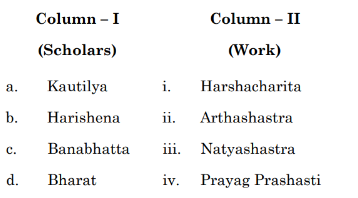
[1 Mark] Diagram 5 – CBSE Class 12 Humanities History 2026 Set 2 Solutions
  • (A) a(iii) , b(ii) ,c(iv) d(i)
  • (B) a(iii) ,b( ii) , c(i ), d(iv)
  • (C) a(ii) , b( iii) ,c( iv ) , d(i)
  • (D) a(ii) , b(iv) c(i) , d(ii)
Explanation:

The correct matching is a with iii, b with ii, c with iv, and d with i because according to the given context and the typical structured format of matching questions, this option aligns the terms correctly. The other options either mismatch the pairs or assign incorrect numbers to the corresponding letters.

Section C

Question 29. How did Buddha attain enlightenment? Explain.
[3 Marks]
Answer: Answer:
Buddha, originally known as Siddhartha, tried different ways to find the truth and end suffering. At first, he practiced extreme bodily mortification which almost led to his death. Realizing these methods were not effective, he abandoned them. Then, he chose to meditate deeply under a Bodhi tree for several days with great focus and determination. Finally, through this meditation, he attained enlightenment, gaining profound knowledge and understanding about life and suffering. After this, he became known as the Buddha or the "Enlightened One". He then spent the rest of his life teaching the Dhamma, the path to righteous living and salvation. His teachings spread widely and inspired many to follow the path of peace and wisdom.
Key Points: Siddhartha practiced bodily mortification - Abandoned extreme methods - Meditated deeply under Bodhi tree - Attained enlightenment - Taught Dhamma or righteous living
Question 30. How has Buddhist literature helped in understanding the sculpture of Sanchi? Explain.
[3 Marks]
Answer: Buddhist literature has been crucial in understanding the sculptures of Sanchi. The sculptures depict scenes from Buddhist stories, such as the Vessantara Jataka, which tells the tale of a generous prince who gave away everything to a Brahmana and lived a simple life in the forest with his family. By comparing these sculptures with the stories found in Buddhist texts, historians can interpret the meaning behind the images. For example, recurrent motifs in the sculptures are directly inspired by popular Buddhist traditions and Jataka tales. Additionally, Buddhist literature helps explain why the mound at Sanchi was built, its significance, and the symbolism of the stone railing around it. Thus, the combination of textual evidence from Buddhist literature with the sculptures allows us to better understand early Buddhist art and religious practices at Sanchi.
Key Points: Sculptures depict Buddhist stories - Comparison with Vessantara Jataka story - Buddhist literature explains meaning and symbolism of sculptures and monument
Question 31. Analyse the causes of conflict between Kauravas and Pandavas that resulted in the battle of Mahabharat.
[3 Marks]
Answer: Causes of conflict between Kauravas and Pandavas:
The Kauravas and Pandavas were cousins belonging to the Kuru family. The main cause of their conflict was a dispute over the throne and kingdom after the death of their grandfather. Dhritarashtra, the father of the Kauravas, was blind, which led to questions about his ability to rule. The Pandavas, being the sons of Pandu, were rightful heirs but the Kauravas, especially Duryodhana, did not accept this.
Other causes include jealousy and rivalry, as the Pandavas were praised for their qualities and virtues, making the Kauravas envious. The game of dice played by the Kauravas against the Pandavas, where the Pandavas lost their kingdom and were sent to exile, further intensified the conflict.
Thus, greed for power, issues of succession, jealousy, and betrayal were key reasons that led to the battle of Mahabharat, in which the Pandavas ultimately emerged victorious and established patrilineal succession.
Historical sources like the Mahabharata epic and archaeological findings in Hastinapura support these events.
Key Points: Conflict over throne and kingdom - Rivalry and jealousy between cousins - Game of dice and exile of Pandavas
Question 32. Why were regular hunting expeditions undertaken by the Mughal Emperors? Explain.
[3 Marks]
Answer: Regular hunting expeditions were undertaken by the Mughal Emperors for several important reasons. Firstly, these hunts allowed the emperor to travel throughout his vast empire and personally hear the grievances of his subjects, thereby strengthening his control and administration. Secondly, hunting symbolised the emperor's role as a protector and ruler concerned for all his people, rich and poor, which was an important part of Mughal political ideology. Thirdly, the hunts ensured the state maintained access to valuable forest resources, such as elephants, which were needed for the army. Additionally, hunting scenes were often depicted by court artists as symbols of a peaceful and harmonious reign. Thus, hunting expeditions were both practical and symbolic acts that helped the emperor govern effectively and display his power and responsibility.
Key Points: To travel across empire and attend to subjects grievances - To symbolise state concern for all subjects - To secure forest resources like elephants for the army - To represent harmonious reign in court art
Question 33. Examine the role of Guru Gobind Singhji in Sikhism.
[3 Marks]
Answer: Guru Gobind Singhji played a crucial role in shaping Sikhism as a distinct religion and community. He compiled the final version of the sacred scripture, the Guru Granth Sahib, which became the eternal Guru for Sikhs. He also established the Khalsa Panth, which means the army of the pure, to strengthen and unify the Sikh community as both a socio-religious and military force. Guru Gobind Singhji defined the five articles of faith, called the Five Ks: uncut hair (kesh), a dagger (kirpan), a pair of shorts (kachera), a wooden comb (kangha), and a steel bangle (kara). These symbols represent courage, discipline, purity, and commitment to Sikh values. Under his leadership, the Sikh community was consolidated to protect religious freedom and social justice, empowering Sikhs to fight oppression and maintain their identity with pride. Thus, Guru Gobind Singhji was a key figure in transforming Sikhism into a vibrant, organized faith and community that continues to thrive today.
Key Points: Compiled the Guru Granth Sahib - Founded the Khalsa Panth - Defined the Five Ks - Strengthened Sikh socio-religious and military identity - Empowered Sikhs against oppression
Question 34. “Mahatma Gandhiji with the Charkha has become the most abiding image of Indian Nationalism.” Substantiate this statement with examples.
[3 Marks]
Answer: Mahatma Gandhiji with the Charkha symbolizes Indian Nationalism deeply. Gandhiji used the charkha, or spinning wheel, as a powerful symbol against the domination of machinery and industrialization, which he felt enslaved people and displaced their labour. He promoted the charkha to encourage self-reliance among the poor by producing their own cloth, thus rejecting foreign-made goods. During his 1921 South India tour, Gandhiji shaved his head and wore a loincloth to identify with the poor, symbolizing simplicity, asceticism, and rejection of consumerism. The image of Gandhiji with the charkha united people across India as a central figure in the nationalist movement. Popular prints and pictures showed him at the center of the movement, with other leaders like Nehru and Patel around him, highlighting his role as a unifying force. His careful organisation, mass appeal, and moral authority made him the most enduring symbol of Indian nationalism, inspiring millions to join the freedom struggle through non-violent means and economic self-sufficiency.
Key Points: Charkha as symbol of self-reliance - Gandhiji identifying with the poor by his attire - Rejection of industrial machinery - Unifying image of nationalism - Moral authority and mass appeal of Gandhiji
Question 35. Explain the events that took place on the very first day (10th May) of the rebellion of 1857 at Meerut.
[3 Marks]
Answer: On 10th May 1857, the rebellion began late in the afternoon in Meerut cantonment where the sepoys of the native infantry mutinied against the British officers. The mutiny quickly spread from the infantry to the cavalry and then to the city itself. The common people from Meerut town and nearby villages joined the sepoys in the revolt. This was the first major outbreak of the 1857 rebellion and it marked the beginning of a large-scale uprising against British rule, setting the stage for the events that followed in other parts of India.
Key Points: Mutiny of sepoys in Meerut cantonment - Spread from infantry to cavalry and city - Joined by local people from town and villages
Question 36. Explain the events that took place on 11th May of the rebellion of 1857 at Red Fort of Delhi.
[3 Marks]
Answer: Events on 11th May 1857 at Red Fort, Delhi:
Early in the morning of 11th May, during the holy month of Ramzan, sepoys arrived at the gates of the Red Fort demanding the Mughal emperor Bahadur Shah Zafar's blessings for their revolt. The emperor had just finished his prayers and meal before the fast began, when he heard the commotion. Surrounded by sepoys who had entered without observing court etiquette, Bahadur Shah had no choice but to give his blessings. This act gave legitimacy to the rebellion as it was now carried on in the name of the emperor. The city of Delhi had clearly come out of British control, with widespread violence against Europeans and rich residents. The days following saw North India remain quiet initially before the news of Delhi's fall spread, encouraging rebels from across North India to join the defense of the capital.
Key Points: Sepoys arrive at Red Fort gates early morning - Emperor Bahadur Shah gives blessings to sepoys - Delhi falls out of British control - Rebellion gains legitimacy in the emperor's name - Widespread violence and looting in Delhi

Section D

Question 37. Examine the characteristic features of architecture of urban centres of Mohenjodaro.
[8 Marks]
Answer: Characteristic Features of Architecture of Urban Centres of Mohenjodaro:
1. Planned City Layout: Mohenjodaro was a well-planned city divided into two parts, the Citadel and the Lower Town. The city had a grid-like pattern with streets intersecting at right angles, showing advanced town planning.
2. Residential Buildings: Houses were built around courtyards with rooms on all sides. The courtyard served as a common area for activities like cooking and weaving, especially in hot weather. The houses were mostly made of baked bricks.
3. Privacy and Security: Most houses had no windows at ground level indicating a concern for privacy and security.
4. Drainage System: The city had an efficient drainage system with covered drains running alongside the streets, showing an advanced understanding of sanitation.
5. Public Buildings: The city had large public buildings like the Great Bath that might have been used for religious or ceremonial purposes.
6. Water Management: Wells were found in many houses ensuring access to water. Water management was a significant feature of Mohenjodaro's architecture.
7. Absence of Palaces and Temples: Despite large buildings, no clear evidence of palaces or temples was found, suggesting a different social or political structure.
Overall, the architecture of Mohenjodaro reflected advanced urban planning, concern for hygiene, privacy, and efficient use of space making it unique among ancient urban centres.
Key Points: Planned city layout-grid pattern - Houses with courtyards and privacy - Advanced drainage system - Presence of wells for water management - Public buildings like Great Bath - No clear evidence of palaces or temples
Question 38. Examine the causes and the evidences of the collapse of the Harappan civilisation.
[8 Marks]
Answer: Causes of the collapse of the Harappan civilisation:
Several factors are believed to have contributed to the decline of this ancient civilisation. These include climatic changes such as long-term droughts, which reduced water availability. Other causes are deforestation and soil degradation due to overuse of the land for agriculture. Natural disasters like excessive floods and shifting or drying up of rivers, especially the Saraswati river, disrupted the urban centres. These environmental changes made it difficult to sustain large populated cities leading to gradual abandonment.

Evidences of the collapse:
The end of Harappan civilisation is marked by certain archaeological evidences. There is a disappearance of their unique seals and writing script in later layers of excavation. Pottery and beads lose their earlier standardised forms. The use of weights, which was once uniform, becomes localised. Cities like Harappa and Mohenjo-Daro show signs of decline and eventual abandonment. These changes suggest the breaking down of the centralised Harappan state and the loss of cultural unity. The civilisation transformed into smaller regional cultures and the urban phase ended.
Key Points: Climatic changes - Deforestation and soil degradation - Floods and river shifting - Disappearance of seals and script - Decline of standardised pottery and weights - Abandonment of cities - Breakup of Harappan state
Question 39. “Vijayanagara Kingdom flourished under conditions of unparalleled peace and prosperity during the rule of Krishandeva Raya but after his death Vijayanagara declined.” Substantiate the statement with examples.
[8 Marks]
Answer: Vijayanagara Kingdom flourished under Krishandeva Raya's rule: Krishandeva Raya was one of the most powerful and successful rulers of the Vijayanagara Kingdom. During his reign, the kingdom experienced unparalleled peace and prosperity. He successfully subdued the rulers of Orissa in 1514 and inflicted severe defeats on the Sultan of Bijapur in 1520, ensuring the security of the kingdom. He also supported claimants to power in neighboring Sultanates and maintained good relations despite religious differences, which showed his diplomatic skills. Under his rule, the kingdom built many beautiful temples and added impressive gopurams, reflecting cultural prosperity. He founded Nagalapuram near Vijayanagara, named after his mother, showing his commitment to development.
Decline after Krishandeva Raya's death: After his death in 1529, the Vijayanagara Kingdom began to decline. Internal strain arose within the empire's structure due to rebellious nayakas or military chiefs, which weakened central authority. Although the kingdom remained militarily prepared, the unity and stability were compromised. Succession disputes weakened the kingdom further and even the Sultan of Bijapur intervened to resolve these disputes, indicating internal weakness. Ultimately, this decline culminated in the sacking of the city of Vijayanagara in 1565, marking the end of its golden period.
Conclusion: Therefore, under Krishandeva Raya, Vijayanagara saw unparalleled peace, military success, cultural growth, and political stability, but after his death, internal conflicts and weakening leadership led to its decline.
Key Points: Krishandeva Raya's military victories and diplomacy - Cultural and architectural development under Krishandeva Raya - Internal rebellion and weakening after Krishandeva Raya's death leading to decline
Question 40. “The fortification of Vijaynagara was impressive in the medieval India.” Substantiate the statement with examples.
[8 Marks]
Answer: Fortification of Vijaynagara
Vijaynagara was one of the most powerful and well-fortified cities of medieval India. The fortifications were impressive due to their scale, complexity, and strategic planning.

Examples of Fortification:
1. Multiple Lines of Fortification: Vijaynagara had three lines of fortification protecting different parts of the city. The first line protected the agricultural belt to safeguard food production. The second line enclosed the inner urban complex, and the third line surrounded the royal centre.
2. Massive Walls and Gates: The fortification walls were thick and high with strong gates that controlled access. These gateways were heavily fortified to prevent enemy entry.
3. Aqueducts for Water Supply: To sustain the fortified city, aqueducts were built to channel water into royal and urban centres.
4. Granaries and Storage: Within the fortifications, large granaries ensured that the city could withstand long sieges.
5. Architectural Features: The fortifications included well-planned gopurams (temple towers) and watchtowers which served both religious and military purposes.

Abdur Razzaq Samarqandi, a fifteenth-century diplomat, described Vijaynagara as a splendid and strongly fortified city. Despite the eventual sacking of the city, the architectural tradition of building palatial and fortified structures was continued by later rulers called Nayakas.

Conclusion: The impressive fortifications of Vijaynagara with multiple defensive walls, strategic location of granaries, gates, aqueducts, and watchtowers made it one of the most secure and well-planned medieval cities in India.
Key Points: Multiple lines of fortification - Thick walls and strong gates - Aqueducts for water supply - Large granaries within the fort - Architectural features like gopurams and watchtowers
Question 41. Describe the events that shaped the vision of the Constitution of India.
[8 Marks]
Answer: Events that Shaped the Vision of the Constitution of India
The vision of the Constitution of India was shaped by many important events and debates that took place before and during its framing between 1946 and 1949.

1. The Objectives Resolution of 13 December 1946: This was introduced by Jawaharlal Nehru in the Constituent Assembly and laid down the fundamental ideals of the Constitution. It emphasized justice, liberty, equality, and fraternity, which became the guiding principles for the new nation.

2. Experience Under British Rule: The Indian people had experienced many colonial laws such as the Acts of 1909, 1919, and 1935 which were imposed by the British colonial government without full participation from Indians. These Acts had limited powers for Indians and showcased the need for a sovereign democratic constitution.

3. History of Freedom Struggle: The struggle for independence, led by leaders like Mahatma Gandhi and Jawaharlal Nehru, emphasized the importance of democracy, social justice, and equality. These ideals influenced the vision to create a Constitution that healed divisions caused by caste, community and class.

4. Diverse Society and Unity: The Constituent Assembly had to consider the vast diversity of India, with different religions, languages, cultures, and social groups. The vision aimed at creating a political unity that embraced this diversity while establishing a democratic framework.

5. Democratic Institutions: India had to nurture democratic institutions in a society previously governed by hierarchy and colonial rule. The Constitution was designed to empower the people through representative government and safeguard their rights.

These events, debates, and experiences collectively shaped the vision of the Indian Constitution as a document that stands for justice, equality, liberty, fraternity, democracy, and unity in diversity.
Key Points: Objectives Resolution by Nehru in 1946 - Experience under British colonial Acts - Influence of the Freedom Struggle - Need for unity in a diverse country - Establishment of democratic institutions
Question 42. Describe the arguments given in the Constituent Assembly against the creation of separate electorates.
[8 Marks]
Answer: Arguments Against Separate Electorates in the Constituent Assembly
During the Constituent Assembly debates, several strong arguments were presented against the creation of separate electorates. Firstly, many leaders like Sardar Patel and others saw separate electorates as a divisive tool deliberately introduced by the British to create religious and social divisions among Indians, thus weakening the unity of the nation.
Secondly, it was argued that separate electorates would perpetuate the social stigma and discrimination, especially for the Depressed Classes or "Untouchables." Mahatma Gandhi strongly opposed separate electorates for them, stating that such a system would ensure their bondage in perpetuity and prevent their integration into society as equal citizens.
Thirdly, leaders like Pant described the demand for separate electorates as suicidal because it would isolate minorities permanently from the mainstream political process, making them vulnerable and depriving them of an effective voice in governance.
Overall, the consensus against separate electorates was based on the belief that they would create divisions, weaken national unity, prolong social stigma, and isolate communities rather than integrate them.
Hence, the idea was rejected with a focus on creating a unified democratic electoral system that would promote equality and national integration.
Key Points: Separate electorates divide the nation - Perpetuate stigma against Depressed Classes - Isolate minorities and weaken political voice

Paper Details

CBSE Board Exam 2026

Class

Class 12 Humanities

Subject

History

Year

2026

Set

Set 2

Other Years — History

2022 Set-1

2022 Set-2

2022 Set-3

2022 Set-4

2022 Set-5

2023 Set-1

2023 Set-3

2023 Set-4

2023 Set-5

2024 Set-1

2024 Set-2

2024 Set-3

2024 Set-4

2024 Set-5

2025 Set-1

2025 Set-2

2025 Set-3

2025 Set-4

2025 Set-5

2025 Set-6

2026 Set-1

2026 Set-2

2026 Set-3

2026 Set-4

2026 Set-5