QUESTION PAPER
2026 BOARD EXAM
CBSE Class 12 Humanities History Board Paper 2026 — Set 3
2026
History
Class 12 Humanities
CBSE EXAMINATION PAPER-2026
HISTORY
(Solved)
General Instructions :
Read the following instructions carefully and follow them :
- This question paper contains 41 questions. All questions are compulsory.
- This question paper is divided into 4 sections.
- Section A – questions number 1 to 5 are case based questions
- Section B – questions number 6 to 27 are multiple choice questions
- Section C – questions number 28 to 35 are short answer
- Section D – questions number 36 to 41 are long answer
- There is no overall choice given in the question paper. However, an internal choice has been provided in few questions.
- Use of calculator is NOT allowed.
Section A
Read the given source carefully and answer the questions thatfollow :
Verses from the Upanishads
Here are two verses from the Chhandogya Upanishad, a text composed in Sanskrit c. sixth century BCE:
The nature of the self
This self of mine within the heart, is smaller than paddy or barley or mustard or millet or the kernel of a seed of millet. This self of mine within the heart is greater than the earth, greater than the intermediate space, greater than heaven, greater than these worlds.
The true sacrifice
This one (the wind) that blows, this is surely a sacrifice ... While moving, it sanctifies all this; therefore it is indeed a sacrifice.
(1) Where does the soul reside according to the verse?
[1 Mark](2) How is the soul described in terms of size?
[1 Mark](3) What happens when a person truly knows the self (soul) according to the Chhandogya Upanishad?
[2 Marks]Read the given source carefully and answer the questions that
follow :
How Silver Came to India
This excerpt from Giovanni Careri’s account (based on Bernier’s account) gives an idea of the enormous amount of wealth that found its way into the Mughal Empire:
That the Reader may form some idea of the Wealth of this (Mughal) Empire, he is to observe that all the Gold and Silver, which circulates throughout the World at last Centres here. It is well known that as much of it comes out of America, after running through several Kingdoms of Europe, goes partly into Turkey, for several sorts of Commodities; and part into Persia, by the way of Smirna for Silk. Now the Turks not being able to abstain from Coffee, which comes from Hyeman (Oman), and Arabia ... nor Persia, Arabia, and the Turks themselves to go without the commodities of India, send vast quantities of Money to Moka (Mocha) on the Red Sea, near Babel Mandel; to Bassora (Basra) at the bottom of the Persian Gulf; ... which is afterwards sent over in Ships to Indostan (Hindustan). Besides the Indian, Dutch, English, and Portuguese Ships, that every Year carry the Commodities of Indostan to Pegu, Tanasserri (parts of Myanmar), Siam (Thailand), Ceylon (Sri Lanka) ... the Maldive Islands, Mozambique and other Places, must of necessity convey much Gold and Silver thither, from those Countries. All that the Dutch fetch from the Mines in Japan, sooner or later, goes to Indostan; and the goods carry’d hence into Europe, whether to France, England, or Portugal, are all purchas’d for ready Money, which remains there.
(1) How did ships contribute to the flow of silver and gold to India?
[1 Mark](2) How did silver and gold from America reach India?
[1 Mark](3) How did India benefit from global trade networks in the 17th century?
[2 Marks]Read the given source carefully and answer the questions that follow :
Framing the Constitution
The Indian Constitution, which came into effect on 26 January, 1950, has the dubious distinction of being the longest in the world. But its length and complexity are perhaps understandable when one considers the country’s size and diversity. At Independence, India was not merely large and diverse, but also deeply divided. A Constitution designed to keep the country together, and to take it forward, had necessarily to be an elaborate, carefully-worked-out, and painstakingly drafted document. For one thing, it sought to heal wounds of the past and the present, to make Indians of different classes, castes and communities come together in a shared political experiment. For another, it sought to nurture democratic institutions in what had long been a culture of hierarchy and deference.
The Constitution of India was framed between December 1946 and November 1949. During this time, its drafts were discussed clause-by-clause in the Constituent Assembly of India.
(1) Why is the Indian Constitution regarded as the longest in the world?
[1 Mark](2) Why was the Constitution seen as essential at the time of Independence?
[1 Mark](3) How did the Constitution seek to nurture democracy in India?
[2 Marks]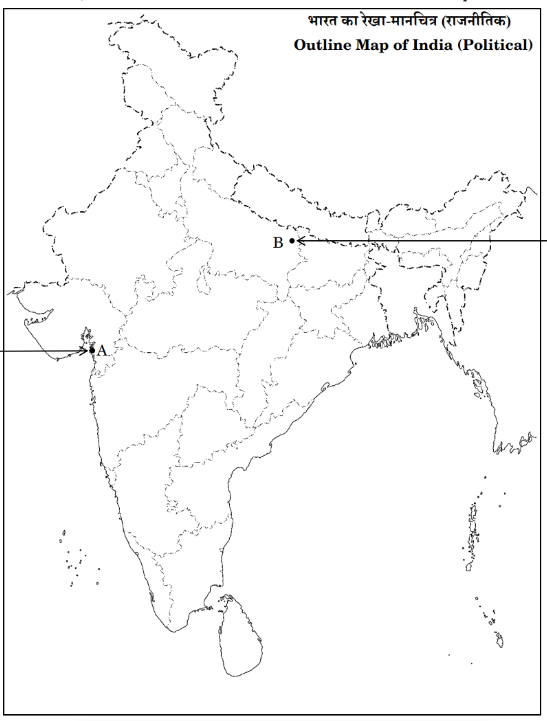
(1) Lothal − A mature Harappan site
[1 Mark](2) Amaravati − A Buddhist site
[1 Mark](3) Delhi − A territory under Mughals
[1 Mark](4) Vijayanagara − A medieval period kingdom
[2 Marks]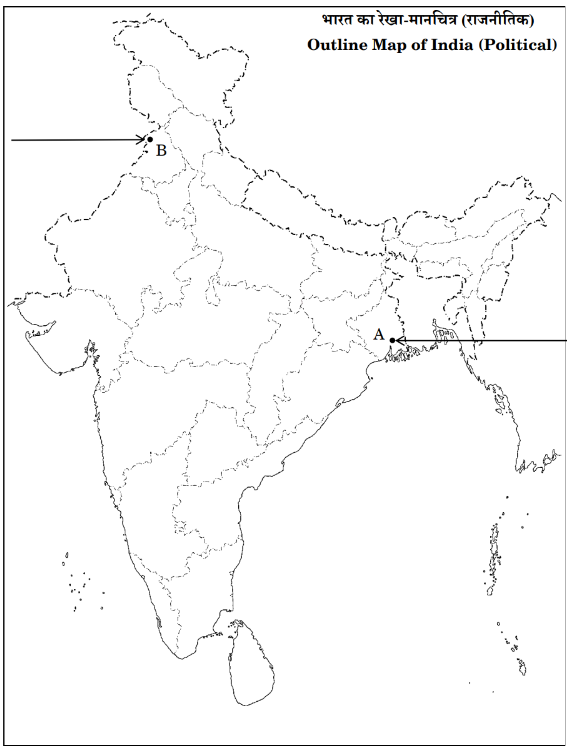
(1) Mention any one mature Harappan site in Western India.
[1 Mark](2) Name any one territory which was under the Mughals.
[1 Mark](3) Mention any one ancient Buddhist site in South Indi
[1 Mark](4) Name any one neighbouring kingdom of the VijayanagaraEmpire.
[1 Mark](5) Name any two centres of the Indian National Movement.
[1 Mark]Section B
Which of the following statements about the Harappan economy are correct ?
I. Urban centres provide remains of organized craft production.
II. Use of iron tools for agriculture was common.
III. Evidence of seals indicates long distance trade.
IV. Standardised weights point towards regulated trade contacts.
Assertion (A) : Most Asokan inscriptions were in the Prakrit language.
Reason (R) : The use of Prakrit shows his attempt to spread the message amongst the common people.
Arrange the following rulers in chronological order:
I. Kanishka
II. Mahapadma Nanda
III. Samudragupta
IV. Chandragupta Maurya
Identify the character from the Mahabharata:
• He was the elder brother of Pandu.
• He was the king of Hastinapur.
• He was the husband of Gandhari.
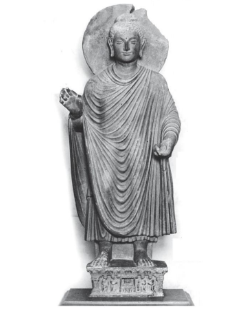
Who amongst the following rulers of Bhopal provided money for the preservation of Sanchi ?
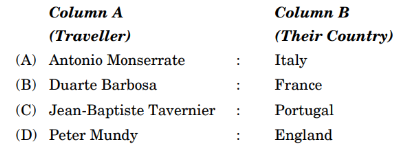
Match Column A with Column B and choose the correct option :
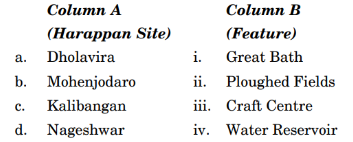
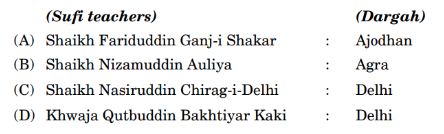
Which one of the following pairs is correctly matched?
Which of the following statements accurately describes Amir Khusrau ?
I. He was a great poet and musician.
II. He introduced the qaul in Chishti Sama.
III. He was a disciple of Shaikh Muinuddin Sijzi.
IV. He laid the foundation of qawwali tradition.
Which of the following battles in 1565 led to the decline of the Vijayanagara Empire?
Fill in the blank with the appropriate word: The Shah Nahar Canal in Punjab was repaired during the reign of ________.
Read the following statements carefully regarding Al-Biruni’s ‘‘Kitab-ul-Hind’’ and choose the correct option :
I. It is a voluminous text of eighty chapters.
II. It is written in Arabic, Urdu and Hindavi.
III. Each of its chapters begins with a question.
IV. It covers many subjects like astronomy, festivals, etc.
Which of the following was not a major centre of the Revolt of 1857 ?
Choose the correct option from the following to fill in the blank regarding the regions of nationalist leaders of India : Bipin Chandra Pal : Bengal; Lala Lajpat Rai : ____________
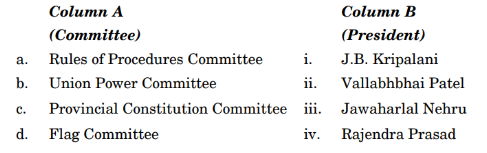
Match Column A with Column B regarding important Committees of the Constituent Assembly and its Presidents and choose the correct option :
Assertion (A) : The Sepoys proclaimed Bahadur Shah Zafar as their leader in the Revolt of 1857.
Reason (R) : Bahadur Shah Zafar’s acceptance gave legitimacy to the Revolt of 1857.
Identify the Indian social reformer of the nineteenth century with the help of the following information and choose the correct option :
• Opposed child marriage
• Advocated for social justice
• Campaigned for reform of Hinduism
• Known for Vedantic theory
Fill in the blank with the appropriate word from the options given below :
The Deccan Riots Commission produced a report that was presented to the __________ Parliament in 1878.
Section C
Section D
Other Years — History