QUESTION PAPER
2026 BOARD EXAM
CBSE Class 12 Humanities History Board Paper 2026 — Set 2
2026
History
Class 12 Humanities
CBSE EXAMINATION PAPER-2026
HISTORY
(Solved)
General Instructions :
Read the following instructions carefully and follow them :
- This question paper contains 42 questions. All questions are compulsory.
- This question paper is divided into 4 sections.
- Section A – questions number 1 to 5 are case based questions
- Section B – questions number 6 to 28 are multiple choice questions
- Section C – questions number 29 to 36 are short answer
- Section D – questions number 37 to 42 are long answer
- There is no overall choice given in the question paper. However, an internal choice has been provided in few questions.
- Use of calculator is NOT allowed.
Section A
Read the source given below carefully and answer the questions that follow:
The Malabar Coast (Present-day Kerala)
Here is an excerpt from Periplus of the Erythraean Sea, composed by an anonymous Greek sailor (First century CE): They (i.e. traders from abroad) send large ships to these market-towns on account of the great quantity and bulk of pepper and malabathrum (possibly cinnamon, produced in these regions). There are imported here, in the first place, a great quantity of coin; topaz... antimony (a mineral used as a colouring substance), coral, crude glass, copper, tin, lead ... There is exported pepper, which is produced in quantity in only one region near these markets.... Besides this there are exported great quantities of fine pearls, ivory, silk cloth, .... transparent stones of all kinds, diamonds and sapphires, and tortoise shell.
Archaeological evidence of a bead-making industry, using precious and semi-precious stones, has been found in Kodumanal (Tamil Nadu). It is likely that local traders brought the stones mentioned in the Periplus from sites such as these to the coastal ports.
(1) Mention the role of rivers in the promotion of trade.
[1 Mark](2) Why were large number of goods traded between India and other countries?
[1 Mark](3) Give reasons for the development of bead-making industry at Kodumanal.
[2 Marks]Read the given source carefully and answer the questions that follow:
A warning for Europe
Bernier warned that if European kings followed the Mughal model:
Their kingdoms would be very far from being well cultivated and peopled, so well built, so rich, so polite and flourishing as we see them. Our kings are otherwise rich and powerful; and we must avow that they are much better and more royally served. They would soon be kings of deserts and solitudes, of beggars and barbarians [...] We should find the great Cities and the great Burroughs rendered uninhabitable because of ill air, and to fall to ruin without anybody taking care of repairing them; the hillocks abandoned, and the fields overspread with bushes, or filled with pestilential marshes, as hath been already intimated.
(1) Why did Bernier warn the European kings against following the Mughal model of kingship?
[1 Mark](2) Mention any one difference between Mughal and European land-ownership.
[1 Mark](3) How did Bernier’s description influence western theorists from the 18th century onwards? Explain.
Read the given source carefully and answer the questions that follow:
On clearance and settled cultivation
Passing through one village in the lower Rajmahal hills, Buchanan wrote: The view of the country is exceedingly fine, the cultivation especially in the narrow valleys of rice winding in all directions, the cleared lands with scattered trees, and the rocky hills are in perfection; all that is wanted is some appearance of progress and a vastly extended and improved cultivation. Plantations of Asan and Palas, for Tessar (Tassar silk worms) and Lac, should occupy the place of woods to as great an extent as demand will admit; the remainder might be all cleared, and the greater part cultivated, while what is not fit for the purpose, might rear Palmyra and Mahua.
(1) How was the landscape described regarding cultivation?
[1 Mark](2) Which crops were recommended for expanding agriculture?
[1 Mark](3) Explain the proposal given by Buchanan for utilizing the land for economic development.
[2 Marks]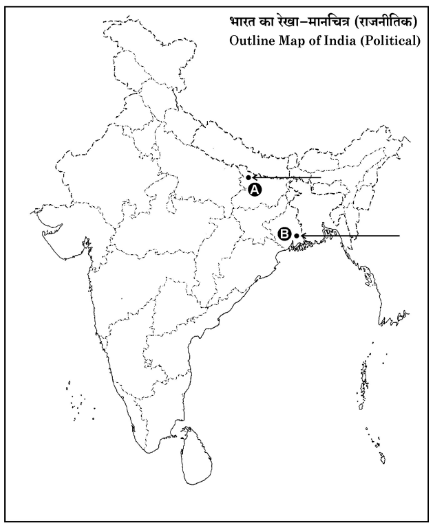
(1) Banawali – a mature Harappan site
[2 Marks](2) Kannauj – An important town from early states
[1 Mark](3) Ajmer – A city under Mughals
[1 Mark](4) Bidar – A medieval town
[1 Mark]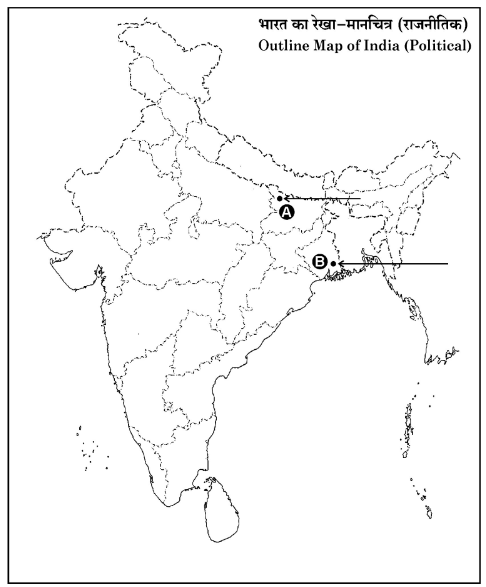
(1) Name any one town which was under the rule of Babur
[1 Mark](2) Mention any one Harappan site from the present state of Haryana.
[1 Mark](3) Mention any one medieval town.
[1 Mark](4) Name any two centres of Indian National Movement.
[2 Marks]Section B
Assertion (A): Like Buddhism, Jainism also spread to many parts of India.
Reason (R): Jaina scholars produced literature in various languages like Tamil, Prakrit and Sanskrit etc.
Read the following statements regarding Buddhism teaching and choose the correct option:
I. The world is transient and constantly changing.
II. It is soulless and there is nothing eternal in it.
III. Sorrows and sufferings are intrinsic to human existence.
IV. Renouncing the world is essential for living. Codes:
Look at the given image and identify the ancient sculptural panel from the options:
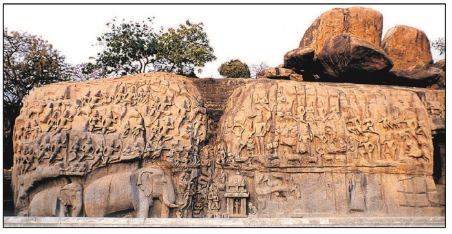
In which of the following states Mahabalipuram temple is located ?
Who among the following was appointed Qazi or Judge of Delhi by Sultan Mohd. Bin Tughlaq ?
Identify the correct statements regarding the early Bhakti movement in South India:
I. Alvars and Nayanars travelled from place to place singing hymns in Tamil.
II. One of the major anthologies of compositions by the Alvars, "Amuktamalyada", is described as Tamil Veda
III. Karaikkal Ammaiyar and Andal were the women devotees of Nayanara and Alvar Tradition.
IV. Both Nayanars and Alvar saints were revered by the Vellala peasants.
Arrange the following dynasties in chronological order:
I. Saluva dynasty
II. Sangama dynasty
III. Aravidu dynasty
IV. Tuluva dynasty
Identify the Sufi Saint with the help of the following information:
• His Hospice was on the bank of river Yamuna in Delhi.
• His disciple was Amir Khusro.
• His disciples addressed him as Sultan-ul-Mashaikh.
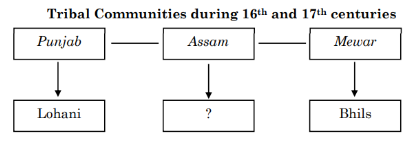
Which one of the following pairs is correctly matched? Travellers of Medieval Period — Native Region
(A) Peter Mundi — Spain
(B) Antonio Monserrate — Portugal
(C) Abdal-Razzaq — Morocco
(D) Marco Polo — Italy
How did the arrival of Santhals in the Raj Mahal hills affect the Paharias ?
Arrange the following historical events in chronological order:
I. Champaran Satyagraha
II. Kheda Satyagraha
III. Jallianwala Bagh Incident
IV. Rowlatt Act
Find the odd one out from the following:
(British Officers) — (Policy)
(A) Dalhousie — Doctrine of Lapse
(B) Cornwallis — Permanent Settlement
(C) Wellesley — Western Education
(D) Hardinge — Enfield rifles for soldiers
Which of the following statements regarding Nana Saheb are correct ?
I. Nana Saheb was the successor of Peshwa Baji Rao-II.
II. Nana Saheb joined the revolt of 1857 from Kanpur.
III. His rebellion collapsed in the beginning of 1857.
IV. Nana Saheb went to Nepal in 1857.
Who amongst the following was the head of the ‘Advisory Committee’ of the Constituent Assembly ?
Identify the British Officer with the help of the following information:
• Was a Physician.
• Organised Zoo in Calcutta.
• Did survey of Bengal.
• He assumed family name as Hamilton.
Read the following statements regarding Buddhism teaching and choose the correct option:
I. The world is transient and constantly changing.
II. It is soulless and there is nothing eternal in it
III. Sorrows and sufferings are intrinsic to human existence.
IV. Renouncing the world is essential for living. Codes:
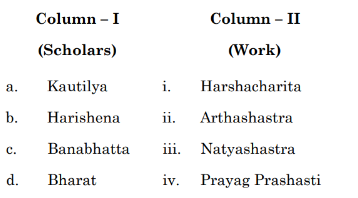
Match Column-I with Column-II and choose the correct option :
Section C
Section D
Other Years — History