QUESTION PAPER
2026 BOARD EXAM
CBSE Class 12 Humanities History Board Paper 2026 — Set 4
2026
History
Class 12 Humanities
CBSE EXAMINATION PAPER-2026
HISTORY
(Solved)
General Instructions :
Read the following instructions carefully and follow them :
- This question paper contains 41 questions. All questions are compulsory.
- This question paper is divided into 4 sections.
- Section A – questions number 1 to 5 are case based questions
- Section B – questions number 6 to 27 are multiple choice questions
- Section C – questions number 28 to 35 are short answer
- Section D – questions number 36 to 41 are long answer
- There is no overall choice given in the question paper. However, an internal choice has been provided in few questions.
- Use of calculator is NOT allowed.
Section A
Read the given source carefully and answer the questions that follow :
How Buddhist texts were prepared and preserved.
The Buddha (and other teachers) taught orally – through discussion and debate. Men and women (perhaps children as well) attended these discourses and discussed what they heard. None of the Buddha’s speeches were written down during his lifetime. After his death (c. fifth-fourth century BCE) his teachings were compiled by his disciples at a council of 'elders' or senior monks at Vesali (Pali for Vaishali in present-day Bihar). These compilations were known as Tipitaka – literally, three baskets to hold different types of texts. They were first transmitted orally and then written and classified according to length as well as subject matter.
The Vinaya Pitaka included rules and regulations for those who joined the sangha or monastic order; the Buddha’s teachings were included in the Sutta Pitaka; and the Abhidhamma Pitaka dealt with philosophical matters. Each pitaka comprised a number of individual texts. Later, commentaries were written on these texts by Buddhist scholars.
As Buddhism travelled to new regions such as Sri Lanka, other texts such as the Dipavamsa (literally, the chronicle of the island) and Mahavamsa (the great chronicle) were written, containing regional histories of Buddhism. Many of these works contained biographies of the Buddha. Some of the oldest texts are in Pali, while later compositions are in Sanskrit.
When Buddhism spread to East Asia, pilgrims such as Fa Xian and Xuan Zang travelled all the way from China to India in search of texts. These they took back to their own country, where they were translated by scholars. Indian Buddhist teachers also travelled to faraway places, carrying texts to disseminate the teachings of the Buddha.
Buddhist texts were preserved in manuscripts for several centuries in monasteries in different parts of Asia. Modern translations have been prepared from Pali, Sanskrit, Chinese and Tibetan texts.
(1) Explain why Buddha’s speeches were not written down during his lifetime.
[1 Mark](2) Assess the impact of orally transmitting texts before writing them down for preservation.
[1 Mark](3) Explain the differences between the Vinaya Pitaka and Sutta Pitaka.
[2 Marks]Read the given source carefully and answer the questions that follow:
Trade between the hill tribes and the plains, c. 1595.
This is how Abu’l Fazl describes the transactions between the hill tribes and the plains in the suba of Awadh (part of present-day Uttar Pradesh):
From the northern mountains quantities of goods are carried on the backs of men, of stout ponies and of goats, such as gold, copper, lead, musk, tails of the kutas cow (the yak), honey, chuk (an acid composed of orange juice and lemon boiled together), pomegranate seed, ginger, long pepper, majith (a plant producing a red dye) root, borax, zedoary (a root resembling turmeric), wax, woollen stuffs, wooden ware, hawks, falcons, black falcons, merlins (a kind of bird), and other articles. In exchange they carry back white and coloured clothes, amber, salt, asafoetida, ornaments, glass and earthen ware.
(1) Why was trade between the mountains and plains important for the Mughal economy?
[1 Mark](2) How did the people of the plains benefit from trade with the hill tribes?
[1 Mark](3) How did Abu’l Fazl describe the variety of goods carried by the hill tribes?
[2 Marks]Read the given source carefully and answer the questions that follow:
What the sepoys thought.
This is one of the arzis (petition or application) of rebel sepoys that have survived. A century ago the British arrived in Hindostan and gradually entertained troops in their service, and became masters of every state. Our forefathers have always served them, and we also entered their service ... By the mercy of God and with our assistance the British also conquered every place they liked, in which thousands of us, Hindostani men were sacrificed, but we never made any excuses or pretences nor revolted ...
But in the year eighteen fifty seven the British issued an order that new cartridges and muskets which had arrived from England were to be issued; in the former of which the fats of cows and pigs were mixed; and also that attah of wheat mixed with powdered bones was to be eaten; and even distributed them in every Regiment of infantry, cavalry and artillery ...
They gave these cartridges to the sowars (mounted soldiers) of the 3rd Light Cavalry, and ordered them to bite them; the troopers objected to it, and said that they would never bite them, for if they did, their religion and faith would be destroyed ... upon this the British officers paraded the men of the 3 Regiments and having prepared 1,400 English soldiers, and other Battalions of European troops and Horse Artillery, surrounded them, and placing six guns before each of the infantry regiments, loaded the guns with grape and made 84 new troopers prisoners, and put them in jail with irons on them ... The reason that the sowars of the Cantonment were put into jail was that we should be frightened into biting the new cartridges. On this account we and all our country-men having united together, have fought the British for the preservation of our faith ... we have been compelled to make war for two years and the Rajahs and Chiefs who are with us in faith and religion, are still so, and have undergone all sorts of trouble; we have fought for two years in order that our faith and religion may not be polluted. If the religion of a Hindoo or Mussalman is lost, what remains in the world?
(1) How did the sepoys justify their rebellion in the ‘arzi’?
[1 Mark](2) How did the British introduce the new cartridges?
[1 Mark](3) Why did the sepoys and Indian chiefs work together?
[2 Marks]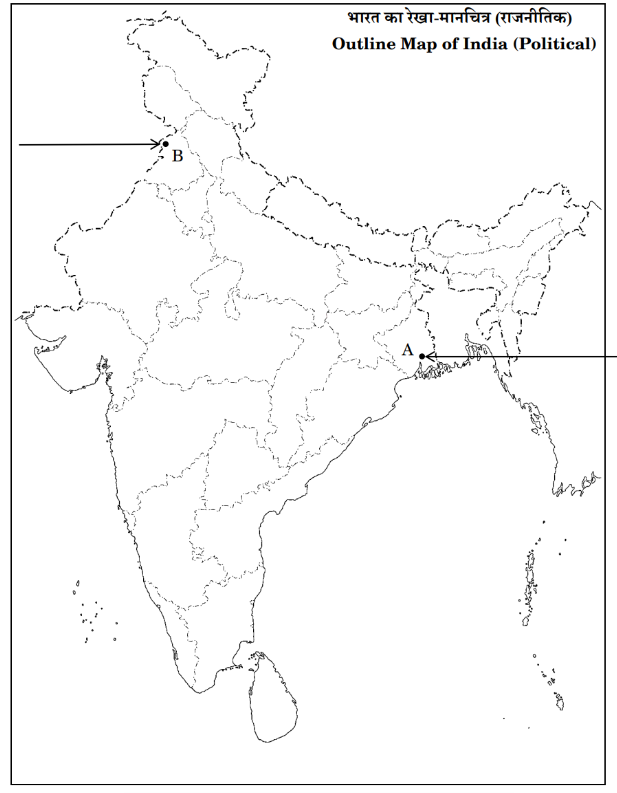
(1) Nagarjunakonda − An Ancient Buddhist site
[2 Marks](2) Dholavira − A mature Harappan site
[1 Mark](3) Agra − A territory under the Mughals
[1 Mark](4) Bijapur − A medieval period state
[1 Mark]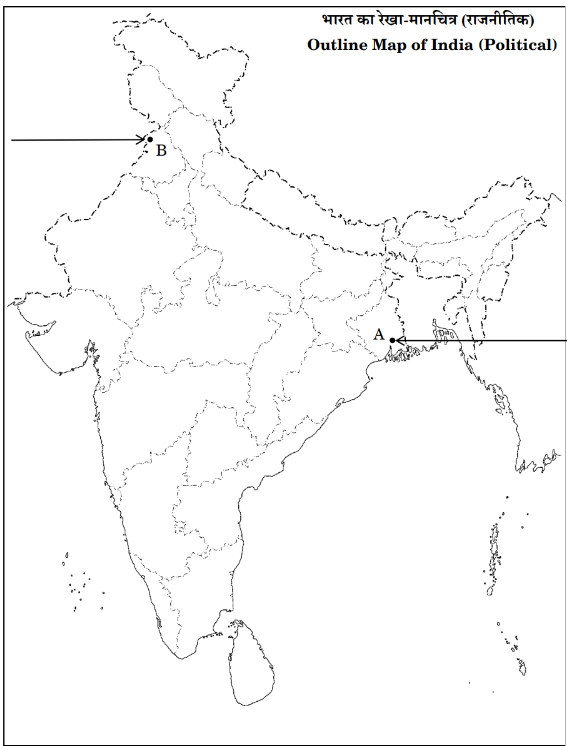
(1) Mention any one mature Harappan site in present Pakistan
[1 Mark](2) Name any one territory which was under the Mughals.
[1 Mark](3) Mention one ancient Buddhist site in Eastern India
[1 Mark](4) Name any one neighbouring kingdom of the Vijayanagara empire.
[1 Mark](5) Name any two centres of the Indian National Movement.
[1 Mark]Section B
Assertion (A) : Asoka was the first ruler who inscribed his messages to his subjects on stone surfaces and pillars.
Reason (R) : Asoka ensured that the message of dhamma reached as many people as possible.
Arrange the following literary compositions in chronological order and choose the correct option :
I. Ashtadhyayi of Panini
II. Harshcharita of Banabhatta
III. Arthashastra of Kautilya
IV. Natyashastra of Bharata
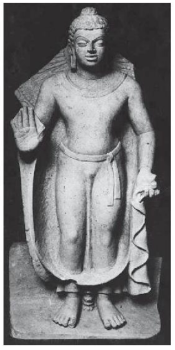
Identify this character of Mahabharata with the help of the following information and choose the correct option :
• He considered himself as a disciple of Dronacharya.
• He honoured his guru by giving his right hand thumb as Gurudakshina.
• He mastered archery through self-practice.
Which of the following is another name for Hinayana Buddhism ?
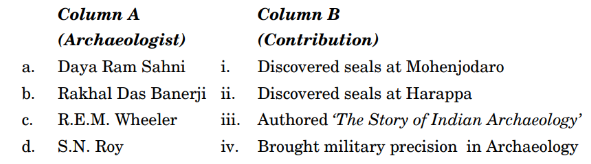
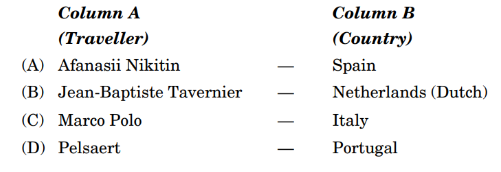
Match Column A with Column B and choose the correct option :
Which of the following statements about Mirabai are correct ?
I. She was married into Sisodia clan of Mewar.
II. She considered Krishna her divine lover.
III. Her spiritual guru was Ramanand.
IV. She founded a sect with a group of followers.
Read the following statements regarding Ibn Battuta’s travel experiences and choose the correct option : I. His travel was unsafe as he was looted many times.
II. He travelled in caravans along with companions.
III. His journey took months due to vast distances.
IV. He has written his travelling experiences in Persian.
Assertion (A) : In the 1850’s Awadh was called the ‘nursery of the Bengal Army’.
Reason (R) : Here a large number of sepoys were recruited from entire India.
Identify the Indian social reformer of the nineteenth century with the help of the following information and choose the correct option :
• He was from Maharashtra
. • He pointed to the suffering of the depressed classes.
• He demanded economic and social justice.
Section C
Section D
‘The temple architecture of the Vijayanagara empire was distinctive and unique.’’ Explain the statement with examples.
Other Years — History