QUESTION PAPER
2026 BOARD EXAM
CBSE Class 12 Humanities History Board Paper 2026 — Set 1
2026
History
Class 12 Humanities
CBSE EXAMINATION PAPER-2026
HISTORY
(Solved)
General Instructions :
Read the following instructions carefully and follow them :
- This question paper contains 41 questions. All questions are compulsory.
- This question paper is divided into 4 sections.
- Section A – questions number 1 to 5 are case based questions
- Section B – questions number 6 to 27 are multiple choice questions
- Section C – questions number 28 to 35 are short answer
- Section D – questions number 36 to 41 are long answer
- There is no overall choice given in the question paper. However, an internal choice has been provided in few questions.
- Use of calculator is NOT allowed.
Section A
Read the given passage carefully and answer the questions that follow :
A Mother’s Advice
The Mahabharata describes how, when war between the Kauravas and the Pandavas became almost inevitable, Gandhari made one last appeal to her eldest son Duryodhana.
By making peace you honour your father and me, as well as your well-wishers... it is the wise man in control of his senses who guards his kingdom. Greed and anger drag a man away from his profits; by defeating these two enemies a king conquers the earth... You will happily enjoy the earth, my son, along with the wise and heroic Pandavas.... There is no good in a war, no law (dharma) and profit (artha), let alone happiness; nor is there (necessarily) victory in the end – don’t set your mind on war...
Duryodhana did not listen to this advice and fought and lost the war.
(1) Explain the main cause of conflict between Kauravas and Pandavas.
[1 Mark](2) Why did Gandhari advice Duryodhana not to fight?
[1 Mark](3) Why did Duryodhana not listen to the advice of his mother, Gandhari?
[2 Marks]Read the following passage carefully and answer the questions that follows :
Declining a Royal Gift
This excerpt from a Sufi text describes the proceedings at Shaikh Nizamuddin Auliya’s hospice in 1313 :
I (the author, Amir Hasan Sijzi) has the good fortune of kissing his (Shaikh Nizamuddin Auliya’s) feet... At this time a local ruler had sent him the deed of ownership to two gardens and much land, along with the provisions and tools for their maintenance. The ruler had also made it clear that he was relinquishing all his rights to both the gardens and land. The master...had not accepted that gift. Instead, he had lamented : “What have I to do with gardens and fields and lands ?... None of .... our spiritual masters had engaged in such activity.
” Then he told an appropriate story : “.... Sultan Ghiyasuddhin, who at that time was still known as Ulugh Khan, came to visit Shaikh Fariduddin (and) offered some money and ownership deeds for four villages to the Shaikh, the money being for the benefit of the dervishes (Sufis), and the land of his use. Smiling, Shaikh al Islam (Fariduddin) said : Give me the money. I will dispense it to the dervishes. But as for those land deeds, keep them. There are many who long for them. Give them away to such persons.”
(1) What was the reaction of Sufi saint on the offerings?
[1 Mark](2) Mention the offering by the local ruler to Sufi saint.
[1 Mark](3) Why did Sufi saint accept money? Explain.
[2 Marks]Read the given passage carefully and answer the following questions :
What taluqdars thought The attitude of the taluqdars was best expressed by Hanwant Singh, the Raja of Kalakankar, near Rae Bareli. During the mutiny, Hanwant Singh had given shelter to a British officer, and conveyed him to safety. While taking leave of the officer, Hanwant Singh told him :
Sahib, your countrymen came into this country. You sent your officers round the districts to examine the titles to the estates. At one blow you took from me lands which from time immemorial had been in my family. I submitted. Suddenly misfortune fell upon you. The people of the land rose against you. You came to me whom you had despoiled. I have saved you. But now – now I march at the head of my retainers to Lucknow to try and drive you from the country.
(1) Explain the anguish of Hanwant Singh for the British officer.
[1 Mark](2) How were Taluqdars facilitated by the rulers?
[1 Mark](3) Explain any two causes of dissatisfaction of Taluqdars from British rule.
[2 Marks]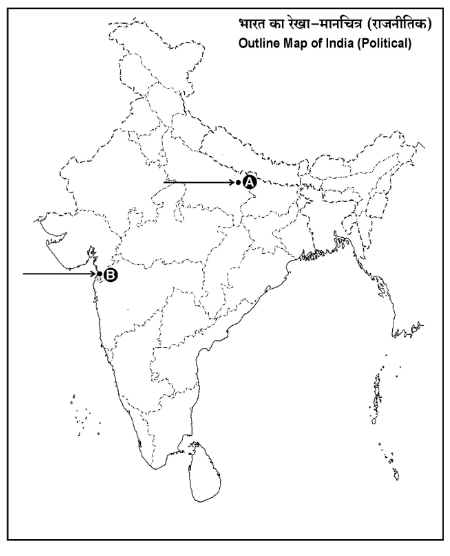
(1) Nageshwar - a mature Harappan site
[2 Marks](2) Goa - an area under Aurangzeb
[1 Mark](3) Kashi - early state.
[1 Mark](4) Thanjavur – a medieval town.
[1 Mark]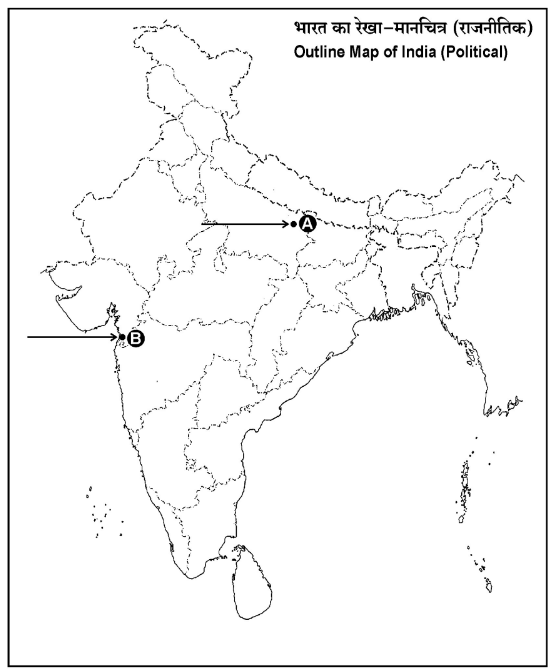
(1) Name the capital of Vijayanagara Empire.
[1 Mark](2) Name any two important capitals of the early states.
[2 Marks](3) Name one area which was under the rule of Aurangzeb.
[1 Mark](4) Mention any two main centres of Indian National Movement
[1 Mark]Section B
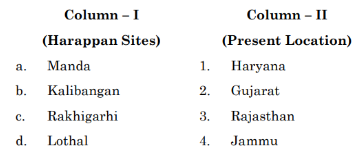
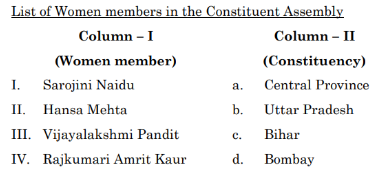
Match the Column – I with Column – II and choose the correct option :
Arrange the following in correct chronological order:
I. Chalcolithic Age
II. Mesolithic Age
III. Neolithic Age
IV. Paleolithic Age
Which of the following pairs is correctly matched?
(Ancient Dynasties) — (Lineage)
(A) Kanvas — Successors of Mauryas
(B) Mauryas — Successors of Mahapadmananda
(C) Satvahanas — Successors of Kushanas
(D) Shakas — Successors of Chalukyas
Which of the following statements regarding Jainism is correct?
I. Vardhaman Mahavira was born in 5th Century CE.
II. Mahavira was the 24th Tirthankara.
III. Jains worship Lord Shiva as Mahavira.
IV. The principle of Ahimsa is emphasised in Jainism. Options:
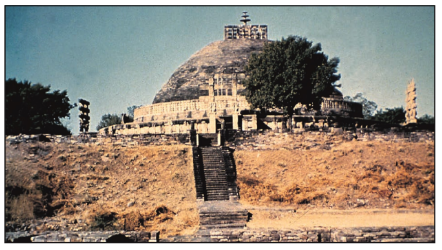
In which of the following modern states of India is Sanchi Stupa located?
Which of the following chronicles was authored by Abul-Fazl?
Identify the foreign traveller with the help of the following information:
• He was a Moroccan traveller of the 14th century.
• He had expertise in Islamic religion law
• He was appointed Qazi of Delhi by Muhammad bin Tughlaq.
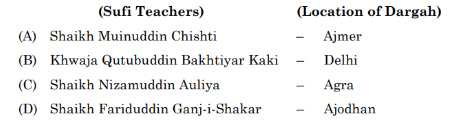
Assertion (A): Baba Guru Nanak Devji advocated Nirguna Bhakti.
Reason (R): For Baba Guru Nanak, the absolute or ‘rab’ had no gender or form.
Which of the following statements accurately describe the conditions of Bombay-Deccan from 1840 to 1850?
I. There was significant agrarian expansion during this period.
II. Prices of agricultural products were rising steadily. III. There were frequent peasant uprisings due to economic distress.
IV. The agrarian landscape largely remained progressive. Options:
Why was the Revolt of 1857 viewed as a serious threat by the British?
Choose the correct pair regarding the local leaders during the Revolt of 1857.
List – I (Local Leader) — List – II (Region)
(A) Gonoa — Chotanagpur
(B) Shahmal — Hyderabad
(C) Kunwar Singh — Kanpur
(D) Maulavi Ahmadullah Shah — Arrah
Identify the Indian Political Leader with the help of the following information:
I. He moved the Objectives Resolution in the Constituent Assembly.
II. He moved the resolution proposing that the National Flag be a horizontal tricolour of saffron, white and dark green in equal proportions with a wheel of navy blue colour in the centre.
Section C
Section D
Other Years — History