Diversity in the Living World
Overview
- Living organisms include plants, insects, birds, animals, and microorganisms.
- Each distinct organism type is a species; known species number about 1.7-1.8 million.
- Biodiversity refers to the variety and number of organisms on Earth.
Memory Aids
- Biodiversity = variety of life forms on Earth.
- Species = distinct organism type.
Quick Checkpoints
- What defines a species?
- What is biodiversity?
Nomenclature
Key Points
- Local names vary; scientific names standardize organism identification worldwide.
- Nomenclature requires correct organism description and identification.
- Scientific names follow agreed principles: ICBN for plants, ICZN for animals.
- Each scientific name has two parts: generic name and specific epithet (binomial nomenclature).
- System introduced by Carolus Linnaeus, used globally.
- Technical names from Linnaeus’ Species Plantarum (1753) and Systema Naturae (1758).
Memory Aids
- Binomial nomenclature = two-part naming system.
- ICBN = plants; ICZN = animals.
- Linnaeus = father of modern nomenclature.
Quick Checkpoints
- What is binomial nomenclature?
- Which codes govern plant and animal naming?
Rules of Nomenclature
Universal Rules
- Names are Latin or Latinized, written in italics.
- First word = genus (capitalized), second = specific epithet (lowercase).
- Example: Mangifera indica (mango).
- Handwritten names are underlined separately; printed names italicized.
- Author’s abbreviated name follows specific epithet, e.g., Mangifera indica Linn.
- Tautonyms: same genus and species name, e.g., Catla catla.
Memory Aids
- Genus capitalized, species lowercase.
- Italicize or underline names.
- Author’s name shows original describer.
Quick Checkpoints
- How are scientific names formatted?
- What is a tautonym?
Classification
Essentials
- Grouping organisms into categories (taxa) based on observable traits.
- Taxa exist at different levels: plants, animals, mammals, dogs.
- Classification process is taxonomy.
- Modern taxonomy uses external/internal structures, cell structure, development, ecology.
- Basic taxonomy processes: characterization, identification, classification, nomenclature.
Memory Aids
- Taxa = groups at any classification level.
- Taxonomy = science of classification.
Quick Checkpoints
- What is taxonomy?
- What are taxa?
Systematics
Key Concepts
- Systematics = systematic arrangement of organisms (from Latin 'systema').
- Includes identification, nomenclature, classification.
- Considers evolutionary relationships.
- Neosystematics (Julian Huxley, 1940) studies interrelationships among organisms.
Memory Aids
- Systematics = classification + evolution.
- Neosystematics = new systematics focusing on relationships.
Quick Checkpoints
- What does systematics include?
- What is neosystematics?
Classification Taxonomic Hierarchy
Hierarchy and Taxonomic Categories
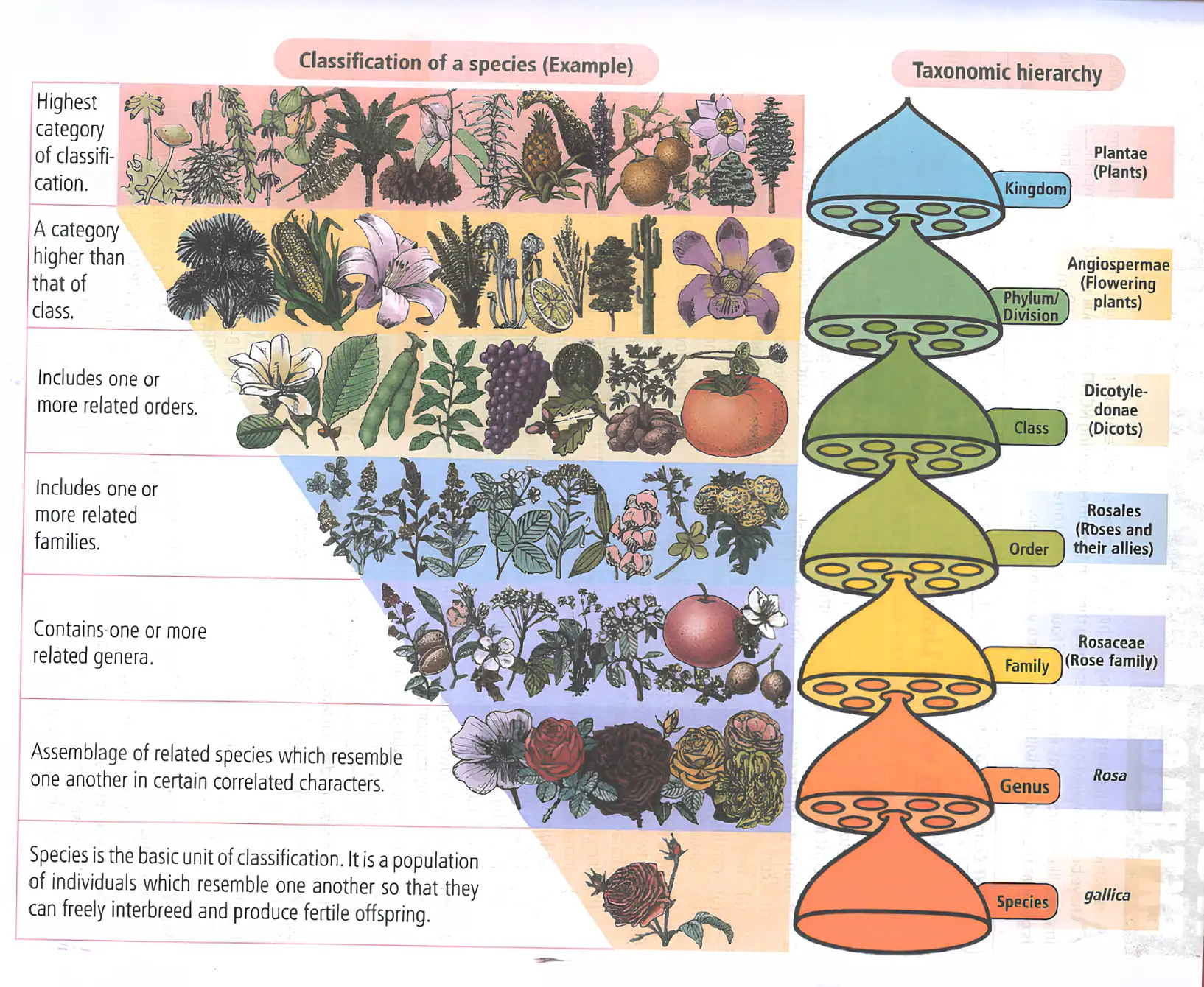
- Classification is a hierarchy of ranks called taxonomic categories.
- Each category is a taxon (plural: taxa), a unit of classification.
- Common categories: Kingdom, Phylum/Division, Class, Order, Family, Genus, Species.
- Taxonomic groups are distinct biological entities, not just morphological groups.
Memory Aids
- Taxonomic hierarchy: Species < Genus < Family < Order < Class < Phylum/Division < Kingdom
- Each step groups organisms by shared features, increasing breadth upwards.
Quick Checkpoints
- What defines a taxonomic category?
- List the main taxonomic ranks in order.
Species
Definition and Characteristics
- Smallest taxonomic category.
- Group of individuals with similar morphology.
- Members can interbreed and produce fertile offspring.
- Ernst Mayr defined biological species concept.
- Example: Rosa gallica (a rose species).
Memory Aids
- Species = interbreeding group producing fertile offspring.
- Specific epithet follows genus in scientific names.
Quick Checkpoints
- What is the smallest taxonomic category?
- How is a species defined biologically?
Genus
Definition and Examples
- Group of related species sharing more characters than species of other genera.
- Example: Genus Solanum includes potato, tomato, brinjal.
- Genus Panthera includes lion, leopard, tiger.
- Monotypic genus: single species; polytypic genus: multiple species.
Memory Aids
- Genus groups closely related species.
- Monotypic = one species; polytypic = many species.
Quick Checkpoints
- What defines a genus?
- Difference between monotypic and polytypic genus?
Family
Definition and Characteristics
- Group of related genera with fewer similarities than genus level.
- Characterized by vegetative and reproductive features.
- Example: Family Solanaceae includes genera Solanum, Petunia, Datura.
- Family Felidae includes genera Panthera and Felis.
- Different families separate similar animals, e.g., Felidae (cats) and Canidae (dogs).
Memory Aids
- Family groups related genera by key features.
- Suffix for plant families: -aceae.
Quick Checkpoints
- What criteria define a family?
- Give examples of families and their genera.
Order
Definition and Examples
- Assemblage of families with few similar characters.
- Example: Order Polemoniales includes families Convolvulaceae, Solanaceae.
- Animal Order Carnivora includes families Felidae and Canidae.
Memory Aids
- Order groups families with shared traits.
- Suffix for orders: -ales.
Quick Checkpoints
- What is an order in taxonomy?
- Examples of orders and their families?
Class
Definition and Examples
- Category including related orders.
- Example: Class Mammalia includes orders Primata and Carnivora.
Memory Aids
- Class groups related orders.
- Suffix for classes: -opsida, -phyceae, -ae.
Quick Checkpoints
- What defines a class?
- Examples of classes and their orders?
Phylum
Definition and Examples
- Category including related classes.
- Example: Phylum Chordata includes fishes, amphibians, reptiles, birds, mammals.
- In plants, equivalent category is Division.
Memory Aids
- Phylum groups classes by major body plans.
- Suffix for divisions: -phyta.
Quick Checkpoints
- What is a phylum?
- Difference between phylum and division?
Kingdom
Definition and Characteristics
- Highest taxonomic category.
- Groups all organisms sharing broad common features.
- Examples: Plant Kingdom, Animal Kingdom.
- As category level rises, shared characteristics decrease.
- Taxonomic hierarchy ascending: Species → Genus → Family → Order → Class → Phylum/Division → Kingdom.

Memory Aids
- Kingdom is the broadest group.
- Higher taxa have fewer shared traits.
Quick Checkpoints
- What is the highest taxonomic category?
- How does shared similarity change with taxonomic rank?
Taxonomic Suffixes
Common Suffixes for Categories
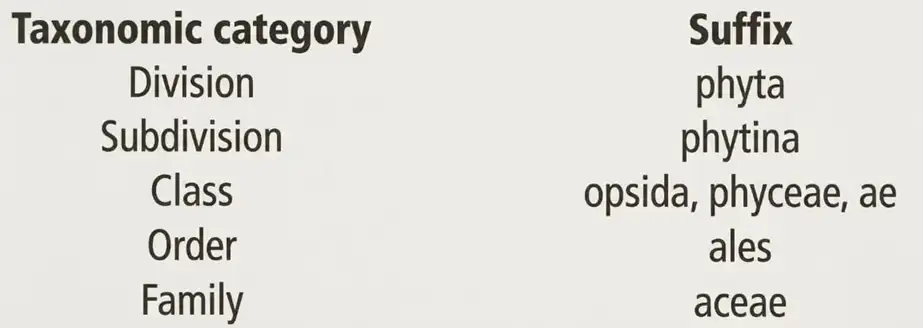
- Division: -phyta
- Subdivision: -phytina
- Class: -opsida, -phyceae, -ae
- Order: -ales
- Family: -aceae
Memory Aids
- Suffixes help identify taxonomic rank.
- Plant families end with -aceae, orders with -ales.
Quick Checkpoints
- What suffixes indicate family and order?
- How to recognize taxonomic rank from suffix?
Introduction
Overview of Biology
- Biology studies life forms and living processes.
- Living organisms inhabit diverse environments: mountains, forests, oceans, lakes, deserts, hot springs.
- Harvard evolutionary biologist known as ‘The Darwin of 20th century’ contributed to ornithology, taxonomy, evolution, zoogeography, systematics, and biology philosophy.
Memory Aids
- Biology = Study of life and living processes.
- Diverse habitats = key to organism variety.
- 20th-century Darwin = Harvard evolutionary biologist.
Quick Checkpoints
- What environments do living organisms inhabit?
- Who is called the Darwin of the 20th century?
- What fields did the Harvard biologist contribute to?
What is Living?
Characteristics of Living Organisms
- Distinctive features: growth, development, reproduction, metabolism, environmental sensing, responsiveness.
- Growth: increase in mass and number; unicellular growth via cell division (growth = reproduction).
- Higher plants/animals: growth (mass increase) and reproduction are separate.
- Growth types: indeterminate (plants, unlimited), determinate (animals, limited).
- Non-living growth by surface accumulation = accretion; living growth is internal.
- Growth alone is not a defining feature of life.
- Reproduction: ability to produce offspring; sexual or asexual.
- Examples: fungi produce asexual spores; yeast and Hydra reproduce by budding; Planaria regenerates lost parts; fragmentation in fungi, algae, mosses.
- Some organisms do not reproduce (mules, sterile bees, infertile humans).
- Reproduction is not an all-inclusive defining feature.
- Metabolism: sum of all chemical reactions in organisms.
- Two types: anabolism (building complex molecules), catabolism (breaking down molecules).
- Metabolism occurs in all plants, animals, fungi, microbes; absent in non-living objects.
- Isolated metabolic reactions in vitro are not living but are living reactions.
- Cellular organization is the defining feature of life.
- All organisms sense and respond to environmental stimuli (physical, chemical, biological).
- Plants respond to light, water, temperature, organisms, pollutants; photoperiod affects reproduction.
- All organisms are aware of surroundings; humans have self-consciousness.
- Consciousness is a defining property of living organisms.
- Brain-dead coma patients lack self-consciousness despite machine support.
- Living phenomena arise from interactions at cellular and molecular levels, producing emergent properties.
- Living organisms are self-replicating, evolving, self-regulating interactive systems.
Memory Aids
- Growth: internal in living, accretion in non-living.
- Reproduction: sexual or asexual, but not universal.
- Metabolism: anabolism + catabolism = life’s chemical reactions.
- Cellular organization = hallmark of life.
- Consciousness = unique to living organisms, especially humans.
- Emergent properties arise from interactions.
Quick Checkpoints
- What distinguishes growth in living vs non-living?
- Why is reproduction not a universal life feature?
- Define metabolism and its types.
- What is the significance of cellular organization?
- How do organisms respond to environmental stimuli?
- What is unique about human consciousness?
- Explain emergent properties in living systems.
NEET Botany — ALL CHAPTERS
1
The Living World
2
Plant Kingdom
3
Morphology of Flowering Plants
4
Anatomy of Flowering Plants
5
The Unit of Life
6
Photosynthesis in Higher Plants
7
Respiration in Plants
8
Plant Growth and Development
9
Sexual Reproduction in Flowering Plants
10
Principles of Inheritance and Variation
11
Molecular Basis of Inheritance
12
Biotechnology :Principles and Processes
13
Biotechnology and its Applications