Plant Kingdom
Classification and Characteristics
- Kingdom Plantae: multicellular, photosynthetic, aquatic or terrestrial.
- Divided into Cryptogamae (no seeds) and Phanerogamae (with seeds).
- Cryptogamae: Thallophyta (algae, no vascular tissue), Bryophyta (mosses, non-vascular), Pteridophyta (ferns, vascular but no seeds).
- Phanerogamae: Gymnospermae (naked seeds, no flowers), Angiospermae (seeds in fruits, flowering plants).
- Classification evolved from artificial (Linnaeus) to natural (Bentham & Hooker) to phylogenetic systems.
- Modern taxonomy includes numerical taxonomy, cytotaxonomy, and chemotaxonomy.
Memory Aids
- Cryptogamae = "hidden seeds" (no seeds).
- Phanerogamae = "visible seeds" (seed plants).
- Artificial systems focus on few traits; natural systems consider anatomy and chemistry.
Quick Checkpoints
- What are the two main groups of Kingdom Plantae?
- Which group has vascular tissue but no seeds?
- Who proposed the natural classification system?
- What is the basis of phylogenetic classification?
Algae
General Characteristics
- Simple, autotrophic, mostly aquatic organisms with chlorophyll.
- Habitat: freshwater, marine, moist terrestrial, symbiotic (e.g., lichens).
- Unusual habitats: halophytic, epiphytic, epizoic, endozoic, parasitic, thermophytic algae.
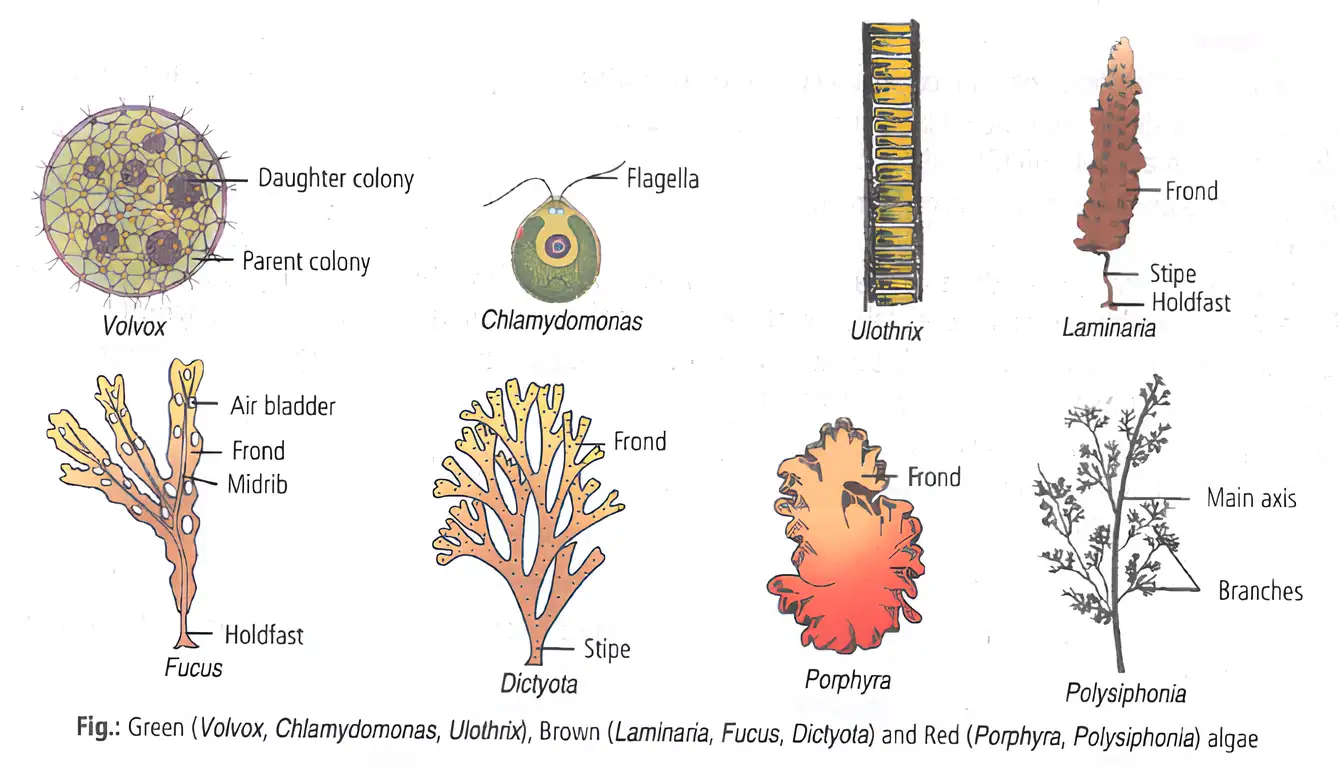
- Forms: unicellular (motile/non-motile), colonial, filamentous, large kelps.
- Thallus: vegetative body; cell wall has cellulose (inner) and pectin (outer).
- Photosynthetic pigments: chlorophyll a (all), b, c, d; carotenoids (carotenes, xanthophylls); phycobilins (phycocyanins, phycoerythrins).
- Food reserves: starch, laminarin, mannitol, floridean starch.
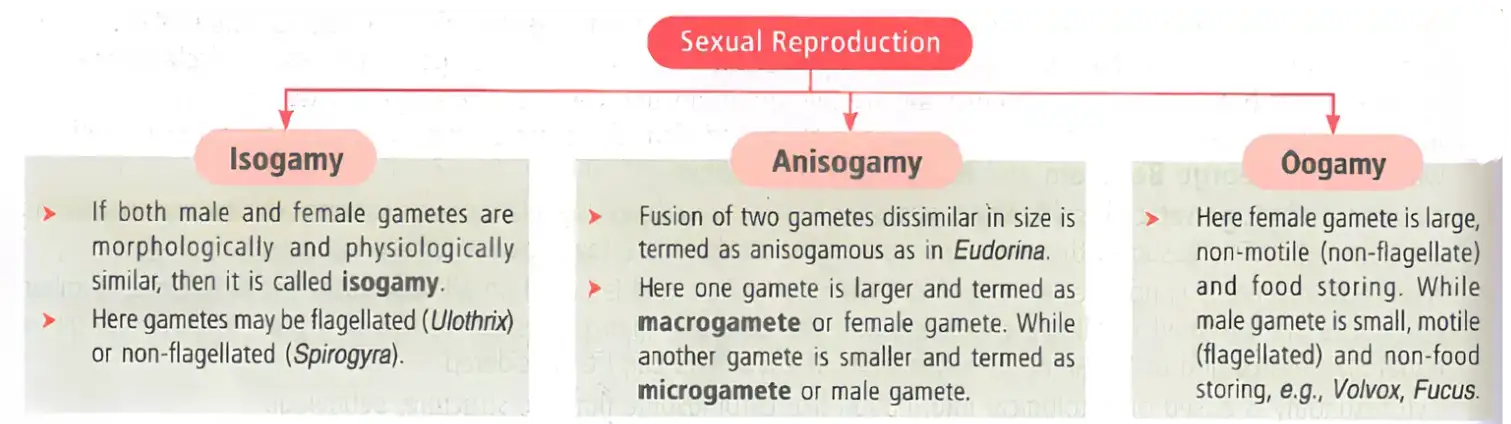
- Reproduction: vegetative (fragmentation), asexual (zoospores), sexual (isogamy, anisogamy, oogamy).
Memory Aids
- Isogamy: gametes alike; Anisogamy: gametes differ in size; Oogamy: large non-motile egg, small motile sperm.
- Kelps = large brown algae, "trees of the sea".
- Thallus = algal body without differentiation.
Quick Checkpoints
- What pigments are common to all algae?
- Name three types of sexual reproduction in algae.
- What is the vegetative body of algae called?
- Which algae live in hot water springs?
Classification of Algae
Classes and Features
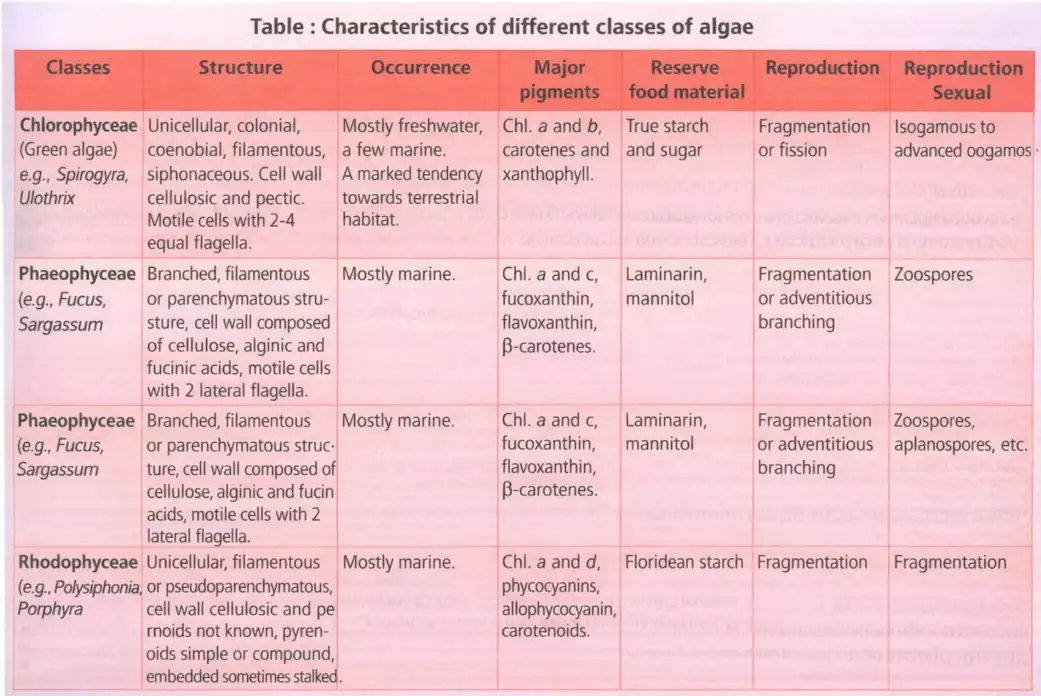
- Based on phylogeny and affinities, algae classified by Dr. F. E. Fritsch and Whittaker.
- Main classes: Chlorophyceae (green algae), Phaeophyceae (brown algae), Rhodophyceae (red algae).
- Chlorophyceae: unicellular/colonial/filamentous; chlorophyll a & b; pyrenoids store protein & starch; cell wall cellulose + pectose; reproduction by fragmentation, flagellated zoospores, sexual types.
- Phaeophyceae: marine; from filamentous to large kelps; pigments chlorophyll a, carotenoids, xanthophylls (fucoxanthin); plant body with holdfast, stipe, frond; reproduction by fragmentation, biflagellate zoospores, sexual types.
- Rhodophyceae: red pigment phycoerythrin; found near surface and deep water; food stored as floridean starch; multicellular thalli; reproduction vegetative by fragmentation, asexual non-motile spores, oogamous sexual reproduction.
Memory Aids
- Chlorophyceae = green, chlorophyll a & b, pyrenoids present.
- Phaeophyceae = brown, fucoxanthin pigment, kelps are large.
- Rhodophyceae = red, phycoerythrin pigment, floridean starch.
Quick Checkpoints
- Which class of algae has pyrenoids?
- What pigment gives brown algae their color?
- Where are red algae found in water?
- What type of spores do red algae produce asexually?
Economic Importance of Algae
Uses and Benefits
- Food: Porphyra, Laminaria, Sargassum; Chlorella rich in protein supplement.
- Photosynthesis: contributes ~50% of Earth's photosynthesis; vital for aquatic respiration.
- Phycocolloids: Alginic acid (from brown algae) used in emulsions, plastics, security glass.
- Agar-agar: from red algae, used as solidifying agent in culture media.
- Carrageen: from red algae, used in pharmaceuticals, textiles, leather, brewing.
- Medicines: Red algae Corallina (anti-worm), brown algae Laminaria & Ascophyllum (antibiotics), Durvillea (vermifuge), green algae Chlorella & Caulerpa (antibiotics).
- Sewage disposal: green algae like Chlamydomonas, Chlorella, Scenedesmus aid aerobic sewage treatment.
Memory Aids
- Phycology = study of algae.
- Algae = non-embryophytes, no embryo, unicellular sex organs.
- Macrocystis pyrifera = largest algae; Laminaria = Devil's Apron.
- Spirogyra = pond silk due to mucilage shine.
Quick Checkpoints
- Name a protein-rich algae used as food supplement.
- What phycocolloid is extracted from brown algae?
- Which algae help in sewage treatment?
- What is the study of algae called?
General Characteristics
Features
- Bryophytes are called amphibians of the plant kingdom; live on soil but need water for sexual reproduction.
- Found in damp, humid, shaded places; important in succession on bare rocks/soil.
- Plant body is thallus-like, prostrate or erect, attached by unicellular/multicellular rhizoids.
- Lack true roots, stems, or leaves but may have root-like, leaf-like, or stem-like structures.
- Main plant body is haploid gametophyte producing gametes.
- Sex organs are multicellular: male antheridium produces biflagellate antherozoids; female archegonium is flask-shaped producing one egg.
- Antherozoids swim in water to fertilize egg forming zygote.
- Zygote forms sporophyte attached to gametophyte; sporophyte produces haploid spores by meiosis.
- Spores germinate into gametophyte, completing life cycle.
Memory Aids
- Amphibians of plants = need water for reproduction.
- Gametophyte = dominant haploid stage.
- Antheridium = male; Archegonium = female.
- Sporophyte depends on gametophyte.
Quick Checkpoints
- Why are bryophytes called amphibians of the plant kingdom?
- What is the dominant stage in bryophytes?
- Describe the structure and function of sex organs in bryophytes.
- How does sporophyte depend on gametophyte?
Liverworts
Characteristics and Reproduction
- Also called Hepaticopsida or Hepaticae.
- Grow in moist, shady habitats: banks, marshy ground, damp soil, tree bark.
- Plant body is thalloid (e.g., Marchantia), dorsiventral, closely attached to substratum.
- Leafy types have tiny leaf-like appendages in two rows on stem-like structures.
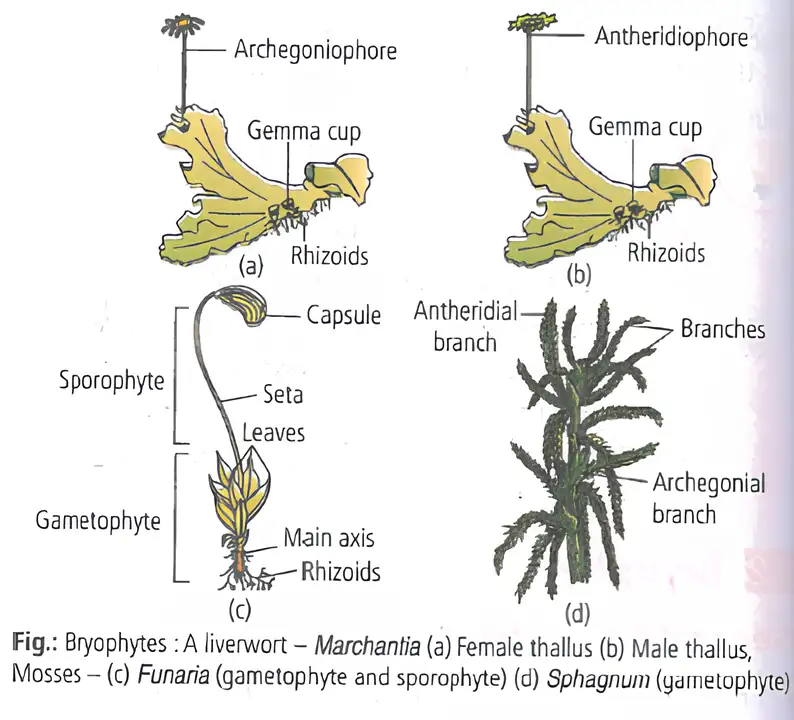
- Asexual reproduction by fragmentation of thalli or by gemmae (multicellular buds) in gemma cups.
- Sexual reproduction: male and female sex organs on same or different thalli.
- Sporophyte has foot, seta, and capsule; spores formed after meiosis in capsule.
- Spores germinate into free-living gametophytes.
Memory Aids
- Gemmae = asexual buds in gemma cups.
- Marchantia = common thalloid liverwort.
- Sporophyte parts: foot, seta, capsule.
Quick Checkpoints
- Where do liverworts commonly grow?
- How do gemmae help in asexual reproduction?
- What are the parts of the sporophyte in liverworts?
Mosses
Life Cycle and Reproduction
- Dominant stage is gametophyte with two stages: protonema and leafy stage.
- Protonema: creeping, green, branched, filamentous stage from spore.
- Leafy stage: develops from lateral bud on secondary protonema; upright axes with spirally arranged leaves.
- Attached to soil by multicellular, branched rhizoids.
- Sex organs (antheridia and archegonia) at apex of leafy shoots.
- Vegetative reproduction by fragmentation and budding in secondary protonema.
- After fertilization, zygote forms sporophyte with foot, seta, and capsule containing spores.
- Common mosses: Funaria, Polytrichum, Sphagnum.
Memory Aids
- Protonema = first stage, filamentous growth.
- Leafy stage bears sex organs.
- Sporophyte parts: foot, seta, capsule.
- Funaria = common moss example.
Quick Checkpoints
- What are the two stages of moss gametophyte?
- How does vegetative reproduction occur in mosses?
- Describe the sporophyte structure in mosses.
Economic Importance of Bryophytes
Uses and Benefits
- Prevention of soil erosion: Mosses form dense mats reducing soil erosion by water and rain impact.
- Soil formation: Bryophytes aid ecological succession and soil formation on rocks (e.g., Sphagnum fills ponds).
- Water retention: Some mosses like Sphagnum absorb 18-26 times their weight in water; used in gardening and plant transport.
- Peat formation: Dead mosses in acidic marshes form peat, used as manure, fuel, and to improve soil aeration and water retention.
- Ecological importance: Mosses and lichens are pioneer colonizers of rocks.
Memory Aids
- Sphagnum = water absorber and peat source.
- Peat = fossilized moss, used as fuel and manure.
- Moss mats prevent soil erosion.
Quick Checkpoints
- How do bryophytes prevent soil erosion?
- What role do bryophytes play in soil formation?
- Why is Sphagnum important in water retention?
- What is peat and its uses?
Additional Facts
Key Points
- Study of bryophytes is called Bryology.
- Tallest bryophytes can reach 70 cm (e.g., Dawsonia).
- Polytrichum is known as hair cap moss.
- Sphagnum is called famine food.
Memory Aids
- Bryology = study of bryophytes.
- Dawsonia = tallest bryophyte.
- Polytrichum = hair cap moss.
- Sphagnum = famine food.
Quick Checkpoints
- What is Bryology?
- Name the tallest bryophyte.
- Which moss is called hair cap moss?
- Why is Sphagnum called famine food?
General Characteristics
Overview
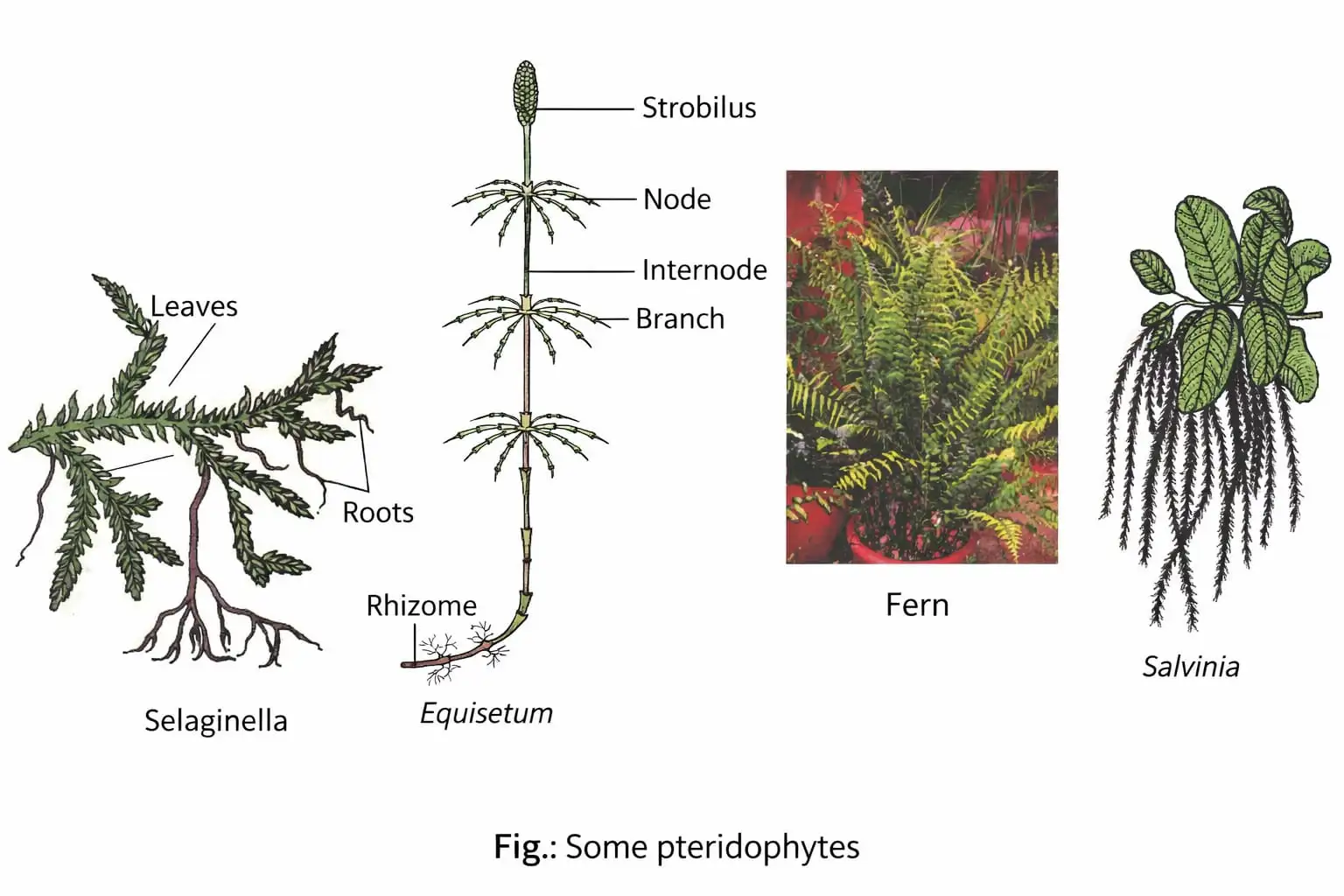
- Pteridophytes include horsetails and ferns; used medicinally, as soil-binders, and ornamentals.
- First terrestrial plants with vascular tissues (xylem and phloem).
- Found mostly in cool, damp, shady places; some thrive in sandy soils.
Plant Body and Reproduction
- Main plant body is a sporophyte with true roots, stems, and leaves (microphylls or macrophylls).
- Sporophytes bear sporangia on leaf-like structures called sporophylls; may form strobili or cones (e.g., Selaginella, Equisetum).
- Sporangia produce spores by meiosis; spores germinate into free-living, photosynthetic gametophytes called prothallus.
- Gametophytes require cool, damp, shady conditions; bear antheridia (male) and archegonia (female).
- Water is essential for antherozoid transfer to archegonium; fertilization forms zygote, which grows into dominant sporophyte.
- Most pteridophytes are homosporous (one spore type); some like Selaginella and Salvinia are heterosporous (macro- and microspores).
- Heterosporous plants retain female gametophytes on sporophyte; embryo development inside female gametophyte is a precursor to seed habit.
Memory Aids
- Pteridophytes = First vascular plants without seeds.
- Sporophyte dominant, gametophyte free-living and photosynthetic.
- Homosporous = one spore type; heterosporous = two spore types.
- Water needed for fertilization.
Quick Checkpoints
- What are the main organs of pteridophyte sporophyte?
- Define sporophyll and strobili.
- Explain the role of water in fertilization.
- Difference between homosporous and heterosporous pteridophytes.
Classification of Pteridophytes
Classes and Features
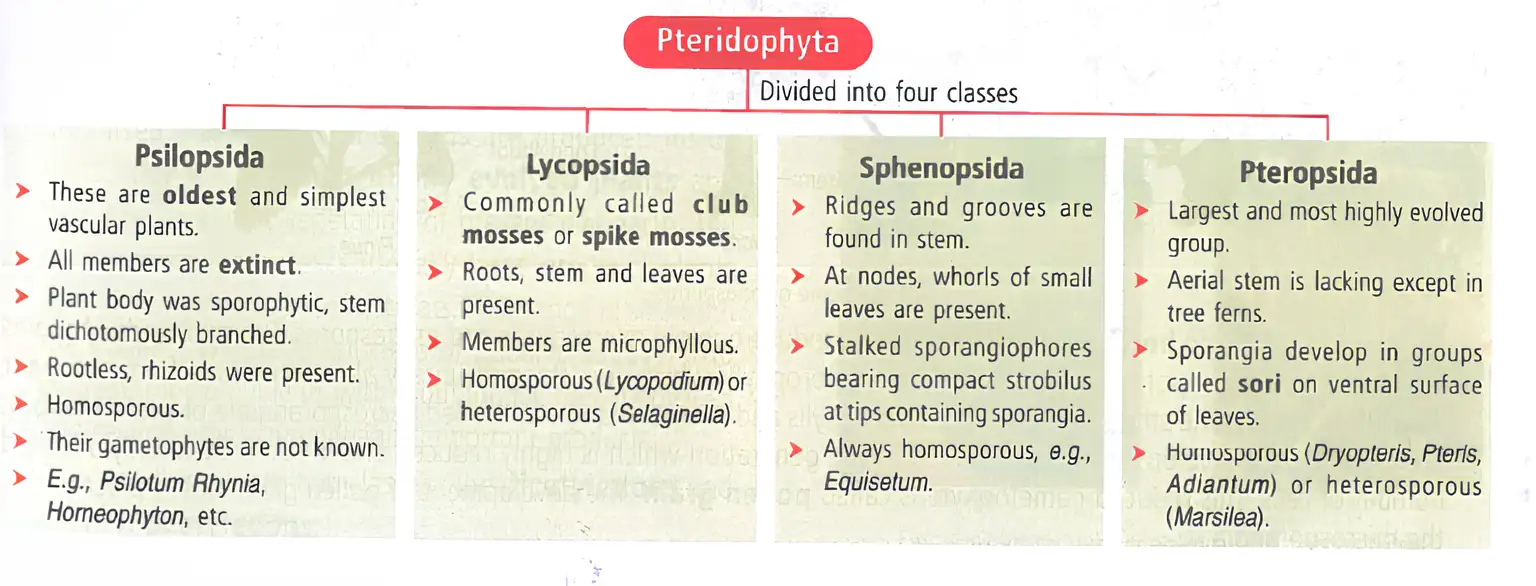
- Psilopsida: Oldest, simplest vascular plants; no roots, have rhizoids; all extinct; e.g., Psilotum.
- Lycopsida: Club mosses/spike mosses; have roots, stems, leaves; homosporous or heterosporous; e.g., Lycopodium, Selaginella.
- Sphenopsida: Stems with ridges/grooves; small leaves in whorls; always homosporous; e.g., Equisetum.
- Pteropsida: Largest, most advanced; mostly lack aerial stem except tree ferns; spores in sori on leaves; homosporous or heterosporous; e.g., Dryopteris, Marsilea.
Memory Aids
- Four classes: Psilopsida (primitive), Lycopsida (club mosses), Sphenopsida (horsetails), Pteropsida (ferns).
- Psilopsida extinct; Lycopsida includes heterosporous plants.
- Sphenopsida always homosporous; Pteropsida most diverse.
Quick Checkpoints
- Name the four classes of pteridophytes.
- Which class is extinct?
- Identify homosporous and heterosporous classes.
- Examples of each class.
Economic Importance of Pteridophytes
Uses
- Food: Sporocarps of Marsilea eaten by some tribal communities.
- Soil binding: Prevent soil erosion on hill slopes.
- Scouring: Stems of Equisetum used for cleaning utensils and polishing metals.
- Nitrogen fixation: Water fern Azolla forms symbiosis with nitrogen-fixing cyanobacteria; used as biofertilizer in paddy fields.
- Medicines: Rhizomes of male shield fern (Dryopteris) yield anti-helminthic drugs; Equisetum used for diuretic, haemostatic, and haemopoietic drugs.
- Ornamental: Ferns grown for attractive foliage; used in bouquets and decorations.
Memory Aids
- Marsilea for food; Equisetum for scouring and medicine.
- Azolla fixes nitrogen; used as biofertilizer.
- Ferns popular as ornamental plants.
Quick Checkpoints
- List economic uses of pteridophytes.
- Which pteridophyte is used as biofertilizer?
- Name medicinal uses of pteridophytes.
- Why are ferns grown ornamentally?
Additional Facts
Key Points
- Term ‘Pteridophyta’ proposed by Haeckel in 1866.
- Study of pteridophytes is called Pteridology.
- Adiantum is called walking fern due to adventitious roots from leaf tips.
- Salvinia is rootless and known as “Sorrow of Kashmir.”
- Alsophila is the tallest pteridophyte; Azolla is the smallest aquatic fern.
- Selaginella species are resurrection plants; dry brown balls revive with water (e.g., S. bryopteris).
Memory Aids
- Pteridophyta named by Haeckel; study called Pteridology.
- Walking fern = Adiantum.
- Rootless fern = Salvinia.
- Tallest = Alsophila, smallest = Azolla.
- Resurrection plant = Selaginella.
Quick Checkpoints
- Who proposed the term Pteridophyta?
- What is Pteridology?
- Why is Adiantum called walking fern?
- Which pteridophyte is rootless?
- Identify the tallest and smallest pteridophytes.
- What are resurrection plants?
General Characteristics
Features
- Gymnosperms have naked ovules exposed before and after fertilisation.
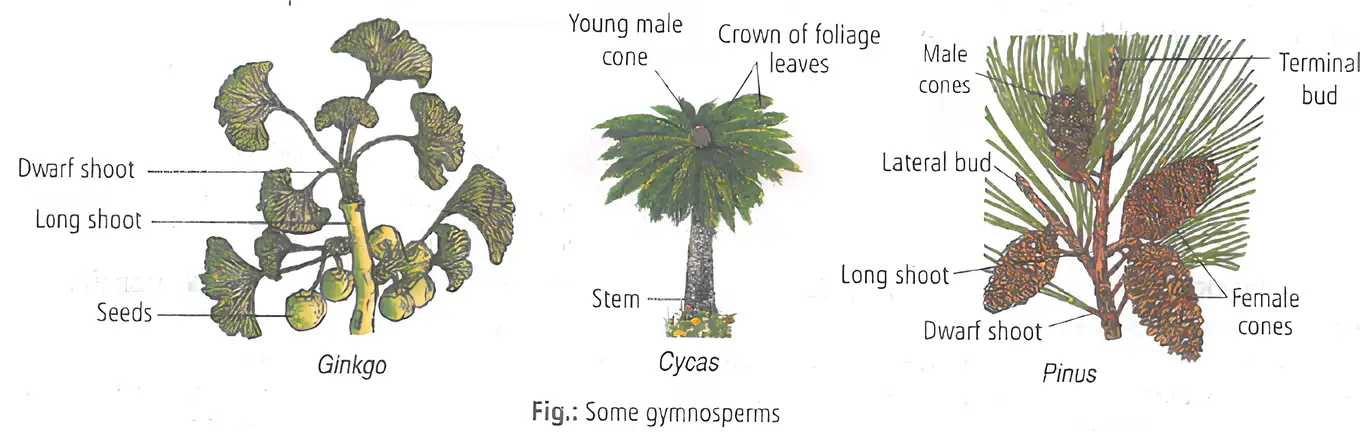
- Include medium to tall trees and shrubs; e.g., Sequoia (giant redwood) is very tall.
- Roots are mostly tap roots; some have mycorrhizal association (Pinus), others have coralloid roots with nitrogen-fixing cyanobacteria (Cycas).
- Stems can be unbranched (Cycas) or branched (Pinus, Cedrus).
- Leaves are simple or compound; Cycas has persistent pinnate leaves.
- Leaves adapted to extreme conditions: needle-like with thick cuticle and sunken stomata to reduce water loss.
Memory Aids
- Gymnosperms = "naked seeds" (no ovary covering).
- Needle leaves = less water loss.
- Sequoia = tallest tree.
Quick Checkpoints
- What type of roots do gymnosperms have?
- How are gymnosperm leaves adapted to dry conditions?
- Which gymnosperm is known as the tallest tree?
Reproductive Structures
Key Points
- Gymnosperms are heterosporous: produce microspores (male) and megaspores (female).
- Spores develop in sporangia on sporophylls arranged in cones (strobili).
- Male cones (microsporangiate strobili) produce pollen grains (reduced male gametophyte).
- Female cones (megasporangiate strobili) bear ovules; ovule = nucellus + envelopes.
- Megaspore mother cell undergoes meiosis → 4 megaspores; one develops into female gametophyte with archegonia inside ovule.
- Male and female gametophytes remain inside sporophyte; no free-living gametophytes.
- Pollen grains released, carried by wind to ovules; pollen tube delivers male gametes to archegonia.
- Fertilisation forms zygote → embryo; ovule develops into seed.
- Four gymnosperm groups: Cycadopsida, Ginkgopsida, Coniferopsida, Gnetopsida.
Memory Aids
- Heterosporous = two spore types → male (pollen) and female (ovule).
- Cones = strobili; male = microsporangiate, female = megasporangiate.
- Pollen grain = reduced male gametophyte.
Quick Checkpoints
- What are the two types of spores in gymnosperms?
- Where do pollen grains develop?
- What is the structure called that bears ovules?
- How is fertilisation achieved in gymnosperms?
Economic Importance
Uses
- Edible seeds: Pinus gerardiana seeds are edible after roasting.
- Timber: Used for light furniture, plywood, railway sleepers.
- Paper: Wood from Picea, Pinus, Larix, Abies used in paper manufacture.
- Linoleum: Sawdust used in linoleum and plastics production.
- Ephedrine: Drug from Ephedra used for respiratory ailments.
- Resin: Extracted for turpentine (solvent) and rosin (waterproofing, paper).
Memory Aids
- Pinus seeds = edible nuts.
- Ephedra = source of ephedrine drug.
- Resin products = turpentine and rosin.
Quick Checkpoints
- Which gymnosperm seeds are edible?
- What are the main uses of gymnosperm wood?
- From which plant is ephedrine obtained?
- What are the products obtained from resin?
Special Adaptations
Adaptations and Features
- Gymnosperms grow on mountain slopes in cold regions; show xerophytic adaptations.
- Vascular plants with xylem and phloem; xylem mostly lacks vessels, phloem lacks companion cells.
- Exceptions with vessels in xylem: Gnetum, Ephedra, Welwitschia.
- Secondary growth occurs; stems are woody but wood is soft due to absence of vessels.
- Endosperm is haploid, formed before fertilisation.
- Ginkgo biloba = Maidenhair tree; Sequoia = Redwood tree.
- Cycas has largest egg, sperm, and ovule among gymnosperms.
Memory Aids
- Xerophytic = adapted to dry, cold mountain slopes.
- Softwood = gymnosperm wood without vessels.
- Ginkgo = Maidenhair tree; Sequoia = Redwood.
Quick Checkpoints
- What type of vascular tissues do gymnosperms have?
- Which gymnosperms have vessels in xylem?
- Why is gymnosperm wood called softwood?
- What is unique about Cycas reproductive cells?
Angiosperms
Overview
- Seed plants with sporophylls organized into flowers.
- Seeds develop inside fruits.
- Most evolved and dominant plants on Earth.
- Range from tiny Wolffia to tall Eucalyptus trees.
- Provide food, fodder, fuel, medicines, and commercial products.
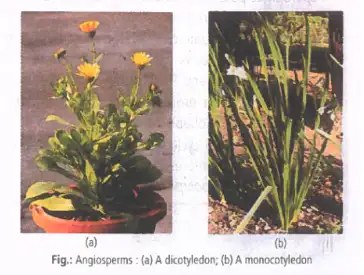
- Divided into two classes: dicotyledons and monocotyledons.
Memory Aids
- Dicots: Two seed leaves, broad leaves, flower parts in 4s or 5s.
- Monocots: One seed leaf, narrow parallel-veined leaves, flower parts in 3s.
Quick Checkpoints
- What defines angiosperms?
- Difference between dicots and monocots?
- Examples of smallest and tallest angiosperms?
Plant Life Cycles and Alternation of Generations
Overview
- Life cycles vary among plant groups but follow a strict sequence of phases.
- This sequence is called alternation of generations.
- Three types of life cycles: haplontic, diplontic, haplodiplontic.
Memory Aids
- Alternation of generations means alternating haploid and diploid phases.
- Haplontic: dominant haploid phase.
- Diplontic: dominant diploid phase.
- Haplodiplontic: both phases multicellular and distinct.
Quick Checkpoints
- What is alternation of generations?
- Name the three life cycle types.
- Which phase is dominant in each type?
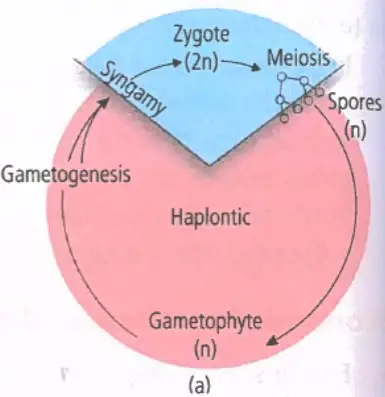
Haplontic Life Cycle
Characteristics
- Single haploid vegetative phase called gametophyte.
- Gametophyte produces haploid gametes.
- Gametes fuse to form diploid zygote (single-celled).
- Zygote does not form multicellular diploid structure; meiosis occurs at germination.
- Meiosis produces haploid nuclei/spores that develop into new gametophytes.
- No true alternation of generations; sporophyte phase is only the single-celled zygote.
- Examples: algae like Volvox, Spirogyra, Chlamydomonas.
Memory Aids
- Haplo = single set of chromosomes dominant.
- Zygote is brief diploid stage only.
Quick Checkpoints
- What is the dominant phase in haplontic cycle?
- When does meiosis occur?
- Does the zygote form a multicellular sporophyte?
Diplontic Life Cycle
Characteristics
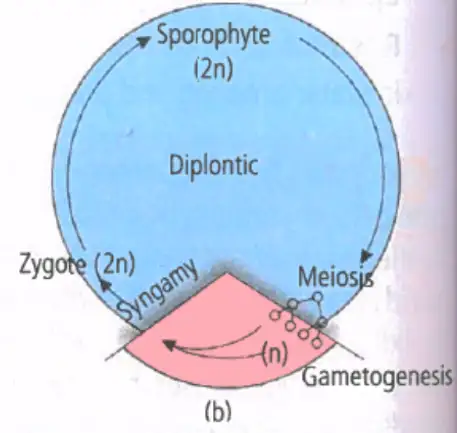
- Single diploid vegetative phase called sporophyte.
- Sporophyte produces haploid gametes via meiosis in sex organs.
- Gametes are the only haploid stage.
- Fertilization produces diploid zygote that grows into sporophyte.
- Occurs in Fucus, Cladophora, and all seed plants (gymnosperms, angiosperms) with some gametophyte variation.
Memory Aids
- Diplo = diploid phase dominant.
- Gametes are haploid but short-lived.
Quick Checkpoints
- Which phase is dominant in diplontic cycle?
- Where does meiosis occur?
- What is the ploidy of gametes?
Haplodiplontic Life Cycle
Characteristics
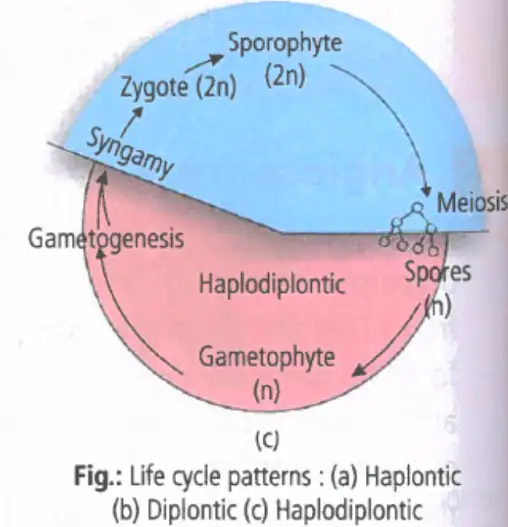
- Two distinct multicellular phases: haploid gametophyte and diploid sporophyte.
- Sporophyte (2n) undergoes meiosis to produce haploid spores.
- Haploid spores grow into gametophytes (n).
- Gametophytes produce gametes; gametes fuse to form diploid zygote.
- Clear alternation of generations between gametophyte and sporophyte.
- Occurs in bryophytes, pteridophytes, and some algae like Dictyota, Ectocarpus, Polysiphonia, kelps.
Memory Aids
- Both haploid and diploid phases are multicellular and independent.
- Alternation of generations is clear and distinct.
Quick Checkpoints
- What are the two phases in haplodiplontic cycle?
- Where does meiosis occur?
- Which phase produces gametes?
NEET Botany — ALL CHAPTERS
1
The Living World
2
Plant Kingdom
3
Morphology of Flowering Plants
4
Anatomy of Flowering Plants
5
The Unit of Life
6
Photosynthesis in Higher Plants
7
Respiration in Plants
8
Plant Growth and Development
9
Sexual Reproduction in Flowering Plants
10
Principles of Inheritance and Variation
11
Molecular Basis of Inheritance
12
Biotechnology :Principles and Processes
13
Biotechnology and its Applications