NEET Ug . NEET Botany . Botany . Biotechnology Principles and Processes
Chapter 12: Biotechnology :Principles and Processes
Ch 12
NEET Botany
NEET Ug
Introduction
Overview
- Biotechnology uses live organisms or enzymes to produce useful products and processes.
- European Federation of Biotechnology defines it as integration of natural science with organisms, cells, parts, and molecular analogues for products and services.
- Includes traditional and modern techniques like in vitro fertilisation, gene synthesis, DNA vaccines, and gene therapy.
- Recombinant DNA technology enables modification of microorganisms and other organisms to create novel capabilities.
- Genetic engineering is the manipulation of genetic material; Berg is the "father of genetic engineering" (Nobel Prize 1980).
- Herbert Boyer and Stanley Cohen pioneered biotechnology by combining restriction enzymes and plasmids to produce proteins in bacteria.
Memory Aids
- Berg = Father of Genetic Engineering (Nobel 1980).
- Boyer + Cohen = Recombinant DNA pioneers.
- Biotechnology = Organisms + Science = Useful products.
Quick Checkpoints
- What is the EFB definition of biotechnology?
- Who are the founders of recombinant DNA technology?
- What is genetic engineering?
Principles of Biotechnology
Core Techniques
- Genetic engineering: Alters DNA/RNA to change host phenotype by gene introduction.
- Chemical engineering: Maintains sterile conditions for microbial or cell growth to produce antibiotics, vaccines, enzymes.
- Genetic engineering involves recombinant DNA creation, gene cloning, and gene transfer.
- First recombinant DNA made by Cohen and Boyer in 1972 using plasmid DNA from Salmonella typhimurium.
- Three steps to create GMOs/transgenic organisms:
- Identify DNA with desired genes.
- Introduce DNA into host.
- Maintain DNA in host and transfer to progeny.
- Alien DNA replicates only when integrated into host chromosome with origin of replication (ori).
- Cloning = making multiple identical copies of DNA.
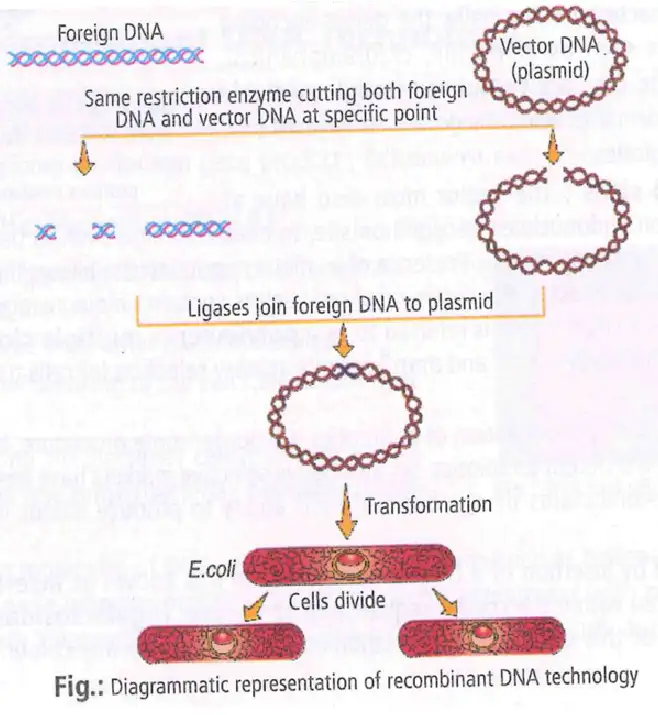
- Restriction enzymes cut DNA at specific sites; plasmids act as vectors to transfer DNA.
- DNA ligase joins cut DNA ends to form recombinant DNA (circular, autonomously replicating DNA).
Memory Aids
- GMO steps: Identify, Introduce, Maintain.
- Restriction enzymes = molecular scissors.
- DNA ligase = molecular glue.
- Plasmid = vector for gene transfer.
Quick Checkpoints
- What are the two core techniques of modern biotechnology?
- What is the role of restriction enzymes?
- How is recombinant DNA formed?
- What are the steps to create a transgenic organism?
Tools of Recombinant DNA Technology
Restriction Enzymes
- Isolated first by W. Arber (1963) in bacteria; Nobel Prize awarded to Arber, Smith, Nathan for discovery.
- Hind II was the first restriction endonuclease; cuts DNA at specific 6-base recognition sequence.
- Enzyme names derive from source organism: first letter genus, next two species (italicized), fourth letter strain (capital), Roman numeral order.
- Restriction enzymes are nucleases: exonucleases remove nucleotides from ends; endonucleases cut within DNA.
- Types based on properties:
- Type I: 3 subunits, require ATP, Mg2+, S-adenosyl methionine; not used in rDNA.
- Type II: require Mg2+; used in rDNA.
- Type III: 2 subunits; not used in rDNA.
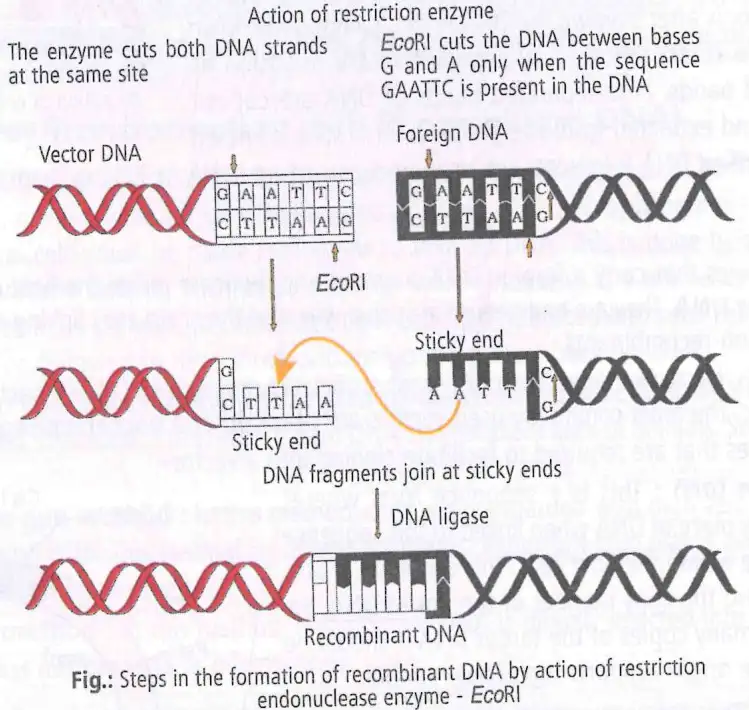
- EcoRI and HindIII produce sticky ends; EcoRII and HindII produce blunt ends.
- Other enzymes:
- Alkaline phosphatase removes 5' phosphate, modifies DNA ends.
- DNA ligase seals gaps in DNA fragments.
- Reverse transcriptase synthesizes cDNA from mRNA template.
- Restriction enzymes recognize palindromic sequences (same read 5'→3' on both strands).
- They cut DNA near center of palindrome, generating 3' or 5' protruding ends (sticky ends).
- Sticky ends have complementary sequences, enabling pairing and ligation by DNA ligase.
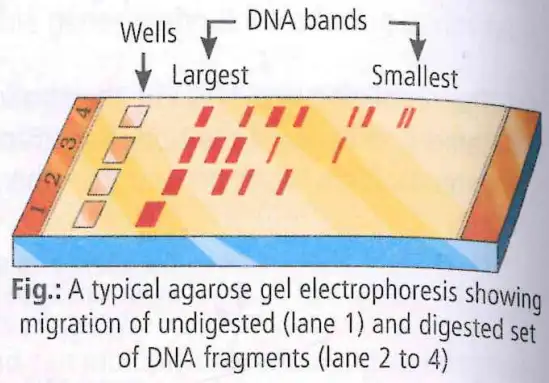
- Restriction fragments separated by gel electrophoresis using agarose gel and stained with ethidium bromide for visualization under UV light.
Memory Aids
- Restriction enzyme names = Genus (italic) + species (italic) + strain (capital) + order (Roman numeral).
- Sticky ends = EcoRI, HindIII; Blunt ends = EcoRII, HindII.
- Type II enzymes used in rDNA; Type I & III not used.
- Palindromic sequences read same 5'→3' on both strands.
Quick Checkpoints
- What defines a restriction enzyme's recognition site?
- Difference between sticky and blunt ends?
- Role of DNA ligase in recombinant DNA?
- How are DNA fragments separated after restriction digestion?

Cloning Vectors
Features and Types
- Vectors carry foreign DNA and replicate inside host cells; also called vehicle or carrier DNA.
- Common vectors: plasmids, bacteriophages, cosmids, YACs, BACs, transposons.
- Key features:
- Origin of replication (ori): Start site for replication; controls copy number.
- Selectable marker: Antibiotic resistance genes (ampicillin, tetracycline, kanamycin) to select transformants.
- Cloning sites: Unique restriction sites (polylinker or MCS) for foreign DNA insertion.
- Insertional inactivation: foreign DNA insertion disrupts marker gene (e.g., B-galactosidase), enabling color-based selection of recombinants.
- Vectors for plants and animals:
- Agrobacterium tumefaciens Ti plasmid modified for plant gene delivery.
- Disarmed retroviruses used for animal gene delivery.
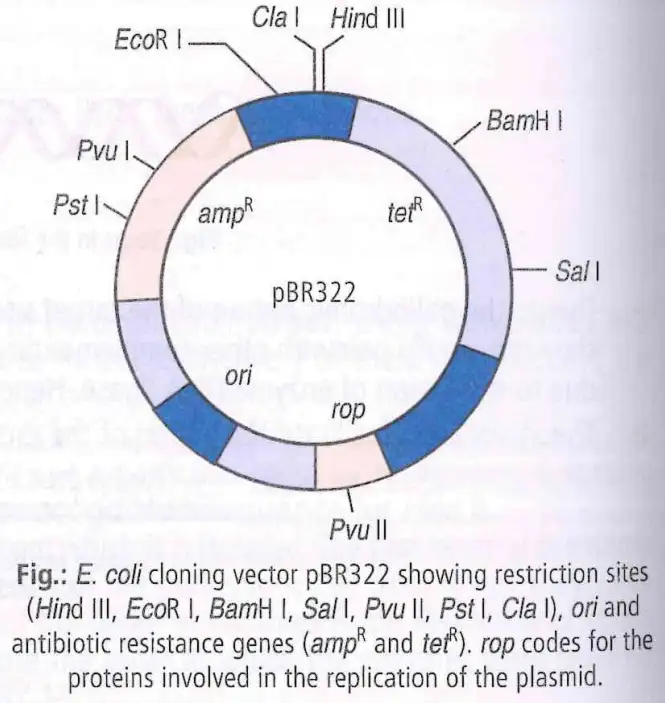
- pBR322: first artificial cloning vector (1977); contains amp^R, tet^R, ori, rop, and multiple restriction sites.
- Shuttle vectors replicate in both eukaryotic and prokaryotic cells.
Memory Aids
- pBR322 = first cloning vector with amp^R and tet^R markers.
- Selectable markers help distinguish transformants by antibiotic resistance or color change.
- Polylinker = multiple cloning sites for easy DNA insertion.
- Agrobacterium Ti plasmid used for plant transformation.
Quick Checkpoints
- What is the role of origin of replication in vectors?
- How do selectable markers aid in recombinant selection?
- What is insertional inactivation?
- Name common vectors used in genetic engineering.
Competent Host (For Transformation with Recombinant DNA)
Host Preparation and Methods
- Competent hosts (E. coli, yeast, animal, plant cells) are required to take up recombinant DNA.
- DNA is hydrophilic; cannot cross membranes without treatment.
- Bacterial cells made competent by treating with divalent cations (e.g., Ca2+) to increase DNA uptake through cell wall pores.
- Transformation steps: incubate cells with DNA on ice, heat shock, then back on ice.
- In eukaryotes, transformation is called transfection.
- Vectorless gene transfer methods:
- Biolistic (gene gun): DNA-coated gold/tungsten particles bombarded into plant cells; used in crops like wheat, rice, maize.
- Microinjection: Direct injection of DNA into animal cell nucleus using micropipette.
- Electroporation creates temporary pores in membranes using lysozyme or calcium chloride.
- Chemicals like polyethylene glycol (PEG) facilitate DNA entry into host cells.
Memory Aids
- Competency increased by Ca2+ treatment and heat shock.
- Biolistic method for plants; microinjection for animals.
- Electroporation and PEG aid DNA uptake.
Quick Checkpoints
- Why must bacterial cells be made competent?
- Difference between transformation and transfection?
- Methods to introduce DNA into eukaryotic cells?
- Role of divalent cations in transformation?
Processes of Recombinant DNA Technology
Steps Involved
- Isolation of genetic material (DNA) from cells.
- Cutting DNA at specific sites using restriction enzymes.
- Amplification of gene of interest by PCR.
- Insertion of recombinant DNA into host cells.
- Production of foreign gene product.
- Downstream processing for product purification.
Memory Aids
- Remember the sequence: Isolate, Cut, Amplify, Insert, Produce, Process.
Quick Checkpoints
- What is the first step in rDNA technology?
- Which enzyme cuts DNA at specific locations?
- How is the gene of interest amplified?
- What is the purpose of downstream processing?
Isolation of Genetic Material
Key Points
- Isolation means removing plasmid or genomic DNA from cells in pure form.
- Cell membranes and walls are broken using enzymes like lysozyme (bacteria), cellulase (plants), chitinase (fungi).
- RNA removed by ribonuclease; proteins removed by protease.
- Purified DNA precipitates with chilled ethanol.
Memory Aids
- Use specific enzymes to break cell walls and remove contaminants.
- Precipitate DNA with cold ethanol for purity.
Quick Checkpoints
- Which enzymes help break cell walls during DNA isolation?
- How are proteins and RNA removed from DNA samples?
- What is the role of chilled ethanol in DNA isolation?
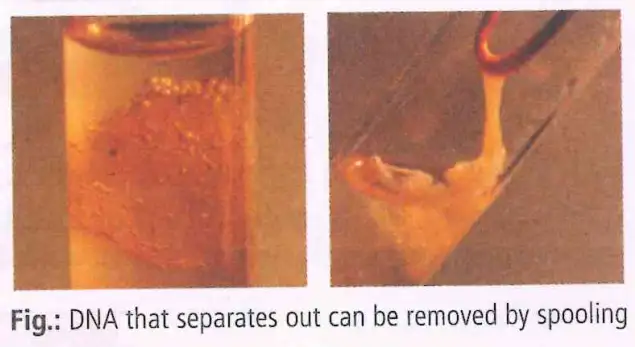
Cutting of DNA at Specific Locations
Key Points
- Restriction enzymes cut purified DNA at specific sequences.
- Digestion progress checked by agarose gel electrophoresis.
- Cut gene of interest and vector DNA are joined using DNA ligase to form recombinant DNA.
Memory Aids
- Restriction enzymes act like molecular scissors at specific sites.
- Gel electrophoresis confirms DNA cutting.
Quick Checkpoints
- What enzyme cuts DNA at specific sites?
- How is the success of DNA cutting verified?
- Which enzyme joins DNA fragments to form recombinant DNA?
Amplification of Gene of Interest using PCR
Key Points
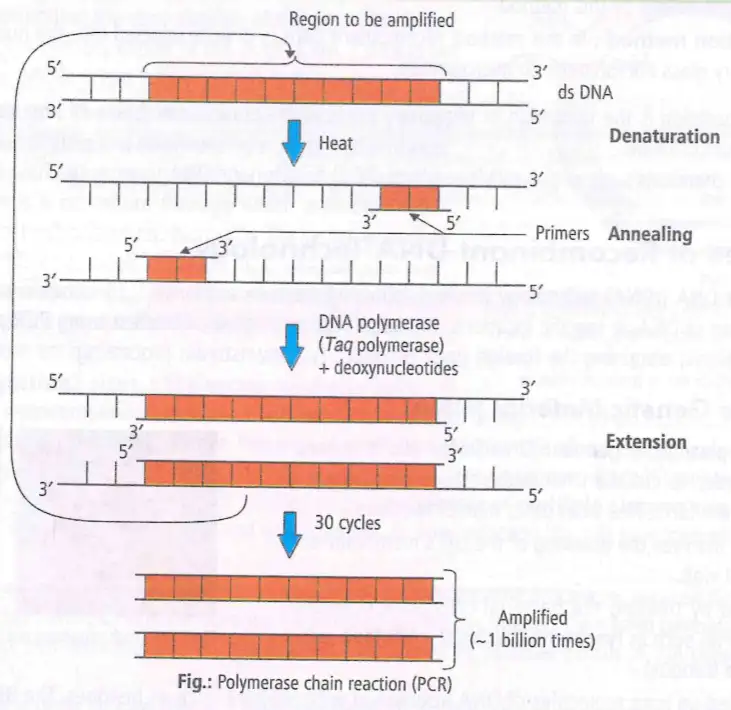
- PCR replicates DNA in vitro using primers and DNA polymerase.
- Thermostable Taq polymerase allows repeated cycles at high temperatures.
- Three steps per cycle: denaturation (90°-98°C), primer annealing (40°-60°C), extension (72°C).
- Amplifies DNA up to a billion times.
- Applications: pathogen diagnosis, DNA fingerprinting, prenatal diagnosis, gene therapy.
Memory Aids
- Denature, Anneal, Extend = PCR cycle steps.
- Taq polymerase works at high heat without denaturing.
Quick Checkpoints
- What enzyme is used in PCR?
- What are the three steps of a PCR cycle?
- How many times can PCR amplify DNA?
Insertion of Recombinant DNA into Host Cell
Key Points
- Recipient cells are made competent to take up recombinant DNA.
- Vector and alien DNA cut by same restriction enzyme to produce complementary sticky ends.
- DNA ligase joins sticky ends forming recombinant DNA.
- Selectable markers like antibiotic resistance genes help identify transformed cells.
- Example: Ampicillin resistance gene allows selection of transformed E. coli on ampicillin plates.
Memory Aids
- Competent cells take up DNA from surroundings.
- Selectable markers identify successful transformants.
Quick Checkpoints
- What makes cells competent?
- How are recombinant DNA fragments joined?
- What is a selectable marker?
Obtaining the Foreign Gene Product
Key Points
- Foreign gene expresses protein called recombinant protein in host cells.
- Cells grown in continuous culture to maintain active growth phase for high protein yield.
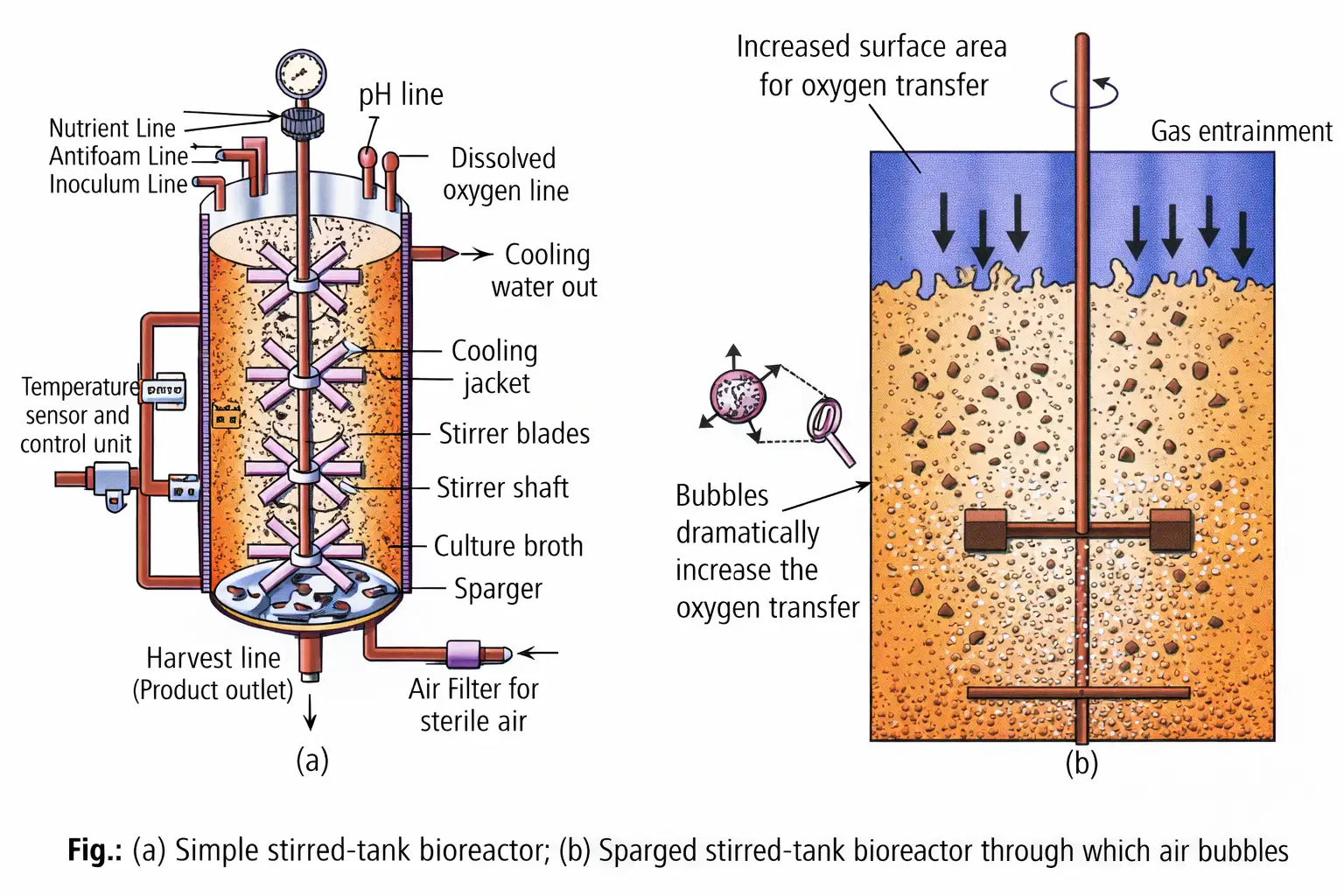
- Bioreactors provide optimal conditions: temperature, pH, oxygen, nutrients.
- Two types of stirred-tank bioreactors: simple and sparged (with air bubbles).
- Bioreactors have systems for mixing, oxygen delivery, foam control, temperature and pH control, and sampling.
Memory Aids
- Bioreactors optimize growth and protein production.
- Sparged bioreactors improve oxygen supply with air bubbles.
Quick Checkpoints
- What is a recombinant protein?
- Why use continuous culture systems?
- What conditions do bioreactors control?
Downstream Processing
Key Points
- Involves separation and purification of the product after biosynthesis.
- Product formulation with preservatives and clinical trials for drugs.
- Strict quality control testing is essential.
- Processes vary depending on the product.
Memory Aids
- Downstream = purification and quality control.
- Formulation and testing ensure product safety.
Quick Checkpoints
- What is the purpose of downstream processing?
- Why is quality control important?
- Does downstream processing vary by product?
NEET Botany — ALL CHAPTERS
1
The Living World
2
Plant Kingdom
3
Morphology of Flowering Plants
4
Anatomy of Flowering Plants
5
The Unit of Life
6
Photosynthesis in Higher Plants
7
Respiration in Plants
8
Plant Growth and Development
9
Sexual Reproduction in Flowering Plants
10
Principles of Inheritance and Variation
11
Molecular Basis of Inheritance
12
Biotechnology :Principles and Processes
13
Biotechnology and its Applications