NEET Ug . NEET Botany . Botany . Morphology of Flowering Plants
Chapter 3: Morphology of Flowering Plants
Ch 3
NEET Botany
NEET Ug
The Root
Structure and Types
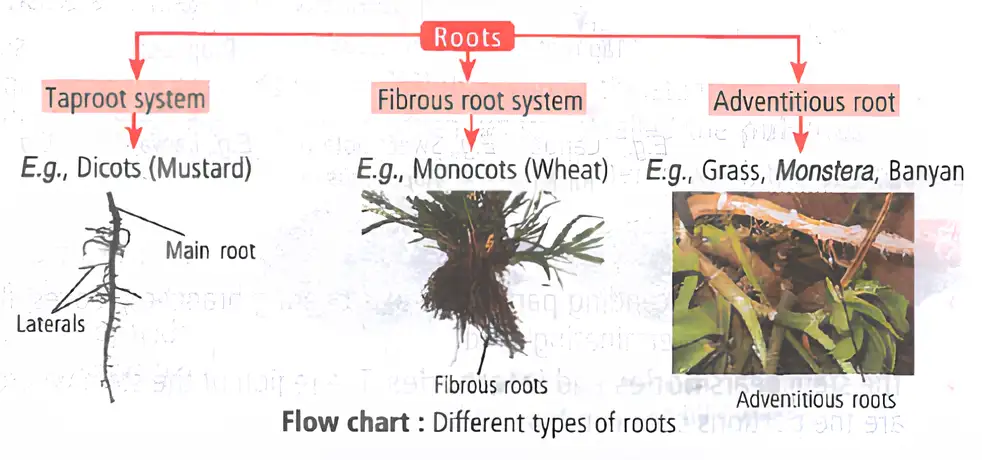
- Dicots: Primary root from radicle grows into soil, forming taproot system with lateral roots (secondary, tertiary).
- Monocots: Primary root short-lived; replaced by fibrous root system from stem base.
- Adventitious roots arise from parts other than radicle (e.g., stems, leaves).
- Functions: Absorb water/minerals, anchor plant, store food, synthesize growth regulators.
Memory Aids
- Taproot = main root + branches (dicots).
- Fibrous roots = many thin roots from stem base (monocots).
- Adventitious roots = roots from non-root parts.
Quick Checkpoints
- What forms the taproot system?
- How do fibrous roots differ from taproots?
- Define adventitious roots.
- List main functions of roots.
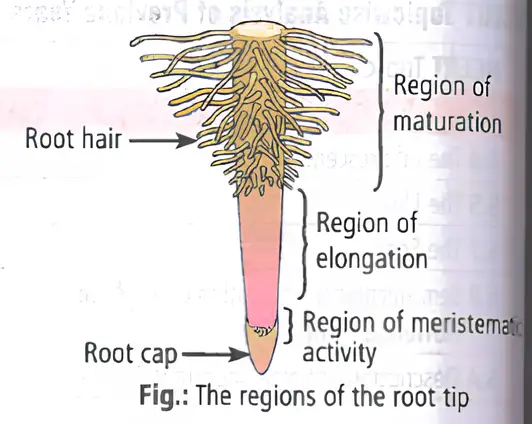
Regions of Root
Root Tip Zones
- Root cap (calyptra): Protects root apex; absent in epiphytes, parasites, hydrophytes, mycorrhizal roots.
- Region of meristematic activity: Small, thin-walled cells dividing rapidly for root growth.
- Region of elongation: Cells elongate, causing root length increase.
- Region of differentiation (maturation): Cells mature; root hairs form here to absorb water/minerals; absent in mycorrhizal roots.
- Region of mature cells: No further change; impermeable to water; anchors plant.
Memory Aids
- Root cap protects tip.
- Meristematic zone = cell division.
- Elongation zone = cell lengthening.
- Differentiation zone = cell specialization + root hairs.
Quick Checkpoints
- What is the function of the root cap?
- Where does cell division occur in root?
- Which region causes root lengthening?
- Where do root hairs develop?
Modifications of Root
Types and Functions
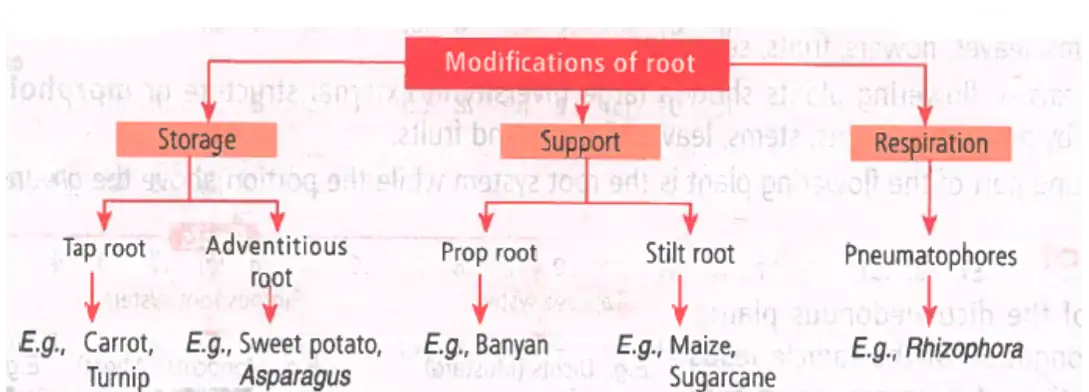
- Roots modify for support, storage, respiration beyond absorption.
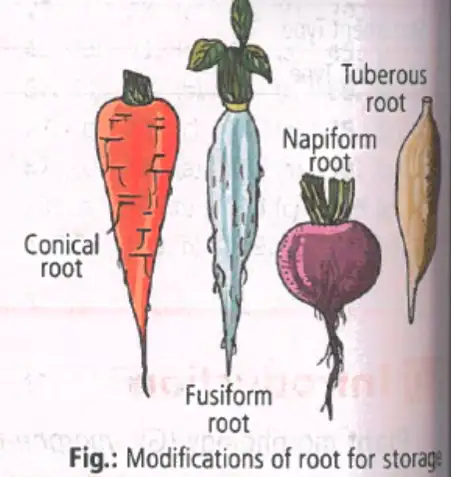
- Storage: Swollen taproots (carrot, turnip), adventitious roots (sweet potato).
- Support: Prop roots (banyan), stilt roots (maize, sugarcane).
- Respiration: Pneumatophores (mangroves like Rhizophora, Sonneratia) grow upwards for oxygen intake.
Memory Aids
- Storage roots: carrot (conical), radish (fusiform), beetroot (napiform), sweet potato (tuberous).
- Support roots: prop and stilt roots stabilize plants.
- Pneumatophores = breathing roots in waterlogged soils.
Quick Checkpoints
- Name root types modified for storage.
- What are prop and stilt roots?
- Function of pneumatophores?
The Stem
Structure and Function
- Ascending part of axis bearing branches, leaves, flowers, and fruits.
- Develops from the plumule of the embryo in a germinating seed.
- Has nodes (where leaves attach) and internodes (regions between nodes).
- Young stems are green; mature stems often become woody and brown.
- Main functions: support branches, conduct water, minerals, and photosynthates.
- Additional roles: food storage, protection, vegetative propagation.
- Bears buds: terminal or axillary; buds are undeveloped shoots with growing points and young leaves.
Memory Aids
- Stem = Support + Transport + Storage + Protection + Propagation.
- Nodes = Leaf attachment points; Internodes = spaces between nodes.
- Buds = Young shoots with growing points.
Quick Checkpoints
- What is the origin of the stem in a seedling?
- Define nodes and internodes.
- List main functions of the stem.
- What are buds and their types?
Modifications of Stem
Types and Functions
- Underground stems store food and aid perennation (e.g., potato tuber, ginger rhizome, turmeric rhizome, zamikand, Colocasia corm).
- Rhizome: horizontal underground stem with nodes, internodes, scaly leaves, and buds (e.g., Zingiber officinale, Curcuma longa).
- Corm: unbranched, spherical, vertical underground stem for storage and vegetative reproduction (e.g., Colocasia, Amorphophallus).
- Tendrils: slender, spirally coiled stems from axillary buds for climbing (e.g., cucumber, grapevine).
- Thorns: modified axillary buds for protection (e.g., Citrus, Bougainvillea).
- Phylloclades: flattened or fleshy stems with chlorophyll for photosynthesis (e.g., Opuntia, Euphorbia).
- Cladodes: one internode long, leaf-like phylloclades capable of photosynthesis (e.g., Ruscus, Asparagus).
- Runners: underground stems spreading to new areas, forming new plants (e.g., grass, strawberry).
- Stolons: slender lateral branches that arch down to the ground and root (e.g., mint, jasmine).
- Offsets: lateral branches with short internodes, rosette leaves, and roots in aquatic plants (e.g., Pistia, Eichhornia).
- Suckers: lateral branches from basal underground stem growing horizontally then upward (e.g., banana, pineapple, chrysanthemum).
- Thorns, spines, prickles, and bristles protect plants from animals and reduce transpiration.
- Thorns: modified stems with vascular tissue and thick bark.
- Spines: modified leaves or parts with vascular strands but no thick bark.
- Prickles: superficial outgrowths without vascular tissue, easily detached.
- Bristles: stiff hairs thickened by silica or calcium carbonate.
Memory Aids
- Rhizome = horizontal underground stem with buds and scaly leaves.
- Corm = vertical, spherical underground stem.
- Tendrils = climbing aid from axillary buds.
- Thorns = protective modified buds.
- Phylloclades and cladodes = photosynthetic stems.
- Runners and stolons = spreading stems for propagation.
- Thorns vs Spines vs Prickles vs Bristles: Stem, leaf, outgrowth, hair.
Quick Checkpoints
- What is a rhizome and examples?
- Define corm and its function.
- How do tendrils help plants?
- Difference between thorns, spines, prickles, and bristles?
- Examples of plants with phylloclades and cladodes.
- What are runners and stolons?
- Role of suckers and offsets?
The Leaf
Structure and Function
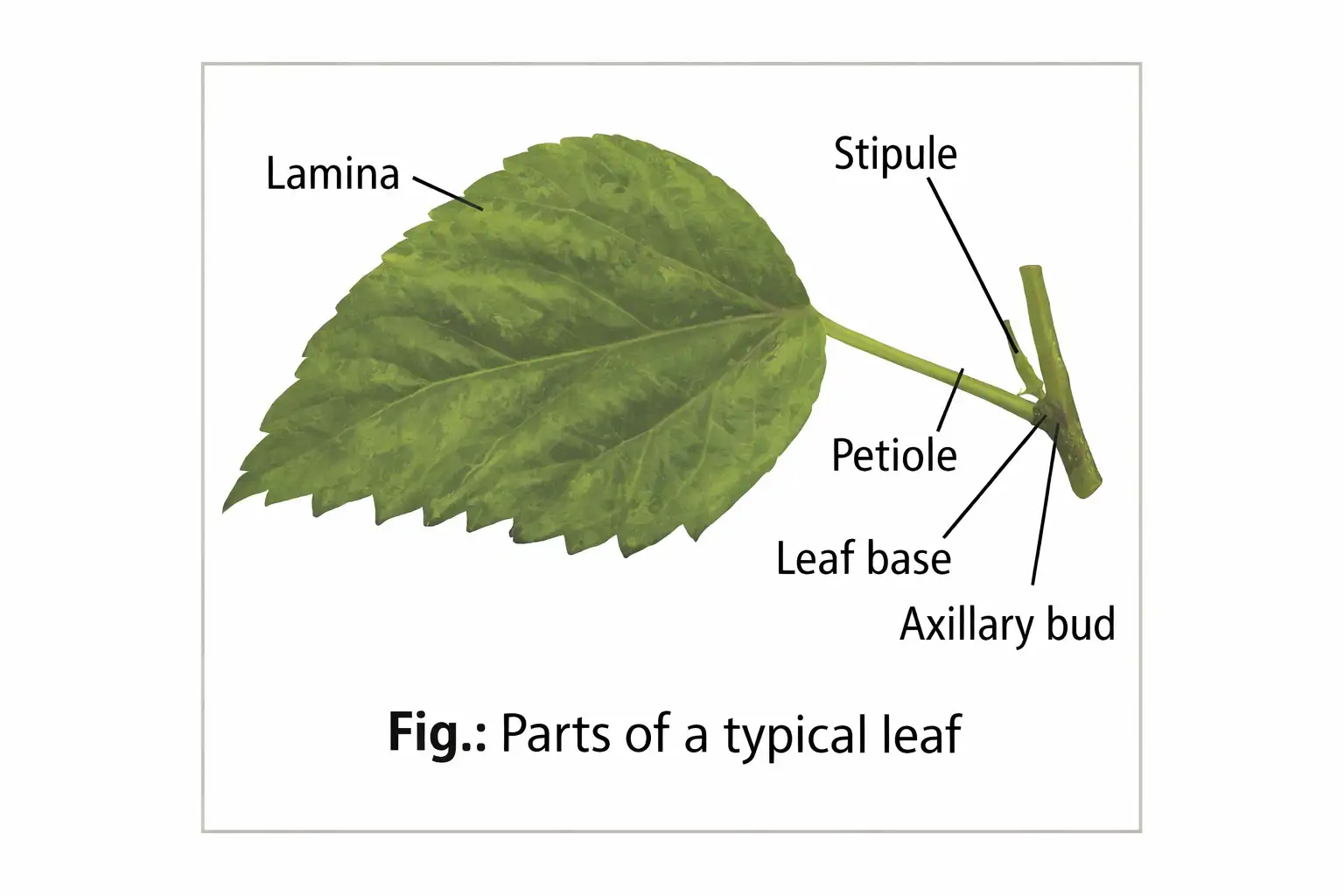
- Leaf is a lateral, flattened structure on stem nodes with an axillary bud that can grow into a branch.
- Leaves develop from shoot apical meristem in acropetal order and are key for photosynthesis.
- Main parts: leaf base, petiole, and lamina.
- Leaf base attaches leaf to stem; may have stipules (small leaf-like structures).
- In monocots (e.g., maize), leaf base forms a sheath around stem; in some legumes, it swells into a pulvinus.
- Petiole holds lamina to light; flexible petioles allow leaf fluttering for cooling and air circulation.
- Lamina is the green expanded blade with veins; midrib is the central prominent vein providing support and transport.
Memory Aids
- Leaf parts: Base, Petiole, Lamina (BPL).
- Petiole flutter = leaf cooling.
- Midrib = main vein for support and transport.
Quick Checkpoints
- What is the function of the axillary bud?
- Which part of the leaf attaches it to the stem?
- How does petiole help in leaf function?
- What is the role of midrib?
Venation
Types and Characteristics
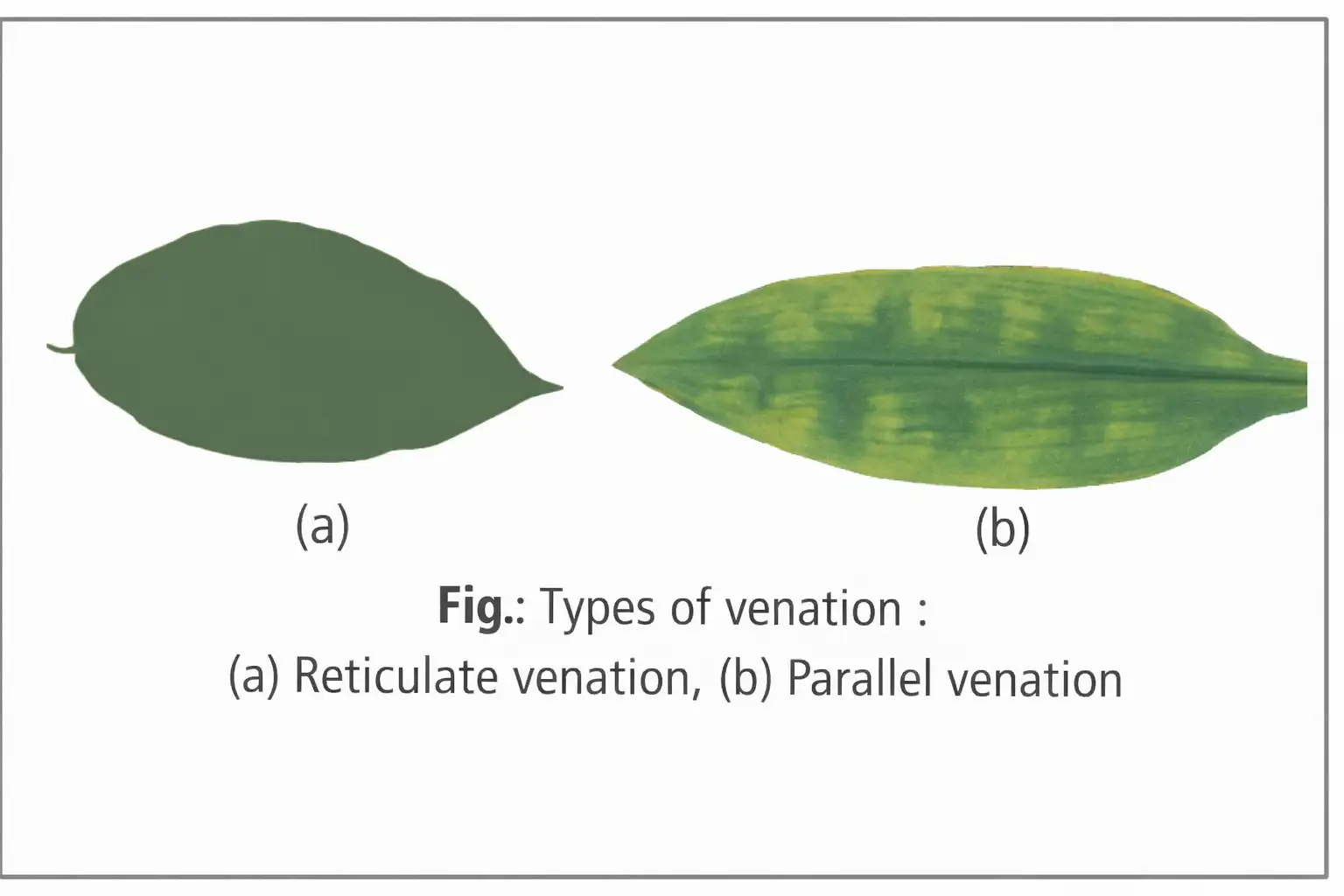
- Venation is the arrangement of veins and veinlets in the leaf lamina.
- Reticulate venation: veins form a network; typical of dicots.
- Parallel venation: veins run parallel; typical of monocots.
- Veins provide mechanical support and transport water, minerals, and food.
Memory Aids
- Reticulate = network (dicots).
- Parallel = side-by-side lines (monocots).
Quick Checkpoints
- What type of venation do dicots have?
- Which venation is found in monocots?
- How do veins support the leaf?
Types of Leaves
Simple and Compound Leaves
- Simple leaf: lamina is entire or incised but incisions do not reach midrib.
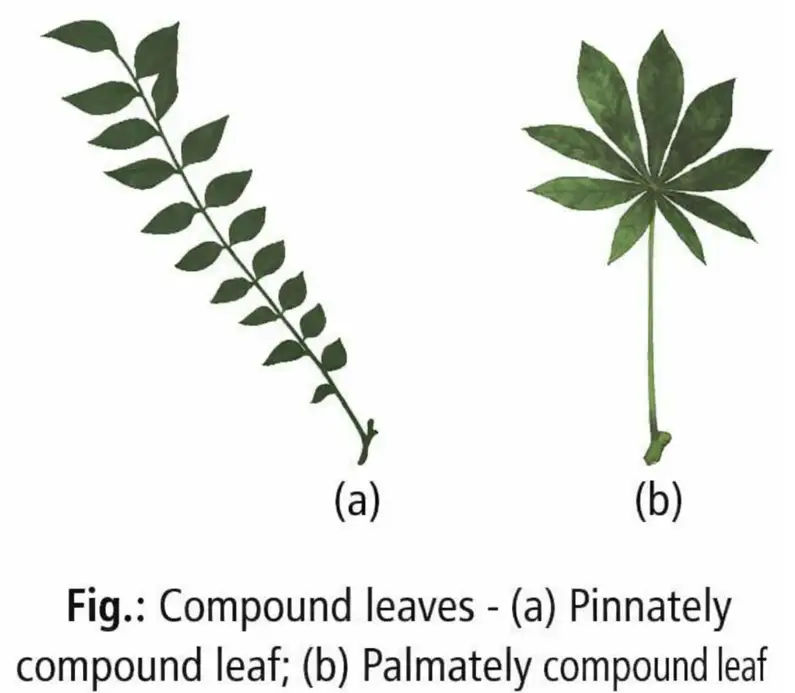
- Compound leaf: lamina incisions reach midrib, dividing into leaflets.
- Bud present in axil of petiole in both types, but not in leaflets of compound leaf.
- Compound leaves are pinnately or palmately compound.
- Pinnately compound: leaflets on a common axis (rachis), e.g., Azadirachta indica (neem).
- Palmately compound: leaflets attached at one point at petiole tip, e.g., Bombax ceiba (silk cotton).
Memory Aids
- Simple = single lamina; Compound = multiple leaflets.
- Pinnate = feather-like; Palmate = hand-like.
Quick Checkpoints
- How to distinguish simple and compound leaves?
- What is a rachis?
- Difference between pinnate and palmate compound leaves?
Phyllotaxy
Leaf Arrangement on Stem
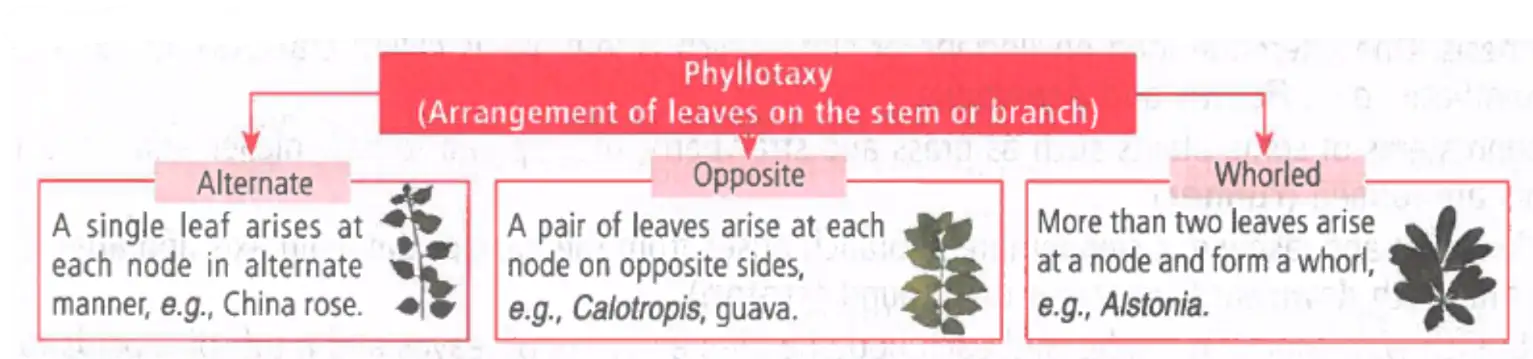
- Phyllotaxy is the arrangement of leaves on a stem or branch.
- Alternate: one leaf per node on alternating sides (e.g., Hibiscus rosa-sinensis).
- Opposite: two leaves per node, opposite each other (e.g., Psidium guajava).
- Whorled: more than two leaves per node forming a circle (e.g., Alstonia).
- Efficient sunlight capture by leaf arrangement.
Memory Aids
- Alternate = one leaf, alternate sides.
- Opposite = two leaves, opposite sides.
- Whorled = multiple leaves in a circle.
Quick Checkpoints
- What is phyllotaxy?
- Examples of alternate and opposite phyllotaxy?
- How does whorled phyllotaxy differ?
Modifications of Leaves
Functional Adaptations
- Leaves modified for functions other than photosynthesis.
- Tendrils for climbing: e.g., Pisum sativum (garden pea).
- Spines for defense: e.g., cactus, Opuntia.
- Fleshy leaves for food storage: onion, garlic.
- Petiole becomes green and photosynthetic in some plants like Australian acacia.
- Insectivorous leaves: pitcher plant (Nepenthes), Venus flytrap (Dionaea).
Memory Aids
- Tendrils = climbing aid.
- Spines = defense.
- Fleshy leaves = storage.
- Insectivorous = insect-catching.
Quick Checkpoints
- What are leaf modifications?
- Examples of leaves modified for climbing and defense?
- Which plants have fleshy storage leaves?
- How do insectivorous leaves function?
Inflorescence
Concept and Types
- A flower is a modified shoot where the shoot apical meristem becomes floral meristem.
- Inflorescence is the arrangement of flowers on the floral axis.
- Two main types: Racemose and Cymose.
- In Racemose, the main axis grows continuously; flowers develop laterally in acropetal succession (younger flowers at the top).
- In Cymose, the main axis ends in a flower, limiting growth; flowers develop in basipetal order (older flowers at the top or center).
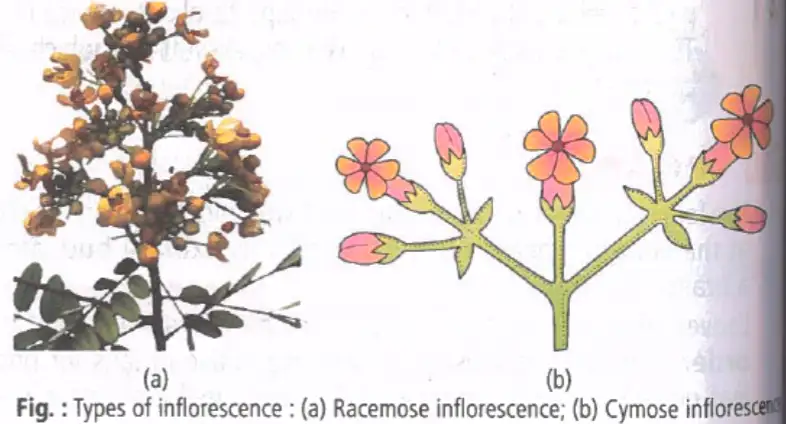
Memory Aids
- Racemose: "R" for "Run" (main axis keeps growing).
- Cymose: "C" for "Cease" (main axis stops at flower).
- Acropetal succession: younger flowers at the apex.
- Basipetal order: older flowers at the apex.
Quick Checkpoints
- What changes in the shoot apical meristem to form a flower?
- Define inflorescence.
- Distinguish between racemose and cymose inflorescence based on growth and flower order.
- What is acropetal succession?
- What is basipetal order?
Special Types of Inflorescence
Examples and Features
- Hypanthodium: Fleshy receptacle forming a hollow structure with an apical opening guarded by scales; e.g., Ficus religiosa (peepal), Ficus benghalensis (banyan).
- Verticillaster: Modified condensed dichasial cyme with two whorls of 3 to 9 flowers on either side of a node; e.g., Ocimum sanctum.
- Cyathium: Inflorescence resembling a single flower; bracts fuse into a cup enclosing one female flower surrounded by many male flowers; e.g., Euphorbia pulcherrima.
Memory Aids
- Hypanthodium: "Hollow house" with guarded opening.
- Verticillaster: "Whorled clusters" on nodes.
- Cyathium: "Cup flower" with many males around one female.
Quick Checkpoints
- What is the structure of hypanthodium?
- How are flowers arranged in verticillaster?
- Describe the composition of cyathium inflorescence.
The Flower
Subtopics
- Unit of sexual reproduction in angiosperms.
- Four whorls: calyx, corolla, androecium, gynoecium on thalamus (receptacle).
- Calyx and corolla are accessory; androecium and gynoecium are reproductive.
- Perianth: when calyx and corolla are indistinct (e.g., lily).
- Bisexual flower: has both androecium and gynoecium; unisexual: only one.
- Complete flower: all four whorls present; incomplete: any whorl absent.
- Symmetry: actinomorphic (radial), zygomorphic (bilateral), asymmetric (irregular).
- Floral appendages in multiples: trimerous (3), tetramerous (4), pentamerous (5).
- Bracteate flowers have bracts at pedicel base; ebracteate lack bracts.
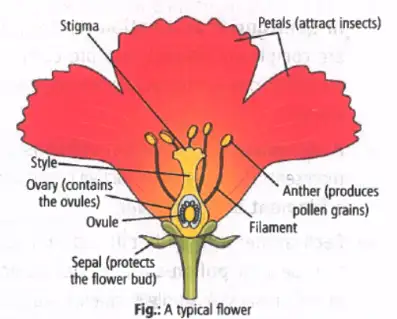
Memory Aids
- Perianth = Calyx + Corolla indistinct.
- Bisexual = Both reproductive whorls present.
- Actinomorphic = Radial symmetry; Zygomorphic = Bilateral symmetry.
- Trimerous, Tetramerous, Pentamerous = Floral parts in multiples of 3, 4, 5.
Quick Checkpoints
- What are the four floral whorls?
- Define bisexual and unisexual flowers.
- What is perianth?
- How to identify actinomorphic vs zygomorphic flowers?
- What does complete flower mean?
Flower Types Based on Ovary Position
Subtopics
- Hypogynous: floral parts below ovary; ovary superior (e.g., mustard, China rose).
- Perigynous: floral parts around ovary on cup-shaped thalamus; ovary half-inferior (e.g., rose, plum).
- Epigynous: floral parts above ovary; ovary inferior (e.g., guava, cucumber, sunflower ray florets).
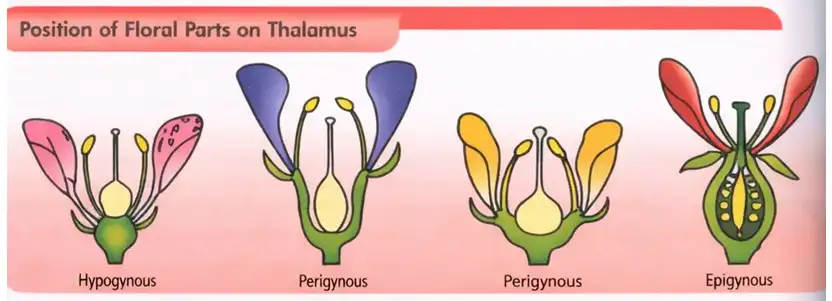
Memory Aids
- Hypogynous = "Hypo" means below; ovary on top.
- Perigynous = "Peri" means around; ovary in middle.
- Epigynous = "Epi" means above; ovary below.
Quick Checkpoints
- Where are floral parts attached in hypogynous flowers?
- What is the ovary position in perigynous flowers?
- Which flowers have inferior ovary?
Types of Placentation
Subtopics
- Parietal: seeds on ovary walls.
- Marginal: seeds in single row along ovary edge.
- Axile: seeds on central column in divided ovary.
- Free central: seeds around central column in undivided ovary.
- Basal: single seed at ovary base.
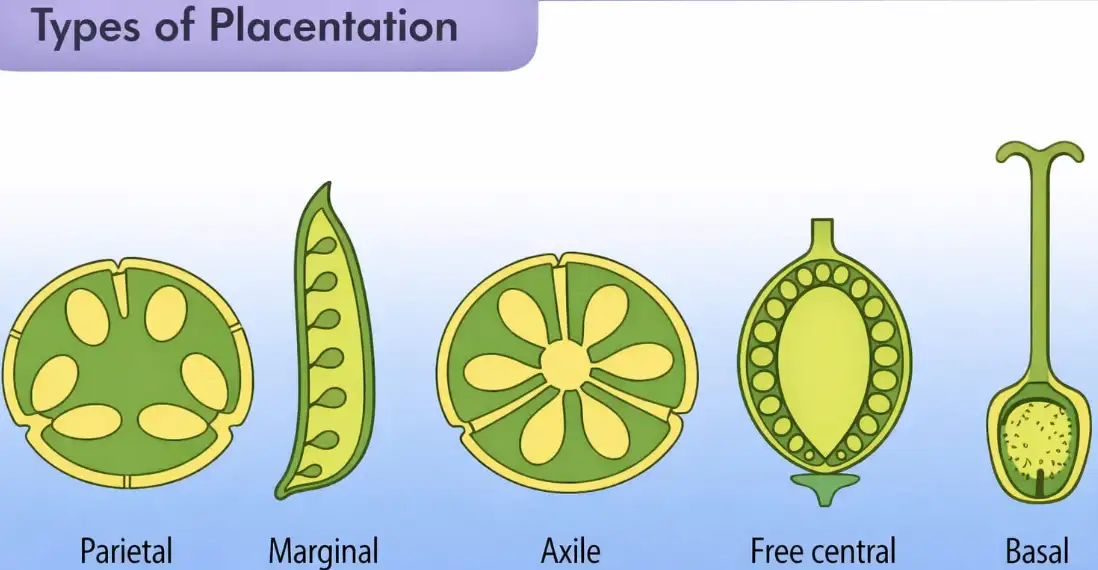
Memory Aids
- Parietal = "Pari" means wall.
- Marginal = seeds on margin edge.
- Axile = Axis center.
- Free central = Central column free in ovary.
- Basal = Base seed.
Quick Checkpoints
- Where are seeds located in axile placentation?
- Define free central placentation.
- Which placentation has single seed?
Parts of Flower
Subtopics
- Calyx: outermost whorl; sepals protect bud; gamosepalous (united) or polysepalous (free).
- Corolla: petals attract pollinators; polypetalous (free) or gamopetalous (united); shapes vary.
Memory Aids
- Sepals = Calyx; Petals = Corolla.
- Gamosepalous = united sepals; Polysepalous = free sepals.
- Polypetalous = free petals; Gamopetalous = united petals.
Quick Checkpoints
- What is the function of sepals?
- Difference between gamosepalous and polysepalous calyx?
- What shapes can corolla have?
Aestivation
Subtopics
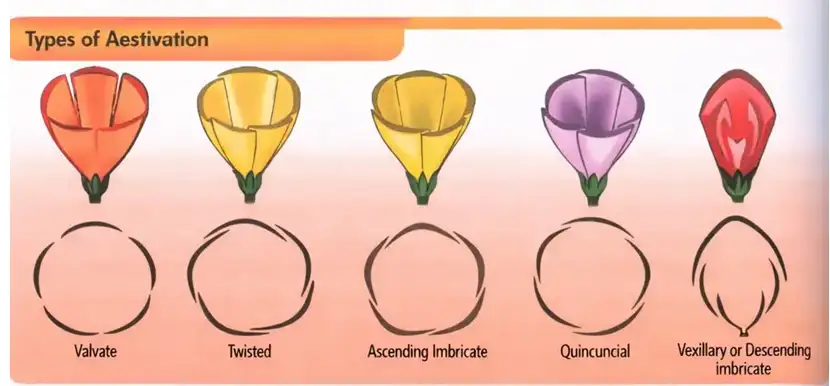
- Arrangement of sepals or petals in floral bud.
- Main types: valvate, twisted, imbricate, vexillary (papilionaceous).
- Valvate: margins touch, no overlap (e.g., Calotropis).
- Twisted: each overlaps next in spiral (e.g., China rose).
- Imbricate: margins overlap irregularly (e.g., Cassia).
- Vexillary: largest petal overlaps others; typical in pea family.
Memory Aids
- Valvate = just touching edges.
- Twisted = spiral overlap.
- Imbricate = random overlap.
- Vexillary = largest petal covers others.
Quick Checkpoints
- What is aestivation?
- Identify valvate and twisted aestivation.
- Which aestivation is typical of pea flowers?
Structure of Monocotyledonous Seed
Subtopics
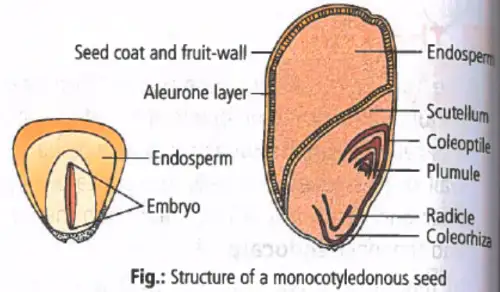
- Mostly endospermic; some non-endospermic (e.g., orchids).
- Seed coat membranous, often fused with fruit wall.
- Endosperm stores food; surrounded by aleurone layer.
- Embryo small, in groove at end of endosperm.
- Embryo parts: scutellum (absorbs food), plumule (shoot), radicle (root).
- Protective sheaths: coleoptile (plumule), coleorhiza (radicle).
Memory Aids
- Scutellum = shield-shaped cotyledon.
- Coleoptile protects plumule; Coleorhiza protects radicle.
- Aleurone layer surrounds endosperm.
Quick Checkpoints
- What is the function of aleurone layer?
- Identify parts of monocot embryo.
- Difference between coleoptile and coleorhiza.
The Fruit
Definition and Structure
- Fruit is a mature ovary developed after fertilisation in flowering plants.
- Parthenocarpic fruit forms without fertilisation, e.g., banana.
- Fruit consists of pericarp (fruit wall) and seeds.
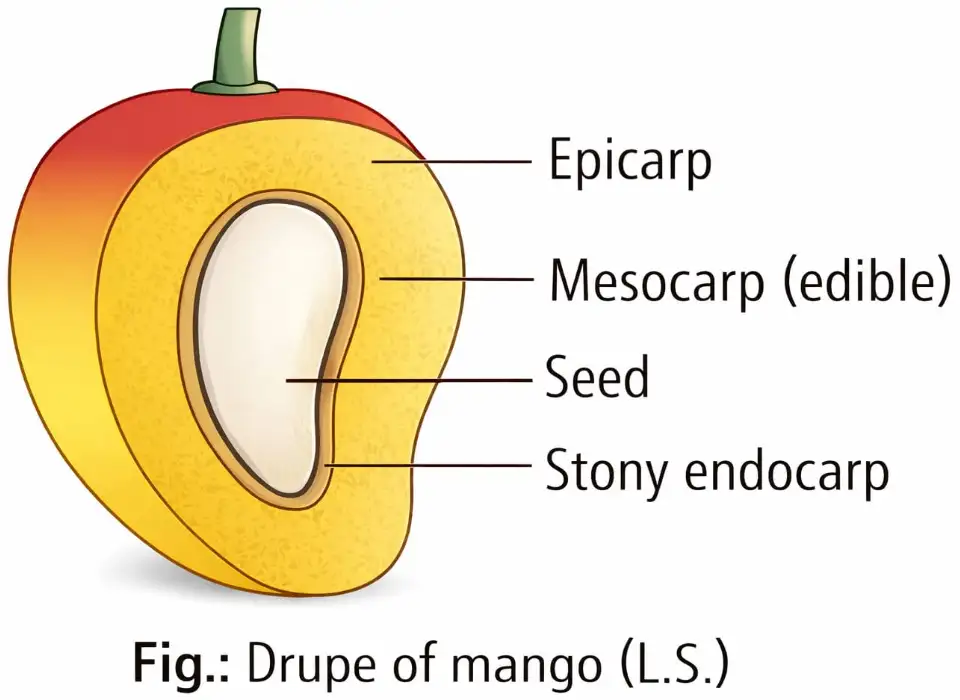
- Pericarp may be dry or fleshy; fleshy pericarp has three layers: epicarp (outer), mesocarp (middle), endocarp (inner).
Examples of Drupe
- Mango and coconut are drupes, developing from monocarpellary superior ovaries.
- Mango pericarp: thin epicarp, fleshy mesocarp (edible), hard stony endocarp.
- Coconut mesocarp is fibrous.
Memory Aids
- Fruit = Mature ovary + seeds.
- Parthenocarpic = No fertilisation (banana).
- Pericarp layers: Epicarp (skin), Mesocarp (flesh), Endocarp (seed cover).
- Drupe = One seed, hard endocarp (mango, coconut).
Quick Checkpoints
- What is a parthenocarpic fruit?
- Name the three layers of pericarp.
- Which fruits are classified as drupes?
Fruit Classification
Simple Fruits
- Develop from mono- or multicarpellary syncarpous ovary.
- Divided into dry and fleshy fruits.
- Dry fruits:
- Dehiscent: Pod (pea), Follicle (Delphinium), Siliqua (mustard), Silicula (Iberis), Capsule (cotton).
- Indehiscent: Cypsela (marigold), Caryopsis (maize), Achene (Mirabilis), Samara (Holoptelia), Nut (litchi).
- Schizocarpic: Lomentum (acacia), Cremocarp (coriander), Double samara (acer), Regma (ricinus).
- Fleshy fruits: Drupe (mango), Berry (tomato), Pepo (cucurbits), Pome (pear), Hesperidium (orange), Balausta (pomegranate).
Aggregate Fruits
- Develop from multicarpellary apocarpous ovary.
- Types:
- Etaerio of achenes (e.g., Ranunculus).
- Etaerio of follicles (e.g., Michelia).
- Etaerio of drupes (e.g., raspberry).
- Etaerio of berries (e.g., custard apple).
Composite Fruits
- Develop from complete inflorescence.
- Examples: Sorosis (pineapple), Syconus (banyan).
Memory Aids
- Simple fruits = Single ovary; dry or fleshy.
- Aggregate fruits = Multiple ovaries, separate carpels.
- Composite fruits = Whole inflorescence forms fruit.
- Dehiscent dry fruits split open; indehiscent do not.
Quick Checkpoints
- What defines a simple fruit?
- Give examples of dehiscent and indehiscent dry fruits.
- How do aggregate fruits develop?
- What are composite fruits?
The Seed
Overview
- Ovules develop into seeds after fertilisation.
- Seed consists of seed coat and embryo.
- Embryo has radicle, embryonal axis, and cotyledons (one in monocots like wheat, maize; two in dicots like gram, pea).
Memory Aids
- Seed = Seed coat + Embryo (radicle + axis + cotyledons).
- Monocot = 1 cotyledon; Dicot = 2 cotyledons.
Quick Checkpoints
- What are the main parts of a seed?
- Difference between monocot and dicot embryos?
Structure of Dicotyledonous Seed
Seed Coat and Embryo
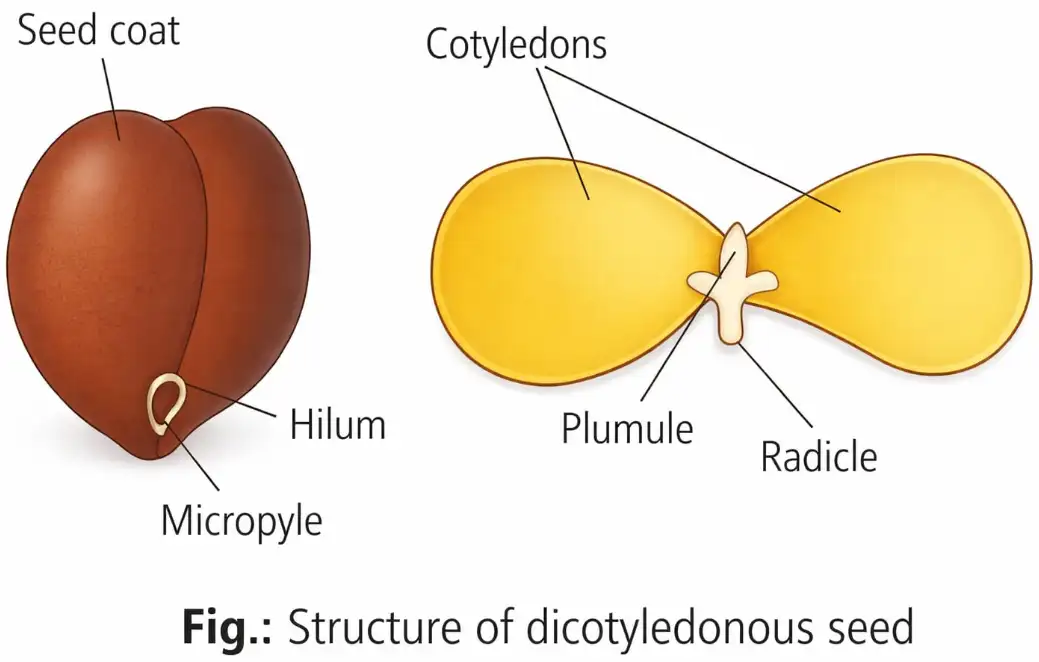
- Seed coat has two layers: outer testa and inner tegmen.
- Hilum: scar where seed attached to fruit.
- Micropyle: small pore above hilum for water entry.
- Embryo inside seed coat has embryonal axis and two cotyledons storing food.
- Embryonal axis ends: radicle (root) and plumule (shoot).
- Endosperm present in some seeds (e.g., castor) as food storage.
- Non-endospermic seeds (e.g., gram, pea) lack endosperm at maturity.
Memory Aids
- Testa = outer seed coat; Tegmen = inner seed coat.
- Hilum = seed attachment scar; Micropyle = water entry pore.
- Radicle = root; Plumule = shoot.
- Dicot seeds usually non-endospermic.
Quick Checkpoints
- What layers form the seed coat?
- Function of micropyle and hilum?
- Difference between endospermic and non-endospermic seeds?
Structure of Monocotyledonous Seed
Seed Components
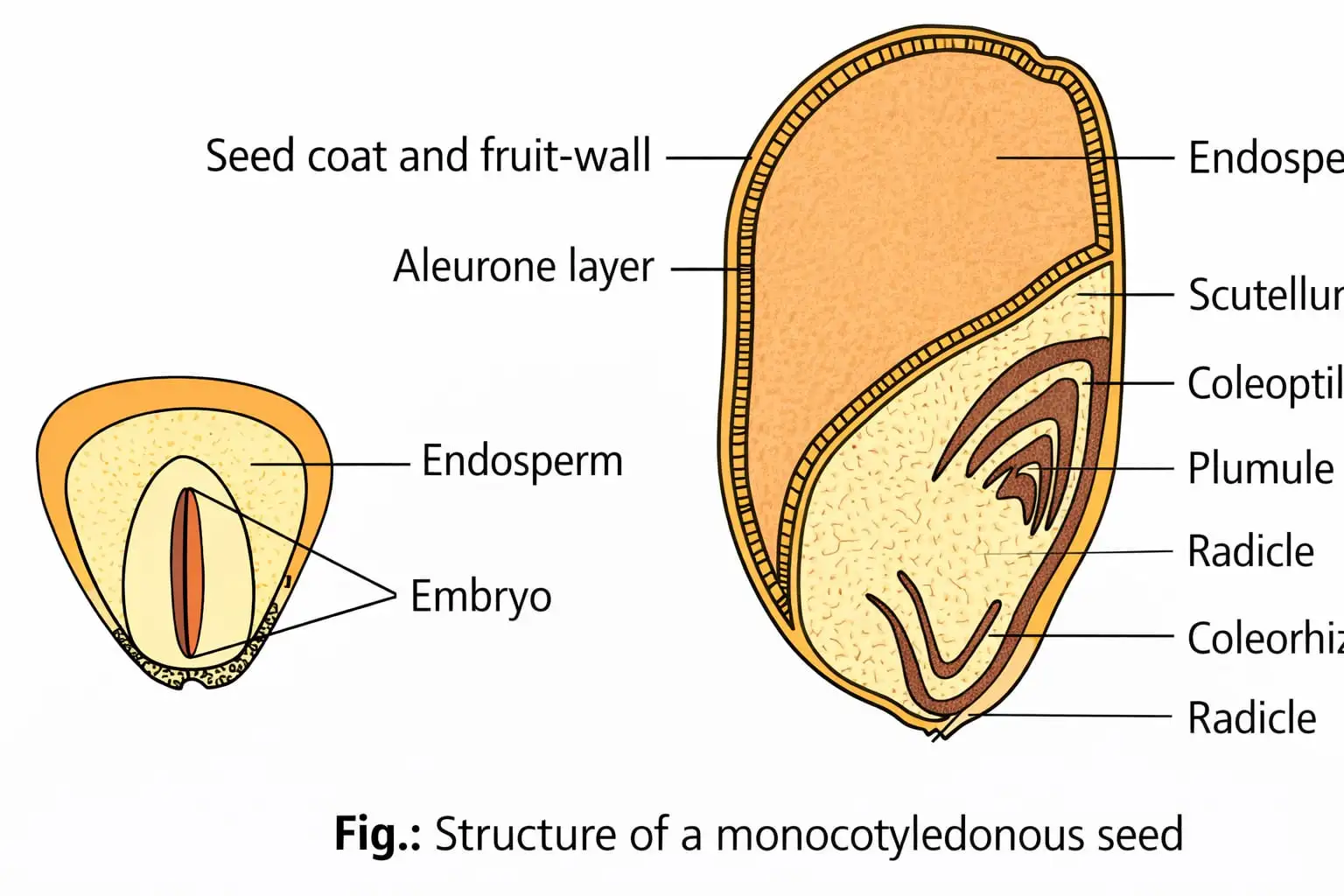
- Monocot seeds mostly endospermic; some (orchids) non-endospermic.
- Seed coat is membranous, often fused with fruit wall.
- Endosperm is large, stores food, surrounded by aleurone layer.
- Embryo small, in groove at one end of endosperm.
- Embryo has one large shield-shaped cotyledon called scutellum.
- Embryonal axis has plumule (shoot) and radicle (root).
- Plumule and radicle enclosed in sheaths: coleoptile (shoot sheath) and coleorhiza (root sheath).
Memory Aids
- Aleurone layer surrounds endosperm.
- Scutellum = single cotyledon in monocots.
- Coleoptile protects plumule; Coleorhiza protects radicle.
- Monocot seeds usually endospermic.
Quick Checkpoints
- What is the role of aleurone layer?
- Identify parts of monocot embryo.
- Difference between coleoptile and coleorhiza?
Semi-technical Description of a Typical Flowering Plant
Floral Formula and Diagram
- Floral formula summarizes floral characters using symbols.
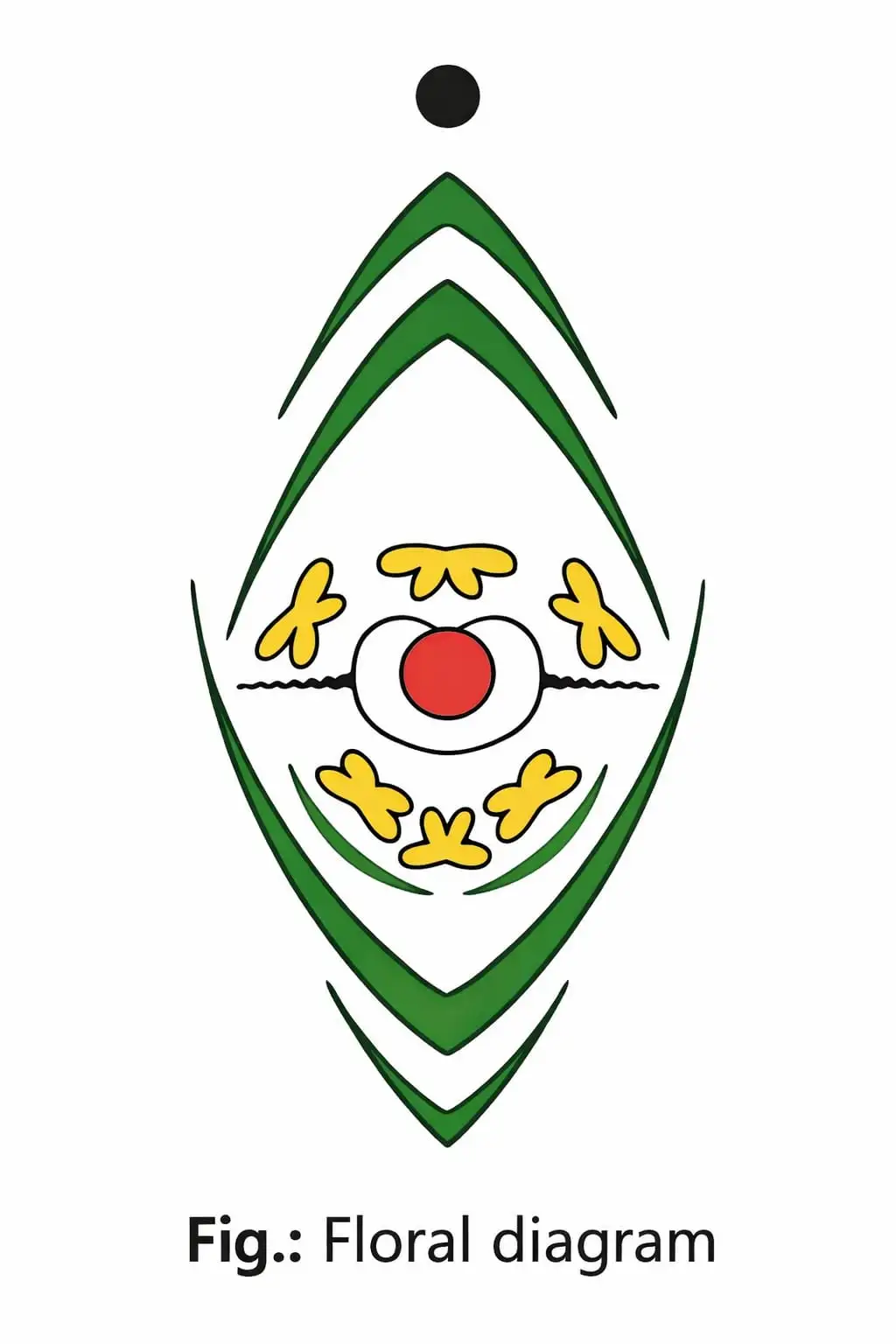
- Floral diagram shows arrangement of flower parts from a transverse section of flower bud.
- Symbols: Br = bracteate, K = calyx, C = corolla, P = perianth, A = androecium, G = gynoecium.
- G̲ = superior ovary, G̅ = inferior ovary.
- ♂ = male, ♀ = female, ⚥ = bisexual.
- ⊕ = actinomorphic, % = zygomorphic flower.
- Fusion shown by brackets; adhesion by line above symbols.
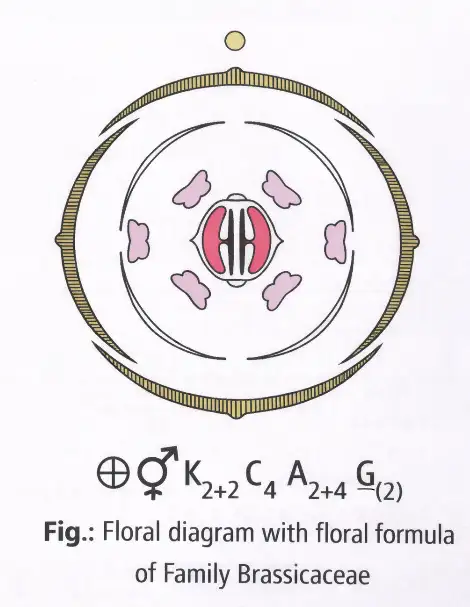
- Floral diagram shows number, arrangement, and relation of parts; mother axis marked by a dot on top.
- Whorls drawn from outside to inside: calyx, corolla, androecium, gynoecium.
- Example: Brassicaceae floral formula ⊕ ⚥ K2+2 C4 A2+4 G̲(2).
Memory Aids
- Br = Bract, K = Calyx, C = Corolla, A = Androecium, G = Gynoecium.
- G̲ = Superior ovary, G̅ = Inferior ovary.
- ⊕ = Radial symmetry, % = Bilateral symmetry.
- Fusion = brackets, Adhesion = line above.
Quick Checkpoints
- What does the floral formula represent?
- How is fusion and adhesion shown in floral formula?
- What information does a floral diagram provide?
- Identify symbols for ovary position and flower sexuality.
Cruciferae or Brassicaceae (Mustard Family)
Characteristics
- Distribution: Cosmopolitan, mostly temperate/cold regions.
- Vegetative: Annual/perennial herbs; taproot fleshy; erect cylindrical stem; leaves radical or cauline, alternate/subopposite, exstipulate, simple or rarely compound.
- Inflorescence: Racemose.
- Flower: Bisexual, actinomorphic (rarely zygomorphic), hypogynous, tetramerous.
- Calyx: 4 sepals in two whorls of 2 each, polysepalous.
- Corolla: 4 petals, polypetalous, cruciform; petals may be reduced/absent.
- Androecium: 6 stamens, tetradynamous (2 short + 4 long), dithecous, introrse.
- Gynoecium: Usually bicarpellary, syncarpous, superior ovary, unilocular, parietal placentation.
- Fruit: Siliqua, silicula, rarely lomentum.
- Seeds: Non-endospermic, often oily.
- Floral formula: ⊕ ⚥ K2+2 C4 A2+4 G̲(2).
Memory Aids
- Tetradynamous stamens = 2 short + 4 long.
- Cruciform corolla = 4 separate petals in cross shape.
- Parietal placentation = ovules on ovary wall.
Quick Checkpoints
- What is the stamen arrangement in Brassicaceae?
- Describe the ovary position and placentation.
- What type of inflorescence is present?
- Identify the floral formula symbols for this family.
Malvaceae (Cotton Family or Mallow Family)
Characteristics
- Genera: Malva, Hibiscus, Gossypium, Sida.
- Vegetative: Annual/perennial herbs or shrubs; taproot; stem with stellate hairs; leaves simple or palmately lobed, alternate, stipulate; mucilaginous sap.
- Inflorescence: Solitary axillary or terminal.
- Flower: Hermaphrodite, actinomorphic, complete, hypogynous, pentamerous.
- Calyx: 5 sepals, free or united at base, persistent, valvate aestivation.
- Corolla: 5 petals, polypetalous, large, showy, imbricate or twisted aestivation.
- Androecium: Numerous stamens, monadelphous, epipetalous, anthers monothecous.
- Gynoecium: Bi- to multicarpellary, syncarpous, superior ovary, multilocular, ovules per locule, long style, stigmas equal to carpels.
- Fruit: Usually capsule.
- Seed: Endospermic or non-endospermic.
Memory Aids
- Stamens fused into a tube (monadelphous).
- Leaves with stellate hairs and mucilage.
- Valvate calyx and showy petals.
Quick Checkpoints
- What type of stamen arrangement is typical?
- Describe the ovary and placentation.
- What is the common fruit type?
- Identify key vegetative features.

Fabaceae (Papilionaceae or Pea Family)
Characteristics
- Previously subfamily Papilionoideae of Leguminosae.
- Vegetative: Trees, herbs, shrubs; taproot with root nodules; erect or climbing stem; leaves alternate, pinnately compound or simple, pulvinus at base, stipulate, reticulate venation.
- Inflorescence: Racemose.
- Flower: Bisexual, zygomorphic.
- Calyx: 5 sepals, gamosepalous, valvate, imbricate aestivation.
- Corolla: 5 petals, polypetalous, papilionaceous (standard, wings, keel), vexillary aestivation.
- Androecium: 10 stamens, diadelphous (9 fused + 1 free), anthers dithecous.
- Gynoecium: Superior ovary, monocarpellary, unilocular, many ovules, single style.
- Fruit: Legume.
- Seed: One to many, non-endospermic.
- Floral formula: % ⚥ K(5) C1+2+(2) A(9)+1 G̲1.
Memory Aids
- Diadelphous stamens = 9 fused + 1 free.
- Papilionaceous corolla = butterfly-shaped petals.
- Legume fruit = pod splitting on two sides.
Quick Checkpoints
- What is the stamen arrangement in Fabaceae?
- Describe the corolla structure.
- What type of fruit is produced?
- Identify the floral formula symbols.
Compositae or Asteraceae (Sunflower Family)
Characteristics
- Largest dicot family: ~950 genera, 20,000 species.
- Vegetative: Mostly herbs, rarely shrubs/trees; taproot; stem erect/prostrate/climbing, hairy or glabrous, latex tubes or oil ducts; leaves alternate (rarely opposite/whorled), exstipulate, simple or compound, reticulate venation.
- Inflorescence: Head or capitulum (many sessile flowers on common receptacle).
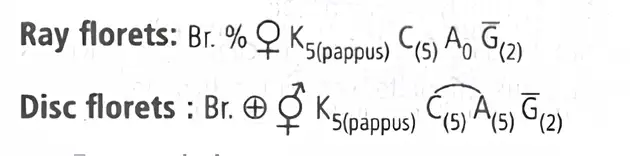
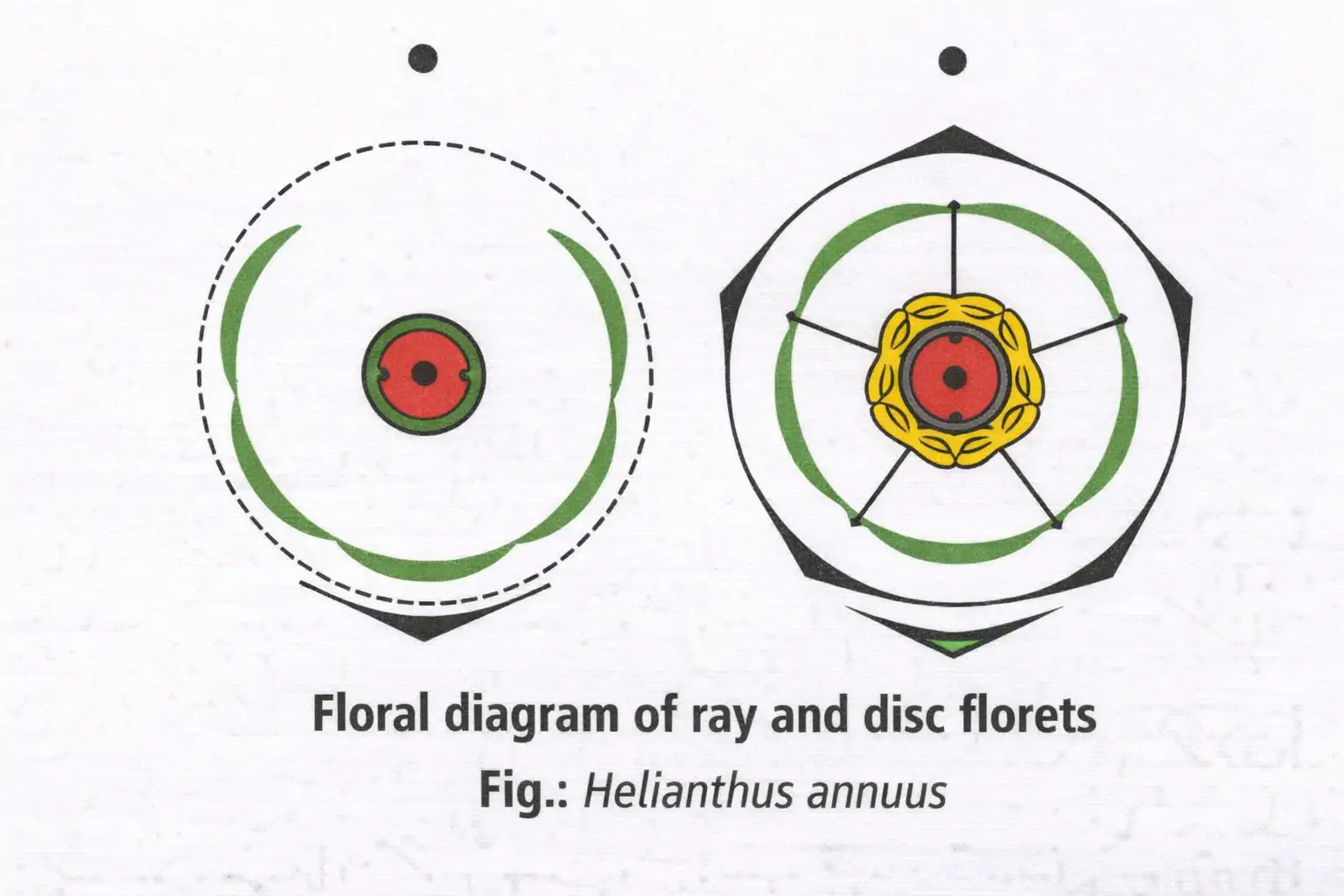
- Florets: Two types - ray florets (zygomorphic, ligulate, neuter/female) and disc florets (actinomorphic, tubular).
- Heads with two floret types are heterogamous; Xanthium has homogamous heads.
- Flower: Bracteate, sessile, actinomorphic (disc) or zygomorphic (ray), bisexual or unisexual, epigynous, pentamerous.
- Calyx: 5 sepals reduced to pappus (hairs/membranes) aiding fruit dispersal.
- Corolla: 5 petals, gamopetalous, tubular (disc) or ligulate (ray), valvate aestivation.
- Androecium: 5 stamens, epipetalous, syngenesious (anthers fused, filaments free).
- Gynoecium: Bicarpellary, syncarpous, inferior ovary, unilocular, basal placentation.
- Fruit: Cypsella.
- Seed: Non-endospermic.
Memory Aids
- Capitulum = many sessile flowers on one receptacle.
- Ray florets = female or neuter, zygomorphic.
- Disc florets = bisexual, actinomorphic.
- Pappus aids seed dispersal.
Quick Checkpoints
- What are the two types of florets in Asteraceae?
- Describe the calyx modification.
- What is the placentation type?
- Identify floral formula symbols for ray and disc florets.
Poaceae or Gramineae
Characteristics
- Famous for grains, cereals, grasses, and bamboos.
- Vegetative: Annual or perennial herbs; some shrubs; adventitious roots; stilt roots in maize; erect/prostrate, cylindrical, jointed stem (culm) with hollow internodes.
- Leaves: Cauline and ramal, alternate, sessile (petiolate in bamboos), exstipulate, sheathing base, simple long narrow lamina with parallel veins.
- Inflorescence: Racemose.
- Flower: Zygomorphic, incomplete, perfect or unisexual (e.g., maize), hypogynous.
- Perianth: 2 or 3 small scales called lodicules, inferior.
- Androecium: 3 or 6 free stamens in one or two whorls.
- Gynoecium: Tricarpellary, syncarpous appearing monocarpellary, superior ovary, unilocular, uniovulate, basal placentation.
- Fruit: Caryopsis.
- Seed: Endospermic with single cotyledon.
- Floral formula: Br. % ⚥ P2 (lodicules) A3 or 3+3 G̲1.
Memory Aids
- Lodicules replace perianth.
- Stem jointed with hollow internodes.
- Fruit is caryopsis (grain).
Quick Checkpoints
- What replaces the perianth in Poaceae flowers?
- Describe the stem and root types.
- What is the ovary and placentation type?
- Identify the floral formula symbols.
Solanaceae
Vegetative characters
- Plants mostly herbs, shrubs, rarely small trees.
- Stem: herbaceous (rarely woody), aerial, erect, cylindrical, branched, solid or hollow, hairy or glabrous.
- Leaves: alternate, simple, rarely pinnately compound, exstipulate; venation reticulate.
Floral characters
- Inflorescence: solitary, axillary or cymose (e.g., Solanum).
- Flower: bisexual, actinomorphic.
- Calyx: 5 sepals, united, persistent, valvate aestivation.
- Corolla: 5 petals, united, valvate aestivation.
- Androecium: 5 stamens, epipetalous.
- Gynoecium: bicarpellary, syncarpous; ovary superior, bilocular, placenta swollen with many ovules.
- Fruit: berry or capsule.

Memory Aids
- "5 united parts" pattern: calyx, corolla, stamens all in fives and united.
- Flower is bisexual and actinomorphic (radial symmetry).
- Ovary is superior and bilocular with many ovules.
Quick Checkpoints
- What type of plants are common in Solanaceae?
- Describe the aestivation type in calyx and corolla.
- How many carpels form the gynoecium?
- What is the nature of the ovary and fruit?
Floral Formula
Explanation
- ♀ symbol: female flower; ♂ symbol: male flower.
- K(5): 5 sepals.
- C(5): 5 petals.
- A(5): 5 stamens.
- G(2): pistil with 2 fused carpels.
- Indicates bisexual flower with 5 sepals, 5 petals, 5 stamens, and bicarpellary pistil.
Memory Aids
- Remember K, C, A, G stand for calyx, corolla, androecium, gynoecium.
- Numbers in parentheses indicate number of parts.
- Bisexual flower shown by presence of both male and female symbols.
Quick Checkpoints
- What does K(5) represent?
- How many stamens are present?
- What does G(2) indicate about carpels?
- What symbols show flower sexuality?
Economic Importance
Uses
- Food: tomato, brinjal, potato.
- Spice: chilli.
- Medicine: belladonna, ashwagandha.
- Fumigatory: tobacco.
- Ornamentals: petunia.
Memory Aids
- Food plants include common vegetables.
- Chilli is a major spice source.
- Medicinal plants include belladonna and ashwagandha.
- Tobacco used for fumigation.
- Petunia is ornamental.
Quick Checkpoints
- Name food plants from Solanaceae.
- Which plant is used as a spice?
- List medicinal plants in this family.
- What is the fumigatory plant?
- Which plant is ornamental?
Floral Diagram
Explanation
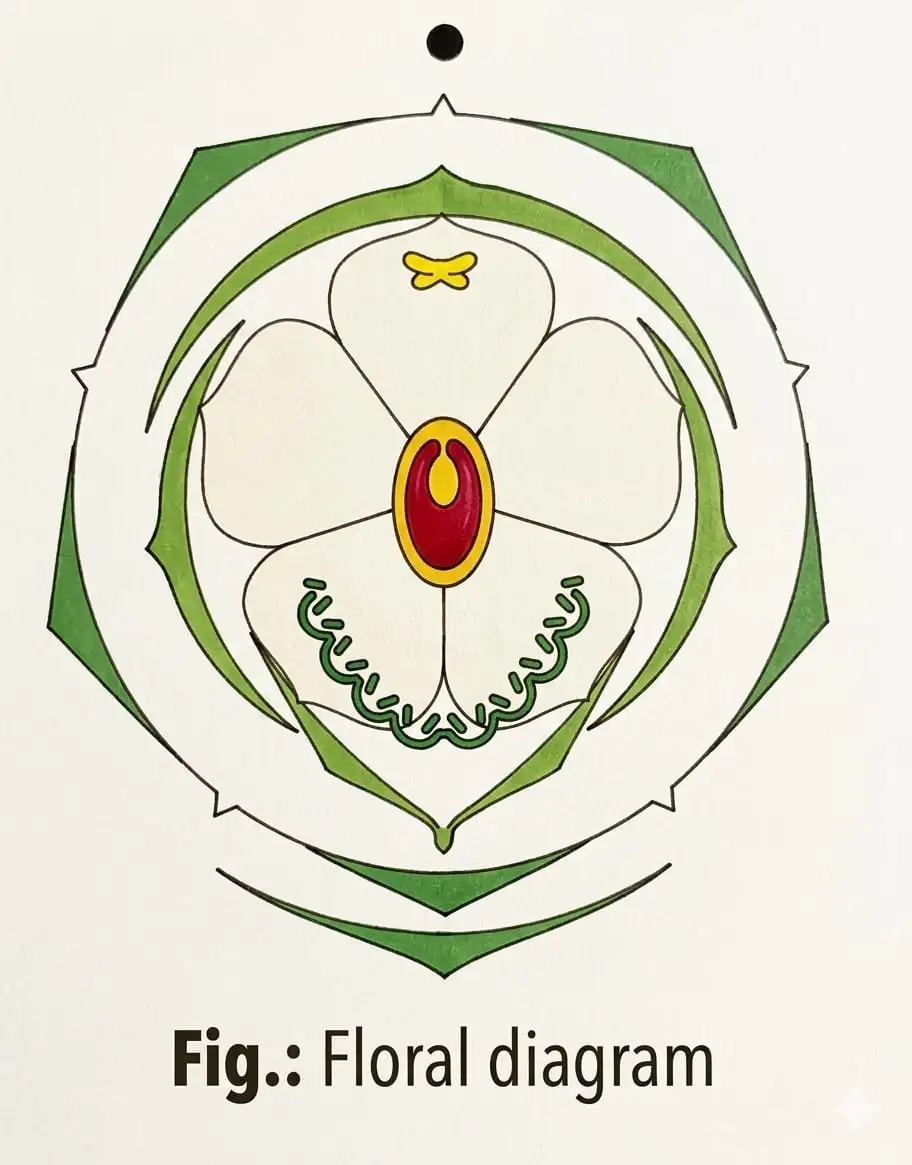
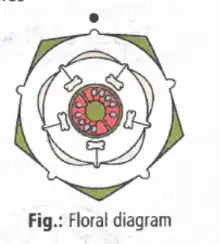
- Outer shapes: sepals protecting flower bud.
- Inside sepals: petals, colorful to attract pollinators.
- Stamens shown with arrows, male pollen-producing parts.
- Center: pistil/carpel with ovary.
- Dots in center represent ovules inside ovary.
- Diagram shows arrangement of flower parts visually.
Memory Aids
- Sepals outermost, petals inside sepals.
- Stamens surround central pistil.
- Ovules shown as dots inside ovary.
- Diagram helps visualize flower structure.
Quick Checkpoints
- What do outermost shapes represent?
- Where are petals located?
- What do arrows indicate?
- What do dots in center represent?
- What is the central part of the flower?
NEET Botany — ALL CHAPTERS
1
The Living World
2
Plant Kingdom
3
Morphology of Flowering Plants
4
Anatomy of Flowering Plants
5
The Unit of Life
6
Photosynthesis in Higher Plants
7
Respiration in Plants
8
Plant Growth and Development
9
Sexual Reproduction in Flowering Plants
10
Principles of Inheritance and Variation
11
Molecular Basis of Inheritance
12
Biotechnology :Principles and Processes
13
Biotechnology and its Applications