NEET Ug . NEET Zoology . Zoology . Reproductive Health
Chapter 8: Reproductive Health
Ch 8
NEET Zoology
NEET Ug
Introduction
Concepts of Reproductive Health
- Reproductive health means healthy reproductive organs with normal functions.
- Includes physical, emotional, behavioural, and social well-being related to reproduction.
- WHO defines it as total well-being in all reproductive aspects.
- Healthy individuals have normal reproductive organs and positive emotional and behavioural interactions in sexual matters.
Memory Aids
- Reproductive health = Physical + Emotional + Social well-being.
- WHO = Total reproductive well-being.
Quick Checkpoints
- What does reproductive health encompass?
- How does WHO define reproductive health?
- What are the components of reproductive well-being?
Reproductive Health Problems and Strategies
Problems and Government Initiatives
- India initiated national programmes for reproductive health, called Reproductive and Child Health care (RCH) programmes.
- RCH aims to raise awareness on reproductive organs, adolescence, STDs, and secondary sexual characters.
- Key programmes: Maternal and child health services, family planning.
- Major problems: Overpopulation, early marriage, maternal health issues.
Strategies for Improvement
- Family planning programme started in 1951.
- Sex education in schools to correct myths and misconceptions.
- Awareness of birth control devices, prenatal and postnatal care, and equal child importance.
- Prevention of sex abuse and sex-related crimes through awareness.
- Medical support for menstrual issues, infertility, pregnancy, contraception, abortions, and STDs.
- Use of advanced techniques and strategies for better reproductive health care.
Memory Aids
- RCH = Awareness + Health services + Family planning.
- Strategies = Family planning + Sex education + Medical care + Crime prevention.
Quick Checkpoints
- What are the main goals of RCH programmes?
- List major reproductive health problems in India.
- What strategies help achieve reproductive health?
Amniocentesis
Test and Uses
- Fetal test based on chromosomal analysis of amniotic fluid.
- Detects genetic disorders: Down syndrome, haemophilia, sickle cell anaemia.
- Assesses fetus survivability.
- Misused for fetal sex determination leading to female feticide.
- Legally banned for sex determination to prevent female feticide.
Memory Aids
- Amniocentesis = Genetic test + Fetal health check.
- Sex determination misuse banned.
Quick Checkpoints
- What disorders can amniocentesis detect?
- Why is sex determination by amniocentesis banned?
- What is the basis of amniocentesis testing?
Population Stabilisation and Birth Control
Population Growth and Control
- Population explosion: rapid increase in population over a short period.
- World population rose from 2 billion (1900) to 7.2 billion (2011).
- India's population grew from 350 million (independence) to 1.2 billion (2011).
- Population: total individuals of a species in an area at a time.
- Demography: scientific study of human population.
- Population increase due to decline in death rate, MMR, IMR, and more people in reproductive age.
- 2011 census: growth rate < 2% (20/1000/year), risking scarcity of essentials.
- Government measures: promote smaller families, raise marriage age (female 18, male 21), incentives for small families.
- Slogan: Hum Do Hamare Do (We two, our two) encourages two-child norm.
Memory Aids
- Population = Species count in area.
- Demography = Study of population.
- Hum Do Hamare Do = Two-child norm slogan.
Quick Checkpoints
- What factors caused population explosion?
- Define demography.
- What government steps control population growth?
Birth Control or Contraception
Definition and Principles
- Birth control/contraception: regulation of conception to limit offspring.
- Prevents fertilisation by blocking sperm transport, ovulation, or embryo implantation.
- Ideal contraceptive: user-friendly, effective, reversible, minimal side effects, no sexual interference.
- Methods: temporary and permanent.
Memory Aids
- Birth control = Prevent fertilisation.
- Ideal contraceptive = Easy, safe, reversible.
Quick Checkpoints
- What are the targets of birth control?
- Characteristics of an ideal contraceptive?
- Types of contraceptive methods?
Temporary Methods of Birth Control
Types and Details
- Used to postpone or space births; require regular use.
- Includes natural, barrier, chemical, IUCDs, oral pills, hormone injections, and implants.
- Natural methods: avoid sperm-ovum meeting.
- Periodic abstinence (Rhythm): avoid intercourse days 10-17 (fertile period).
- Coitus interruptus (Withdrawal): male withdraws before ejaculation.
- Lactational amenorrhea: no ovulation during intense breastfeeding (up to 6 months).
- Barrier methods: physical barriers prevent sperm entry.
- Condoms: male (Nirodh) and female (femidoms).
- Diaphragms, cervical caps, vaults: rubber barriers covering cervix, reusable.
- Condoms also protect against STIs and AIDS.
- Chemical methods: spermicidal creams, jellies, foams used with barriers.
- Contain lactic acid, citric acid, boric acid, zinc sulphate, potassium permanganate.
- Sponge ('Today') and cream (Delfin) are spermicidal products, less reliable.
- Intrauterine Contraceptive Devices (IUCDs): plastic/metal devices inserted in uterus.
- Non-medicated (e.g., Lippes loop): S-shaped plastic wire increasing sperm phagocytosis.
- Hormone releasing (e.g., LNG-20, progestasert): make uterus hostile to implantation and sperm.
- Copper releasing (e.g., CuT, Cu7, Multiload 375): Cu ions reduce sperm motility and fertilisation.
- Disadvantages: expulsion risk (10-15%), uterine perforation, infection, excessive bleeding, pain.
- Oral contraceptive pills: tablets with progestogens or progestogen-estrogen.
- Combined pills (e.g., Mala D, Mala N): synthetic progesterone + estrogen, inhibit ovulation.
- Mini pills (e.g., Saheli): progestin only, non-steroidal, inhibit implantation.
- Saheli: weekly dose, safe long-term, minor side effect delayed menstruation (8%).
- Side effects: risk of intravascular clotting, acne, weight gain, depression, hypertension, nausea.
- Hormone injections and subcutaneous implants:
- Progestogens alone or with estrogen block ovulation, thicken cervical mucus.
- Emergency contraceptives: effective within 72 hours post-coitus.
- Hormone injections: convenient, effective, occasional heavy bleeding.
- Subcutaneous implants: matchstick-sized capsules under arm skin, release progesterone for 5 years.
- Examples: Depot medroxyprogesterone acetate (DMPA), Norethisterone enanthate (NET-EN).
Memory Aids
- Natural = Avoid sperm-ovum meeting.
- Barrier = Physical sperm block.
- Chemical = Spermicides enhance barriers.
- IUCD = Uterus device, multiple types.
- Oral pills = Hormonal, daily intake.
- Hormone injections/implants = Long-term hormonal control.
Quick Checkpoints
- List natural methods of contraception.
- What are barrier methods and examples?
- Types and function of IUCDs?
- Difference between combined and mini oral pills?
- How do hormone implants work?
Permanent Methods of Birth Control
Surgical Sterilisation
- Also called sterilisation methods; advised as terminal contraception.
- Blocks gamete transport to prevent conception.
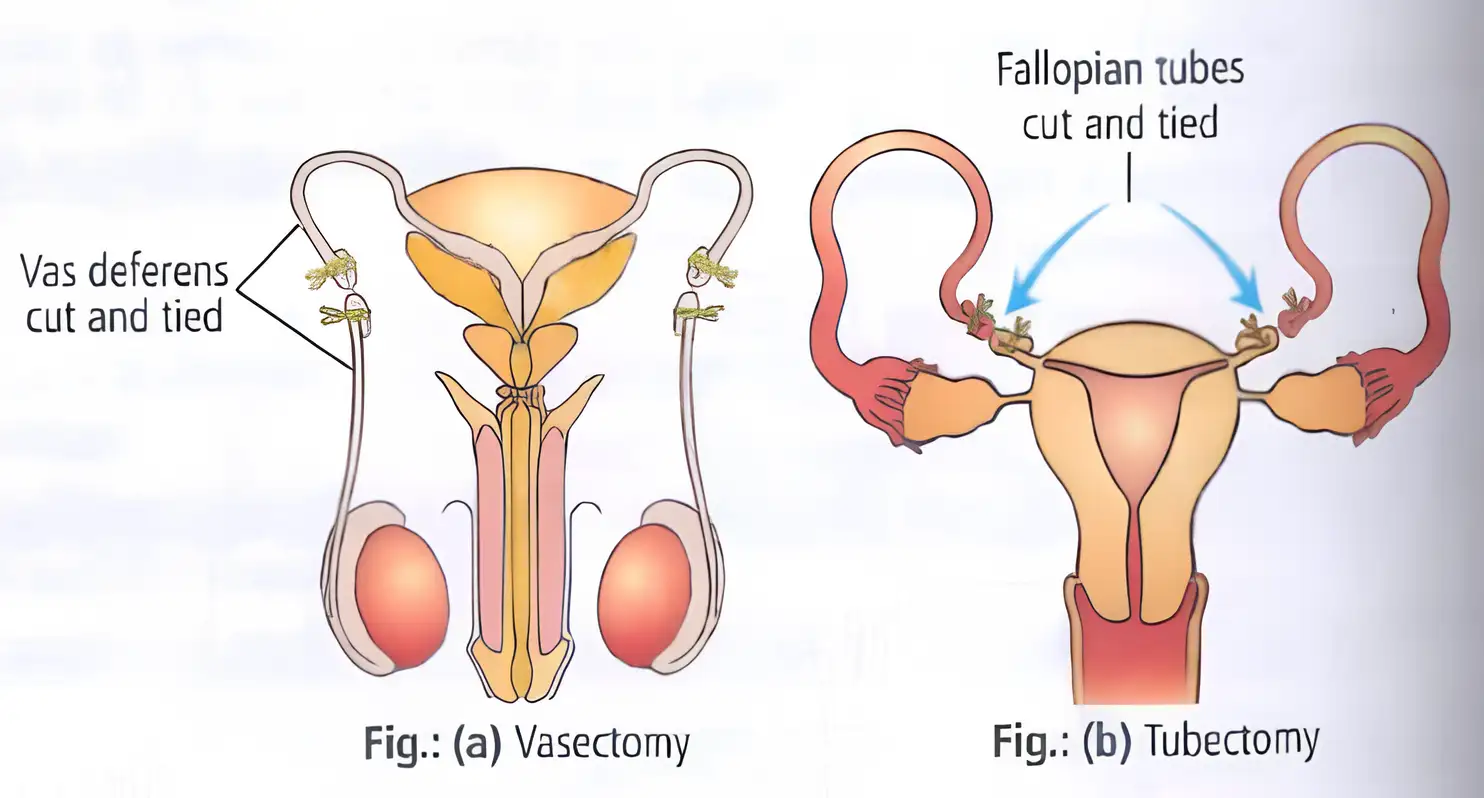
- Male sterilisation: vasectomy - removal or tying of vas deferens via scrotal incision.
- Female sterilisation: tubectomy - removal or tying of fallopian tubes via abdominal or vaginal incision.
- Highly effective but poor reversibility.
- Does not affect hormone production or sexual function.
- Consult medical professionals before choosing method; consider side effects like nausea, pain, irregular bleeding.
Memory Aids
- Vasectomy = Male sterilisation, vas deferens cut.
- Tubectomy = Female sterilisation, fallopian tubes cut.
- Permanent = Blocks gamete transport.
Quick Checkpoints
- What is vasectomy and its purpose?
- Describe tubectomy procedure.
- Why is sterilisation considered permanent?
Images
Hormone Implants
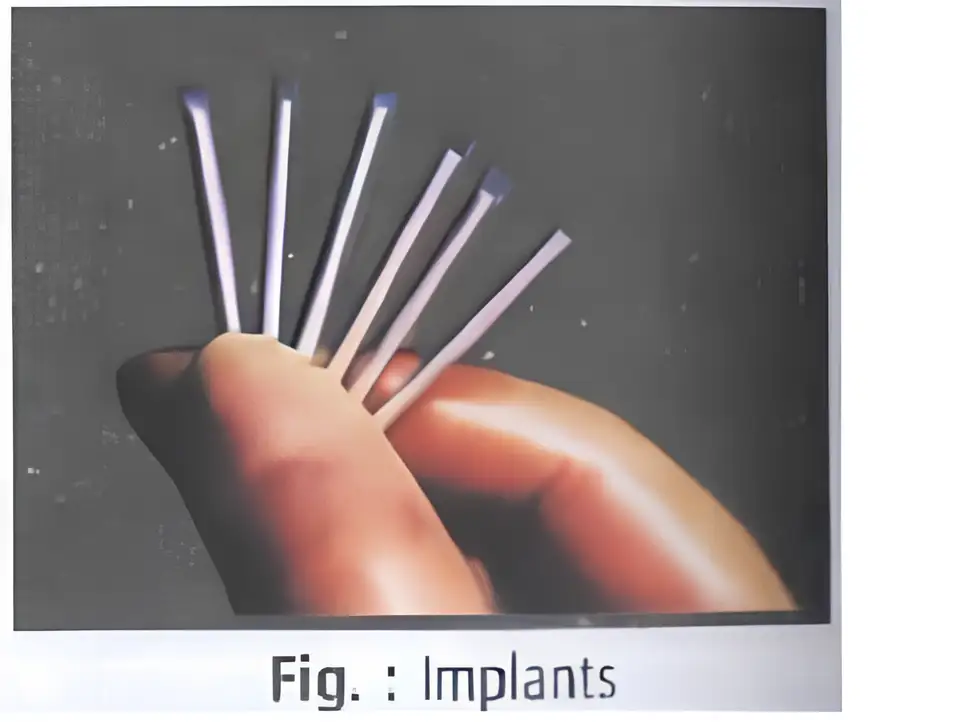
Implants are small devices inserted under the skin to release hormones slowly for contraception.
Permanent Birth Control Surgeries
Vasectomy and tubectomy surgeries block sperm and egg transport respectively to prevent pregnancy permanently.
Medical Termination of Pregnancy (MTP)
Overview
- Intentional termination of pregnancy before full term is called Medical Termination of Pregnancy (MTP) or induced abortion.
- Approximately 45 to 50 million MTPs occur worldwide annually, about 1/5th of all conceived pregnancies.
- Legalised in India in 1971 with strict conditions to prevent misuse and illegal female feticide.
- MTP is used to end unwanted pregnancies due to unprotected intercourse, contraceptive failure, or rape.
- Also performed when pregnancy continuation risks the health of mother, fetus, or both.
- Safe mostly during the first trimester (up to 12 weeks); second trimester abortions carry higher risks.
- Many MTPs are done illegally by unqualified persons, posing serious health risks.
- Misuse of amniocentesis for sex determination followed by MTP is dangerous and discouraged.
- Effective counselling is essential to prevent unprotected sex and illegal abortions.
Memory Aids
- MTP: Medical Termination of Pregnancy = Induced abortion before full term.
- Safe period: First trimester (up to 12 weeks).
- Legalised India: 1971 with strict conditions.
- Risks: Illegal MTPs and sex-selective abortions are harmful.
Quick Checkpoints
- What is the definition of MTP?
- When was MTP legalised in India?
- Why are MTPs performed?
- What is the safest period for MTP?
- What are the risks of illegal MTPs?
- Why is misuse of amniocentesis dangerous?
- How can illegal abortions be prevented?
Sexually Transmitted Infections (STIs)
Overview
- STIs are infections transmitted mainly through sexual intercourse.
- Also called venereal diseases (VDs) or reproductive tract infections (RTIs).
- Transmission modes: sexual contact, sharing needles, surgical instruments, blood transfusion, mother to fetus.
- Except HIV, hepatitis B, and genital herpes, most STIs are curable if treated early.
- Early symptoms: itching, swelling, fluid discharge, mild pain.
- Untreated STIs can cause abortions, stillbirths, ectopic pregnancy, infertility, reproductive tract cancer, pelvic inflammatory disease.
- High incidence in 15-24 years age group.
Common STIs and Detection
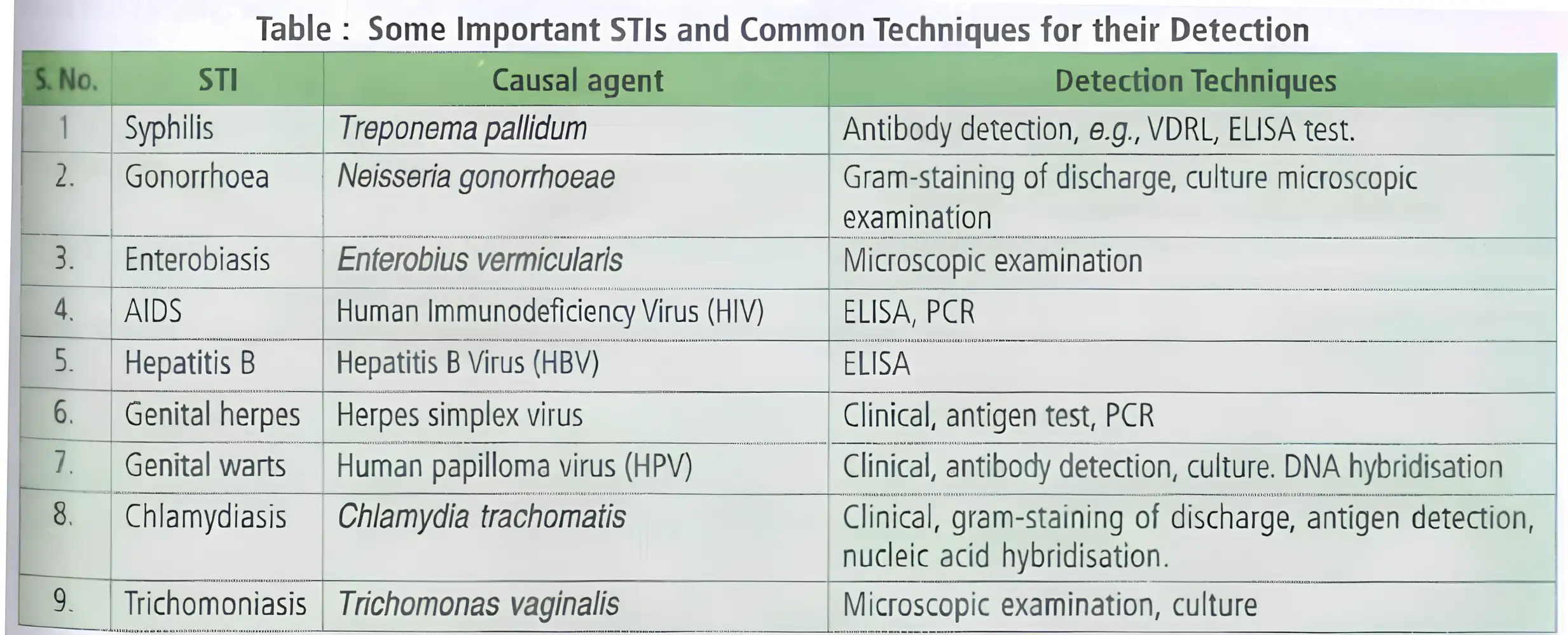
- Common STIs: Syphilis, Gonorrhoea, AIDS, Genital herpes, etc.
- Causal agents: specific bacteria or viruses causing each STI.
- Detection methods: antibody tests, microscopic examination, DNA-based tests.
- Accurate diagnosis aids effective treatment and control.
Prevention
- Avoid sex with unknown or multiple partners.
- Use condoms consistently during intercourse.
- Seek early medical advice and complete treatment if infected.
Memory Aids
- STIs = Sexually Transmitted Infections = VDs = RTIs.
- Transmission: Sex, Needles, Surgery, Blood, Mother-to-fetus (SNSBM).
- High risk: Age 15-24 years.
- Prevention: Avoid unknown partners, Use condoms, Early treatment (AUE).
Quick Checkpoints
- What are the main transmission routes of STIs?
- Which STIs are incurable?
- List common early symptoms of STIs.
- Why is early detection important?
- What are key prevention methods?
Infertility
Causes and Diagnosis
- Inability to conceive despite unprotected sex.
- Caused by physical, congenital, immunological, or psychological disorders.
- Specialized clinics diagnose and treat some causes.
- Assisted reproductive technologies (ART) help infertile couples conceive.
Memory Aids
- Infertility = No conception despite unprotected sex.
- ART = Medical help for conception.
Quick Checkpoints
- What are the main causes of infertility?
- How do infertility clinics assist couples?
- What is the role of ART?
Assisted Reproductive Technologies
Key Techniques
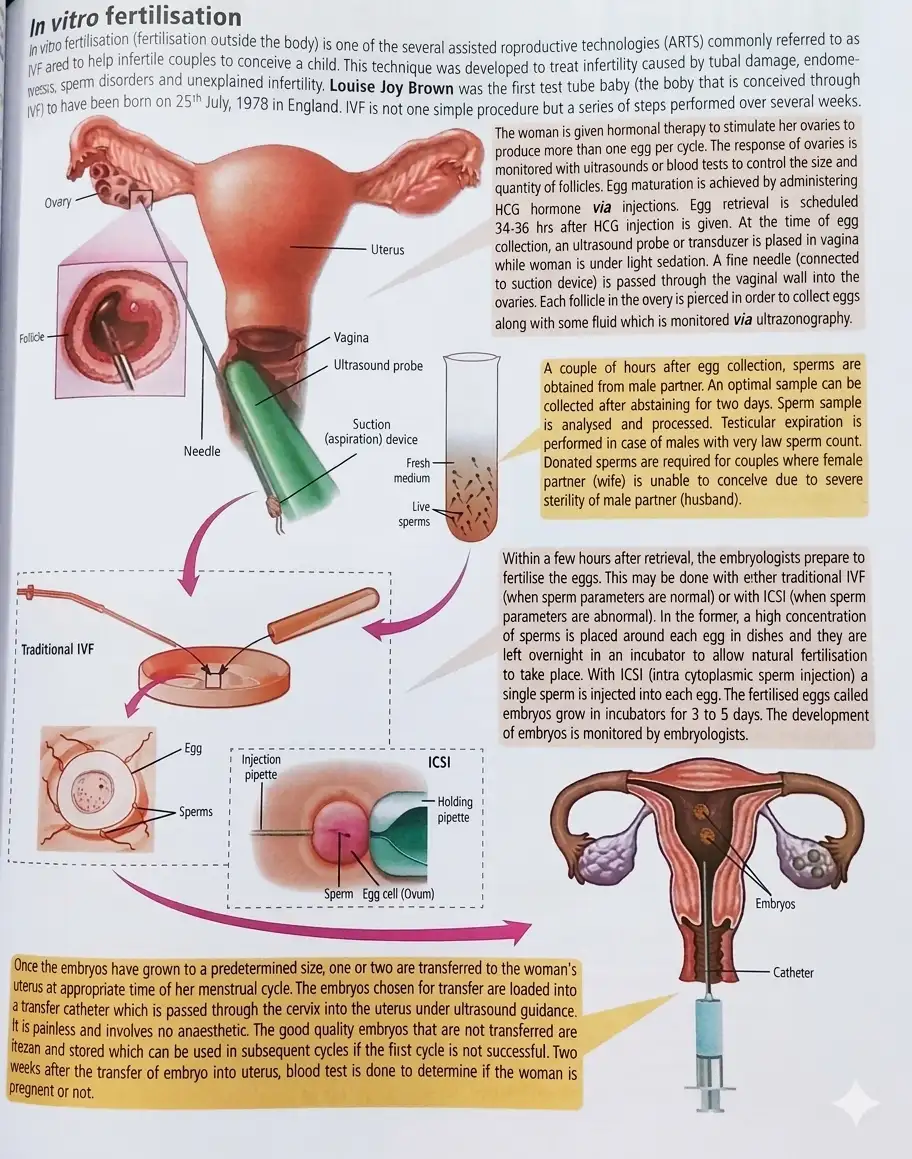
- Test tube baby programme (IVF + embryo transfer).
- Gamete intra fallopian transfer (GIFT).
- Intra cytoplasmic sperm injection (ICSI).
- Artificial insemination (AI) including intrauterine insemination (IUI).
Memory Aids
- IVF = Fertilisation outside body + embryo transfer.
- GIFT = Sperm + ovum placed in fallopian tube.
- ICSI = Sperm injected into ovum cytoplasm.
- AI = Semen introduced artificially into female tract.
Quick Checkpoints
- What is IVF and how does it work?
- When is GIFT used?
- Describe ICSI technique.
- What conditions require AI?
Test Tube Baby Programme
Process
- Ova and sperm collected from wife/husband or donors.
- Fertilisation occurs outside body (in vitro fertilisation).
- Embryo transfer:
- Up to 8 blastomeres: transferred to fallopian tube (ZIFT).
- More than 8 blastomeres: transferred to uterus (IUT).
- Embryo can be implanted in another female (surrogate mother).
Memory Aids
- IVF = Fertilisation outside body.
- ZIFT = Zygote transferred to fallopian tube.
- IUT = Embryo transferred to uterus.
- Surrogate mother = Female who carries embryo for another.
Quick Checkpoints
- What is the difference between ZIFT and IUT?
- Who is a surrogate mother?
- What Nobel Prize was awarded related to IVF?
Gamete Intra Fallopian Transfer
Technique
- Used when female cannot produce ova but can support embryo development.
- Sperm and ovum from donor introduced into fallopian tube of recipient female.
Memory Aids
- GIFT = Gametes placed directly in fallopian tube.
Quick Checkpoints
- When is GIFT preferred over IVF?
- What gametes are used in GIFT?
Intra Cytoplasmic Sperm Injection
Technique
- Sperm directly injected into ovum cytoplasm in lab.
- Embryo transferred by ZIFT or IUT into female.
Memory Aids
- ICSI = Direct sperm injection into ovum.
Quick Checkpoints
- How does ICSI differ from IVF?
- What happens after sperm injection in ICSI?
Artificial Insemination
Technique
- Used when husband cannot inseminate or has low sperm count.
- Semen from husband or donor introduced into vagina or uterus (IUI).
Memory Aids
- AI = Artificial introduction of semen.
- IUI = Intrauterine insemination.
Quick Checkpoints
- When is AI recommended?
- What is IUI?
Detection of Fetal Disorders
Techniques
- Amniocentesis: Fluid from amniotic sac tested for chromosomal disorders and fetal sex.
- Chorionic Villi Sampling (CVS): Fetal tissue from placenta used for karyotyping.
- Ultrasound imaging: Non-invasive fetal condition assessment.
- Fetoscopy: Direct viewing of fetus using a thin tube inserted into uterus.
Memory Aids
- Amniocentesis = Amniotic fluid test.
- CVS = Placental tissue test.
- Ultrasound = Non-invasive imaging.
- Fetoscopy = Direct fetal view.
Quick Checkpoints
- What is the purpose of amniocentesis?
- How is CVS performed?
- Which technique is non-invasive?
- What does fetoscopy allow?
NEET Zoology — ALL CHAPTERS
1
Structural Organisation in Animals
2
Breathing and Exchange of Gases
3
Body Fluids and Circulation
4
Excretory Products and their Elimination
5
Locomotion and Movement
6
Neural Control and Coordination
7
Human Reproduction
8
Reproductive Health
9
Evolution
10
Microbes in Human Welfare
11
Organism and Population
12
Ecosystem
13
Biodiversity and Conservation