NEET Ug . NEET Zoology . Zoology . Organism and Population
Chapter 11: Organism and Population
Ch 11
NEET Zoology
NEET Ug
Introduction
Biological Hierarchy and Ecology
- Living world is diverse and complex with levels: macromolecules, cells, tissues, organs, organisms, populations, communities, ecosystems, biomes.
- Ecology: Study of interactions among organisms and with abiotic environment.
- Term coined by Ernst Haeckel (1866); Ramdeo Misra is Father of Ecology in India.
- Ecological hierarchy: Levels of ecological organisation; individual organism is the basic unit.
Memory Aids
- Ecology = Organism + Environment interactions.
- Hierarchy: Organism → Population → Community → Ecosystem → Biome.
Quick Checkpoints
- What is ecological hierarchy?
- Who coined the term ecology?
- Basic unit of ecological organisation?
Organism and its Environment
Organismic Ecology and Biomes
- Physiological ecology studies organism adaptations for survival and reproduction.
- Seasonal and annual precipitation variations form major biomes: desert, rainforest, tundra.
- Local variations create diverse habitats within biomes.
- Life exists in extreme habitats: deserts, rainforests, deep ocean, polar regions, thermal springs, intestines.
- Key habitat factors: temperature, water, light, soil.
- Habitat includes abiotic (physico-chemical) and biotic components (pathogens, predators, competitors).
- Organisms evolve adaptations via natural selection to optimize survival and reproduction.
- Niche: Range of tolerance, resource use, and functional role of an organism.
- Weather: short-term atmospheric conditions; Climate: long-term regional atmosphere.
- Microclimate: local climatic conditions.
- Habitat: specific locality where a community lives.
- Niche: specific part of habitat occupied by a species; no two species share the same niche.
- Niche overlap: sharing resources; Niche density: species abundance in habitat.
Memory Aids
- Habitat = Where organism lives; Niche = How organism lives.
- Weather = short term; Climate = long term.
- Niche is unique to each species.
Quick Checkpoints
- Define niche and habitat.
- Difference between weather and climate?
- What factors define a niche?
Major Abiotic Factors
Temperature
- Ranges from subzero in polar/high altitudes to >50°C in tropical deserts; thermal springs exceed 100°C.
- Affects enzyme kinetics, metabolism, activity, physiology.
- Thermal tolerance influences species distribution.
- Types by temperature tolerance:
- Eurythermal: tolerate wide temperature range (e.g., mammals, birds, Artemesia tridentata).
- Stenothermal: tolerate narrow temperature range (e.g., polar bear, lizards).
- Types by body temperature regulation:
- Poikilothermal: body temp varies with environment; ectothermic (e.g., reptiles, amphibians).
- Homoiothermal: constant body temp; endothermic (e.g., birds, mammals).
- Temperature affects photosynthesis, respiration, reproduction, growth in plants; metabolism, distribution, behavior in animals.
Water
- Water quality (pH, chemical composition) important for aquatic life.
- Salinity varies: <5 ppt inland, 30-35 ppt sea, >100 ppt hypersaline lagoons.
- Euryhaline: tolerate wide salinity range (e.g., salmon).
- Stenohaline: tolerate narrow salinity range (e.g., shark).
- Freshwater and marine animals face osmotic challenges crossing habitats.
- Terrestrial plants by moisture availability:
- Hygrophytes: wet areas, soft stems, large leaves with hydathodes.
- Mesophytes: moist habitats, luxuriant growth (most crops).
- Xerophytes: dry habitats, water loss adaptations (e.g., Acacia, Casuarina).
Light
- Life processes depend on light intensity, duration, quality.
- Photosynthesis requires sunlight; shade plants adapt to low light.
- Photoperiod cues animal behavior: foraging, migration, reproduction.
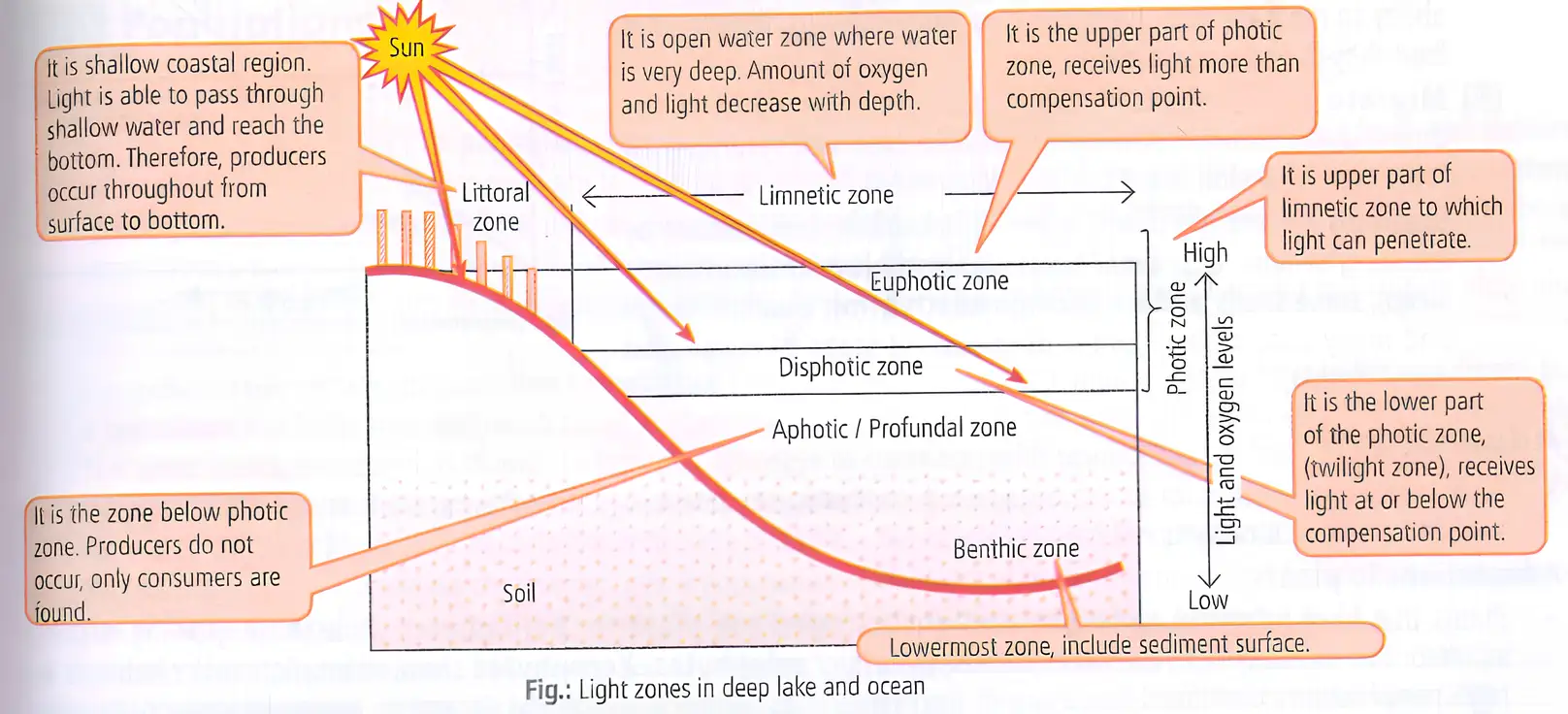
- Deep oceans (>500 m) are dark; different light zones exist in lakes/oceans.
Soil
- Soil: upper weathered humus layer supporting terrestrial plants.
- Properties depend on climate, weathering, soil type (transported/sedimentary).
- Soil characteristics (composition, grain size, pH, minerals) affect vegetation.
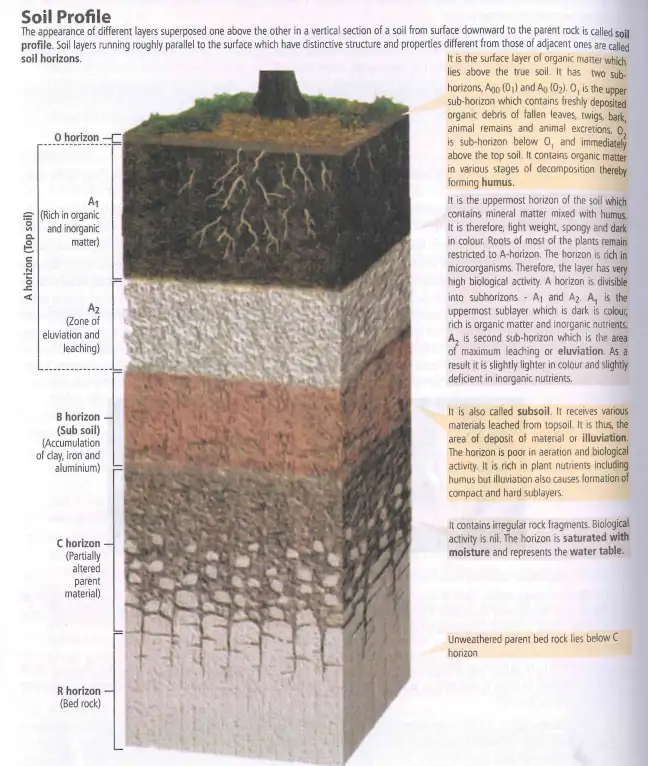
- Soil profile: vertical layers (horizons) O, A, B, C, R.
- O horizon: organic litter; A horizon: topsoil rich in organic matter; B horizon: subsoil with clay, iron; C horizon: weathered rock; R horizon: bedrock.
Memory Aids
- Temperature: Eurythermal = wide range; Stenothermal = narrow range.
- Water: Euryhaline = wide salinity tolerance; Stenohaline = narrow.
- Soil horizons: O (organic), A (topsoil), B (subsoil), C (weathered rock), R (bedrock).
Quick Checkpoints
- Define eurythermal and stenothermal organisms.
- What are the soil horizons?
- How does salinity affect aquatic organisms?
Responses to Abiotic Factors
Homeostasis and Coping Mechanisms
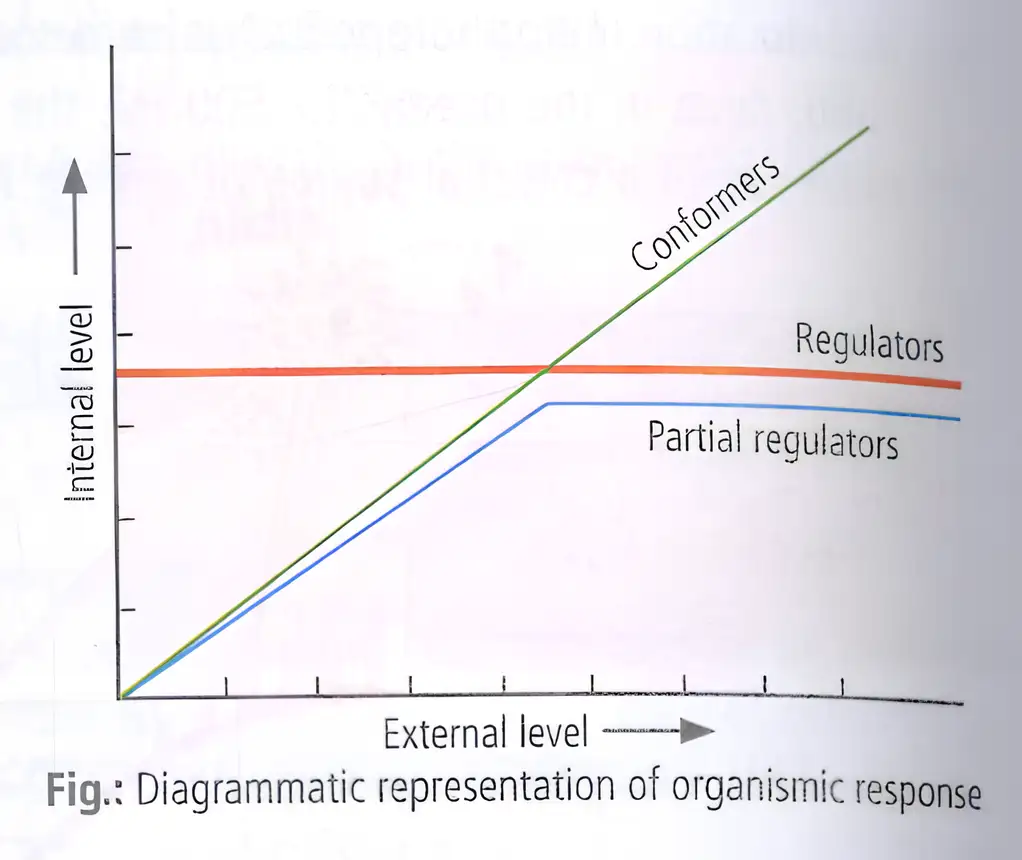
- Homeostasis: maintaining internal stability despite external changes.
- Organism responses:
- Regulators: maintain constant internal conditions (e.g., birds, mammals).
- Conformers: internal conditions vary with environment (99% animals, most plants).
- Partial regulators: regulate partially, conform beyond limits.
- Migrate: move to favorable habitats temporarily.
- Suspend: escape unfavorable conditions via hibernation, aestivation, diapause.
Memory Aids
- Regulators = constant internal state.
- Conformers = internal state matches environment.
- Partial regulators = intermediate response.
- Suspension = hibernation, aestivation, diapause.
Quick Checkpoints
- What is homeostasis?
- Difference between regulators and conformers?
- Examples of suspension strategies?
Adaptations
Plant Adaptations
- Adaptation: traits enabling survival and reproduction.
- Sun plants (heliophytes): adapted to bright sunlight.
- Shade plants (sciophytes): adapted to low light.
- Xerophytes: dry habitat adaptations; types:
- Ephemerals (drought escapers)
- Annuals (drought evaders)
- Succulents (drought resistants)
- Non-succulent perennials (drought endurers)
- Desert plants: thick cuticle, sunken stomata, CAM photosynthesis, leaf spines (e.g., Opuntia).
- Hydrophytes: mucilage-covered, reduced roots, aerenchyma present.
- Halophytes: tolerate saline soils, salt secretion, succulence, pneumatophores.
Animal Adaptations
- Adaptations can be short-term (tanning, heartbeat) or long-term (beak, claw).
- Most animal adaptations are physiological and behavioral.
- Camouflage: blending with environment to avoid detection.
- Mimicry: resemblance to another species for protection.
- Desert animals reduce water loss and tolerate arid conditions (e.g., kangaroo rat).
- Behavioral adaptations include activity timing and habitat use.
Memory Aids
- Allen's rule: shorter ears/limbs in cold climates.
- Bergman rule: larger body size in cold regions.
- Gloger's rule: darker skin in warm, humid areas.
- Jordan's rule: more vertebrae in cold-water fish.
- Rensch's rule: narrow wings in cold-area birds.
Quick Checkpoints
- Types of xerophytes?
- Difference between camouflage and mimicry?
- Examples of animal behavioral adaptations?
Populations
Population Attributes
- Population: Group of individuals of a species in a defined area sharing resources and potentially interbreeding.
- Includes asexual groups for ecological studies (e.g., bacteria in culture).
- Population has birth rate and death rate (per capita births and deaths).
- Sex ratio: Proportion of males and females in population (e.g., 60% females, 40% males).
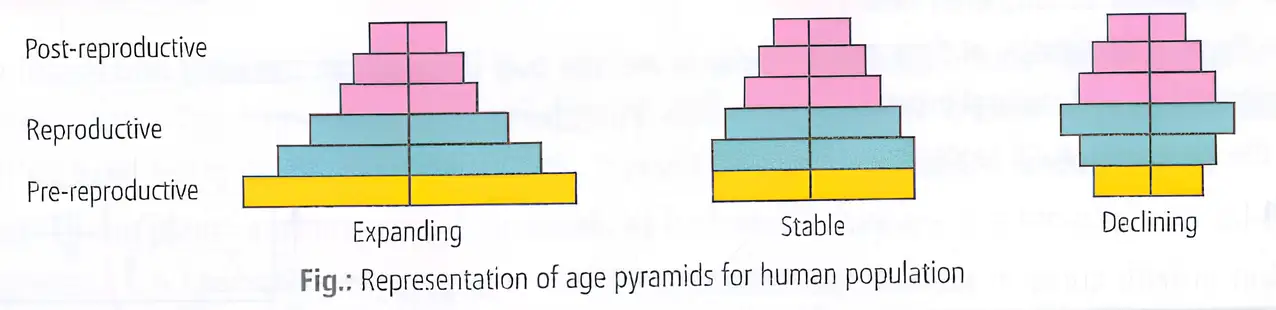
- Age structure: Distribution of individuals in pre-reproductive, reproductive, and post-reproductive stages.
- Age pyramid types: Triangular (growing), Bell-shaped (stable), Urn-shaped (declining).
- Local population (demes): Subgroups in a specific area.
- Sister populations: Same species in different locations.
- Demography: Study of population size.
Memory Aids
- Population = Group + Interbreeding + Shared area.
- Sex ratio = % females vs males.
- Age pyramid shapes indicate growth trends.
- Demography = Population size study.
Quick Checkpoints
- What defines a population?
- How is sex ratio expressed?
- What are the three age groups in a population?
- What does a triangular age pyramid indicate?
Population Growth
Population Dynamics
- Population size changes over time due to food, predation, weather.
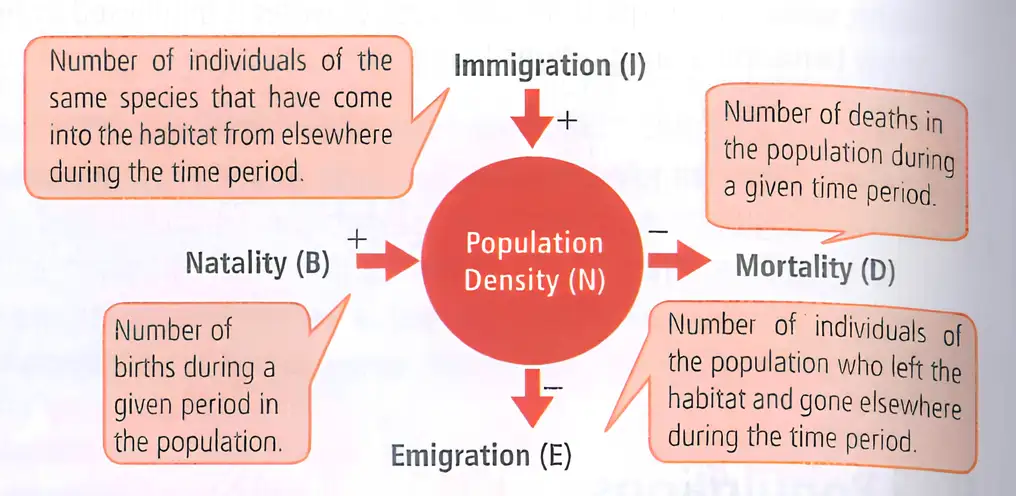
- Population density changes by natality (births), immigration (in), mortality (deaths), emigration (out).
- Population density = number of individuals per unit area or volume.
- Population size often estimated by indirect signs (e.g., tiger pug marks).
Memory Aids
- Population density = N.
- Increase factors: Natality + Immigration.
- Decrease factors: Mortality + Emigration.
- Indirect counting used for large populations.
Quick Checkpoints
- What factors increase population density?
- How is population density defined?
- Why use indirect methods for population size?
Growth Models
Exponential Growth
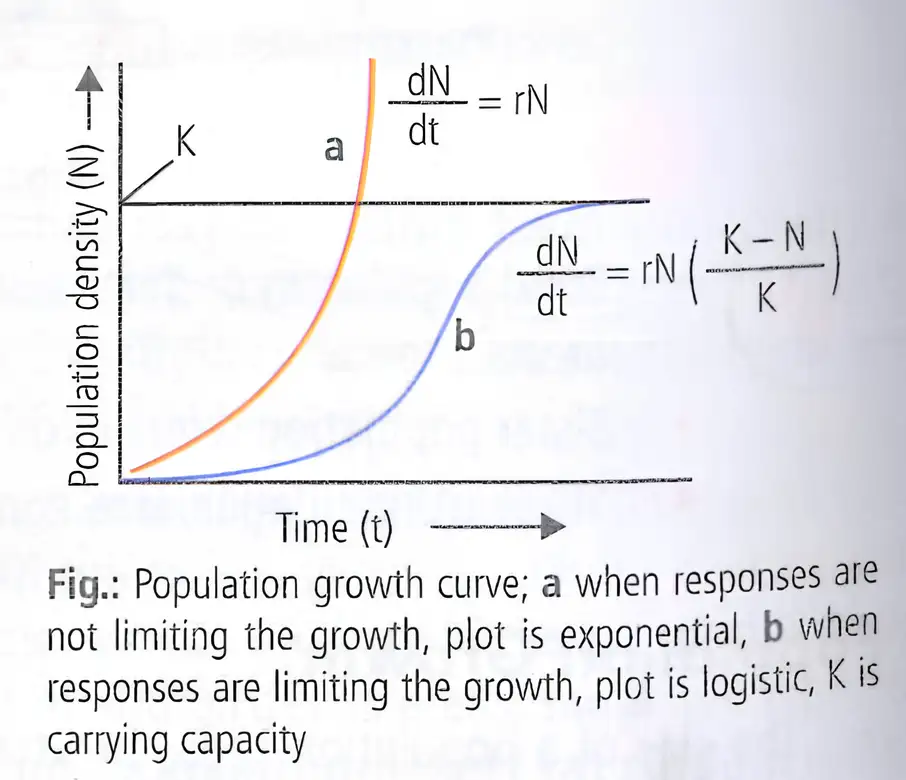
- Occurs when resources are unlimited.
- Population grows rapidly in J-shaped curve.
- Growth rate depends on intrinsic rate and current population size.
Logistic Growth
- Growth slows as population nears carrying capacity (K).
- Produces S-shaped (sigmoid) curve.
- More realistic model due to limited resources.
Memory Aids
- Exponential = unlimited growth, J-curve.
- Logistic = limited growth, S-curve, carrying capacity K.
- Carrying capacity = max population environment supports.
Quick Checkpoints
- What shape is exponential growth curve?
- What limits logistic growth?
- Define carrying capacity.
Life History Variation
Reproductive Strategies
- Populations evolve to maximize reproductive fitness (Darwinian fitness).
- Some species breed once; others breed multiple times.
- Offspring size and number vary: many small or few large.
- Life history traits adapt to habitat constraints.
- Biotic potential: max reproductive capacity in optimal conditions.
- k-selected species: large size, few offspring, long lifespan, low metabolism.
- r-selected species: small size, many offspring, short lifespan, high metabolism.
Memory Aids
- k-selected = K for "Kare" (care, fewer offspring).
- r-selected = Rapid reproduction, many offspring.
- Biotic potential = max reproduction under ideal conditions.
Quick Checkpoints
- What is biotic potential?
- Difference between k-selected and r-selected species?
- How do life history traits relate to habitat?
Population Interactions
Types of Interactions
- Intra-specific: within same species.
- Inter-specific: between different species.
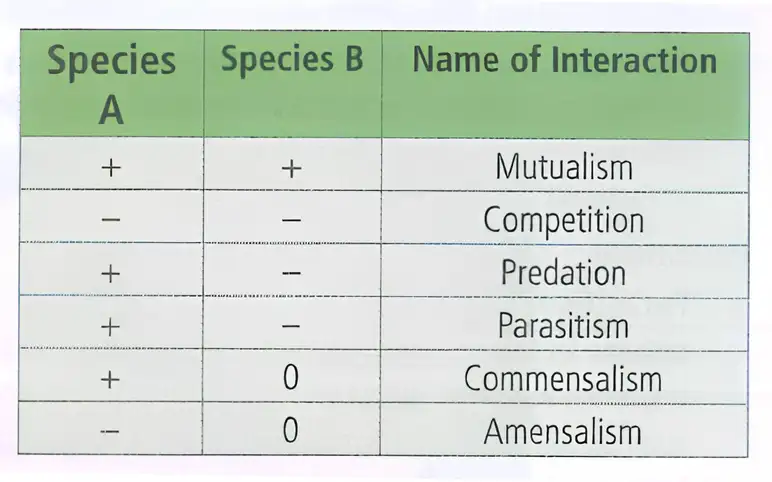
- Positive interactions: mutualism, proto-cooperation, commensalism.
- Negative interactions: amensalism, competition, parasitism, predation.
- Interactions summarized by + (benefit), - (harm), 0 (neutral).
Memory Aids
- + / + = Mutualism
- - / - = Competition
- + / - = Predation or Parasitism
- + / 0 = Commensalism
- - / 0 = Amensalism
Quick Checkpoints
- What is intra-specific interaction?
- Give examples of positive interactions.
- What does + / - interaction indicate?
Predation
Predator-Prey Relationship
- Predators capture, kill, and eat prey species.
- Transfers energy to higher trophic levels and controls prey population.
- Herbivores are ecologically predators of plants.
- Invasive species spread fast due to lack of natural predators.
- Predators regulate prey populations, maintaining species diversity.
- Predators are 'prudent' to avoid overexploiting prey.
- Prey defenses: camouflage, toxicity (e.g., Monarch butterfly).
- Plants defend with thorns and chemical toxins (e.g., cardiac glycosides).
Memory Aids
- Predation = predator kills prey.
- Prey defenses: camouflage, poison.
- Plants use thorns and chemicals for defense.
- Predators maintain ecosystem balance.
Quick Checkpoints
- What is predation?
- How do prey avoid predation?
- Why are predators called prudent?
Competition
Competition Types
- Active demand for common resources by individuals of same or different species.
- Intraspecific: within species, more severe.
- Interspecific: between species, less severe.
- Competitive release: species expands range when competitor removed.
- Gause's competitive exclusion: two species cannot coexist if competing for same resource indefinitely.
- Resource partitioning: species avoid competition by using different resources or times.
Memory Aids
- Intraspecific = same species competition.
- Interspecific = different species competition.
- Competitive exclusion = no coexistence with same niche.
- Resource partitioning avoids competition.
Quick Checkpoints
- Define intraspecific competition.
- What is competitive exclusion principle?
- How do species avoid competition?
Parasitism
Parasite-Host Relationship
- Parasite obtains food from host, usually smaller and lives on/in host.
- Adaptations: loss of sense organs, adhesive organs, loss of digestive system, high reproduction.
- Ectoparasites: live on host surface (e.g., lice, ticks, Cuscuta).
- Endoparasites: live inside host (e.g., liver, blood parasites), complex life cycles.
- Brood parasitism: parasitic bird lays eggs in host nest; eggs mimic host eggs.
Memory Aids
- Ectoparasites: outside host.
- Endoparasites: inside host.
- Brood parasitism: egg mimicry in birds.
Quick Checkpoints
- What adaptations do parasites have?
- Difference between ectoparasites and endoparasites?
- What is brood parasitism?
Commensalism
One Benefits, Other Neutral
- One species benefits; other neither harmed nor benefited.
- Examples: orchid on mango, barnacles on whale, cattle egret with cattle.
- Sea anemone and clown fish: fish protected, anemone unaffected.
- Epiphytes: attach to trees but photosynthesize, called ectocommensals.
Memory Aids
- Commensalism = one benefits, other neutral.
- Epiphytes are ectocommensals.
- Classic example: cattle egret and cattle.
Quick Checkpoints
- What is commensalism?
- Give an example of ectocommensal.
- How does clown fish benefit in commensalism?
Mutualism
Mutually Beneficial Obligatory Relationship
- Both species benefit and cannot live separately.
- Examples: lichens (fungus + algae), mycorrhizae (fungi + plant roots).
- Plant-animal mutualism: pollination and seed dispersal with rewards.
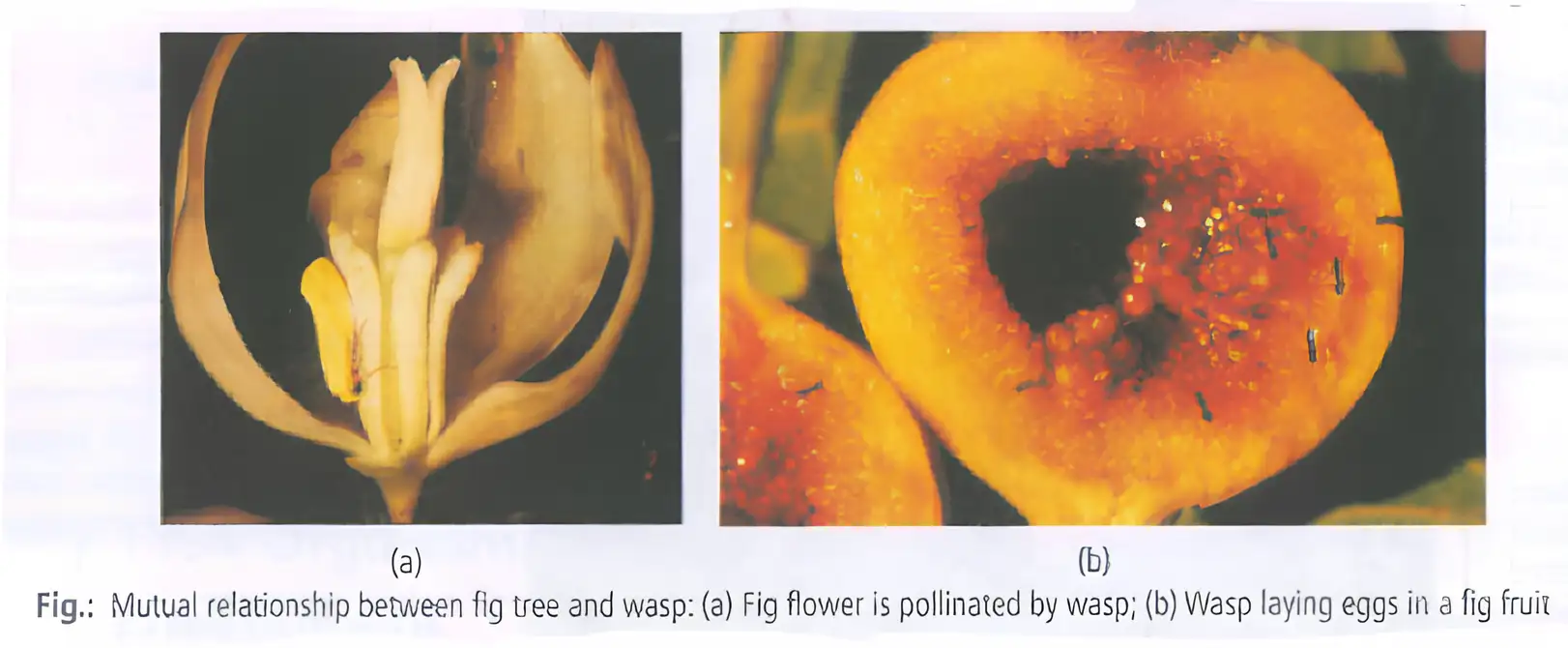
- Fig tree and wasp: wasp pollinates and lays eggs; fig provides food and shelter.
- Ophrys orchid uses sexual deceit to attract bee pollinator.
Memory Aids
- Mutualism = both benefit, obligatory.
- Lichens = fungus + algae symbiosis.
- Fig-wasp = tight one-to-one pollination.
- Sexual deceit = orchid mimics female bee.
Quick Checkpoints
- What defines mutualism?
- Give examples of mutualistic relationships.
- How does fig-wasp mutualism work?
Amensalism
One Species Inhibits Another
- One species inhibits growth or survival of another without benefit or harm to itself.
- Example: Grevillea robusta produces chemicals inhibiting nearby seedlings.
Memory Aids
- Amensalism = one harmed, other unaffected.
- Example: chemical inhibition by plants.
Quick Checkpoints
- What is amensalism?
- Give an example of amensalism in plants.
Additional Note
- Protocooperation: Both benefit but can live separately (e.g., tick bird and rhinoceros).
NEET Zoology — ALL CHAPTERS
1
Structural Organisation in Animals
2
Breathing and Exchange of Gases
3
Body Fluids and Circulation
4
Excretory Products and their Elimination
5
Locomotion and Movement
6
Neural Control and Coordination
7
Human Reproduction
8
Reproductive Health
9
Evolution
10
Microbes in Human Welfare
11
Organism and Population
12
Ecosystem
13
Biodiversity and Conservation