Introduction
Overview
- Evolutionary biology studies the history of life on Earth.
- Evolution means an orderly change from one condition to another.
- It involves changes in flora and fauna over millions of years.
Memory Aids
- Evolution = Orderly change in life forms.
Quick Checkpoints
- What does evolutionary biology study?
- Define evolution in simple terms.
Origin of Life
Key Points
- Universe is about 13.8 billion years old.
- Big Bang theory: Universe began with a huge explosion called Big Bang.
- Hydrogen and helium formed after expansion and cooling.
- Earth formed about 4.5 billion years ago in the solar system.
- Life originated on Earth from non-living matter (biopoiesis) about 4000-4200 million years ago.
- Several theories explain origin of life: special creation, cosmic panspermia, biogenesis, Oparin-Haldane theory.
Memory Aids
- Biopoiesis = Life from non-living matter.
Quick Checkpoints
- What is biopoiesis?
- When did Earth form?
Theories for Origin of Life
Main Theories
- Theory of special creation: Life created by supernatural power; organisms formed suddenly and unchanged.
- Cosmic panspermia theory: Life came from spores transferred from space.
- Theory of spontaneous generation: Life arose from decaying matter; disproved later.
- Theory of biogenesis: Life arises only from pre-existing life; supported by Pasteur's experiments.
Memory Aids
- Biogenesis = Life from life only.
- Spontaneous generation = Disproved old idea.
Quick Checkpoints
- What does biogenesis state?
- Who disproved spontaneous generation?
Modern Hypothesis or Chemical Theory
Oparin-Haldane Theory
- Life originated from non-living organic molecules via chemical evolution.
- Early Earth had different atmosphere and conditions.
- Spontaneous generation under current conditions is impossible.
- Published in Oparin's book The Origin of Life.
Memory Aids
- Chemical evolution = Life from organic molecules.
Quick Checkpoints
- What is chemical evolution?
- Who proposed the chemical theory?
Chemical Evolution
Key Experiments
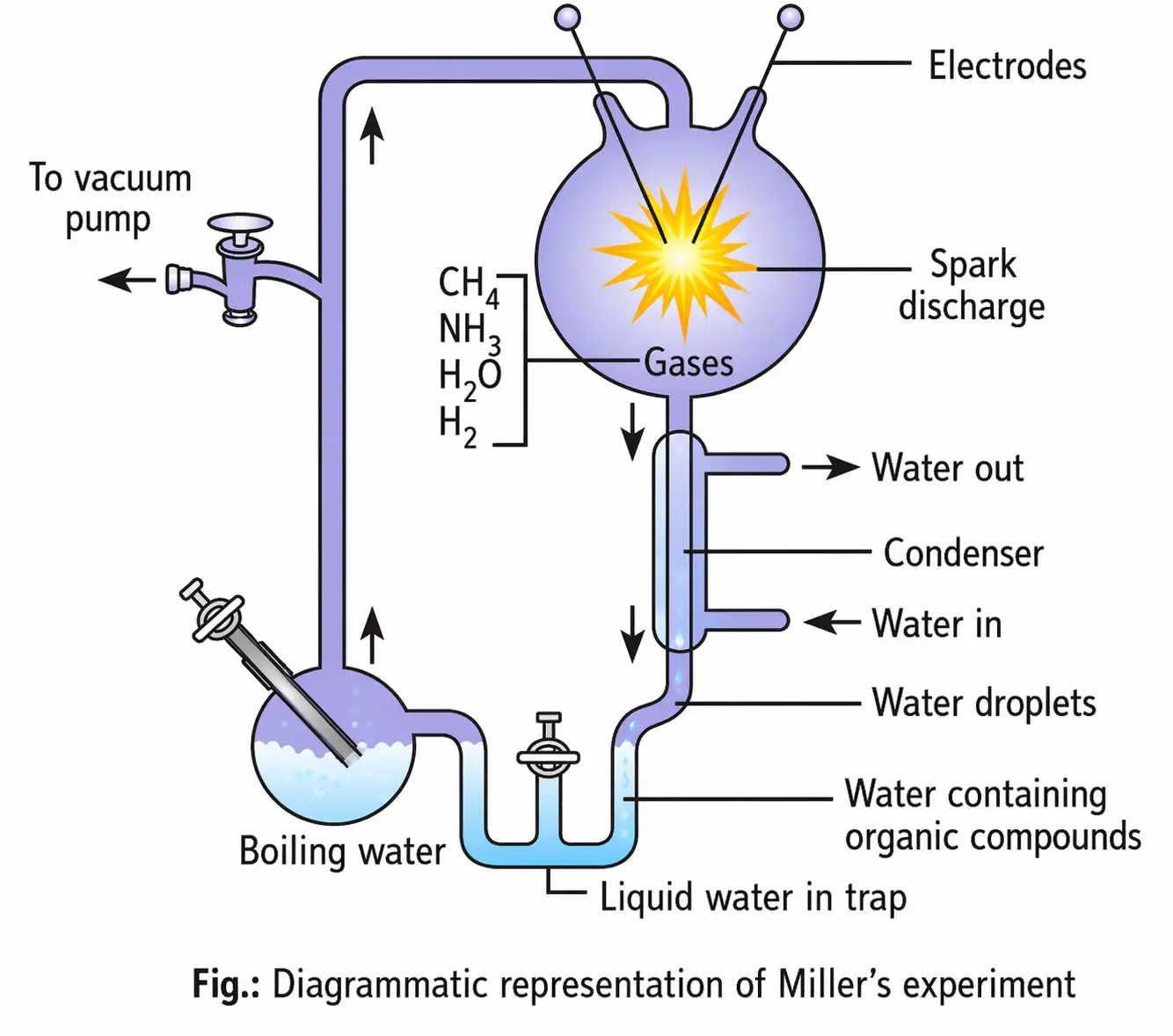
- 1953: S.L. Miller simulated early Earth conditions in lab.
- Electric discharge passed through gases (CH4, H2, NH3, water vapor) at 800°C.
- Amino acids and other organic compounds formed.
- Supports idea of "hot dilute soup" where life building blocks formed.
Memory Aids
- Miller experiment = Lab simulation of early Earth.
Quick Checkpoints
- What gases were used in Miller's experiment?
- What was the significance of electric sparks?
Biological Evolution
Evolution of Life Forms
- First non-cellular life forms appeared ~3 billion years ago (RNA, proteins, polysaccharides).
- Macromolecules formed protobionts (protein, lipid, nucleic acid clusters) with simple metabolism.
- Artificial protobionts: Oparin's coacervates (no lipid membrane), Fox's microspheres (lipid coat).
- Nucleic acid mutation led to self-duplication; nucleoproteins formed first life signs.
- Protocells (nucleoproteins + lipid coat) were first life forms.
- Protocells evolved into prokaryotic cells.
- First living beings: single-celled prokaryotes with naked DNA, mostly anaerobic chemoheterotrophs.
- Some evolved into chemoautotrophs using chemosynthesis (e.g., iron bacteria).
- Development of bacteriochlorophyll led to photosynthesis.
- True chlorophyll evolved; oxygenic photosynthetic bacteria (cyanobacteria) released free oxygen.
- Development of nucleus, mitochondria, and organelles led to metabolically active eukaryotic cells (~1.5 billion years ago).
Memory Aids
- Protobionts = Precursors to cells.
- Protocell = First true life form.
- Cyanobacteria = First oxygen producers.
Quick Checkpoints
- What are protobionts?
- How did photosynthesis evolve?
- When did eukaryotic cells appear?
Evolution of Life Forms
Key Observations
- Charles Darwin observed during H.M.S Beagle voyage that living forms share similarities with each other and with extinct life forms.
- Extinctions occurred over time; new life forms appeared in different geological periods.
- Populations have built-in variations in traits.
- Traits aiding survival in natural conditions lead to better reproduction.
Memory Aids
- "Survival of the fittest" means better reproductive success.
- Variation + Environment = Natural Selection.
Quick Checkpoints
- What did Darwin conclude about similarities among life forms?
- How do variations affect survival?
- What is the role of natural selection?
Fitness and Natural Selection
Concepts
- Fitness refers to reproductive success, not just survival.
- Individuals better adapted to environment leave more offspring.
- Natural selection is the process where nature selects fitter individuals.
- This process drives evolution over time.
Memory Aids
- Fitness = Reproductive success.
- Natural selection = Nature's filter.
Quick Checkpoints
- Define fitness in evolutionary terms.
- How does natural selection affect populations?
- What is the mechanism of evolution according to Darwin?
Contributions of Alfred Wallace
Insights
- Alfred Wallace independently reached similar conclusions as Darwin.
- New organism types appear over time.
- All life forms share common ancestors from different geological periods.
- Geological and biological histories of Earth are closely linked.
Memory Aids
- Wallace = Co-discoverer of natural selection.
- Common ancestors link all life forms.
Quick Checkpoints
- Who was Alfred Wallace?
- What is the significance of common ancestors?
- How are geological and biological histories related?
What are the Evidences for Evolution?
Palaeontological Evidences
- Fossils are remains of hard parts of life-forms found in sedimentary rocks.
- Different-aged rock layers contain fossils of different life-forms indicating their existence in specific geological periods.
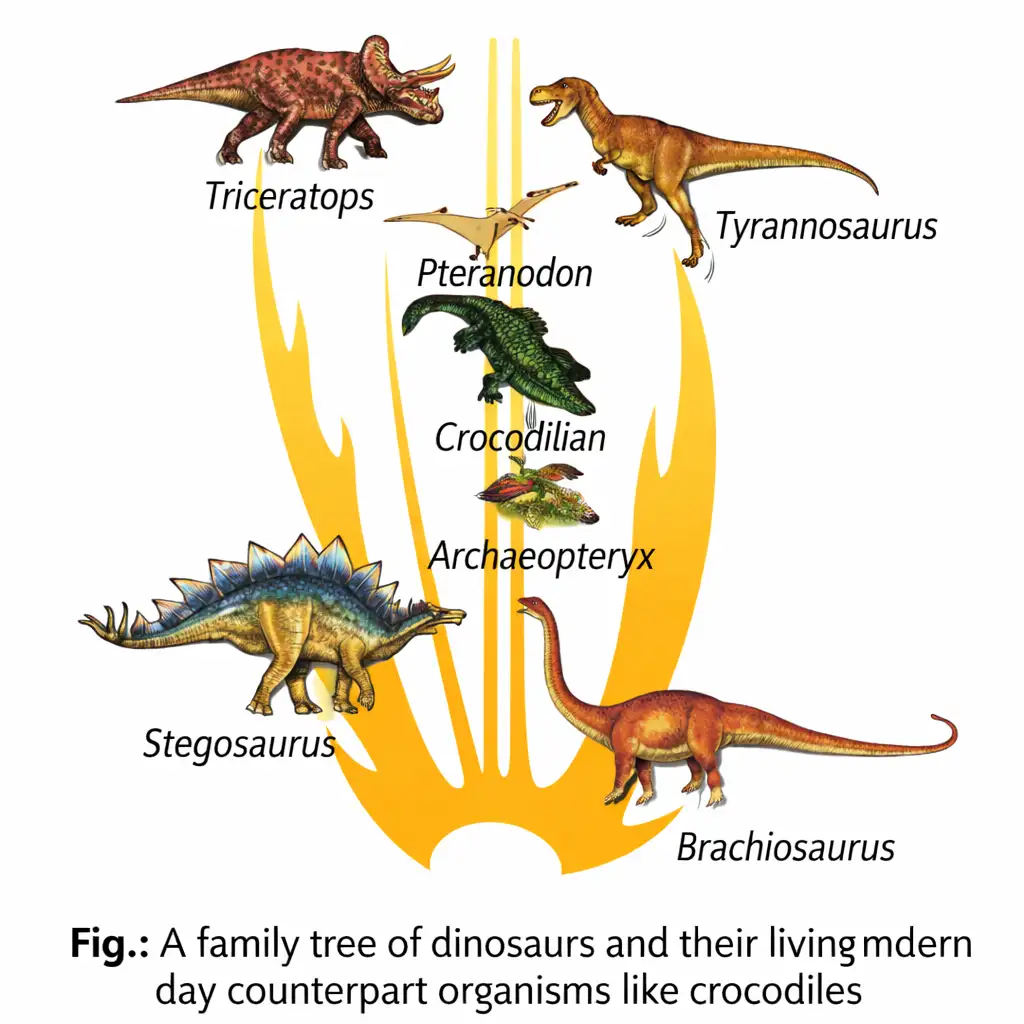
- Fossil records show a chronological succession: fishes → amphibians → reptiles → birds → mammals.
- Unaltered fossils preserve original form (e.g., woolly mammoths in ice, insects in amber).
- Petrified fossils form by mineral replacement of hard parts (bones, teeth, shells).
- Geological time is divided into eras, periods, and epochs based on fossil study.
- Mass extinction events caused large-scale disappearance of species, possibly due to meteor impacts or continental shifts.
Memory Aids
- Fossils show life’s timeline in rocks.
- Unaltered = original form; petrified = mineral replaced.
- Mass extinction = sudden large-scale species loss.
Quick Checkpoints
- What do fossils indicate about past life?
- Difference between unaltered and petrified fossils?
- What causes mass extinction?
Evidences from Comparative Anatomy and Morphology
Homology
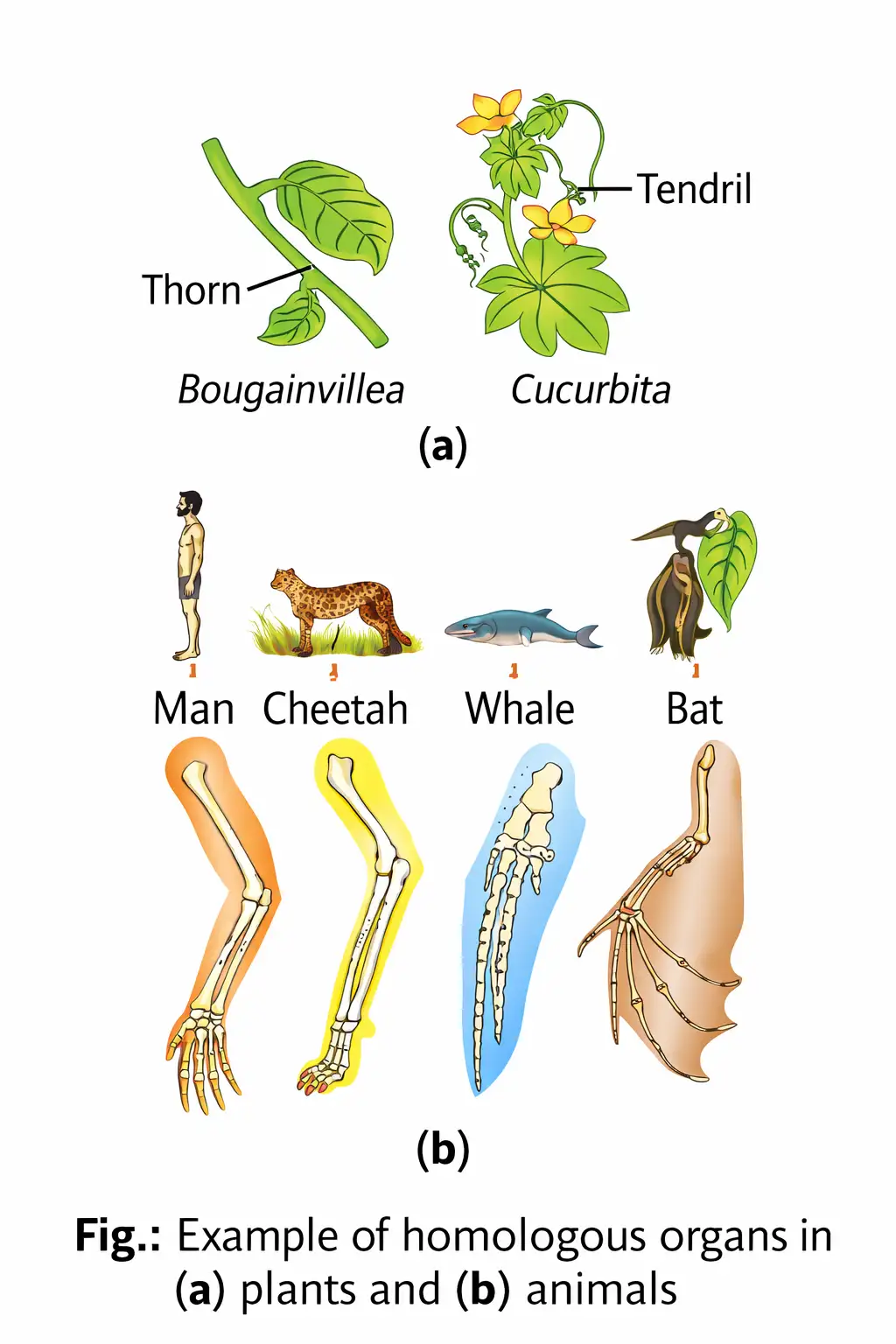
- Homologous organs share common ancestry and embryonic origin but perform different functions.
- Example: Forelimbs of whale, bat, cheetah, and human have similar bone structure (humerus, radius, ulna, carpals, metacarpals, phalanges).
- Divergent evolution/adaptive radiation leads to homologous structures.
- Heart structure in vertebrates shows gradual complexity from fishes (2-chambered) to mammals (4-chambered), confirming evolutionary changes.
Memory Aids
- Homology = same structure, different function.
- Forelimb bones pattern is key homology example.
- Heart chambers increase complexity in evolution.
Quick Checkpoints
- What defines homologous organs?
- Examples of homologous structures?
- How does vertebrate heart complexity support evolution?
Analogy
Analogous Organs
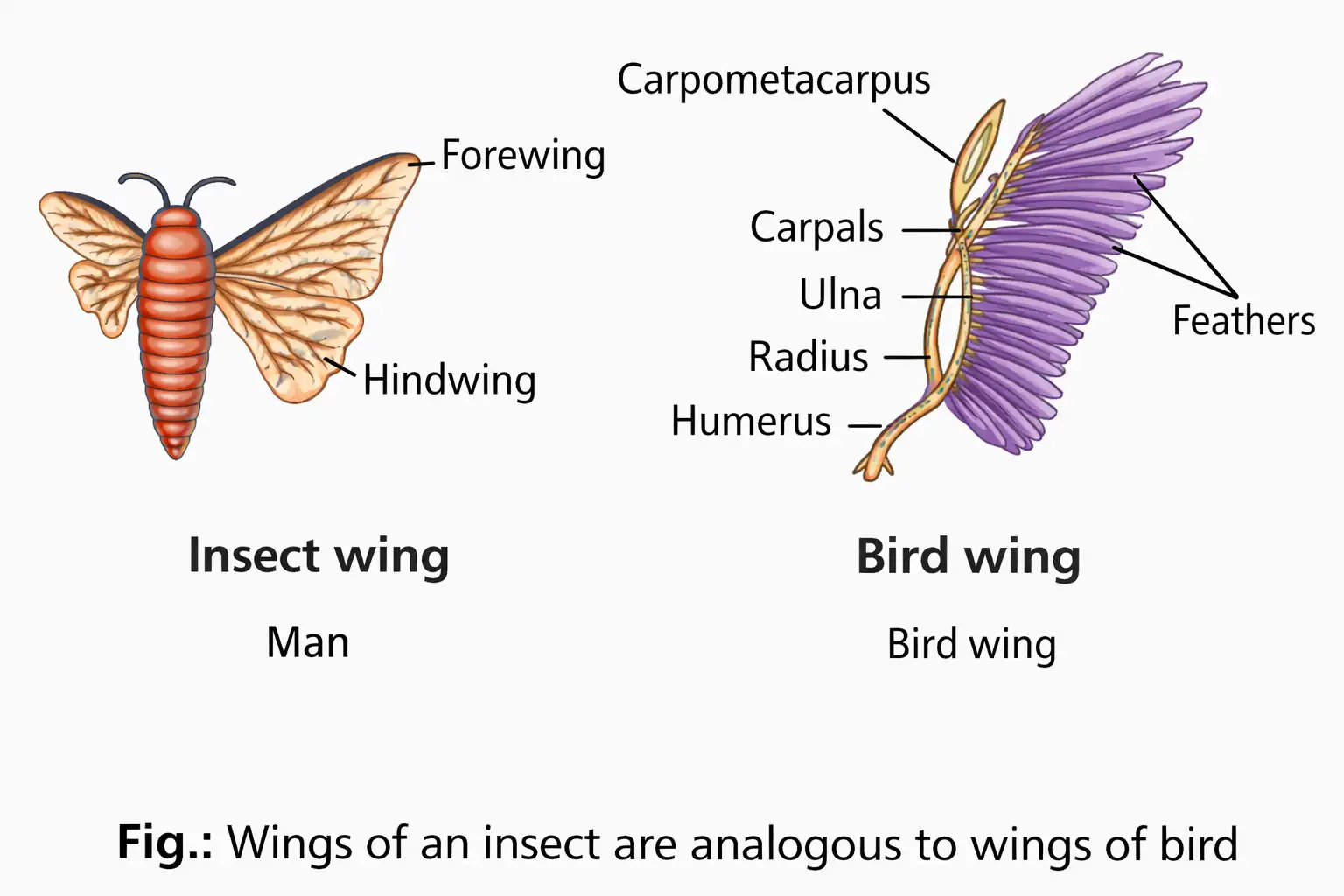
- Analogous organs differ in structure and origin but perform similar functions.
- Example: Wings of butterflies and birds look alike but differ anatomically.
- Other examples: Octopus eye vs mammal eye; penguin flippers vs dolphin flippers; sweet potato (root) vs potato (stem).
- Analogy results from convergent evolution or adaptive convergence.
- Biochemical similarities in proteins and genes also indicate common ancestry.
- Connecting links show traits of two taxonomic groups (e.g., Protopterus between fish and amphibians).
- Vestigial organs are reduced, non-functional remnants (e.g., human nictitating membrane).
- Atavism is reappearance of ancestral traits (e.g., moving pinna in some humans).
Memory Aids
- Analogy = different structure, same function.
- Convergent evolution creates analogous organs.
- Vestigial organs = evolutionary leftovers.
Quick Checkpoints
- Define analogous organs.
- Examples of analogy in animals and plants?
- What are vestigial organs and atavism?
Evidences from Embryology
Embryological Evidence
- All multicellular organisms start development from a single fertilized egg forming blastula and then gastrula with ectoderm and endoderm layers.
- Early embryos of vertebrates show remarkable similarity, hard to distinguish between species.
- Recapitulation theory: Ontogeny recapitulates phylogeny (development repeats evolutionary history).
- Retrogressive metamorphosis: loss of chordate features during development (e.g., ascidian tadpole).
- Neoteny: retention of larval traits in adults (e.g., cartilaginous skeleton in adult chondrichthyes, larval gills in salamanders).
Memory Aids
- Embryos show common early development.
- Recapitulation links development to evolution.
- Neoteny retains juvenile traits in adults.
Quick Checkpoints
- What is homology in embryonic development?
- Explain recapitulation theory.
- Examples of retrogressive metamorphosis and neoteny?
Natural Selection
Industrial Melanism
- Example of natural selection studied in moths by R.A. Fischer, E.B. Ford, and H.B.D. Kettlewell.
- Dark melanic moths appeared in industrial areas with soot-darkened trees.
- Peppered moth has two forms: light grey (typica) and dark melanic (carbonaria) due to mutation.
- Before industrialization, white moths camouflaged on lichen-covered trees and survived better.
- After industrialization, soot covered trees, white moths were preyed upon more, dark moths survived better.
- Result: increase in dark moth population, decrease in white moths.
Memory Aids
- Natural selection favors traits suited to environment.
- Industrial melanism shows color adaptation to pollution.
- Mutation creates variation for selection.
Quick Checkpoints
- What is industrial melanism?
- How does environment affect moth coloration?
- Role of mutation in natural selection?
Adaptive Radiation
Definition and Examples
- Evolution of different species from a common ancestor in a geographical area, spreading to various habitats.
- Darwin's finches of Galapagos Islands: Different beak types evolved due to varied feeding habits from a common seed-eating ancestor.
- Australian marsupials: Diverse species evolved from a single ancestral stock within Australia.
- Multiple adaptive radiations in one area lead to convergent evolution.
- Example of convergent evolution: Australian marsupials and placental mammals (e.g., placental wolf and Tasmanian wolf-marsupial).
- Parallel evolution: Convergent evolution in closely related species (e.g., running habit in deer and horse with vestigial splint bones).
Memory Aids
- Adaptive radiation = species radiate from one ancestor to many habitats.
- Darwin's finches = beak diversity from seed-eating ancestor.
- Convergent evolution = similar traits in different lineages.
- Parallel evolution = similar traits in closely related species.
Quick Checkpoints
- What defines adaptive radiation?
- Examples of adaptive radiation in nature?
- Difference between convergent and parallel evolution?
- Role of common ancestor in adaptive radiation?
Biological Evolution
Lamarck's Theory
- Lamarck published his theory in 1809 as 'The inheritance of acquired characters.'
- Changes acquired during an individual's life due to environment are inherited by offspring.
- Four main propositions:
- Internal vital force: Organisms grow due to an internal force.
- Effect of environment and new needs: Environmental changes create new needs, producing new structures (appetency).
- Use and disuse of organs: Used organs develop; unused organs degenerate.
- Inheritance of acquired characters: Acquired traits are passed to offspring, accumulating over generations to form new species.
Memory Aids
- Appetency = Desire for new structures.
- Use organs = Grow; Disuse organs = Shrink.
- Internal vital force drives growth.
Quick Checkpoints
- What triggers new needs in Lamarckism?
- How does use and disuse affect organs?
- What is inherited according to Lamarck?
Evidences in favour of Lamarckism
- Giraffe's long neck evolved by gradual elongation due to food scarcity in dry deserts.
Criticism of Lamarckism
- August Weismann disproved inheritance of acquired characters.
- Only germ cell traits are inherited (continuity of germplasm theory).
- Experiment: Rats' tails cut for 22 generations; offspring still had tails.
Darwin's Theory
Natural Selection
- Charles Darwin studied nature extensively during H.M.S. Beagle voyage.
- Observed variations in Galapagos Islands, called it "living laboratory of evolution."
- Theory announced in 1858 by Darwin and Alfred Russel Wallace.
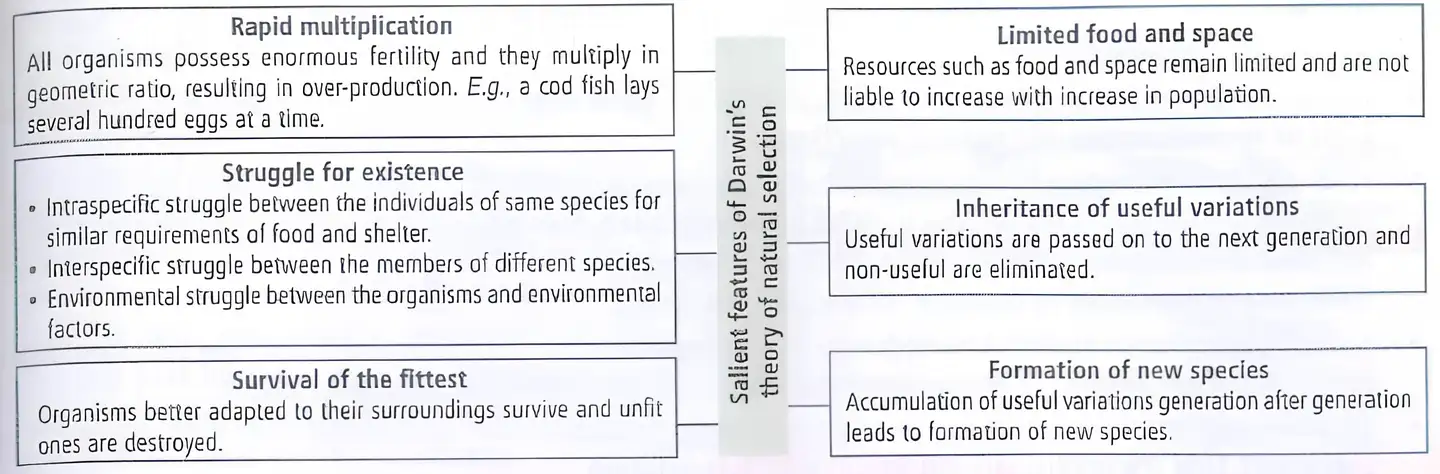
- Key steps:
- Rapid multiplication: Many offspring produced.
- Struggle for existence: Competition for resources.
- Survival of the fittest: Best adapted survive.
- Limited resources: Food and space are limited.
- Inheritance of useful variations: Favorable traits passed on.
- Formation of new species: Accumulated changes create new species.
Memory Aids
- Survival of the fittest = Best traits survive.
- Struggle for existence = Competition for limited resources.
- New species form by accumulated useful changes.
Quick Checkpoints
- What causes struggle for existence?
- How are useful variations inherited?
- What leads to formation of new species?
Evidences in favour of Darwinism
- Variations, mimicry, protective coloration, and flower-insect correlations support Darwinism.
- Lederberg's replica experiment with penicillin supports adaptation.
Criticism against Darwinism
- Did not distinguish somatic and germinal variations.
- Cannot explain unchanged organisms over millions of years.
- Discontinuous variations and survival of the fittest have limitations.
- Use and disuse effects and vestigial organs unexplained.
Mechanism of Evolution
Hugo de Vries' Mutation Theory
- Proposed by Dutch botanist Hugo de Vries based on experiments on Oenothera lamarckiana (evening primrose).
- Mutations or discontinuous variations are the raw materials of evolution.
- Mutations appear suddenly and become effective immediately.
- Mutations are random and directionless, unlike Darwinian small, directional variations.
- Mutations do not revolve around the species' mean character, unlike continuous variations.
- Same mutation types can appear in multiple individuals of a species.
- All mutations are inheritable.
- Mutations occur in all possible directions.
- Useful mutations are naturally selected; lethal ones are eliminated; harmless or useless mutations may persist.
- Evolution by mutation is called saltation (single-step large mutation), contrasting Darwin's gradualism.
Neo-Darwinism
- Modified Darwinism incorporating research by Weismann, de Vries, Stebbins, Dobzhansky, Wright, Mayr, etc.
- Factors for new species formation: genetic variation, isolation, heredity, natural selection, and speciation.
Memory Aids
- Mutation = sudden, inheritable change.
- Saltation = big jump in evolution.
- Neo-Darwinism = Darwin + genetics + natural selection.
Quick Checkpoints
- What is the basis of mutation theory?
- How do mutations differ from Darwinian variations?
- Define saltation in evolution.
- List factors responsible for speciation in Neo-Darwinism.
Hardy-Weinberg Principle
Genetic Equilibrium and Formulae
- Genetic equilibrium: gene frequencies remain constant across generations in a large, randomly mating population without mutation, selection, or gene flow.
- Alleles: D (dominant) with frequency p, d (recessive) with frequency q.
- Genotype frequencies: DD = p2, Dd = 2pq, dd = q2.
- Equations: p + q = 1 (allele frequencies), p2 + 2pq + q2 = 1 (genotype frequencies).
- p2 = homozygous dominant %, q2 = homozygous recessive %, 2pq = heterozygous %.
Factors Affecting Equilibrium
- Gene migration: movement of individuals changes gene frequencies in original and new populations.
- Gene flow: repeated gene migration causing gene exchange between populations.
- Genetic drift: random changes in allele frequencies by chance.
- Founder effect: new population with different allele frequencies due to small group migration.
- Mutation and genetic recombination introduce new variations.
- Natural selection alters gene frequencies based on survival advantage.
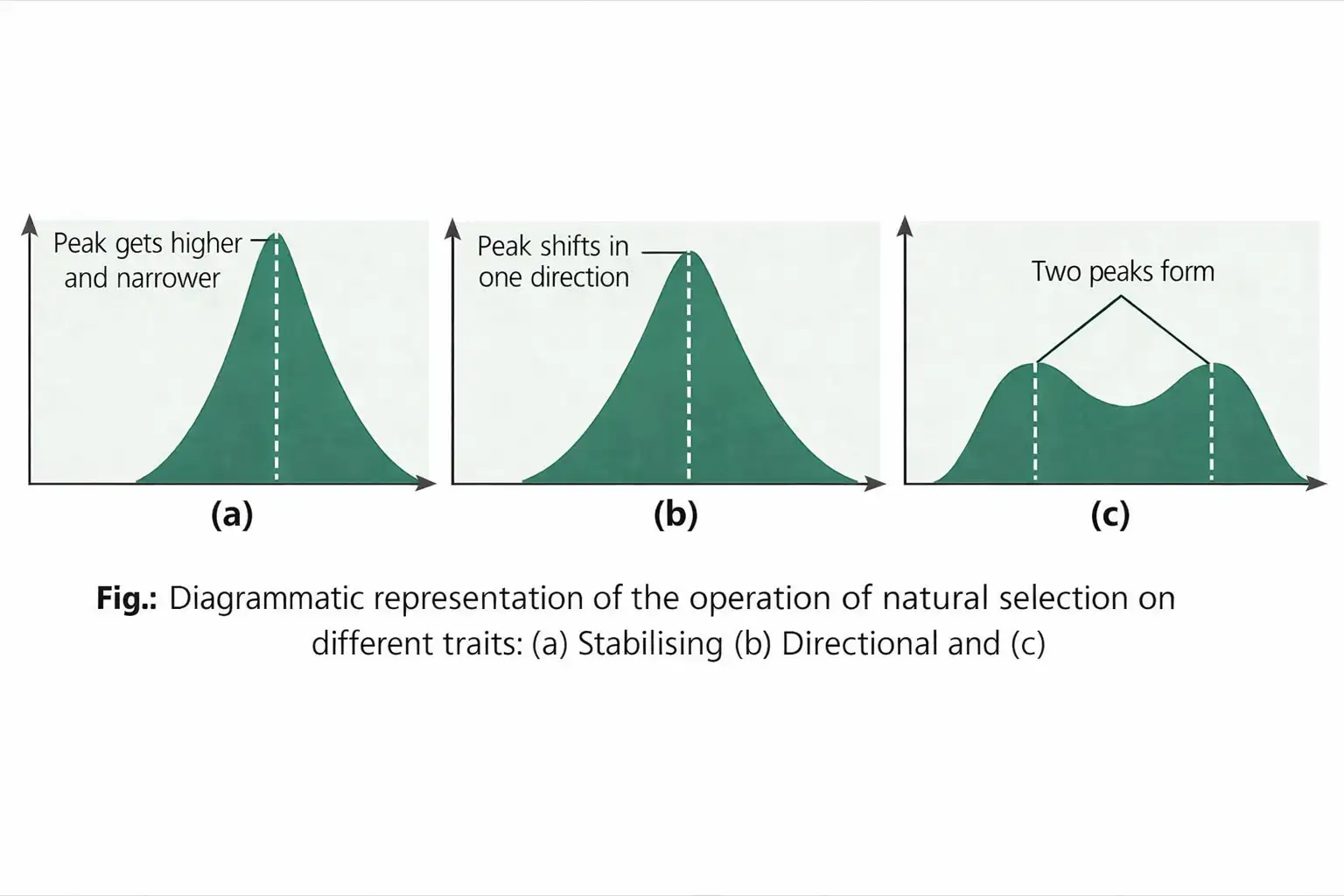
Natural Selection Types
- Stabilising selection: favors average traits, reduces extremes.
- Directional selection: favors one extreme trait, shifts population trait distribution.
- Disruptive selection: favors both extremes, reduces average traits.
Memory Aids
- p + q = 1: total allele frequency.
- p2 + 2pq + q2 = 1: genotype frequency sum.
- Gene flow = repeated gene migration.
- Founder effect = small group starts new population.
- Natural selection types: Stabilising (average), Directional (one extreme), Disruptive (both extremes).
Quick Checkpoints
- What conditions maintain Hardy-Weinberg equilibrium?
- How do gene migration and gene flow differ?
- What causes genetic drift and founder effect?
- How do mutation and recombination affect allele frequencies?
- What are the three types of natural selection and their effects?
A Brief Account of Evolution
Evolution Timeline and Key Events
- About 2000 million years ago (mya), first cellular life appeared on Earth.
- Single-celled organisms evolved into multicellular forms.
- By 500 mya, invertebrates were active.
- Jawless fish evolved around 350 mya.
- Seaweeds and early plants appeared around 320 mya.
- Plants were the first to invade land, becoming widespread before animals.
- Fish with strong fins (lobefins) evolved into first amphibians around 350 mya.
- Amphibians gave rise to reptiles with thick-shelled eggs resistant to drying.
- Reptiles dominated for 200 million years; some returned to water (e.g., Ichthyosaurs).
- Dinosaurs, including Tyrannosaurus rex, existed until about 65 mya before sudden extinction.
- Small reptiles survived; mammals evolved as viviparous, intelligent animals.
- Continental drift influenced mammal distribution; pouched mammals survived in Australia.
- Some mammals adapted fully to aquatic life (whales, dolphins, seals, sea cows).
Evolution of Plants and Vertebrates
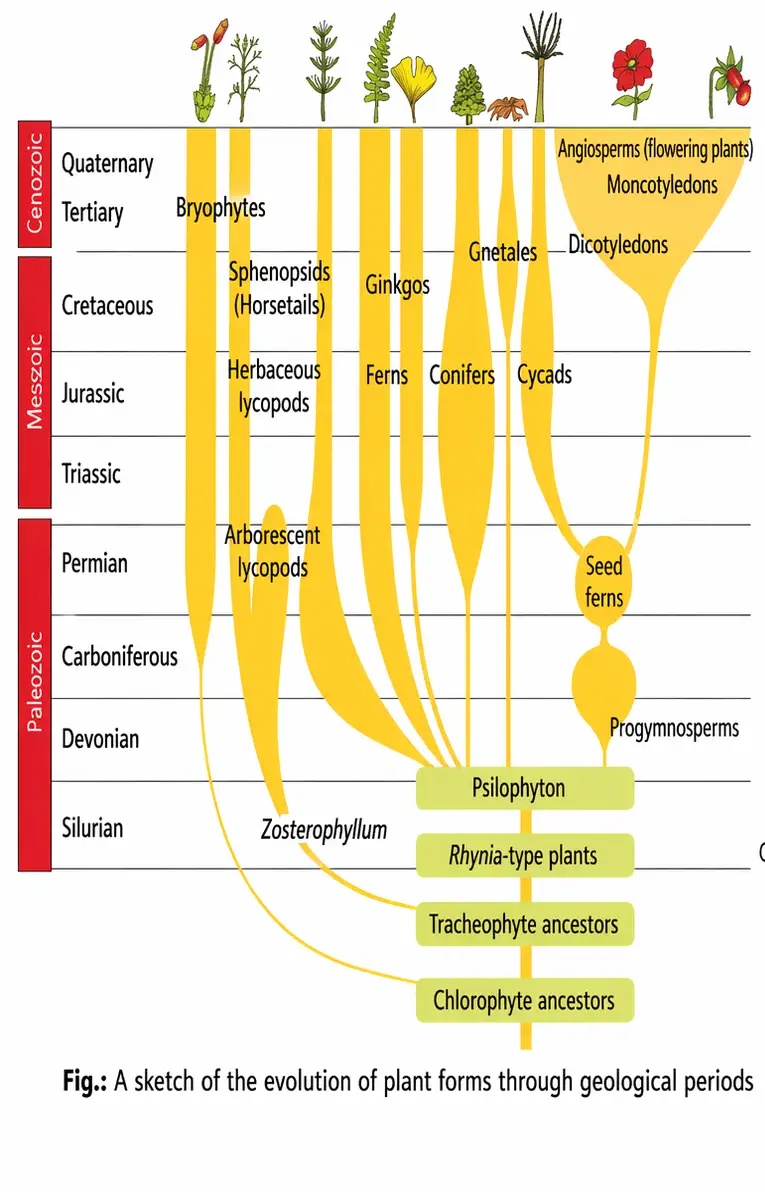
- Plants evolved from Chlorophyte ancestors to land plants.
- Major plant groups: ferns, conifers, cycads, ginkgos, horsetails.
- Seed plants evolved from progymnosperms, splitting into seed ferns and gymnosperms.
- Flowering plants (angiosperms) appeared in the Cretaceous period, including monocots and dicots.
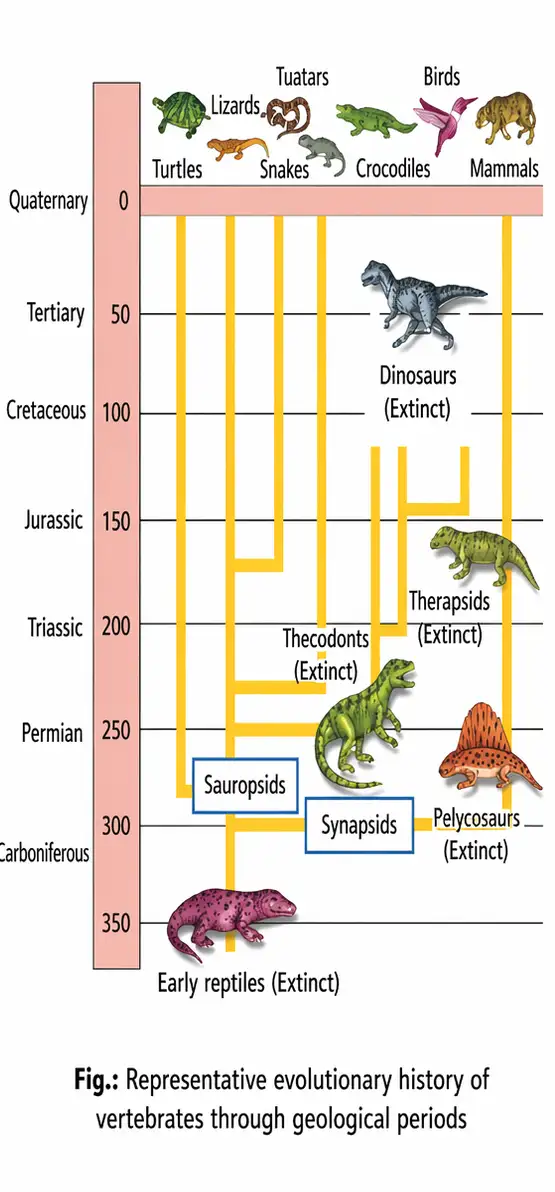
- Vertebrates evolved into Sauropsids (reptiles, birds) and Synapsids (mammals).
- Extinct groups: Thecodonts, Therapsids, Pelycosaurs.
- Modern reptiles include turtles, lizards, snakes, tuatars, crocodiles.
- Birds and mammals evolved and continue to exist today.
Memory Aids
- "2000 mya first life, 500 mya invertebrates thrive"
- "Lobefins to amphibians, then reptiles lay tough eggs"
- "Dinosaurs extinct 65 mya, mammals rise and survive"
- "Plants first on land, then animals follow"
- "Sauropsids = reptiles & birds, Synapsids = mammals"
- "Continental drift shapes mammal distribution"
Quick Checkpoints
- When did first cellular life appear?
- What are lobefins and their significance?
- Which group evolved first on land, plants or animals?
- What caused dinosaur extinction?
- How did mammals differ from reptiles in reproduction?
- What are the main vertebrate evolutionary groups?
- How did continental drift affect mammal evolution?
Origin and Evolution of Man
Human Evolution Overview
- Human evolution (anthropogenesis) is the biological evolution of Homo sapiens sapiens from other hominids and mammals.
- Primates like Dryopithecus and Ramapithecus existed ~15 million years ago (mya); hairy, walked like apes.
- Ramapithecus was more man-like; Dryopithecus more ape-like.
- Fossils in Ethiopia and Tanzania (~3-4 mya) show hominid features; upright walking, height under 4 feet.
- Australopithecus lived ~2 mya in East African grasslands; hunted with stone tools, mainly frugivorous.
- Homo habilis (brain 650-800 cc) was the first hominid, likely non-meat eater.
- Homo erectus (~1.5 mya) had ~900 cc brain, likely ate meat.
- Neanderthal man (brain 1400 cc) lived 100,000-40,000 years ago in Near East and Central Asia; used hides, buried dead.
- Homo sapiens arose in Africa, spread globally, developed races.
- Modern Homo sapiens appeared during Ice Age (75,000-10,000 years ago).
- Prehistoric cave art (~18,000 years ago) found at Bhimbetka rock shelter, Madhya Pradesh.
- Agriculture and human settlements began ~10,000 years ago.
Memory Aids
- Dryopithecus = "Dry ape" (more ape-like).
- Ramapithecus = "Rama man" (more man-like).
- Australopithecus = "Southern ape" (early upright walker).
- Homo habilis = "Handy man" (first tool user).
- Homo erectus = "Upright man" (fire user, meat eater).
- Neanderthal = "Near East man" (buried dead, used hides).
- Modern humans = "Wise man" (advanced culture and technology).
Quick Checkpoints
- What distinguishes Ramapithecus from Dryopithecus?
- Brain size range of Homo habilis?
- Key features of Neanderthal man?
- When did modern Homo sapiens appear?
- Significance of Bhimbetka rock shelter?
Human Evolution
Evolutionary Stages
- Australopithecus (5 mya): Ape-like, upright walking, small brain, plant eater, climbed trees.
- Homo habilis (1.5-2 mya): "Skillful man," used simple tools, larger brain than Australopithecus.
- Homo erectus (1.8-1.7 mya): Taller, human-like, used fire, lived in groups, omnivorous.
- Homo sapiens neanderthalensis (400,000-30,000 years ago): Strong, used tools and fire, cared for sick.
- Homo sapiens fossilis (50,000-10,000 years ago): Early modern humans (Cro-Magnon), skilled tool makers, artists, complex communities.
- Homo sapiens sapiens (25,000 years ago to present): Modern humans, larger brains, advanced culture and technology, originated near Caspian and Mediterranean seas.
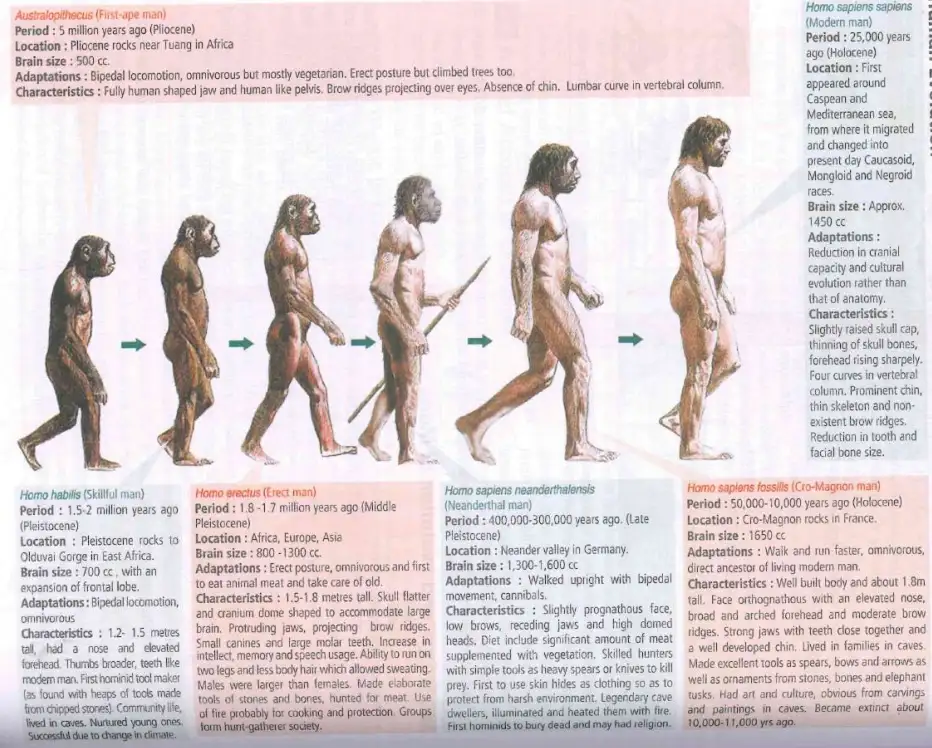
Memory Aids
- Australopithecus = "Southern ape," early upright walker.
- Homo habilis = "Handy man," first tool user.
- Homo erectus = "Upright man," fire user.
- Neanderthals = "Near East man," cared for sick.
- Homo sapiens fossilis = Early modern humans, artists.
- Homo sapiens sapiens = "Wise man," modern culture.
Quick Checkpoints
- Order of human ancestors from Australopithecus to modern humans?
- Which species first used fire?
- Brain size progression in human evolution?
- Characteristics of Neanderthals?
- Significance of Cro-Magnon humans?
NEET Zoology — ALL CHAPTERS
1
Structural Organisation in Animals
2
Breathing and Exchange of Gases
3
Body Fluids and Circulation
4
Excretory Products and their Elimination
5
Locomotion and Movement
6
Neural Control and Coordination
7
Human Reproduction
8
Reproductive Health
9
Evolution
10
Microbes in Human Welfare
11
Organism and Population
12
Ecosystem
13
Biodiversity and Conservation