CLASS 12-HUMANITIES . HISTORY . THEMES IN INDIAN HISTORY PART III . MAHATMA GANDHI-AND-THE-NATIONALIST-MOVEMENT-CIVIL-DISOBEDIENCE-AND-BEYOND
Chapter 3 : MAHATMA GANDHI AND THE NATIONALIST MOVEMENT CIVIL DISOBEDIENCE AND BEYOND
Ch 3
HISTORY
CLASS 12-HUMANITIES
Mahatma Gandhi and the Nationalist Movement
Mahatma Gandhi played a pivotal role in India's struggle for independence through his leadership in various nationalist movements. After returning from South Africa in 1915, where he had developed his philosophy of non-violence and Satyagraha, Gandhi spent time understanding India's social and political conditions. He led significant movements such as the Non-Cooperation Movement and the Civil Disobedience Movement, which united diverse groups including peasants, workers, and women in the fight against British colonial rule.
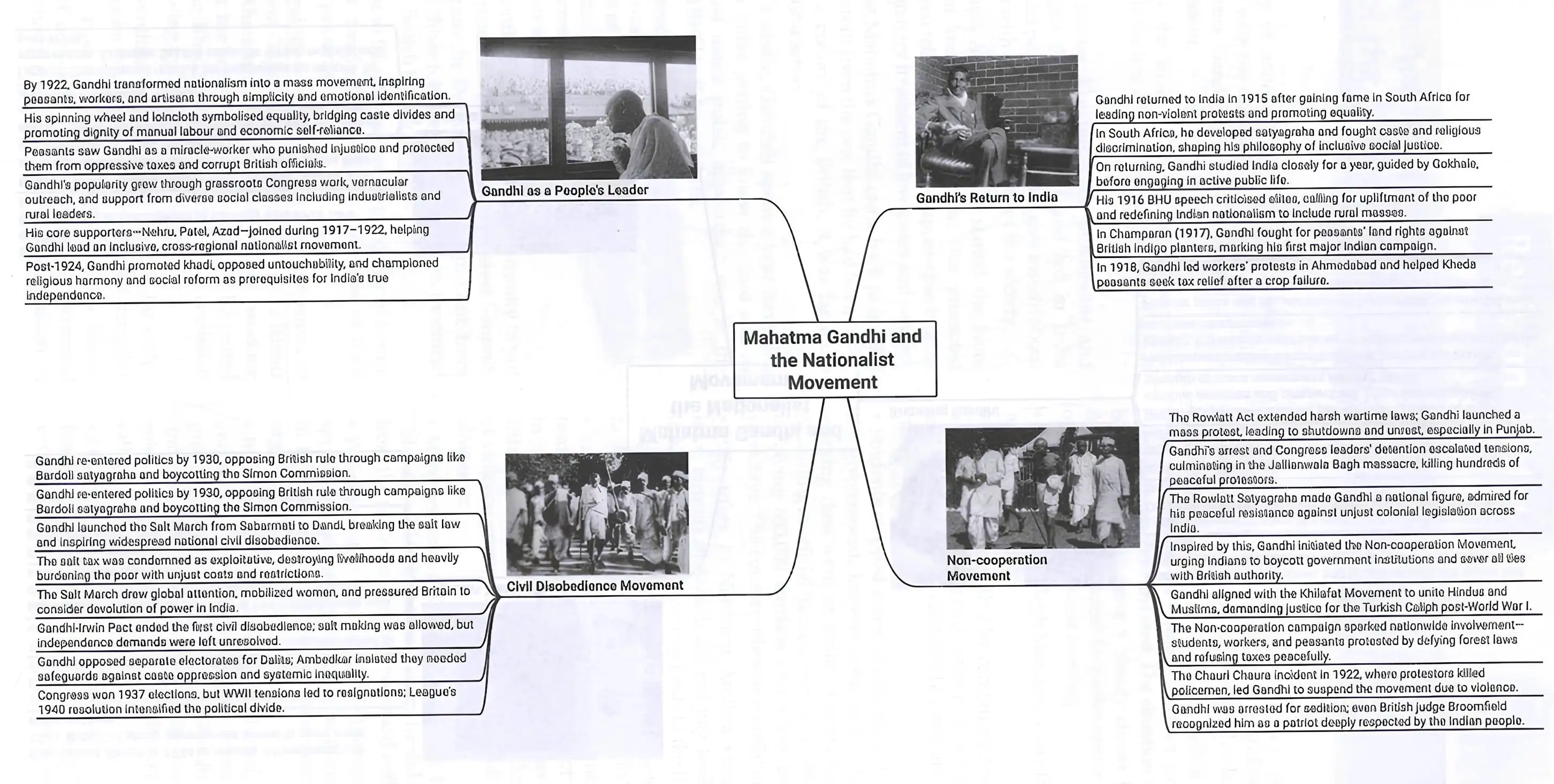
Gandhi's Return and Early Activities
Gandhi returned to India in 1915 and spent a year traveling across the country to understand its people and problems. His first major public appearance was at the opening of the Banaras Hindu University in 1916. He soon became involved in local struggles such as the Champaran movement, where he fought for peasants' rights against British indigo planters.
Non-Cooperation Movement
Launched in response to the Rowlatt Act and the Jallianwala Bagh massacre, the Non-Cooperation Movement aimed to boycott British goods and institutions. It united Hindus and Muslims but was suspended in 1922 after violent incidents like the Chauri Chaura episode.
Civil Disobedience Movement
Beginning with the Salt March in 1930, this movement involved breaking unjust laws, such as the salt tax, through peaceful protests. It attracted widespread participation, including women, and brought international attention to India's independence struggle.
Gandhi as a People's Leader
By the 1920s, Gandhi had become a symbol of unity and self-reliance, promoting rural industries like khadi and advocating social reforms such as the abolition of untouchability and child marriage.
Exam Question
Q: What were the main objectives of the Non-Cooperation Movement led by Gandhi?
A: The Non-Cooperation Movement aimed to boycott British goods, institutions, and services to protest against repressive laws like the Rowlatt Act and to unite Indians against colonial rule through peaceful means.
Salt Satyagraha and the Quit India Movement
The Salt Satyagraha and the Quit India Movement were two major campaigns led by Gandhi that intensified the struggle for Indian independence.
Salt Satyagraha
In 1930, Gandhi led the famous Salt March from Sabarmati Ashram to the Arabian Sea to protest the British monopoly on salt production and sales. This act of civil disobedience inspired millions to break salt laws and participate in the movement, marking a significant phase in the freedom struggle.
Quit India Movement
Launched in August 1942, the Quit India Movement demanded an immediate end to British rule. Despite Gandhi's arrest, the movement saw widespread protests and strikes across the country, involving thousands of Indians from various backgrounds.
Political Developments
During this period, the Indian National Congress declared Purna Swaraj (complete independence) as its goal. The Muslim League, however, pushed for a separate nation, Pakistan. The political landscape became complex, leading to the eventual partition of India in 1947.
Exam Question
Q: What was the significance of the Salt Satyagraha in India's independence movement?
A: The Salt Satyagraha was significant because it was a mass civil disobedience movement that united Indians across regions and social groups against British salt laws, drawing international attention and pressuring the British government.
The Last Heroic Days
After India gained independence on 15 August 1947, Gandhi focused on promoting peace amid communal violence and the challenges of partition. He fasted and worked tirelessly to reconcile Hindus and Muslims. Tragically, he was assassinated on 30 January 1948 by Nathuram Godse.
Gandhi's legacy includes his lifelong commitment to non-violence, social reform, and unity. His writings, speeches, and the accounts of contemporaries provide valuable insights into his leadership and the nationalist movement.
Sources of Historical Information
Historical understanding of Gandhi and the nationalist movement comes from his writings, government records, and contemporary newspapers. These sources offer multiple perspectives but also reflect biases, especially between British and Indian nationalist accounts.
Exam Question
Q: How did Gandhi respond to the communal violence following independence?
A: Gandhi responded by fasting, visiting hospitals and refugee camps, and urging peace and unity between Hindus and Muslims, despite the challenges posed by partition.
Key Dates in the Nationalist Movement
| Year | Event | Significance |
|---|---|---|
| 1915 | Gandhi returns from South Africa | Beginning of Gandhi's active involvement in Indian nationalism |
| 1917 | Champaran Movement | First major peasant movement led by Gandhi |
| 1919 | Rowlatt Satyagraha and Jallianwala Bagh Massacre | Protests against repressive laws; massacre intensified nationalist sentiments |
| 1921 | Non-Cooperation and Khilafat Movements | Mass movements uniting Hindus and Muslims against British rule |
| 1930 | Civil Disobedience Movement and Salt March | Nationwide protest against salt laws and British authority |
| 1942 | Quit India Movement | Demand for immediate British withdrawal; mass protests |
| 1947 | India's Independence and Partition | End of British rule; creation of India and Pakistan |
Important Centres of the National Movement
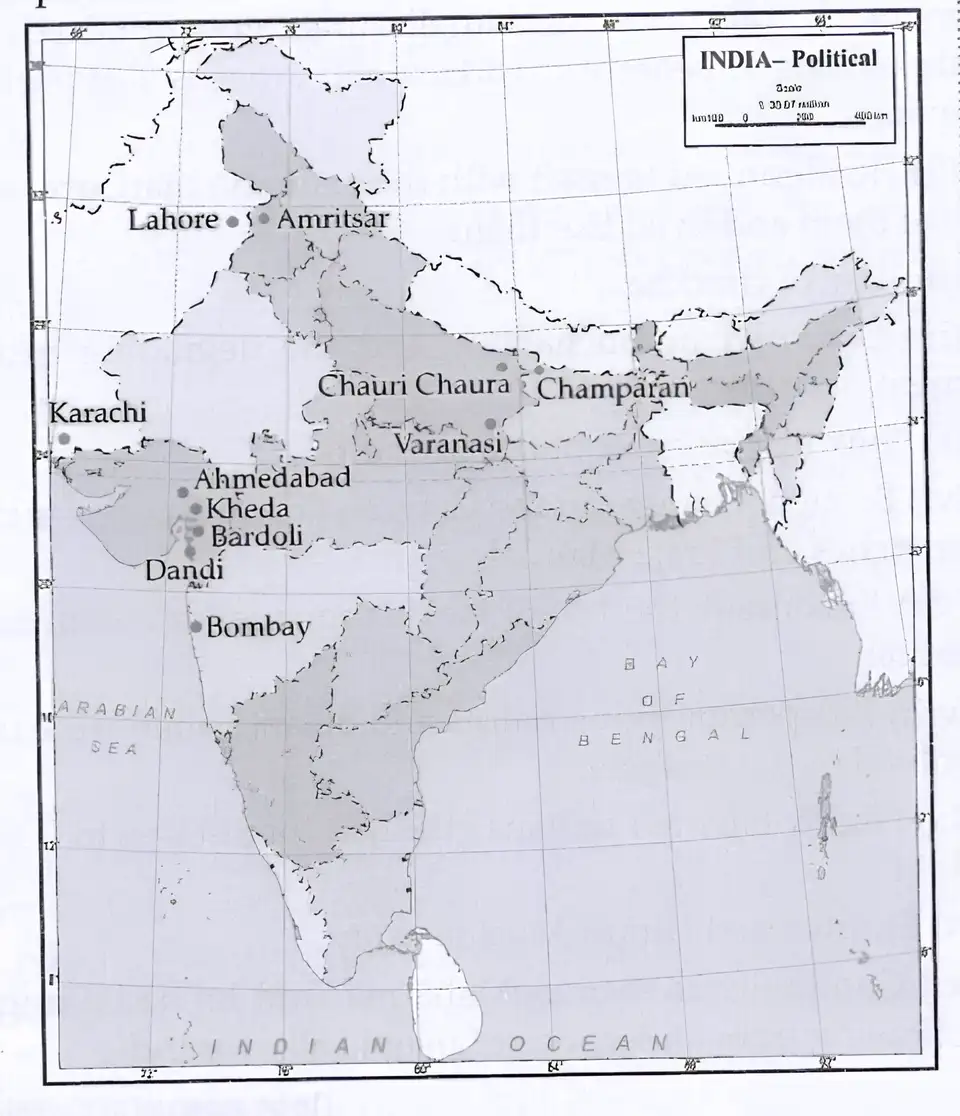
This political map highlights key locations such as Lahore, Amritsar, Karachi, Ahmedabad, Bombay, Champaran, Kheda, Bardoli, and Dandi, which were significant in India's freedom struggle.
Solved Examples
Example 1
Question: Explain the reasons for the suspension of the Non-Cooperation Movement in 1922.
Answer: The Non-Cooperation Movement was suspended by Gandhi in 1922 after the violent incident at Chauri Chaura, where protesters killed policemen by setting a police station on fire. Gandhi believed that the movement should remain non-violent and called off the campaign to prevent further violence.
Example 2
Question: What was the Gandhi-Irwin Pact and its significance?
Answer: The Gandhi-Irwin Pact was an agreement in 1931 between Gandhi and the British Viceroy Irwin. It ended the Civil Disobedience Movement temporarily, with the British agreeing to release political prisoners and allow Indians to make salt legally. It showed the British willingness to negotiate but did not resolve the demand for full independence.
Practice Set
Easy
- When did Gandhi return to India from South Africa?
- What was the main objective of the Salt March?
Moderate
- Describe the impact of the Jallianwala Bagh massacre on the Indian nationalist movement.
- Explain the reasons behind the launch of the Quit India Movement.
Challenging
- Analyze the role of peasants and workers in the Non-Cooperation Movement.
- Discuss the challenges Gandhi faced in uniting different religious communities during the freedom struggle.
Answer Key
Easy
- Gandhi returned to India in 1915.
- The Salt March aimed to protest the British salt tax and monopoly.
Moderate
- The Jallianwala Bagh massacre intensified anti-British sentiments and united Indians against colonial rule.
- The Quit India Movement was launched due to the failure of British promises and the demand for immediate independence.
Challenging
- Peasants and workers actively participated by boycotting taxes, strikes, and protests, interpreting Non-Cooperation in their own ways.
- Gandhi faced religious divisions, political rivalries, and communal tensions, making unity difficult.
Quick Reference
- Non-Cooperation Movement: 1920-1922, boycott of British goods and institutions.
- Civil Disobedience Movement: 1930-1934, breaking unjust laws peacefully.
- Salt March: 1930, protest against salt tax.
- Quit India Movement: 1942, demand for British withdrawal.
- Partition of India: 1947, creation of India and Pakistan.
Glossary
- Satyagraha: Non-violent resistance or civil disobedience.
- Khadi: Homespun cloth promoted by Gandhi to encourage self-reliance.
- Purna Swaraj: Complete independence from British rule.
- Rowlatt Act: Legislation allowing detention without trial, opposed by Gandhi.
- Two Nation Theory: The idea that Hindus and Muslims are separate nations, leading to partition.
- Chauri Chaura Incident: Violent clash in 1922 that led to suspension of Non-Cooperation Movement.