CLASS 12-HUMANITIES . HISTORY . THEMES IN INDIAN HISTORY PART III . FRAMING THE-CONSTITUTION-THE-BEGINNING-OF-A-NEW-ERA
Chapter 4 : FRAMING THE CONSTITUTION THE BEGINNING OF A NEW ERA
Ch 4
HISTORY
CLASS 12-HUMANITIES
Framing the Constitution The Beginning of a New Era
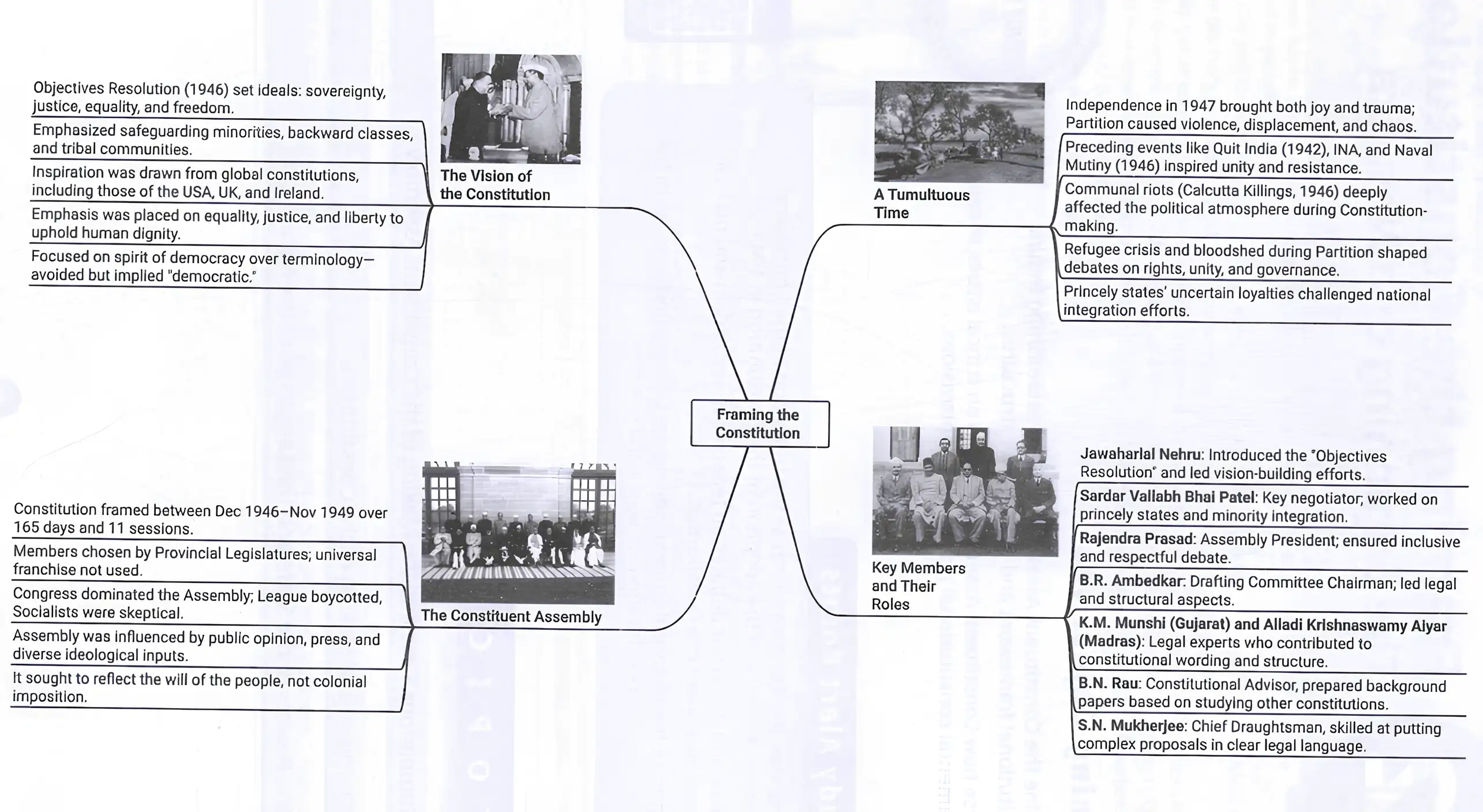
The framing of the Indian Constitution marked the beginning of a new era in the history of India. The Constituent Assembly was formed in 1946 to draft the Constitution, which was adopted in 1949 and came into effect on 26th January 1950. This Constitution is the lengthiest in the world and was created to unify a large, diverse, and deeply divided country after independence.
The process involved extensive debates on federalism, secularism, minority rights, and the powers of the state. The Constitution aimed to establish sovereignty, justice, equality, and freedom, protecting minorities and drawing inspiration from other countries' constitutions. The historical context of colonial rule, the freedom struggle, and the traumatic partition influenced the values and provisions of the Constitution.
The Constituent Assembly and Key Members
The Constituent Assembly consisted of 300 members, including representatives from British Indian provinces and princely states. The Muslim League boycotted early sessions, leaving the Congress as the dominant party. Important members included Jawaharlal Nehru, who moved the Objective Resolution and proposed the national flag; Sardar Vallabhbhai Patel; Rajendra Prasad; and Dr. B. R. Ambedkar, chairman of the Drafting Committee.
Exam Question:
Q: Who was the chairman of the Drafting Committee of the Indian Constitution and what was his role?
A: Dr. B. R. Ambedkar was the chairman of the Drafting Committee. He guided the drafting of the Constitution through the Assembly, overseeing the preparation of the final document over three years.
The Tumultuous Time and Challenges
India’s independence in 1947 was accompanied by joy and hope but also by violence and chaos due to Partition. Millions of refugees moved across borders, and princely states posed challenges due to their ambiguous constitutional status. The Constituent Assembly sessions were held amidst this turmoil, reflecting the diverse views of its members.
Exam Question:
Q: What were some challenges faced by the Constituent Assembly during the framing of the Constitution?
A: Challenges included managing the refugee crisis caused by Partition, integrating princely states with ambiguous status, and addressing diverse political and social views within the Assembly.
The Vision and Ideals of the Constitution
On 13th December 1946, Jawaharlal Nehru introduced the Objectives Resolution, which defined the ideals of the Constitution. It declared India an Independent Sovereign Republic guaranteeing justice, equality, freedom, and safeguarding minorities, tribal areas, and backward classes. The Constitution sought to blend liberal democracy with socialist economic justice within the Indian context.
Debates included the issue of separate electorates for minorities, which was opposed by many nationalists fearing it would divide the nation. The Assembly emphasized social justice, abolition of untouchability, and reservation of seats and jobs for lower castes.
Exam Question:
Q: What was the Objectives Resolution and why was it significant?
A: The Objectives Resolution, introduced by Nehru, outlined the fundamental principles of the Constitution, including sovereignty, justice, equality, and protection of minorities. It set the vision for India as a democratic and just republic.
The Powers of the State and Language Debates
The Constitution divided subjects into Central, State, and Concurrent lists, defining the powers of the Union and States. Article 356 allowed the Centre to take over state administration under certain conditions. Fiscal federalism was established with tax distribution between Centre and States.
Language was a contentious issue. Hindi in Devanagari script was proposed as the official language, but many opposed this, especially in the South. Mahatma Gandhi supported Hindustani, a blend of Hindi and Urdu, as a unifying language. The Assembly adopted a middle path to balance these views.
Exam Question:
Q: How did the Constitution address the division of powers between the Centre and the States?
A: The Constitution created three lists—Central, State, and Concurrent—to allocate subjects. It also included provisions like Article 356 for Centre’s intervention in states and established fiscal federalism for tax distribution.
Key Dates in the Framing of the Constitution
| Year | Event | Significance |
|---|---|---|
| 1946 | Formation of Constituent Assembly and start of sessions | Beginning of Constitution drafting process |
| 1947 | India’s Independence on 15 August | Marked end of British rule and start of sovereign nation |
| 1949 | Adoption of the Constitution in December | Finalization of the Constitution document |
| 1950 | Constitution came into effect on 26 January | India became a Republic with its own Constitution |
Solved Examples
Example 1: Explain the role of the Constituent Assembly in framing the Indian Constitution.
Answer: The Constituent Assembly was responsible for drafting the Constitution. It held 11 sessions over 165 days between 1946 and 1949. Members debated various issues such as federalism, minority rights, and language, reflecting the aspirations of a newly independent India.
Example 2: What were the main ideals enshrined in the Objectives Resolution?
Answer: The Objectives Resolution declared India an Independent Sovereign Republic, guaranteeing justice, equality, freedom, and protection for minorities and backward classes. It laid the foundation for a democratic and just society.
Practice Set
Easy
- When was the Constituent Assembly formed?
- Who introduced the Objectives Resolution?
Moderate
- What challenges did the Constituent Assembly face during the framing of the Constitution?
- Explain the significance of Article 356.
Challenging
- Discuss the debates on separate electorates and their impact on the Constitution.
- Analyze the language controversy during the framing of the Constitution and how it was resolved.
Answer Key
- Easy 1: The Constituent Assembly was formed in 1946.
- Easy 2: Jawaharlal Nehru introduced the Objectives Resolution.
- Moderate 1: Challenges included Partition violence, refugee crisis, princely states integration, and diverse political views.
- Moderate 2: Article 356 allows the Centre to take over state administration under certain conditions.
- Challenging 1: Separate electorates were opposed by many as divisive; ultimately, the Constitution abolished them and promoted social justice.
- Challenging 2: The language controversy involved Hindi, Urdu, and Hindustani; a middle path was adopted to balance regional sentiments.
Quick Reference
- Constituent Assembly: Formed in 1946 to draft the Constitution.
- Objectives Resolution: Defined the ideals of justice, equality, and freedom.
- Article 356: Provision for Centre’s intervention in states.
- Separate Electorates: Rejected to promote national unity.
- Language Issue: Hindi proposed as official language; compromise reached.
Glossary
- Constituent Assembly: A body elected to draft or adopt a constitution.
- Objectives Resolution: A resolution outlining the guiding principles of the Constitution.
- Federalism: A system where power is divided between central and regional governments.
- Separate Electorates: Electoral system where minorities elect their own representatives.
- Secularism: Principle of equal treatment of all religions by the state.
- Fiscal Federalism: Financial relations between different levels of government.