CLASS 12-HUMANITIES . HISTORY . THEMES IN INDIAN HISTORY PART II . PEASANTS ZAMINDARS-AND-THE-STATE-AGRARIAN-SOCIETY-AND-THE-MUGHAL-EMPIRE-C-SIXTEENTH-SEVENTEENTH-CENTURY
Chapter 4 : PEASANTS, ZAMINDARS AND THE STATE AGRARIAN SOCIETY AND THE MUGHAL EMPIRE (C. SIXTEENTH- SEVENTEENTH CENTURY)
Ch 4
HISTORY
CLASS 12-HUMANITIES
Peasants, Zamindars and the State Agrarian Society and the Mughal Empire (c. Sixteenth-Seventeenth Centuries)
The Mughal Empire during the sixteenth and seventeenth centuries was characterized by a complex agrarian society where peasants, zamindars, and the state played interconnected roles. Agriculture was the backbone of the economy, with about 85% of the population living in rural areas and engaged in farming and related activities. The Mughal state derived a major share of its income from land revenue, collected through a system involving zamindars and state officials.
Peasants were the primary cultivators, involved in tilling, sowing, and harvesting crops throughout the year. They produced food grains as well as agro-based goods like sugar and oil. The village was the basic unit of agrarian society, functioning as a self-sufficient community governed by panchayats and headed by a village headman. Women contributed significantly to agricultural labor and household industries, with some rights to property inheritance.
Zamindars were landowners who collected revenue on behalf of the state and held social and economic privileges. They maintained armed contingents and fortresses, played a role in colonizing agricultural land, and had a complex relationship with peasants based on reciprocity and patronage. The Mughal land revenue system was detailed in the Ain-i-Akbari, a key administrative document compiled by Abul Fazl, which described the empire's administration, revenue collection, and social organization.
The agrarian society also included forest-dwelling tribes who practiced shifting cultivation and hunting, maintaining distinct cultural identities. The Mughal state interacted with these groups through tribute and trade in forest produce. The period saw the introduction of new crops and irrigation techniques, contributing to agricultural expansion and economic growth.
Exam Question
Q: What roles did peasants and zamindars play in the Mughal agrarian society?
A: Peasants were the primary cultivators engaged in agricultural production, while zamindars were landowners who collected revenue for the state and held social and economic privileges. Zamindars also maintained armed forces and helped settle cultivators, creating a relationship of cooperation and conflict with peasants.
Crops, Technology and Agricultural Production
During the sixteenth and seventeenth centuries, agriculture was the mainstay of the Indian economy. The majority of the population lived in villages and were engaged in farming. Peasants cultivated a variety of crops including rice, wheat, millets, cotton, sugarcane, lentils, and oilseeds. The agricultural year was divided into two main seasons: Kharif (autumn) and Rabi (spring), with some areas producing multiple crops annually.
New crops such as maize, tomatoes, potatoes, chillies, pineapple, and papaya were introduced from other parts of the world during this period. Irrigation systems were developed to supplement monsoon rains, and the broadcasting method of sowing seeds was common. Land ownership was mostly individual, with peasants owning and trading land freely.
Primary sources like the Ain-i-Akbari and regional revenue records provide detailed information about agricultural practices, crop patterns, and revenue systems. Peasants were classified as Khud-Kashta (resident cultivators owning land) and Pahi-Kashta (non-resident cultivators working on contract). The Mughal state encouraged the cultivation of high-quality crops (Jins-i-Kamil) to increase revenue.
Exam Question
Q: What were the main crops and agricultural practices during the Mughal period?
A: The main crops included rice, wheat, millets, cotton, sugarcane, lentils, and oilseeds. Agriculture was organized into Kharif and Rabi seasons, with irrigation systems supplementing monsoon rains. New crops like maize, tomatoes, and chillies were introduced, and peasants practiced individual land ownership and crop diversity.
The Village, Community, Forests and Tribes
The village was the fundamental social and economic unit in Mughal agrarian society. It consisted of cultivators, a panchayat (council of elders), and a headman (Mandal or Muqaddam). The panchayat maintained social order, upheld caste boundaries, and administered local justice, including levying fines and expelling offenders. Jati panchayats also existed for caste-specific matters and were generally respected by the state.
Villages had complex economic relationships, including the Jajmani system, where artisans like blacksmiths and carpenters were supported by zamindars. Women actively participated in agricultural work and had property rights, especially in regions like Punjab.
Forests covered about 40% of the territory and were inhabited by tribal groups who depended on hunting, gathering, and shifting cultivation. The Mughal state engaged with forest communities through tribute (Peshkash) and trade in forest products like honey and beeswax. Over time, tribal chieftains sometimes became zamindars or kings, and cultural influences such as Sufism spread into forest areas.
Exam Question
Q: Describe the role of the village panchayat and the position of women in Mughal agrarian society.
A: The village panchayat was a council of elders responsible for maintaining social order, enforcing caste boundaries, and administering justice. Women contributed to agricultural labor, household industries, and had rights to inherit and sell property, particularly in regions like Punjab.
Zamindars, Land Revenue System and Abul Fazl's Ain-i-Akbari
Zamindars were influential landowners who collected land revenue for the Mughal state and held social and economic privileges. They maintained private lands (milkiyat) and could sell or mortgage them. Zamindars also controlled military resources and played a role in settling cultivators by providing loans and support.
The Mughal land revenue system was a major source of state income. The Ain-i-Akbari, compiled by Abul Fazl in 1598 CE, is a comprehensive administrative record detailing the empire's governance, revenue collection, military organization, and cultural life. It is divided into daftars (sections) covering the royal household, civil and military administration, fiscal policies, and cultural traditions.
While the Ain-i-Akbari contains some inaccuracies and regional data inconsistencies, it remains a crucial source for understanding Mughal administration and society. The Mughal Empire's stability and expansion were supported by a steady flow of silver bullion from international trade, which facilitated economic growth and currency circulation.
Exam Question
Q: What is the significance of the Ain-i-Akbari in understanding the Mughal Empire?
A: The Ain-i-Akbari is a detailed administrative record compiled by Abul Fazl that describes the Mughal Empire's governance, revenue system, military, and cultural life. It provides valuable insights into the empire's organization and functioning during Akbar's reign.
Key Dates
| Year | Event | Significance |
|---|---|---|
| 1526 | Babur defeats Ibrahim Lodi at Panipat | Establishment of the Mughal Empire in India |
| 1530-40 | First phase of Humayun's reign | Early consolidation of Mughal rule |
| 1540-55 | Humayun defeated by Sher Shah, exile at Safavid court | Temporary loss of Mughal power |
| 1555-56 | Humayun regains lost territories | Restoration of Mughal rule |
| 1556-1605 | Reign of Akbar | Expansion and consolidation of the empire |
| 1605-27 | Reign of Jahangir | Continued stability and cultural growth |
| 1628-58 | Reign of Shah Jahan | Architectural achievements and economic prosperity |
| 1658-1707 | Reign of Aurangzeb | Empire at greatest territorial extent |
| 1739 | Nadir Shah invades India and sacks Delhi | Decline of Mughal power |
| 1761 | Ahmad Shah Abdall defeats Marathas at Panipat | Shift in regional power dynamics |
| 1765 | Diwani of Bengal transferred to East India Company | Beginning of British economic control |
| 1857 | Last Mughal ruler Bahadur Shah II deposed | End of Mughal Empire and start of British colonial rule |
Solved Examples
Example 1: Explain the role of zamindars in the Mughal land revenue system.
Solution: Zamindars were landowners who collected land revenue on behalf of the Mughal state. They held private lands and maintained armed forces. Zamindars helped settle cultivators by providing loans and support, and their relationship with peasants was based on patronage and reciprocity. They played a key role in the administration and economic structure of the empire.
Example 2: What were the main features of agricultural production during the Mughal period?
Solution: Agriculture was the main occupation, with peasants cultivating food grains and cash crops. The agricultural year was divided into Kharif and Rabi seasons. Irrigation systems supplemented monsoon rains, and new crops were introduced. Land ownership was mostly individual, and peasants used methods like broadcasting seeds. The Mughal state encouraged cultivation of high-quality crops to increase revenue.
Practice Set
Easy
- Define the terms Khud-Kashta and Pahi-Kashta peasants.
- What were the two main agricultural seasons in Mughal India?
Moderate
- Describe the role of the village panchayat in maintaining social order.
- Explain the significance of the Ain-i-Akbari for Mughal administration.
Challenging
- Analyze the relationship between zamindars and peasants during the Mughal period.
- Discuss the impact of international trade on the Mughal economy, especially the flow of silver.
Answer Key
- Khud-Kashta: Resident peasants who owned land in their villages.
- Pahi-Kashta: Non-resident cultivators who farmed land on a contractual basis.
- Agricultural seasons: Kharif (autumn) and Rabi (spring).
- Village panchayat: Council of elders that maintained caste boundaries, administered justice, and upheld social order.
- Ain-i-Akbari: A detailed administrative record describing Mughal governance, revenue, and culture.
- Zamindar-peasant relationship: Based on reciprocity, patronage, and sometimes conflict, with zamindars collecting revenue and supporting cultivators.
- International trade impact: Brought silver bullion into India, facilitating currency circulation and boosting the economy.
Quick Reference
- Peasants: Primary cultivators, engaged in farming and agro-based production.
- Zamindars: Landowners and revenue collectors with military and social power.
- Ain-i-Akbari: Administrative compendium of Akbar's empire by Abul Fazl.
- Khud-Kashta: Resident land-owning peasants.
- Pahi-Kashta: Contractual cultivators from other villages.
- Kharif and Rabi: Main agricultural seasons.
- Panchayat: Village council maintaining social order.
- Jajmani System: Economic exchange between zamindars and artisans.
- Peshkash: Tribute paid to the Mughal state.
Glossary
- Zamindar
- A landowner who collected revenue for the Mughal state and held social privileges.
- Peasant
- A cultivator engaged in agricultural production, often owning or working land.
- Ain-i-Akbari
- An administrative record compiled by Abul Fazl detailing Mughal governance and society.
- Khud-Kashta
- Resident peasants who owned land in their villages.
- Pahi-Kashta
- Non-resident cultivators who farmed land on a contractual basis.
- Panchayat
- A village council of elders responsible for social order and justice.
- Jajmani System
- A system of economic exchange between zamindars and village artisans.
- Peshkash
- Tribute or gifts paid to the Mughal state, often including forest products.
Timeline of Key Events
| Year | Event | Significance |
|---|---|---|
| 1526 | Babur establishes Mughal Empire | Start of Mughal rule in India |
| 1556-1605 | Reign of Akbar | Consolidation of empire and administrative reforms |
| 1598 | Completion of Ain-i-Akbari | Comprehensive record of Mughal administration |
| 1658-1707 | Reign of Aurangzeb | Empire reaches greatest territorial extent |
| 1765 | Diwani of Bengal to East India Company | Start of British economic dominance |
| 1857 | End of Mughal Empire | Beginning of British colonial rule |
Key Map: Expansion of the Mughal Empire
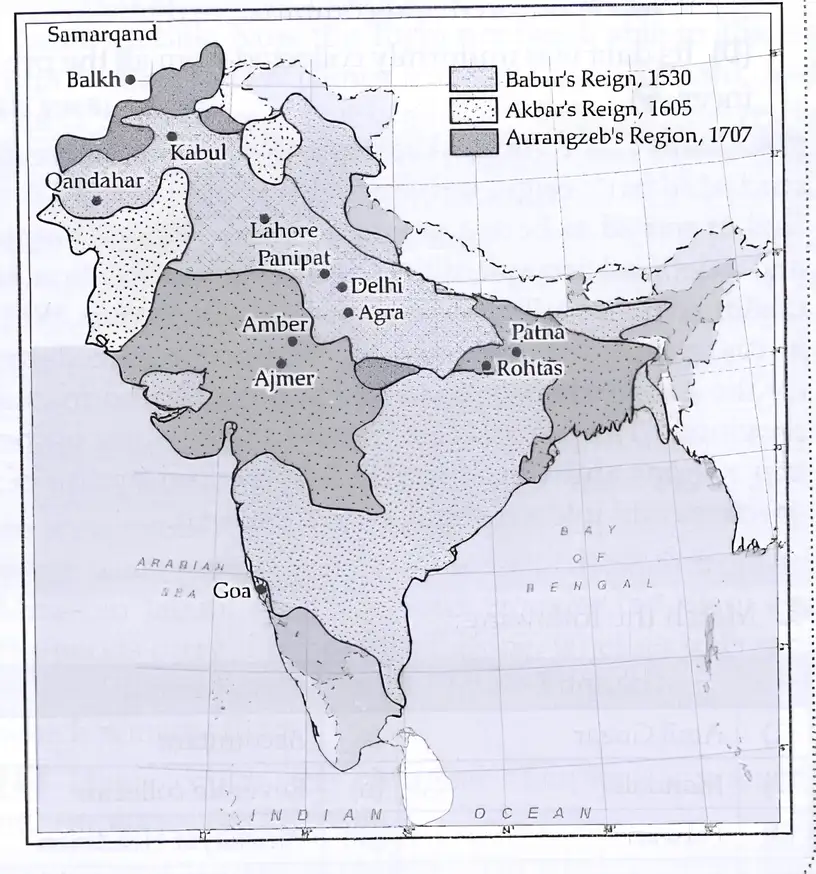
This map illustrates the territorial growth of the Mughal Empire from Babur's initial conquests in 1530, through Akbar's expansion by 1605, to Aurangzeb's reign at the empire's greatest extent in 1707.