CLASS 12-HUMANITIES . HISTORY . THEMES IN INDIAN HISTORY PART II . AN IMPERIAL-CAPITAL-VIJAYANAGARA-C-FOURTEENTH-TO-SIXTEENTH-CENTURY
Chapter 3 : AN IMPERIAL CAPITAL VIJAYANAGARA (C. FOURTEENTH TO SIXTEENTH CENTURY)
Ch 3
HISTORY
CLASS 12-HUMANITIES
An Imperial Capital: Vijayanagara (c. Fourteenth to Sixteenth Centuries)
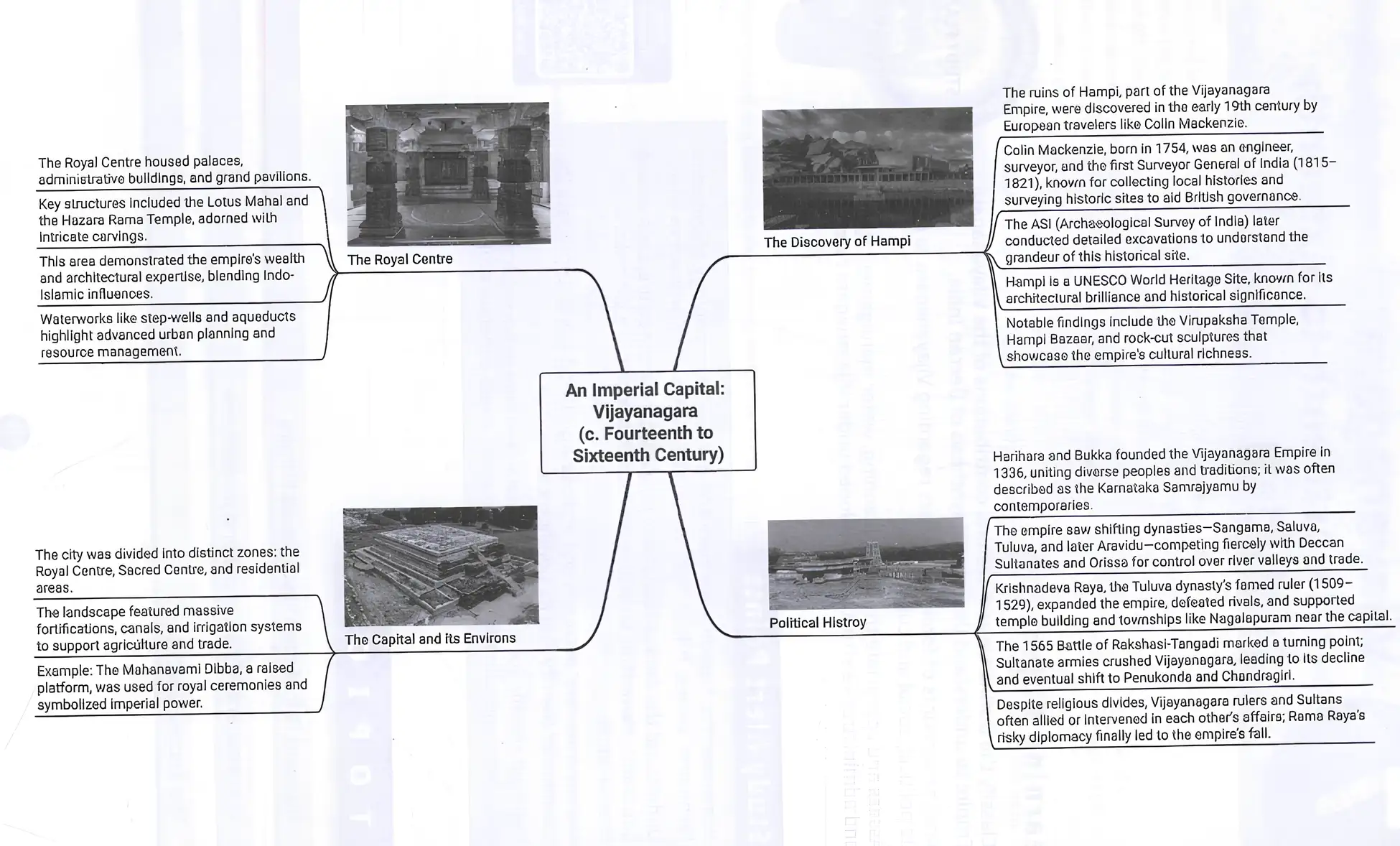
Vijayanagara, meaning "City of Victory," was a prominent imperial capital and empire in South India from the 14th to the 16th centuries. Founded in 1336 CE by brothers Harihara and Bukka, it became a powerful kingdom stretching from the Krishna River in the north to the southern tip of the Indian peninsula. The empire was ruled by four main dynasties: Sangama, Saluva, Tuluva, and Aravidu, with notable rulers such as Krishnadeva Raya, who led the empire to its zenith.
The city of Vijayanagara was renowned for its unique architecture, including large gopurams (temple gateways), monolithic structures, and iconic temples like Virupaksha and Hazara Rama. The architecture combined Indian and Islamic styles, reflecting the empire's cultural diversity. Advanced water management systems, including reservoirs and canals, supported irrigation agriculture and urban needs.
Trade was a significant aspect of Vijayanagara's economy, with horses imported from Arabia and Central Asia, controlled initially by Arab traders and local merchants known as 'kudirai chettis.' The arrival of Portuguese traders in 1498 introduced muskets and new political dynamics. The empire was famous for spices, textiles, and precious stones, contributing to its prosperity.
Vijayanagara's political history involved competition with neighboring sultanates and kingdoms, including the Deccan sultans (ashvapati) and the Gajapati rulers of Orissa. The empire's administration included military chiefs called Nayakas, who governed territories and collected revenue under the Amara-Nayaka system, a significant political innovation possibly influenced by the Delhi Sultanate's Iqta system.
The empire declined after the Battle of Talikota in 1565 CE, where the combined forces of Bijapur, Ahmednagar, and Golconda defeated Vijayanagara's army, leading to the city's plunder and abandonment. Despite its fall, the legacy of Vijayanagara survives through archaeological remains, inscriptions, and oral traditions.
Study Alert Points
• Remember the founders Harihara and Bukka, the chronology of dynasties (Sangama, Saluva, Tuluva, Aravidu) and key rulers like Krishnadeva Raya.
• Understand the unique features of Vijayanagara architecture, such as large gopurams, monolithic structures, and iconic temples like Virupaksha and Hazara Rama.
• Analyse travellers' accounts and archaeological findings to appreciate the grandeur of the city and its significance.
• Highlight specific socio-economic details like trade in horses, irrigation agriculture, and cultural patronage to avoid vague generalisations.
Exam-Oriented Questions
Q1: Who were the founders of the Vijayanagara Empire?
A1: The Vijayanagara Empire was founded by two brothers, Harihara and Bukka, in 1336 CE.
Q2: Name the four dynasties that ruled Vijayanagara.
A2: The four dynasties were Sangama, Saluva, Tuluva, and Aravidu.
Q3: What were some unique architectural features of Vijayanagara?
A3: Unique features included large gopurams (temple gateways), monolithic structures, and iconic temples such as Virupaksha and Hazara Rama.
Q4: What was the significance of the Amara-Nayaka system?
A4: The Amara-Nayaka system was a political and military arrangement where Nayakas governed territories, collected revenue, maintained troops, and pledged loyalty to the king, helping maintain control over the empire.
Rise and Fall of the Vijayanagara Empire
The Vijayanagara Empire was established in the 14th century and became a dominant power in South India. It expanded its territory under rulers like Krishnadeva Raya, who conquered regions such as the Raichur Doab and subdued neighboring kingdoms. The empire was known for its military strength, cultural patronage, and economic prosperity.
However, internal conflicts and external pressures led to its decline. The Battle of Talikota in 1565 CE was a turning point where the combined forces of the Deccan sultanates defeated Vijayanagara's army. The city was plundered and abandoned, marking the end of the empire's dominance. Despite this, the cultural and architectural achievements of Vijayanagara continue to be celebrated.
Exam-Oriented Questions
Q1: What was the extent of the Vijayanagara Empire at its peak?
A1: At its peak, the empire stretched from the Krishna River in the north to the southern tip of the Indian peninsula.
Q2: What led to the decline of the Vijayanagara Empire?
A2: The decline was due to internal conflicts, the defeat at the Battle of Talikota in 1565 CE by the combined Deccan sultanates, and subsequent plundering and abandonment of the city.
Q3: Who was Krishnadeva Raya and why is he significant?
A3: Krishnadeva Raya was a ruler of the Tuluva dynasty known for expanding and consolidating the empire, building temples, and promoting cultural achievements.
Vijayanagara—The Capital and Its Environs
The city of Vijayanagara was strategically located in a natural basin formed by the Tungabhadra River, surrounded by granite hills. It featured advanced water management systems including reservoirs like the Kamalapuram Tank and canals such as the Hiriya Canal, supporting irrigation and urban needs.
The city was fortified with multiple lines of walls and gates, protecting not only the urban center but also agricultural lands. The Royal Centre housed palaces, temples, and administrative buildings, including the king's palace with the Audience Hall and the Mahanavami Dibba, a royal platform symbolizing power.
Markets and bazaars lined the main roads extending from temple gateways. The city had diverse religious shrines and temples supported by various communities. Archaeological evidence shows the presence of granaries, wells, and rainwater tanks, indicating a well-planned urban settlement.
Exam-Oriented Questions
Q1: What natural features influenced the location of Vijayanagara?
A1: The city was located in a natural basin formed by the Tungabhadra River and surrounded by granite hills.
Q2: Describe the water management systems in Vijayanagara.
A2: The city had reservoirs like Kamalapuram Tank and canals such as the Hiriya Canal, which were used for irrigation and supplying water to the Royal Centre.
Q3: What was the significance of the Mahanavami Dibba?
A3: The Mahanavami Dibba was a royal platform used for public ceremonies and symbolized the king's power.
The Sacred Centre
The Sacred Centre of Vijayanagara held religious and cultural significance. Local beliefs connected the northern rocky hills to the monkey kingdom of Vali and Sugriva from the Ramayana. The Mother Goddess Pampadevi was believed to have performed penance here to marry Virupaksha, the incarnation of Shiva and the kingdom's guardian deity.
The Virupaksha temple, dating back to the 9th-10th centuries, was expanded during the Vijayanagara period. Krishnadeva Raya contributed to its development by building halls and the first gopuram. The temple complex hosted various cultural activities including music, dance, and drama.
The Vitthala Temple, dedicated to an incarnation of Lord Vishnu, was another important shrine, famous for its chariot street lined with pillared pavilions where traders set up shops. These temples were central to the religious and social life of the city.
Exam-Oriented Questions
Q1: What is the significance of the Virupaksha temple in Vijayanagara?
A1: The Virupaksha temple was a major religious center, expanded during the Vijayanagara period, and served as a place for worship and cultural activities.
Q2: Who was Pampadevi and what was her connection to Vijayanagara?
A2: Pampadevi was the local Mother Goddess believed to have performed penance in the hills to marry Virupaksha, the guardian deity of the kingdom.
Q3: Describe the chariot street of the Vitthala Temple.
A3: The chariot street was a stone-paved street extending from the temple gopuram, lined with pillared pavilions where traders set up shops.
Key Dates
| Time Period / Year | Event / Change | Importance |
|---|---|---|
| c. 1200-1300 | Establishment of the Delhi Sultanate | Set the political context in India before Vijayanagara's rise |
| c. 1300-1400 | Establishment of the Vijayanagara Empire; Bahmani Kingdom; Sultanates in Jaunpur, Kashmir, and Madura | Beginning of Vijayanagara and other regional powers |
| c. 1400-1500 | Establishment of the Gajapati kingdom of Orissa; Sultanates of Gujarat and Malwa; Emergence of Ahmadnagar, Bijapur, and Berar Sultanates | Regional political developments affecting Vijayanagara |
| c. 1500-1600 | Conquest of Goa by the Portuguese; Collapse of Bahmani kingdom; Emergence of Golconda Sultanate; Establishment of Mughal Empire by Babur | Major political and colonial changes impacting Vijayanagara |
| 1800 | Colin Mackenzie visits Vijayanagara | Beginning of archaeological study of Vijayanagara ruins |
| 1815 | Hampi discovered by Colin Mackenzie | First survey and documentation of Vijayanagara ruins |
| 1856 | Alexander Green Law takes first detailed photographs of Hampi | Visual documentation aiding historical research |
| 1876 | J.F. Fleet documents inscriptions on temple walls | Epigraphical studies of Vijayanagara |
| 1902 | Conservation begins under John Marshall | Preservation of Vijayanagara heritage |
| 1986 | Hampi declared a World Heritage Site by UNESCO | International recognition and protection |
Solved Examples
Example 1: Explain the significance of the Battle of Talikota in the history of Vijayanagara.
Solution: The Battle of Talikota in 1565 CE was a decisive conflict where the combined forces of the Deccan sultanates defeated Vijayanagara's army. This led to the plundering and destruction of the city, marking the end of the empire's dominance. The battle highlighted the failure of Vijayanagara's political strategy and the rise of regional powers.
Example 2: Describe the Amara-Nayaka system and its role in Vijayanagara's administration.
Solution: The Amara-Nayaka system was a military and administrative arrangement where Nayakas (military commanders) were granted territories to govern. They collected taxes, maintained troops, and pledged loyalty to the king. This system helped maintain control over the vast empire and ensured military readiness.
Practice Set
Easy
- Who founded the Vijayanagara Empire?
- Name two important temples in Vijayanagara.
Moderate
- Explain the importance of trade in the Vijayanagara Empire.
- What were the main features of Vijayanagara's architecture?
Challenging
- Discuss the causes and consequences of the Battle of Talikota.
- Analyze the role of the Amara-Nayaka system in the political stability of Vijayanagara.
Answer Key
Easy:
- Harihara and Bukka
- Virupaksha and Hazara Rama temples
Moderate:
- Trade in horses, spices, textiles, and precious stones contributed to the empire's prosperity and military strength.
- Large gopurams, monolithic structures, fusion of Indian and Islamic styles, and iconic temples.
Challenging:
- The Battle of Talikota was caused by Vijayanagara's political miscalculations and alliances among Deccan sultanates; it resulted in the empire's decline and destruction of the capital.
- The Amara-Nayaka system decentralized military and administrative power, enabling effective control over territories but also leading to occasional rebellions.
Quick Reference
- Founders: Harihara and Bukka
- Dynasties: Sangama, Saluva, Tuluva, Aravidu
- Famous Ruler: Krishnadeva Raya
- Key Battle: Battle of Talikota (1565 CE)
- Important Temples: Virupaksha, Hazara Rama, Vitthala
- Political System: Amara-Nayaka system
- Trade: Horses, spices, textiles, precious stones
- Water Management: Kamalapuram Tank, Hiriya Canal
- Architectural Features: Gopurams, monolithic structures, fusion of styles
Glossary
- Gopuram
- Main entrance tower of a South Indian temple, often elaborately decorated.
- Amara-Nayaka System
- Military and administrative system where Nayakas governed territories under the king's authority.
- Nayaka
- Military commander and territorial governor in Vijayanagara Empire.
- Virupaksha
- Incarnation of Shiva and guardian deity of Vijayanagara; also the name of a major temple.
- Mandapa
- Pavilion or pillared hall within a temple complex used for various purposes.
- Battle of Talikota
- Decisive battle in 1565 CE leading to the defeat and decline of Vijayanagara Empire.
- Krishnadeva Raya
- Most famous ruler of the Tuluva dynasty known for expansion and cultural patronage.