CLASS 12-HUMANITIES . HISTORY . THEMES IN INDIAN HISTORY PART II . BHAKTI SUFI-TRADITIONS-CHANGES-IN-RELIGIOUS-BELIEFS-AND-DEVOTIONAL-TEXTS-C-EIGHTH-TO-EIGHTEENTH-CENTURY
Chapter 2 : BHAKTI- SUFI TRADITIONS CHANGES IN RELIGIOUS BELIEFS AND DEVOTIONAL TEXTS (C. EIGHTH TO EIGHTEENTH CENTURY)
Ch 2
HISTORY
CLASS 12-HUMANITIES
Bhakti-Sufi Traditions Changes in Religious Beliefs and Devotional Texts (c. Eighth to Eighteenth Centuries)
The period from the eighth to the eighteenth century in India witnessed significant transformations in religious beliefs and devotional practices. The Bhakti and Sufi traditions emerged as powerful movements that emphasized personal devotion, social equality, and spiritual experience beyond orthodox rituals. These movements used vernacular languages to reach common people and challenged social hierarchies such as caste discrimination. They also influenced political legitimacy and societal cohesion through royal patronage.
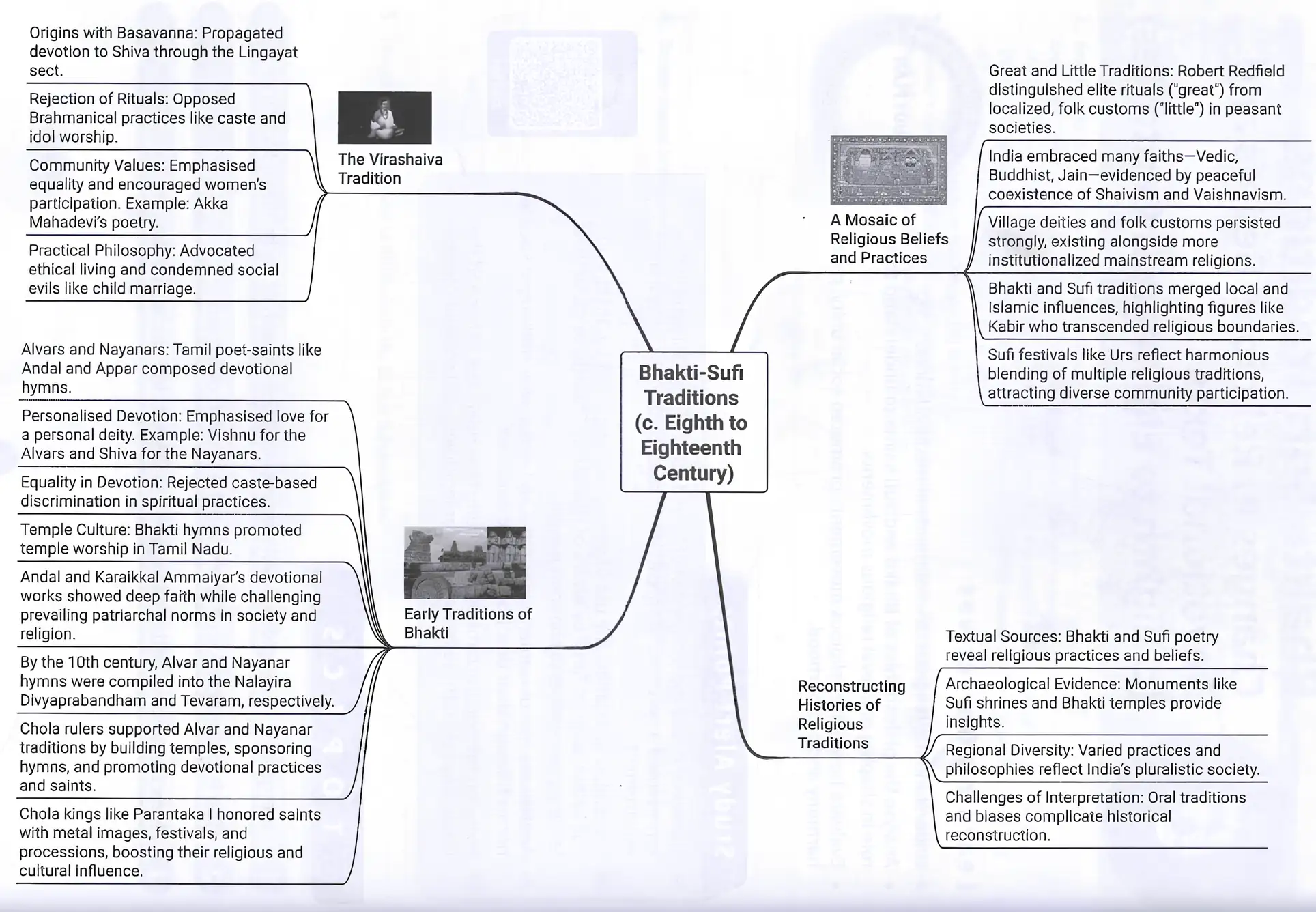
The Bhakti-Sufi traditions represent a synthesis of diverse religious ideas and practices, integrating local deities and folk customs with major religious systems. This period saw the rise of devotional poetry, temple culture, and inclusive community values that transcended caste and class barriers.
Exam Question
Q: How did the Bhakti and Sufi traditions contribute to social equality in medieval India?
A: The Bhakti and Sufi traditions promoted devotion accessible to all, rejected caste discrimination, and encouraged participation of women and lower social groups, thus fostering social equality.
Integration of Religious Developments and the Growth of Early Bhakti Movements
From the eighth to the eighteenth century, religious traditions in India evolved with the rise of Bhakti and Sufi movements. Poet-saints composed devotional songs in regional languages, making spirituality accessible to the masses. The period saw the increasing visibility of various gods and goddesses in sculpture and texts, and the integration of cults through Puranic texts in simple Sanskrit.
Brahmanas began accepting beliefs and practices of women and Shudras, who were traditionally excluded from Vedic learning. Tantric worship, connected to the Shakti cult, spread widely, emphasizing participation beyond caste and class distinctions.
Bhakti traditions are classified into Saguna Bhakti, worshipping deities with attributes like Shiva and Vishnu, and Nirguna Bhakti, focusing on an abstract form of God. Early Bhakti movements originated in South India, led by Alvars (devotees of Vishnu) and Nayanars (devotees of Shiva), who composed hymns in Tamil and traveled to sacred shrines that later became pilgrimage centers.
These saints often opposed caste hierarchies, coming from diverse social backgrounds. Women played a significant role, with figures like Andal and Karaikkal Ammaiyar contributing devotional compositions and ascetic practices. The Chola rulers supported these traditions, as seen in inscriptions consecrating images of poet-saints.
The Virashaiva or Lingayat movement emerged in Karnataka in the twelfth century under Basavanna, promoting devotion to Shiva, rejecting caste discrimination, and funeral rites prescribed by Dharmashastras. Lingayats practiced burial and questioned rebirth theories.
Exam Question
Q: What are the main features of the Virashaiva or Lingayat movement?
A: The Virashaiva movement emphasized devotion to Shiva, rejected caste discrimination and orthodox funeral rites, practiced burial, and promoted equality and ethical living.
The Popular Practice of Islam and the Growth of Sufism
Islam spread in India with the arrival of Muslim rulers and Arab traders, who settled along the Malabar coast and adopted local customs. Mosques combined universal Islamic architectural features with regional variations. Early Islamic culture in India did not rigidly classify people as Hindu or Muslim but by birthplace.
Sufism, a mystical form of Islam, arose as a protest against materialism in the Caliphate, emphasizing love, devotion, and personal experience of God. Sufi orders, or silsilas, maintained spiritual genealogies linking masters and disciples to Prophet Muhammad. Initiation rituals included oaths, distinctive garments, and head shaving.
After a Sufi Shaikh's death, his tomb (dargah) became a pilgrimage site (ziyarat) where devotees sought blessings. Various ascetic groups like Qalandars and Malangs practiced celibacy and mendicancy. The Chishti order, arriving in India in the late twelfth century, adapted to local traditions, establishing Khanqahs as centers of social and spiritual life.
Chishti dargahs attracted pilgrims of all backgrounds, with music and dance (sama) used in devotion. The dargah of Khwaja Muinuddin Chishti at Ajmer became especially popular, receiving royal patronage from rulers like Akbar. Sufism spread to the Deccan, with saints composing poetry in Dakhani, a local Urdu variant.
Chishti saints maintained austerity, accepted donations without accumulating wealth, and generally had cordial relations with rulers, who sought their support for legitimacy and social harmony.
Exam Question
Q: How did the Chishti Sufi order influence religious and social life in medieval India?
A: The Chishti order promoted inclusivity, used music and vernacular languages in devotion, established Khanqahs as community centers, and maintained good relations with rulers, influencing religious and social harmony.
New Devotional Paths: Dialogue and Dissent in Northern India
In northern India, new devotional movements emerged that engaged in dialogue and dissent with existing religious and social norms. Kabir, a poet-saint of the fourteenth-fifteenth centuries, composed verses in multiple traditions, emphasizing nirguna bhakti and critiquing caste and religious divisions. His legacy is claimed by both Hindu and Muslim communities.
Baba Guru Nanak (1469-1539), founder of Sikhism, was born into a Hindu family but preached a form of nirguna bhakti rejecting rituals, sacrifices, and image worship. He emphasized remembrance of the Divine Name (rab) through hymns called shabad in Punjabi.
Mirabai, a fifteenth-sixteenth century woman poet, is renowned for her devotional bhajans dedicated to Krishna, challenging societal norms through her faith and compositions.
Historians reconstruct these religious traditions through diverse sources including sculpture, architecture, hagiographies, and devotional literature, recognizing the rich diversity and complexity of Indian spiritual life.
Exam Question
Q: What contributions did Kabir and Guru Nanak make to devotional traditions in northern India?
A: Kabir promoted nirguna bhakti and challenged caste and religious divisions, while Guru Nanak founded Sikhism, emphasizing devotion to a formless God and rejecting ritualistic practices.
Solved Examples
Example 1: Explain the significance of the use of vernacular languages by Bhakti and Sufi saints.
Answer: The use of vernacular languages like Tamil by Alvars and Hindavi by Chishtis made religious teachings accessible to common people, breaking the monopoly of Sanskrit and elite knowledge, thus promoting wider participation in devotional practices.
Example 2: Describe the role of women in the Bhakti tradition.
Answer: Women like Mirabai and Andal composed devotional songs and challenged social norms by expressing personal devotion, thus playing a vital role in spreading Bhakti ideals and promoting gender inclusivity.
Practice Set
Easy
- Who were the Alvars and Nayanars?
- What is a dargah?
Moderate
- Explain the difference between Saguna and Nirguna Bhakti.
- What was the significance of the Chishti Sufi order in India?
Challenging
- Discuss how Bhakti and Sufi traditions contributed to social cohesion during the medieval period.
- Analyze the role of Kabir in promoting religious dialogue and dissent.
Answer Key
- Alvars and Nayanars were poet-saints from South India devoted to Vishnu and Shiva respectively.
- A dargah is a tomb shrine of a Sufi saint.
- Saguna Bhakti worships God with attributes; Nirguna Bhakti worships a formless, attribute-less God.
- The Chishti order promoted inclusivity, music in devotion, and established social centers called Khanqahs.
- Bhakti and Sufi traditions fostered social equality, challenged caste, and promoted unity through shared devotional practices.
- Kabir used poetry to critique religious orthodoxy and promote harmony between Hindu and Muslim communities.
Quick Reference
- Bhakti Movement: Devotional movement emphasizing personal love for God, rejecting caste and ritualism.
- Sufism: Mystical Islamic tradition focusing on love, devotion, and personal experience of God.
- Alvars and Nayanars: South Indian poet-saints devoted to Vishnu and Shiva.
- Virashaivas/Lingayats: Shaiva devotional movement rejecting caste and orthodox rituals.
- Chishti Order: Influential Sufi order in India known for inclusivity and music in worship.
- Kabir: Poet-saint promoting nirguna bhakti and religious harmony.
- Guru Nanak: Founder of Sikhism advocating devotion to a formless God.
Glossary
- Alvars
- Devotees of Vishnu who composed Tamil devotional hymns.
- Nayanars
- Devotees of Shiva who composed Tamil devotional hymns.
- Dargah
- Tomb shrine of a Sufi saint, a place of pilgrimage.
- Ziyarat
- Pilgrimage to the tomb of a Sufi saint.
- Wali
- A Sufi saint believed to be close to God and capable of miracles.
- Zikr
- Remembrance of God through recitation of divine names.
- Qawwals
- Musicians who perform devotional songs in Sufi traditions.
- Hagiography
- Biography of a saint written by followers.
- Virashaivas/Lingayats
- A Shaiva devotional community rejecting caste and orthodox rituals.
- Saguna Bhakti
- Devotion to God with attributes and forms.
- Nirguna Bhakti
- Devotion to a formless, attribute-less God.