NEET Ug . NEET Chemistry . Chemistry . Thermodynamics
Chapter 5: Thermodynamics
Ch 5
NEET Chemistry
NEET Ug
Introduction
Overview
- Thermodynamics studies energy forms and transformations, mainly heat to work and vice versa.
- Laws apply only when system is in equilibrium or moves between equilibrium states.
- Chemical thermodynamics focuses on chemical changes and substances.
Solved Examples
- Ex 1: Identify the branch of thermodynamics studying chemical reactions only.
Answer: Chemical thermodynamics.
Practice Set
- Q1: Thermodynamics mainly studies:
A. Motion of particles
B. Energy transformations
C. Chemical bonding
D. Atomic structure - Q2: Laws of thermodynamics apply when:
A. System is in equilibrium
B. System is non-equilibrium
C. System is isolated only
D. System is open only - Q3: Chemical thermodynamics deals with:
A. Physical changes
B. Chemical changes
C. Nuclear changes
D. Mechanical changes
Answer Key
- Q1: B - Thermodynamics studies energy transformations.
- Q2: A - Laws apply only at equilibrium states.
- Q3: B - Chemical thermodynamics studies chemical changes.
Memory Aids
- Thermodynamics = Energy + Heat + Work
- Equilibrium needed for laws to apply
- Chemical thermodynamics = chemical reactions focus
Thermodynamic Terms
Key Definitions
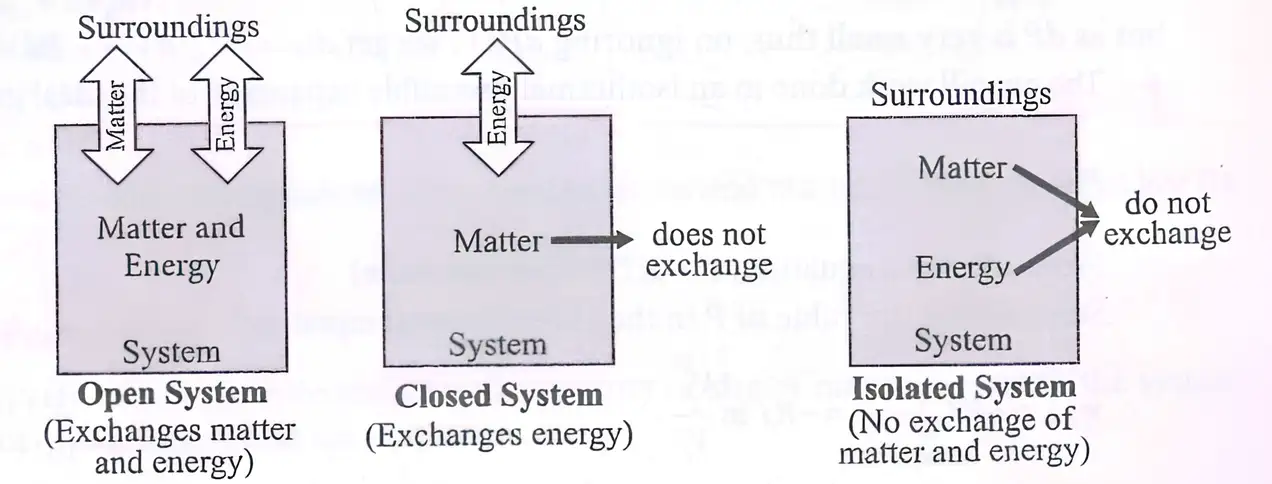
- System: Part of universe under study; rest is surroundings.
- Boundary: Real or imaginary surface separating system and surroundings.
- Types of systems:
- Open: Exchange of matter and energy.
- Closed: Exchange of energy only.
- Isolated: No exchange of matter or energy.
Solved Examples
- Ex 1: Classify a system that exchanges only energy but not matter.
Answer: Closed system.
Practice Set
- Q1: Which system exchanges both matter and energy?
A. Open
B. Closed
C. Isolated
D. None - Q2: A system that exchanges no matter or energy is:
A. Open
B. Closed
C. Isolated
D. None - Q3: Boundary is:
A. Part of surroundings
B. Surface separating system and surroundings
C. System itself
D. Energy flow path
Answer Key
- Q1: A - Open system exchanges both matter and energy.
- Q2: C - Isolated system exchanges neither matter nor energy.
- Q3: B - Boundary separates system and surroundings.
Memory Aids
- Open = Both matter & energy exchange
- Closed = Only energy exchange
- Isolated = No exchange
The State of the System
State and Processes
- Thermodynamic state: measurable properties needed for calculations.
- State variables/functions: pressure (P), temperature (T), volume (V), amount (n); depend only on state, not path.
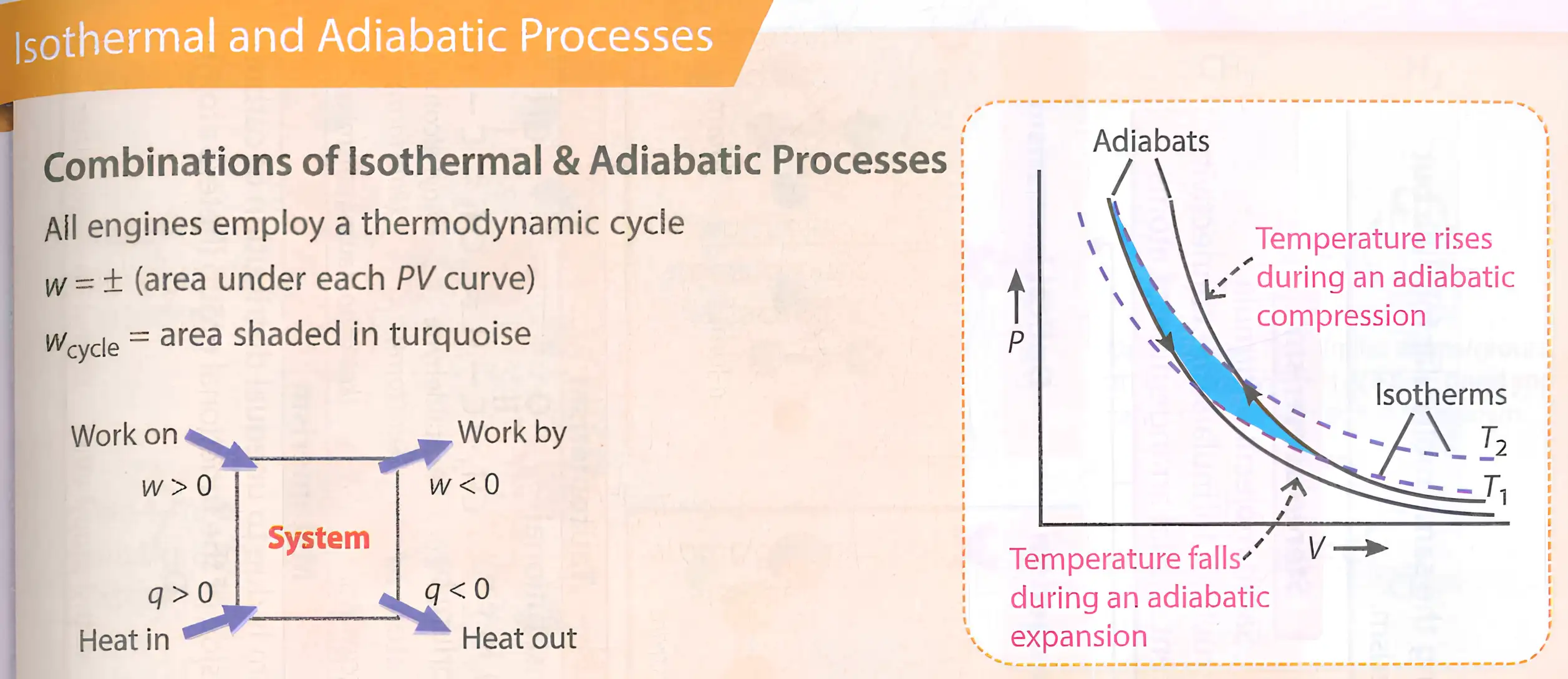
- Thermodynamic processes:
- Isothermal: constant temperature (ΔT=0)
- Adiabatic: no heat exchange (q=0)
- Isobaric: constant pressure (ΔP=0)
- Isochoric: constant volume (ΔV=0)
- Processes can be cyclic, reversible, or irreversible.
Solved Examples
- Ex 1: Identify process with no heat exchange.
Answer: Adiabatic process.
Practice Set
- Q1: Which process occurs at constant temperature?
A. Isobaric
B. Isothermal
C. Adiabatic
D. Isochoric - Q2: In which process is volume constant?
A. Isobaric
B. Isochoric
C. Isothermal
D. Adiabatic - Q3: A cyclic process:
A. Cannot be reversed
B. Returns system to original state
C. Has ΔU ≠ 0
D. Is irreversible
Answer Key
- Q1: B - Isothermal means constant temperature.
- Q2: B - Isochoric means constant volume.
- Q3: B - Cyclic process returns system to original state.
Memory Aids
- Isothermal = T constant
- Adiabatic = No heat exchange
- Isobaric = P constant
- Isochoric = V constant
State and Processes
- Thermodynamic state: measurable properties needed for calculations.
- State variables/functions: pressure (P), temperature (T), volume (V), amount (n); depend only on state, not path.
- Thermodynamic processes:
- Isothermal: constant temperature (ΔT=0)
- Adiabatic: no heat exchange (q=0)
- Isobaric: constant pressure (ΔP=0)
- Isochoric: constant volume (ΔV=0)
- Processes can be cyclic, reversible, or irreversible.
Solved Examples
- Ex 1: Identify process with no heat exchange.
Answer: Adiabatic process.
Practice Set
- Q1: Which process occurs at constant temperature?
A. Isobaric
B. Isothermal
C. Adiabatic
D. Isochoric - Q2: In which process is volume constant?
A. Isobaric
B. Isochoric
C. Isothermal
D. Adiabatic - Q3: A cyclic process:
A. Cannot be reversed
B. Returns system to original state
C. Has ΔU ≠ 0
D. Is irreversible
Answer Key
- Q1: B - Isothermal means constant temperature.
- Q2: B - Isochoric means constant volume.
- Q3: B - Cyclic process returns system to original state.
Memory Aids
- Isothermal = T constant
- Adiabatic = No heat exchange
- Isobaric = P constant
- Isochoric = V constant
Internal Energy
Concept and First Law
- Internal energy (U): total energy inside system (chemical, electrical, mechanical, etc.), a state function.
- U changes when:
- Heat enters or leaves system
- Work is done on or by system
- Matter enters or leaves system
- First law: Energy of isolated system is constant (conservation of energy).
- Equation: ΔU = q + w or q = ΔU − w
- q and w are path functions; ΔU is state function.
- Sign convention:
- Heat absorbed by system = +ve
- Heat evolved by system = −ve
- Work done on system = +ve
- Work done by system = −ve
- For adiabatic change: ΔU = U2 − U1 = wad (q=0)
- At constant volume (no work): ΔU = qv
Solved Examples
- Ex 1: Calculate ΔU if 100 J heat is absorbed and 50 J work is done by system.
Solution: ΔU = q + w = +100 + (−50) = +50 J
Practice Set
- Q1: Internal energy is:
A. Path function
B. State function
C. Neither
D. Both - Q2: If system absorbs 200 J heat and does 80 J work, ΔU is:
A. 280 J
B. 120 J
C. −120 J
D. −280 J - Q3: For adiabatic process:
A. q ≠ 0
B. w = 0
C. ΔU = w
D. ΔU = q
Answer Key
- Q1: B - Internal energy is a state function.
- Q2: B - ΔU = q + w = 200 − 80 = 120 J.
- Q3: C - For adiabatic, ΔU = work done (q=0).
Memory Aids
- ΔU = q + w
- Heat in (+), work done by system (−)
- Adiabatic: no heat exchange
Work
Isothermal reversible expansion of an ideal gas
- Gas expands in a cylinder with a frictionless piston; volume increases, pressure decreases.
- External pressure initially equals internal pressure; piston moves when external pressure decreases by dP.
- Work done in infinitesimal expansion: dw = -Pex dV = -P dV.
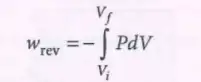
- Total work done from volume Vi to Vf: wrev = -∫ViVf P dV.
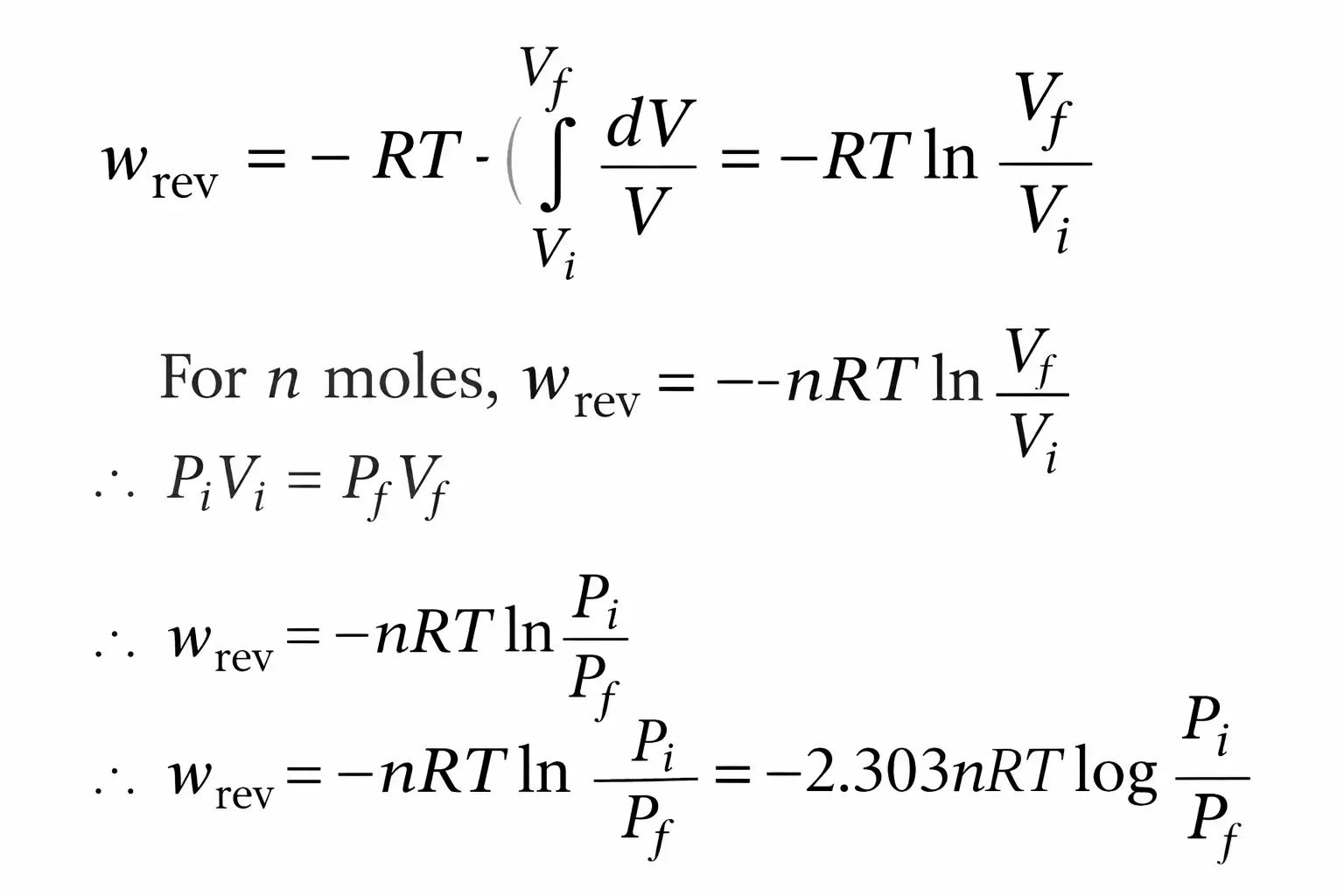
- Using ideal gas law P = nRT/V, work done: wrev = -nRT ln(Vf/Vi) = nRT ln(Pi/Pf).
- Work done during isothermal reversible compression: wrev = 2.303 nRT log(Pi/Pf).
Free expansion
- Expansion of gas into vacuum (Pex = 0) is free expansion.
- No work done during free expansion, reversible or irreversible.
- At constant volume (ΔV = 0), internal energy change ΔU = qv.
Isothermal and free expansion of an ideal gas
- Isothermal expansion into vacuum: work w = 0 since Pex = 0.
- Isothermal irreversible change: q = -Pex (Vf - Vi).
- Isothermal reversible change: q = w = 2.303 nRT log(Vf/Vi).
Adiabatic change
- Heat exchange q = 0.
- Change in internal energy equals work done: ΔU = wad.
Solved Examples
- Ex 1: Calculate work done in isothermal expansion of 1 mole ideal gas from 10 L to 20 L at 300 K.
- Use w = -nRT ln(Vf/Vi).
- w = -1 × 8.314 × 300 × ln(2) = -1729 J.
- Ex 2: Work done in isothermal compression from 20 atm to 10 atm at 300 K for 2 moles.
- w = 2.303 nRT log(Pi/Pf) = 2.303 × 2 × 8.314 × 300 × log(2) ≈ 7910 J.
Practice Set
- Q1: Work done in free expansion of an ideal gas is:
- A) Positive
- B) Negative
- C) Zero
- D) Depends on volume
- Q2: For isothermal reversible expansion, work done is:
- A) -nRT ln(Vf/Vi)
- B) nRT ln(Vf/Vi)
- C) Zero
- D) nRT ln(Pf/Pi)
- Q3: Work done in isothermal compression of 1 mole gas from 5 atm to 10 atm at 300 K is:
- A) Negative
- B) Zero
- C) Positive
- D) Cannot be determined
Answer Key
- Q1: C) Zero - No work is done in free expansion as external pressure is zero.
- Q2: A) -nRT ln(Vf/Vi) - Work done is negative for expansion.
- Q3: C) Positive - Work done on the gas during compression is positive.
Memory Aids
- Work done in isothermal expansion: Negative sign, gas does work on surroundings.
- Free expansion: No work done, w = 0.
- Compression work is positive, expansion work is negative.
Isothermal reversible expansion of an ideal gas
- Gas expands in a cylinder with a frictionless piston; volume increases, pressure decreases.
- External pressure initially equals internal pressure; piston moves when external pressure decreases by dP.
- Work done in infinitesimal expansion: \( dw = -P_{ex} dV = -P dV \).
- Total work done from volume \( V_i \) to \( V_f \): \( w_{rev} = -\int_{V_i}^{V_f} P dV \).
- Using ideal gas law \( P = \frac{nRT}{V} \), work done: \( w_{rev} = -nRT \ln \frac{V_f}{V_i} = nRT \ln \frac{P_i}{P_f} \).
- Work done during isothermal reversible compression: \( w_{rev} = 2.303 nRT \log \frac{P_i}{P_f} \).
Free expansion
- Expansion of gas into vacuum (\( P_{ex} = 0 \)) is free expansion.
- No work done during free expansion, reversible or irreversible.
- At constant volume (\( \Delta V = 0 \)), internal energy change \( \Delta U = q_v \).
Isothermal and free expansion of an ideal gas
- Isothermal expansion into vacuum: work \( w = 0 \) since \( P_{ex} = 0 \).
- Isothermal irreversible change: \( q = -P_{ex} (V_f - V_i) \).
- Isothermal reversible change: \( q = w = 2.303 nRT \log \frac{V_f}{V_i} \).
Adiabatic change
- Heat exchange \( q = 0 \).
- Change in internal energy equals work done: \( \Delta U = w_{ad} \).
Solved Examples
- Ex 1: Calculate work done in isothermal expansion of 1 mole ideal gas from 10 L to 20 L at 300 K.
- Use \( w = -nRT \ln \frac{V_f}{V_i} \).
- \( w = -1 \times 8.314 \times 300 \times \ln(2) = -1729 \text{ J} \).
- Ex 2: Work done in isothermal compression from 20 atm to 10 atm at 300 K for 2 moles.
- \( w = 2.303 nRT \log \frac{P_i}{P_f} = 2.303 \times 2 \times 8.314 \times 300 \times \log(2) \approx 7910 \text{ J} \).
Practice Set
- Q1: Work done in free expansion of an ideal gas is:
- A) Positive
- B) Negative
- C) Zero
- D) Depends on volume
- Q2: For isothermal reversible expansion, work done is:
- A) \( -nRT \ln \frac{V_f}{V_i} \)
- B) \( nRT \ln \frac{V_f}{V_i} \)
- C) Zero
- D) \( nRT \ln \frac{P_f}{P_i} \)
- Q3: Work done in isothermal compression of 1 mole gas from 5 atm to 10 atm at 300 K is:
- A) Negative
- B) Zero
- C) Positive
- D) Cannot be determined
Answer Key
- Q1: C) Zero - No work is done in free expansion as external pressure is zero.
- Q2: A) \( -nRT \ln \frac{V_f}{V_i} \) - Work done is negative for expansion.
- Q3: C) Positive - Work done on the gas during compression is positive.
Memory Aids
- Work done in isothermal expansion: Negative sign, gas does work on surroundings.
- Free expansion: No work done, \( w = 0 \).
- Compression work is positive, expansion work is negative.
Enthalpy
Basic concepts
- Total heat content at constant pressure.
- Extensive and state function.
- Mathematically: H = U + PV.
- Change in enthalpy: ΔH = ΔU + PΔV.
- Exothermic: ΔH < 0, Endothermic: ΔH > 0.
Relation with first law
- First law: q = ΔU - w, with w = -PΔV.
- At constant volume: w = 0, so qv = ΔU.
- At constant pressure: qp = ΔU + PΔV = ΔH.
- ΔH = ΔU + ΔngRT, where Δng is change in moles of gas.
- If Δng > 0, then ΔH > ΔU; if Δng < 0, then ΔH < ΔU; if zero, ΔH = ΔU.
- For solids/liquids or closed vessel reactions, ΔH = ΔU.
Solved Examples
- Ex 1: Calculate ΔH for reaction with ΔU = -100 kJ, Δng = 2, at 298 K.
- ΔH = ΔU + ΔngRT = -100 + 2 × 8.314 × 298 / 1000 = -95.05 kJ.
- Ex 2: For reaction with no gas change, ΔH = ΔU = -50 kJ.
Practice Set
- Q1: Enthalpy is a:
- A) Intensive property
- B) Extensive property
- C) Neither
- D) Depends on temperature
- Q2: At constant volume, heat exchanged equals:
- A) ΔH
- B) ΔU
- C) Zero
- D) Work done
- Q3: For reaction with Δng = 1, ΔH is:
- A) Less than ΔU
- B) Equal to ΔU
- C) Greater than ΔU
- D) Cannot say
Answer Key
- Q1: B) Extensive property - Enthalpy depends on system size.
- Q2: B) ΔU - At constant volume, heat equals internal energy change.
- Q3: C) Greater than ΔU - Positive gas moles increase enthalpy.
Memory Aids
- ΔH = ΔU + PΔV.
- Exothermic: Negative ΔH, Endothermic: Positive ΔH.
- At constant pressure, heat equals enthalpy change.
Basic concepts
- Total heat content at constant pressure.
- Extensive and state function.
- Mathematically: \( H = U + PV \).
- Change in enthalpy: \( \Delta H = \Delta U + P \Delta V \).
- Exothermic: \( \Delta H < 0 \), Endothermic: \( \Delta H > 0 \).
Relation with first law
- First law: \( q = \Delta U - w \), with \( w = -P \Delta V \).
- At constant volume: \( w = 0 \), so \( q_v = \Delta U \).
- At constant pressure: \( q_p = \Delta U + P \Delta V = \Delta H \).
- \( \Delta H = \Delta U + \Delta n_g RT \), where \( \Delta n_g \) is change in moles of gas.
- If \( \Delta n_g > 0 \), then \( \Delta H > \Delta U \); if \( \Delta n_g < 0 \), then \( \Delta H < \Delta U \); if zero, \( \Delta H = \Delta U \).
- For solids/liquids or closed vessel reactions, \( \Delta H = \Delta U \).
Solved Examples
- Ex 1: Calculate \( \Delta H \) for reaction with \( \Delta U = -100 \text{ kJ} \), \( \Delta n_g = 2 \), at 298 K.
- \( \Delta H = \Delta U + \Delta n_g RT = -100 + 2 \times 8.314 \times 298 / 1000 = -95.05 \text{ kJ} \).
- Ex 2: For reaction with no gas change, \( \Delta H = \Delta U = -50 \text{ kJ} \).
Practice Set
- Q1: Enthalpy is a:
- A) Intensive property
- B) Extensive property
- C) Neither
- D) Depends on temperature
- Q2: At constant volume, heat exchanged equals:
- A) \( \Delta H \)
- B) \( \Delta U \)
- C) Zero
- D) Work done
- Q3: For reaction with \( \Delta n_g = 1 \), \( \Delta H \) is:
- A) Less than \( \Delta U \)
- B) Equal to \( \Delta U \)
- C) Greater than \( \Delta U \)
- D) Cannot say
Answer Key
- Q1: B) Extensive property - Enthalpy depends on system size.
- Q2: B) \( \Delta U \) - At constant volume, heat equals internal energy change.
- Q3: C) Greater than \( \Delta U \) - Positive gas moles increase enthalpy.
Memory Aids
- \( \Delta H = \Delta U + P \Delta V \).
- Exothermic: Negative \( \Delta H \), Endothermic: Positive \( \Delta H \).
- At constant pressure, heat equals enthalpy change.
Extensive and Intensive Properties
Definitions and examples
- Extensive: Depends on amount of matter (mass, volume, internal energy, enthalpy, heat capacity).
- Intensive: Independent of amount (temperature, density, pressure, molar volume, molar heat capacity).
Solved Examples
- Ex 1: Identify property: mass (Extensive), temperature (Intensive).
- Ex 2: Heat capacity of 2 moles vs 1 mole: doubles (Extensive).
Practice Set
- Q1: Which is an intensive property?
- A) Volume
- B) Mass
- C) Temperature
- D) Enthalpy
- Q2: Heat capacity depends on:
- A) Amount of substance
- B) Temperature only
- C) Pressure only
- D) None
- Q3: Molar heat capacity is:
- A) Extensive
- B) Intensive
- C) Neither
- D) Depends on mass
Answer Key
- Q1: C) Temperature - Intensive property does not depend on amount.
- Q2: A) Amount of substance - Heat capacity increases with quantity.
- Q3: B) Intensive - Molar heat capacity is per mole, independent of amount.
Memory Aids
- Extensive: Depends on size (mass, volume).
- Intensive: Independent of size (temperature, pressure).
Heat Capacity
Types and formulas
- Heat capacity (C): Heat required to raise temperature by 1°C, C = Q/ΔT.
- Molar heat capacity (Cm): Heat to raise 1 mole by 1°C, Cm = C/n.
- Specific heat capacity (c): Heat to raise 1 g by 1°C, q = mcΔT.
- Water's specific heat: 1 cal g-1 K-1 = 4.18 J g-1 K-1.
- Relation for ideal gas: Cp = ΔH/ΔT, Cv = ΔU/ΔT, Cp - Cv = R.
- Ratio γ = Cp/Cv: monatomic = 1.66, diatomic = 1.40, triatomic = 1.30.
Solved Examples
- Ex 1: Calculate Cm if C = 100 J/K and n = 2 moles.
- Cm = 100/2 = 50 J/mol K.
- Ex 2: Find heat required to raise 10 g water by 5°C.
- q = mcΔT = 10 × 4.18 × 5 = 209 J.
Practice Set
- Q1: Heat capacity is heat required to raise temperature by:
- A) 1 K
- B) 1°C
- C) 10°C
- D) 100°C
- Q2: Specific heat capacity is heat required to raise temperature of:
- A) 1 mole
- B) 1 gram
- C) 1 kg
- D) 1 liter
- Q3: For ideal gas, Cp - Cv = ?
- A) 0
- B) R
- C) Cp
- D) Cv
Answer Key
- Q1: B) 1°C - Definition of heat capacity.
- Q2: B) 1 gram - Specific heat is per gram basis.
- Q3: B) R - Difference of heat capacities equals gas constant.
Memory Aids
- Heat capacity: Heat per 1°C rise.
- Specific heat: Heat per gram per °C.
- Cp - Cv = R for ideal gases.
Types and formulas
- Heat capacity (C): Heat required to raise temperature by 1°C, \( C = \frac{Q}{\Delta T} \).
- Molar heat capacity (C_m): Heat to raise 1 mole by 1°C, \( C_m = \frac{C}{n} \).
- Specific heat capacity (c): Heat to raise 1 g by 1°C, \( q = mc \Delta T \).
- Water's specific heat: 1 cal g-1 K-1 = 4.18 J g-1 K-1.
- Relation for ideal gas: \( C_p = \frac{\Delta H}{\Delta T}, C_v = \frac{\Delta U}{\Delta T}, C_p - C_v = R \).
- Ratio \( \gamma = \frac{C_p}{C_v} \): monatomic = 1.66, diatomic = 1.40, triatomic = 1.30.
Solved Examples
- Ex 1: Calculate \( C_m \) if \( C = 100 \text{ J/K} \) and \( n = 2 \) moles.
- \( C_m = \frac{100}{2} = 50 \text{ J/mol K} \).
- Ex 2: Find heat required to raise 10 g water by 5°C.
- \( q = mc \Delta T = 10 \times 4.18 \times 5 = 209 \text{ J} \).
Practice Set
- Q1: Heat capacity is heat required to raise temperature by:
- A) 1 K
- B) 1°C
- C) 10°C
- D) 100°C
- Q2: Specific heat capacity is heat required to raise temperature of:
- A) 1 mole
- B) 1 gram
- C) 1 kg
- D) 1 liter
- Q3: For ideal gas, \( C_p - C_v = \) ?
- A) 0
- B) R
- C) \( C_p \)
- D) \( C_v \)
Answer Key
- Q1: B) 1°C - Definition of heat capacity.
- Q2: B) 1 gram - Specific heat is per gram basis.
- Q3: B) R - Difference of heat capacities equals gas constant.
Memory Aids
- Heat capacity: Heat per 1°C rise.
- Specific heat: Heat per gram per °C.
- \( C_p - C_v = R \) for ideal gases.
Efficiency of Heat Engine
Basic formula and terms
- Efficiency η = w/q2 = (T2 - T1)/T2 = (q2 - q1)/q2.
- q2: Heat absorbed at high temperature T2.
- q1: Heat rejected at low temperature T1.
- w: Net work done by the engine.
- Unit conversions: 1 J = 0.2390 cal, 1 cal = 4.184 J, 1 litre-atm = 101.3 J.
Solved Examples
- Ex 1: Calculate efficiency if T2 = 500 K, T1 = 300 K.
- η = (500 - 300)/500 = 0.4 = 40%.
Practice Set
- Q1: Efficiency of heat engine depends on:
- A) T1 only
- B) T2 only
- C) Both T1 and T2
- D) Neither
- Q2: If q1 = q2, efficiency is:
- A) 1
- B) 0
- C) T1/T2
- D) T2/T1
- Q3: Net work done w is:
- A) q1 + q2
- B) q2 - q1
- C) q1 - q2
- D) Zero
Answer Key
- Q1: C) Both T1 and T2 - Efficiency depends on temperature difference.
- Q2: B) 0 - No heat difference means no work done.
- Q3: B) q2 - q1 - Work done equals heat absorbed minus heat rejected.
Memory Aids
- Efficiency η = (T2 - T1)/T2.
- Heat engine converts heat difference into work.
Basic formula and terms
- Efficiency \( \eta = \frac{w}{q_2} = \frac{T_2 - T_1}{T_2} = \frac{q_2 - q_1}{q_2} \).
- \( q_2 \): Heat absorbed at high temperature \( T_2 \).
- \( q_1 \): Heat rejected at low temperature \( T_1 \).
- \( w \): Net work done by the engine.
- Unit conversions: 1 J = 0.2390 cal, 1 cal = 4.184 J, 1 litre-atm = 101.3 J.
Solved Examples
- Ex 1: Calculate efficiency if \( T_2 = 500 K \), \( T_1 = 300 K \).
- \( \eta = \frac{500 - 300}{500} = 0.4 = 40\% \).
Practice Set
- Q1: Efficiency of heat engine depends on:
- A) \( T_1 \) only
- B) \( T_2 \) only
- C) Both \( T_1 \) and \( T_2 \)
- D) Neither
- Q2: If \( q_1 = q_2 \), efficiency is:
- A) 1
- B) 0
- C) \( \frac{T_1}{T_2} \)
- D) \( \frac{T_2}{T_1} \)
- Q3: Net work done \( w \) is:
- A) \( q_1 + q_2 \)
- B) \( q_2 - q_1 \)
- C) \( q_1 - q_2 \)
- D) Zero
Answer Key
- Q1: C) Both \( T_1 \) and \( T_2 \) - Efficiency depends on temperature difference.
- Q2: B) 0 - No heat difference means no work done.
- Q3: B) \( q_2 - q_1 \) - Work done equals heat absorbed minus heat rejected.
Memory Aids
- Efficiency \( \eta = \frac{T_2 - T_1}{T_2} \).
- Heat engine converts heat difference into work.
Joule–Thomson Effect
Definition and coefficient
- Temperature change during adiabatic expansion from high to low pressure through a small opening.
- Joule-Thomson coefficient: μJT = (∂T/∂P)H.
- Zero for ideal gases; no heat absorbed or evolved during expansion in vacuum.
Adiabatic reversible expansion
- Relations: PVγ = constant, TVγ - 1 = constant, TrP1-γ = constant.
- Work done: w = nR(T1 - T2)/(γ - 1).
Solved Examples
- Ex 1: Calculate work done in adiabatic expansion of 1 mole gas from 400 K to 300 K, γ = 1.4.
- w = 1 × 8.314 × (400 - 300)/(1.4 - 1) = 2078.5 J.
Practice Set
- Q1: Joule-Thomson effect is zero for:
- A) Real gases
- B) Ideal gases
- C) Liquids
- D) Solids
- Q2: Work done in adiabatic expansion is proportional to:
- A) Temperature difference
- B) Pressure difference
- C) Volume difference
- D) Number of moles only
- Q3: For adiabatic reversible expansion, PVγ = ?
- A) Variable
- B) Constant
- C) Zero
- D) Depends on temperature
Answer Key
- Q1: B) Ideal gases - No temperature change during expansion.
- Q2: A) Temperature difference - Work depends on T1 - T2.
- Q3: B) Constant - Adiabatic condition relation.
Memory Aids
- Joule-Thomson effect zero for ideal gases.
- Adiabatic expansion: PVγ = constant.
- Work w = nR(T1 - T2)/(γ - 1).
Definition and coefficient
- Temperature change during adiabatic expansion from high to low pressure through a small opening.
- Joule-Thomson coefficient: \( \mu_{JT} = \left( \frac{\partial T}{\partial P} \right)_H \).
- Zero for ideal gases; no heat absorbed or evolved during expansion in vacuum.
Adiabatic reversible expansion
- Relations: \( PV^\gamma = \text{constant} \), \( TV^{\gamma - 1} = \text{constant} \), \( T^r P^{1-\gamma} = \text{constant} \).
- Work done: \( w = \frac{nR (T_1 - T_2)}{\gamma - 1} \).
Solved Examples
- Ex 1: Calculate work done in adiabatic expansion of 1 mole gas from 400 K to 300 K, \( \gamma = 1.4 \).
- \( w = \frac{1 \times 8.314 \times (400 - 300)}{1.4 - 1} = 2078.5 \text{ J} \).
Practice Set
- Q1: Joule-Thomson effect is zero for:
- A) Real gases
- B) Ideal gases
- C) Liquids
- D) Solids
- Q2: Work done in adiabatic expansion is proportional to:
- A) Temperature difference
- B) Pressure difference
- C) Volume difference
- D) Number of moles only
- Q3: For adiabatic reversible expansion, \( PV^\gamma = \) ?
- A) Variable
- B) Constant
- C) Zero
- D) Depends on temperature
Answer Key
- Q1: B) Ideal gases - No temperature change during expansion.
- Q2: A) Temperature difference - Work depends on \( T_1 - T_2 \).
- Q3: B) Constant - Adiabatic condition relation.
Memory Aids
- Joule-Thomson effect zero for ideal gases.
- Adiabatic expansion: \( PV^\gamma = \text{constant} \).
- Work \( w = \frac{nR (T_1 - T_2)}{\gamma - 1} \).
Measurement of ΔU and ΔH: Calorimetry
Measurement of ΔU
- Performed using a bomb calorimeter.
- Formula: ΔU = C × Δt × (M / m)
- Where,
- m = mass of substance taken
- M = molar mass of substance
- C = heat capacity of the calorimeter
- Δt = rise in temperature
Measurement of ΔH
- Reaction carried out in an insulated vessel (calorimeter).
- Temperature change (rise or fall) is recorded.
- Temperature change indicates whether reaction is exothermic or endothermic.
Solved Examples
- Ex 1: Calculate ΔU if C = 500 J/K, Δt = 2 K, M = 100 g/mol, m = 50 g.
- ΔU = 500 × 2 × (100 / 50) = 2000 J
- Ex 2: In a calorimeter, temperature rises by 3 K for a reaction. If C = 400 J/K, M = 80 g/mol, m = 40 g, find ΔU.
- ΔU = 400 × 3 × (80 / 40) = 2400 J
Practice Set
- Q1: Which instrument is used to measure ΔU?
- A. Bomb calorimeter
- B. Thermometer
- C. Barometer
- D. Voltmeter
- Q2: In the formula ΔU = C × Δt × (M / m), what does Δt represent?
- A. Mass of substance
- B. Molar mass
- C. Heat capacity
- D. Temperature rise
- Q3: A reaction in a calorimeter causes temperature to fall. What type of reaction is it?
- A. Exothermic
- B. Endothermic
- C. Neutral
- D. None of these
Answer Key
- Q1: A - Bomb calorimeter is specifically designed to measure internal energy change (ΔU).
- Q2: D - Δt represents the rise in temperature during the reaction.
- Q3: B - Temperature fall indicates an endothermic reaction absorbing heat.
Memory Aids
- Bomb calorimeter → Measures ΔU (internal energy change).
- Insulated vessel calorimeter → Measures ΔH (enthalpy change).
- Temperature rise → Exothermic reaction.
- Temperature fall → Endothermic reaction.
Enthalpy Change Reaction Enthalpy
Definition and Formula
- Reaction enthalpy (ΔrH): Enthalpy change during a chemical reaction.
- Calculated as: ΔrH = Σ aiHproducts - Σ biHreactants
- Here, ai and bi are stoichiometric coefficients of products and reactants.
- Example: CH4(g) + 2O2(g) → CO2(g) + 2H2O(l)
- Reaction enthalpy: ΔrH = [Hm(CO2) + 2Hm(H2O)] - [Hm(CH4) + 2Hm(O2)]
- Hm is molar enthalpy.
Standard Enthalpy of Reaction
- Enthalpy change when all substances are in their standard states (pure form at 1 bar pressure).
- Example: Liquid ethanol at 298 K and 1 bar; solid iron at 500 K and 1 bar.
Enthalpy Changes During Phase Transformations
- Enthalpy of fusion: Energy to convert 1 mole solid to liquid at melting point.
- Example: H2O(s) → H2O(l) at 273 K, ΔfusH° = +6.0 kJ/mol
- Enthalpy of vaporisation: Energy to convert 1 mole liquid to vapor at boiling point.
- Example: H2O(l) → H2O(g) at 373 K, ΔvapH° = +40.79 kJ/mol
- Enthalpy of sublimation: Energy to convert 1 mole solid directly to vapor.
- Example: Iodine, ΔsubH° = +62.4 kJ/mol
- Relation: ΔsubH° = ΔfusH° + ΔvapH°
- Enthalpy of formation: Energy change when 1 mole compound forms from elements in stable states.
- Example: Cgraphite,s + 2H2(g) → CH4(g), ΔfH° = -74.8 kJ/mol
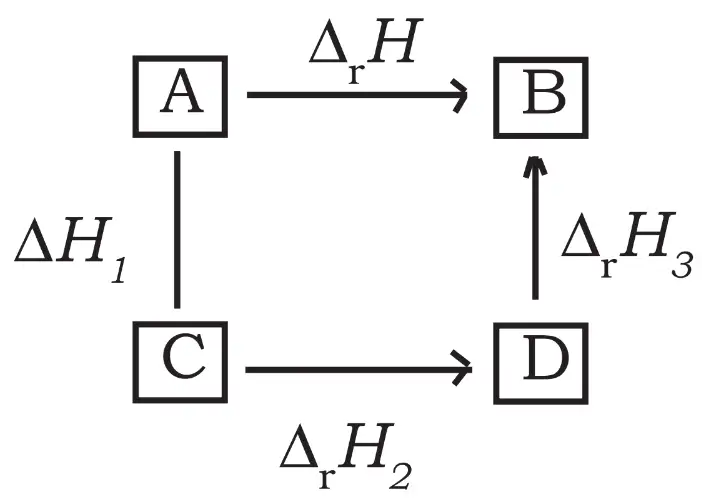
Hess’s Law of Constant Heat Summation
- If a reaction occurs in steps, total enthalpy change is sum of enthalpy changes of steps at same temperature.
- Formula: ΔrH = ΔrH1 + ΔrH2 + ΔrH3
Solved Examples
- Ex 1: Calculate ΔrH for CH4 + 2O2 → CO2 + 2H2O given molar enthalpies: Hm(CH4) = -75, Hm(CO2) = -393, Hm(H2O) = -286, Hm(O2) = 0 kJ/mol.
- ΔrH = [-393 + 2(-286)] - [-75 + 2(0)] = (-393 - 572) - (-75) = -965 + 75 = -890 kJ/mol
- Ex 2: Use Hess’s law to find ΔrH if ΔrH1 = -100, ΔrH2 = +50, ΔrH3 = -30 kJ/mol.
- ΔrH = -100 + 50 - 30 = -80 kJ/mol
Practice Set
- Q1: What is the reaction enthalpy for N2 + 3H2 → 2NH3 if Σ Hproducts = -92 kJ and Σ Hreactants = 0 kJ?
- A. +92 kJ
- B. -92 kJ
- C. 0 kJ
- D. -46 kJ
- Q2: Enthalpy of vaporisation of water is:
- A. +6.0 kJ/mol
- B. +40.79 kJ/mol
- C. +62.4 kJ/mol
- D. -74.8 kJ/mol
- Q3: Hess’s law states that total enthalpy change is:
- A. Product of enthalpy changes of steps
- B. Sum of enthalpy changes of steps
- C. Difference of enthalpy changes of steps
- D. None of the above
Answer Key
- Q1: B. -92 kJ; Reaction enthalpy = products - reactants = -92 - 0 = -92 kJ (exothermic)
- Q2: B. +40.79 kJ/mol; Energy to convert liquid water to vapor at boiling point.
- Q3: B. Sum of enthalpy changes of steps; Hess’s law defines total enthalpy as sum of steps.
Memory Aids
- Enthalpy of sublimation = fusion + vaporisation
- Standard state = pure substance at 1 bar
- Hess’s law: Add enthalpy changes of intermediate steps
Definition and Formula
- Reaction enthalpy (\(\Delta_rH\)): Enthalpy change during a chemical reaction.
- Calculated as: \(\Delta_rH = \sum a_iH_{products} - \sum b_iH_{reactants}\)
- Here, \(a_i\) and \(b_i\) are stoichiometric coefficients of products and reactants.
- Example: \(CH_4(g) + 2O_2(g) \to CO_2(g) + 2H_2O(l)\)
- Reaction enthalpy: \(\Delta_rH = [H_m(CO_2) + 2H_m(H_2O)] - [H_m(CH_4) + 2H_m(O_2)]\)
- \(H_m\) is molar enthalpy.
Standard Enthalpy of Reaction
- Enthalpy change when all substances are in their standard states (pure form at 1 bar pressure).
- Example: Liquid ethanol at 298 K and 1 bar; solid iron at 500 K and 1 bar.
Enthalpy Changes During Phase Transformations
- Enthalpy of fusion: Energy to convert 1 mole solid to liquid at melting point.
- Example: \(H_2O_{(s)} \to H_2O_{(l)}\) at 273 K, \(\Delta_{fus}H^\circ = +6.0\) kJ/mol
- Enthalpy of vaporisation: Energy to convert 1 mole liquid to vapor at boiling point.
- Example: \(H_2O_{(l)} \to H_2O_{(g)}\) at 373 K, \(\Delta_{vap}H^\circ = +40.79\) kJ/mol
- Enthalpy of sublimation: Energy to convert 1 mole solid directly to vapor.
- Example: Iodine, \(\Delta_{sub}H^\circ = +62.4\) kJ/mol
- Relation: \(\Delta_{sub}H^\circ = \Delta_{fus}H^\circ + \Delta_{vap}H^\circ\)
- Enthalpy of formation: Energy change when 1 mole compound forms from elements in stable states.
- Example: \(C_{graphite,s} + 2H_2(g) \to CH_4(g)\), \(\Delta_fH^\circ = -74.8\) kJ/mol
Hess’s Law of Constant Heat Summation
- If a reaction occurs in steps, total enthalpy change is sum of enthalpy changes of steps at same temperature.
- Formula: \(\Delta_rH = \Delta_rH_1 + \Delta_rH_2 + \Delta_rH_3\)
Solved Examples
- Ex 1: Calculate \(\Delta_rH\) for \(CH_4 + 2O_2 \to CO_2 + 2H_2O\) given molar enthalpies: \(H_m(CH_4) = -75\), \(H_m(CO_2) = -393\), \(H_m(H_2O) = -286\), \(H_m(O_2) = 0\) kJ/mol.
- \(\Delta_rH = [-393 + 2(-286)] - [-75 + 2(0)] = (-393 - 572) - (-75) = -965 + 75 = -890\) kJ/mol
- Ex 2: Use Hess’s law to find \(\Delta_rH\) if \(\Delta_rH_1 = -100\), \(\Delta_rH_2 = +50\), \(\Delta_rH_3 = -30\) kJ/mol.
- \(\Delta_rH = -100 + 50 - 30 = -80\) kJ/mol
Practice Set
- Q1: What is the reaction enthalpy for \(N_2 + 3H_2 \to 2NH_3\) if \(\sum H_{products} = -92\) kJ and \(\sum H_{reactants} = 0\) kJ?
- A. +92 kJ
- B. -92 kJ
- C. 0 kJ
- D. -46 kJ
- Q2: Enthalpy of vaporisation of water is:
- A. +6.0 kJ/mol
- B. +40.79 kJ/mol
- C. +62.4 kJ/mol
- D. -74.8 kJ/mol
- Q3: Hess’s law states that total enthalpy change is:
- A. Product of enthalpy changes of steps
- B. Sum of enthalpy changes of steps
- C. Difference of enthalpy changes of steps
- D. None of the above
Answer Key
- Q1: B. -92 kJ; Reaction enthalpy = products - reactants = -92 - 0 = -92 kJ (exothermic)
- Q2: B. +40.79 kJ/mol; Energy to convert liquid water to vapor at boiling point.
- Q3: B. Sum of enthalpy changes of steps; Hess’s law defines total enthalpy as sum of steps.
Memory Aids
- Enthalpy of sublimation = fusion + vaporisation
- Standard state = pure substance at 1 bar
- Hess’s law: Add enthalpy changes of intermediate steps
Enthalpy of Combustion
Concept
- Change in enthalpy when 1 mole of substance burns completely in oxygen.
- Example: C(s) + O2(g) → CO2(g); ΔcH° = –393.5 kJ mol–1
- ΔcH° is always negative (exothermic reaction).
Solved Examples
- Ex 1: Calculate heat released when 2 moles of carbon burn.
- ΔcH° for 1 mole C = –393.5 kJ
- For 2 moles: Heat = 2 × (–393.5) = –787 kJ
Practice Set
- Q1: What is the sign of enthalpy of combustion?
- A. Positive
- B. Negative
- C. Zero
- D. Depends on substance
- Q2: Which of the following represents enthalpy of combustion?
- A. CH4 + 2O2 → CO2 + 2H2O
- B. C + O2 → CO2
- C. H2 + 1/2 O2 → H2O
- D. N2 + O2 → 2NO
- Q3: Heat released on burning 3 moles of carbon is?
- A. –1180.5 kJ
- B. –393.5 kJ
- C. +1180.5 kJ
- D. +393.5 kJ
Answer Key
- Q1: B. Negative – Combustion releases heat, so enthalpy change is negative.
- Q2: B. C + O2 → CO2 – Represents combustion of 1 mole carbon.
- Q3: A. –1180.5 kJ – 3 × (–393.5) = –1180.5 kJ heat released.
Memory Aids
- Combustion enthalpy always negative (exothermic).
- Complete burning means full oxidation to CO2 and H2O.
Enthalpy of Atomization
Concept
- Enthalpy change when 1 mole of bonds breaks to form gaseous atoms.
- Example: CH4(g) → C(g) + 4H(g); ΔaH = 1665 kJ mol–1
- Bond dissociation enthalpy is enthalpy to break 1 mole of covalent bonds in gas phase.
Solved Examples
- Ex 1: Calculate bond dissociation enthalpy if breaking 1 mole C–H bonds requires 1665 kJ.
- Given: CH4 → C + 4H, ΔaH = 1665 kJ
- Bond dissociation enthalpy per C–H bond = 1665/4 = 416.25 kJ/mol
Practice Set
- Q1: Enthalpy of atomization involves breaking bonds to form?
- A. Molecules
- B. Ions
- C. Gaseous atoms
- D. Liquids
- Q2: If ΔaH for CH4 is 1665 kJ, bond dissociation enthalpy for one C–H bond is?
- A. 416.25 kJ/mol
- B. 1665 kJ/mol
- C. 332.5 kJ/mol
- D. 665 kJ/mol
- Q3: Bond dissociation enthalpy is enthalpy change when?
- A. One mole of ionic bonds break
- B. One mole of covalent bonds break in gas phase
- C. One mole of atoms form molecules
- D. One mole of molecules ionize
Answer Key
- Q1: C. Gaseous atoms – Atomization forms gaseous atoms by bond breaking.
- Q2: A. 416.25 kJ/mol – Total enthalpy divided by number of bonds.
- Q3: B. One mole of covalent bonds break in gas phase – Definition of bond dissociation enthalpy.
Memory Aids
- Atomization = bond breaking to atoms in gas phase.
- Bond dissociation enthalpy = energy to break covalent bonds.
Bond Enthalpy
Concept
- Standard enthalpy of reaction related to bond enthalpies of reactants and products.
- Formula: ΔrH° = Σ bond enthalpiesreactants − Σ bond enthalpiesproducts
- Used for gas phase reactions involving covalent bonds.
Solved Examples
- Ex 1: Calculate ΔrH° for H2 + Cl2 → 2HCl
- Bond enthalpies: H–H = 436, Cl–Cl = 243, H–Cl = 431 kJ/mol
- ΔrH° = (436 + 243) – 2 × 431 = 679 – 862 = –183 kJ/mol
Practice Set
- Q1: Bond enthalpy is energy required to break bonds in?
- A. Liquids
- B. Solids
- C. Gaseous molecules
- D. Ionic compounds
- Q2: ΔrH° = Σ bond enthalpies reactants – products means reaction is?
- A. Exothermic if negative
- B. Endothermic if negative
- C. Always positive
- D. Zero
- Q3: Calculate ΔrH° for CH4 + 2Cl2 → CH2Cl2 + 2HCl given bond enthalpies (C–H=412, Cl–Cl=243, C–Cl=338, H–Cl=431 kJ/mol).
- A. –123 kJ/mol
- B. +123 kJ/mol
- C. –200 kJ/mol
- D. +200 kJ/mol
Answer Key
- Q1: C. Gaseous molecules – Bond enthalpy applies to gaseous covalent bonds.
- Q2: A. Exothermic if negative – Negative ΔH means heat release.
- Q3: A. –123 kJ/mol – Calculate reactants and products bond enthalpy difference.
Memory Aids
- ΔrH° = Σ bonds broken – Σ bonds formed.
- Negative ΔH means exothermic reaction.
Lattice Enthalpy
Concept
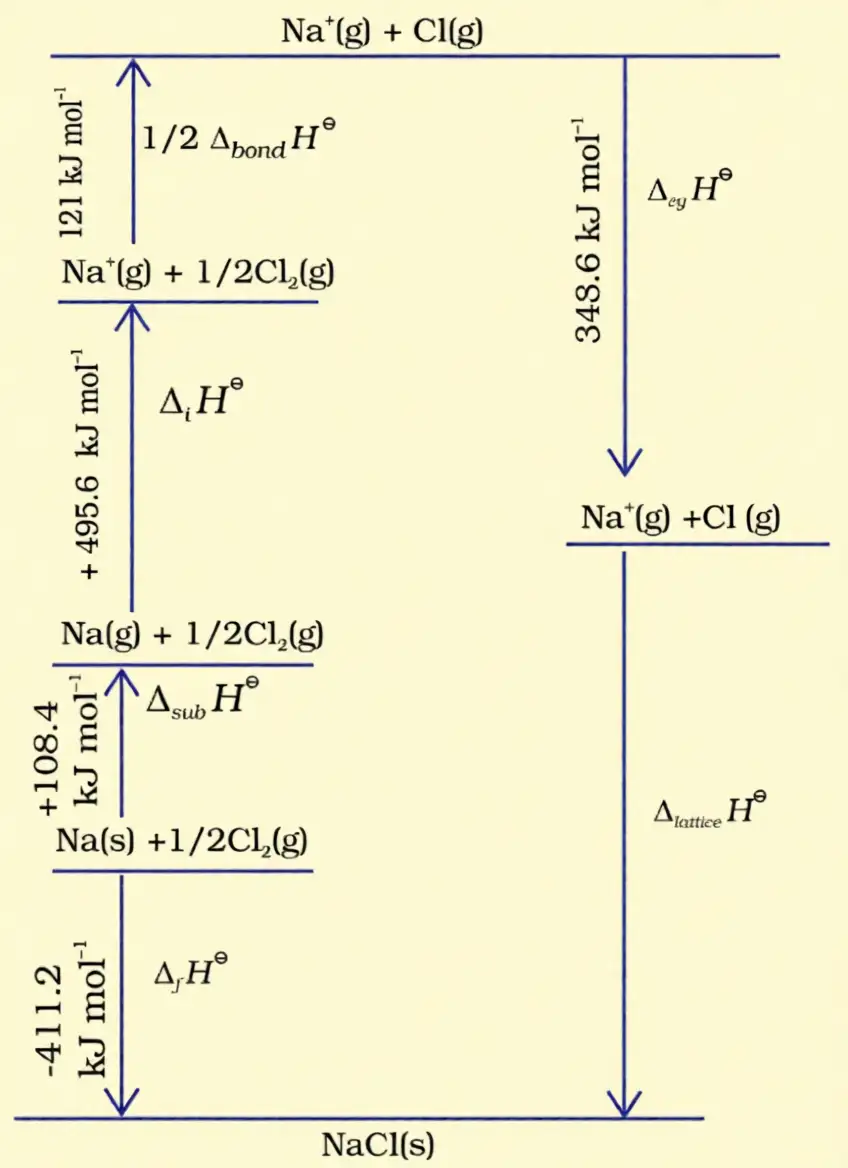
- Enthalpy change when 1 mole ionic compound dissociates into gaseous ions.
- Calculated using Born–Haber cycle.
- Example: NaCl formation enthalpy equation:
- ΔfH°(NaCl) = ΔsubH°(Na) + 1/2 ΔdissH°(Cl2) + ΔionH°(Na) + ΔegH°(Cl) + ΔlatticeH°(NaCl)
Solved Examples
- Ex 1: Use Born-Haber cycle to find lattice enthalpy if other values are known.
Practice Set
- Q1: Lattice enthalpy is enthalpy change when?
- A. Ionic compound forms solid
- B. Ionic compound dissociates into gaseous ions
- C. Covalent bonds break
- D. Molecules ionize
- Q2: Born-Haber cycle helps calculate?
- A. Bond enthalpy
- B. Lattice enthalpy
- C. Enthalpy of combustion
- D. Enthalpy of atomization
- Q3: In NaCl Born-Haber cycle, which step involves ionization energy?
- A. Na(s) → Na(g)
- B. Cl2(g) → 2Cl(g)
- C. Na(g) → Na+(g) + e–
- D. Cl(g) + e– → Cl–(g)
Answer Key
- Q1: B. Ionic compound dissociates into gaseous ions – Definition of lattice enthalpy.
- Q2: B. Lattice enthalpy – Born-Haber cycle calculates lattice enthalpy.
- Q3: C. Na(g) → Na+(g) + e– – Ionization energy step.
Memory Aids
- Born-Haber cycle = sum of steps to form ionic solid.
- Lattice enthalpy is always exothermic (negative) when ions form solid.
Concept
- Enthalpy change when 1 mole ionic compound dissociates into gaseous ions.
- Calculated using Born–Haber cycle.
- Example: NaCl formation enthalpy equation:
- ΔfH°(NaCl) = ΔsubH°(Na) + 1/2 ΔdissH°(Cl2) + ΔionH°(Na) + ΔegH°(Cl) + ΔlatticeH°(NaCl)
Solved Examples
- Ex 1: Use Born-Haber cycle to find lattice enthalpy if other values are known.
Practice Set
- Q1: Lattice enthalpy is enthalpy change when?
- A. Ionic compound forms solid
- B. Ionic compound dissociates into gaseous ions
- C. Covalent bonds break
- D. Molecules ionize
- Q2: Born-Haber cycle helps calculate?
- A. Bond enthalpy
- B. Lattice enthalpy
- C. Enthalpy of combustion
- D. Enthalpy of atomization
- Q3: In NaCl Born-Haber cycle, which step involves ionization energy?
- A. Na(s) → Na(g)
- B. Cl2(g) → 2Cl(g)
- C. Na(g) → Na+(g) + e–
- D. Cl(g) + e– → Cl–(g)
Answer Key
- Q1: B. Ionic compound dissociates into gaseous ions – Definition of lattice enthalpy.
- Q2: B. Lattice enthalpy – Born-Haber cycle calculates lattice enthalpy.
- Q3: C. Na(g) → Na+(g) + e– – Ionization energy step.
Memory Aids
- Born-Haber cycle = sum of steps to form ionic solid.
- Lattice enthalpy is always exothermic (negative) when ions form solid.
Enthalpy of Solution
Concept
- Enthalpy change when 1 mole of substance dissolves in specified solvent amount.
- Formula: ΔsolH° = ΔlatticeH° + ΔhydH°
- Most ionic compounds have positive ΔsolH° (endothermic dissociation).
- Solubility increases with temperature if ΔsolH° is positive.
- High lattice enthalpy may prevent dissociation.
Solved Examples
- Ex 1: Calculate ΔsolH° if lattice enthalpy = 700 kJ/mol and hydration enthalpy = –650 kJ/mol.
- ΔsolH° = 700 + (–650) = +50 kJ/mol (endothermic)
Practice Set
- Q1: Enthalpy of solution is heat change when?
- A. Substance melts
- B. Substance dissolves in solvent
- C. Substance reacts with acid
- D. Substance ionizes
- Q2: If ΔsolH° is positive, solubility of salt?
- A. Decreases with temperature
- B. Increases with temperature
- C. Remains constant
- D. Zero
- Q3: What happens if lattice enthalpy is very high?
- A. Salt dissolves easily
- B. Salt does not dissociate
- C. Salt reacts with water
- D. Salt melts
Answer Key
- Q1: B. Substance dissolves in solvent – Definition of enthalpy of solution.
- Q2: B. Increases with temperature – Endothermic dissolution favors solubility with heat.
- Q3: B. Salt does not dissociate – High lattice enthalpy prevents dissociation.
Memory Aids
- ΔsolH° = lattice enthalpy + hydration enthalpy.
- Positive ΔsolH° means endothermic dissolution.
Enthalpy of Dilution
Concept
- Heat change when additional solvent is added to a solution at constant temperature and pressure.
- Heat withdrawn from surroundings on dilution.
- Depends on original concentration of solution.
Solved Examples
- Ex 1: Adding water to concentrated acid causes heat change due to dilution.
Practice Set
- Q1: Enthalpy of dilution is heat change when?
- A. Solute dissolves
- B. Solvent added to solution
- C. Solute reacts
- D. Solution evaporates
- Q2: Enthalpy of dilution depends on?
- A. Temperature only
- B. Original concentration
- C. Volume only
- D. Pressure only
- Q3: Heat withdrawn on dilution means process is?
- A. Exothermic
- B. Endothermic
- C. Neutral
- D. Variable
Answer Key
- Q1: B. Solvent added to solution – Definition of enthalpy of dilution.
- Q2: B. Original concentration – Dilution enthalpy depends on concentration.
- Q3: A. Exothermic – Heat withdrawn means heat released to surroundings.
Memory Aids
- Dilution enthalpy depends on concentration.
- Heat withdrawn means exothermic process.
Enthalpy of Solution at Infinite Dilution
Concept
- Enthalpy change when substance dissolves in infinite solvent amount.
- Ion interactions negligible at infinite dilution.
Solved Examples
- Ex 1: Enthalpy change measured when solute dissolves in large solvent volume.
Practice Set
- Q1: Infinite dilution means solvent amount is?
- A. Very small
- B. Infinite
- C. Equal to solute
- D. None
- Q2: At infinite dilution, ion interactions are?
- A. Strong
- B. Negligible
- C. Moderate
- D. Variable
- Q3: Enthalpy of solution at infinite dilution is?
- A. Dependent on concentration
- B. Independent of concentration
- C. Zero
- D. Negative always
Answer Key
- Q1: B. Infinite – Definition of infinite dilution.
- Q2: B. Negligible – Ion interactions minimal at infinite dilution.
- Q3: B. Independent of concentration – No ion interaction effect.
Memory Aids
- Infinite dilution means very large solvent volume.
- Ion interactions negligible at infinite dilution.
Enthalpy of Neutralisation
Concept
- Heat change when 1 gram equivalent acid neutralised by 1 gram equivalent base in dilute solution.
- Example: HCl(aq) + NaOH(aq) → NaCl(aq) + H2O(l); ΔneuH = –57.1 kJ mol–1
- Usually exothermic (heat released).
Solved Examples
- Ex 1: Calculate heat released when 1 mole HCl neutralised by NaOH.
- Heat = –57.1 kJ
Practice Set
- Q1: Enthalpy of neutralisation is heat change when?
- A. Acid reacts with base
- B. Acid evaporates
- C. Base melts
- D. Acid ionizes
- Q2: Heat change in neutralisation is usually?
- A. Positive
- B. Negative
- C. Zero
- D. Variable
- Q3: Reaction: HCl + NaOH → ?
- A. NaCl + H2O
- B. NaOH + HCl
- C. H2 + Cl2
- D. Na + Cl
Answer Key
- Q1: A. Acid reacts with base – Definition of neutralisation.
- Q2: B. Negative – Heat is released in neutralisation.
- Q3: A. NaCl + H2O – Products of acid-base neutralisation.
Memory Aids
- Neutralisation always releases heat (exothermic).
- One equivalent acid reacts with one equivalent base.
Enthalpy of Transition
Concept
- Enthalpy change when 1 mole substance changes from one allotrope to another.
- Example: C(graphite) → C(diamond); ΔtransH = 1.9 kJ mol–1
Solved Examples
- Ex 1: Calculate heat absorbed when 1 mole graphite converts to diamond.
- ΔtransH = +1.9 kJ/mol (endothermic)
Practice Set
- Q1: Enthalpy of transition involves change between?
- A. Different elements
- B. Different allotropes
- C. Different compounds
- D. Different ions
- Q2: ΔtransH for graphite to diamond is?
- A. –1.9 kJ/mol
- B. +1.9 kJ/mol
- C. Zero
- D. Variable
- Q3: Transition enthalpy is usually?
- A. Exothermic
- B. Endothermic
- C. Zero
- D. None
Answer Key
- Q1: B. Different allotropes – Transition is between allotropes.
- Q2: B. +1.9 kJ/mol – Heat absorbed to convert graphite to diamond.
- Q3: B. Endothermic – Transition requires energy input.
Memory Aids
- Graphite to diamond is endothermic transition.
- Allotropes differ in structure, not composition.
Enthalpy of Hydration
Concept
- Heat change when 1 mole anhydrous substance combines with water to form hydrated compound.
- Example: CuSO4(s) + 5H2O → CuSO4·5H2O(s); ΔhydH = –78.2 kJ mol–1
Solved Examples
- Ex 1: Calculate heat released when 1 mole CuSO4 forms pentahydrate.
- ΔhydH = –78.2 kJ/mol (exothermic)
Practice Set
- Q1: Enthalpy of hydration is heat change when?
- A. Substance melts
- B. Anhydrous substance forms hydrate
- C. Substance ionizes
- D. Substance evaporates
- Q2: Heat change in hydration is usually?
- A. Positive
- B. Negative
- C. Zero
- D. Variable
- Q3: Reaction: CuSO4 + 5H2O → ?
- A. CuSO4·5H2O
- B. CuSO4
- C. Cu + H2O
- D. CuSO4 + H2O
Answer Key
- Q1: B. Anhydrous substance forms hydrate – Definition of hydration enthalpy.
- Q2: B. Negative – Hydration usually releases heat.
- Q3: A. CuSO4·5H2O – Hydrated compound formed.
Memory Aids
- Hydration releases heat (exothermic).
- Hydrates contain water molecules in crystal lattice.
Spontaneity
Key Points
- A spontaneous process is irreversible without external influence.
- Entropy (S) measures system randomness or disorder.
- For reversible reactions, ΔS = qrev/T.
- Total entropy change for spontaneous process: ΔStotal = ΔSsystem + ΔSsurroundings > 0.
- At equilibrium, entropy is maximum and ΔS = 0.
- Entropy change for reversible process: ΔSsys = qsys,rev/T.
- Entropy changes during phase changes:
- Fusion: ΔS = ΔHfus/Tm
- Vaporization: ΔS = ΔHvap/Tb
- Sublimation: ΔS = ΔHsub/T
- Tm: melting point, Tb: boiling point, T: sublimation temperature.
- Entropy change of reaction: ΔrS° = ΣS°products - ΣS°reactants.

Solved Examples
- Ex 1: Calculate entropy change when 1 mole of ice melts at 273 K. Given ΔHfus = 6.01 kJ/mol.
- ΔS = ΔHfus/Tm = 6010/273 = 22.02 J/K
Practice Set
- Q1: What is the entropy change for vaporization at boiling point?
A) ΔHvap/Tb B) ΔHfus/Tm C) ΔHsub/T D) Zero - Q2: At equilibrium, entropy change is:
A) Positive B) Negative C) Zero D) Infinite - Q3: For a spontaneous process, total entropy change is:
A) < 0 B) = 0 C) > 0 D) Undefined
Answer Key
- Q1: A - Entropy change for vaporization is heat absorbed divided by boiling temperature.
- Q2: C - At equilibrium, entropy change is zero.
- Q3: C - Spontaneous processes have positive total entropy change.
Memory Aids
- Entropy increases with phase change: solid < liquid < gas.
- Spontaneous process: total entropy change > 0.
- At equilibrium, entropy change = 0.
Key Points
- A spontaneous process is irreversible without external influence.
- Entropy (S) measures system randomness or disorder.
- For reversible reactions, \( \Delta S = \frac{q_{rev}}{T} \).
- Total entropy change for spontaneous process: \( \Delta S_{total} = \Delta S_{system} + \Delta S_{surroundings} > 0 \).
- At equilibrium, entropy is maximum and \( \Delta S = 0 \).
- Entropy change for reversible process: \( \Delta S_{sys} = \frac{q_{sys,rev}}{T} \).
- Entropy changes during phase changes:
- Fusion: \( \Delta S = \frac{\Delta H_{fus}}{T_m} \)
- Vaporization: \( \Delta S = \frac{\Delta H_{vap}}{T_b} \)
- Sublimation: \( \Delta S = \frac{\Delta H_{sub}}{T} \)
- \( T_m \): melting point, \( T_b \): boiling point, \( T \): sublimation temperature.
- Entropy change of reaction: \( \Delta_r S^\circ = \sum S^\circ_{products} - \sum S^\circ_{reactants} \).
Solved Examples
- Ex 1: Calculate entropy change when 1 mole of ice melts at 273 K. Given \( \Delta H_{fus} = 6.01 \text{ kJ/mol} \).
- \( \Delta S = \frac{\Delta H_{fus}}{T_m} = \frac{6010}{273} = 22.02 \text{ J/K} \)
Practice Set
- Q1: What is the entropy change for vaporization at boiling point?
A) \( \frac{\Delta H_{vap}}{T_b} \) B) \( \frac{\Delta H_{fus}}{T_m} \) C) \( \frac{\Delta H_{sub}}{T} \) D) Zero - Q2: At equilibrium, entropy change is:
A) Positive B) Negative C) Zero D) Infinite - Q3: For a spontaneous process, total entropy change is:
A) \( < 0 \) B) \( = 0 \) C) \( > 0 \) D) Undefined
Answer Key
- Q1: A - Entropy change for vaporization is heat absorbed divided by boiling temperature.
- Q2: C - At equilibrium, entropy change is zero.
- Q3: C - Spontaneous processes have positive total entropy change.
Memory Aids
- Entropy increases with phase change: solid < liquid < gas.
- Spontaneous process: total entropy change > 0.
- At equilibrium, entropy change = 0.
Gibbs Free Energy
Key Points
- Gibbs free energy (G) = energy available for work: G = H - TS.
- Standard free energy change: ΔrG° = ΣΔfG°products - ΣΔfG°reactants.
- Gibbs–Helmholtz equation: ΔG = ΔH - TΔS.
- Relation with emf: ΔG° = -nFE° where E° is standard emf.
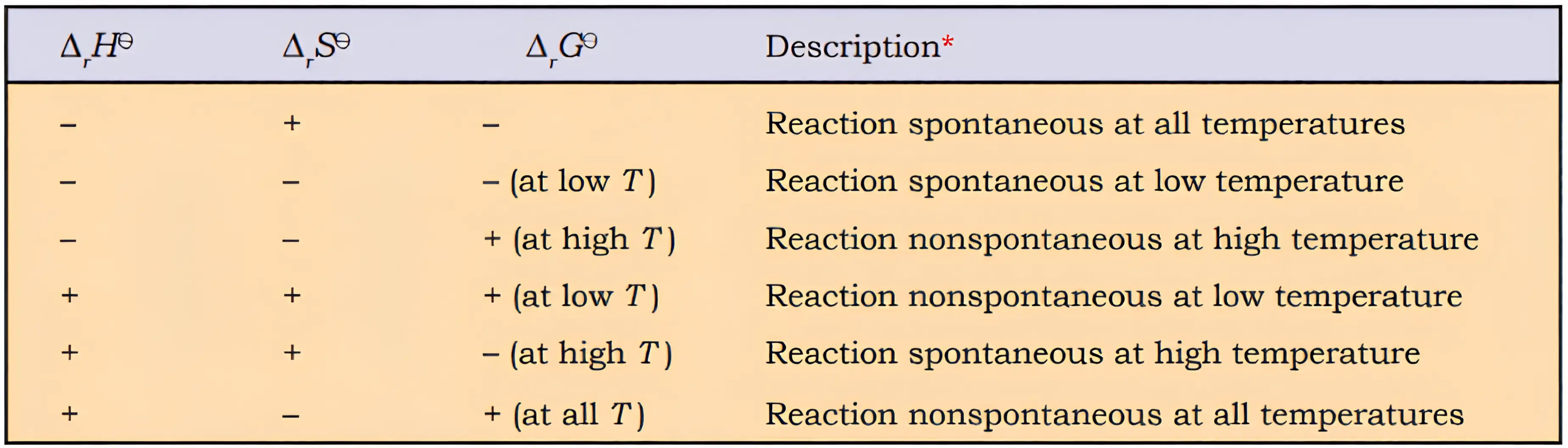
- Spontaneity criteria at constant P and T:
- ΔG < 0: spontaneous
- ΔG > 0: non-spontaneous
- ΔG = 0: equilibrium
Solved Examples
- Ex 1: Determine spontaneity if ΔH° = -40 kJ, ΔS° = -100 J/K at 300 K.
- ΔG° = ΔH° - TΔS° = -40000 - 300 × (-100) = -40000 + 30000 = -10000 J
- Since ΔG° < 0, reaction is spontaneous.
Practice Set
- Q1: If ΔG < 0, the process is:
A) Non-spontaneous B) Spontaneous C) At equilibrium D) Irreversible - Q2: Gibbs free energy equation is:
A) G = H + TS B) G = H - TS C) G = TS - H D) G = H / TS - Q3: For ΔG° = -nFE°, what does E° represent?
A) Standard emf B) Entropy C) Enthalpy D) Temperature
Answer Key
- Q1: B - Negative ΔG means spontaneous process.
- Q2: B - Gibbs free energy is G = H - TS.
- Q3: A - E° is standard emf of the cell.
Memory Aids
- Spontaneous if ΔG < 0.
- Use ΔG = ΔH - TΔS to check spontaneity.
- Negative ΔH and positive ΔS always spontaneous.
Key Points
- Gibbs free energy (G) = energy available for work: \( G = H - TS \).
- Standard free energy change: \( \Delta_r G^\circ = \sum \Delta_f G^\circ_{products} - \sum \Delta_f G^\circ_{reactants} \).
- Gibbs–Helmholtz equation: \( \Delta G = \Delta H - T\Delta S \).
- Relation with emf: \( \Delta G^\circ = -nFE^\circ \) where \( E^\circ \) is standard emf.
- Spontaneity criteria at constant P and T:
- \( \Delta G < 0 \): spontaneous
- \( \Delta G > 0 \): non-spontaneous
- \( \Delta G = 0 \): equilibrium
Solved Examples
- Ex 1: Determine spontaneity if \( \Delta H^\circ = -40 \text{ kJ} \), \( \Delta S^\circ = -100 \text{ J/K} \) at 300 K.
- \( \Delta G^\circ = \Delta H^\circ - T\Delta S^\circ = -40000 - 300 \times (-100) = -40000 + 30000 = -10000 \text{ J} \)
- Since \( \Delta G^\circ < 0 \), reaction is spontaneous.
Practice Set
- Q1: If \( \Delta G < 0 \), the process is:
A) Non-spontaneous B) Spontaneous C) At equilibrium D) Irreversible - Q2: Gibbs free energy equation is:
A) \( G = H + TS \) B) \( G = H - TS \) C) \( G = TS - H \) D) \( G = H / TS \) - Q3: For \( \Delta G^\circ = -nFE^\circ \), what does \( E^\circ \) represent?
A) Standard emf B) Entropy C) Enthalpy D) Temperature
Answer Key
- Q1: B - Negative \( \Delta G \) means spontaneous process.
- Q2: B - Gibbs free energy is \( G = H - TS \).
- Q3: A - \( E^\circ \) is standard emf of the cell.
Memory Aids
- Spontaneous if \( \Delta G < 0 \).
- Use \( \Delta G = \Delta H - T\Delta S \) to check spontaneity.
- Negative \( \Delta H \) and positive \( \Delta S \) always spontaneous.
Thermodynamics Laws
Key Points
- Second law: Total entropy change ΔStotal > 0 for spontaneous processes.
- Third law: Entropy of pure crystalline substance approaches zero at absolute zero temperature.
- More symmetrical molecules have lower entropy than less symmetrical ones with similar mass and heat capacity.
- Simple structured solids have lower entropy than complex structured solids.
- Entropy decreases when rubber band stretches (more order), increases when egg boils (protein denaturation).
- Entropy of liquids/solids changes little with pressure due to volume stability.
- Entropy change of ideal gas (1 mole):
- ΔS = Cv ln (T2/T1) + R ln (V2/V1) = Cp ln (T2/T1) + R ln (P1/P2)
- Isothermal: ΔST = R ln (V2/V1) = R ln (P1/P2)
- Isochoric: ΔSV = Cv ln (T2/T1) = Cv ln (P2/P1)
- Isobaric: ΔSP = Cp ln (T2/T1) = Cp ln (V2/V1)
- Gibbs Helmholtz equations:
- ΔG = ΔH + T [d(ΔG)/dT]P
- (ΔG - ΔH)/T = [d(ΔG)/dT]P
- -ΔS = [d(ΔG)/dT]P
Solved Examples
- Ex 1: Calculate entropy change for 1 mole ideal gas expanding isothermally from volume V1 to V2.
- ΔST = R ln (V2/V1)
Practice Set
- Q1: According to second law, total entropy change for spontaneous process is:
A) Negative B) Zero C) Positive D) Undefined - Q2: Entropy of pure crystalline substance at absolute zero is:
A) Maximum B) Zero C) Negative D) Undefined - Q3: Entropy change for isothermal expansion of ideal gas is:
A) Cv ln (T2/T1) B) R ln (V2/V1) C) Cp ln (T2/T1) D) Zero
Answer Key
- Q1: C - Second law states total entropy change is positive for spontaneous processes.
- Q2: B - Third law states entropy approaches zero at absolute zero.
- Q3: B - Isothermal entropy change is R ln (V2/V1).
Memory Aids
- Second law: total entropy increases in spontaneous processes.
- Third law: entropy zero at 0 K for pure crystals.
- Entropy formulas depend on process type (isothermal, isochoric, isobaric).
Key Points
- Second law: Total entropy change \( \Delta S_{total} > 0 \) for spontaneous processes.
- Third law: Entropy of pure crystalline substance approaches zero at absolute zero temperature.
- More symmetrical molecules have lower entropy than less symmetrical ones with similar mass and heat capacity.
- Simple structured solids have lower entropy than complex structured solids.
- Entropy decreases when rubber band stretches (more order), increases when egg boils (protein denaturation).
- Entropy of liquids/solids changes little with pressure due to volume stability.
- Entropy change of ideal gas (1 mole):
- \( \Delta S = C_v \ln \frac{T_2}{T_1} + R \ln \frac{V_2}{V_1} = C_p \ln \frac{T_2}{T_1} + R \ln \frac{P_1}{P_2} \)
- Isothermal: \( \Delta S_T = R \ln \frac{V_2}{V_1} = R \ln \frac{P_1}{P_2} \)
- Isochoric: \( \Delta S_V = C_v \ln \frac{T_2}{T_1} = C_v \ln \frac{P_2}{P_1} \)
- Isobaric: \( \Delta S_P = C_p \ln \frac{T_2}{T_1} = C_p \ln \frac{V_2}{V_1} \)
- Gibbs Helmholtz equations:
- \( \Delta G = \Delta H + T \left[ \frac{d(\Delta G)}{dT} \right]_P \)
- \( \frac{\Delta G - \Delta H}{T} = \left[ \frac{d(\Delta G)}{dT} \right]_P \)
- \( -\Delta S = \left[ \frac{d(\Delta G)}{dT} \right]_P \)
Solved Examples
- Ex 1: Calculate entropy change for 1 mole ideal gas expanding isothermally from volume \( V_1 \) to \( V_2 \).
- \( \Delta S_T = R \ln \frac{V_2}{V_1} \)
Practice Set
- Q1: According to second law, total entropy change for spontaneous process is:
A) Negative B) Zero C) Positive D) Undefined - Q2: Entropy of pure crystalline substance at absolute zero is:
A) Maximum B) Zero C) Negative D) Undefined - Q3: Entropy change for isothermal expansion of ideal gas is:
A) \( C_v \ln \frac{T_2}{T_1} \) B) \( R \ln \frac{V_2}{V_1} \) C) \( C_p \ln \frac{T_2}{T_1} \) D) Zero
Answer Key
- Q1: C - Second law states total entropy change is positive for spontaneous processes.
- Q2: B - Third law states entropy approaches zero at absolute zero.
- Q3: B - Isothermal entropy change is \( R \ln \frac{V_2}{V_1} \).
Memory Aids
- Second law: total entropy increases in spontaneous processes.
- Third law: entropy zero at 0 K for pure crystals.
- Entropy formulas depend on process type (isothermal, isochoric, isobaric).
Gibbs Energy Change and Equilibrium
Concept and Equation
- Gibbs energy change (ΔrG°) relates to equilibrium constant (K) by: ΔrG° = -2.303 RT log K
- R = gas constant, T = temperature in Kelvin
- Negative ΔrG° means reaction favors products
- Positive ΔrG° means reaction favors reactants
- Zero ΔrG° means reactants and products are at equilibrium
Relationship Table
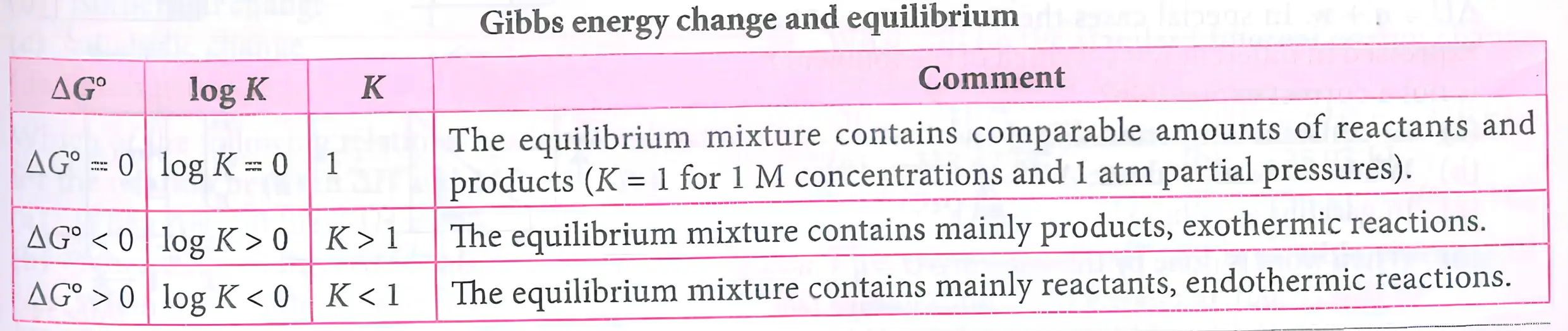
- ΔG° = 0, log K = 0, K = 1: Equal reactants and products at equilibrium
- ΔG° < 0, log K > 0, K > 1: Reaction favors products, exothermic
- ΔG° > 0, log K < 0, K < 1: Reaction favors reactants, endothermic
Solved Examples
- Ex 1: Calculate ΔrG° at 298 K if K = 103.
- Use ΔrG° = -2.303 × 8.314 × 298 × log 103
- log 103 = 3
- ΔrG° = -2.303 × 8.314 × 298 × 3 = -17094 J/mol
- Ex 2: Determine equilibrium constant if ΔrG° = 0 at 298 K.
- 0 = -2.303 RT log K ⇒ log K = 0 ⇒ K = 1
Practice Set
- Q1: If ΔrG° < 0, which is true?
- A. K < 1
- B. K = 1
- C. K > 1
- D. Reaction is non-spontaneous
- Q2: For a reaction at 298 K, K = 0.01. What is the sign of ΔrG°?
- A. Positive
- B. Negative
- C. Zero
- D. Cannot determine
- Q3: Calculate K at 298 K if ΔrG° = 5.7 kJ/mol.
- A. 0.01
- B. 1
- C. 100
- D. 10
Answer Key
- Q1: C. K > 1 because negative ΔrG° favors product formation.
- Q2: A. Positive, since K < 1 implies ΔrG° > 0 and reaction favors reactants.
- Q3: A. 0.01
- Use ΔrG° = -2.303 RT log K
- 5700 = -2.303 × 8.314 × 298 × log K ⇒ log K = -1.0 ⇒ K = 0.1
- Closest option is 0.01
Memory Aids
- Negative ΔG° → K > 1 → products favored
- Positive ΔG° → K < 1 → reactants favored
- Zero ΔG° → K = 1 → equilibrium
Concept and Equation
- Gibbs energy change (\( \Delta_{r}G^\circ \)) relates to equilibrium constant (\( K \)) by: \( \Delta_{r}G^\circ = -2.303 RT \log K \)
- \( R \) = gas constant, \( T \) = temperature in Kelvin
- Negative \( \Delta_{r}G^\circ \) means reaction favors products
- Positive \( \Delta_{r}G^\circ \) means reaction favors reactants
- Zero \( \Delta_{r}G^\circ \) means reactants and products are at equilibrium
Relationship Table
- \( \Delta G^\circ = 0 \), \( \log K = 0 \), \( K = 1 \): Equal reactants and products at equilibrium
- \( \Delta G^\circ < 0 \), \( \log K > 0 \), \( K > 1 \): Reaction favors products, exothermic
- \( \Delta G^\circ > 0 \), \( \log K < 0 \), \( K < 1 \): Reaction favors reactants, endothermic
Solved Examples
- Ex 1: Calculate \( \Delta_{r}G^\circ \) at 298 K if \( K = 10^3 \).
- Use \( \Delta_{r}G^\circ = -2.303 \times 8.314 \times 298 \times \log 10^3 \)
- \( \log 10^3 = 3 \)
- \( \Delta_{r}G^\circ = -2.303 \times 8.314 \times 298 \times 3 = -17094 \) J/mol
- Ex 2: Determine equilibrium constant if \( \Delta_{r}G^\circ = 0 \) at 298 K.
- \( 0 = -2.303 RT \log K \Rightarrow \log K = 0 \Rightarrow K = 1 \)
Practice Set
- Q1: If \( \Delta_{r}G^\circ < 0 \), which is true?
- A. \( K < 1 \)
- B. \( K = 1 \)
- C. \( K > 1 \)
- D. Reaction is non-spontaneous
- Q2: For a reaction at 298 K, \( K = 0.01 \). What is the sign of \( \Delta_{r}G^\circ \)?
- A. Positive
- B. Negative
- C. Zero
- D. Cannot determine
- Q3: Calculate \( K \) at 298 K if \( \Delta_{r}G^\circ = 5.7 \) kJ/mol.
- A. 0.01
- B. 1
- C. 100
- D. 10
Answer Key
- Q1: C. \( K > 1 \) because negative \( \Delta_{r}G^\circ \) favors product formation.
- Q2: A. Positive, since \( K < 1 \) implies \( \Delta_{r}G^\circ > 0 \) and reaction favors reactants.
- Q3: A. 0.01
- Use \( \Delta_{r}G^\circ = -2.303 RT \log K \)
- \( 5700 = -2.303 \times 8.314 \times 298 \times \log K \Rightarrow \log K = -1.0 \Rightarrow K = 0.1 \)
- Closest option is 0.01
Memory Aids
- Negative \( \Delta G^\circ \) → \( K > 1 \) → products favored
- Positive \( \Delta G^\circ \) → \( K < 1 \) → reactants favored
- Zero \( \Delta G^\circ \) → \( K = 1 \) → equilibrium
NEET Chemistry — ALL CHAPTERS
1
Some Basic Concepts of Chemistry
2
Structure of Atom
3
Classification of Elements and Periodicity in Properties
4
Chemical Bonding and Molecular Structure
5
Thermodynamics
6
Equilibrium
7
Redox Reactions
8
Organic Chemistry - Some Basic Principles and Techniques
9
Hydrocarbons
10
Solutions
11
Electrochemistry
12
Chemical Kinetics
13
The d- and f- Block Elements
14
Coordination Compounds
15
Haloalkanes and Haloarenes
16
Alcohols, Phenols and Ethers
17
Aldehydes, Ketones and Carboxylic Acids
18
Amines
19
Biomolecules
20
The p-Block Elements (Group 13 and 14)
21
The p-Block Elements (Group 15 to 18)
22
Principles Related to Practical Chemistry