NEET Ug . NEET Chemistry . Chemistry . Chemical Kinetics
Chapter 12: Chemical Kinetics
Ch 12
NEET Chemistry
NEET Ug
Introduction
Chemical Kinetics Overview
- Chemical kinetics studies reaction rates and mechanisms.
- It helps determine how fast reactions occur and how conditions affect rates.
Solved Examples
- Ex 1: Identify the branch of chemistry studying reaction speed.
Answer: Chemical kinetics.
Practice Set
- Q1: What does chemical kinetics study?
A) Reaction equilibrium
B) Reaction rates and mechanisms
C) Atomic structure
D) Molecular bonding - Q2: Which factor is NOT studied in chemical kinetics?
A) Reaction speed
B) Reaction mechanism
C) Reaction equilibrium constant
D) Effect of temperature on rate - Q3: Chemical kinetics helps to:
A) Predict product stability
B) Determine reaction speed and rate changes
C) Calculate molecular mass
D) Identify element types
Answer Key
- Q1: B - Chemical kinetics focuses on reaction rates and mechanisms.
- Q2: C - Equilibrium constant is studied in chemical equilibrium, not kinetics.
- Q3: B - Kinetics determines speed and how rates change with conditions.
Memory Aids
- "Kinetics = Speed + Path" (rate and mechanism)
- Focus on how fast and how reactions proceed.
Rate of a Chemical Reaction
Definition and Units
- Rate = change in concentration of reactant or product per unit time.
- For reaction R → P, rate = -Δ[R]/Δt or +Δ[P]/Δt.
- Units: mol L-1 s-1 or atm s-1 for gases.
Average and Instantaneous Rate
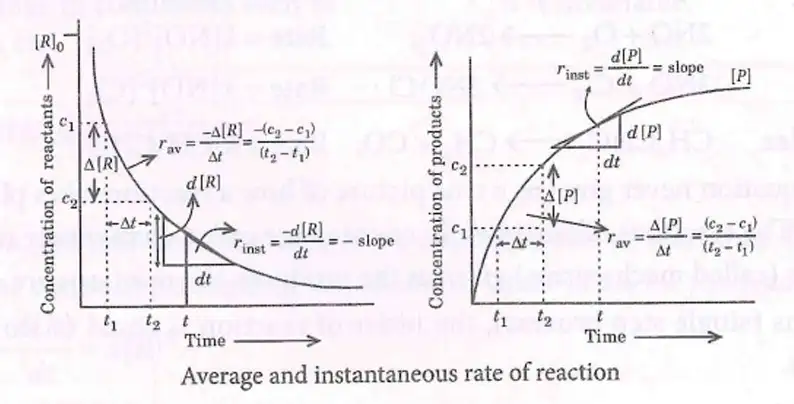
- Average rate: change over a large time interval, rav = -Δ[R]/Δt or +Δ[P]/Δt.
- Instantaneous rate: rate at a specific time, rinst = -d[R]/dt or +d[P]/dt.
- Δ indicates larger change (average), d indicates small change (instantaneous).
Solved Examples
- Ex 1: Calculate average rate if [R] changes from 0.5 to 0.2 mol/L in 10 s.
Rate = -(0.2 - 0.5)/10 = 0.03 mol L-1 s-1. - Ex 2: Find instantaneous rate at t = 5 s from slope of tangent on concentration-time graph.
Practice Set
- Q1: Rate of reaction is defined as:
A) Change in temperature per time
B) Change in concentration per time
C) Change in pressure per time
D) Change in volume per time - Q2: Units of reaction rate for gases are:
A) mol L-1 s-1
B) atm s-1
C) Both A and B
D) mol s-1 - Q3: Instantaneous rate differs from average rate because:
A) It uses larger time intervals
B) It is rate at a specific instant
C) It ignores concentration changes
D) It is always zero
Answer Key
- Q1: B - Rate measures concentration change per unit time.
- Q2: C - Both mol L-1 s-1 and atm s-1 are used.
- Q3: B - Instantaneous rate is at a specific moment, unlike average rate.
Memory Aids
- Average rate uses Δ (big change), instantaneous uses d (small change).
- Rate = concentration change/time interval.
Definition and Units
- Rate = change in concentration of reactant or product per unit time.
- For reaction R → P, rate = -Δ[R]/Δt or +Δ[P]/Δt.
- Units: mol L-1 s-1 or atm s-1 for gases.
Average and Instantaneous Rate
- Average rate: change over a large time interval, rav = -Δ[R]/Δt or +Δ[P]/Δt.
- Instantaneous rate: rate at a specific time, rinst = -d[R]/dt or +d[P]/dt.
- Δ indicates larger change (average), d indicates small change (instantaneous).
Solved Examples
- Ex 1: Calculate average rate if [R] changes from 0.5 to 0.2 mol/L in 10 s.
Rate = -(0.2 - 0.5)/10 = 0.03 mol L-1 s-1. - Ex 2: Find instantaneous rate at t = 5 s from slope of tangent on concentration-time graph.
Practice Set
- Q1: Rate of reaction is defined as:
A) Change in temperature per time
B) Change in concentration per time
C) Change in pressure per time
D) Change in volume per time - Q2: Units of reaction rate for gases are:
A) mol L-1 s-1
B) atm s-1
C) Both A and B
D) mol s-1 - Q3: Instantaneous rate differs from average rate because:
A) It uses larger time intervals
B) It is rate at a specific instant
C) It ignores concentration changes
D) It is always zero
Answer Key
- Q1: B - Rate measures concentration change per unit time.
- Q2: C - Both mol L-1 s-1 and atm s-1 are used.
- Q3: B - Instantaneous rate is at a specific moment, unlike average rate.
Memory Aids
- Average rate uses Δ (big change), instantaneous uses d (small change).
- Rate = concentration change/time interval.
Integrated Rate Equations
Zero Order Reaction
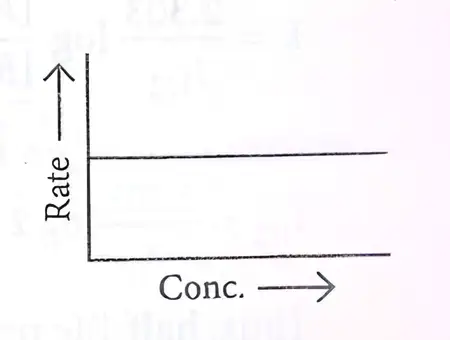
- Rate is independent of reactant concentration.
- Rate remains constant: rate = k.
- Reaction: R → Products, rate = -d[R]/dt = k[R]0 = k.
- Integrated rate equation: k = ([R]0 - [R]t)/t.
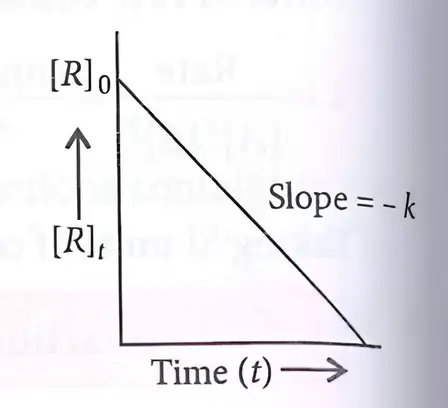
- Concentration-time relation: [R]t = -kt + [R]0 (linear with slope -k).
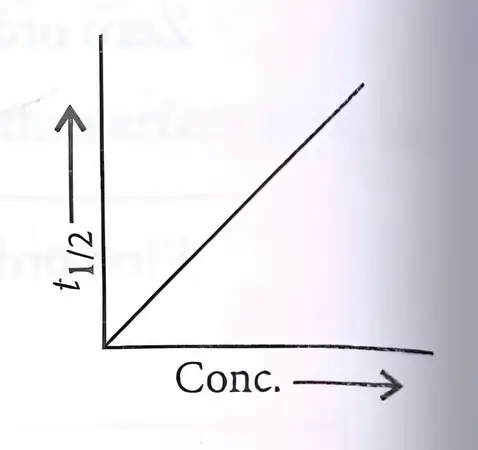
- Half-life: t1/2 = [R]0/(2k), directly proportional to initial concentration.
Solved Examples
- Ex 1: Calculate rate constant k if [R]0 = 0.5 M, [R]t = 0.2 M after 10 s.
Solution: k = (1/10)(0.5 - 0.2) = 0.03 M/s.
Practice Set
- Q1: For a zero order reaction, rate is:
A. Proportional to [R]
B. Independent of [R]
C. Proportional to [R]2
D. Inversely proportional to [R] - Q2: The half-life of a zero order reaction is:
A. Constant
B. Proportional to [R]0
C. Inversely proportional to [R]0
D. Independent of [R]0 - Q3: If k = 0.04 M/s and [R]0 = 0.8 M, time to reduce concentration to 0.4 M is:
A. 10 s
B. 20 s
C. 5 s
D. 15 s
Answer Key
- Q1: B - Rate is independent of concentration in zero order.
- Q2: B - Half-life is directly proportional to initial concentration.
- Q3: B - t = ([R]0 - [R]t)/k = (0.8 - 0.4)/0.04 = 10 s.
Memory Aids
- Zero order: Rate constant, straight line [R] vs. t.
- Half-life ∝ initial concentration.
- Rate independent of [R].
First Order Reaction
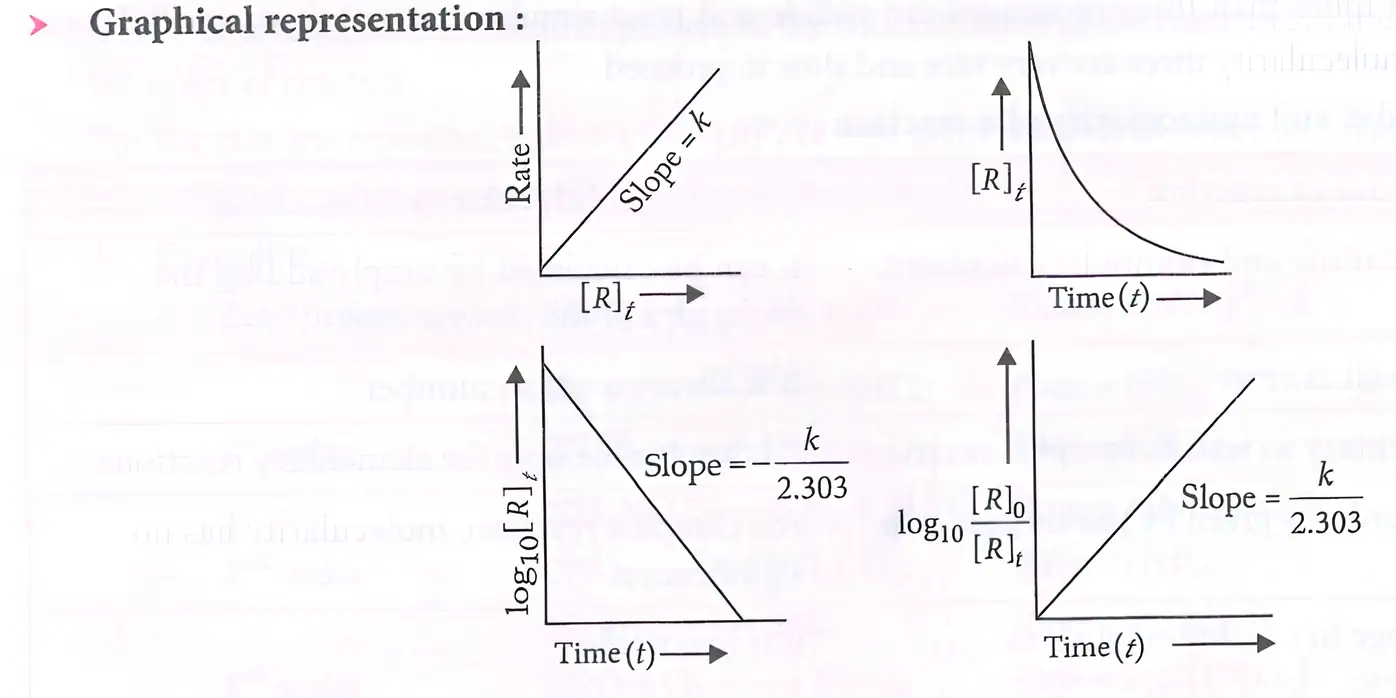
- Rate depends on one reactant concentration: rate = k[R].
- Integrated rate equation: k = (2.303/t) log ([R]0/[R]t).
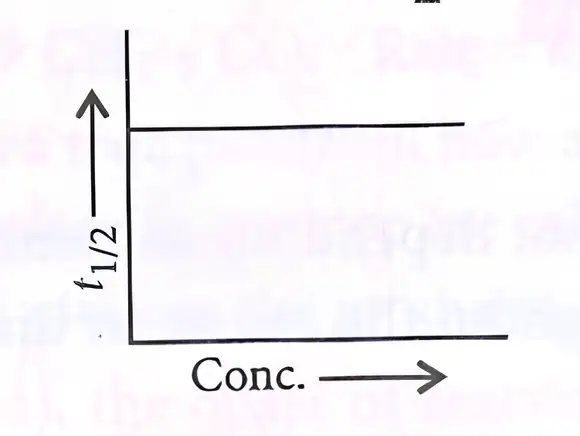
- Half-life: t1/2 = 0.693/k, independent of concentration.
- Time for nth fraction completion: t1/n = (2.303/k) log (n/(n-1)).
- Time to reduce to nth fraction: t = (2.303/k) log n.
Solved Examples
- Ex 1: Calculate k if [R]0 = 0.5 M, [R]t = 0.25 M after 20 s.
Solution: k = (2.303/20) log(0.5/0.25) = 0.115 s-1. - Ex 2: Find half-life if k = 0.1 s-1.
Solution: t1/2 = 0.693/0.1 = 6.93 s.
Practice Set
- Q1: Half-life of first order reaction is:
A. Proportional to [R]0
B. Independent of [R]0
C. Proportional to 1/[R]0
D. Proportional to [R]02 - Q2: For first order, integrated rate law is:
A. [R]t = -kt + [R]0
B. k = (2.303/t) log([R]0/[R]t)
C. k = (1/t)([R]0 - [R]t)
D. k = (1/t) log([R]0/[R]t) - Q3: Time to reduce to half concentration for k = 0.2 s-1 is:
A. 3.465 s
B. 0.693 s
C. 6.93 s
D. 1.386 s
Answer Key
- Q1: B - Half-life is independent of initial concentration.
- Q2: B - Correct integrated rate law for first order.
- Q3: A - t1/2 = 0.693/0.2 = 3.465 s.
Memory Aids
- First order: Half-life constant, independent of concentration.
- Plot log[R] vs. time for straight line.
- Use t1/2 = 0.693/k for calculations.
General Integrated Rate Equations and Graphs
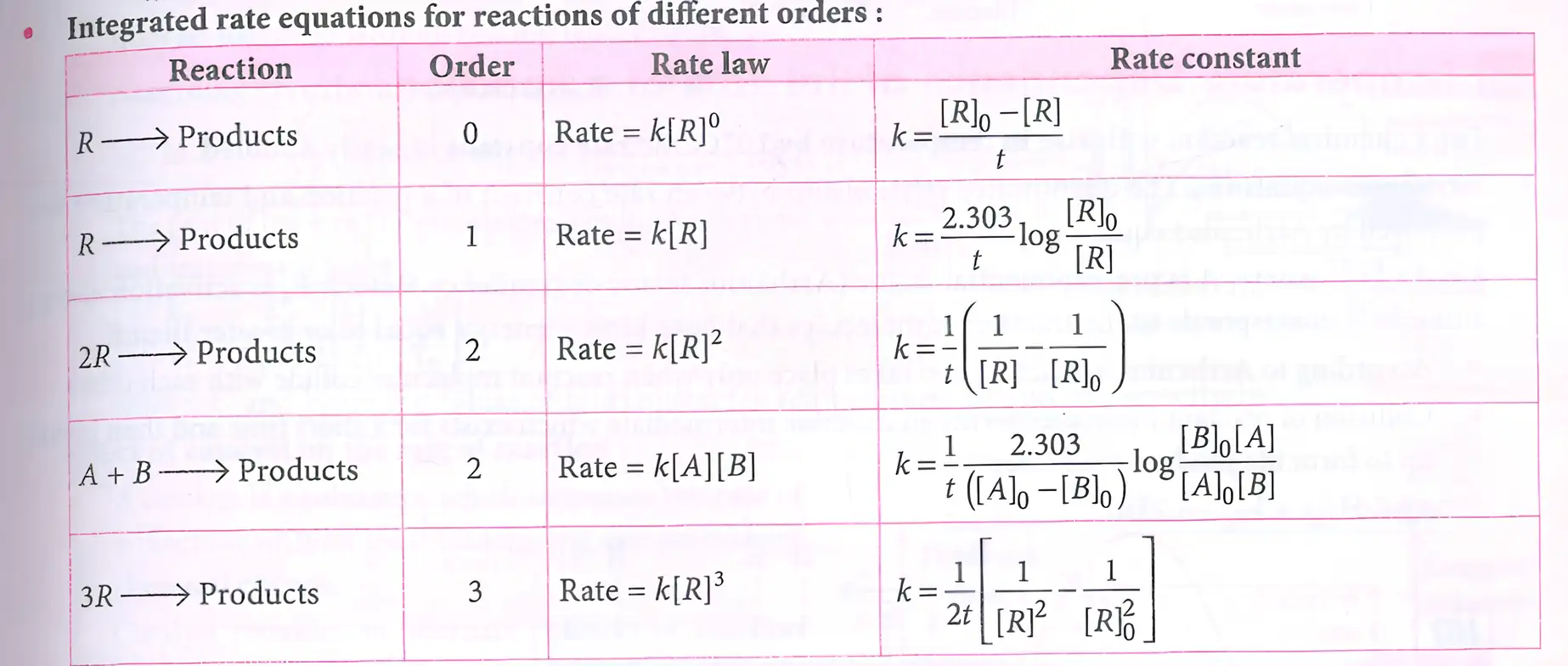
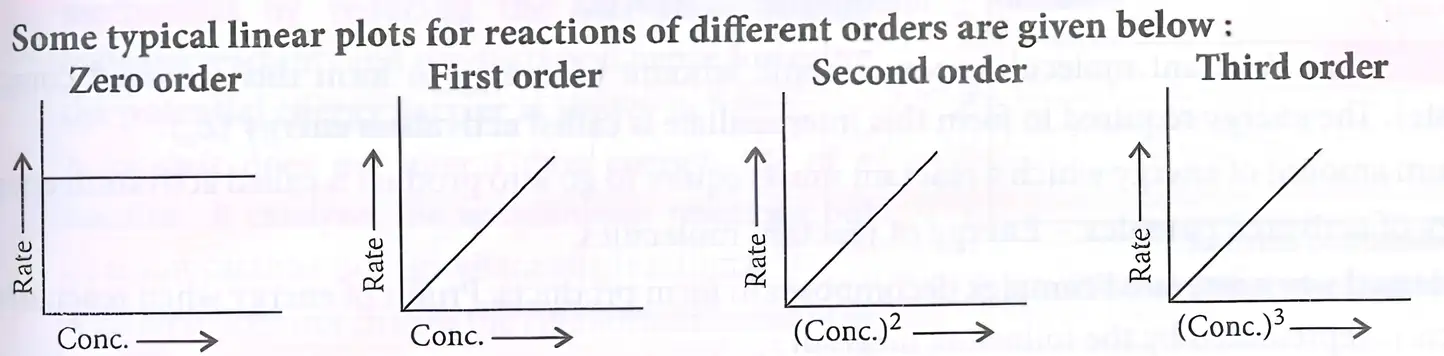
- Zero order: Rate = k, [R] = -kt + [R]0.
- First order: Rate = k[R], log[R] = -kt/2.303 + log[R]0.
- Second order: Rate = k[R]2, 1/[R] = kt + 1/[R]0.
- Third order: Rate = k[R]3, 1/[R]2 = 2kt + 1/[R]02.
- Half-life varies with order:
- Zero order: t1/2 ∝ [R]0
- First order: t1/2 = constant
- Second order: t1/2 ∝ 1/[R]0
- Third order: t1/2 ∝ 1/[R]02
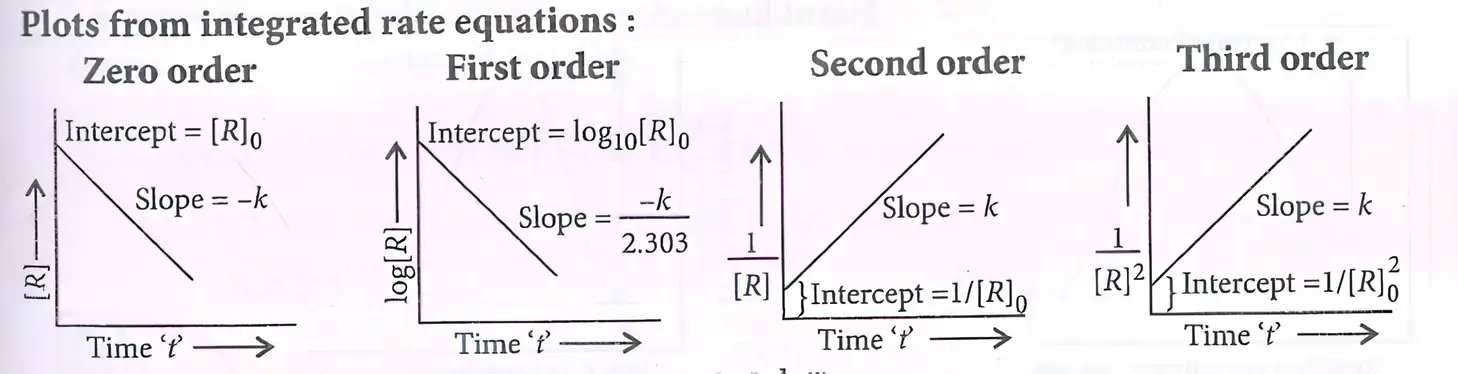
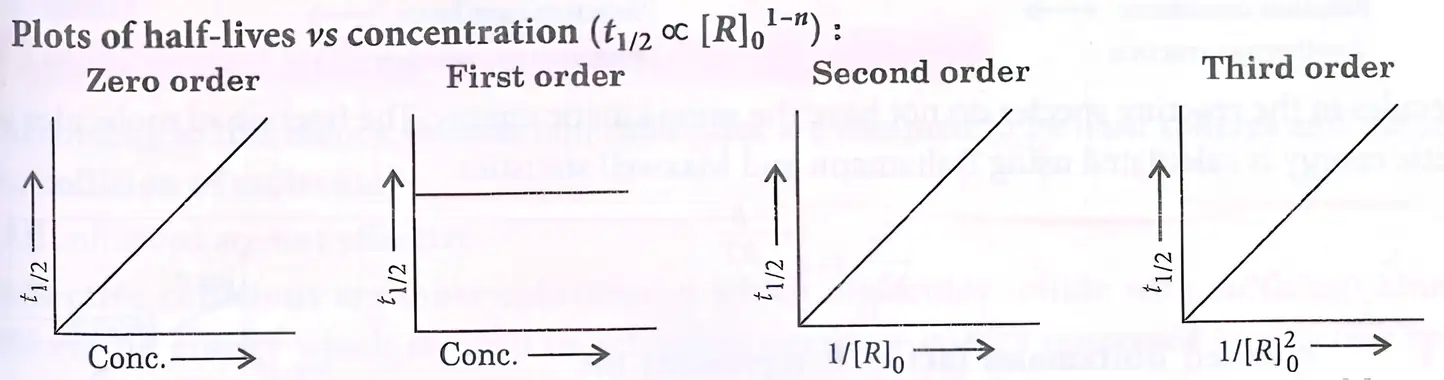
Time Relationships in First Order Reactions
- Time for different completion fractions related to half-life:
- 75% completion ≈ 2 t1/2, 87.5% ≈ 3 t1/2, 93.75% ≈ 4 t1/2, etc.
- Amount left after n half-lives: [R]0/2n.
- Pseudo first order reactions behave like first order under certain conditions.

Examples of Pseudo First Order Reactions
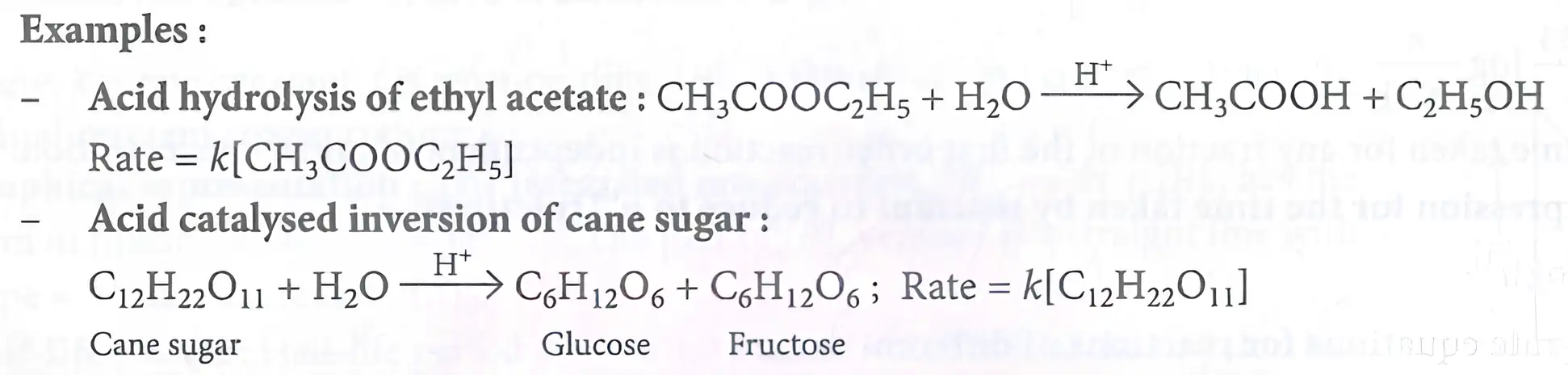
- Acid hydrolysis of ethyl acetate: Rate = k[ethyl acetate].
- Acid-catalyzed inversion of cane sugar: Rate = k[cane sugar].
Zero Order Reaction
- Rate is independent of reactant concentration.
- Rate remains constant: rate = k.
- Reaction: R → Products, rate = -d[R]/dt = k[R]0 = k.
- Integrated rate equation: k = \(\frac{1}{t}([R]_0 - [R]_t)\).
- Concentration-time relation: [R]t = -kt + [R]0 (linear with slope -k).
- Half-life: t1/2 = \(\frac{[R]_0}{2k}\), directly proportional to initial concentration.
Solved Examples
- Ex 1: Calculate rate constant k if [R]0 = 0.5 M, [R]t = 0.2 M after 10 s.
Solution: k = (1/10)(0.5 - 0.2) = 0.03 M/s.
Practice Set
- Q1: For a zero order reaction, rate is:
A. Proportional to [R]
B. Independent of [R]
C. Proportional to [R]2
D. Inversely proportional to [R] - Q2: The half-life of a zero order reaction is:
A. Constant
B. Proportional to [R]0
C. Inversely proportional to [R]0
D. Independent of [R]0 - Q3: If k = 0.04 M/s and [R]0 = 0.8 M, time to reduce concentration to 0.4 M is:
A. 10 s
B. 20 s
C. 5 s
D. 15 s
Answer Key
- Q1: B - Rate is independent of concentration in zero order.
- Q2: B - Half-life is directly proportional to initial concentration.
- Q3: B - t = ([R]0 - [R]t)/k = (0.8 - 0.4)/0.04 = 10 s.
Memory Aids
- Zero order: Rate constant, straight line [R] vs. t.
- Half-life ∝ initial concentration.
- Rate independent of [R].
First Order Reaction
- Rate depends on one reactant concentration: rate = k[R].
- Integrated rate equation: k = \(\frac{2.303}{t} \log \frac{[R]_0}{[R]_t}\).
- Half-life: t1/2 = 0.693/k, independent of concentration.
- Time for nth fraction completion: t1/n = \(\frac{2.303}{k} \log \frac{n}{n-1}\).
- Time to reduce to nth fraction: t = \(\frac{2.303}{k} \log n\).
Solved Examples
- Ex 1: Calculate k if [R]0 = 0.5 M, [R]t = 0.25 M after 20 s.
Solution: k = (2.303/20) log(0.5/0.25) = 0.115 s-1. - Ex 2: Find half-life if k = 0.1 s-1.
Solution: t1/2 = 0.693/0.1 = 6.93 s.
Practice Set
- Q1: Half-life of first order reaction is:
A. Proportional to [R]0
B. Independent of [R]0
C. Proportional to 1/[R]0
D. Proportional to [R]02 - Q2: For first order, integrated rate law is:
A. [R]t = -kt + [R]0
B. k = (2.303/t) log([R]0/[R]t)
C. k = (1/t)([R]0 - [R]t)
D. k = (1/t) log([R]0/[R]t) - Q3: Time to reduce to half concentration for k = 0.2 s-1 is:
A. 3.465 s
B. 0.693 s
C. 6.93 s
D. 1.386 s
Answer Key
- Q1: B - Half-life is independent of initial concentration.
- Q2: B - Correct integrated rate law for first order.
- Q3: A - t1/2 = 0.693/0.2 = 3.465 s.
Memory Aids
- First order: Half-life constant, independent of concentration.
- Plot log[R] vs. time for straight line.
- Use t1/2 = 0.693/k for calculations.
General Integrated Rate Equations and Graphs
- Zero order: Rate = k, [R] = -kt + [R]0.
- First order: Rate = k[R], log[R] = -kt/2.303 + log[R]0.
- Second order: Rate = k[R]2, 1/[R] = kt + 1/[R]0.
- Third order: Rate = k[R]3, 1/[R]2 = 2kt + 1/[R]02.
- Half-life varies with order:
- Zero order: t1/2 ∝ [R]0
- First order: t1/2 = constant
- Second order: t1/2 ∝ 1/[R]0
- Third order: t1/2 ∝ 1/[R]02
Time Relationships in First Order Reactions
- Time for different completion fractions related to half-life:
- 75% completion ≈ 2 t1/2, 87.5% ≈ 3 t1/2, 93.75% ≈ 4 t1/2, etc.
- Amount left after n half-lives: [R]0/2n.
- Pseudo first order reactions behave like first order under certain conditions.
Examples of Pseudo First Order Reactions
- Acid hydrolysis of ethyl acetate: Rate = k[ethyl acetate].
- Acid-catalyzed inversion of cane sugar: Rate = k[cane sugar].
Collision Theory
Explanation
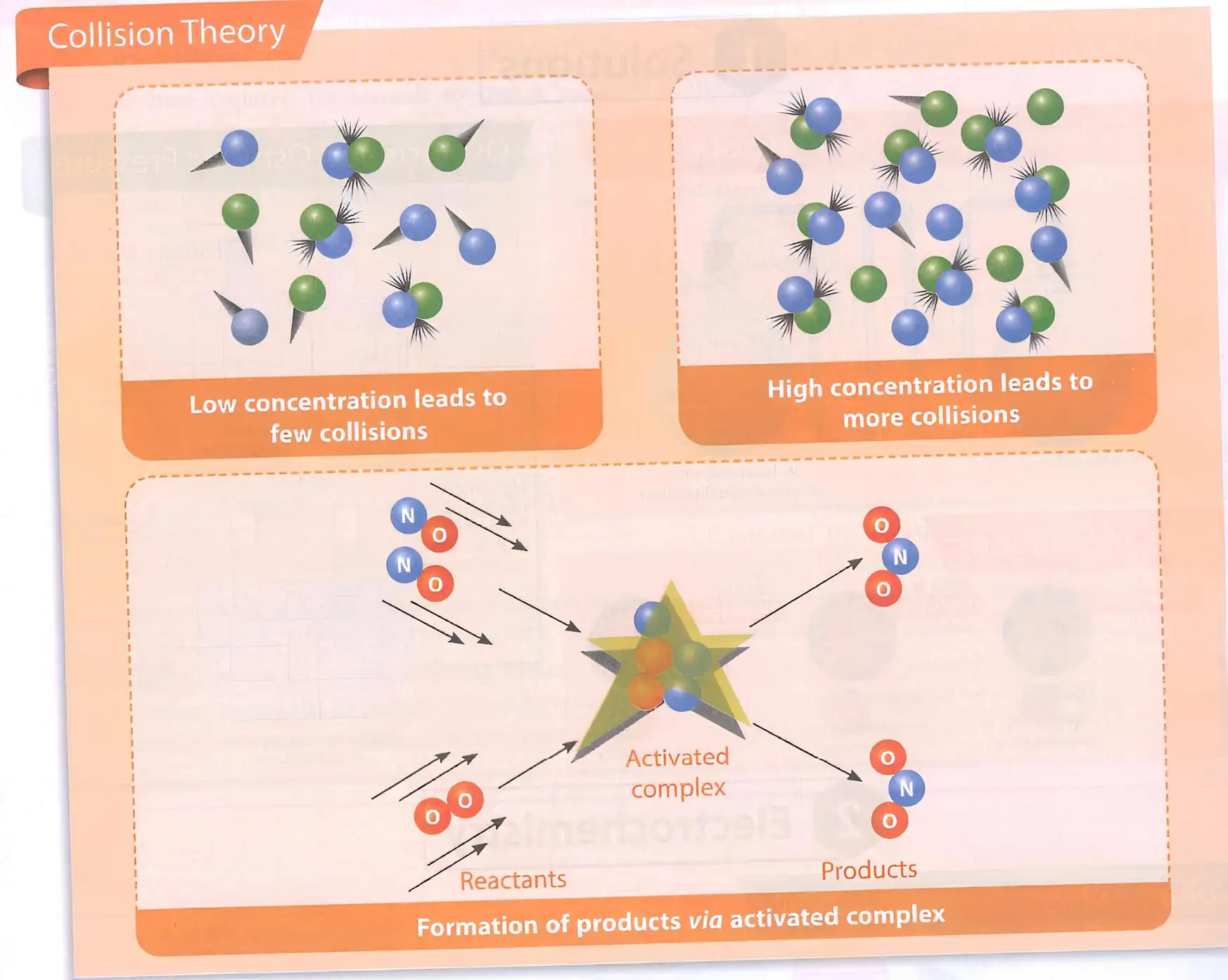
- Reaction occurs due to collision between reactant molecules (assumed as hard spheres).
- Not all collisions lead to reaction; only effective collisions do.
- Effective collisions require sufficient kinetic energy (threshold energy = activation energy + energy of reactants) and proper molecular orientation.
- Rate equation: Rate = PZABe-Ea/RT, where P = steric factor, ZAB = collision frequency.
- Activation energy and orientation determine reaction rate.
- Drawback: Ignores molecular structure, treats molecules as hard spheres.
Solved Examples
- Ex 1: Calculate rate if P = 0.5, ZAB = 1010 collisions/s, Ea = 50 kJ/mol, T = 300 K, R = 8.314 J/mol·K.
Solution: Rate = 0.5 × 10¹⁰ × e-(50000)/(8.314×300) = 0.5 × 10¹⁰ × e-20.04 ≈ negligible (very slow reaction).
Practice Set
- Q1: What is required for an effective collision?
- A. Any collision
- B. Collision with sufficient energy and proper orientation
- C. Collision with low energy
- D. Collision without orientation
- Q2: Which factor does NOT affect collision frequency?
- A. Concentration of reactants
- B. Temperature
- C. Molecular orientation
- D. Volume of reaction mixture
- Q3: Rate equation in collision theory includes:
- A. Activation energy and steric factor
- B. Only activation energy
- C. Only collision frequency
- D. None of these
Answer Key
- Q1: B - Effective collisions need sufficient energy and proper orientation.
- Q2: C - Molecular orientation affects effectiveness, not frequency.
- Q3: A - Rate = PZABe-Ea/RT includes activation energy and steric factor.
Memory Aids
- "Collision + Energy + Orientation = Reaction"
- Only collisions with energy ≥ activation energy and correct orientation produce products.
- Hard sphere model ignores molecular shape.
Explanation
- Reaction occurs due to collision between reactant molecules (assumed as hard spheres).
- Not all collisions lead to reaction; only effective collisions do.
- Effective collisions require sufficient kinetic energy (threshold energy = activation energy + energy of reactants) and proper molecular orientation.
- Rate equation: Rate = PZABe\u2212Ea/RT, where P = steric factor, ZAB = collision frequency.
- Activation energy and orientation determine reaction rate.
- Drawback: Ignores molecular structure, treats molecules as hard spheres.
Solved Examples
- Ex 1: Calculate rate if P = 0.5, ZAB = 1010 collisions/s, Ea = 50 kJ/mol, T = 300 K, R = 8.314 J/mol·K.
Solution: Rate = 0.5 × 10¹⁰ × e\u2212(50000)/(8.314×300) = 0.5 × 10¹⁰ × e\u221220.04 ≈ negligible (very slow reaction).
Practice Set
- Q1: What is required for an effective collision?
- A. Any collision
- B. Collision with sufficient energy and proper orientation
- C. Collision with low energy
- D. Collision without orientation
- Q2: Which factor does NOT affect collision frequency?
- A. Concentration of reactants
- B. Temperature
- C. Molecular orientation
- D. Volume of reaction mixture
- Q3: Rate equation in collision theory includes:
- A. Activation energy and steric factor
- B. Only activation energy
- C. Only collision frequency
- D. None of these
Answer Key
- Q1: B - Effective collisions need sufficient energy and proper orientation.
- Q2: C - Molecular orientation affects effectiveness, not frequency.
- Q3: A - Rate = PZABe\u2212Ea/RT includes activation energy and steric factor.
Memory Aids
- "Collision + Energy + Orientation = Reaction"
- Only collisions with energy ≥ activation energy and correct orientation produce products.
- Hard sphere model ignores molecular shape.
Reaction Order and Rate Constants
Explanation
- Zero order: k = ([A]0 - [A]) / t; half-life t1/2 = [A]0 / 2k.
- First order: k = (2.303 / t) log ([A]0 / [A]) = (2.303 / t) log (a / (a - x)).
- In terms of pressure: k = (2.303 / t) log (Pi / (2Pi - Pt)).
- Half-life for first order: t1/2 = 0.693 / k.
- Other times: t60% = 0.9166 / k, t75% = 1.386 / k, t90% = 2.303 / k, t99.9% = 6.93 / k.
- Time to reduce to nth fraction: t = (2.303 / k) log (a / (a / n)) = (2.303 / k) log n.
- Concentration after n half-lives: [A] = [A]0 / 2n.
- Order determination by half-life method: n = 1 + (log t1/21 - log t1/22) / (log a2 - log a1).
Solved Examples
- Ex 1: For a zero order reaction with [A]0 = 0.1 M, k = 0.02 M/s, find t1/2.
Solution: t1/2 = [A]0 / 2k = 0.1 / (2 × 0.02) = 2.5 s. - Ex 2: For a first order reaction, if k = 0.1 s-1, find t1/2.
Solution: t1/2 = 0.693 / k = 0.693 / 0.1 = 6.93 s.
Practice Set
- Q1: For a zero order reaction, half-life is:
- A. Independent of initial concentration
- B. Directly proportional to initial concentration
- C. Inversely proportional to initial concentration
- D. Equal to 0.693/k
- Q2: For a first order reaction, rate constant k is given by:
- A. k = (2.303 / t) log (a / (a - x))
- B. k = (a - x) / t
- C. k = (a + x) / t
- D. k = (2.303 / t) log (a + x)
- Q3: The half-life of a first order reaction is 10 min. What is the rate constant?
- A. 0.0693 min-1
- B. 0.693 min-1
- C. 6.93 min-1
- D. 0.00693 min-1
Answer Key
- Q1: B - Half-life for zero order is proportional to initial concentration.
- Q2: A - k = (2.303 / t) log (a / (a - x)) for first order.
- Q3: A - k = 0.693 / t1/2 = 0.693 / 10 = 0.0693 min-1.
Memory Aids
- Zero order: t1/2 [A]0, First order: t1/2 constant.
- First order k from log formula: k = (2.303 / t) log (a / (a - x)).
- Half-life formula: t1/2 = 0.693 / k for first order.
Explanation
- Zero order: k = ([A]0 - [A]) / t; half-life t1/2 = [A]0 / 2k.
- First order: k = (2.303 / t) log ([A]0 / [A]) = (2.303 / t) log (a / (a - x)).
- In terms of pressure: k = (2.303 / t) log (Pi / (2Pi - Pt)).
- Half-life for first order: t1/2 = 0.693 / k.
- Other times: t60% = 0.9166 / k, t75% = 1.386 / k, t90% = 2.303 / k, t99.9% = 6.93 / k.
- Time to reduce to nth fraction: t = (2.303 / k) log (a / (a / n)) = (2.303 / k) log n.
- Concentration after n half-lives: [A] = [A]0 / 2n.
- Order determination by half-life method: n = 1 + (log t1/21 - log t1/22) / (log a2 - log a1).
Solved Examples
- Ex 1: For a zero order reaction with [A]0 = 0.1 M, k = 0.02 M/s, find t1/2.
Solution: t1/2 = [A]0 / 2k = 0.1 / (2 × 0.02) = 2.5 s. - Ex 2: For a first order reaction, if k = 0.1 s−1, find t1/2.
Solution: t1/2 = 0.693 / k = 0.693 / 0.1 = 6.93 s.
Practice Set
- Q1: For a zero order reaction, half-life is:
- A. Independent of initial concentration
- B. Directly proportional to initial concentration
- C. Inversely proportional to initial concentration
- D. Equal to 0.693/k
- Q2: For a first order reaction, rate constant k is given by:
- A. k = (2.303 / t) log (a / (a - x))
- B. k = (a - x) / t
- C. k = (a + x) / t
- D. k = (2.303 / t) log (a + x)
- Q3: The half-life of a first order reaction is 10 min. What is the rate constant?
- A. 0.0693 min−1
- B. 0.693 min−1
- C. 6.93 min−1
- D. 0.00693 min−1
Answer Key
- Q1: B - Half-life for zero order is proportional to initial concentration.
- Q2: A - k = (2.303 / t) log (a / (a - x)) for first order.
- Q3: A - k = 0.693 / t1/2 = 0.693 / 10 = 0.0693 min−1.
Memory Aids
- Zero order: t1/2 [A]0, First order: t1/2 constant.
- First order k from log formula: k = (2.303 / t) log (a / (a - x)).
- Half-life formula: t1/2 = 0.693 / k for first order.
NEET Chemistry — ALL CHAPTERS
1
Some Basic Concepts of Chemistry
2
Structure of Atom
3
Classification of Elements and Periodicity in Properties
4
Chemical Bonding and Molecular Structure
5
Thermodynamics
6
Equilibrium
7
Redox Reactions
8
Organic Chemistry - Some Basic Principles and Techniques
9
Hydrocarbons
10
Solutions
11
Electrochemistry
12
Chemical Kinetics
13
The d- and f- Block Elements
14
Coordination Compounds
15
Haloalkanes and Haloarenes
16
Alcohols, Phenols and Ethers
17
Aldehydes, Ketones and Carboxylic Acids
18
Amines
19
Biomolecules
20
The p-Block Elements (Group 13 and 14)
21
The p-Block Elements (Group 15 to 18)
22
Principles Related to Practical Chemistry