NEET Ug . NEET Chemistry . Chemistry . Coordination Compounds
Chapter 14: Coordination Compounds
Ch 14
NEET Chemistry
NEET Ug
Introduction to Coordination Compounds
Key Characteristics
- Transition metals form complexes by coordinate bonds.
- Central metal atom linked to ions or neutral molecules via lone pair donation.
- Examples: Chlorophyll (Mg), Haemoglobin (Fe), Vitamin B12 (Co).
Solved Examples
- Ex 1: Identify the central metal in haemoglobin.
Answer: Iron (Fe).
Practice Set
- Q1: What type of bond links the central metal to ligands in coordination compounds?
A. Ionic bond
B. Covalent bond
C. Coordinate bond
D. Metallic bond - Q2: Which of the following is a coordination compound?
A. NaCl
B. Haemoglobin
C. H2O
D. CO2 - Q3: Which metal is central in vitamin B12?
A. Magnesium
B. Iron
C. Cobalt
D. Copper
Answer Key
- Q1: C - Coordinate bonds form by donation of lone pairs from ligands to metal.
- Q2: B - Haemoglobin is a coordination compound with iron as central metal.
- Q3: C - Cobalt is the central metal in vitamin B12.
Memory Aids
- Coordination compounds = Central metal + ligands via coordinate bonds.
- Remember: Chlorophyll (Mg), Haemoglobin (Fe), Vitamin B12 (Co).
Werners Theory of Coordination Compounds
Main Postulates
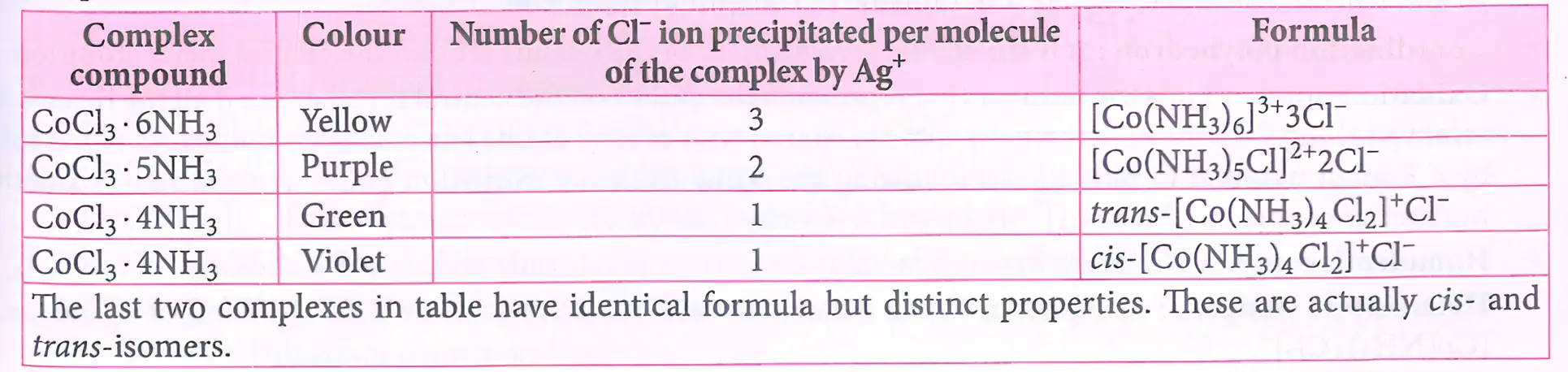
- Metals show two valencies: primary (ionisable) and secondary (non-ionisable).
- Primary valency = oxidation state, satisfied by negative ions, non-directional.
- Secondary valency = coordination number, satisfied by ligands, directional, defines geometry.
- Coordination entities are inside square brackets; ions outside are counter ions.
- Common geometries: octahedral, tetrahedral, square planar.
- Examples: [Co(NH3)6]3+ (octahedral), [Ni(CO)4] (tetrahedral), [PtCl4]2- (square planar).
Solved Examples
- Ex 1: Determine the coordination number of Co in [CoCl(NH3)5]2+.
Answer: 6 (octahedral geometry).
Practice Set
- Q1: What does the primary valency of a metal represent?
A. Coordination number
B. Oxidation state
C. Number of ligands
D. Number of counter ions - Q2: Which geometry is common for [Ni(CO)4] complex?
A. Octahedral
B. Tetrahedral
C. Square planar
D. Linear - Q3: In Werner’s theory, secondary valency corresponds to:
A. Ionisable valency
B. Coordination number
C. Oxidation state
D. Number of counter ions
Answer Key
- Q1: B - Primary valency = oxidation state of metal.
- Q2: B - [Ni(CO)4] has tetrahedral geometry.
- Q3: B - Secondary valency = coordination number, non-ionisable.
Memory Aids
- Primary valency = oxidation state (ionisable).
- Secondary valency = coordination number (defines geometry).
- Common shapes: Octahedral (6), Tetrahedral (4), Square planar (4).
Difference Between Double Salt and Complex
Key Differences
- Both formed by combination of stable compounds in fixed ratio.
- Double salts dissociate into ions in solution.
- Examples of double salts: Carnallite (KCl·MgCl2·6H2O), Mohr's salt (FeSO4·(NH4)2SO4·6H2O), Potash alum (KAl(SO4)2·12H2O).
- Complexes do not dissociate into ions easily; ligands remain bonded.
Solved Examples
- Ex 1: Identify if Mohr's salt is a double salt or complex.
Answer: Double salt (dissociates into ions).
Practice Set
- Q1: Which of the following is a double salt?
A. [Co(NH3)6]Cl3
B. KAl(SO4)2·12H2O
C. [Ni(CO)4]
D. [PtCl4]2- - Q2: Double salts in solution:
A. Do not dissociate
B. Dissociate into ions
C. Form coordinate bonds
D. Are covalent compounds - Q3: Which property distinguishes complexes from double salts?
A. Stoichiometric ratio
B. Dissociation into ions
C. Formation of coordinate bonds
D. Presence of metal
Answer Key
- Q1: B - KAl(SO4)2·12H2O is a double salt.
- Q2: B - Double salts dissociate into ions in solution.
- Q3: C - Complexes have coordinate bonds; double salts do not.
Memory Aids
- Double salts dissociate; complexes do not.
- Double salts: Mohr's salt, Carnallite, Potash alum.
- Complexes: Coordinate bonds, fixed geometry.
Coordination Entity/Coordination Sphere
Explanation
- Central metal atom/ion and ligands directly attached are enclosed in square brackets.
- Collectively called coordination sphere or coordination entity.
- Coordination sphere is non-ionisable.
Solved Examples
- In K4[Fe(CN)6], coordination sphere is [Fe(CN)6]4-.
Practice Set
- Q1: What is enclosed in the coordination sphere?
- A. Only ligands
- B. Only metal ion
- C. Metal ion and ligands
- D. Counter ions
- Q2: Which of the following is non-ionisable?
- A. Coordination sphere
- B. Counter ions
- C. Both
- D. None
- Q3: In K4[Fe(CN)6], what is the charge on coordination sphere?
- A. 4+
- B. 4-
- C. Neutral
- D. 2-
Answer Key
- Q1: C - Coordination sphere includes both metal ion and ligands.
- Q2: A - Coordination sphere is non-ionisable.
- Q3: B - Coordination sphere [Fe(CN)6]4- has 4- charge.
Memory Aids
- Coordination sphere = [Metal + Ligands]
- Non-ionisable part of complex
Counter Ions
Explanation
- Ionisable groups written outside the coordination sphere brackets.
- Balance the charge of coordination entity.
Solved Examples
- In K4[Fe(CN)6], counter ion is K+.
Practice Set
- Q1: Where are counter ions written in a coordination compound?
- A. Inside brackets
- B. Outside brackets
- C. Both inside and outside
- D. None
- Q2: What is the role of counter ions?
- A. Coordinate with metal
- B. Balance charge
- C. Donate electrons
- D. Form coordinate bonds
- Q3: In [Co(NH3)5Cl]Cl2, what are the counter ions?
- A. NH3
- B. Cl- outside brackets
- C. Co3+
- D. Cl inside brackets
Answer Key
- Q1: B - Counter ions are outside the brackets.
- Q2: B - They balance the charge of the complex.
- Q3: B - Cl- ions outside brackets are counter ions.
Memory Aids
- Counter ions = outside brackets, ionisable
- Balance complex charge
Central Metal Atom/Ion
Explanation
- Metal atom/ion bonded to ligands by coordinate bonds in definite geometry.
- Acts as Lewis acid (electron pair acceptor).
- Examples: Ni2+ in [NiCl2(H2O)4], Co3+ in [CoCl(NH3)5]2+, Fe3+ in [Fe(CN)6]3-.
Solved Examples
- Identify central metal ion in [Fe(CN)6]3-: Fe3+.
Practice Set
- Q1: What is the role of central metal ion?
- A. Electron donor
- B. Lewis acid
- C. Ligand
- D. Counter ion
- Q2: Which is central metal ion in [Co(NH3)6]3+?
- A. NH3
- B. Co3+
- C. Cl-
- D. H2O
- Q3: Central metal ion in [NiCl2(H2O)4] is?
- A. Ni2+
- B. Cl-
- C. H2O
- D. NH3
Answer Key
- Q1: B - Central metal ion acts as Lewis acid.
- Q2: B - Co3+ is central metal ion.
- Q3: A - Ni2+ is central metal ion.
Memory Aids
- Central metal = Lewis acid
- Coordinates ligands
Ligands
Explanation
- Molecules or ions donating lone pair to central metal via coordinate bond.
- Types based on donor atoms:
- Unidentate: single donor atom
- Didentate: two donor atoms
- Polydentate: several donor atoms
- Ambidentate: can coordinate through two different atoms
Solved Examples
- Unidentate ligands: Cl-, H2O, NH3
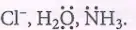
- Didentate ligands: Ethylenediamine (H2NCH2CH2NH2), Oxalate (C2O42-)

Practice Set
- Q1: What type of ligand is NH3?
- A. Unidentate
- B. Didentate
- C. Polydentate
- D. Ambidentate
- Q2: Which ligand binds through two donor atoms?
- A. Cl-
- B. Ethylenediamine
- C. H2O
- D. NO2-
- Q3: Ambidentate ligand example is?
- A. NH3
- B. NO2-
- C. EDTA4-
- D. C2O42-
Answer Key
- Q1: A - NH3 is unidentate ligand.
- Q2: B - Ethylenediamine is didentate ligand.
- Q3: B - NO2- is ambidentate ligand.
Memory Aids
- Unidentate = 1 donor atom
- Didentate = 2 donor atoms
- Ambidentate = 2 possible donor atoms, binds through one
Polydentate Ligand
Explanation
- Ligand binds through several donor atoms to metal ion.
- Example: EDTA4-.
Solved Examples
- EDTA4- binds through multiple donor atoms forming stable complexes.
Practice Set
- Q1: Polydentate ligand binds through how many donor atoms?
- A. One
- B. Two
- C. Several
- D. None
- Q2: Which is an example of polydentate ligand?
- A. NH3
- B. EDTA4-
- C. Cl-
- D. NO2-
- Q3: Polydentate ligands form complexes that are?
- A. Unstable
- B. Stable
- C. Neutral
- D. Ionised
Answer Key
- Q1: C - Polydentate ligands bind through several donor atoms.
- Q2: B - EDTA4- is polydentate ligand.
- Q3: B - Polydentate ligands form stable complexes.
Memory Aids
- Polydentate = many donor atoms
- EDTA = common polydentate ligand
Chelate Ligand
Explanation
- Didentate or polydentate ligand forming two or more coordinate bonds with metal.
- Forms 5 or 6 membered ring with metal ion.
Solved Examples
- Ethylene diamine forms chelate ring with metal ion.
Practice Set
- Q1: Chelate ligand forms how many coordinate bonds?
- A. One
- B. Two or more
- C. None
- D. Only one donor atom
- Q2: Chelate ring size is usually?
- A. 3 or 4 membered
- B. 5 or 6 membered
- C. 7 or 8 membered
- D. 2 membered
- Q3: Which ligand forms chelate complex?
- A. NH3
- B. EDTA4-
- C. Cl-
- D. NO2-
Answer Key
- Q1: B - Chelate ligands form two or more coordinate bonds.
- Q2: B - Chelate rings are 5 or 6 membered.
- Q3: B - EDTA4- forms chelate complexes.
Memory Aids
- Chelate = ring formation with metal
- 5 or 6 membered rings are most stable
Ambidentate Ligand
Explanation
- Unidentate ligand that can coordinate through two different atoms.
- Examples: NO2-, SCN-.
Solved Examples
- NO2- can bind through N or O atom.
Practice Set
- Q1: Ambidentate ligand binds through?
- A. One fixed atom
- B. Two different atoms alternatively
- C. Several atoms simultaneously
- D. None
- Q2: Which is an ambidentate ligand?
- A. NH3
- B. NO2-
- C. EDTA4-
- D. Cl-
- Q3: SCN- binds through?
- A. S atom
- B. N atom
- C. Both S or N
- D. O atom
Answer Key
- Q1: B - Ambidentate ligands can bind through two different atoms alternatively.
- Q2: B - NO2- is ambidentate ligand.
- Q3: C - SCN- can bind through S or N atom.
Memory Aids
- Ambidentate = two possible donor atoms
- Binding site depends on conditions
Coordination Number
Explanation
- Total number of coordinate bonds between central metal and ligands.
- Examples:
- [PtCl6]2- coordination number = 6
- [Ni(NH3)4]2+ coordination number = 4
- [Fe(C2O4)3]3- coordination number = 6 (oxalate is didentate)
- [Co(en)3]3+ coordination number = 6 (en = ethane-1,2-diamine, didentate)
Solved Examples
- Find coordination number of Ni in [Ni(NH3)4]2+: 4
Practice Set
- Q1: Coordination number is number of?
- A. Ligands
- B. Coordinate bonds
- C. Metal atoms
- D. Counter ions
- Q2: Coordination number of Fe in [Fe(C2O4)3]3- is?
- A. 3
- B. 6
- C. 4
- D. 2
- Q3: Coordination number of Pt in [PtCl6]2- is?
- A. 4
- B. 6
- C. 2
- D. 1
Answer Key
- Q1: B - Coordination number counts coordinate bonds.
- Q2: B - Oxalate is didentate, total 6 bonds.
- Q3: B - Pt has 6 coordinate bonds with Cl ligands.
Memory Aids
- Coordination number = total coordinate bonds
- Didentate ligands count twice
Coordination Polyhedron
Explanation
- Spatial arrangement of ligands around central metal ion.
- Determines geometry of complex.
Solved Examples
- Octahedral, tetrahedral, square planar are common coordination polyhedra.
Practice Set
- Q1: Coordination polyhedron describes?
- A. Ligand types
- B. Spatial arrangement of ligands
- C. Metal ion charge
- D. Counter ions
- Q2: Which geometry is common for coordination number 6?
- A. Tetrahedral
- B. Octahedral
- C. Square planar
- D. Linear
- Q3: Coordination polyhedron affects?
- A. Stability
- B. Color
- C. Magnetic properties
- D. All of the above
Answer Key
- Q1: B - It describes spatial arrangement of ligands.
- Q2: B - Octahedral geometry is common for coordination number 6.
- Q3: D - Geometry affects stability, color, magnetism.
Memory Aids
- Octahedral = 6 ligands
- Tetrahedral = 4 ligands
- Square planar = 4 ligands, different geometry
Oxidation Number
Explanation
- Charge on central metal if ligands removed with shared electron pairs.
- Represented by Roman numeral in parentheses after name.
- Example: Cu in [Cu(CN)4]3- is +1, written as Cu(I).
Solved Examples
- Oxidation number of Fe in [Fe(CN)6]3- is +3.
Practice Set
- Q1: Oxidation number represents?
- A. Total electrons in complex
- B. Charge on metal after ligand removal
- C. Number of ligands
- D. Number of counter ions
- Q2: Oxidation number of Cu in [Cu(CN)4]3- is?
- A. +1
- B. +2
- C. 0
- D. -1
- Q3: How is oxidation number represented?
- A. Arabic numeral
- B. Roman numeral in parentheses
- C. Chemical symbol
- D. Charge outside brackets
Answer Key
- Q1: B - Charge on metal after removing ligands.
- Q2: A - Cu is +1 in given complex.
- Q3: B - Roman numeral in parentheses.
Memory Aids
- Oxidation number = metal charge after ligand removal
- Use Roman numerals in names
Homoleptic Complex
Explanation
- Metal ion bound to only one kind of ligand.
- Example: [Co(NH3)6]3+.
Solved Examples
- [Co(NH3)6]3+ is homoleptic complex.
Practice Set
- Q1: Homoleptic complex has how many ligand types?
- A. One
- B. Two
- C. More than two
- D. None
- Q2: Which is homoleptic?
- A. [Co(NH3)6]3+
- B. [Co(NH3)4Cl2]+
- C. [Fe(CN)6]3-
- D. [Ni(H2O)6]2+
- Q3: Homoleptic complexes are generally?
- A. Mixed ligands
- B. Single ligand type
- C. Unstable
- D. Ionised
Answer Key
- Q1: A - Only one ligand type.
- Q2: A - [Co(NH3)6]3+ has only NH3 ligands.
- Q3: B - Homoleptic means single ligand type.
Memory Aids
- Homo = same ligands
- Single ligand type only
Heteroleptic Complex
Explanation
- Metal ion bound to more than one kind of ligand.
- Example: [Co(NH3)4Cl2]+.
Solved Examples
- [Co(NH3)4Cl2]+ is heteroleptic complex.
Practice Set
- Q1: Heteroleptic complex has how many ligand types?
- A. One
- B. More than one
- C. None
- D. Only metal ion
- Q2: Which is heteroleptic?
- A. [Co(NH3)6]3+
- B. [Co(NH3)4Cl2]+
- C. [Fe(CN)6]3-
- D. [Ni(H2O)6]2+
- Q3: Heteroleptic complexes are generally?
- A. Mixed ligands
- B. Single ligand type
- C. Unstable
- D. Ionised
Answer Key
- Q1: B - More than one ligand type.
- Q2: B - [Co(NH3)4Cl2]+ has NH3 and Cl ligands.
- Q3: A - Heteroleptic means mixed ligands.
Memory Aids
- Hetero = different ligands
- More than one ligand type
Effective Atomic Number Rule (EAN Rule)
Explanation
- EAN = Atomic number of metal - electrons lost + electrons gained from ligands.
- Used to predict stability of complexes.
- Examples following EAN: [Pd(NH3)6]4+, [Pt(NH3)6]4+, [Cu(CN)4]3-.
- Examples not following EAN but stable: [PdCl4]2-, [Ag(NH3)2]+, [Ni(CN)4]2-, [Ni(en)3]2+.
Solved Examples
- Calculate EAN for [Cu(CN)4]3-:
- Cu atomic no. = 29
- Electrons lost = +1 (Cu(I))
- Electrons from 4 CN ligands = 8
- EAN = 29 - 1 + 8 = 36
Practice Set
- Q1: EAN formula is?
- A. Atomic no. + electrons lost - electrons from ligands
- B. Atomic no. - electrons lost + electrons from ligands
- C. Atomic no. + electrons lost + electrons from ligands
- D. Atomic no. - electrons lost - electrons from ligands
- Q2: Which complex follows EAN rule?
- A. [PdCl4]2-
- B. [Pd(NH3)6]4+
- C. [Ag(NH3)2]+
- D. [Ni(en)3]2+
- Q3: EAN of [Cu(CN)4]3- is?
- A. 36
- B. 34
- C. 50
- D. 52
Answer Key
- Q1: B - EAN = Atomic no. - electrons lost + electrons from ligands.
- Q2: B - [Pd(NH3)6]4+ follows EAN.
- Q3: A - EAN calculated as 36.
Memory Aids
- EAN = Atomic no. - lost + gained electrons
- Stable complexes often follow EAN
Isomerism in Coordination Compounds
Types of Isomerism
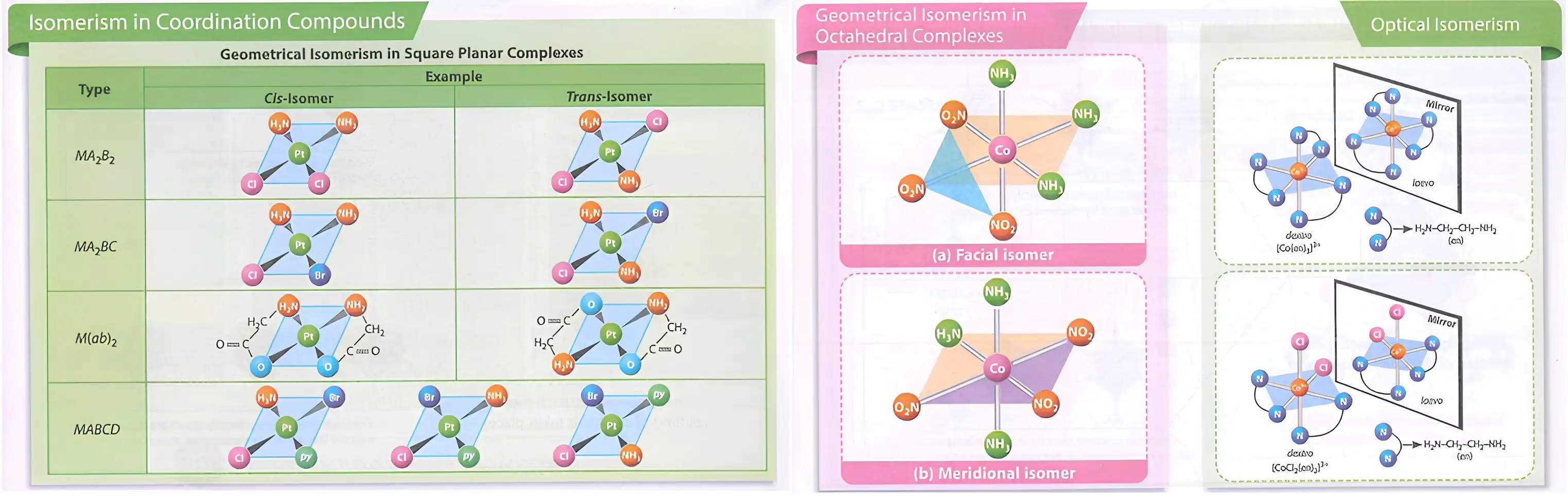
- Geometrical Isomerism: Different spatial arrangements of ligands around the metal center.
- Square Planar Complexes:
- Cis-isomer: Similar ligands adjacent.
- Trans-isomer: Similar ligands opposite. - Octahedral Complexes:
- Facial (fac) isomer: Three identical ligands on one face.
- Meridional (mer) isomer: Three identical ligands in a plane through the center. - Optical Isomerism: Non-superimposable mirror images (enantiomers) that rotate plane-polarized light differently.
Solved Examples
- Ex 1: Identify cis and trans isomers in [Pt(NH3)2Cl2] (square planar).
Step 1: Locate similar ligands.
Step 2: If adjacent, it is cis; if opposite, trans. - Ex 2: Distinguish fac and mer isomers in [Co(NH3)3Cl3] (octahedral).
Step 1: Check positions of three Cl ligands.
Step 2: If on one face, fac; if in a plane, mer.
Practice Set
- Q1: In a square planar complex, which arrangement corresponds to trans isomer?
A. Similar ligands adjacent
B. Similar ligands opposite
C. All ligands different
D. None of these - Q2: Which is true for facial (fac) isomer in octahedral complexes?
A. Three identical ligands in a plane
B. Three identical ligands on one face
C. Two ligands opposite
D. Mirror images - Q3: Optical isomers are:
A. Superimposable mirror images
B. Non-superimposable mirror images
C. Geometrical isomers
D. Ionisation isomers
Answer Key
- Q1: B - Trans isomer has similar ligands opposite each other.
- Q2: B - Fac isomer has three identical ligands on one face of octahedron.
- Q3: B - Optical isomers are non-superimposable mirror images.
Memory Aids
- "Cis" = "Side by side"; "Trans" = "Across"
- Facial = Face of octahedron; Meridional = Meridian plane
- Optical isomers = Like left and right hands
Classification of Isomerism
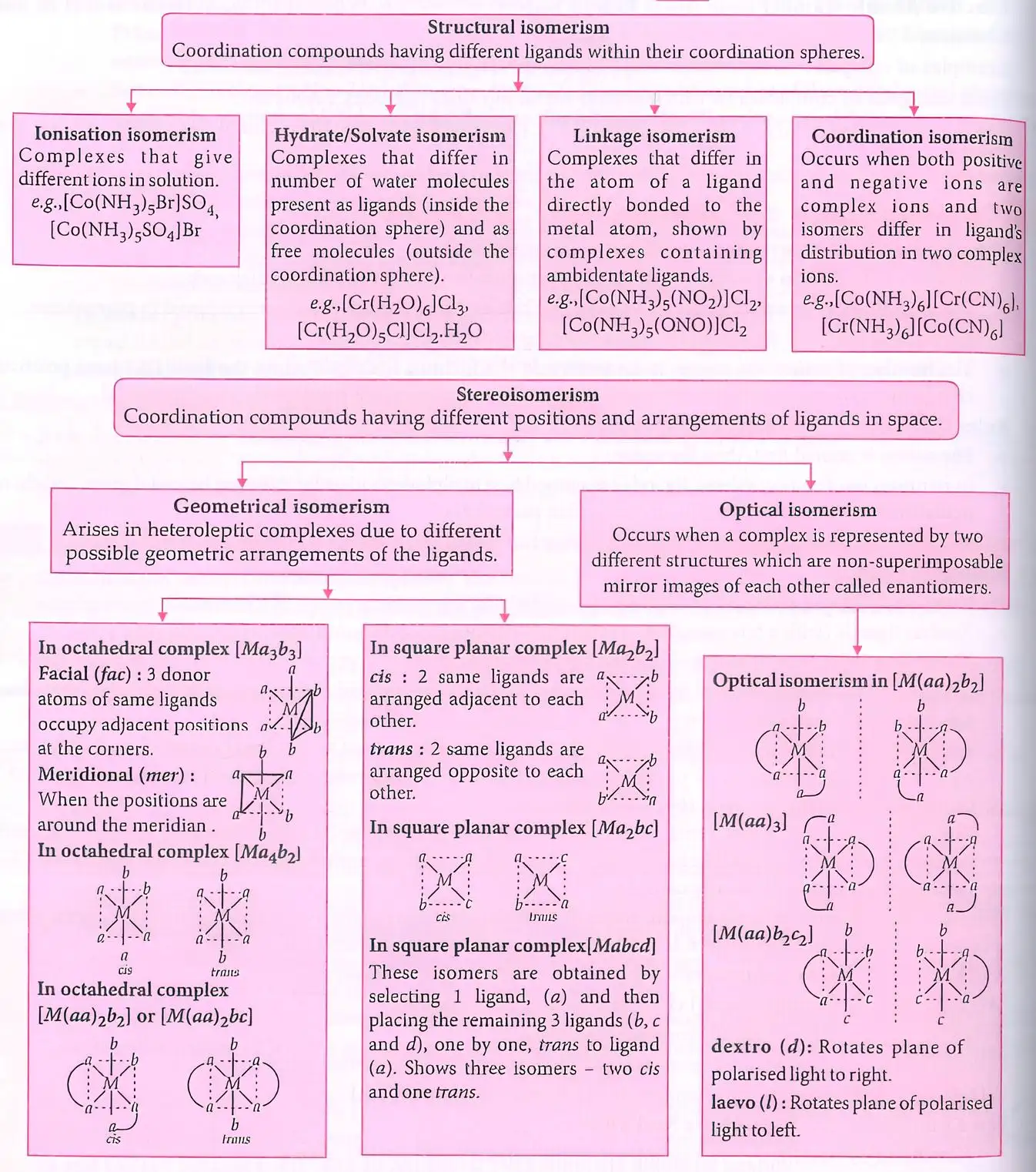
Structural Isomerism
- Different ligands or ions within coordination spheres.
- Ionisation Isomerism: Different ions released in solution.
- Hydrate/Solvate Isomerism: Variation in water molecules inside/outside coordination sphere.
- Linkage Isomerism: Ligands bind through different atoms (e.g., NO2- via N or O).
- Coordination Isomerism: Ligand exchange between cationic and anionic complexes.
Stereoisomerism
- Same ligands, different spatial arrangement.
- Geometrical Isomerism: Cis/trans arrangements in octahedral and square planar complexes.
- Optical Isomerism: Non-superimposable mirror images (enantiomers) rotating plane-polarized light differently.
Solved Examples
- Ex 1: Identify ionisation isomers in [Co(NH3)5Br]SO4 and [Co(NH3)5SO4]Br.
Step 1: Check ions released in solution.
Step 2: Different ions indicate ionisation isomers. - Ex 2: Determine linkage isomerism in [Co(NH3)5NO2]ClO4.
Step 1: Identify ligand binding atom (N or O).
Step 2: Different binding sites indicate linkage isomers.
Practice Set
- Q1: Which is an example of coordination isomerism?
A. [Co(NH3)6][Cr(CN)6]
B. [Co(NH3)5Br]SO4
C. Cis-[Pt(NH3)2Cl2]
D. Optical isomers - Q2: Hydrate isomerism differs in:
A. Number of ligands
B. Number of water molecules
C. Metal center
D. Charge on complex - Q3: Linkage isomerism occurs due to:
A. Different ligand atoms binding
B. Different ions released
C. Different spatial arrangement
D. Ligand exchange between ions
Answer Key
- Q1: A - Coordination isomerism involves ligand exchange between cation and anion complexes.
- Q2: B - Hydrate isomers differ in water molecules inside/outside coordination sphere.
- Q3: A - Linkage isomerism arises from ligands binding through different atoms.
Memory Aids
- Ionisation = Different ions in solution
- Hydrate = Water molecule variation
- Linkage = Ligand binds via different atoms
- Coordination = Ligand swap between ions
Optical and Geometrical Isomerism Details
Optical Isomerism
- Non-superimposable mirror images called enantiomers.
- Rotate plane-polarized light in opposite directions: Dextro (+) and Laevo (-).
- Optically inactive forms (meso, racemic, dl) do not rotate light due to internal or external compensation.
- Example: Octahedral complex [Pt(Py)(NH3)(NO2)(Cl)(Br)(I)] has 15 possible geometrical isomers; each has d and l optical forms, total 30 optically active isomers.
Geometrical Isomerism
- Different spatial arrangements of ligands in octahedral and square planar complexes.
- 15 theoretical geometrical isomers possible for octahedral complex with six different monodentate ligands.
- Only 3 geometrical isomers isolated experimentally for [Pt(Py)(NH3)(NO2)(Cl)(Br)(I)].
Solved Examples
- Ex 1: Calculate total optically active isomers for [Pt(Py)(NH3)(NO2)(Cl)(Br)(I)].
Step 1: 15 geometrical isomers.
Step 2: Each has d and l forms.
Step 3: Total = 15 × 2 = 30.
Practice Set
- Q1: Optical isomers are:
A. Superimposable mirror images
B. Non-superimposable mirror images
C. Geometrical isomers
D. Ionisation isomers - Q2: An optically inactive isomer is called:
A. Enantiomer
B. Meso form
C. D form
D. L form - Q3: How many geometrical isomers are theoretically possible for [Pt(Py)(NH3)(NO2)(Cl)(Br)(I)]?
A. 3
B. 6
C. 15
D. 30
Answer Key
- Q1: B - Optical isomers are non-superimposable mirror images.
- Q2: B - Meso form is optically inactive due to internal compensation.
- Q3: C - 15 geometrical isomers are theoretically possible.
Memory Aids
- Optical isomers = Left and right hands
- Meso = Optically inactive
- Geometrical = Cis/trans arrangements
Bonding in Metal Carbonyls
Overview
- Transition metal carbonyls are organometallic compounds with only CO ligands (homoleptic carbonyls).
- Metal-carbon bond has both sigma (σ) and pi (π) character.
- Bond formation involves sigma donation from CO to metal and pi back-donation from metal to CO (back bonding).
- Back bonding stabilizes the metal-ligand interaction (synergic effect).
Solved Examples
- Ex 1: Describe bonding in Fe(CO)5.
- CO donates lone pair to Fe forming σ bond.
- Fe d-orbitals back-donate electrons to CO π* orbitals forming π bond.
- Result: strong Fe–CO bond with synergic effect.
Practice Set
- Q1: What type of bonding is present in metal carbonyls?
- A) Only σ bonding
- B) Only π bonding
- C) Both σ and π bonding
- D) Ionic bonding
- Q2: Back bonding in metal carbonyls involves overlap of
- A) Metal d-orbitals with CO lone pair
- B) Metal d-orbitals with CO π* orbitals
- C) CO lone pair with metal s-orbitals
- D) Metal s-orbitals with CO π orbitals
- Q3: Synergic effect in metal carbonyls refers to
- A) Strengthening of metal-ligand bond by combined σ and π bonding
- B) Weakening of metal-ligand bond
- C) Only σ bonding effect
- D) Only π bonding effect
Answer Key
- Q1: C - Metal carbonyls have both σ and π bonding.
- Q2: B - Back bonding is metal d-orbitals overlapping with CO π* orbitals.
- Q3: A - Synergic effect is the combined strengthening by σ and π bonding.
Memory Aids
- Remember: CO donates electrons via σ bond; metal returns electrons via π back bonding.
- Synergic effect = mutual strengthening of bonds.
Examples of Metal Carbonyls
Mononuclear Carbonyls
- V(CO)5 - Pentacarbonylvanadium (0)
- Cr(CO)6 - Hexacarbonylchromium (0)
- Mo(CO)6 - Hexacarbonylmolybdenum (0)
- W(CO)6 - Hexacarbonyltungsten (0)
- Ni(CO)4 - Tetracarbonylnickel (0)
- Fe(CO)5 - Pentacarbonyliron (0)
Polynuclear Carbonyls
- Co2(CO)8 - Octacarbonyldicobalt (0)
- Co4(CO)12 - Dodecacarbonyltetracobalt (0)
- Mn2(CO)10 - Decacarbonyldimanganese (0)
Solved Examples
- Ex 1: Identify the formula of hexacarbonylchromium.
- Answer: Cr(CO)6
- Ex 2: Name Ni(CO)4.
- Answer: Tetracarbonylnickel (0)
Practice Set
- Q1: Which is a mononuclear carbonyl?
- A) Co2(CO)8
- B) Ni(CO)4
- C) Co4(CO)12
- D) Mn2(CO)10
- Q2: The formula of pentacarbonyliron is
- A) Fe(CO)4
- B) Fe(CO)5
- C) Fe(CO)6
- D) Fe2(CO)10
- Q3: Which polynuclear carbonyl has 12 CO ligands?
- A) Co2(CO)8
- B) Co4(CO)12
- C) Mn2(CO)10
- D) Ni(CO)4
Answer Key
- Q1: B - Ni(CO)4 is mononuclear.
- Q2: B - Pentacarbonyliron is Fe(CO)5.
- Q3: B - Co4(CO)12 has 12 CO ligands.
Memory Aids
- Mononuclear: Ni(CO)4, Fe(CO)5, Cr(CO)6
- Polynuclear: Co2(CO)8, Co4(CO)12, Mn2(CO)10
Structures of Metal Carbonyls
Common Structures
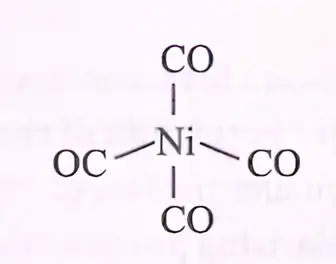
- Ni(CO)4: Tetrahedral geometry.
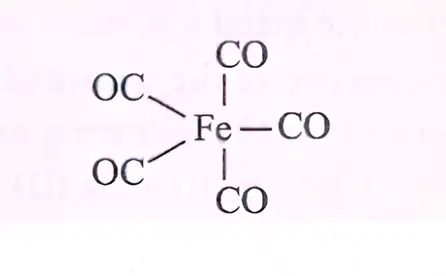
- Fe(CO)5: Trigonal bipyramidal geometry.
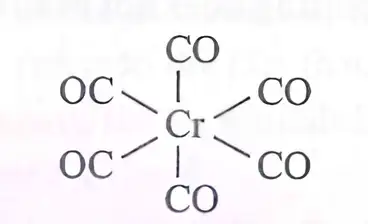
- Cr(CO)6: Octahedral geometry.
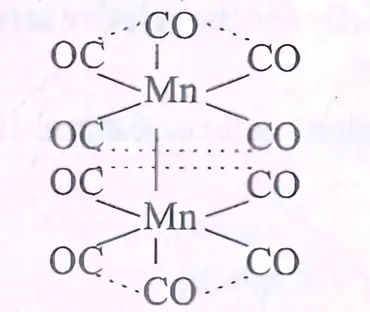
- Mn2(CO)10: Two square pyramidal units joined by Mn–Mn bond.
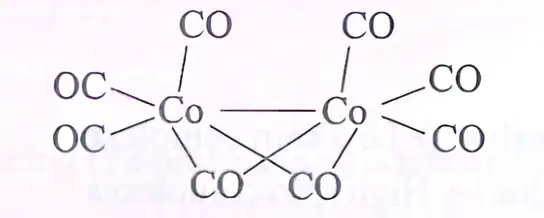
- Co2(CO)8: Co–Co bond bridged by two CO ligands.
Solved Examples
- Ex 1: Identify geometry of Ni(CO)4.
- Tetrahedral
- Ex 2: Describe bonding in Mn2(CO)10.
- Two Mn atoms bonded; each Mn bonded to 5 CO groups.
- Structure: two square pyramids joined by Mn–Mn bond.
Practice Set
- Q1: Geometry of Fe(CO)5 is
- A) Tetrahedral
- B) Square planar
- C) Trigonal bipyramidal
- D) Octahedral
- Q2: Mn2(CO)10 consists of
- A) Two octahedrons
- B) Two square pyramids joined by Mn–Mn bond
- C) One tetrahedron and one octahedron
- D) One square planar and one tetrahedron
- Q3: Co2(CO)8 has
- A) Co–Co bond bridged by two CO ligands
- B) No metal-metal bond
- C) Single Co atom
- D) Octahedral geometry
Answer Key
- Q1: C - Fe(CO)5 is trigonal bipyramidal.
- Q2: B - Mn2(CO)10 has two square pyramids joined by Mn–Mn bond.
- Q3: A - Co2(CO)8 has Co–Co bond bridged by two CO ligands.
Memory Aids
- Ni(CO)4 - Tetrahedral
- Fe(CO)5 - Trigonal bipyramidal
- Cr(CO)6 - Octahedral
- Mn2(CO)10 - Two square pyramids joined
- Co2(CO)8 - Metal-metal bond bridged by CO
Stability of Coordination Compounds
Factors Affecting Stability
- Stability refers to the degree of association in equilibrium: M + 4L ⇔ ML4
- Magnitude of equilibrium constant (K) expresses stability.
- Factors affecting stability:
- Charge on metal ion: Higher charge increases stability.
- Basic nature of ligand: Stronger base ligands increase stability.
- Chelate rings: Presence increases stability.
- Size of metal ion: Smaller size increases stability.
- Electronegativity and polarising power: Higher values increase stability.
Irving-Williams Order
- Stability order of divalent first-row transition metal ions:
- Mn(II) < Fe(II) < Co(II) < Ni(II) < Cu(II) > Zn(II)
Solved Examples
- Ex 1: Which metal ion forms the most stable complex?
- Answer: Cu(II) as per Irving-Williams order.
Practice Set
- Q1: Stability of coordination complex increases with
- A) Decreasing metal ion charge
- B) Increasing ligand basicity
- C) Larger metal ion size
- D) Decreasing polarising power
- Q2: Which factor does NOT increase complex stability?
- A) Chelate ring formation
- B) Smaller metal ion size
- C) Lower metal ion charge
- D) Higher electronegativity of metal ion
- Q3: According to Irving-Williams order, which ion forms the least stable complex?
- A) Mn(II)
- B) Cu(II)
- C) Ni(II)
- D) Zn(II)
Answer Key
- Q1: B - Increasing ligand basicity increases stability.
- Q2: C - Lower metal ion charge decreases stability.
- Q3: A - Mn(II) forms the least stable complex.
Memory Aids
- Irving-Williams order mnemonic: "My Fe Co Ni Cu Zn" (increasing stability)
- Chelate rings always increase stability.
Importance and Applications of Coordination Compounds
Qualitative and quantitative analysis
- Dimethyl glyoxime (DMG) forms a coordination compound with Ni(II) used to detect nickel.
- Cobalt is detected using coordination compound with α-nitroso-β-naphthol.
- EDTA acts as a ligand for detection and estimation of many metal ions.
- Water hardness is estimated by titration with Na2EDTA; Ca2+ and Mg2+ form stable complexes with EDTA.
- Selective estimation of Ca2+ and Mg2+ is possible due to different stability constants.
Extraction of metals
- Many metals are extracted as coordination compounds from ores.
- Silver and gold are extracted as cyanide complexes: [Ag(CN)2]- and [Au(CN)2]-.
- Metals can be precipitated from solution by adding zinc.
Purification of metals
- Purification involves formation and decomposition of coordination compounds.
- Example: Impure Ni forms Ni(CO)4, which decomposes to give pure nickel.
In biological systems
- Chlorophyll: Mg-complex with macrocyclic porphyrin, responsible for photosynthesis.
- Haemoglobin: Fe-complex with macrocyclic porphyrin, carries oxygen in blood.
- Myoglobin: Stores oxygen and regulates respiration.
- Vitamin B-12 (cyanocobalamine): Cobalt complex essential for health.
- Enzymes like carboxypeptidase-A are Zn complexes with proteins.
Catalysts
- Organometallic compounds act as catalysts.
- Ziegler-Natta catalyst [TiCl4(C2H5)3Al] polymerizes alkenes at room temperature and pressure.
- Wilkinson's catalyst [RhCl(PPh3)3] catalyzes hydrogenation.
- Metal carbonyls serve as industrial catalysts.
- Electroplating with silver and gold is smoother from complexes [Ag(CN)2]- and [Au(CN)2]-.
- In black and white photography, hypo solution fixes film by forming [Ag(S2O3)2]3- complex.
Treatment of diseases
- Medicines often used as coordination compounds.
- Excess toxic metals removed by chelating agents like penicillamine and desferrioxime-B.
- EDTA treats lead poisoning.
- Cis-platin [PtCl2(NH3)2] used in cancer treatment.
Solved Examples
- Ex 1: Detection of Ni using DMG
- Mix sample with DMG solution.
- Formation of red precipitate confirms Ni presence.
- Ex 2: Estimation of water hardness
- Titrate water sample with Na2EDTA.
- Calculate Ca2+ and Mg2+ concentration from volume used.
- Ex 3: Purification of Ni
- Impure Ni reacts with CO to form Ni(CO)4 gas.
- Decompose Ni(CO)4 to get pure Ni metal.
Practice Set
- Q1: Which ligand is used to detect Ni(II)?
A. α-nitroso-β-naphthol
B. Dimethyl glyoxime
C. EDTA
D. Penicillamine - Q2: Which complex is used in the extraction of gold?
A. [Au(CN)2]-
B. Ni(CO)4
C. [RhCl(PPh3)3]
D. [Ag(S2O3)2]3- - Q3: Which coordination compound is used in cancer treatment?
A. EDTA
B. Cis-platin
C. Vitamin B-12
D. Ziegler-Natta catalyst
Answer Key
- Q1: B - Dimethyl glyoxime forms a red precipitate with Ni(II) for detection.
- Q2: A - Gold is extracted as the cyanide complex [Au(CN)2]-.
- Q3: B - Cis-platin [PtCl2(NH3)2] is used in cancer treatment.
Memory Aids
- DMG detects Ni by red precipitate formation.
- EDTA titration differentiates Ca2+ and Mg2+ by stability constants.
- Ni(CO)4 formation purifies nickel.
- Ziegler-Natta catalyst polymerizes alkenes at room temperature.
- Cis-platin is a platinum coordination compound used in chemotherapy.
NEET Chemistry — ALL CHAPTERS
1
Some Basic Concepts of Chemistry
2
Structure of Atom
3
Classification of Elements and Periodicity in Properties
4
Chemical Bonding and Molecular Structure
5
Thermodynamics
6
Equilibrium
7
Redox Reactions
8
Organic Chemistry - Some Basic Principles and Techniques
9
Hydrocarbons
10
Solutions
11
Electrochemistry
12
Chemical Kinetics
13
The d- and f- Block Elements
14
Coordination Compounds
15
Haloalkanes and Haloarenes
16
Alcohols, Phenols and Ethers
17
Aldehydes, Ketones and Carboxylic Acids
18
Amines
19
Biomolecules
20
The p-Block Elements (Group 13 and 14)
21
The p-Block Elements (Group 15 to 18)
22
Principles Related to Practical Chemistry