NEET Ug . NEET Chemistry . Chemistry . Some Basic Concepts of Chemistry
Chapter 1: Some Basic Concepts of Chemistry
Ch 1
NEET Chemistry
NEET Ug
Introduction
Definition and Scope
- Chemistry studies preparation, properties, structures, and reactions of substances.
- Focuses on composition, structure, properties, and interactions of matter.
- Atoms and molecules are the basic units studied.
- Known as the science of atoms and molecules.
Solved Examples
- Ex 1: Identify the basic units studied in chemistry.
Answer: Atoms and molecules.
Practice Set
- Q1: What is the primary focus of chemistry?
A. Study of living organisms
B. Study of atoms and molecules
C. Study of celestial bodies
D. Study of physical forces - Q2: Chemistry is also called the science of:
A. Cells and tissues
B. Atoms and molecules
C. Planets and stars
D. Energy and work - Q3: Which of the following is NOT a focus of chemistry?
A. Properties of substances
B. Reactions of substances
C. Structure of substances
D. Study of human anatomy
Answer Key
- Q1: B - Chemistry focuses on atoms and molecules, the basic units of matter.
- Q2: B - Chemistry is known as the science of atoms and molecules.
- Q3: D - Human anatomy is studied in biology, not chemistry.
Memory Aids
- Chemistry = Science of Atoms & Molecules (CAM).
- Focus on composition, structure, properties, and reactions.
Importance of Chemistry
Applications and Role
- Studies properties, structures, and changes of substances.
- Central to science; linked with other branches.
- Used in weather prediction, brain function, and computer operation.
- Essential in chemical industries: fertilizers, dyes, polymers, drugs, soaps, metals, alloys.
- Enables isolation and synthesis of lifesaving drugs (e.g., cisplatin, taxol, AZT).
- Develops safer alternatives to harmful refrigerants like CFCs.
Solved Examples
- Ex 1: Name a drug synthesized through chemistry used in cancer therapy.
Answer: Cisplatin or Taxol.
Practice Set
- Q1: Which branch of science studies changes in substances?
A. Physics
B. Chemistry
C. Biology
D. Astronomy - Q2: Which of the following is a product of chemical industry?
A. Fertilizers
B. Computers
C. Planets
D. Stars - Q3: Which drug is used to help AIDS patients?
A. Cisplatin
B. Taxol
C. AZT
D. Penicillin
Answer Key
- Q1: B - Chemistry studies properties and changes of substances.
- Q2: A - Fertilizers are produced by chemical industries.
- Q3: C - AZT is used for AIDS treatment.
Memory Aids
- Chemistry = Central science linking various fields.
- Remember drugs: Cisplatin (cancer), Taxol (cancer), AZT (AIDS).
- CFCs replaced by safer refrigerants to protect ozone.
Nature of Matter
Physical States of Matter
- Matter occupies space and has mass.
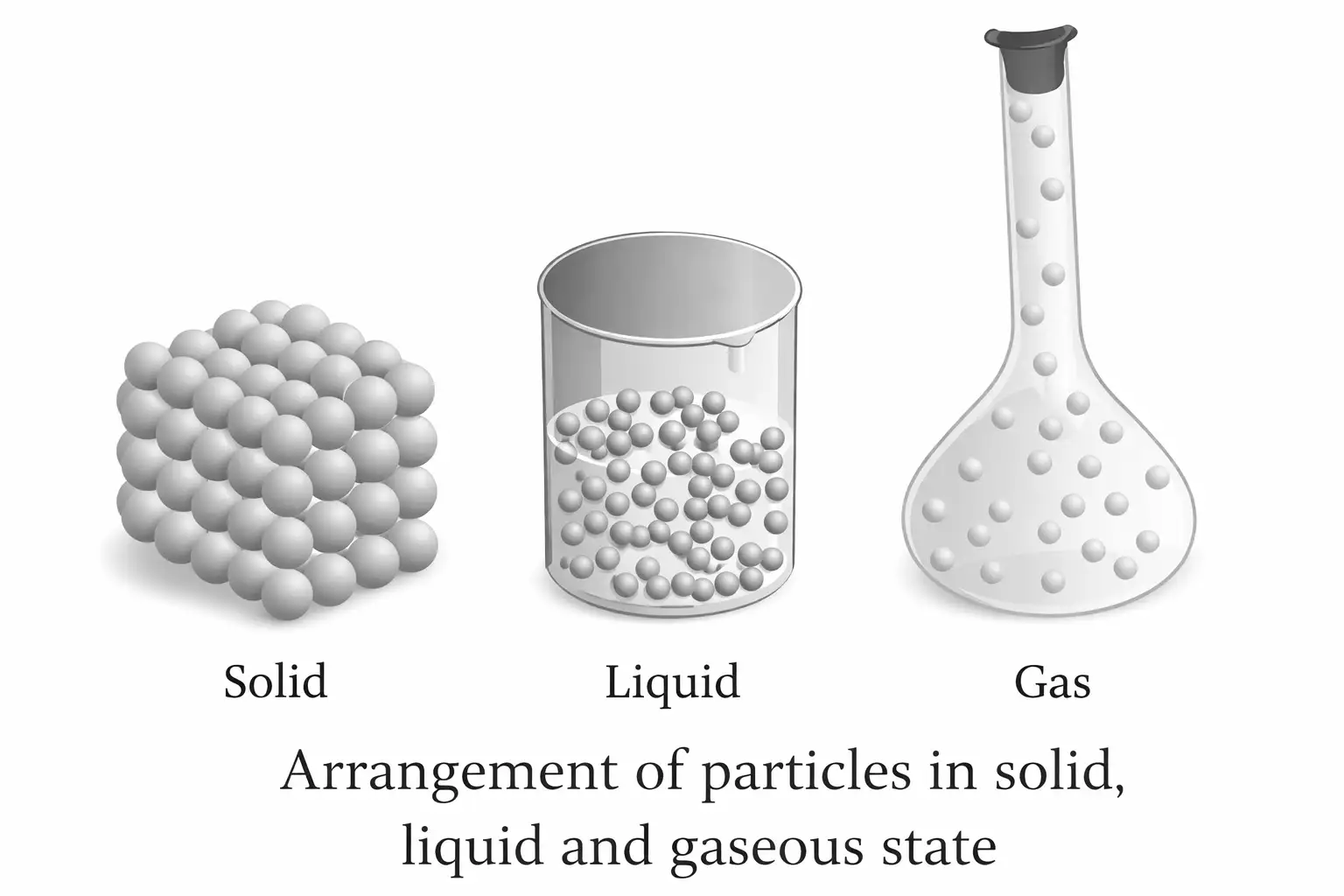
- Exists in three states: solid, liquid, gas.
- Solid: Particles tightly packed, strong forces, fixed positions, definite shape and volume.
- Liquid: Particles close but move freely, weak forces, definite volume, shape of container.
- Gas: Particles far apart, random motion, no definite shape or volume, fills container.
Interconversion of States
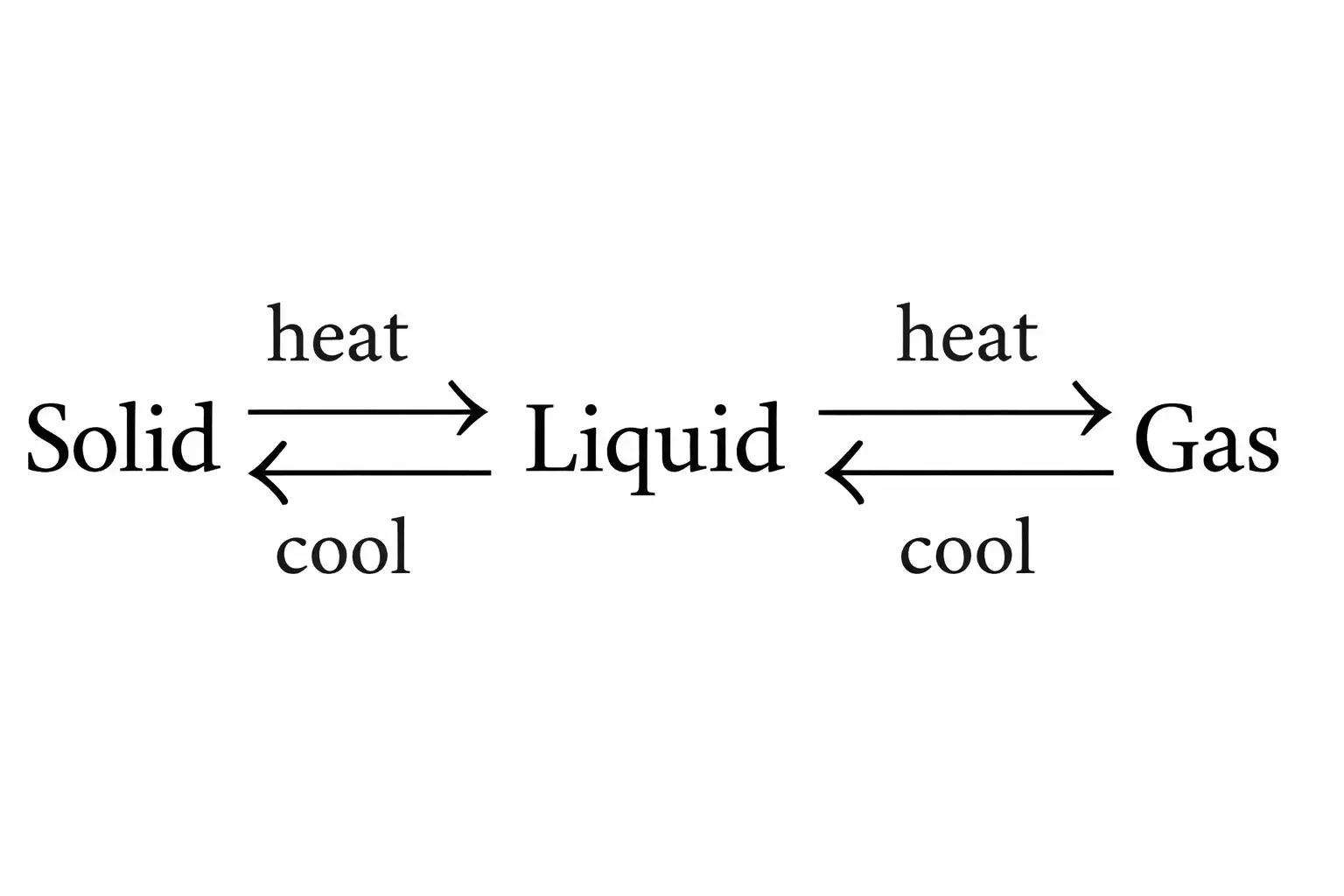
- States change by temperature and pressure.
- Heating solid → liquid (melting), liquid → gas (evaporation/boiling).
- Cooling gas → liquid (condensation), liquid → solid (freezing).
- Heating increases particle movement; cooling decreases it.
Classification of Matter
- Pure substances: Elements or compounds with fixed composition, e.g., Cu, Ag, Au, H2O, glucose.
- Cannot be separated by physical methods.
- Mixtures: Two or more substances, homogeneous or heterogeneous.
- Homogeneous mixture: Uniform composition and properties, e.g., sugar solution, air.
- Heterogeneous mixture: Physically distinct phases, non-uniform composition, e.g., salt and sugar mix.
Solved Examples
- Ex 1: Identify the state of matter: Particles are close, fixed shape and volume.
Answer: Solid. - Ex 2: What happens when a liquid is heated?
Answer: It evaporates or boils to form gas. - Ex 3: Classify air as pure substance or mixture.
Answer: Homogeneous mixture.
Practice Set
- Q1: Which state of matter has definite volume but no definite shape?
A. Solid
B. Liquid
C. Gas
D. Plasma - Q2: What process converts gas to liquid?
A. Melting
B. Freezing
C. Condensation
D. Evaporation - Q3: Which of the following is a heterogeneous mixture?
A. Air
B. Salt dissolved in water
C. Salt and sugar mixture
D. Pure water
Answer Key
- Q1: B - Liquids have definite volume but take the shape of the container.
- Q2: C - Condensation is gas to liquid transition.
- Q3: C - Salt and sugar mixture has distinct phases, non-uniform.
Memory Aids
- Solid = fixed shape and volume (S for Stiff).
- Liquid = definite volume, shape varies (L for Loose shape).
- Gas = no fixed shape or volume (G for Go everywhere).
- Heating: Solid → Liquid → Gas (S to L to G).
- Cooling: Gas → Liquid → Solid (reverse).
- Pure substances = fixed composition, no physical separation.
- Mixtures = physical combination, can be separated.
Properties of Matter
Physical Properties
- Characteristics observable without changing substance composition.
- Examples: state (solid, liquid, gas), colour, taste, odour, melting point, boiling point, density.
Chemical Properties
- Ability to form new substances via reactions or decomposition.
- Examples: acidity, basicity, combustibility.
Solved Examples
- Ex 1: Identify if melting point is a physical or chemical property.
Step 1: Melting point is observed without changing composition.
Step 2: Therefore, it is a physical property.
Practice Set
- Q1: Which of the following is a chemical property?
A. Density
B. Boiling point
C. Combustibility
D. Colour - Q2: Which property changes the substance's composition?
A. Physical property
B. Chemical property
C. Both
D. None - Q3: Which is NOT a physical property?
A. Taste
B. Odour
C. Acidity
D. Melting point
Answer Key
- Q1: C - Combustibility involves chemical change.
- Q2: B - Chemical property changes composition.
- Q3: C - Acidity is a chemical property.
Memory Aids
- Physical = observed without change.
- Chemical = involves new substances.
International System of Units
SI Units Basics
- Decimal system for mass, length, time, and other quantities.
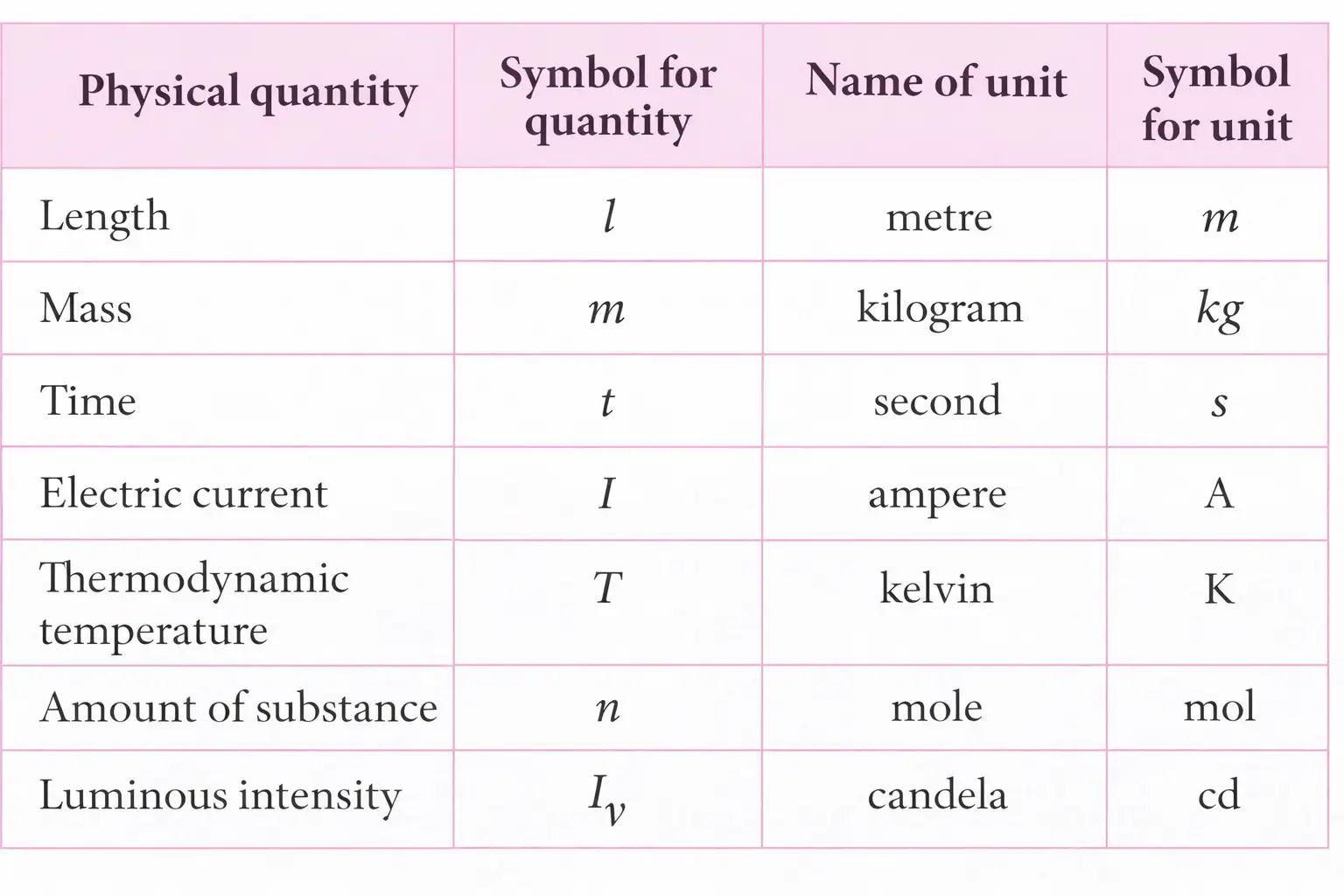
- Seven basic units: length (m), mass (kg), time (s), electric current (A), temperature (K), amount of substance (mol), luminous intensity (cd).
SI Prefixes
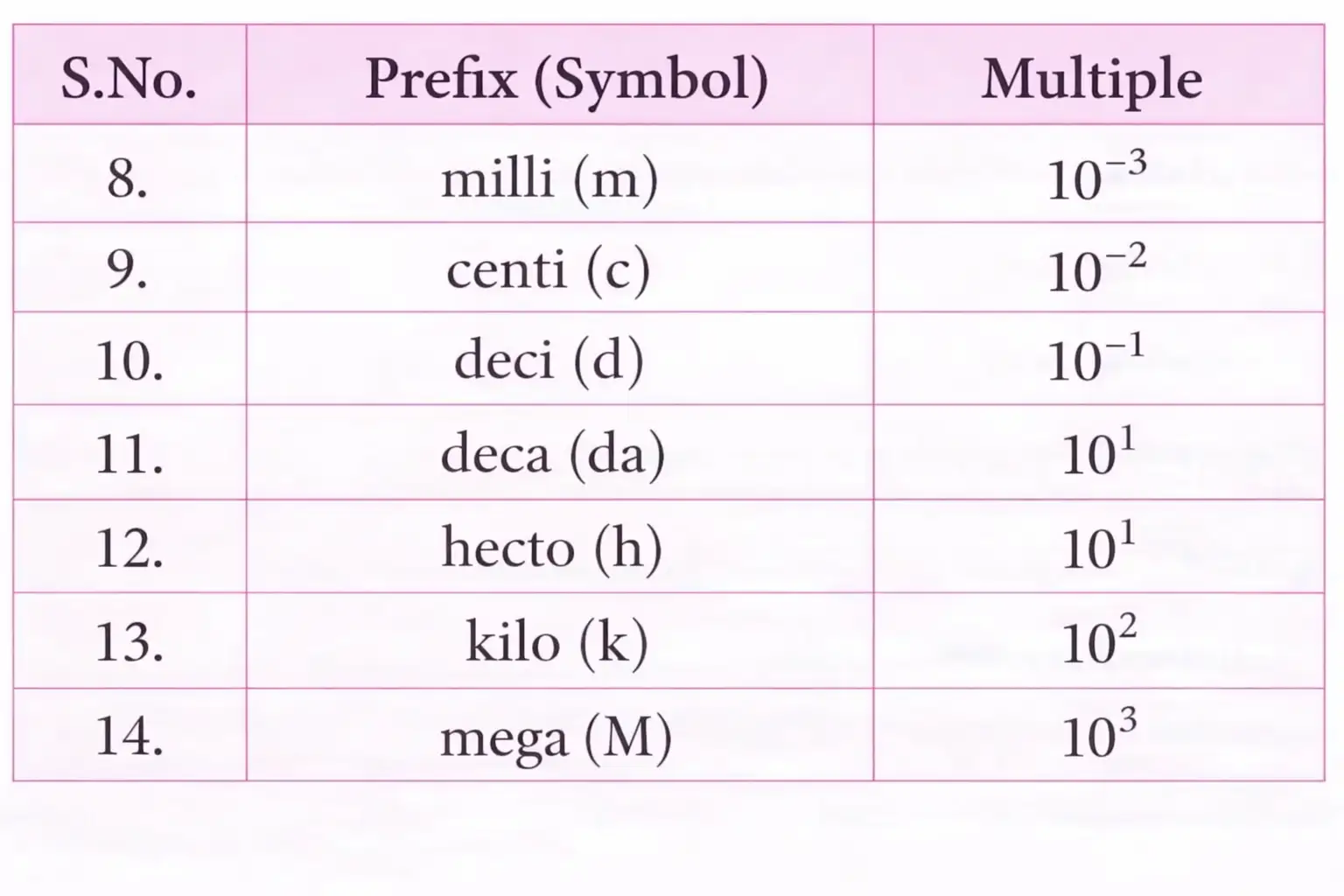
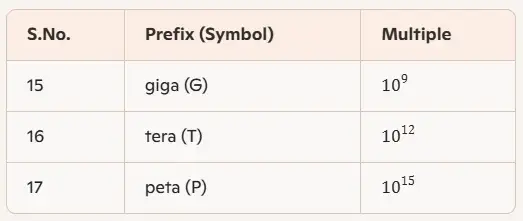
- Prefixes indicate multiples or submultiples of units.
- Small prefixes: yocto (y, 10-24), nano (n, 10-9), micro (µ, 10-6), etc.
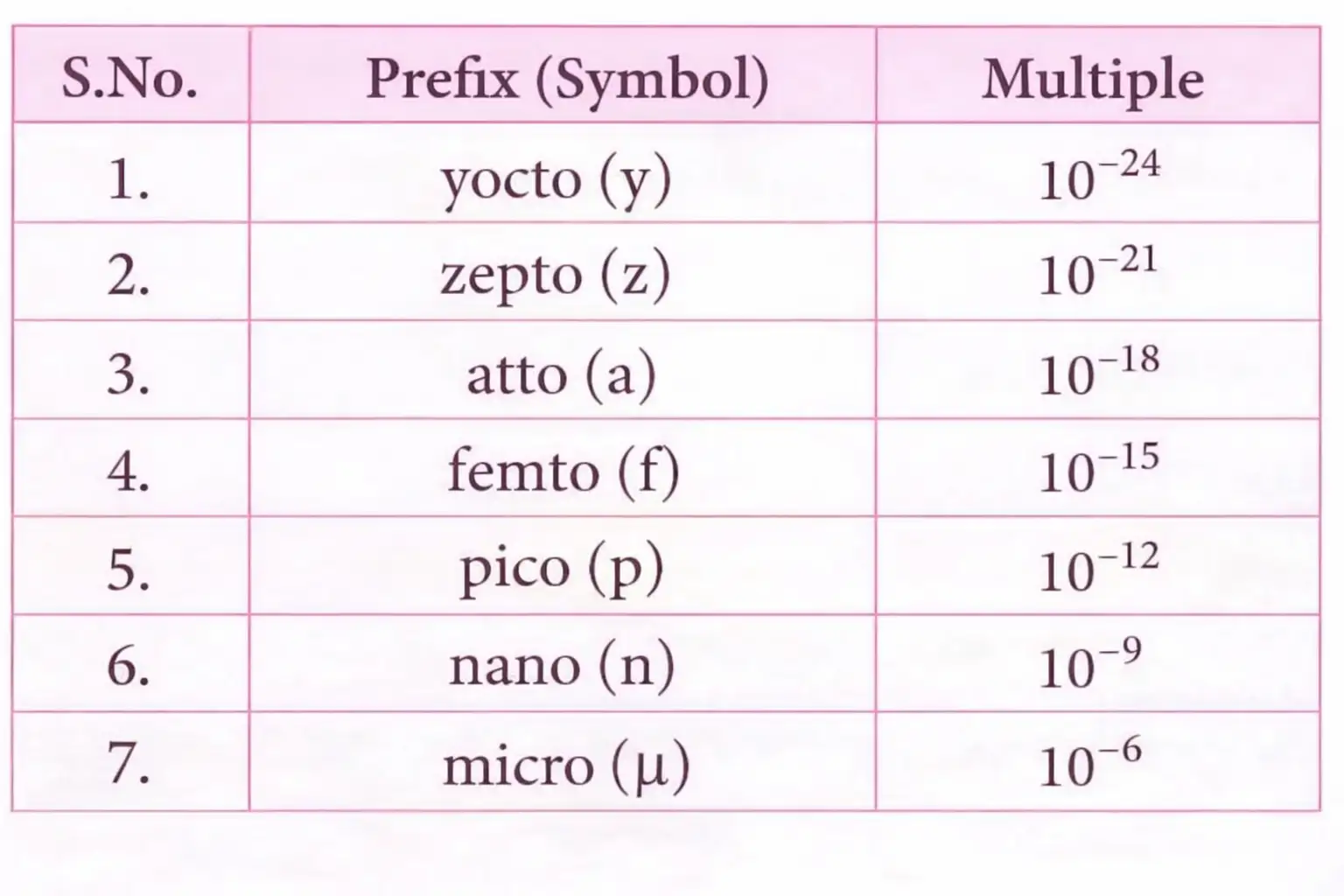
- Common prefixes: milli (m, 10-3), centi (c, 10-2), deci (d, 10-1), deca (da, 101), kilo (k, 103), mega (M, 106).
- Large prefixes: giga (G, 109), tera (T, 1012), peta (P, 1015).
Solved Examples
- Ex 1: Convert 5 km to meters.
Step 1: 1 km = 1000 m.
Step 2: 5 km = 5 × 1000 = 5000 m.
Practice Set
- Q1: What is the SI unit of mass?
A. Gram
B. Kilogram
C. Meter
D. Second - Q2: Which prefix means 10-3?
A. Centi
B. Milli
C. Kilo
D. Mega - Q3: Convert 3 megameters to meters.
A. 3 × 10³
B. 3 × 10⁶
C. 3 × 10⁹
D. 3 × 10¹²
Answer Key
- Q1: B - Kilogram is SI unit of mass.
- Q2: B - Milli means 10-3.
- Q3: B - Mega means 106, so 3 Mm = 3 × 10⁶ m.
Memory Aids
- Remember kilo = 103, milli = 10-3.
- Prefixes increase/decrease by powers of 10.
Mass and Weight
Mass
- Amount of matter in a substance.
- Measured by analytical balance.
- SI unit: kilogram (kg).
- Mass is constant everywhere.
Weight
- Force due to gravity on an object.
- Varies with location due to gravity changes.
Solved Examples
- Ex 1: Why does weight vary but mass remains constant?
Step 1: Weight depends on gravity force.
Step 2: Gravity varies by location.
Step 3: Mass is matter amount, constant everywhere.
Practice Set
- Q1: What is the SI unit of mass?
A. Newton
B. Kilogram
C. Gram
D. Pound - Q2: Weight depends on
A. Mass only
B. Gravity only
C. Both mass and gravity
D. Volume - Q3: Which is constant everywhere?
A. Weight
B. Mass
C. Volume
D. Density
Answer Key
- Q1: B - Kilogram is SI unit of mass.
- Q2: C - Weight = mass × gravity.
- Q3: B - Mass is constant; weight varies.
Memory Aids
- Mass = matter amount, constant.
- Weight = force, varies with gravity.
Volume and Density
Volume
- Space occupied by a substance.
- SI unit: cubic meter (m3).
- Common lab units: cm3, dm3, litre (L).
- Conversions: 1 L = 1000 mL; 1000 cm3 = 1 dm3.
Density
- Mass per unit volume.
- SI unit: kg m-3, commonly g cm-3.
Solved Examples
- Ex 1: Calculate density if mass = 200 g and volume = 100 cm3.
Step 1: Density = mass/volume = 200/100 = 2 g cm-3.
Practice Set
- Q1: What is the SI unit of volume?
A. m3
B. Litre
C. cm3
D. dm3 - Q2: Density is mass per
A. Length
B. Volume
C. Area
D. Time - Q3: If mass = 500 g and volume = 250 cm3, density is
A. 0.5 g cm-3
B. 2 g cm-3
C. 125 g cm-3
D. 750 g cm-3
Answer Key
- Q1: A - SI unit of volume is cubic meter (m3).
- Q2: B - Density = mass/volume.
- Q3: B - Density = 500/250 = 2 g cm-3.
Memory Aids
- Density = mass ÷ volume.
- Volume units: m3, cm3, dm3, L.
Temperature Measurement
Temperature Units
- SI unit: Kelvin (K).
- Also used: degree Celsius (°C), degree Fahrenheit (°F).
- Conversions: °F = (9/5)(°C) + 32; K = °C + 273.15.
Solved Examples
- Ex 1: Convert 25 °C to Kelvin.
Step 1: K = 25 + 273.15 = 298.15 K.
Practice Set
- Q1: What is the SI unit of temperature?
A. °C
B. °F
C. Kelvin
D. Rankine - Q2: Convert 0 °C to °F.
A. 32 °F
B. 0 °F
C. 100 °F
D. -32 °F - Q3: Convert 100 °F to °C.
A. 37.78 °C
B. 212 °C
C. 0 °C
D. 50 °C
Answer Key
- Q1: C - Kelvin is SI unit of temperature.
- Q2: A - °F = 9/5(°C) + 32; for 0 °C, °F = 32.
- Q3: A - °C = (°F - 32) × 5/9 = 37.78 °C.
Memory Aids
- Kelvin = Celsius + 273.15.
- Fahrenheit to Celsius: subtract 32, multiply by 5/9.
Temperature Units
- SI unit: Kelvin (K).
- Also used: degree Celsius (°C), degree Fahrenheit (°F).
- Conversions: °F = \( \frac{9}{5} \)(°C) + 32; K = °C + 273.15.
Solved Examples
- Ex 1: Convert 25 °C to Kelvin.
Step 1: K = 25 + 273.15 = 298.15 K.
Practice Set
- Q1: What is the SI unit of temperature?
A. °C
B. °F
C. Kelvin
D. Rankine - Q2: Convert 0 °C to °F.
A. 32 °F
B. 0 °F
C. 100 °F
D. -32 °F - Q3: Convert 100 °F to °C.
A. 37.78 °C
B. 212 °C
C. 0 °C
D. 50 °C
Answer Key
- Q1: C - Kelvin is SI unit of temperature.
- Q2: A - °F = 9/5(°C) + 32; for 0 °C, °F = 32.
- Q3: A - °C = (°F - 32) × 5/9 = 37.78 °C.
Memory Aids
- Kelvin = Celsius + 273.15.
- Fahrenheit to Celsius: subtract 32, multiply by 5/9.
Uncertainty in Measurement
Scientific Notation
- Express numbers as N × 10n, where 1 ≤ N < 10 and n is an integer.
- Example: 0.0000298 = 2.98 × 10⁻⁵, 130596 = 1.30596 × 10⁵.
- Multiplication: (N1 × 10n1) × (N2 × 10n2) = (N1 × N2) × 10n1+n2.
- Division: (N1 × 10n1) / (N2 × 10n2) = (N1 / N2) × 10n1-n2.
- Addition/Subtraction: Convert to same exponent, then add/subtract mantissas.
Precision and Accuracy
- Precision: Closeness of repeated measurements.
- Accuracy: Closeness to true value.
- Uncertainty shown by significant figures.
Significant Figures
- All non-zero digits are significant.
- Zeros between non-zero digits or after non-zero digits (right of decimal) are significant.
- Leading zeros are not significant.
- Exact numbers have infinite significant figures.
- Result cannot have more decimal digits than original numbers in addition/subtraction.
Rounding Rules
- Addition/Subtraction: Round to least decimal places.
- Multiplication/Division: Round to least significant figures.
- If digit to remove > 5, increase preceding digit by 1.
- If digit to remove < 5, leave preceding digit.
- If digit to remove = 5, round up if preceding digit is odd, else leave it.
Dimensional Analysis
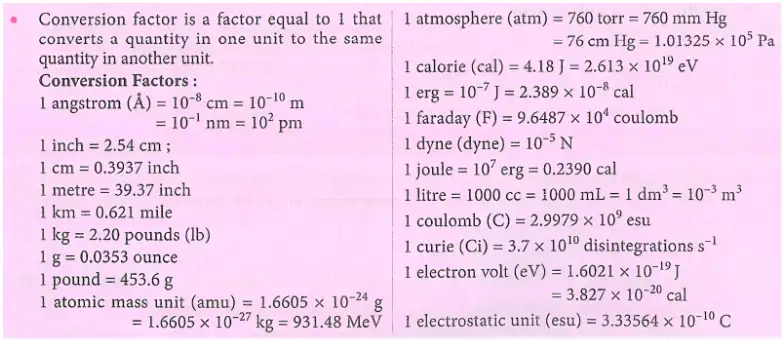
- Convert quantities using fundamental units.
- Use factor label or unit factor method.
- Example: 1 inch = 2.54 cm, so 1 inch / 2.54 cm = 1.
- Unit conversion factors equal 1 and convert units without changing quantity.
- Quantity required = Quantity given × Conversion factor.
Solved Examples
- Ex 1: Multiply (5.6 × 10⁵) and (6.9 × 10⁸)
- Multiply mantissas: 5.6 × 6.9 = 38.64
- Add exponents: 5 + 8 = 13
- Result: 38.64 × 1013 = 3.864 × 10¹⁴
- Ex 2: Add 6.65 × 10⁴ and 8.95 × 10³
- Convert 8.95 × 10³ to 0.895 × 10⁴
- Add mantissas: 6.65 + 0.895 = 7.545
- Result: 7.545 × 10⁴
- Ex 3: Subtract 4.8 × 10⁻³ from 2.5 × 10⁻²
- Convert 4.8 × 10⁻³ to 0.48 × 10⁻²
- Subtract mantissas: 2.5 - 0.48 = 2.02
- Result: 2.02 × 10⁻²
Practice Set
- Q1: What is the product of (3.2 × 10⁴) and (2.5 × 10³)?
- A) 8.0 × 10⁷
- B) 5.7 × 10⁷
- C) 8.0 × 10⁶
- D) 5.7 × 10⁶
- Q2: Add 4.5 × 10² and 3.2 × 10³ using scientific notation.
- A) 3.65 × 10³
- B) 7.7 × 10³
- C) 3.65 × 10²
- D) 7.7 × 10²
- Q3: Which rule applies when rounding off 2.345 to 2 significant figures?
- A) Increase preceding digit if digit to remove is 5 and preceding digit is odd
- B) Do not change preceding digit if digit to remove is 5 and preceding digit is even
- C) Both A and B depending on preceding digit
- D) Always round up
Answer Key
- Q1: A) 8.0 × 10⁷ - Multiply mantissas (3.2 × 2.5 = 8.0) and add exponents (4 + 3 = 7).
- Q2: A) 3.65 × 10³ - Convert 4.5 × 10² to 0.45 × 10³, then add mantissas (0.45 + 3.2 = 3.65).
- Q3: C) Both A and B depending on preceding digit - Rounding depends on whether preceding digit is odd or even when digit to remove is 5.
Memory Aids
- Scientific notation: Multiply/divide mantissas, add/subtract exponents.
- Significant figures: Non-zero digits always count; leading zeros do not.
- Rounding 5: Round up if preceding digit odd, else keep same.
- Dimensional analysis: Use conversion factor = 1 to switch units.
Scientific Notation
- Express numbers as N × 10n, where 1 ≤ N < 10 and n is an integer.
- Example: 0.0000298 = 2.98 × 10⁻⁵, 130596 = 1.30596 × 10⁵.
- Multiplication: (N1 × 10n1) × (N2 × 10n2) = (N1 × N2) × 10n1+n2.
- Division: (N1 × 10n1) / (N2 × 10n2) = (N1 / N2) × 10n1-n2.
- Addition/Subtraction: Convert to same exponent, then add/subtract mantissas.
Precision and Accuracy
- Precision: Closeness of repeated measurements.
- Accuracy: Closeness to true value.
- Uncertainty shown by significant figures.
Significant Figures
- All non-zero digits are significant.
- Zeros between non-zero digits or after non-zero digits (right of decimal) are significant.
- Leading zeros are not significant.
- Exact numbers have infinite significant figures.
- Result cannot have more decimal digits than original numbers in addition/subtraction.
Rounding Rules
- Addition/Subtraction: Round to least decimal places.
- Multiplication/Division: Round to least significant figures.
- If digit to remove > 5, increase preceding digit by 1.
- If digit to remove < 5, leave preceding digit.
- If digit to remove = 5, round up if preceding digit is odd, else leave it.
Dimensional Analysis
- Convert quantities using fundamental units.
- Use factor label or unit factor method.
- Example: 1 inch = 2.54 cm, so 1 inch / 2.54 cm = 1.
- Unit conversion factors equal 1 and convert units without changing quantity.
- Quantity required = Quantity given × Conversion factor.
Solved Examples
- Ex 1: Multiply (5.6 × 10⁵) and (6.9 × 10⁸)
- Multiply mantissas: 5.6 × 6.9 = 38.64
- Add exponents: 5 + 8 = 13
- Result: 38.64 × 1013 = 3.864 × 10¹⁴
- Ex 2: Add 6.65 × 10⁴ and 8.95 × 10³
- Convert 8.95 × 10³ to 0.895 × 10⁴
- Add mantissas: 6.65 + 0.895 = 7.545
- Result: 7.545 × 10⁴
- Ex 3: Subtract 4.8 × 10⁻³ from 2.5 × 10⁻²
- Convert 4.8 × 10⁻³ to 0.48 × 10⁻²
- Subtract mantissas: 2.5 - 0.48 = 2.02
- Result: 2.02 × 10⁻²
Practice Set
- Q1: What is the product of (3.2 × 10⁴) and (2.5 × 10³)?
- A) 8.0 × 10⁷
- B) 5.7 × 10⁷
- C) 8.0 × 10⁶
- D) 5.7 × 10⁶
- Q2: Add 4.5 × 10² and 3.2 × 10³ using scientific notation.
- A) 3.65 × 10³
- B) 7.7 × 10³
- C) 3.65 × 10²
- D) 7.7 × 10²
- Q3: Which rule applies when rounding off 2.345 to 2 significant figures?
- A) Increase preceding digit if digit to remove is 5 and preceding digit is odd
- B) Do not change preceding digit if digit to remove is 5 and preceding digit is even
- C) Both A and B depending on preceding digit
- D) Always round up
Answer Key
- Q1: A) 8.0 × 10⁷ - Multiply mantissas (3.2 × 2.5 = 8.0) and add exponents (4 + 3 = 7).
- Q2: A) 3.65 × 10³ - Convert 4.5 × 10² to 0.45 × 10³, then add mantissas (0.45 + 3.2 = 3.65).
- Q3: C) Both A and B depending on preceding digit - Rounding depends on whether preceding digit is odd or even when digit to remove is 5.
Memory Aids
- Scientific notation: Multiply/divide mantissas, add/subtract exponents.
- Significant figures: Non-zero digits always count; leading zeros do not.
- Rounding 5: Round up if preceding digit odd, else keep same.
- Dimensional analysis: Use conversion factor = 1 to switch units.
Law of Conservation of Mass
Explanation
- Matter cannot be created or destroyed in a chemical reaction.
- Total mass of reactants equals total mass of products.
- Mass remains constant during chemical changes.
Solved Examples
- Ex 1: If 10 g of reactant A reacts with 15 g of reactant B, total mass of products = 10 g + 15 g = 25 g.
Practice Set
- Q1: In a chemical reaction, the total mass of reactants is 20 g. What is the total mass of products?
- A. Less than 20 g
- B. Equal to 20 g
- C. More than 20 g
- D. Cannot be determined
- Q2: Which law states that mass is neither created nor destroyed?
- A. Law of definite proportions
- B. Law of conservation of mass
- C. Law of multiple proportions
- D. Avogadro's law
- Q3: If 5 g of hydrogen reacts with 40 g of oxygen, what is the mass of water formed?
- A. 35 g
- B. 45 g
- C. 50 g
- D. 55 g
Answer Key
- Q1: B - Mass remains constant; products mass equals reactants mass.
- Q2: B - Law of conservation of mass states mass is neither created nor destroyed.
- Q3: C - Total mass = 5 g + 40 g = 45 g water formed.
Memory Aids
- Mass in = Mass out
- Think of a closed system with no mass loss.
Law of Definite Proportions
Explanation
- Ratio of masses of elements in a compound is constant.
- Same compound always contains elements in fixed mass ratio.
- Also called Law of Definite Composition.
Solved Examples
- Ex 1: Water always contains hydrogen and oxygen in 1:8 mass ratio.
Practice Set
- Q1: What does the law of definite proportions state?
- A. Elements combine in simple ratios by volume
- B. Elements combine in fixed mass ratios in compounds
- C. Mass is conserved in reactions
- D. Equal volumes of gases have equal molecules
- Q2: If a compound contains 40% carbon and 60% oxygen by mass, what will be the ratio of masses?
- A. 2:3
- B. 3:2
- C. 1:1
- D. Variable
- Q3: Which law explains fixed composition of compounds?
- A. Law of multiple proportions
- B. Law of conservation of mass
- C. Law of definite proportions
- D. Gay Lussac’s law
Answer Key
- Q1: B - Fixed mass ratio in compounds is the law's essence.
- Q2: A - 40:60 simplifies to 2:3 fixed ratio.
- Q3: C - Law of definite proportions explains fixed composition.
Memory Aids
- Fixed mass ratio = definite proportions
- Think of pure water always H2O with same mass ratio
Law of Multiple Proportions
Explanation
- Two elements form more than one compound.
- Masses of one element combining with fixed mass of other are in small whole number ratios.
- Explains existence of multiple oxides, chlorides etc.
Solved Examples
- Ex 1: Carbon and oxygen form CO and CO2. Mass ratio of oxygen in CO2 to CO is 2:1.
Practice Set
- Q1: What does the law of multiple proportions state?
- A. Mass is conserved
- B. Elements combine in fixed mass ratios
- C. Mass ratios of elements in different compounds are simple whole numbers
- D. Equal volumes of gases have equal molecules
- Q2: If 1 g of element A combines with 2 g of element B in one compound, and 1 g of A combines with 4 g of B in another, what is the ratio?
- A. 1:2
- B. 2:1
- C. 1:1
- D. 3:2
- Q3: Which pair illustrates the law of multiple proportions?
- A. H2O and H2O2
- B. CO2 and O2
- C. NaCl and KCl
- D. NH3 and CH4
Answer Key
- Q1: C - Small whole number ratios in different compounds.
- Q2: A - 2 g : 4 g = 1:2 ratio.
- Q3: A - H2O and H2O2 differ by oxygen mass in simple ratio.
Memory Aids
- Multiple compounds = multiple ratios
- Think CO and CO2 oxygen ratio 1:2
Gay Lussac’s Law of Gaseous Volumes
Explanation
- Gases combine or form in simple volume ratios.
- Conditions: same temperature and pressure.
- Volume ratios are simple whole numbers.
Solved Examples
- Ex 1: 2 volumes of H2 react with 1 volume of O2 to form 2 volumes of H2O vapor.
Practice Set
- Q1: According to Gay Lussac, volume ratios of reacting gases are?
- A. Random
- B. Simple whole numbers
- C. Equal volumes
- D. Equal masses
- Q2: If 3 volumes of nitrogen react with 1 volume of hydrogen, what is the volume ratio?
- A. 3:1
- B. 1:3
- C. 2:1
- D. 1:1
- Q3: In reaction 2H2 + O2 → 2H2O, volume of H2 to O2 is?
- A. 1:1
- B. 2:1
- C. 1:2
- D. 3:2
Answer Key
- Q1: B - Volume ratios are simple whole numbers.
- Q2: A - Given volume ratio is 3:1.
- Q3: B - 2 volumes H2 react with 1 volume O2.
Memory Aids
- Volume ratios = simple whole numbers
- Think 2H2 + O2 → 2H2O
Avogadro Law
Explanation
- Equal volumes of gases at same temperature and pressure contain equal number of molecules.
- Volume proportional to number of molecules.
- Basis for molar volume concept (22.4 L at STP).
Solved Examples
- Ex 1: 22.4 L of any gas at STP contains 6.022 × 10²³ molecules.
Practice Set
- Q1: Avogadro's law states equal volumes of gases have?
- A. Equal masses
- B. Equal molecules
- C. Equal densities
- D. Equal pressures
- Q2: Volume of 1 mole gas at STP is?
- A. 11.2 L
- B. 22.4 L
- C. 44.8 L
- D. 1 L
- Q3: If 2 volumes of gas A and 3 volumes of gas B react, number of molecules ratio is?
- A. 2:3
- B. 3:2
- C. 1:1
- D. Cannot be determined
Answer Key
- Q1: B - Equal volumes have equal molecules.
- Q2: B - Molar volume at STP is 22.4 L.
- Q3: A - Molecules ratio equals volume ratio.
Memory Aids
- Equal volume = equal molecules
- Remember 22.4 L at STP for 1 mole gas
Law of Reciprocal Proportions
Explanation
- Two elements separately combine with fixed mass of third element.
- Ratio of their masses combining with third element is same or simple multiple of ratio in which they combine with each other.
- Helps in determining atomic weights and formulae.
Solved Examples
- Ex 1: If element A combines with 10 g of element C, and element B combines with 20 g of C, then ratio of masses A:B is 1:2 or simple multiple.
Practice Set
- Q1: What does the law of reciprocal proportions state?
- A. Mass is conserved
- B. Elements combine in fixed mass ratios
- C. Ratio of masses combining with third element is same or multiple of ratio combining with each other
- D. Equal volumes have equal molecules
- Q2: If A combines with 5 g of C and B combines with 10 g of C, ratio of A:B is?
- A. 1:2
- B. 2:1
- C. 1:1
- D. Cannot be determined
- Q3: Which law helps in determining atomic weights?
- A. Law of conservation of mass
- B. Law of definite proportions
- C. Law of reciprocal proportions
- D. Gay Lussac’s law
Answer Key
- Q1: C - Ratio of masses combining with third element relates to ratio combining with each other.
- Q2: A - Ratio is 5:10 = 1:2.
- Q3: C - Law of reciprocal proportions aids atomic weight determination.
Memory Aids
- Reciprocal = ratio relation with third element
- Think elements combining via a common element
Dalton's Atomic Theory
Main Points
- Matter is made of indivisible atoms.
- Atoms of the same element have identical properties and mass; atoms of different elements differ in mass.
- Compounds form when atoms of different elements combine in fixed ratios.
- Chemical reactions rearrange atoms; atoms are neither created nor destroyed.
- Explains laws of chemical combination but not gaseous volume laws or atomic combining reasons.
Solved Examples
- Ex 1: If element A has atoms of mass 10 u and element B has atoms of mass 20 u, are they the same element?
Answer: No, atoms differ in mass, so they are different elements. - Ex 2: Compound AB forms with atoms combining in 1:2 ratio. If 1 mole of A combines, how many moles of B combine?
Answer: 2 moles of B combine with 1 mole of A.
Practice Set
- Q1: According to Dalton’s theory, atoms are:
A) Divisible
B) Indivisible
C) Made of protons
D) Made of electrons - Q2: Atoms of the same element have:
A) Different masses
B) Identical properties
C) Different chemical behavior
D) Different atomic numbers - Q3: Which statement is NOT explained by Dalton’s theory?
A) Law of conservation of mass
B) Law of definite proportions
C) Law of gaseous volumes
D) Atoms combine in fixed ratios
Answer Key
- Q1: B - Dalton stated atoms are indivisible particles.
- Q2: B - Atoms of the same element have identical properties including mass.
- Q3: C - Dalton’s theory could not explain laws of gaseous volumes.
Memory Aids
- Atoms are "Indivisible" and "Identical" within an element.
- Compounds = fixed atom ratios.
- Atoms rearranged, not created/destroyed in reactions.
- Dalton explains chemical combination laws, not gas volume laws.
Atomic and Molecular Masses
Concepts
- Atomic mass (atomic weight) is the average relative mass of atoms compared to carbon-12 (12 u exactly).
- 1 unified mass unit (u) = 1.66056 × 10⁻²⁴ g; 1 u = 1/12 mass of carbon-12 atom.
- Average atomic mass is calculated using isotopic masses and their relative abundances.
- Formula: Average atomic mass = \((RA \times At. mass)_1 + (RA \times At. mass)_2 + ...\) / \(RA_1 + RA_2 + ...\), where RA = relative abundance.
- Example: Carbon isotopes 12C, 13C, 14C with given abundances and masses.
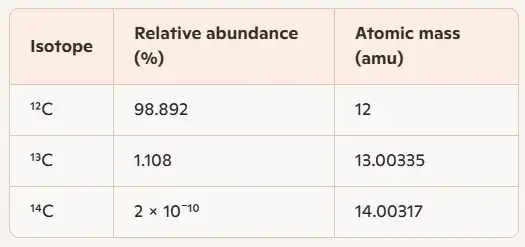
- Average atomic mass of carbon = (0.98892 × 12 u) + (0.01108 × 13.00335 u) + (2 × 10-12 × 14.00317 u) = 12.011 u.
- Molecular mass = sum of atomic masses of atoms in a molecule.
- Formula mass = sum of atomic masses in an ionic compound.
- Molecular mass formula: Molecular mass = Average mass of one molecule / (1/12) × Mass of carbon-12 atom.
- Useful relations:
- Atomic mass = Equivalent mass × Valency
- Atomic mass = Molecular mass / Atomicity
- Actual mass of one molecule = Molecular mass × 1.66 × 10⁻²⁴ g
- Atomic mass = 6.4 / Specific heat (cal)
- Molecular mass = 2 × Vapour density
Solved Examples
- Ex 1: Calculate average atomic mass of carbon given isotopes and abundances.
- Use formula: Average atomic mass = Σ (RA × atomic mass)
- Substitute: (0.98892 × 12) + (0.01108 × 13.00335) + (2 × 10-12 × 14.00317) = 12.011 u
- Ex 2: Find molecular mass of H2O.
- Atomic masses: H = 1 u, O = 16 u
- Molecular mass = 2 × 1 + 16 = 18 u
Practice Set
- Q1: What is the atomic mass unit (u) defined as?
- A. Mass of one proton
- B. One-twelfth the mass of carbon-12 atom
- C. Mass of one neutron
- D. Mass of one electron
- Q2: Which isotope of carbon is most abundant?
- A. Carbon-12
- B. Carbon-13
- C. Carbon-14
- D. Carbon-15
- Q3: Calculate molecular mass of CO2 given atomic masses: C = 12 u, O = 16 u.
- A. 28 u
- B. 44 u
- C. 32 u
- D. 16 u
Answer Key
- Q1: B - Atomic mass unit is defined as one-twelfth the mass of carbon-12 atom.
- Q2: A - Carbon-12 is the most abundant isotope (~98.9%).
- Q3: B - Molecular mass of CO2 = 12 + 2 × 16 = 44 u.
Memory Aids
- Atomic mass unit (u) = 1/12 mass of carbon-12.
- Average atomic mass = weighted average of isotopes.
- Molecular mass = sum of atomic masses in molecule.
- Formula mass used for ionic compounds.
- Remember: Molecular mass = 2 × Vapour density.
Mole Concept and Molar Masses
Definition and Basics
- One mole contains 6.023 × 10²³ particles (atoms, molecules, ions).
- Number of particles in 1 mole = Avogadro constant (Na) = 6.023 × 10²³.
- One mole of any substance has mass equal to its molar mass in grams.
- Molar mass (g/mol) = Atomic/Molecular/Formula mass (u).
- At STP, 1 mole of gas occupies 22.4 L volume.
- 1 gram atom = Na atoms = Gram atomic mass.
- 1 gram molecule = Na molecules = Gram molecular mass.
Solved Examples
- Ex 1: Calculate number of atoms in 12 g of carbon.
- Given: 12 g of 12C
- Number of atoms = 1 mole × Na = 6.023 × 10²³ atoms.
- Ex 2: Find molar mass of H2O.
- Atomic masses: H = 1 u, O = 16 u
- Molar mass = 2 × 1 + 16 = 18 g/mol.
Practice Set
- Q1: One mole of a substance contains how many particles?
- A. 6.023 × 10²²
- B. 6.023 × 10²³
- C. 12
- D. 22.4
- Q2: Molar mass of CO2 is:
- A. 12 g/mol
- B. 16 g/mol
- C. 44 g/mol
- D. 22.4 g/mol
- Q3: Volume occupied by 2 moles of gas at STP is:
- A. 11.2 L
- B. 22.4 L
- C. 44.8 L
- D. 6.023 × 10²³ L
Answer Key
- Q1: B - One mole contains Avogadro number of particles (6.023 × 10²³).
- Q2: C - Molar mass of CO2 = 12 + 2 × 16 = 44 g/mol.
- Q3: C - 1 mole gas at STP = 22.4 L, so 2 moles = 44.8 L.
Memory Aids
- Avogadro number = 6.023 × 10²³ (think: 6.02 rounded for quick recall).
- Molar mass in grams = atomic/molecular mass in u (same number, different units).
- Gas volume at STP = 22.4 L per mole (easy to remember for gas calculations).
Percentage Composition
Definition and Formula
- Mass % of an element = (Mass of that element in the compound × 100) / Molar mass of the compound
- Used to find the percentage by mass of each element in a compound
Empirical and Molecular Formulas
- Empirical formula: simplest whole number ratio of atoms in a compound
- Molecular formula: exact number of atoms of each element in a molecule
- Different compounds can share the same empirical formula but not the same molecular formula
- Molecular formula = n × Empirical formula = (Empirical formula)n
- n = Molecular mass / Empirical formula mass (n = 1, 2, 3, ...)
Solved Examples
- Ex 1: Calculate % of C in CO2.
- Molar mass CO2 = 12 + 2×16 = 44 g/mol
- %C = (12/44) × 100 = 27.27%
- Ex 2: Find molecular formula if empirical formula is CH2 and molecular mass is 56 g/mol.
- Empirical mass = 12 + 2×1 = 14 g/mol
- n = 56 / 14 = 4
- Molecular formula = (CH2)4 = C4H8
Practice Set
- Q1: What is the % of H in H2O?
- A) 11.11%
- B) 22.22%
- C) 66.67%
- D) 88.89%
- Q2: The empirical formula of a compound is CH2O. Its molecular mass is 180 g/mol. What is the molecular formula?
- A) CH2O
- B) C6H12O6
- C) C3H6O3
- D) C2H4O2
- Q3: Calculate the % of oxygen in H2SO4 (Molar mass = 98 g/mol).
- A) 32.65%
- B) 48.98%
- C) 65.31%
- D) 75.51%
Answer Key
- Q1: A) 11.11% - H mass = 2 g, molar mass H2O = 18 g; (2/18)×100 = 11.11%
- Q2: B) C6H12O6 - Empirical mass = 30 g; n = 180/30 = 6; molecular formula = (CH2O)6
- Q3: C) 65.31% - O mass = 4×16 = 64 g; (64/98)×100 = 65.31%
Memory Aids
- Empirical formula = simplest ratio; molecular formula = exact number
- Use n = Molecular mass / Empirical mass to find molecular formula
- Mass % = (mass of element / molar mass) × 100
Stoichiometry and Stoichiometric Calculations
Concepts
- Stoichiometry calculates masses or volumes of reactants and products in balanced reactions.
- Limiting reagent: Reactant fully consumed, limits product amount.
- Concentration expressions:
- Mass percent = (Mass of solute / Mass of solution) × 100
- Volume percent = (Volume of solute / Volume of solution) × 100
- Mole fraction = Moles of solute / (Moles of solute + Moles of solvent)
- Molarity (M) = Moles of solute / Volume of solution (L)
- Molality (m) = Moles of solute / Mass of solvent (kg)
- Temperature effect:
- Molality and mole fraction are temperature-independent.
- Molarity changes with temperature due to volume change.
- Normality (N) = Gram equivalent of solute / Volume of solution (L) = (W × 1000) / (GEM × V in mL)
- Equivalent masses:
- Element = Atomic mass / Valency
- Acid = Molecular mass / Basicity
- Base = Molecular mass / Acidity
- Salt = Formula mass / Total charge (positive or negative)
- Oxidising agent = Molecular mass / Total change in oxidation number
- Relation: Molarity × GMM = Normality × GEM (GMM = gram molecular mass)
- Dilution formulas:
- N1V1 = N2V2
- M1V1 = M2V2
- M1V1 / n1 = M2V2 / n2 (n = moles in balanced equation)
- Mixing non-reacting solutions: M3(V1 + V2) = M1V1 + M2V2
- Conversions and counts:
- Millimoles = Molarity × Volume (mL)
- Equivalents = Normality × Volume (L)
- Milliequivalents = Normality × Volume (mL)
- Gram atoms or moles = Mass of element / Gram atomic mass
- 1 mole = 6.023 × 10²³ particles (atoms/molecules)
- 1 mole atoms = Gram atomic mass = 6.023 × 10²³ atoms
- 1 mole molecules = Gram molecular mass = 6.023 × 10²³ molecules = 22.4 L at STP
- 1 mole ionic compound = Gram formula mass = 6.023 × 10²³ formula units
- Gram equivalents = Weight of solute / Equivalent weight
- Milliequivalents = (Weight of solute / Equivalent weight) × 1000
- Strength = Weight of solute (g) / Volume of solution (L)
- Parts per million (ppm) = (Mass or Volume of A / Mass or Volume of solution) × 106
Solved Examples
- Ex 1: Calculate molarity of 2 moles solute in 4 L solution.
- Molarity = 2 / 4 = 0.5 M
- Ex 2: Find normality of 49 g H2SO4 in 1 L solution (GEM = 49 g/mol).
- Normality = (49 × 1000) / (49 × 1000) = 1 N
Practice Set
- Q1: Limiting reagent is
- A) Reactant in excess
- B) Reactant fully consumed
- C) Product formed
- D) Catalyst
- Q2: Molarity is defined as
- A) Moles of solute / Mass of solvent
- B) Moles of solute / Volume of solution (L)
- C) Mass of solute / Mass of solution
- D) Volume of solute / Volume of solution
- Q3: If 1 mole solute is dissolved in 1 kg solvent, molality is
- A) 0.5 m
- B) 1 m
- C) 2 m
- D) 1.5 m
Answer Key
- Q1: B - Limiting reagent is the reactant fully consumed, limiting product formation.
- Q2: B - Molarity = moles of solute per litre of solution.
- Q3: B - Molality = moles solute per kg solvent, here 1 mole/1 kg = 1 m.
Memory Aids
- Limiting reagent fully consumed, limits product.
- Molality and mole fraction don't change with temperature.
- Normality relates to equivalents, use N1V1 = N2V2 for dilution.
- 1 mole = 6.023 × 10²³ particles (Avogadro's number).
Molarity and Molality Conversion
Concepts
- Molality (m): Moles of solute per kg of solvent.
- Molarity (M): Moles of solute per litre of solution.
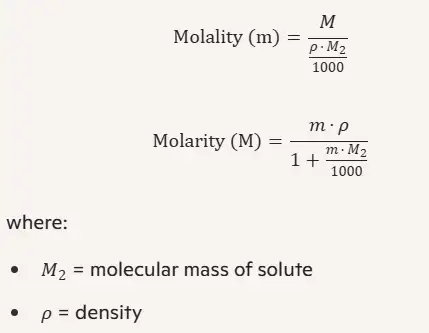
- Conversion formulas:
- From M to m:
m = (M/(ρ - M × M2 / 1000)) where M2 = molecular mass of solute, ρ = density of solution (g/mL) - From m to M:
M = (m × ρ/(1 + m × M2 / 1000))
- From M to m:
- Variables:
- n1 M1 = mass of solute
- n2 M2 = mass of solvent
- Mass of solution = n1 M1 + n2 M2
Solved Examples
- Ex 1: Convert 1 M solution to molality given M2 = 58.5 g/mol, density ρ = 1.2 g/mL.
- m = 1/(1.2 - (1 × 58.5 / 1000)) = 1/(1.2 - 0.0585) = 0.88 m
- Ex 2: Convert 0.5 m molality to molarity with same data.
- M = (0.5 × 1.2/(1 + 0.5 × 58.5 / 1000)) = 0.6/(1 + 0.02925) = 0.58 M
Practice Set
- Q1: Molality is defined as
- A) Moles solute / Volume solution
- B) Moles solute / Mass solvent (kg)
- C) Mass solute / Mass solution
- D) Volume solute / Volume solution
- Q2: Which concentration unit does not change with temperature?
- A) Molarity
- B) Molality
- C) Volume %
- D) Normality
- Q3: Given M = 2, M2 = 40 g/mol, ρ = 1.1 g/mL, molality is approximately
- A) 1.9 m
- B) 2.1 m
- C) 2.5 m
- D) 1.5 m
Answer Key
- Q1: B - Molality = moles solute per kg solvent.
- Q2: B - Molality does not change with temperature.
- Q3: A - Using formula, molality ≈ 1.9 m.
Memory Aids
- Molality = moles per kg solvent, molarity = moles per litre solution.
- Molality unaffected by temperature; molarity changes.
- Use density and molecular mass for conversions.
Concepts
- Molality (m): Moles of solute per kg of solvent.
- Molarity (M): Moles of solute per litre of solution.
- Conversion formulas:
- From M to m:
m = \( \frac{M}{\rho - M \times M_2 / 1000} \) where \( M_2 \) = molecular mass of solute, \( \rho \) = density of solution (g/mL) - From m to M:
M = \( \frac{m \times \rho}{1 + m \times M_2 / 1000} \)
- From M to m:
- Variables:
- \( n_1 M_1 \) = mass of solute
- \( n_2 M_2 \) = mass of solvent
- Mass of solution = \( n_1 M_1 + n_2 M_2 \)
Solved Examples
- Ex 1: Convert 1 M solution to molality given \( M_2 = 58.5 \) g/mol, density \( \rho = 1.2 \) g/mL.
- m = \( \frac{1}{1.2 - (1 \times 58.5 / 1000)} = \frac{1}{1.2 - 0.0585} = 0.88 \) m
- Ex 2: Convert 0.5 m molality to molarity with same data.
- M = \( \frac{0.5 \times 1.2}{1 + 0.5 \times 58.5 / 1000} = \frac{0.6}{1 + 0.02925} = 0.58 \) M
Practice Set
- Q1: Molality is defined as
- A) Moles solute / Volume solution
- B) Moles solute / Mass solvent (kg)
- C) Mass solute / Mass solution
- D) Volume solute / Volume solution
- Q2: Which concentration unit does not change with temperature?
- A) Molarity
- B) Molality
- C) Volume %
- D) Normality
- Q3: Given M = 2, \( M_2 = 40 \) g/mol, \( \rho = 1.1 \) g/mL, molality is approximately
- A) 1.9 m
- B) 2.1 m
- C) 2.5 m
- D) 1.5 m
Answer Key
- Q1: B - Molality = moles solute per kg solvent.
- Q2: B - Molality does not change with temperature.
- Q3: A - Using formula, molality ≈ 1.9 m.
Memory Aids
- Molality = moles per kg solvent, molarity = moles per litre solution.
- Molality unaffected by temperature; molarity changes.
- Use density and molecular mass for conversions.
NEET Chemistry — ALL CHAPTERS
1
Some Basic Concepts of Chemistry
2
Structure of Atom
3
Classification of Elements and Periodicity in Properties
4
Chemical Bonding and Molecular Structure
5
Thermodynamics
6
Equilibrium
7
Redox Reactions
8
Organic Chemistry - Some Basic Principles and Techniques
9
Hydrocarbons
10
Solutions
11
Electrochemistry
12
Chemical Kinetics
13
The d- and f- Block Elements
14
Coordination Compounds
15
Haloalkanes and Haloarenes
16
Alcohols, Phenols and Ethers
17
Aldehydes, Ketones and Carboxylic Acids
18
Amines
19
Biomolecules
20
The p-Block Elements (Group 13 and 14)
21
The p-Block Elements (Group 15 to 18)
22
Principles Related to Practical Chemistry