Amines
Overview
- Amines are ammonia derivatives where 1, 2, or 3 H atoms are replaced by alkyl or aryl groups.
- Found naturally in proteins, vitamins, alkaloids, and hormones.
Solved Examples
- Ex 1: Identify the type of amine in CH3NH2.
Answer: Primary amine (one alkyl group attached to N).
Practice Set
- Q1: What is an amine?
A. A hydrocarbon
B. Ammonia derivative
C. Alcohol
D. Ketone - Q2: Amines are found in which natural compounds?
A. Proteins
B. Vitamins
C. Alkaloids
D. All of the above - Q3: Which group replaces hydrogen in amines?
A. Halogens
B. Alkyl/Aryl groups
C. Oxygen
D. Sulfur
Answer Key
- Q1: B - Amines are derivatives of ammonia.
- Q2: D - Amines occur in proteins, vitamins, and alkaloids.
- Q3: B - Alkyl or aryl groups replace hydrogen atoms in amines.
Memory Aids
- Amines = Ammonia + Alkyl/Aryl groups
- Natural occurrence: Proteins, Vitamins, Alkaloids
Diazonium Salts
Properties and Naming
- Arenediazonium salts have formula ArN2+X-, where Ar = aryl group (e.g., C6H5), X = Cl-, Br-, NO3-, HSO4-, BF4-.
- Named by adding "diazonium" suffix to parent hydrocarbon + anion name (e.g., benzenediazonium chloride).
- Primary aliphatic amines form unstable alkyldiazonium salts.
- Primary aromatic amines form arenediazonium salts stable at 273-278 K.
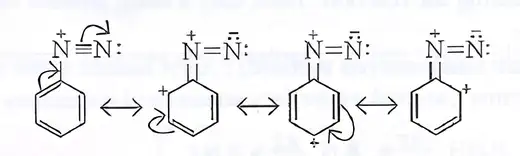
- Arenediazonium salts are more stable due to positive charge delocalization over benzene ring.
Solved Examples
- Ex 1: Name C6H5N2+Cl-.
Answer: Benzenediazonium chloride.
Practice Set
- Q1: What is the general formula of arenediazonium salts?
A. RNH2
B. ArN2+X-
C. RNO2
D. ArOH - Q2: Which salt is more stable?
A. Alkyldiazonium salt
B. Arenediazonium salt
C. Both equal
D. None - Q3: Benzenediazonium hydrogensulphate has formula:
A. C6H5N2+HSO4-
B. C6H5NH2
C. C6H5NO2
D. C6H5Cl
Answer Key
- Q1: B - Arenediazonium salts have formula ArN2+X-.
- Q2: B - Arenediazonium salts are more stable due to resonance.
- Q3: A - Benzenediazonium hydrogensulphate is C6H5N2+HSO4-.
Memory Aids
- Diazonium salts: ArN2+X-
- Stability: Arenediazonium > Alkyldiazonium
- Named by parent hydrocarbon + diazonium + anion
Structure of Amines
Geometry and Hybridization
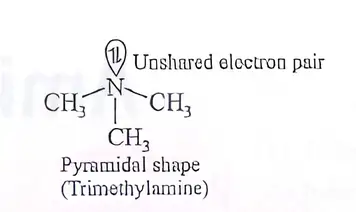
- Nitrogen in amines is sp3 hybridized.
- Amines have pyramidal shape due to lone pair on nitrogen.
- Bond angle C–N–E (E = C or H) is less than 109.5°, e.g., 108° in trimethylamine.
Solved Examples
- Ex 1: Describe the shape of trimethylamine.
Answer: Pyramidal due to lone pair on N.
Practice Set
- Q1: What is the hybridization of nitrogen in amines?
A. sp
B. sp2
C. sp3
D. sp3d - Q2: What is the shape of amines?
A. Linear
B. Pyramidal
C. Planar
D. Tetrahedral - Q3: Why is the bond angle in amines less than 109.5°?
A. Lone pair repulsion
B. Double bonds
C. No lone pairs
D. Hydrogen bonding
Answer Key
- Q1: C - Nitrogen is sp3 hybridized in amines.
- Q2: B - Amines have pyramidal shape due to lone pair.
- Q3: A - Lone pair repulsion reduces bond angle below 109.5°.
Memory Aids
- Amines: sp3 N, pyramidal shape
- Bond angle < 109.5° due to lone pair
Classification
Explanation
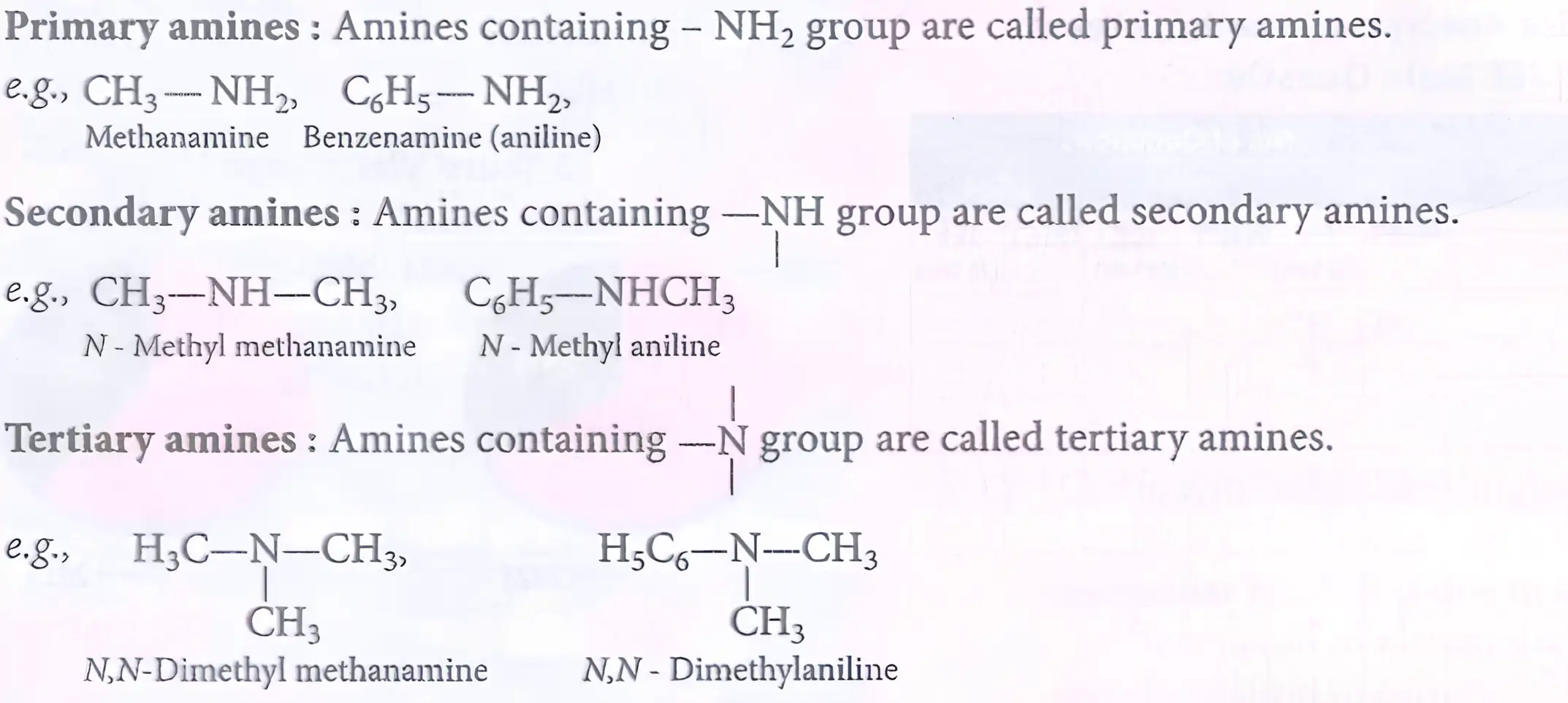
- Amines are classified based on the number of alkyl/aryl groups attached to the nitrogen atom.
- Primary amines (1°): One alkyl/aryl group attached to NH2 (RNH2).
- Secondary amines (2°): Two alkyl/aryl groups attached to NH (R2NH).
- Tertiary amines (3°): Three alkyl/aryl groups attached to N (R3N), no hydrogen on nitrogen.
- Examples:
- Primary: Methanamine (CH3-NH2)
- Secondary: N-Methyl methanamine (CH3-NH-CH3)
- Tertiary: N,N-Dimethyl methanamine (CH3-N(CH3)-CH3)
Solved Examples
- Ex 1: Identify the type of amine: CH3-NH2.
Solution: One alkyl group attached to NH2 → Primary amine. - Ex 2: Identify the type of amine: CH3-NH-CH3.
Solution: Two alkyl groups attached to NH → Secondary amine. - Ex 3: Identify the type of amine: CH3-N(CH3)-CH3.
Solution: Three alkyl groups attached to N, no H → Tertiary amine.
Practice Set
- Q1: Which of the following is a primary amine?
A. CH3-NH-CH3
B. CH3-NH2
C. N(CH3)3
D. NH3 - Q2: Identify the secondary amine:
A. CH3-NH2
B. CH3-NH-CH3
C. N(CH3)3
D. NH3 - Q3: Which amine has no hydrogen attached to nitrogen?
A. Primary amine
B. Secondary amine
C. Tertiary amine
D. Ammonia
Answer Key
- Q1: B. CH3-NH2 - One alkyl group attached to NH2 defines primary amine.
- Q2: B. CH3-NH-CH3 - Two alkyl groups attached to NH defines secondary amine.
- Q3: C. Tertiary amine - No hydrogen attached to nitrogen.
Memory Aids
- Primary amine = 1 alkyl group + NH2.
- Secondary amine = 2 alkyl groups + NH.
- Tertiary amine = 3 alkyl groups, no H on N.
- Remember: "1° = 1 R, 2° = 2 R, 3° = 3 R" attached to N.
Nomenclature
Common System Naming
- Aliphatic amines named by prefixing alkyl group to "amine" (e.g., methylamine).
IUPAC System Naming
- Amines named as alkanamines.
- For secondary and tertiary amines, if alkyl groups are identical, use prefixes di-, tri- before alkyl name.
Solved Examples
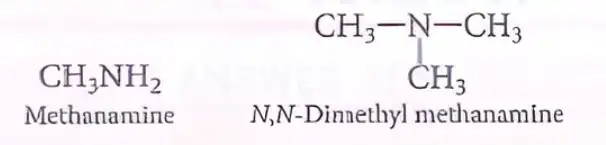
- Ex 1: Name CH3NH2 - Methanamine (simple alkylamine).
- Ex 2: Name (CH3)2NCH3 - N,N-Dimethyl methanamine (two methyl groups on N).
Practice Set
- Q1: What is the IUPAC name of CH3NH2?
A. Methylamine
B. Methanamine
C. Ethylamine
D. Methanamine N,N-dimethyl - Q2: How is a tertiary amine with three identical alkyl groups named?
A. Alkylamine
B. Alkanamine
C. Tri-alkylamine
D. N,N-Dialkylamine - Q3: What prefix is used when two identical alkyl groups are attached to nitrogen?
A. Mono-
B. Di-
C. Tri-
D. Tetra-
Answer Key
- Q1: B - Methanamine is the correct IUPAC name for CH3NH2.
- Q2: C - Tertiary amines with three identical alkyl groups use tri- prefix.
- Q3: B - Di- prefix is used for two identical alkyl groups on nitrogen.
Memory Aids
- Common system: Alkyl + amine (e.g., methylamine).
- IUPAC: Alkanamine; use di-, tri- for multiple identical alkyl groups.
- Look for N-substitution to apply prefixes.
Preparation from Nitro Compounds
Explanation
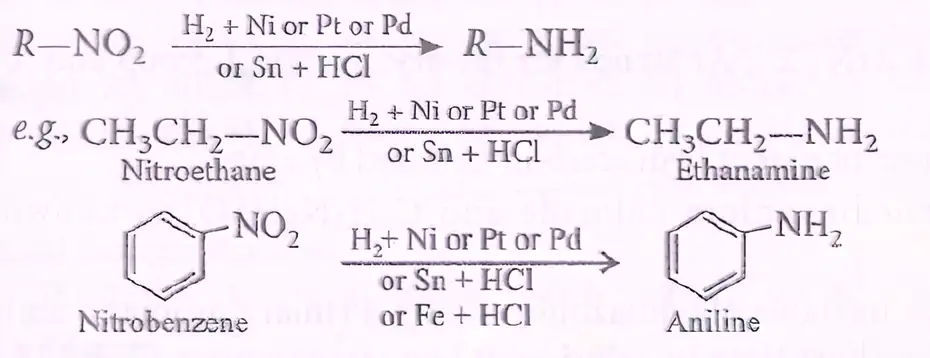
- Nitro compounds (R–NO2) are reduced to amines (R–NH2).
- Reduction agents: H2 with Ni, Pd, Pt catalysts or metals in acid (e.g., Sn + HCl).
- Commercially, iron scrap and HCl are used; FeCl formed hydrolyses to release HCl, requiring only a small amount of acid.
- Examples: Nitroethane → Ethanamine, Nitrobenzene → Aniline.
Solved Examples
- Ex 1: Reduce nitrobenzene using H2/Pd catalyst → Aniline (C6H5NH2).
Practice Set
- Q1: Which catalyst is NOT used for reduction of nitro compounds to amines?
- A. Nickel
- B. Palladium
- C. Copper
- D. Platinum
- Q2: What is the product of reduction of nitroethane?
- A. Ethanolamine
- B. Ethanamine
- C. Ethylamine
- D. Ethane
- Q3: Why is iron scrap used commercially with HCl in nitro compound reduction?
- A. To increase temperature
- B. To generate HCl in situ
- C. To act as catalyst
- D. To absorb hydrogen
Answer Key
- Q1: C - Copper is not used; Ni, Pd, Pt are common catalysts.
- Q2: B - Reduction of nitroethane gives ethanamine (primary amine).
- Q3: B - FeCl hydrolyses to release HCl, reducing the need for added acid.
Memory Aids
- Reduction of R–NO2 → R–NH2 using H2/Ni, Pd, Pt or Sn/HCl.
- Iron scrap + HCl generates HCl in situ for commercial use.
Preparation from Alkyl Halides
Explanation
- Alkyl halides (R–X) react with ethanolic ammonia to give a mixture of primary, secondary, tertiary amines and quaternary ammonium salts.
- This process is called Hoffmann ammonolysis (cleavage of C–X bond by NH3).
- Excess ammonia favors primary amine formation.
- Order of halide reactivity: R–I > R–Br > R–Cl.
- Reaction is nucleophilic substitution; ammonium salt formed is treated with strong base to get amine.
- Aryl halides do not undergo this reaction.
- Tertiary butyl bromide prefers elimination over substitution with NH3.

Solved Examples
- Ex 1: React CH3Br with excess NH3 → CH3NH2 (primary amine).
Practice Set
- Q1: What is the main product when excess alkyl halide is used in Hoffmann ammonolysis?
- A. Primary amine
- B. Secondary amine
- C. Tertiary amine
- D. Quaternary ammonium salt
- Q2: Which halide reacts fastest in ammonolysis?
- A. R–Cl
- B. R–Br
- C. R–I
- D. Aryl halide
- Q3: What happens when tertiary butyl bromide reacts with NH3?
- A. Substitution to amine
- B. Elimination
- C. No reaction
- D. Polymerization
Answer Key
- Q1: C - Excess alkyl halide gives mainly tertiary amine.
- Q2: C - R–I is most reactive.
- Q3: B - Tertiary butyl bromide undergoes elimination, not substitution.
Memory Aids
- Hoffmann ammonolysis: R–X + NH3 → mixture of amines + quaternary salt.
- Excess NH3 → primary amine; excess R–X → tertiary amine.
- Reactivity order: I > Br > Cl; aryl halides do not react.
Preparation from Nitriles
Explanation
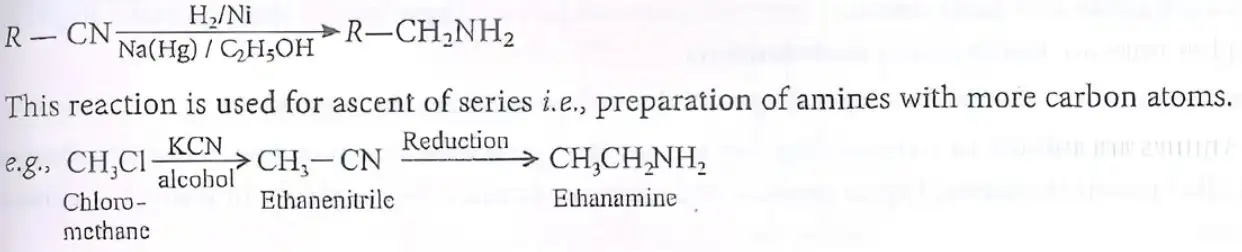
- Nitriles (R–CN) are reduced to primary amines (R–CH2NH2).
- Reducing agents: LiAlH4 or catalytic hydrogenation (H2/Ni).
- Reduction by Na(Hg) and C2H5OH is called Mendius reduction.
- Example: CH3Cl + KCN → CH3CN (ethanenitrile), then reduced to ethylamine.
Solved Examples
- Ex 1: Reduce ethanenitrile with LiAlH4 → Ethylamine.
Practice Set
- Q1: Which reagent is used for reduction of nitriles to primary amines?
- A. NaBH4
- B. LiAlH4
- C. H2SO4
- D. KMnO4
- Q2: Mendius reduction involves reduction by:
- A. Na(Hg) and C2H5OH
- B. LiAlH4
- C. H2/Ni
- D. Sn and HCl
- Q3: What is the product when CH3CN is reduced?
- A. Methylamine
- B. Ethylamine
- C. Propylamine
- D. Aniline
Answer Key
- Q1: B - LiAlH4 is a strong reducing agent for nitriles.
- Q2: A - Mendius reduction uses Na(Hg) and ethanol.
- Q3: B - CH3CN reduction gives ethylamine (2 carbon atoms).
Memory Aids
- Nitrile reduction adds two hydrogens to form primary amine.
- Mendius reduction = Na(Hg) + C2H5OH.
Preparation from Amides
Explanation
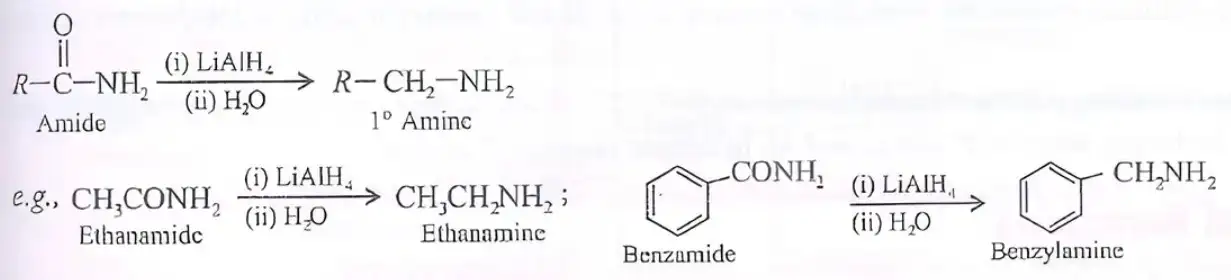
- Alkanamides (R-CONH2) are reduced to primary amines using LiAlH4.
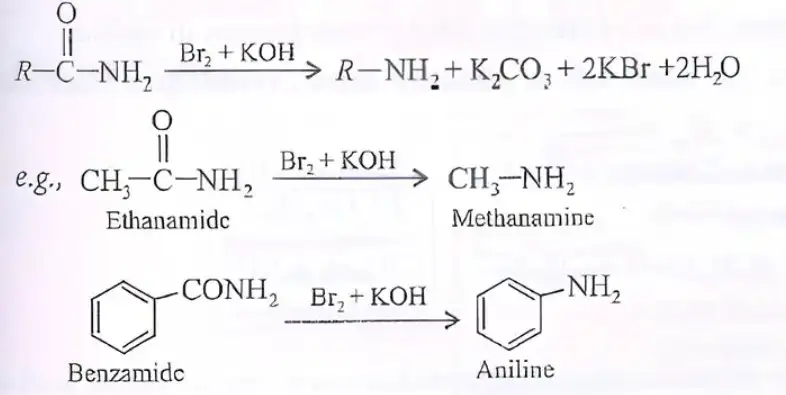
- Hoffmann bromamide degradation: Primary amides treated with Br2 and alkali give primary amines with one less carbon.
- Mechanism involves formation of bromoamide, isocyanate intermediate, then amine.

Solved Examples
- Ex 1: Reduce ethanamide with LiAlH4 → Ethanamine.
- Ex 2: Treat benzamide with Br2 and KOH → Aniline (one carbon less).
Practice Set
- Q1: What is the product of Hoffmann bromamide degradation?
- A. Primary amine with same carbon number
- B. Primary amine with one less carbon
- C. Secondary amine
- D. Tertiary amine
- Q2: Which reagent reduces amides to amines?
- A. NaBH4
- B. LiAlH4
- C. H2/Ni
- D. Br2/KOH
- Q3: What intermediate forms in Hoffmann bromamide degradation?
- A. Isocyanate
- B. Nitrile
- C. Amide
- D. Ammonium salt
Answer Key
- Q1: B - Primary amine with one less carbon is formed.
- Q2: B - LiAlH4 reduces amides to amines.
- Q3: A - Isocyanate intermediate forms during reaction.
Memory Aids
- Hoffmann bromamide degradation shortens carbon chain by one.
- LiAlH4 reduces amides to primary amines.
Gabriel Phthalimide Synthesis
Explanation
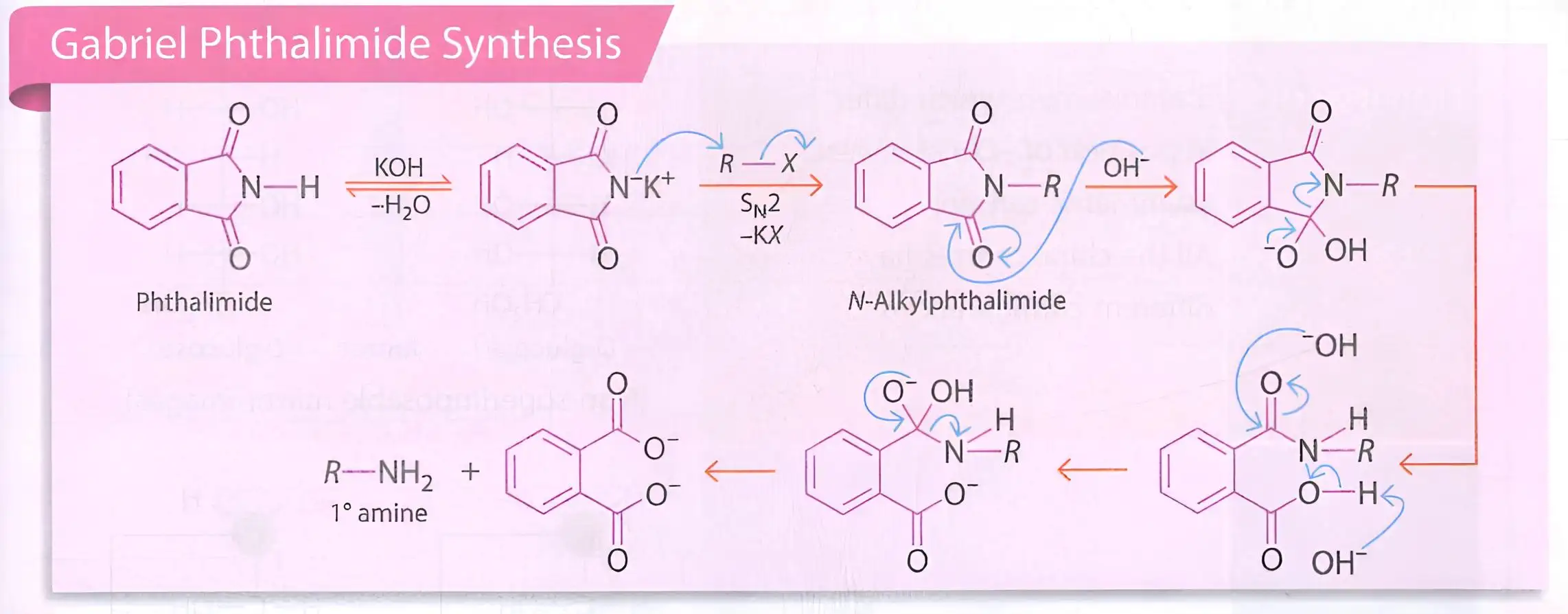
- Potassium phthalimide reacts with alkyl halides to form N-alkyl phthalimide.
- Alkaline hydrolysis of N-alkyl phthalimide produces primary amines.
- Used to prepare primary amines without secondary/tertiary amines.
- 1° aromatic amines (aniline, toluidines) cannot be prepared as aryl halides do not react under mild conditions.

Solved Examples
- Ex 1: React potassium phthalimide with ethyl bromide → N-ethyl phthalimide, then hydrolyze → ethylamine.
Practice Set
- Q1: What is the main product of Gabriel synthesis?
- A. Secondary amine
- B. Tertiary amine
- C. Primary amine
- D. Quaternary ammonium salt
- Q2: Why can't aromatic amines be prepared by Gabriel synthesis?
- A. Aryl halides do not undergo nucleophilic substitution
- B. Reaction is too slow
- C. Phthalimide is unstable
- D. Aromatic amines are unstable
- Q3: Which reagent is used to hydrolyze N-alkyl phthalimide?
- A. HCl
- B. NaOH
- C. KOH
- D. NH3
Answer Key
- Q1: C - Gabriel synthesis produces primary amines.
- Q2: A - Aryl halides do not undergo nucleophilic substitution under mild conditions.
- Q3: B - NaOH is used for hydrolysis.
Memory Aids
- Gabriel synthesis: potassium phthalimide + R–X → N-alkyl phthalimide → hydrolysis → primary amine.
- Does not work for aryl halides (no nucleophilic substitution).
Physical Properties
Physical State
- Lower aliphatic amines: gases with ammoniacal smell.
- Primary amines (≥3 C atoms): liquids with fishy odour.
- Lower aromatic amines: liquids with unpleasant odour.
- Higher aromatic amines: solids, odourless.
Colour
- Pure amines are colourless.
- Get coloured due to atmospheric oxidation.
Solubility
- Amines are soluble in water due to hydrogen bonding.
- Solubility decreases with increasing alkyl size.
- Higher and aromatic amines are insoluble in water but soluble in organic solvents.
Boiling Points
- Amines are polar and form intermolecular hydrogen bonds (except tertiary amines).
- Exist as associated molecules, showing higher boiling points than hydrocarbons of similar molecular mass.
- Boiling points are lower than alcohols and carboxylic acids of comparable molecular mass.
- Order of boiling points: 1° > 2° > 3° amines due to number of hydrogen atoms available for bonding.
Solved Examples
- Ex 1: Identify physical state of amine with 2 carbon atoms.
Answer: Gas with ammoniacal smell (lower aliphatic amine). - Ex 2: Compare boiling points of 1° and 3° amines.
Answer: 1° amine has higher boiling point due to more hydrogen bonding.
Practice Set
- Q1: What is the physical state of primary amines with three or more carbon atoms?
A. Gas
B. Liquid
C. Solid
D. Colourless gas - Q2: Why do pure amines get coloured on exposure to air?
A. Reaction with water
B. Atmospheric oxidation
C. Hydrogen bonding
D. Polymerization - Q3: Which order correctly represents boiling points of isomeric amines?
A. 3° > 2° > 1°
B. 1° > 2° > 3°
C. 2° > 1° > 3°
D. 1° > 3° > 2°
Answer Key
- Q1: B - Primary amines with ≥3 carbons are liquids with fishy odour.
- Q2: B - Amines get coloured due to atmospheric oxidation.
- Q3: B - Boiling points decrease from 1° to 3° due to hydrogen bonding availability.
Memory Aids
- Lower aliphatic amines: gas + ammoniacal smell.
- Boiling point order: 1° (two H) > 2° (one H) > 3° (no H).
- Pure amines colourless; colour on air due to oxidation.
Chemical Reactions
Overview of Primary Amine Reactions
- Primary amines (RNH2) undergo alkylation with alkyl halides (R'X) to form secondary, tertiary amines, and quaternary ammonium salts.
- Acylation with acid chlorides (R'COCl) or anhydrides forms amides (RNH-COR').
- Benzoylation with benzoyl chloride (C6H5COCl) produces benzamides (RNHCOC6H5).
- Carbylamine test: Primary amines react with chloroform and alcoholic KOH to form isocyanides (RNC), confirming primary amines.
- Hinsberg’s test: Primary amines react with benzenesulfonyl chloride to form soluble sulfonamides in alkali.
- Nitrous acid reaction: Primary amines react with HNO2 to give alcohols, nitrogen gas, and water.
Solved Examples
- Ex 1: Alkylation of methylamine (CH3NH2) with ethyl bromide (C2H5Br) forms ethylmethylamine.
- Ex 2: Carbylamine test with an unknown amine producing foul-smelling isocyanide confirms primary amine.
Practice Set
- Q1: Which reagent is used in the carbylamine test?
- A. Chloroform and alcoholic KOH
- B. Benzoyl chloride
- C. Nitrous acid
- D. Alkyl halide
- Q2: Primary amines react with benzenesulfonyl chloride to form?
- A. Insoluble sulfonamides
- B. Soluble sulfonamides
- C. Quaternary ammonium salts
- D. Isocyanides
- Q3: Reaction of primary amines with nitrous acid produces?
- A. Alcohols and nitrogen gas
- B. N-nitrosamines
- C. Nitrite salts
- D. Diazonium salts
Answer Key
- Q1: A - Chloroform and alcoholic KOH produce isocyanides in carbylamine test.
- Q2: B - Primary amines form soluble sulfonamides with benzenesulfonyl chloride.
- Q3: A - Primary amines react with nitrous acid to give alcohols and nitrogen gas.
Memory Aids
- Carbylamine test positive only for primary amines.
- Hinsberg’s test solubility distinguishes 1°, 2°, and 3° amines.
- Nitrous acid reaction: primary amines → alcohols; aromatic primary amines → diazonium salts.
Basic Character of Amines
Key Points on Basicity
- Amines are basic due to lone pair on nitrogen.
- Aliphatic amines are stronger bases than ammonia due to +I effect of alkyl groups.
- Basicity affected by inductive, steric, solvation, and resonance effects.
- Gaseous phase basicity order: 3° amine > 2° amine > 1° amine > NH3.
- Aqueous phase basicity varies due to solvation; e.g., (C2H5)2NH > (C2H5)3N > C2H5NH3 > NH3.
- Aromatic amines are weaker bases due to resonance delocalization of lone pair.
Solved Examples
- Ex 1: Compare basicity of methylamine and aniline; methylamine is stronger base due to no resonance.
- Ex 2: Explain why 3° amines are more basic than 1° in aqueous phase due to steric hindrance reducing solvation.
Practice Set
- Q1: Why are aliphatic amines stronger bases than ammonia?
- A. Resonance effect
- B. +I effect of alkyl groups
- C. Steric hindrance
- D. Solvation effect
- Q2: Order of basicity in gaseous phase is?
- A. 1° > 2° > 3° > NH3
- B. 3° > 2° > 1° > NH3
- C. NH3 > 1° > 2° > 3°
- D. 2° > 3° > 1° > NH3
- Q3: Aromatic amines are weaker bases because?
- A. Lone pair is localized on nitrogen
- B. Lone pair is delocalized over benzene ring
- C. They have no lone pair
- D. They are sterically hindered
Answer Key
- Q1: B - +I effect of alkyl groups increases electron density on nitrogen.
- Q2: B - Gaseous phase basicity order is 3° > 2° > 1° > NH3.
- Q3: B - Resonance delocalizes lone pair, reducing availability for protonation.
Memory Aids
- Basicity in aqueous phase affected by solvation and steric hindrance.
- Aromatic amines weaker bases due to resonance.
- 3° amines more basic than 1° in aqueous phase due to steric effects.
Distinction Between 1°, 2° and 3° Amines
Hinsberg’s Test
- Primary amines react with benzenesulfonyl chloride to form N-alkylbenzenesulfonamides soluble in alkali.
- Secondary amines form N,N-dialkylbenzenesulfonamides insoluble in alkali.
- Tertiary amines do not react.
Solved Examples
- Ex 1: Identify amine type by solubility of Hinsberg’s test product in alkali.
Practice Set
- Q1: Hinsberg’s test product soluble in alkali indicates?
- A. Primary amine
- B. Secondary amine
- C. Tertiary amine
- D. Quaternary ammonium salt
- Q2: Which amine does not react with Hinsberg’s reagent?
- A. Primary
- B. Secondary
- C. Tertiary
- D. Quaternary
- Q3: Hinsberg’s test distinguishes amines based on?
- A. Solubility of sulfonamide
- B. Color change
- C. Gas evolution
- D. Precipitate formation
Answer Key
- Q1: A - Soluble sulfonamide indicates primary amine.
- Q2: C - Tertiary amines do not react with Hinsberg’s reagent.
- Q3: A - Test is based on solubility differences of sulfonamides.
Memory Aids
- Hinsberg’s test: Primary soluble, secondary insoluble, tertiary no reaction.
- Carbylamine test positive only for primary amines.
- Azo dye test positive only for primary aromatic amines.
Electrophilic Substitution Reactions of Arylamines
Key Reactions of Aniline
- Aniline undergoes electrophilic substitution; —NH2 is ortho/para directing and activating.
- Bromination forms tribromoaniline or p-bromoaniline.
- Nitration forms p-nitroaniline.
- Sulfonation with H2SO4 forms sulphanilic acid (zwitter ion).
- Diazotization with NaNO2/HCl forms diazonium salt.
- Reaction with chloroform and KOH forms phenyl isocyanide.
- Oxidation forms p-benzoquinone.
- Aniline forms salt with AlCl3 during alkylation, deactivating electrophilic substitution; no Friedel-Crafts reaction.
Solved Examples
- Ex 1: Bromination of aniline yields tribromoaniline due to activating —NH2 group.
- Ex 2: Explain why aniline does not undergo Friedel-Crafts alkylation.
Practice Set
- Q1: The —NH2 group in aniline directs substitution to?
- A. Meta position
- B. Ortho and para positions
- C. Only para position
- D. No substitution
- Q2: Why does aniline not undergo Friedel-Crafts reaction?
- A. It is too reactive
- B. Forms salt with AlCl3 deactivating ring
- C. No lone pair on nitrogen
- D. It is a weak base
- Q3: Diazonium salt formation requires?
- A. NaNO2 and HCl at 0-5 °C
- B. Chloroform and KOH
- C. Bromine water
- D. Concentrated H2SO4
Answer Key
- Q1: B - —NH2 is ortho/para directing.
- Q2: B - Aniline forms salt with AlCl3, deactivating electrophilic substitution.
- Q3: A - Diazotization requires NaNO2 and HCl at low temperature.
Memory Aids
- —NH2 group activates and directs ortho/para substitution.
- Aniline salt formation with AlCl3 prevents Friedel-Crafts reaction.
- Diazonium salts form at 0-5 °C with NaNO2/HCl.
Basicity of Substituted Anilines
Effect of Substituents
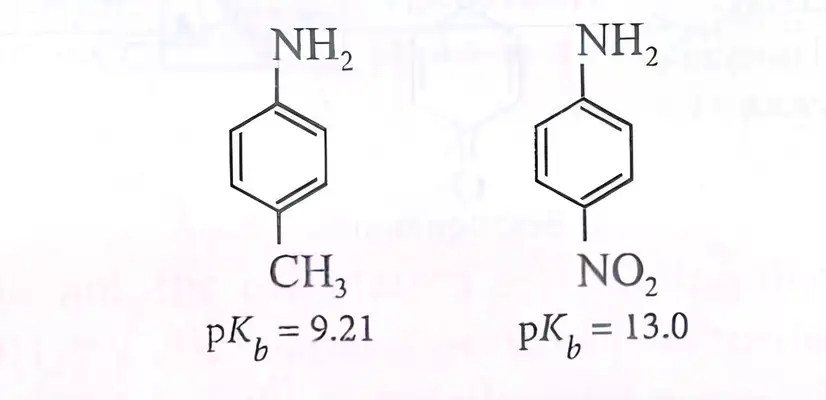
- Electron releasing groups (-OCH3, -CH3) increase electron density on nitrogen, enhancing basicity.
- Electron withdrawing groups (-NO2, -SO3H, -COOH, -X) decrease basicity.
- pKb values indicate strength: lower pKb means stronger base.
Solved Examples
- Ex 1: Compare pKb of p-methylaniline (9.21) and p-nitroaniline (13.0); methyl group increases basicity.
Practice Set
- Q1: Which group increases basicity of aniline?
- A. -NO2
- B. -SO3H
- C. -CH3
- D. -COOH
- Q2: Lower pKb value indicates?
- A. Weaker base
- B. Stronger base
- C. No change
- D. Acidic nature
- Q3: Electron withdrawing groups cause?
- A. Increase in basicity
- B. Decrease in basicity
- C. No effect
- D. Increase in acidity
Answer Key
- Q1: C - Electron donating -CH3 increases basicity.
- Q2: B - Lower pKb means stronger base.
- Q3: B - Electron withdrawing groups decrease basicity.
Memory Aids
- Electron donating groups increase basicity; withdrawing groups decrease it.
- pKb values help compare basic strengths.
Anilinium Ion Stability
Key Points
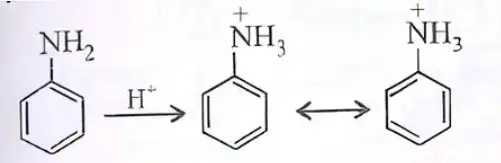
- Anilinium ion (protonated aniline) has fewer resonance structures (2) than aniline (5), making it less stable.
- Protonation reduces electron delocalization on nitrogen.
Solved Examples
- Ex 1: Explain why anilinium ion is less stable than aniline based on resonance.
Practice Set
- Q1: Anilinium ion is less stable because?
- A. More resonance structures
- B. Fewer resonance structures
- C. No lone pair on nitrogen
- D. It is neutral
- Q2: Protonation affects aniline by?
- A. Increasing electron delocalization
- B. Decreasing resonance
- C. No effect
- D. Increasing basicity
- Q3: Resonance in aniline involves?
- A. Benzene ring and nitrogen lone pair
- B. Only benzene ring
- C. Only nitrogen lone pair
- D. No resonance
Answer Key
- Q1: B - Anilinium ion has fewer resonance forms, less stable.
- Q2: B - Protonation reduces resonance delocalization.
- Q3: A - Resonance involves benzene ring and nitrogen lone pair.
Memory Aids
- Protonation reduces resonance, lowering stability.
- Aniline has 5 resonance forms; anilinium ion has 2.
Method of Preparation of Diazonium Salts
Explanation
- Benzenediazonium chloride is prepared by reacting aniline (C6H5NH2) with nitrous acid (HNO2), generated in situ from sodium nitrite (NaNO2) and hydrochloric acid (HCl).
- The reaction is carried out at low temperature (0-5 °C) to maintain the stability of the diazonium salt.
- This process is called diazotisation — conversion of primary aromatic amines into diazonium salts.
- Diazonium salts are unstable and generally used immediately after preparation.
- Chemical reaction:
- C6H5NH2 + NaNO2 + 2HCl → C6H5N2+Cl− + NaCl + 2H2O

Solved Examples
- Ex 1: Write the reaction for the preparation of benzenediazonium chloride from aniline.
- React aniline with NaNO2 and HCl at 0-5 °C.
- Product formed: C6H5N2+Cl− (benzenediazonium chloride).
Practice Set
- Q1: What is the temperature range for the diazotisation reaction?
- A. 25-30 °C
- B. 0-5 °C
- C. 50-60 °C
- D. 10-15 °C
- Q2: Which reagent is NOT used in the preparation of benzenediazonium chloride?
- A. Aniline
- B. Sodium nitrite
- C. Hydrochloric acid
- D. Sulfuric acid
- Q3: What are the by-products formed during the diazotisation of aniline?
- A. NaCl and H2O
- B. NaOH and H2O
- C. HCl and NaNO2
- D. NH3 and HCl
Answer Key
- Q1: B. 0-5 °C — Low temperature is required to stabilize the diazonium salt.
- Q2: D. Sulfuric acid — HCl is used, not H2SO4.
- Q3: A. NaCl and H2O — These are the by-products formed in the reaction.
Memory Aids
- Diazotisation = Primary aromatic amine + NaNO2 + HCl at 0-5 °C → Diazonium salt.
- Keep temperature low to prevent decomposition.
- Diazonium salts are unstable; use immediately.
Physical Properties
Properties of Benzenediazonium Chloride
- Colourless crystalline solid.
- Readily soluble in water.
- Stable when kept cold.
- Reacts with water on warming.
- Decomposes easily in dry state.
Properties of Benzenediazonium Fluoroborate
- Insoluble in water.
- Stable at room temperature.
Solved Examples
- Ex 1: Identify the solubility of benzenediazonium chloride.
- Answer: Soluble in water.
- Ex 2: State the stability condition of benzenediazonium fluoroborate.
- Answer: Stable at room temperature.
Practice Set
- Q1: What is the physical state of benzenediazonium chloride?
- A. Colourless crystalline solid
- B. Coloured liquid
- C. Powdered solid
- D. Gaseous
- Q2: Which of the following is true about benzenediazonium chloride?
- A. Insoluble in water
- B. Stable when warm
- C. Decomposes easily when dry
- D. Stable at room temperature
- Q3: Benzenediazonium fluoroborate is:
- A. Water soluble and unstable
- B. Water insoluble and stable at room temperature
- C. Water soluble and stable at room temperature
- D. Water insoluble and unstable
Answer Key
- Q1: A - It is a colourless crystalline solid as per its physical description.
- Q2: C - It decomposes easily in dry state and is stable only when cold.
- Q3: B - Benzenediazonium fluoroborate is water insoluble and stable at room temperature.
Memory Aids
- Benzenediazonium chloride: "Cold stable, water soluble, dry state decomposes".
- Benzenediazonium fluoroborate: "Water insoluble, room temperature stable".
Reactions involving displacement of nitrogen (diazo group)
Explanation
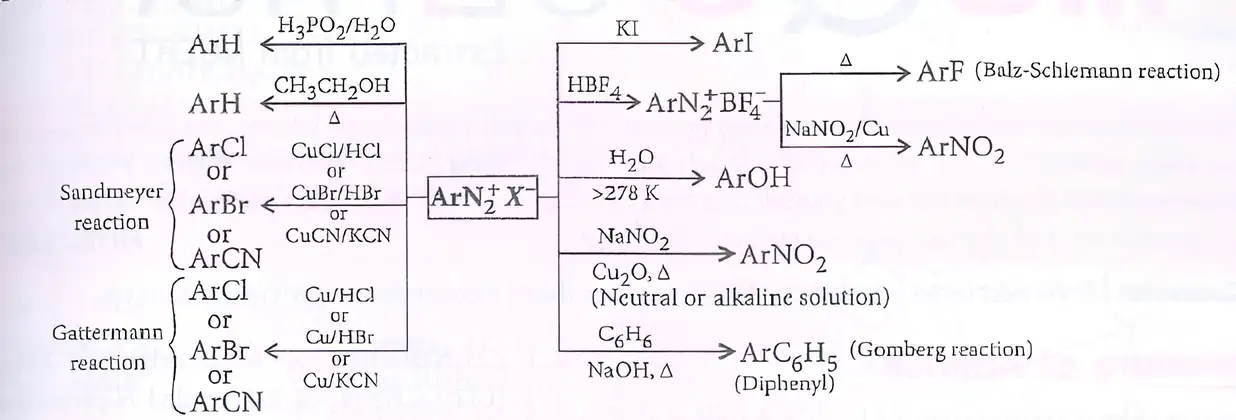
- Arenediazonium salts (ArN2+X-) are key intermediates in aromatic substitution.
- Displacement of N2 group leads to various substituted aromatic compounds.
- Common reagents and products:
- KI → ArI (aryl iodide)
- HBF4, heat (Δ) → ArF (aryl fluoride) via Balz-Schiemann reaction
- H2O, high temperature → ArOH (phenol)
- NaNO2, Cu → ArNO2 (nitrobenzene)
- NaOH, benzene (C6H6) → ArC6H5 (diphenyl) via Gomberg reaction
- Sandmeyer and Gattermann reactions use Cu salts to form ArCl, ArBr, ArCN
- Conversion back to ArH (aromatic hydrocarbon) is also possible.
Solved Examples
- Ex 1: Convert ArN2+X- to ArI using KI.
- Step 1: Add KI to arenediazonium salt.
- Step 2: ArN2+X- + KI → ArI + N2 + KX
- Ex 2: Prepare ArF from arenediazonium salt.
- Step 1: Treat ArN2+X- with HBF4 and heat.
- Step 2: ArN2+X- → ArF + N2 + BF3
Practice Set
- Q1: Which reagent converts ArN2+X- to ArI?
- A. NaOH
- B. KI
- C. HBF4
- D. CuCl
- Q2: The Balz-Schiemann reaction produces:
- A. ArCl
- B. ArF
- C. ArBr
- D. ArCN
- Q3: Which reaction forms diphenyl (ArC6H5)?
- A. Sandmeyer reaction
- B. Gomberg reaction
- C. Gattermann reaction
- D. Balz-Schiemann reaction
Answer Key
- Q1: B - KI replaces diazo group with iodine forming ArI.
- Q2: B - Balz-Schiemann reaction converts diazonium salt to aryl fluoride (ArF).
- Q3: B - Gomberg reaction couples arenediazonium salt with benzene to form diphenyl.
Memory Aids
- "KI for Iodine" - KI replaces N2+ with I.
- Balz-Schiemann = ArF formation using HBF4 and heat.
- Sandmeyer uses Cu salts for ArCl, ArBr, ArCN.
- Gomberg reaction forms diphenyl from ArN2+ and benzene.
Reactions involving retention of diazo group (coupling reactions)
Explanation
- Diazonium salts (ArN2+X-) can couple with aromatic compounds retaining the diazo group.
- Coupling depends on pH and reagents, producing azo dyes.
- Example: p-aminoazobenzene forms diazonium salt intermediate at low temperature and acidic pH.
- Adding phenol under basic conditions (pH 9-10) forms p-hydroxyazobenzene (orange dye).
- In p-aminophenol, coupling position depends on pH:
- Acidic (pH 4-5): coupling ortho to amino group.
- Basic (pH 9-10): coupling ortho to phenolic group.


Solved Examples
- Ex 1: Formation of p-hydroxyazobenzene from p-aminoazobenzene.
- Step 1: Diazotize p-aminoazobenzene with aniline and acid at 0-5°C, pH 4-5.
- Step 2: Add phenol and base (OH-) at pH 9-10, low temperature.
- Step 3: Diazonium salt couples with phenol forming p-hydroxyazobenzene.
- Ex 2: p-Aminophenol coupling position changes with pH.
- Acidic pH (4-5): Coupling ortho to -NH2 group forming 4-amino-3-phenylazophenol.
- Basic pH (9-10): Coupling ortho to -OH group forming 4-amino-2-phenylazophenol.
Practice Set
- Q1: What is the product when p-aminoazobenzene is diazotized and reacted with phenol at pH 9-10?
- A. p-Aminoazobenzene
- B. p-Hydroxyazobenzene
- C. Phenol
- D. Aniline
- Q2: In acidic medium, coupling of p-aminophenol occurs at which position?
- A. Ortho to -OH
- B. Ortho to -NH2
- C. Para to -OH
- D. Para to -NH2
- Q3: Which pH favors coupling ortho to phenolic group in p-aminophenol?
- A. pH 4-5
- B. pH 7
- C. pH 9-10
- D. pH 1-2
Answer Key
- Q1: B - Phenol reacts with diazonium salt at basic pH to form p-hydroxyazobenzene.
- Q2: B - Acidic medium causes coupling ortho to amino (-NH2) group.
- Q3: C - Basic pH (9-10) favors coupling ortho to phenolic (-OH) group.
Memory Aids
- Coupling reactions retain diazo group forming azo dyes.
- Acidic pH → coupling near amino group.
- Basic pH → coupling near phenol group.
- p-Aminoazobenzene → diazotization → azo dye formation.
NEET Chemistry — ALL CHAPTERS
1
Some Basic Concepts of Chemistry
2
Structure of Atom
3
Classification of Elements and Periodicity in Properties
4
Chemical Bonding and Molecular Structure
5
Thermodynamics
6
Equilibrium
7
Redox Reactions
8
Organic Chemistry - Some Basic Principles and Techniques
9
Hydrocarbons
10
Solutions
11
Electrochemistry
12
Chemical Kinetics
13
The d- and f- Block Elements
14
Coordination Compounds
15
Haloalkanes and Haloarenes
16
Alcohols, Phenols and Ethers
17
Aldehydes, Ketones and Carboxylic Acids
18
Amines
19
Biomolecules
20
The p-Block Elements (Group 13 and 14)
21
The p-Block Elements (Group 15 to 18)
22
Principles Related to Practical Chemistry