NEET Ug . NEET Chemistry . Chemistry . The D and F Block Elements
Chapter 13: The d- and f- Block Elements
Ch 13
NEET Chemistry
NEET Ug
Position in The Periodic Table
d- and f-Block Series
f-block elements — Elements in which the \(4f\) or \(5f\) orbitals are progressively filled in the two long periods.
Transition Elements
Transition elements (d-block elements) — Elements located between the s-block and p-block elements in the long-form periodic table.
Why they are called d-block elements
- Last electron: It enters a d orbital.
Quick recap
- The d-block comprises four series formed by filling the \(3d\), \(4d\), \(5d\) and \(6d\) subshells.
- The f-block involves progressive filling of the \(4f\) and \(5f\) orbitals in two long periods.
- Transition elements lie between the s-block and p-block in the long-form periodic table.
- They are called d-block elements because the last electron enters a d orbital.
Electronic Configurations of the d-Block Elements
General Electronic Configuration of d-Block Elements
General electronic configuration — The outer electronic configuration of d-block elements is generally \((n-1)d^{1-10}ns^{0-2}\).
Why Zn, Cd, Hg and Cn Are Not Transition Elements
- Configuration: Their outer configurations follow \((n-1)d^{10}ns^2\).
- Reason: The d subshell is completely filled in both their ground-state atoms and common oxidation states; therefore, they are not regarded as transition elements.
The Four Transition Series
| Transition series | d subshell | Elements included |
|---|---|---|
| First | 3d | Sc–Zn (atomic numbers 21–30) |
| Second | 4d | Y–Cd (atomic numbers 39–48) |
| Third | 5d | La; Hf–Hg (atomic numbers 57, 72–80) |
| Fourth | 6d | Ac; Rf–Cn (atomic numbers 89, 104–112) |
Electronic Configurations of the Transition Series
| Atomic number | Element | Configuration |
|---|---|---|
| 21 | Sc | \(3d^1 4s^2\) |
| 22 | Ti | \(3d^2 4s^2\) |
| 23 | V | \(3d^3 4s^2\) |
| 24 | Cr | \(3d^5 4s^1\) |
| 25 | Mn | \(3d^5 4s^2\) |
| 26 | Fe | \(3d^6 4s^2\) |
| 27 | Co | \(3d^7 4s^2\) |
| 28 | Ni | \(3d^8 4s^2\) |
| 29 | Cu | \(3d^{10} 4s^1\) |
| 30 | Zn | \(3d^{10} 4s^2\) |
| Atomic number | Element | Configuration |
|---|---|---|
| 39 | Y | \(4d^1 5s^2\) |
| 40 | Zr | \(4d^2 5s^2\) |
| 41 | Nb | \(4d^4 5s^1\) |
| 42 | Mo | \(4d^5 5s^1\) |
| 43 | Tc | \(4d^5 5s^2\) |
| 44 | Ru | \(4d^7 5s^1\) |
| 45 | Rh | \(4d^8 5s^1\) |
| 46 | Pd | \(4d^{10} 5s^0\) |
| 47 | Ag | \(4d^{10} 5s^1\) |
| 48 | Cd | \(4d^{10} 5s^2\) |
| Atomic number | Element | Configuration |
|---|---|---|
| 57 | La | \(5d^1 6s^2\) |
| 72 | Hf | \(4f^{14} 5d^2 6s^2\) |
| 73 | Ta | \(4f^{14} 5d^3 6s^2\) |
| 74 | W | \(4f^{14} 5d^4 6s^2\) |
| 75 | Re | \(4f^{14} 5d^5 6s^2\) |
| 76 | Os | \(4f^{14} 5d^6 6s^2\) |
| 77 | Ir | \(4f^{14} 5d^7 6s^2\) |
| 78 | Pt | \(4f^{14} 5d^9 6s^1\) |
| 79 | Au | \(4f^{14} 5d^{10} 6s^1\) |
| 80 | Hg | \(4f^{14} 5d^{10} 6s^2\) |
| Atomic number | Element | Configuration |
|---|---|---|
| 89 | Ac | \(6d^1 7s^2\) |
| 104 | Rf | \(5f^{14} 6d^2 7s^2\) |
| 105 | Db | \(5f^{14} 6d^3 7s^2\) |
| 106 | Sg | \(5f^{14} 6d^4 7s^2\) |
| 107 | Bh | \(5f^{14} 6d^5 7s^2\) |
| 108 | Hs | \(5f^{14} 6d^6 7s^2\) |
| 109 | Mt | \(5f^{14} 6d^7 7s^2\) |
| 110 | Ds | \(5f^{14} 6d^9 7s^1\) |
| 111 | Rg | \(5f^{14} 6d^{10} 7s^1\) |
| 112 | Cn | \(5f^{14} 6d^{10} 7s^2\) |
Why are Zn, Cd, Hg and Cn excluded from the transition elements?
State the general outer electronic configuration of d-block elements.
Quick recap
- The general outer configuration of d-block elements is \((n-1)d^{1-10}ns^{0-2}\).
- The d-block has four transition series: 3d, 4d, 5d and 6d.
- The first series is Sc–Zn; the second is Y–Cd.
- The third series includes La and Hf–Hg; the fourth includes Ac and Rf–Cn.
- Zn, Cd, Hg and Cn have filled d subshells in their ground states and common oxidation states, so they are not regarded as transition elements.
General Properties of the Transition Elements (d-Block)
Metallic Nature and Physical Properties
Metallic character
- Typical metals: Transition elements generally have high tensile strength, ductility, malleability, thermal and electrical conductivity, and metallic lustre.
- Structures: Most have typical metallic crystal structures at ordinary temperatures; Mn, Zn, Cd and Hg are exceptions.
- Melting and boiling points: Usually high because both \((n-1)d\) and \(ns\) electrons contribute to metallic bonding.
- Atomisation enthalpy: Usually high because atoms are held together by strong interatomic interactions.
| Property | Trend | Explanation / exception |
|---|---|---|
| Atomic and ionic sizes | Generally decrease across a series; increase down a group. | Increasing nuclear charge and weak shielding by \(d\) electrons cause the across-series decrease. Third-series radii are nearly those of the second series because of lanthanoid contraction. |
| Lanthanoid contraction | Regular decrease in atomic radii across the lanthanoids. | Filling \(4f\) orbitals before \(5d\) orbitals and the poor shielding of \(4f\) electrons lead to similar radii in corresponding \(4d\) and \(5d\) elements. |
| Ionisation enthalpy | Generally increases from left to right across a series. | The first ionisation enthalpies of Zn, Cd and Hg are high because of their filled configurations. |
| Second ionisation enthalpy | Cr and Cu have unusually high values; Zn has a low value. | Removing an electron from \(Cr^+\) or \(Cu^+\) disrupts stable \(d^5\) or \(d^{10}\) configurations. Ionisation of \(Zn^+\) produces stable \(Zn^{2+}(d^{10})\). |
| Third ionisation enthalpy | Very high for Mn; very low for Fe. | Ionising \(Mn^{2+}(d^5)\) disrupts a stable configuration, whereas ionising \(Fe^{2+}\) produces stable \(Fe^{3+}(d^5)\). |
Oxidation States and Electrode Potentials
Variable oxidation states
- Cause: The energy gap between \((n-1)d\) and \(ns\) orbitals is small, so electrons from both can participate in bonding.
- Common states: Compounds in the \(+2\) and \(+3\) states are mostly ionic.
- Range: The highest oxidation state generally corresponds to the total number of \(s\) and \(d\) electrons; the maximum rises from Sc to Mn and then falls towards Zn.
- Series pattern: Most transition elements show variable oxidation states; the first and last members of a series are exceptions in the general trend.
| Couple | Trend and explanation |
|---|---|
| \(M^{2+}/M\) | Values show no regular trend because ionisation enthalpies and atomisation enthalpies vary irregularly. More negative values for Mn and Zn relate to stable \(Mn^{2+}(d^5)\) and \(Zn^{2+}(d^{10})\); Ni is also more negative because of its high negative hydration enthalpy. Cu has a positive value, associated with its low hydration enthalpy. |
| \(M^{3+}/M^{2+}\) | Values vary with the relative stability of the ions. Values are high for Mn and Zn, associated with stable \(d^5\) and \(d^{10}\) configurations; they are low for Fe and Sc because \(Fe^{3+}(d^5)\) and \(Sc^{3+}(d^0)\) are especially stable. V has a low value because \(V^{2+}\) has a stable half-filled \(t_{2g}\) set. |
Magnetic Properties
Paramagnetism and magnetic moment
- Paramagnetism: Ions and compounds with unpaired \((n-1)d\) electrons are attracted to a magnetic field.
- Strength: Paramagnetism increases as the number of unpaired electrons rises from 1 to 5.
- Diamagnetism: Species with no unpaired electrons are diamagnetic.
Use \(n\) for the number of unpaired electrons; the magnetic moment is measured in Bohr magnetons (BM).
Colour, Complexes and Other Chemical Properties
Colour in transition-metal compounds
- Cause: In anions’ presence, the metal’s \(d\) orbitals split into lower- and higher-energy sets; absorption can promote electrons between them.
- Colour: These \(d\)–\(d\) transitions in incompletely filled \(d\) orbitals commonly make transition-metal compounds coloured in solids and aqueous solutions.
- Colourless ions: \(Sc^{3+}\), \(Ti^{4+}\), \(V^{5+}\), \(Cr^{6+}\) and \(Mn^{7+}\) have empty \(d\) orbitals, so \(d\)–\(d\) transitions are impossible.
- Charge-transfer colour: \(VO_2^+\) is pale yellow, \(CrO_4^{2-}\) is deep yellow and \(MnO_4^-\) is intense purple; their colour arises from charge-transfer spectra.
Complex formation
- Why complexes form: Transition-metal ions have high charge density (high charge-to-size ratio) and can accept lone pairs from ligands into available orbitals.
- Result: Transition metals form many coordination complexes.
Catalysis, interstitial compounds and alloys
- Catalysis: Variable oxidation states and complex formation help transition metals act as catalysts.
- Interstitial compounds: Small atoms such as H, C, B and N occupy spaces in the metal lattice; examples include \(TiC\), \(Mn_4N\) and \(Fe_3H\).
- Alloys: Similar atomic sizes let one transition metal replace another in a crystal lattice, forming solid solutions and smooth alloys.
Stability of Higher Oxidation States
| Element / example | Key point |
|---|---|
| Ti | Its highest oxidation state, \(+4\), occurs in tetrahalides \(TiX_4\). |
| V and Cr | Their highest halides are \(VF_5\) and \(CrF_6\), respectively. |
| Mn | A simple \(+7\) halide is not formed, but the oxyfluoride \(MnO_3F\) is known. |
| Fluorine | It can stabilise high oxidation states through high lattice enthalpy or strong bonds in covalent compounds. \(CoF_3\) is stabilised by high lattice enthalpy; \(VF_5\) and \(CrF_6\) by high bond enthalpy. |
| Vanadium(V) halides | \(VF_5\) is the only known pentahalide; other vanadium(V) halides hydrolyse to oxohalides \(VOX_3\). |
| Copper(II) halides | All are known except \(CuI_2\): \(Cu^{2+}\) oxidises \(I^-\) to \(I_2\), while \(CuI\) precipitates. |
Copper(I) and copper(II) stability
- Disproportionation: Aqueous \(Cu^+\) is unstable and forms \(Cu^{2+}\) and copper metal.
- Aqueous stability: \(Cu^{2+}\) is more stable than \(Cu^+\) because the more negative hydration enthalpy of \(Cu^{2+}\) more than offsets copper’s second ionisation enthalpy.
- Large anions: Some copper(I) compounds are more stable than corresponding copper(II) compounds, for example \(CuI\) over \(CuI_2\) and \(CuCN\) over \(Cu(CN)_2\).
Oxides and Oxoanions
Oxides in high oxidation states
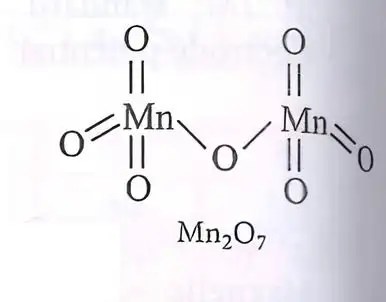
- Oxidation state: The highest oxidation number in an oxide can match the element’s group number, as in \(Sc_2O_3\), \(TiO_2\), \(V_2O_5\), \(CrO_3\) and \(Mn_2O_7\).
- Beyond group 7: No higher oxides are known for the later elements in this trend; notable oxides include \(Fe_2O_3\) and \(Co_3O_4\).
- Oxides versus fluorides: High oxidation states are often more stable in oxides because oxygen forms multiple bonds with metals. Mn reaches \(+7\) in \(Mn_2O_7\), but only \(+4\) in \(MnF_4\).
- Manganese(VII) oxide: In \(Mn_2O_7\), each Mn is tetrahedrally surrounded by O atoms, with an \(Mn-O-Mn\) bridge.
Oxoanions
- Examples: Tetrahedral oxoanions include \(VO_4^{3-}\), \(CrO_4^{2-}\), \(MnO_4^{3-}\), \(MnO_4^{2-}\) and \(MnO_4^-\).
Additional Exam-Relevant Facts
Classification and examples
- Pseudo-transition elements: Zn, Cd and Hg are d-block elements but are not transition elements; they are also called non-typical transition elements.
- White anhydrous salts: Anhydrous \(FeSO_4\) and \(CuSO_4\) are white because crystal-field splitting is absent, even though their ions have unpaired electrons.
- Copper stability: \(Cu^{2+}(3d^9)\) is favoured in aqueous solution over \(Cu^+(3d^{10})\); typical potentials are \(E^\circ(Cu^{2+}/Cu)=0.34\,V\) and \(E^\circ(Cu^+/Cu)=0.52\,V\).
- Melting-point extremes: Tungsten, \(W\) (\(Z=74\)), has the highest melting point, about \(3410^\circ C\); mercury, \(Hg\) (\(Z=80\)), has the lowest, about \(-38.9^\circ C\).
Do not assume that every coloured transition-metal species is coloured by \(d\)–\(d\) transitions: ions with empty \(d\) orbitals, such as \(MnO_4^-\), are coloured by charge transfer.
Why do transition metals show variable oxidation states?
State the formula for the spin-only magnetic moment and define its variable.
Why is \(CuI_2\) not stable?
Quick recap
- Transition metals generally show metallic character, strong bonding, and high melting and atomisation enthalpies.
- Small energy differences between \((n-1)d\) and \(ns\) orbitals produce variable oxidation states.
- Unpaired \(d\) electrons cause paramagnetism; the spin-only moment is \(\mu=\sqrt{n(n+2)}\) BM.
- Many transition-metal ions are coloured by \(d\)–\(d\) transitions; some empty-\(d\) ions are coloured by charge transfer.
- Complex formation, variable oxidation states and lattice features explain complex formation, catalysis, interstitial compounds and alloys.
- Fluorine stabilises high oxidation states in some halides, while multiple metal–oxygen bonding helps stabilise high oxidation states in oxides.
- Aqueous \(Cu^+\) disproportionates, and \(Cu^{2+}\) oxidises iodide; tungsten and mercury mark the highest and lowest melting-point extremes.
Some Important Compounds of Transition Elements
Oxides and Oxoanions of Metals
Formation and character of transition-metal oxides
- Formation: Transition metals combine with oxygen at high temperatures to form oxides.
- Monoxides: Metals generally form ionic monoxides, \(MO\), up to manganese; scandium is an exception.
- Oxidation states: The highest oxidation number in an oxide generally equals the element’s group number; examples include \(Sc_2O_3\), \(TiO_2\), \(V_2O_5\), \(Cr_2O_3\) and \(Mn_2O_7\).
- Beyond manganese: The only higher oxides known after manganese are \(Fe_2O_3\) and \(Co_3O_4\).
- Covalent character: It increases with oxidation number. High-oxidation-state oxides such as \(V_2O_5\), \(Cr_2O_3\) and \(Mn_2O_7\) have relatively low melting points; \(Mn_2O_7\) is a green covalent oil.
- Acidity: Oxide acidity generally increases as the metal’s oxidation number rises.
| Oxide | Character / reaction |
|---|---|
| \(V_2O_3\) | Basic |
| \(V_2O_4\) | Less basic than \(V_2O_3\) |
| \(V_2O_5\) | Amphoteric; reacts with alkalis to form \(VO_4^{3-}\) and with acids to form \(VO_2^+\) |
| \(CrO\) | Basic |
| \(Cr_2O_3\) | Amphoteric |
| \(CrO_3\) and \(Mn_2O_7\) | Acidic; form acids with water |
Potassium Dichromate
Potassium dichromate — Potassium dichromate, \(K_2Cr_2O_7\), is an orange chromium(VI) salt and a strong oxidising agent, especially in acidic solution.
Preparation
- Ore: Chromite, \(FeCr_2O_4\), is fused with sodium carbonate in air to produce sodium chromate.
- Conversion: Sodium chromate is acidified to sodium dichromate; treatment with potassium chloride gives the less soluble potassium dichromate.
Structure and physical properties
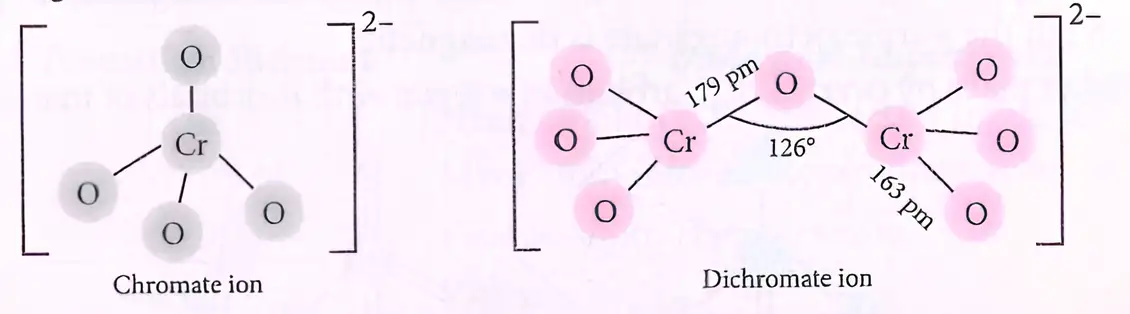
- Chromate ion: \(CrO_4^{2-}\) has a tetrahedral structure.
- Dichromate ion: \(Cr_2O_7^{2-}\) consists of two tetrahedra sharing one corner; the \(Cr-O-Cr\) bond angle is \(126^\circ\).
- Appearance and solubility: Potassium dichromate forms orange crystals, moderately soluble in cold water and readily soluble in hot water.
| Salt | Key property / use |
|---|---|
| Sodium dichromate, \(Na_2Cr_2O_7\) | More soluble in water; widely used as an oxidising agent in organic chemistry |
| Potassium dichromate, \(K_2Cr_2O_7\) | Used as a primary standard in volumetric analysis; strong oxidising agent in acidic medium |
Oxidising action of dichromate
- Oxidised substances: Acidified dichromate oxidises iodide to iodine, hydrogen sulphide to sulphur, tin(II) to tin(IV), and iron(II) to iron(III).
- Ionic method: Add the six-electron dichromate reduction half-reaction to the balanced oxidation half-reaction of the reducing agent.
- Iron(II) example: The net ionic equation shows \(Fe^{2+}\) oxidised to \(Fe^{3+}\).
Chromyl chloride test
- Test: Heat a chloride with solid potassium dichromate and concentrated sulphuric acid.
- Positive result: Red vapours of chromyl chloride, \(CrO_2Cl_2\), are produced.
Potassium Permanganate
Potassium permanganate — Potassium permanganate, \(KMnO_4\), is a purple manganese(VII) salt and a strong oxidising agent.
Preparation
- Starting ore: Pyrolusite, \(MnO_2\), is fused with potassium hydroxide and oxidised to green manganate, \(K_2MnO_4\).
- Commercial route: Alkaline oxidative fusion is followed by electrolytic oxidation of manganate to permanganate.
- Laboratory route: Manganese(II) ions can be oxidised to permanganate by peroxodisulphate.
Disproportionation and structure
- Disproportionation: In acidic or neutral medium, manganate forms permanganate and manganese dioxide.
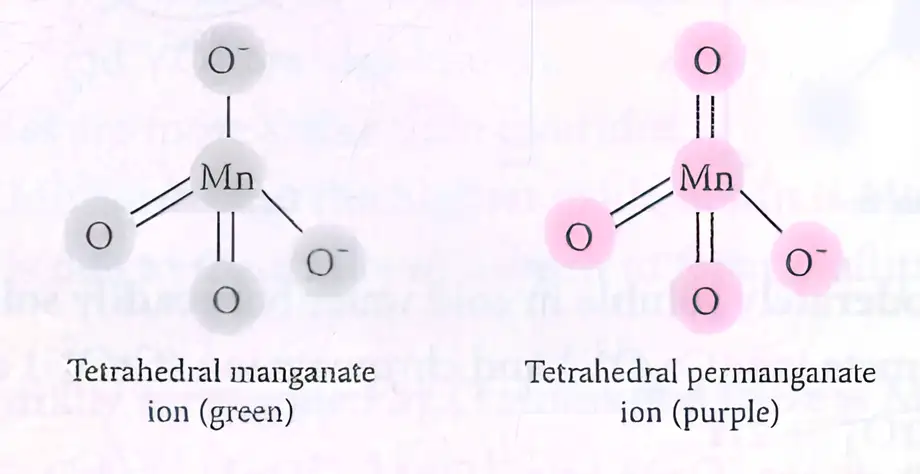
- Geometry: Both manganate and permanganate ions are tetrahedral.
- Magnetism: Green \(MnO_4^{2-}\) is paramagnetic with one unpaired electron; purple \(MnO_4^-\) is diamagnetic.
- Bonding: The \(\pi\) bonding involves overlap of oxygen \(p\) orbitals with manganese \(d\) orbitals.
Physical properties and thermal decomposition
- Appearance: \(KMnO_4\) forms dark purple, almost black crystals and is sparingly soluble in water.
- Structure type: Its crystals are isostructural with \(KClO_4\).
- Heating: At \(513\,K\), potassium permanganate decomposes to potassium manganate, manganese dioxide and oxygen.
Oxidising action in acidic medium
- Reduction product: In acidic solution, permanganate is reduced to \(Mn^{2+}\).
- Common oxidations: It oxidises iodide to iodine, iron(II) to iron(III), oxalate to carbon dioxide, hydrogen sulphide to sulphur, sulphite to sulphate, and nitrite to nitrate.
- Oxalate condition: Oxidation of oxalate or oxalic acid is carried out at \(333\,K\).
Oxidising action in neutral or faintly alkaline medium
- Reduction product: Permanganate is reduced to solid \(MnO_2\).
- Iodide: It is oxidised to iodate, \(IO_3^-\).
- Thiosulphate: It is oxidised almost quantitatively to sulphate.
- Manganese(II): It is oxidised to \(MnO_2\); zinc sulphate or zinc oxide catalyses this oxidation.
Use dilute \(H_2SO_4\) for \(KMnO_4\) volumetric titrations. Do not substitute \(HCl\) (it can be oxidised to \(Cl_2\)) or \(HNO_3\) (it is itself an oxidising agent and may oxidise the reducing agent).
Uses of potassium permanganate
- Analytical chemistry: Used in volumetric analysis as an oxidising agent.
- Organic chemistry: A common oxidant in preparative reactions.
- Other uses: Bleaches wool, cotton, silk and other textile fibres; decolourises oils.
| Element | Biological importance |
|---|---|
| \(Fe\) | Haemoglobin carries oxygen in blood; myoglobin stores oxygen in muscle. |
| \(Cu\) | Present in plastocyanin and haemocyanin. |
| \(Co\) | Present in vitamin \(B_{12}\). |
| \(Zn\) | Present in carbonic anhydrase. |
The Inner Transition Elements (f-Block)
f-block elements — Elements in which the last electron enters an \(f\) orbital are called \(f\)-block elements, also known as inner transition elements.
| Series | Elements described |
|---|---|
| Lanthanoids | The fourteen elements following lanthanum |
| Actinoids | The fourteen elements following actinium |
How does the chromate–dichromate equilibrium respond to acid and alkali?
What is the reduction product of permanganate in acidic and neutral media?
Quick recap
- Oxide covalent character and acidity generally increase with the metal’s oxidation number.
- \(CrO_4^{2-}\) is yellow; acidic conditions favour orange \(Cr_2O_7^{2-}\), while alkaline conditions favour chromate.
- Acidified dichromate is reduced from chromium(VI) to chromium(III) and oxidises several common reducing agents.
- Permanganate is reduced to \(Mn^{2+}\) in acid and to \(MnO_2\) in neutral or faintly alkaline medium.
- Use dilute \(H_2SO_4\), not \(HCl\) or \(HNO_3\), in permanganate titrations.
- \(f\)-block elements are inner transition elements; the series are lanthanoids and actinoids.
The Lanthanoids
Electronic Configurations and Radii
Lanthanoids — The lanthanoids extend from lanthanum (\(\mathrm{La}\)) to lutetium (\(\mathrm{Lu}\)); their general symbol is \(\mathrm{Ln}\).
Configuration patterns
- Neutral atoms: They generally have \(6s^2\) with variable occupancy of the \(4f\) level; La, Gd and Lu also have a \(5d^1\) electron.
- Most stable ions: The predominant \(+3\) ions have configurations \(4f^n\); \(n\) increases across the series from \(0\) for La to \(14\) for Lu.
- Notation: The configurations below show only electrons outside the \([\mathrm{Xe}]\) core.
| Atomic number | Element | Neutral atom | \(\mathrm{Ln}^{2+}\) | \(\mathrm{Ln}^{3+}\) | \(\mathrm{Ln}^{4+}\) | Atomic radius (pm) | \(\mathrm{Ln}^{3+}\) radius (pm) |
|---|---|---|---|---|---|---|---|
| 57 | La | \(5d^1 6s^2\) | \(5d^1\) | \(4f^0\) | — | 187 | 106 |
| 58 | Ce | \(4f^1 5d^1 6s^2\) | \(4f^2\) | \(4f^1\) | \(4f^0\) | 183 | 103 |
| 59 | Pr | \(4f^3 6s^2\) | \(4f^3\) | \(4f^2\) | \(4f^1\) | 182 | 101 |
| 60 | Nd | \(4f^4 6s^2\) | \(4f^4\) | \(4f^3\) | \(4f^2\) | 181 | 99 |
| 61 | Pm | \(4f^5 6s^2\) | \(4f^5\) | \(4f^4\) | — | 181 | 98 |
| 62 | Sm | \(4f^6 6s^2\) | \(4f^6\) | \(4f^5\) | — | 180 | 96 |
| 63 | Eu | \(4f^7 6s^2\) | \(4f^7\) | \(4f^6\) | — | 199 | 95 |
| 64 | Gd | \(4f^7 5d^1 6s^2\) | \(4f^7 5d^1\) | \(4f^7\) | — | 180 | 94 |
| 65 | Tb | \(4f^9 6s^2\) | \(4f^9\) | \(4f^8\) | \(4f^7\) | 178 | 92 |
| 66 | Dy | \(4f^{10} 6s^2\) | \(4f^{10}\) | \(4f^9\) | \(4f^8\) | 177 | 91 |
| 67 | Ho | \(4f^{11} 6s^2\) | \(4f^{11}\) | \(4f^{10}\) | — | 176 | 89 |
| 68 | Er | \(4f^{12} 6s^2\) | \(4f^{12}\) | \(4f^{11}\) | — | 175 | 88 |
| 69 | Tm | \(4f^{13} 6s^2\) | \(4f^{13}\) | \(4f^{12}\) | — | 174 | 87 |
| 70 | Yb | \(4f^{14} 6s^2\) | \(4f^{14}\) | \(4f^{13}\) | — | 173 | 86 |
| 71 | Lu | \(4f^{14} 5d^1 6s^2\) | \(4f^{14} 5d^1\) | \(4f^{14}\) | — | — | — |
Lanthanoid Contraction
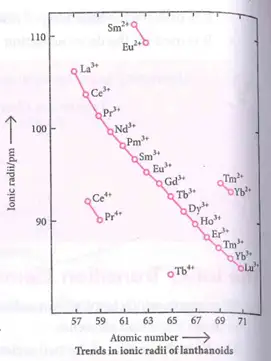
Lanthanoid contraction — The gradual decrease in atomic and ionic radii from lanthanum to lutetium is called lanthanoid contraction.
Cause and trend
- Cause: From La to Lu, nuclear charge increases as electrons are added to the \(4f\) orbitals.
- Poor shielding: \(4f\) electrons shield the growing nuclear charge imperfectly, so effective nuclear charge increases and radii decrease.
- Trend detail: Atomic radii decrease irregularly because of irregular electronic configurations; ionic radii decrease regularly.
Consequences of Lanthanoid Contraction
- Transition-series radii: Atomic radii of corresponding second- and third-transition-series elements are nearly identical; for example, \(\mathrm{Zr}=160\,\mathrm{pm}\) and \(\mathrm{Hf}=159\,\mathrm{pm}\).
- Difficult separation: Similar radii cause these elements to occur together in nature and make their separation from mixtures difficult.
- Lanthanoid properties: Small differences in the atomic and ionic radii of lanthanoids cause differences in their basic properties.
- Separating lanthanoids: Small differences in lanthanoid radii are used to separate them by solvent extraction or ion exchange.
Why are zirconium and hafnium difficult to separate?
Oxidation States
- Origin of exceptions: Other oxidation states can be favoured by stable empty (\(4f^0\)), half-filled (\(4f^7\)) or fully filled (\(4f^{14}\)) subshells.
- Examples: \(\mathrm{Ce}^{4+}\) is \(4f^0\); \(\mathrm{Eu}^{2+}\) is \(4f^7\); \(\mathrm{Tb}^{4+}\) is \(4f^7\); and \(\mathrm{Yb}^{2+}\) is \(4f^{14}\).
- Cerium: Formation of \(\mathrm{Ce}^{4+}\) is favoured by its noble-gas configuration. \(E^\circ(\mathrm{Ce}^{4+}/\mathrm{Ce}^{3+})=1.74\,\mathrm{V}\); it is a strong oxidant that can oxidise water very slowly, so \(\mathrm{Ce(IV)}\) is a useful analytical reagent.
- Other \(+4\) ions: Pr, Nd, Tb and Dy also show the \(+4\) state, but only in oxides of formula \(\mathrm{MO_2}\).
- Europium: \(\mathrm{Eu}^{2+}\) is favoured by its stable half-filled \(4f^7\) configuration but is a strong reducing agent, changing to the common \(+3\) state.
- Ytterbium: \(\mathrm{Yb}^{2+}\) has a fully filled \(4f^{14}\) configuration and is a reductant.
- Terbium and samarium: \(\mathrm{Tb}^{4+}\) has a half-filled \(4f^7\) configuration and is an oxidant; samarium shows both \(+2\) and \(+3\) states.
| Ion | Configuration | Key behaviour |
|---|---|---|
| \(\mathrm{Ce}^{4+}\) | \(4f^0\) | Strong oxidant; used as an analytical reagent |
| \(\mathrm{Eu}^{2+}\) | \(4f^7\) | Strong reducing agent |
| \(\mathrm{Tb}^{4+}\) | \(4f^7\) | Oxidant |
| \(\mathrm{Yb}^{2+}\) | \(4f^{14}\) | Reducing agent |
Why do some lanthanoids show oxidation states other than \(+3\)?
General Characteristics
- Appearance and air: Soft, silvery-white metals that tarnish readily in moist air; they burn in oxygen to form \(\mathrm{Ln_2O_3}\).
- Hardness: Generally increases with atomic number; samarium is exceptionally hard, like steel.
- Melting points: Usually \(1000\)–\(1200\,\mathrm{K}\); samarium is an exception at \(1623\,\mathrm{K}\).
- Conductivity: Their metallic structure makes them good conductors of heat and electricity.
- Density: Density and related properties change smoothly, except for Eu and Yb and occasionally Sm and Tm.
- Colour: Ions are generally coloured due to \(f\)–\(f\) transitions involving unpaired electrons. \(\mathrm{La}^{3+}\) (\(4f^0\)) and \(\mathrm{Lu}^{3+}\) (\(4f^{14}\)) are colourless.
- Magnetism: \(\mathrm{La}^{3+}\) and \(\mathrm{Lu}^{3+}\) are diamagnetic; the other trivalent lanthanoid ions are paramagnetic.
- Ionisation enthalpy: First values are about \(600\,\mathrm{kJ\,mol^{-1}}\) and second values about \(1200\,\mathrm{kJ\,mol^{-1}}\); third values vary irregularly.
- Third ionisation exception: The third ionisation enthalpies of La, Gd and Lu are abnormally low due to exchange-enthalpy considerations, which stabilise the \(4f^0\), \(4f^7\) and \(4f^{14}\) configurations, respectively.
- Standard electrode potentials: For \(\mathrm{Ln^{3+}_{(aq)}+3e^-\rightarrow Ln_{(s)}}\), \(E^\circ\) is generally in the range \(-2.2\) to \(-2.4\,\mathrm{V}\); Eu is an exception at \(-2.0\,\mathrm{V}\).
Chemical Behaviour
- Hydrogen: On gentle heating, lanthanoids combine with hydrogen to form hydrides.
- Carbon: Heating with carbon forms carbides: \(\mathrm{Ln_3C}\), \(\mathrm{LnC_2}\) and \(\mathrm{Ln_2C_3}\).
- Dilute acids: They liberate hydrogen and form \(\mathrm{Ln^{3+}}\) ions.
- Halogens: Burning in halogens forms trihalides, \(\mathrm{LnX_3}\).
- Oxygen: Burning in oxygen forms oxides, \(\mathrm{Ln_2O_3}\).
- Basic compounds: Their oxides and hydroxides have formulas \(\mathrm{Ln_2O_3}\) and \(\mathrm{Ln(OH)_3}\) and are basic, like alkaline-earth metal oxides and hydroxides.
What causes lanthanoid contraction, and how does it affect the third ionisation enthalpies of La, Gd and Lu?
Quick recap
- Lanthanoids generally have \(6s^2\) atoms and predominantly form stable \(+3\) ions with configurations from \(4f^0\) to \(4f^{14}\).
- Lanthanoid contraction is the decrease in radii from La to Lu, caused by imperfect shielding by \(4f\) electrons.
- Contraction makes Zr and Hf radii almost equal and helps explain why they occur together in nature and are difficult to separate.
- Small differences in lanthanoid radii cause differences in basic properties and allow separation by solvent extraction or ion exchange.
- The common oxidation state is \(+3\); \(+2\) and \(+4\) states can be favoured by stable \(4f^0\), \(4f^7\) or \(4f^{14}\) subshells.
- \(\mathrm{La}^{3+}\) and \(\mathrm{Lu}^{3+}\) are colourless and diamagnetic; other trivalent lanthanoid ions are generally coloured and paramagnetic.
- Lanthanoids form hydrides, carbides, trihalides and basic \(\mathrm{Ln_2O_3}\) oxides and \(\mathrm{Ln(OH)_3}\) hydroxides.
The Actinoids
Electronic Configuration and Radioactivity
Ionic Radii and Actinoid Contraction
Oxidation States
General Characteristics
Lanthanoids vs Actinoids
Why is actinoid contraction greater than lanthanoid contraction?
Why do actinoids show a wider range of oxidation states than lanthanoids?
Name three colourless actinoid ions and give the reason.
Quick recap
- Actinoids from Th to Lr have general configuration \(5f^{0-14}6d^{0-2}7s^2\) and are all radioactive.
- Extra stability of \(f^0\), \(f^7\) and \(f^{14}\) causes configuration irregularities.
- Ionic radii decrease across the series; actinoid contraction is greater than lanthanoid contraction.
- The common oxidation state is \(+3\); a small \(5f\)–\(6d\)–\(7s\) energy gap permits higher states.
- Actinoids are silvery-white, strongly paramagnetic, have low ionisation energies and are strong reducing agents.
- Compared with lanthanoids, actinoids show higher oxidation states, form oxo-cations and complexes more readily, and have more basic compounds.
Some Applications of d- and f-Block Elements
Uses of d- and f-Block Elements
| Material or element | Application |
|---|---|
| Iron and steel | Important materials for construction. |
| \(TiO_2\) | Used in the pigment industry. |
| \(MnO_2\), Zn, Ni and Cd | Used in the battery industry. |
| Cu, Ag and Au | Used to make coins and ornaments. |
| \(V_2O_5\) | Catalyst in the manufacture of sulphuric acid. |
| \(TiCl_4\) with \(Al(CH_3)_3\) | Used in the manufacture of polythene. |
| Iron | Catalyst in Haber’s process for manufacturing ammonia. |
| Ni | Catalyst for hydrogenation of fats. |
| Ni complexes | Useful in polymerisation of alkynes and other organic compounds. |
| \(PdCl_2\) | Catalyst in Wacker’s process for oxidation of ethyne to ethanal. |
| \(AgBr\) | Its light-sensitive property is used in photographic industries. |
| Neodymium and praseodymium oxides | Used to make coloured goggles that absorb yellow sodium light; useful for glass blowers. |
Quick recap
- Iron and steel are major construction materials.
- \(TiO_2\) is used as a pigment; several transition metals and compounds are used in batteries.
- Cu, Ag and Au are used for coins and ornaments.
- Transition-metal catalysts are important in chemical manufacture and organic reactions.
- The light sensitivity of \(AgBr\) is used in photography.
- Neodymium and praseodymium oxides make goggles that absorb yellow sodium light.
NEET Chemistry — ALL CHAPTERS
1
Some Basic Concepts of Chemistry
2
Structure of Atom
3
Classification of Elements and Periodicity in Properties
4
Chemical Bonding and Molecular Structure
5
Thermodynamics
6
Equilibrium
7
Redox Reactions
8
Organic Chemistry - Some Basic Principles and Techniques
9
Hydrocarbons
10
Solutions
11
Electrochemistry
12
Chemical Kinetics
13
The d- and f- Block Elements
14
Coordination Compounds
15
Haloalkanes and Haloarenes
16
Alcohols, Phenols and Ethers
17
Aldehydes, Ketones and Carboxylic Acids
18
Amines
19
Biomolecules
20
The p-Block Elements (Group 13 and 14)
21
The p-Block Elements (Group 15 to 18)
22
Principles Related to Practical Chemistry