CLASS 12-HUMANITIES . GEOGRAPHY . FUNDAMENTALS OF HUMAN GEOGRAPHY . SECONDARY ACTIVITIES
Chapter 5 : Secondary Activities
Ch 5
GEOGRAPHY
CLASS 12-HUMANITIES
Secondary Activities
Secondary activities involve the transformation of natural resources into finished goods through manufacturing, processing, and construction industries. These activities add value to raw materials by converting them into products that are useful for consumption and further production.
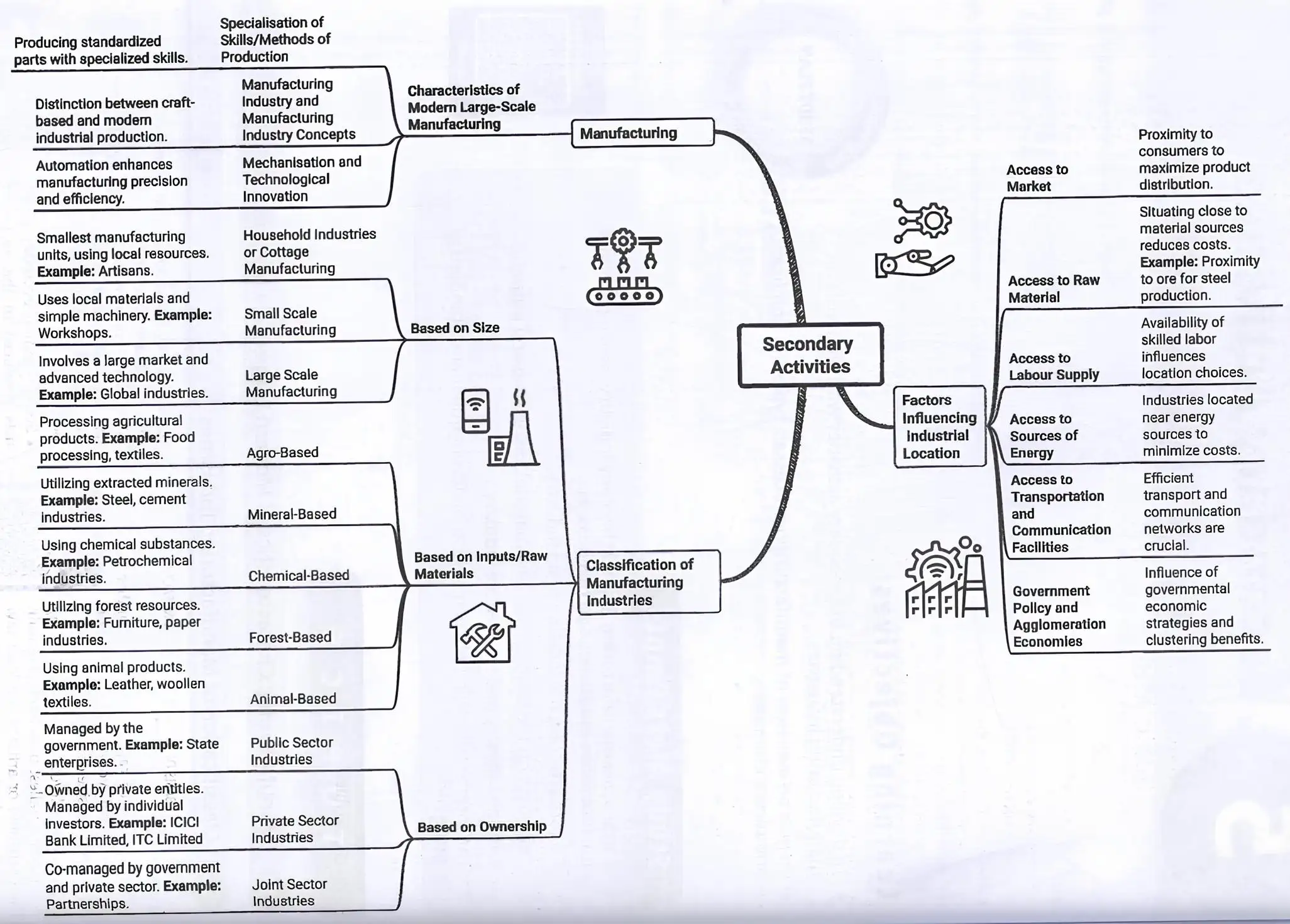
Characteristics of Secondary Activities
Secondary activities are characterized by the use of power, machinery, and specialized labor in factory settings to produce standardized goods. They include both modern large-scale manufacturing and traditional craft methods.
Exam Question: What are secondary activities and how do they add value to natural resources?
Answer: Secondary activities involve manufacturing, processing, and construction that transform raw materials into finished goods, thereby adding value to natural resources.
Factors Affecting the Location of Industries
Industries are located based on factors such as availability of raw materials, access to markets, labor supply, energy sources, transportation, communication, and government policies. Proximity to raw materials is crucial for industries using bulky or weight-losing materials, while market access is vital for finished goods.
Exam Question: What are the main factors influencing the location of industries?
Answer: The main factors include availability of raw materials, market access, labor supply, energy sources, transportation, communication, and government policies.
Interrelationship Between Industrial Development and Standard of Living
Industrial development leads to economic growth, employment generation, and improved infrastructure, which collectively enhance the standard of living. Developed regions with advanced industries tend to have higher purchasing power and better quality of life.
Exam Question: How does industrial development affect the standard of living?
Answer: Industrial development creates jobs, increases income, and improves infrastructure, which raises the standard of living.
Characteristics of Modern Large-Scale Manufacturing
Modern large-scale manufacturing involves mass production of standardized products using complex machinery, specialized labor, and significant capital investment. It contrasts with the craft method, which produces limited quantities made-to-order with higher costs.
- Use of complex machine technology
- Extreme specialization and division of labor
- Large capital investment
- Large organizational structures with executive bureaucracy
- Location chosen to minimize production costs
Exam Question: What distinguishes modern large-scale manufacturing from the craft method?
Answer: Modern manufacturing uses mass production with specialized labor and machinery to produce large quantities of standardized goods, while the craft method produces few made-to-order items with higher costs.
Classification of Manufacturing Industries
Manufacturing industries are classified based on size, raw materials used, ownership, and output.
Classification by Size
Size depends on capital invested, number of workers, and production volume.
- Cottage Industry: Smallest units, using local raw materials and hand tools, often family-run with low commercial significance.
- Small-Scale Industry: Uses simple power-driven machines and semi-skilled labor.
- Large-Scale Industry: Requires large markets, various raw materials, advanced technology, specialized workers, and large capital.
Exam Question: What are the differences between cottage, small-scale, and large-scale industries?
Answer: Cottage industries are small, family-based units using hand tools; small-scale industries use simple machines and semi-skilled labor; large-scale industries involve advanced technology, large capital, and mass production.
Classification by Raw Material
- Agro-Based Industries: Process raw materials from agriculture, e.g., sugar, cotton textiles.
- Mineral-Based Industries: Use minerals like iron ore and coal.
- Chemical-Based Industries: Use natural chemical minerals and products from wood and coal.
- Forest-Based Industries: Use timber, bamboo, grass, and lac.
- Animal-Based Industries: Use leather and wool.
Exam Question: Name different types of manufacturing industries based on raw materials.
Answer: Agro-based, mineral-based, chemical-based, forest-based, and animal-based industries.
Classification by Ownership
- Public Sector Industries: Owned and managed by the government.
- Private Sector Industries: Owned by individual investors.
- Joint Sector Industries: Managed by joint stock companies or a combination of public and private sectors.
Exam Question: What are the types of industries based on ownership?
Answer: Public sector, private sector, and joint sector industries.
High Technology Industries
High-tech industries use robotics, computer-aided design, electronic controls, and develop new chemical and pharmaceutical products. They represent the latest generation of manufacturing activities.
Exam Question: What characterizes high technology industries?
Answer: Use of advanced robotics, computer-aided design, electronic controls, and continuous innovation in products.
Basic and Heavy Industries
The iron and steel industry is the basic industry forming the foundation for other industries. It is also called heavy industry due to the use of bulky raw materials and heavy products.
Exam Question: Why is the iron and steel industry called a basic industry?
Answer: Because it provides essential materials for other industries and uses large quantities of raw materials and produces heavy products.
Cotton Textile Industry
This industry has three sub-sectors: handloom, powerloom, and mill sectors. It requires good quality cotton, produced mainly in India, China, USA, Pakistan, Uzbekistan, and Egypt.
Exam Question: What are the sub-sectors of the cotton textile industry?
Answer: Handloom, powerloom, and mill sectors.
Solved Examples
- Example: Explain why industries based on bulky raw materials are located near the source of raw materials.
Solution: Bulky raw materials are heavy and expensive to transport. Locating industries near the source reduces transportation costs and losses, making production more economical. - Example: What factors influence the location of a manufacturing industry?
Solution: Factors include availability of raw materials, market access, labor supply, energy sources, transportation, communication, and government policies.
Practice Set
Easy
- Define secondary activities.
- What is a cottage industry?
Moderate
- List three factors that influence the location of industries.
- Explain the difference between public sector and private sector industries.
Challenging
- Describe the characteristics of modern large-scale manufacturing.
- Discuss the importance of the iron and steel industry in industrial development.
Answer Key
- Secondary activities involve manufacturing, processing, and construction that transform raw materials into finished goods.
- A cottage industry is a small manufacturing unit where artisans use local raw materials and hand tools, often family-run.
- Factors influencing location include raw materials, market access, labor supply, energy, transportation, communication, and government policies.
- Public sector industries are owned and managed by the government, while private sector industries are owned by individuals or private companies.
- Modern large-scale manufacturing uses complex machinery, specialized labor, mass production, and large capital investment.
- The iron and steel industry is the basic industry providing essential materials for other industries and is called heavy industry due to its use of bulky raw materials.
Quick Reference
- Secondary Activities: Manufacturing, processing, construction industries.
- Factors Affecting Industry Location: Raw materials, market, labor, energy, transport, communication, government policies.
- Industry Classification: Size (cottage, small-scale, large-scale), raw material (agro, mineral, chemical, forest, animal), ownership (public, private, joint).
- Modern Manufacturing: Mass production, specialization, machinery, large capital.
- Basic Industry: Iron and steel industry.
- High-Tech Industry: Robotics, CAD, electronic controls.
Glossary
- Secondary Activities
- Activities that involve manufacturing, processing, and construction to add value to raw materials.
- Cottage Industry
- Small-scale manufacturing units using local materials and hand tools, often family-run.
- Capital
- Wealth or assets invested in a business to generate income.
- Agglomeration Economies
- Benefits gained by businesses from being located close to each other, such as reduced costs and shared services.
- Public Sector Industries
- Industries owned and managed by the government.
- Private Sector Industries
- Industries owned by private individuals or companies.
- Joint Sector Industries
- Industries managed jointly by public and private sectors.
- High Technology Industry
- Industries using advanced technology like robotics and computer-aided design.
- Basic Industry
- Industry that provides essential materials for other industries, e.g., iron and steel.
| Time Period / Year | Event / Change | Importance |
|---|---|---|
| Pre-Industrial Era | Craft method manufacturing | Small-scale, made-to-order production with high costs |
| Industrial Revolution | Introduction of mass production and mechanization | Increased production, specialization, and lower costs |
| 20th Century | Development of large-scale industries and agglomeration economies | Growth of industrial regions and economic development |
| Late 20th Century | Emergence of high technology industries | Advanced manufacturing with robotics and computer-aided design |