CLASS 12-HUMANITIES . GEOGRAPHY . FUNDAMENTALS OF HUMAN GEOGRAPHY . THE WORLD-POPULATION-DISTRIBUTION-DENSITY-AND-GROWTH
Chapter 2 : The World Population Distribution, Density And Growth
Ch 2
GEOGRAPHY
CLASS 12-HUMANITIES
World Population Distribution, Density and Growth
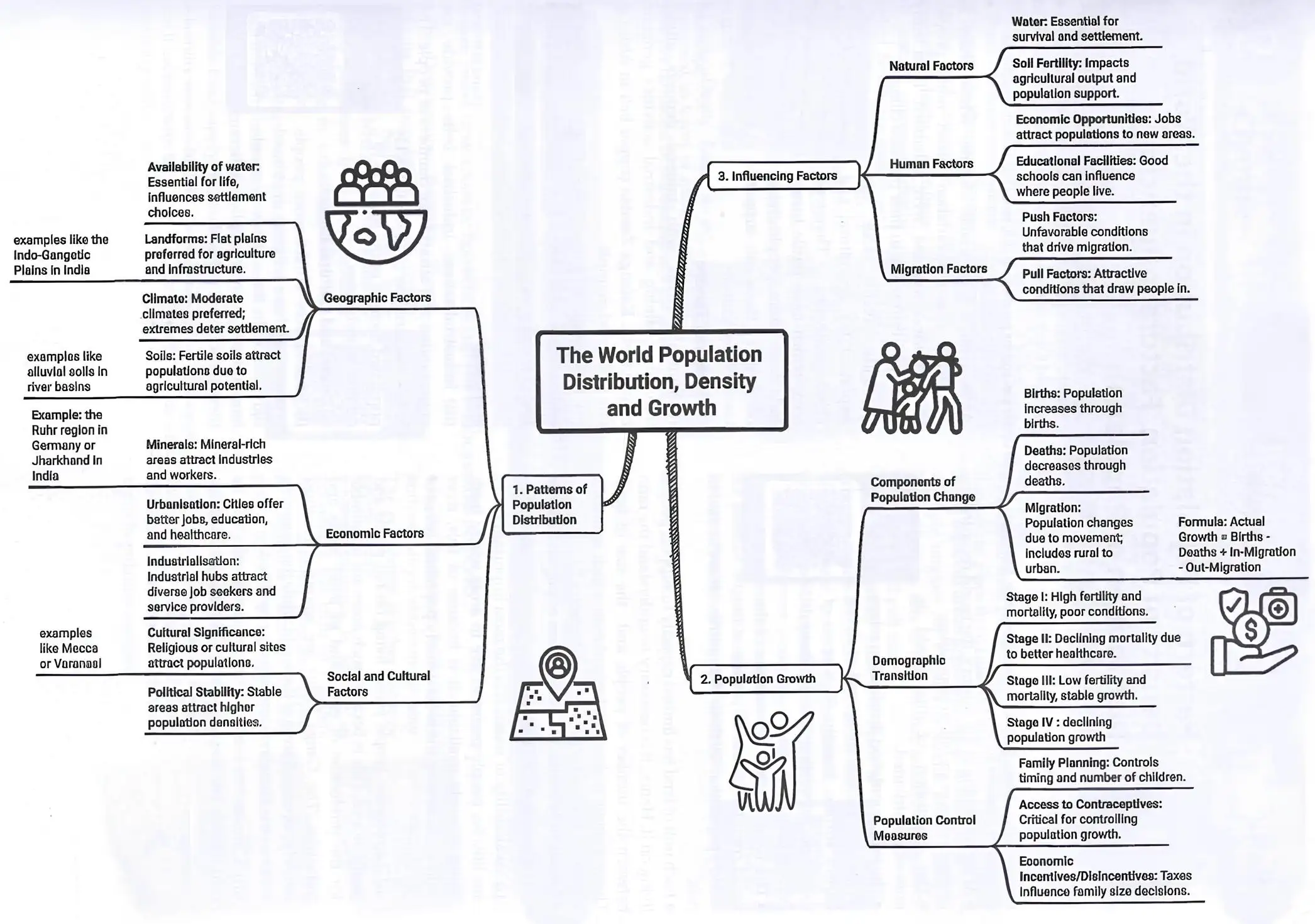
The world population distribution, density, and growth are fundamental concepts in human geography that explain how people are spread across the Earth, the concentration of people in specific areas, and the changes in population size over time.
Pattern of Population Distribution in the World
Population distribution refers to the way people are spaced over the Earth's surface. It is uneven, with about 90 percent of the world population living on only 10 percent of the land area. The ten most populous countries contribute about 60 percent of the world’s population, with six of these countries located in Asia.
Population density measures the number of people per square kilometer and indicates how crowded a place is.
Factors Influencing Population Distribution
Several factors influence where people live:
- Geographical Factors:
- Availability of Water: Fresh water is essential for life, making river valleys some of the most densely populated areas.
- Landforms: Flat plains and gentle slopes are preferred for agriculture and infrastructure development, such as the Ganga Plains, which are densely populated, unlike mountainous regions like the Himalayas.
- Climate: Comfortable climates attract more people, while extreme climates like deserts are sparsely populated. Mediterranean regions have been inhabited since early history due to their pleasant climate.
- Soils: Fertile soils, especially loamy soils, support intensive agriculture and thus attract higher populations.
- Economic Factors:
- Minerals: Areas rich in minerals attract industries and employment, such as the Katanga copper belt in Zambia.
- Urbanisation: Cities offer better employment, education, healthcare, and transport, attracting migrants.
- Industrialisation: Industrial belts like the Kobe-Osaka region in Japan have high population densities due to job opportunities.
- Social and Cultural Factors:
- Places with religious or cultural significance attract people, while social and political unrest can cause people to move away.
Exam Question
Q: What are the main geographical factors influencing population distribution?
A: The main geographical factors are availability of water, landforms, climate, and soil fertility.
Population Growth and Components of Population Change
Population growth refers to the change in the number of inhabitants in a territory over a specific period. It is an important indicator of economic development, social progress, and cultural background.
Components of Population Change
Population change is influenced by three components:
- Births: Number of live births contributing to natural increase.
- Deaths: Number of deaths reflecting healthcare quality.
- Migration: Movement of people into or out of an area, which can be permanent, temporary, or seasonal.
Migration occurs in various forms: rural to rural, rural to urban, urban to urban, and urban to rural.
Migration is influenced by:
- Push Factors: Conditions that drive people away from their place of origin, such as unemployment, poor living conditions, political turmoil, and unpleasant climate.
- Pull Factors: Conditions that attract people to a new place, such as better job opportunities and living conditions.
Exam Question
Q: What are the three components of population change?
A: The three components are births, deaths, and migration.
Demographic Transition
The Demographic Transition Theory explains how population changes as a society progresses from a rural, agrarian, and illiterate stage to an urban, industrial, and literate stage.
Stages of Demographic Transition
- Stage 1: High birth and death rates due to compensating for deaths caused by epidemics and food supply variability.
- Stage 2: Death rates decline due to improvements in healthcare, but birth rates remain high initially and then start to decline.
- Stage 3: Both birth and death rates decline significantly, leading to a stable or slowly growing population.
Mortality Rate: Number of deaths in a population.
Fertility Rate: Average number of children born to women of childbearing age.
Family planning, including access to contraceptives and spacing of births, plays a significant role in controlling population growth and improving women's health.
Exam Question
Q: What does the Demographic Transition Theory describe?
A: It describes the transition of a society from high birth and death rates to low birth and death rates as it develops economically and socially.
Solved Examples
Example 1: Explain why river valleys are densely populated.
Answer: River valleys have abundant fresh water, fertile soil, and flat land, making them suitable for agriculture and human settlement, leading to high population density.
Example 2: What are push and pull factors in migration?
Answer: Push factors are conditions that drive people away from their current location, such as unemployment or political unrest. Pull factors are conditions that attract people to a new location, such as better job opportunities and living conditions.
Practice Set
Easy
- Define population density.
- List two geographical factors affecting population distribution.
Moderate
- Explain the role of economic factors in population distribution.
- What are the components of population change?
Challenging
- Describe the stages of demographic transition and their significance.
- Discuss how migration affects population growth.
Answer Key
- Population density: Number of people per square kilometer.
- Geographical factors: Availability of water, landforms.
- Economic factors: Minerals, urbanisation, industrialisation attract population.
- Components of population change: Births, deaths, migration.
- Stages of demographic transition: High birth/death rates; declining death rates; low birth/death rates.
- Migration effects: Changes population size by moving people in or out of areas.
Quick Reference
- Population Distribution: Uneven spread of people over the Earth.
- Population Density: Number of people per unit area.
- Demographic Transition: Shift from high birth/death rates to low birth/death rates.
- Migration: Movement of people affecting population size.
- Push Factors: Reasons to leave a place.
- Pull Factors: Reasons to move to a place.
Glossary
- Population Distribution: The pattern of where people live on the Earth's surface.
- Population Density: Measurement of population per unit area.
- Demographic Transition: The process of change in a society's population from high birth and death rates to low birth and death rates.
- Migration: Movement of people from one place to another.
- Fertility Rate: Average number of children born to a woman during her lifetime.
- Mortality Rate: Number of deaths in a population.
- Push Factors: Negative aspects that drive people away from their current location.
- Pull Factors: Positive aspects that attract people to a new location.
| Time Period / Year | Event / Change | Importance |
|---|---|---|
| Early 21st Century | World population exceeds six billion | Highlights rapid population growth and uneven distribution |
| Demographic Transition Stages | Shift from high birth/death rates to low birth/death rates | Explains population growth patterns linked to development |