CLASS 12-HUMANITIES . GEOGRAPHY . FUNDAMENTALS OF HUMAN GEOGRAPHY . TRANSPORT AND-COMMUNICATION
Chapter 7 : Transport And Communication
Ch 7
GEOGRAPHY
CLASS 12-HUMANITIES
Transport and Communication
Transport and communication are essential components that connect producing centres with consuming centres, facilitating trade and economic activities. Efficient transport and communication networks contribute to high living standards and quality of life by enabling the movement of goods, services, and information.
Transport modes include land (roads and railways), water (inland waterways and ocean routes), air, and pipelines. Communication has evolved from traditional postal services to modern digital systems such as the internet and satellite communication, making the concept of a global village a reality.
Modes of Transport
Transport modes are classified into four principal types:
- Land Transport: Includes roads and railways. Roads are further divided into highways and rural roads. Railways are used for transporting bulky goods and passengers over long distances.
- Water Transport: Utilizes rivers, canals, and sea routes. It is cost-effective for carrying bulky goods over long distances.
- Air Transport: The fastest mode, preferred for long-distance passenger travel but is costly.
- Pipelines: Used for transporting liquids and gases such as petroleum, natural gas, and liquefied coal.
Exam Questions
Q1: What are the principal modes of transport?
Answer: The principal modes of transport are land (roads and railways), water (inland waterways and ocean routes), air, and pipelines.
Q2: Why is water transport considered economical for bulky goods?
Answer: Water transport does not require route construction and is cheaper for carrying bulky goods over long distances compared to land and air transport.
Land Transport, Water Transport, Air Transport, and Pipelines
Historically, humans initially carried goods themselves. The invention of the wheel led to carts and wagons, but the steam engine revolutionized transport in the eighteenth century. The internal combustion engine further advanced road transport with motor vehicles.
Road Transport: Most economical for short distances. Road density varies globally, with Asia having the highest road density and number of vehicles. Highways are metalled roads connecting distant places, extensively developed in Europe.
Rail Transport: Suitable for bulky goods and long distances. Railway gauges vary globally. Notable transcontinental railways include the Trans-Siberian Railway, Trans-Canadian Railway, Union and Pacific Railway, Orient Express, and Australian Trans-Continental Railway, built for economic and political reasons.
Water Transport: Major ocean routes include the Northern Atlantic Sea Route, Mediterranean-Indian Ocean Route, Cape of Good Hope Sea Route, North Atlantic Sea Route, and South Pacific Sea Route. Inland waterways depend on navigability and water flow.
Air Transport: Fastest mode, costly, preferred for long-distance passenger travel. No place in the world is more than 35 hours away by air.
Pipelines: Used extensively for transporting liquids and gases like petroleum, natural gas, and LPG. Pipelines connect oil wells to refineries, ports, or markets in Europe, Russia, West Asia, and India.
Exam Questions
Q1: What factors influence the significance of a mode of transport?
Answer: The type of goods and services, cost of transportation, and availability of the mode influence its significance.
Q2: Name two major transcontinental railways and their purpose.
Answer: The Trans-Siberian Railway and the Trans-Canadian Railway were constructed to facilitate long-distance travel for economic and political reasons.
Communication: Satellite Communication and Cyberspace-Internet
Communication methods have evolved from telegraph and telephone to modern digital systems. Telephones remain widely used, with cell phones enabled by satellites playing a crucial role in rural connectivity.
Satellites are artificial bodies placed in orbit to collect information or facilitate communication. They enable connectivity even in remote areas.
The internet is the largest electronic network, connecting over a billion people worldwide. Cyberspace refers to the electronic computerized space encompassing the internet and the World Wide Web.
The rapid expansion of cyberspace has transformed economic and social activities through email, e-commerce, e-learning, and e-governance. Communication technologies like fax, television, and radio complement internet access, bridging distances and time.
Exam Questions
Q1: What is the role of satellites in communication?
Answer: Satellites facilitate communication by enabling connectivity in remote areas and supporting technologies like cell phones and internet.
Q2: Define cyberspace.
Answer: Cyberspace is the electronic computerized space that includes the internet and the World Wide Web, enabling digital communication and activities.
Solved Examples
Example 1: Explain why water transport is preferred for carrying bulky goods over long distances.
Solution: Water transport does not require the construction of routes like roads or railways, making it cost-effective. It can carry large volumes of goods over long distances, especially between continents, making it ideal for bulky cargo.
Example 2: Describe the significance of the Trans-Siberian Railway.
Solution: The Trans-Siberian Railway is the world’s longest railway, connecting eastern and western Russia. It facilitates economic integration, trade, and political unity across eight time zones.
Practice Set
Easy
- List the four principal modes of transport.
- What is a metalled road?
- Define road density.
Moderate
- Explain the economic importance of pipelines.
- Describe the role of satellites in modern communication.
- What are the advantages of air transport?
Challenging
- Compare and contrast land transport and water transport in terms of cost, speed, and suitability.
- Discuss the significance of major transcontinental railways.
- Explain how the internet has transformed global communication.
Answer Key
Easy:
- Land, water, air, and pipelines.
- Roads made of cement and concrete.
- Ratio of total road length to land area.
Moderate:
- Pipelines transport liquids and gases efficiently and continuously, connecting production to consumption points.
- Satellites enable communication in remote areas and support technologies like cell phones and internet.
- Air transport is the fastest mode, preferred for long-distance travel despite high costs.
Challenging:
- Land transport is faster for short distances and more flexible; water transport is cheaper for bulky goods over long distances but slower.
- Transcontinental railways connect distant regions, promote trade, and have political significance.
- The internet connects billions globally, enabling instant communication, e-commerce, and access to information.
Quick Reference
- Transport Modes: Land (roads, railways), Water (inland waterways, sea routes), Air, Pipelines.
- Major Railways: Trans-Siberian, Trans-Canadian, Union and Pacific, Orient Express, Australian Trans-Continental.
- Major Sea Routes: Northern Atlantic, Mediterranean-Indian Ocean, Cape of Good Hope, North Atlantic, South Pacific.
- Communication: Satellite communication, internet, cyberspace.
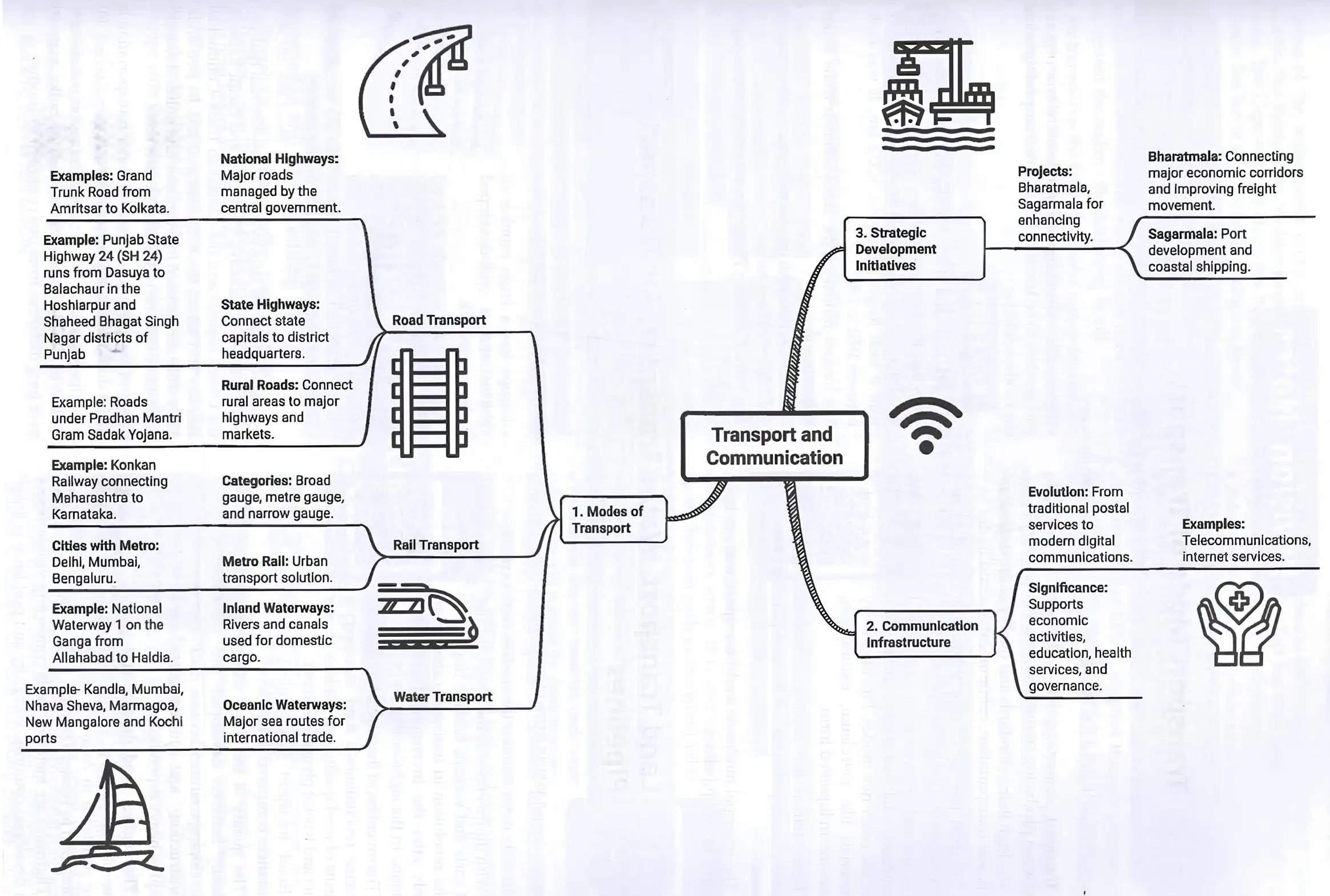
- Projects: Bharatmala and Sagarmala aim to improve transport connectivity and shipping.
Glossary
- Metalled Road
- Roads made of cement and concrete for durability and smooth travel.
- Road Density
- The ratio of the total length of roads to the land area of a country.
- Satellite
- An artificial body placed in orbit to collect information or facilitate communication.
- Cyberspace
- The electronic computerized space encompassing the internet and digital communication networks.
- Pipeline
- A system of pipes used to transport liquids and gases over long distances.
| Time Period / Year | Event / Change | Importance |
|---|---|---|
| 1891-1905 | Construction of Trans-Siberian Railway | Longest railway connecting eastern and western Russia, facilitating trade and political unity. |
| Early 20th Century | Completion of Trans-Canadian Pacific Railway | Connected eastern and western Canada, promoting economic development. |
| 18th Century | Invention of Steam Engine | Revolutionized transport by enabling mechanized movement of goods and people. |
| 20th Century | Development of Satellite Communication | Enabled global communication and connectivity, especially in remote areas. |
| 21st Century | Expansion of Internet and Cyberspace | Transformed communication, commerce, education, and governance worldwide. |