CLASS 12-HUMANITIES . GEOGRAPHY . INDIA PEOPLE AND ECONOMY . UNIT III-MINERAL-AND-ENERGY-RESOURCES
Chapter 5 : UNIT - III MINERAL AND ENERGY RESOURCES
Ch 5
GEOGRAPHY
CLASS 12-HUMANITIES
Mineral and Energy Resources
Minerals are natural substances with specific chemical and physical properties. India is endowed with a rich variety of mineral resources due to its varied geological structure. These minerals provide the necessary base for industrial development in the country.
Study Alert Points
- Classification of minerals on the basis of chemical and physical properties.
- Major mineral belts of India and their locations on the map.
- Different types of non-conventional mineral resources.
- Measures to conserve our non-renewable resources.
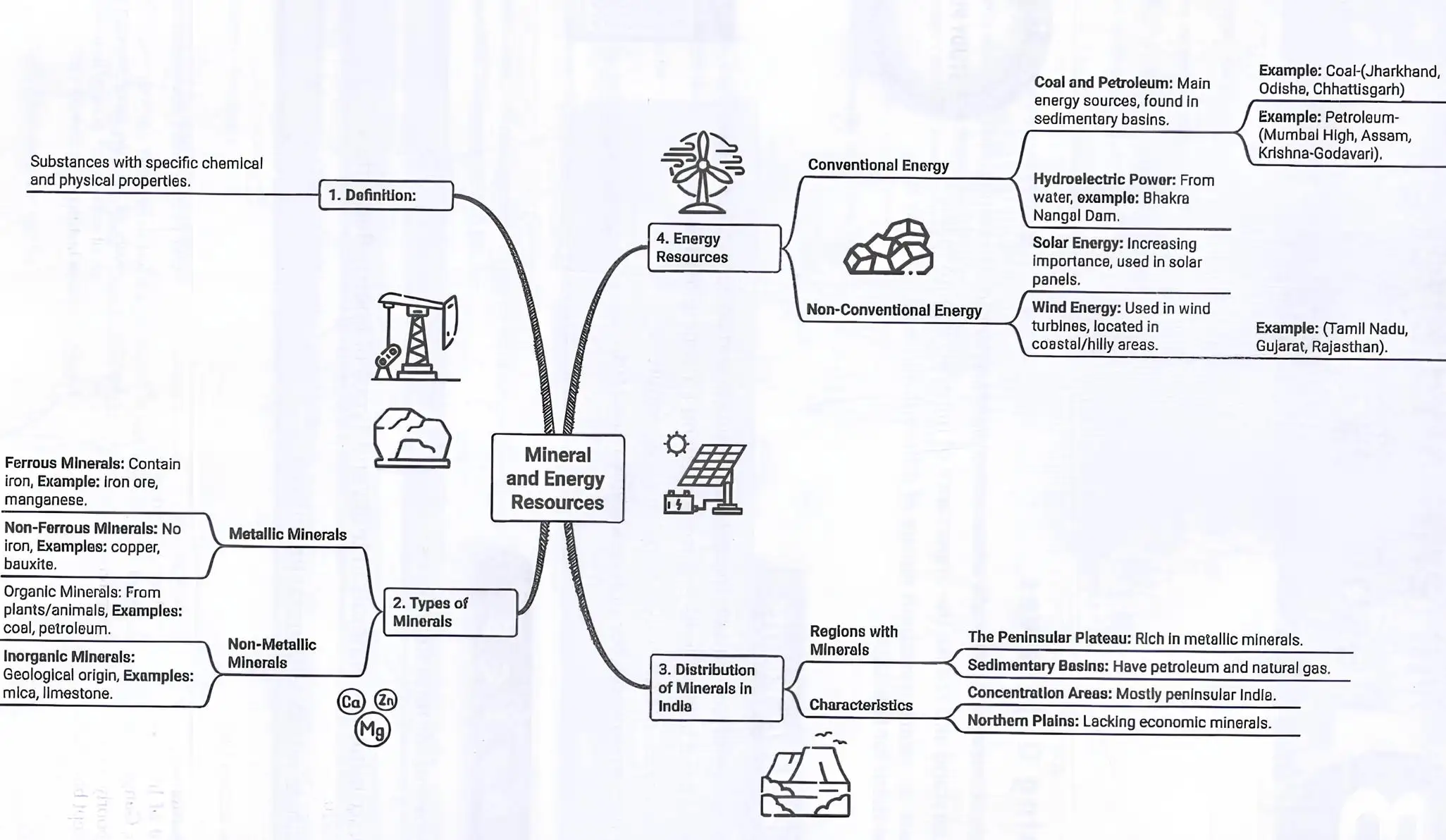
This mind map summarizes the definition, types, distribution in India, and types of energy resources. It helps understand how minerals and energy resources are classified and where they are found, especially in India.
Types of Mineral Resources
Minerals in India are classified based on their chemical and physical properties into two main categories: metallic and non-metallic minerals.
Metallic Minerals: These contain metals and are further divided into ferrous and non-ferrous minerals.
- Ferrous minerals contain iron, such as iron ore.
- Non-ferrous minerals do not contain iron, such as copper and bauxite.
Non-Metallic Minerals: These are either organic or inorganic in origin.
- Organic non-metallic minerals include fossil fuels like coal and petroleum derived from buried plant and animal life.
- Inorganic non-metallic minerals include mica, limestone, and graphite.
India has abundant iron ore reserves, the largest in Asia, mainly located in Odisha, Jharkhand, Chhattisgarh, Karnataka, Goa, Andhra Pradesh, and Tamil Nadu.
Ore: Naturally occurring solid material from which a metal or valuable mineral can be extracted.
Manganese, important for smelting iron ore and manufacturing ferrous alloys, is mainly produced in Odisha.
India has limited non-ferrous metallic minerals except for bauxite, which is used to manufacture aluminium and is found mainly in tertiary deposits associated with laterite rocks.
Copper, essential in electrical industries, is found mainly in Singhbhum (Jharkhand), Balaghat (Madhya Pradesh), and Jhunjhunu and Alwar (Rajasthan).
Mica, important for electrical and electronic industries, is mainly found in Jharkhand, Andhra Pradesh, Rajasthan, Tamil Nadu, West Bengal, and Madhya Pradesh.
Exam Questions
Q1: What are the two main categories of minerals based on their chemical and physical properties?
Answer: Metallic minerals and non-metallic minerals.
Q2: Name two ferrous and two non-ferrous minerals found in India.
Answer: Ferrous minerals: Iron ore, manganese; Non-ferrous minerals: Copper, bauxite.
Q3: What is the significance of mica in industries?
Answer: Mica is used in electrical and electronic industries because it can be split into thin, tough, and flexible sheets.
Distribution of Minerals in India and Types of Energy Resources
Minerals in India are concentrated in three broad belts:
- North-Eastern Plateau Region: Covers Chotanagpur (Jharkhand), Odisha Plateau, West Bengal, and parts of Chhattisgarh. Rich in iron ore, coal, manganese, bauxite, and mica.
- South-Western Plateau Region: Extends over Karnataka, Goa, Tamil Nadu uplands, and Kerala. Rich in ferrous metals, bauxite, high-grade iron ore, manganese, and limestone.
- North-Western Region: Extends along Aravali in Rajasthan and parts of Gujarat. Known for copper, zinc, building stones, petroleum, and salt deposits.
The Himalayan belt also contains minerals like copper, lead, zinc, cobalt, and tungsten. Assam valley has mineral oil deposits, and offshore areas near Mumbai Coast (Mumbai High) have oil resources.
Mineral fuels such as coal and petroleum are essential for power generation and various sectors of the economy.
Coal occurs mainly in Gondwana and tertiary deposits, with about 80% being bituminous and non-coking grade. Major coal fields include Jharia, Raniganj, Godavari, Mahanadi, and Sone river valleys.
Petroleum is vital for internal combustion engines and petrochemical industries. Oil exploration expanded after the establishment of the Oil and Natural Gas Commission in 1956. Major oil fields are in Assam, Gujarat, Mumbai High, and other regions.
Natural gas reserves are found along the eastern coast, Tripura, Rajasthan, Gujarat, and Maharashtra.
Nuclear energy uses uranium and thorium minerals, with power plants in Tarapur, Rawatbhata, Kalpakkam, Narora, Kaiga, and Kakrapara.
Non-conventional energy sources include solar, wind, geothermal, and bio-energy.
- Solar energy: Abundant in western India (Gujarat, Rajasthan), converted using photovoltaic cells.
- Wind energy: Pollution-free and inexhaustible, with major plants in Gujarat, Tamil Nadu, Rajasthan, Maharashtra, and Karnataka.
- Geothermal energy: Heat energy from the earth, with a plant in Manikaran, Himachal Pradesh.
- Bio-energy: Derived from biological products and waste, used for electricity, heat, and gas.
Exam Questions
Q1: Name the three broad mineral belts of India and one mineral found in each.
Answer: North-Eastern Plateau (iron ore), South-Western Plateau (bauxite), North-Western Region (copper).
Q2: What are the main types of coal deposits in India?
Answer: Gondwana and tertiary deposits.
Q3: List two non-conventional sources of energy and their advantages.
Answer: Solar energy (abundant and free), wind energy (pollution-free and inexhaustible).
Conservation of Mineral Resources
Traditional resource use methods generate large waste and environmental problems. Sustainable development requires conserving resources for future generations.
Alternative energy sources like solar, wind, wave, and geothermal energy are inexhaustible and help conserve non-renewable resources.
Conservation measures include:
- Recycling metals by using scrap metals.
- Using substitutes for scarce metals to reduce consumption.
- Reducing export of strategic and scarce minerals to extend reserve life.
Export: The process of selling and shipping goods or services from one country to another for trade.
Exam Questions
Q1: Why is conservation of mineral resources important?
Answer: To ensure sustainable development and protect resources for future generations.
Q2: Name two methods to conserve metallic minerals.
Answer: Recycling scrap metals and using substitutes for scarce metals.
Q3: What role do alternative energy sources play in conservation?
Answer: They provide inexhaustible energy options that reduce dependence on non-renewable mineral fuels.
Solved Examples
Example 1: Identify the major mineral belt where iron ore is abundantly found in India.
Solution: The North-Eastern Plateau region, covering Odisha, Jharkhand, and Chhattisgarh, is rich in iron ore deposits.
Example 2: Explain why wind energy is considered a clean source of energy.
Solution: Wind energy is pollution-free, inexhaustible, and does not produce harmful emissions, making it a clean energy source.
Practice Set
Easy
- What are metallic minerals? Give two examples.
- Where is bauxite mainly found in India?
Moderate
- Describe the distribution of coal in India.
- List three non-conventional sources of energy.
Challenging
- Explain the importance of conserving mineral resources and suggest measures for conservation.
- Discuss the significance of the three major mineral belts of India.
Answer Key
- Metallic minerals contain metals; examples: iron ore, copper.
- Bauxite is mainly found in the plateau and hill ranges of peninsular India and coastal tracts.
- Coal is mainly found in Gondwana and tertiary deposits; major coal fields include Jharia, Raniganj, Godavari, Mahanadi, and Sone valleys.
- Non-conventional energy sources include solar energy, wind energy, geothermal energy, and bio-energy.
- Conservation is important for sustainable development; measures include recycling, using substitutes, and reducing exports.
- The three mineral belts are North-Eastern Plateau (rich in iron ore, coal), South-Western Plateau (ferrous metals, bauxite), and North-Western Region (copper, petroleum).
Quick Reference
- Metallic minerals: Ferrous (iron-containing) and non-ferrous (non-iron).
- Non-metallic minerals: Organic (coal, petroleum) and inorganic (mica, limestone).
- Major mineral belts: North-Eastern Plateau, South-Western Plateau, North-Western Region.
- Energy resources: Conventional (coal, petroleum, hydroelectric), Non-conventional (solar, wind, geothermal, bio-energy).
- Conservation: Recycling, substitutes, reducing exports, promoting alternative energy.
Glossary
- Ore: Naturally occurring solid material from which a metal or valuable mineral can be extracted.
- Ferrous minerals: Minerals containing iron.
- Non-ferrous minerals: Minerals not containing iron.
- Petroleum: A thick, black liquid used as fuel and raw material in petrochemical industries.
- Nuclear energy: Energy released during nuclear reactions such as fission or fusion.
- Geothermal energy: Heat energy generated and stored in the Earth.
- Export: Selling and shipping goods or services from one country to another.
| Time Period / Year | Event / Change | Importance |
|---|---|---|
| 1956 | Establishment of Oil and Natural Gas Commission | Systematic oil exploration and production in India began |
| 1973 | Discovery of Mumbai High oil field | Major offshore oil production started |
| 1976 | Production commenced at Mumbai High | Boosted India's oil production capacity |
| 1984 | Formation of Gas Authority of India Limited (GAIL) | Transport and marketing of natural gas improved |
| Recent years | Development of non-conventional energy sources | Promoted sustainable and renewable energy use |