CLASS 12-HUMANITIES . GEOGRAPHY . FUNDAMENTALS OF HUMAN GEOGRAPHY . HUMAN DEVELOPMENT
Chapter 3 : Human Development
Ch 3
GEOGRAPHY
CLASS 12-HUMANITIES
Human Development
Human development is a comprehensive concept that goes beyond mere economic growth to include improvements in the quality of life and expansion of people's choices. It focuses on enhancing human capabilities in key areas such as health, education, and access to resources, enabling individuals to live meaningful and productive lives.
Growth and Development
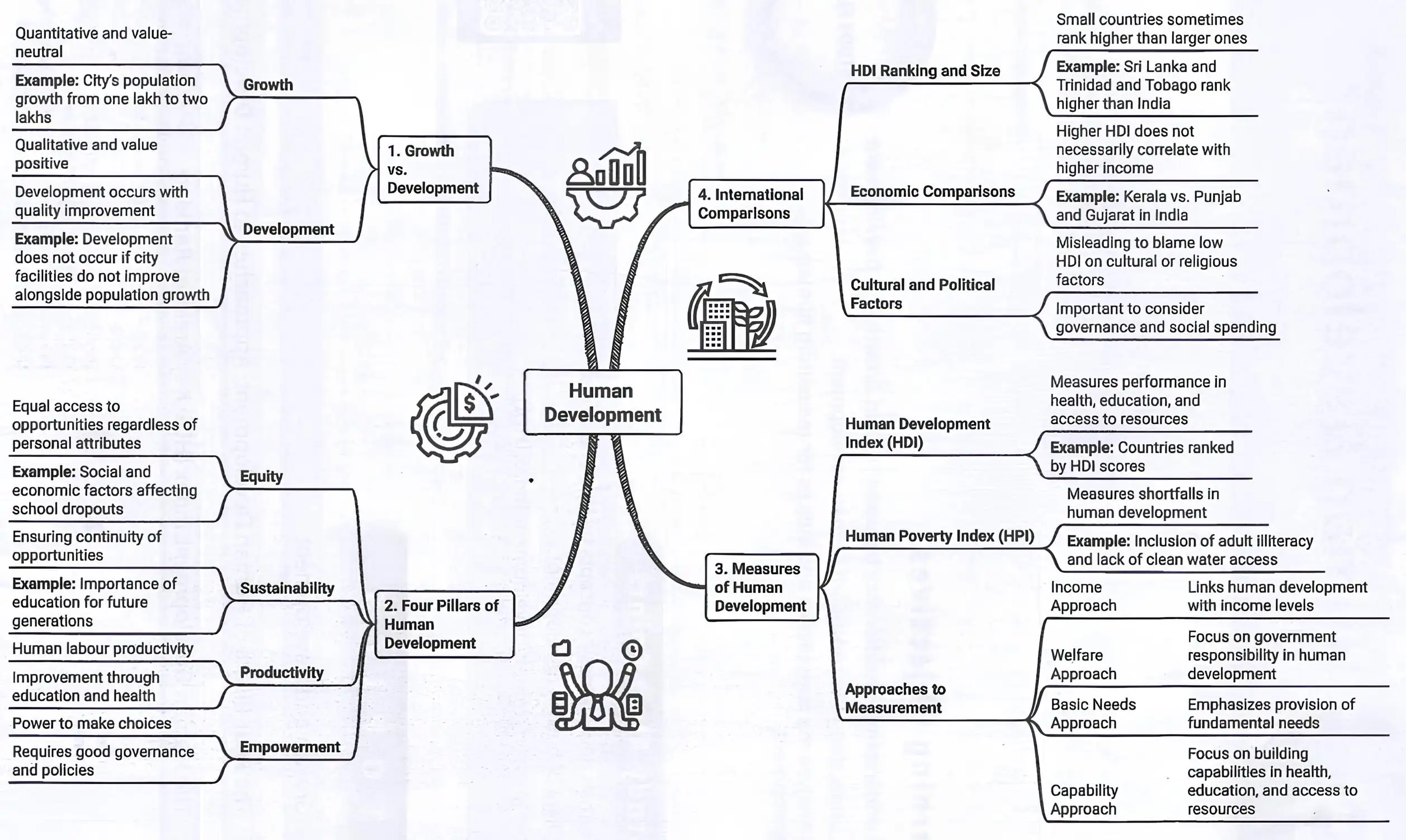
Growth refers to quantitative changes, such as an increase in size or number, and can be either positive or negative. Development, however, is a qualitative improvement that always has a positive value, indicating better living conditions and expanded opportunities. Positive growth is necessary but not sufficient for development. The concept of human development was introduced by Dr. Mahbub-ul-Haq, who defined it as increasing people's choices and improving their lives.
Exam Question
Q: What is the difference between growth and development in human development?
A: Growth is a quantitative change that can be positive or negative, while development is a qualitative positive change that improves the quality of life and expands people's choices.
The Four Pillars of Human Development and Approaches
Human development rests on four pillars:
- Equity: Equal access to opportunities regardless of gender, race, income, or caste.
- Sustainability: Ensuring opportunities are available for future generations.
- Productivity: Enhancing human labor productivity through education and health.
- Empowerment: Increasing freedom and capability to make choices, supported by good governance.
Approaches to human development include:
- Income Approach: Links development to income levels; higher income implies higher development.
- Welfare Approach: Emphasizes government spending on education, health, and social security; people are passive recipients.
- Basic Needs Approach: Focuses on providing essential amenities like health, education, food, water, sanitation, and housing.
- Capability Approach: Builds human capabilities in health, education, and resource access to increase choices.
Exam Question
Q: What are the four pillars of human development?
A: Equity, sustainability, productivity, and empowerment are the four pillars supporting human development.
The Human Development Index and Key Areas of Ranking
The Human Development Index (HDI) ranks countries based on health, education, and access to resources. Life expectancy is a key indicator, representing the average years a person is expected to live. The Human Poverty Index (HPI) measures the shortfall in human development, often revealing more about deprivation than HDI.
International comparisons show that smaller countries often perform better in human development than larger ones. Countries are grouped by HDI scores:
- Very High Human Development (HDI > 0.800): 51 countries, mostly industrialized Western nations.
- High Human Development: 55 countries with significant investment in social sectors.
- Medium Human Development: 46 countries forming the largest group.
- Low Human Development: 41 countries, many facing political turmoil, civil war, famine, or disease.
Exam Question
Q: What does the Human Development Index measure?
A: The HDI measures a country's performance in health, education, and access to resources to assess human development.
Timeline of Human Development Concepts
| Year | Event | Significance |
|---|---|---|
| 1990 | Introduction of Human Development Index by UNDP | Provided a composite measure of health, education, and income to assess development beyond GDP. |
| 1990s | Development of Human Poverty Index | Highlighted deprivation and shortfalls in human development. |
| 2000s | Emphasis on Capability Approach | Shifted focus to building human capabilities and freedoms. |
Solved Examples
Example 1: Explain why development is considered a qualitative change while growth is quantitative.
Solution: Growth refers to numerical increase, such as population or income, which can be positive or negative. Development implies improvement in quality of life, such as better health and education, which is always positive and enhances human capabilities.
Example 2: List the four pillars of human development and briefly explain one.
Solution: The four pillars are equity, sustainability, productivity, and empowerment. Empowerment means enabling people to have the freedom and capability to make choices affecting their lives.
Practice Set
Easy
- Define human development.
- What is life expectancy?
Moderate
- Explain the difference between the income approach and the capability approach to human development.
- Why is sustainability important in human development?
Challenging
- Discuss why some small countries have higher HDI scores than larger countries.
- Analyze the significance of the Human Poverty Index in understanding development.
Answer Key
- Human development is the process of enlarging people's choices and improving their quality of life.
- Life expectancy is the average number of years a person is expected to live.
- The income approach links development to income levels, while the capability approach focuses on building human abilities and freedoms.
- Sustainability ensures that opportunities remain available for future generations, maintaining continuous development.
- Small countries may have higher HDI due to focused social investments, better governance, and fewer disparities.
- The Human Poverty Index reveals deprivation levels, highlighting areas where development is lacking beyond income measures.
Quick Reference
- Human Development: Improvement in quality of life and expansion of choices.
- Growth: Quantitative increase, can be positive or negative.
- Development: Qualitative positive change.
- Four Pillars: Equity, Sustainability, Productivity, Empowerment.
- HDI: Composite index measuring health, education, and income.
- HPI: Measures deprivation and poverty.
Glossary
- Equity
- Equal access to opportunities regardless of personal characteristics.
- Sustainability
- Maintaining opportunities for future generations.
- Productivity
- Efficiency and effectiveness of human labor.
- Empowerment
- Ability to make choices and have control over one's life.
- Human Development Index (HDI)
- A composite measure of health, education, and income used to rank countries.
- Human Poverty Index (HPI)
- An index measuring deprivation in basic human needs.
- Life Expectancy
- The average number of years a person is expected to live.
- Political Turmoil
- Instability and chaos in a political system caused by conflict or power struggles.