CLASS 12-HUMANITIES . GEOGRAPHY . FUNDAMENTALS OF HUMAN GEOGRAPHY . PRIMARY ACTIVITIES
Chapter 4 : Primary Activities
Ch 4
GEOGRAPHY
CLASS 12-HUMANITIES
Primary Activities
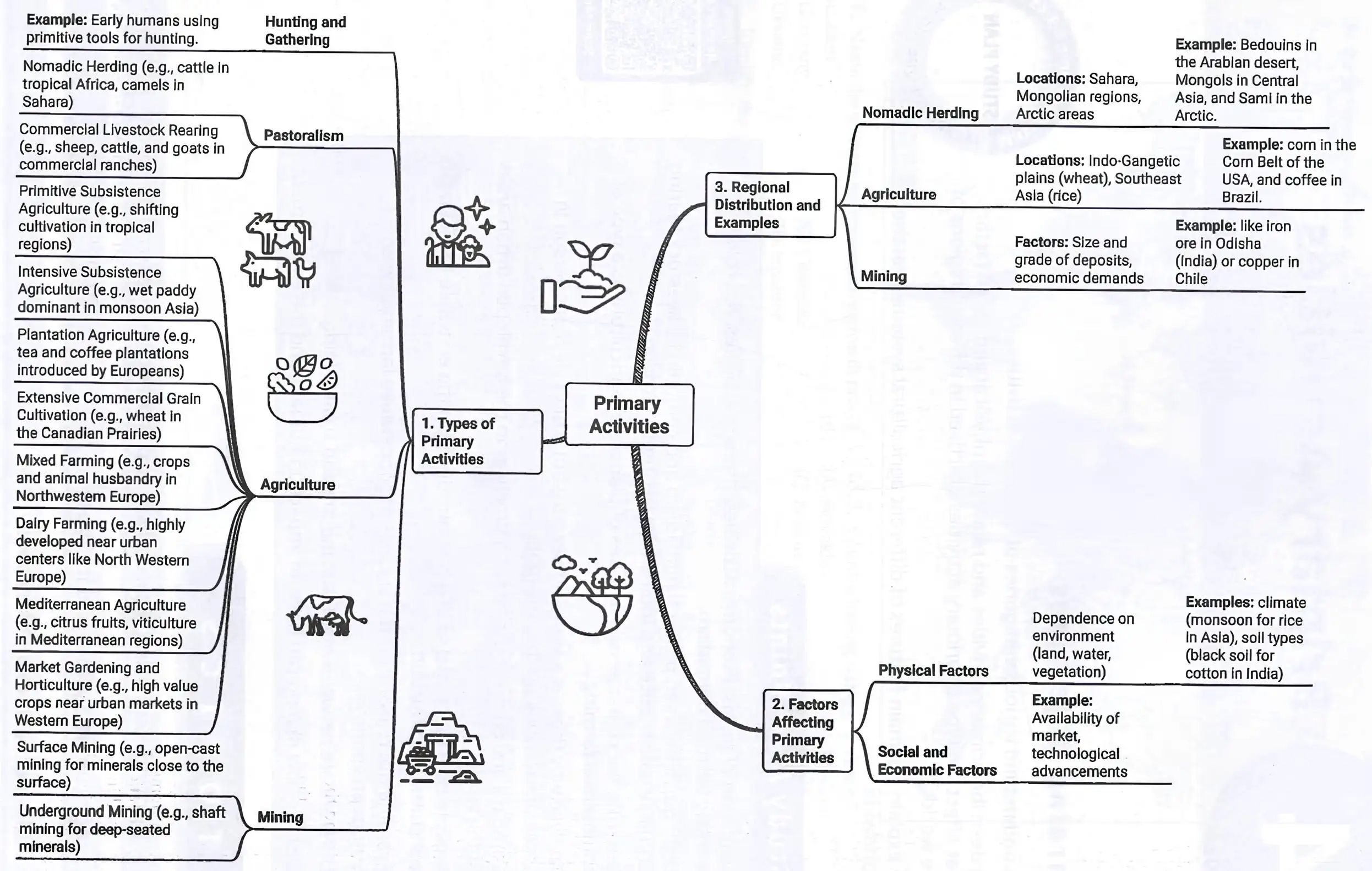
Primary activities are economic activities that involve the direct use of natural resources from the earth. These activities depend heavily on the environment and include hunting, gathering, pastoralism, fishing, forestry, agriculture, and mining. They form the foundation of human economic activity by utilizing land, water, vegetation, minerals, and other natural resources.
Hunting, Gathering, Pastoralism and Herding
Hunting and gathering are the oldest forms of primary activities where early humans hunted animals and gathered edible plants for survival. These activities are mostly practiced in regions with harsh climatic conditions and involve primitive tools, resulting in low yield per person and minimal surplus production.
Pastoral nomadism or nomadic herding is a subsistence activity where herders rely on animals for food, clothing, shelter, and transport. Nomads move with their livestock in search of pastures, often following traditional migration routes. Transhumance is a form of seasonal migration practiced in mountainous regions, such as the Himalayas.
Commercial livestock rearing is a more organized and capital-intensive activity practiced on permanent ranches, producing meat, wool, hides, and skins for export. Important countries practicing commercial livestock rearing include New Zealand, Australia, Argentina, Uruguay, and the United States.
Exam Questions
Q1: What are primary activities and why are they dependent on the environment?
A1: Primary activities involve the direct use of natural resources such as land, water, and minerals. They depend on the environment because they utilize natural resources that are available in specific physical conditions.
Q2: Differentiate between pastoral nomadism and commercial livestock rearing.
A2: Pastoral nomadism is a subsistence activity where herders move with their animals to find pastures, relying on animals for their livelihood. Commercial livestock rearing is organized, capital-intensive, and practiced on permanent ranches for producing products like meat and wool for markets.
Agriculture Systems and Types
Agriculture is the practice of farming, including soil cultivation and animal rearing. It is practiced under various physical and socio-economic conditions, resulting in different agricultural systems.
Subsistence Agriculture
Subsistence agriculture is where farmers grow food primarily for their own consumption. It includes:
- Primitive Subsistence Agriculture (Shifting Cultivation): Vegetation is cleared by fire (slash and burn), and primitive tools are used. After soil fertility declines, farmers shift to new areas.
- Intensive Subsistence Agriculture: Characterized by high labor input and small landholdings. It has two types: dominated by wet paddy cultivation and dominated by crops other than paddy like wheat and barley.
Commercial Agriculture
Commercial agriculture involves farming for sale and profit, often with large capital investment and mechanization. Types include:
- Plantation Agriculture: Large estates growing single crops like tea, coffee, or rubber, requiring scientific methods, cheap labor, and good transportation.
- Extensive Commercial Grain Cultivation: Large mechanized farms growing wheat, barley, oats, and rye.
- Mixed Farming: Moderate-sized farms growing crops and rearing animals, using crop rotation and inter-cropping.
- Dairy Farming: Capital and labor-intensive rearing of milch animals for milk production.
- Mediterranean Agriculture: Specialized commercial farming producing fruits, vegetables, olives, and grapes in Mediterranean climates.
- Market Gardening and Horticulture: Cultivation of high-value crops like vegetables and flowers for urban markets, often using advanced technology.
- Co-operative Farming: Farmers pool resources voluntarily for efficient farming while retaining individual land ownership.
- Collective Farming: Social ownership of land and collective labor, with small plots retained for personal use.
Exam Questions
Q1: What is shifting cultivation and why is it also called slash and burn agriculture?
A1: Shifting cultivation involves clearing vegetation by burning, which adds nutrients to the soil. It is called slash and burn because the vegetation is cut (slashed) and burned before cultivation.
Q2: Describe the key features of plantation agriculture.
A2: Plantation agriculture involves large estates, capital investment, scientific cultivation methods, single crop specialization, cheap labor, and good transportation linking estates to markets.
Mining: Factors and Methods
Mining is the process of extracting valuable minerals and metals from the earth's surface or subsurface for economic purposes. Its development accelerated with the Industrial Revolution and continues to be important.
Factors Affecting Mining
- Physical Factors: Size, grade, and mode of occurrence of mineral deposits.
- Economic Factors: Demand for minerals, available technology, capital for infrastructure, labor, and transport costs.
Methods of Mining
- Surface Mining (Open-cast Mining): Extraction of minerals near the surface by removing layers of soil and rock. It is cheaper and easier.
- Underground Mining (Shaft Mining): Used when minerals lie deep below the surface. It requires lifts, drills, ventilation, and is riskier due to hazards like poisonous gases and cave-ins.
Developed economies are reducing mining activities due to high labor costs, while some countries in Africa, South America, and Asia rely heavily on mineral earnings.
Exam Questions
Q1: What are the two main types of mining and how do they differ?
A1: Surface mining involves extracting minerals near the surface by removing overlying material, while underground mining extracts minerals deep below the surface using shafts and tunnels.
Q2: What physical and economic factors influence mining activities?
A2: Physical factors include the size and quality of mineral deposits. Economic factors include demand, technology, capital, labor, and transport costs.
Solved Examples
Example 1: Explain why shifting cultivation is practiced in tropical forest regions.
Solution: Shifting cultivation is practiced in tropical forest regions because the dense vegetation is cleared by burning, which adds nutrients to the soil. The soil fertility is initially high but declines after a few years, prompting farmers to move to new areas. The practice suits the physical environment and low population density.
Example 2: Describe the characteristics of dairy farming.
Solution: Dairy farming is capital and labor-intensive, involving the rearing of milch animals for milk production. It requires animal sheds, storage for fodder, feeding and milking machines, and rigorous care in feeding and milking.
Practice Set
Easy
- Define primary activities.
- What is pastoral nomadism?
Moderate
- Explain the difference between primitive subsistence agriculture and intensive subsistence agriculture.
- List the factors affecting mining activities.
Challenging
- Discuss the advantages of cooperative farming.
- Compare and contrast open-cast mining and underground mining.
Answer Key
- Primary activities: Economic activities involving direct use of natural resources.
- Pastoral nomadism: A subsistence activity where herders move with their livestock in search of pastures.
- Primitive vs Intensive Subsistence Agriculture: Primitive involves shifting cultivation with primitive tools; intensive involves high labor input and small landholdings.
- Factors affecting mining: Physical (deposit size, grade), economic (demand, technology, capital, labor, transport).
- Advantages of cooperative farming: Resource pooling, efficient farming, shared profits, and retaining individual land ownership.
- Open-cast vs Underground mining: Open-cast is surface mining, cheaper and safer; underground mining is deep mining, more expensive and risky.
Quick Reference
- Primary Activities: Hunting, gathering, pastoralism, agriculture, mining.
- Subsistence Agriculture: Primitive (shifting cultivation), Intensive (wet paddy and other crops).
- Commercial Agriculture: Plantation, extensive grain, mixed farming, dairy, Mediterranean, market gardening.
- Mining Methods: Surface (open-cast), underground (shaft).
Glossary
- Primary Activities: Economic activities involving direct extraction of natural resources.
- Pastoral Nomadism: A form of subsistence herding involving seasonal movement of livestock.
- Shifting Cultivation: Agricultural system where land is cleared by burning and cultivated temporarily.
- Plantation Agriculture: Large-scale commercial farming of a single crop.
- Open-cast Mining: Surface mining method involving removal of surface layers.
- Underground Mining: Mining method involving extraction from deep below the surface.
- Cooperative Farming: Farming system where farmers pool resources but retain individual land ownership.
Chronology of Primary Activities
| Time Period / Year | Event / Change | Importance |
|---|---|---|
| Prehistoric Era | Hunting and Gathering | Earliest form of human economic activity using natural resources. |
| Ancient Times | Domestication of Animals | Led to pastoral nomadism and settled agriculture. |
| Medieval Period | Development of Shifting Cultivation | Adaptation to tropical forest environments. |
| Industrial Revolution | Expansion of Mining | Increased demand for minerals and technological advances. |
| Modern Era | Commercial Agriculture and Cooperative Farming | Increased productivity and market orientation. |