CLASS 12-PCB . BIOLOGY . BIOLOGY . ORGANISMS AND-POPULATIONS
Chapter 11 : Organisms And Populations
Ch 11
BIOLOGY
CLASS 12-PCB
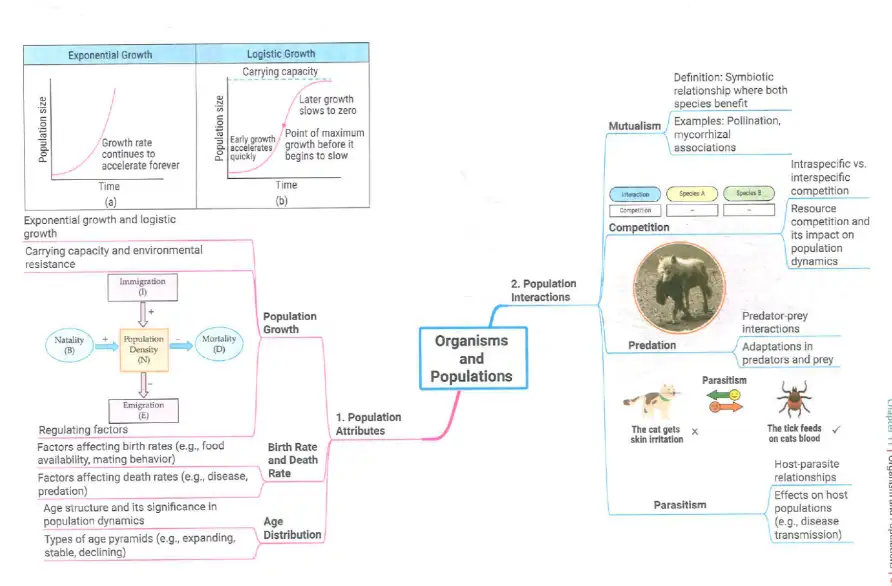
Organism Populations
Population Definition
A population is a group of individuals of the same species living in a specific geographical area at a particular time, functioning as a unit.
Population Characteristics
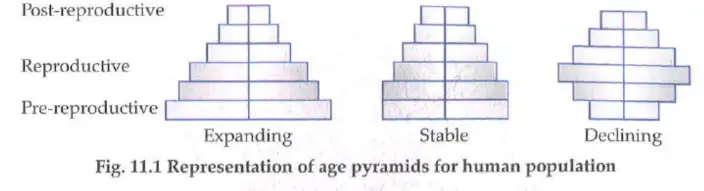
Populations have attributes such as birth rates, death rates, and age distribution, which differ from individual organisms. Age distribution is often represented by age pyramids showing pre-reproductive, reproductive, and post-reproductive groups.
Population Size and Density
Population size or density (N) is the number of individuals per unit area or volume at a given time.
Population Growth Factors
Population size changes over time due to natality (birth rate), mortality (death rate), immigration (individuals entering), and emigration (individuals leaving).
Population Growth Equation
If N is the population density at time t, then at time t + 1:
N₍ₜ₊₁₎ = Nₜ + [(B + I) - (D + E)]
Birth and Death Rates
Birth rate (Natality): Ratio of live births to the population in an area.
Death rate (Mortality): Ratio of deaths to the population in an area.
Population Growth Models
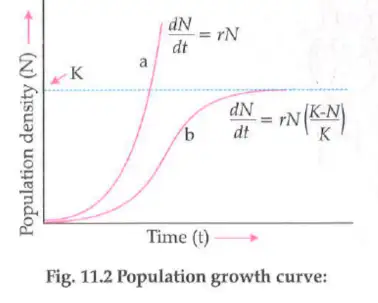
Exponential Growth: Occurs when resources are unlimited. Population grows rapidly following the equation:
\[ \frac{dN}{dt} = rN \]
where \( r = b - d \) is the intrinsic rate of natural increase.
Logistic Growth: Occurs when resources are limited, leading to competition. Growth slows as population approaches carrying capacity (K), modeled by:
\[ \frac{dN}{dt} = rN \left(\frac{K - N}{K}\right) \]
where K is the maximum population the environment can sustain.
Carrying Capacity
The carrying capacity (K) is the maximum number of individuals an environment can support sustainably.
Population Interactions
Populations interact in various ways:
- Predation: One species hunts and eats another.
- Parasitism: One species (parasite) benefits at the expense of another (host).
- Competition: Organisms compete for the same resources.
- Mutualism: Both species benefit and depend on each other.
Age Pyramids
Age pyramids show the distribution of age groups in a population:
- Expanding Pyramid: Wide base, many young individuals, population growing.
- Stable Pyramid: Equal age groups, population stable.
- Declining Pyramid: Narrow base, fewer young individuals, population shrinking.
Solved Examples
Example 1: Calculate the population density at time t + 1 if the population at time t is 1000, with 50 births, 20 deaths, 10 immigrants, and 5 emigrants.
Solution:
Given:
- Nₜ = 1000
- B = 50
- D = 20
- I = 10
- E = 5
Using the formula:
N₍ₜ₊₁₎ = Nₜ + [(B + I) - (D + E)]
= 1000 + [(50 + 10) - (20 + 5)]
= 1000 + (60 - 25)
= 1000 + 35 = 1035
Population density at time t + 1 is 1035 individuals.
Example 2: Describe the difference between exponential and logistic growth models.
Solution:
Exponential growth occurs when resources are unlimited, leading to rapid population increase with a J-shaped curve. Logistic growth accounts for limited resources, causing growth to slow and stabilize at carrying capacity, producing an S-shaped curve.
Practice Set
Conceptual Questions
- Level 1: Define population density.
- Level 2: Explain the significance of carrying capacity in population growth.
Application-based Question
- Level 3: A population of 500 has 30 births, 10 deaths, 5 immigrants, and 15 emigrants in one year. Calculate the population size at the end of the year and describe which growth model (exponential or logistic) might apply if the carrying capacity is 600.
Answer Key
Conceptual Questions
- Level 1: Population density is the number of individuals of a species per unit area or volume at a given time.
- Level 2: Carrying capacity is important because it limits population growth by the maximum number of individuals the environment can sustain, preventing overpopulation and resource depletion.
Application-based Question
Initial population (Nₜ) = 500
Births (B) = 30
Deaths (D) = 10
Immigrants (I) = 5
Emigrants (E) = 15
Population at t + 1:
N₍ₜ₊₁₎ = 500 + [(30 + 5) - (10 + 15)] = 500 + (35 - 25) = 510
Since the population is below the carrying capacity (600), exponential growth may occur initially, but as it approaches 600, logistic growth will regulate the population size.
Quick Reference Table
Population Parameters:
- Population Density (N): Number of individuals per unit area or volume.
- Natality (Birth Rate): Number of births per population per unit time.
- Mortality (Death Rate): Number of deaths per population per unit time.
- Immigration (I): Individuals entering a population.
- Emigration (E): Individuals leaving a population.
Population Growth Models:
- Exponential Growth: \( \frac{dN}{dt} = rN \)
- Logistic Growth: \( \frac{dN}{dt} = rN \left(\frac{K - N}{K}\right) \)
Carrying Capacity (K): Maximum sustainable population size.
Population Interactions: Predation, Parasitism, Competition, Mutualism.
Common Mistakes and Misconceptions
- Confusing population density with population size; density is per unit area, size is total individuals.
- Mixing up age structure groups with population size.
- Confusing sex ratio with fertility rate.
- Misunderstanding natality and mortality rates as migration rates.
- Assuming exponential and logistic growth models describe the same growth pattern.
Glossary
- Population: Group of individuals of the same species in a specific area.
- Natality: Birth rate; number of births in a population.
- Mortality: Death rate; number of deaths in a population.
- Immigration: Movement of individuals into a population.
- Emigration: Movement of individuals out of a population.
- Carrying Capacity: Maximum population size an environment can sustain.
- Intrinsic Rate of Increase (r): Difference between birth and death rates.
- Exponential Growth: Rapid population increase under unlimited resources.
- Logistic Growth: Population growth limited by resources, stabilizing at carrying capacity.
- Predation: Interaction where one species hunts another.
- Parasitism: One species benefits at the expense of another.
- Competition: Rivalry for resources among organisms.
- Mutualism: Interaction benefiting both species.