CLASS 12-PCB . BIOLOGY . BIOLOGY . BIODIVERSITY AND-CONSERVATION
Chapter 13 : Biodiversity And Conservation
Ch 13
BIOLOGY
CLASS 12-PCB
Biodiversity
Definition and Concept
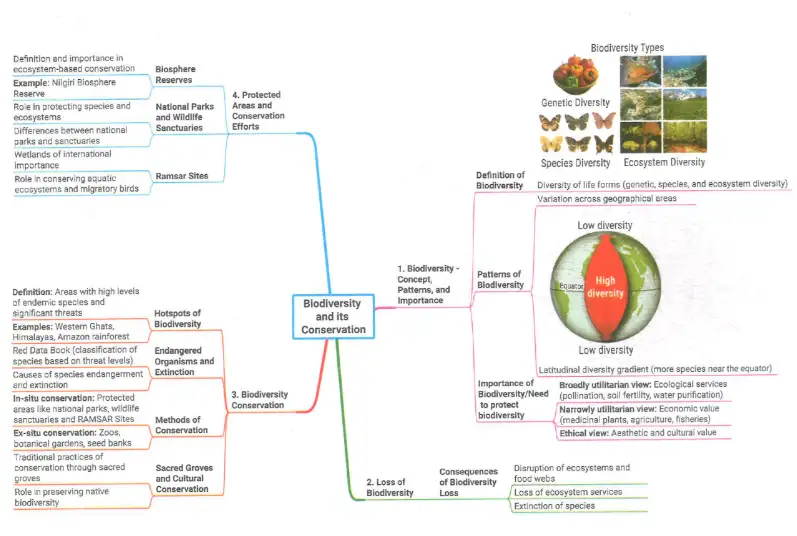
Biodiversity refers to the variety and variability of life forms on Earth, encompassing diversity at genetic, species, and ecosystem levels. It includes all living organisms, their genetic differences, and the ecosystems they form.
Levels of Biodiversity
Genetic Diversity: Variation of genes within a species, such as different strains of rice or varieties of mangoes.
Species Diversity: Variety of species within a habitat or ecosystem, for example, the amphibian species in the Western Ghats.
Ecological Diversity: Diversity of ecosystems in a region, such as deserts, rainforests, mangroves, coral reefs, wetlands, and alpine meadows.
Patterns of Biodiversity
Biodiversity is not evenly distributed globally. It varies with latitude and area size.
Latitudinal Gradient: Species diversity decreases from the equator towards the poles. Tropical regions have the highest species richness due to longer evolutionary time, stable climate, and abundant solar energy.
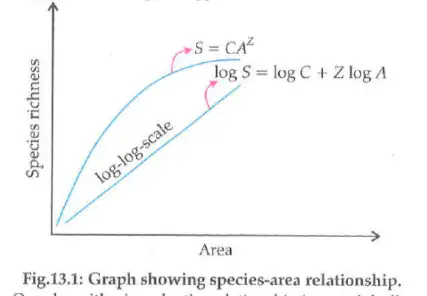
Species-Area Relationship: Species richness increases with the area studied, following the equation log S = log C + Z log A, where S is species richness, A is area, C is a constant, and Z is the slope (typically 0.1 to 0.2).
Importance of Biodiversity
Biodiversity supports ecosystem stability, productivity, and resilience. It provides essential ecosystem services such as pollination, climate regulation, nutrient cycling, and pest control. It also has economic, medicinal, and cultural significance.
Loss of Biodiversity
Human activities have caused significant biodiversity loss, leading to species extinction and ecosystem disruption. The current extinction rate is much higher than natural background rates, threatening ecosystem health and human survival.
Causes of Biodiversity Loss (The Evil Quartet):
- Habitat loss and fragmentation
- Over-exploitation
- Alien species invasions
- Co-extinction
Solved Examples
Example 1
Question: What kind of biodiversity is represented by more than a thousand varieties of mangoes in India? Explain how this diversity is possible.
Answer: This represents genetic diversity because it shows variation within a single species. Different varieties grow in various geographical regions and climatic conditions, and genetic variation arises due to breeding and mutations.
Practice Set
- Level 1 (Easy): Define the three levels of biodiversity with examples.
- Level 2 (Moderate): Explain the species-area relationship and its significance in biodiversity studies.
- Level 3 (Challenging): Discuss the main causes of biodiversity loss and suggest conservation strategies to mitigate these causes.
Answer Key
- Level 1: Genetic diversity (variation within species), species diversity (variety of species in an ecosystem), ecological diversity (variety of ecosystems). Examples: different rice strains, amphibians in Western Ghats, deserts and rainforests.
- Level 2: Species-area relationship shows that species richness increases with area studied, following the equation log S = log C + Z log A. It helps in understanding how habitat size affects biodiversity.
- Level 3: Causes include habitat loss, over-exploitation, alien species invasions, and co-extinction. Conservation strategies include in-situ conservation (protected areas) and ex-situ conservation (zoos, seed banks).
Conservation
Reasons for Conservation
Conservation of biodiversity is essential for economic benefits, ecosystem services, and ethical reasons. Humans rely on biodiversity for food, medicine, raw materials, and maintaining ecological balance.
Types of Conservation
In-situ Conservation: Protecting species in their natural habitats, such as national parks, wildlife sanctuaries, biosphere reserves, sacred groves, and biodiversity hotspots.
Ex-situ Conservation: Conserving species outside their natural habitats, including zoos, botanical gardens, seed banks, and gene banks. Techniques like cryopreservation and tissue culture aid in preserving genetic material.
International Efforts
The Earth Summit (1992) focused on biodiversity conservation, sustainable use, and equitable sharing of genetic resources. The World Summit on Sustainable Development (2002) aimed to reduce biodiversity loss globally.
Solved Examples
Example 1
Question: Differentiate between in-situ and ex-situ conservation with examples.
Answer: In-situ conservation involves protecting species in their natural habitats, such as national parks and biosphere reserves. Ex-situ conservation involves conserving species outside their natural habitats, like zoos and seed banks.
Practice Set
- Level 1 (Easy): List two examples each of in-situ and ex-situ conservation methods.
- Level 2 (Moderate): Explain the importance of biodiversity hotspots in conservation.
- Level 3 (Challenging): Describe the role of international agreements in biodiversity conservation.
Answer Key
- Level 1: In-situ: National parks, wildlife sanctuaries. Ex-situ: Zoos, seed banks.
- Level 2: Biodiversity hotspots are regions with high species richness and significant threat levels. Protecting them helps conserve many species and reduces extinction rates.
- Level 3: International agreements like the Earth Summit promote global cooperation for conservation, sustainable use, and fair sharing of genetic resources.
Quick Reference Table
- Levels of Biodiversity: Genetic diversity, species diversity, ecological diversity.
- Species-Area Relationship: Species richness increases with area, described by log S = log C + Z log A.
- Causes of Biodiversity Loss: Habitat loss, over-exploitation, alien species invasions, co-extinction.
- Conservation Methods: In-situ (national parks, sanctuaries, biosphere reserves) and ex-situ (zoos, seed banks, cryopreservation).
- International Efforts: Earth Summit (1992), World Summit on Sustainable Development (2002).
Common Mistakes and Misconceptions
- Confusing the three levels of biodiversity as the same; they represent different scales and types of diversity.
- Assuming all species are equally affected by biodiversity loss; vulnerability varies by species and ecosystem.
- Mixing up in-situ and ex-situ conservation methods and their purposes.
- Overlooking the importance of biodiversity hotspots and their role in conservation.
- Ignoring the indirect ecosystem services provided by biodiversity, such as climate regulation and pest control.
Glossary
- Biodiversity: The variety and variability of life forms at genetic, species, and ecosystem levels.
- Genetic Diversity: Variation of genes within a species.
- Species Diversity: Variety of species within an ecosystem.
- Ecological Diversity: Diversity of ecosystems in a region.
- In-situ Conservation: Protecting species in their natural habitats.
- Ex-situ Conservation: Conserving species outside their natural habitats.
- Habitat Loss: Destruction or fragmentation of natural habitats leading to biodiversity decline.
- Alien Species: Species introduced outside their natural range, potentially invasive.
- Rivet Popper Hypothesis: Analogy explaining how loss of species weakens ecosystem stability.
- Cryopreservation: Preservation of cells or tissues at very low temperatures.
- Tissue Culture: Growing cells or tissues in artificial media for conservation or propagation.
- Biodiversity Hotspots: Regions with high species richness and significant threat levels.