CLASS 12-PCB . BIOLOGY . BIOLOGY . BIOTECHNOLOGY PRINCIPLES-AND-PROCESSES
Chapter 9 : Biotechnology : Principles And Processes
Ch 9
BIOLOGY
CLASS 12-PCB
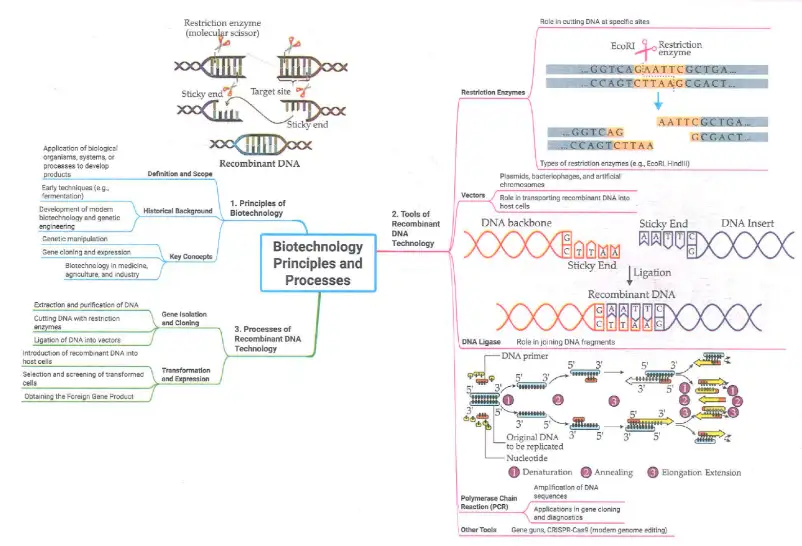
Biotechnology Principles and Processes
Introduction to Biotechnology
Biotechnology involves the use of living organisms or their enzymes to produce useful products and processes for humans. The term was coined by Karl Ereky in 1919. The European Federation of Biotechnology defines it as the integration of natural sciences with organisms, cells, parts thereof, and molecular analogues for products and services.
Applications of Biotechnology
Biotechnology includes microbe-mediated processes such as making curd, bread, and wine; in vitro fertilisation; synthesis and use of genes; preparation of DNA vaccines; and correcting defective genes.
Core Techniques of Modern Biotechnology
The two main techniques are genetic engineering, which chemically alters genetic material to change an organism's phenotype, and chemical engineering, which grows desired microbes or cells in large quantities for manufacturing antibiotics, vaccines, and enzymes.
Recombinant DNA Technology
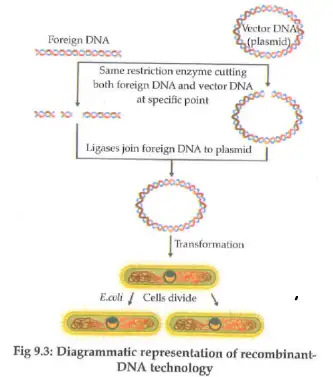
This technology combines DNA from two different organisms to create recombinant DNA (rDNA). It involves two basic steps: cutting or isolating DNA and transferring or joining DNA segments. Stanley Cohen and Herbert Boyer constructed the first recombinant DNA in 1972 by isolating an antibiotic resistance gene from a plasmid. Organisms containing artificially inserted genes are called transgenic or genetically modified organisms (GMOs).
Plasmids and Genome
Plasmids are small, circular, double-stranded DNA molecules naturally found in bacteria and some eukaryotes. The genome is the entire set of DNA instructions in a cell. Transferred DNA may remain dormant or integrate into the host genome to be inherited.
Steps in Genetically Modifying an Organism
1. Identification of DNA with desirable genes.
2. Introduction of the identified DNA into the host.
3. Maintenance and transfer of the introduced DNA to progeny.
Tools of Recombinant DNA Technology
Recombinant DNA technology uses several essential tools to manipulate and study genes. These tools include:
- Restriction Enzymes: Also called molecular scissors, these enzymes cut DNA at specific palindromic sequences, producing fragments with sticky ends that can be joined to other DNA pieces.
- DNA Ligase: An enzyme that joins DNA fragments by forming phosphodiester bonds between the sugar-phosphate backbones, sealing the sticky ends to create recombinant DNA molecules.
- Cloning Vectors: DNA molecules such as plasmids and bacteriophages that carry foreign DNA into host cells and replicate independently.
- Competent Host Cells: Bacterial or other cells treated to take up foreign DNA efficiently during transformation.
- Polymerase Chain Reaction (PCR): A technique to amplify specific DNA segments in vitro using primers and DNA polymerase.
- Gel Electrophoresis: A method to separate DNA fragments based on size by applying an electric field through an agarose gel matrix.
- Gene Gun (Biolistics): A physical method to deliver DNA into plant cells by bombarding them with DNA-coated micro-particles.
- Microinjection: Direct injection of DNA into the nucleus of animal cells using fine needles.
- Electroporation: Use of electric pulses to create temporary pores in cell membranes to facilitate DNA uptake.
Restriction Enzymes
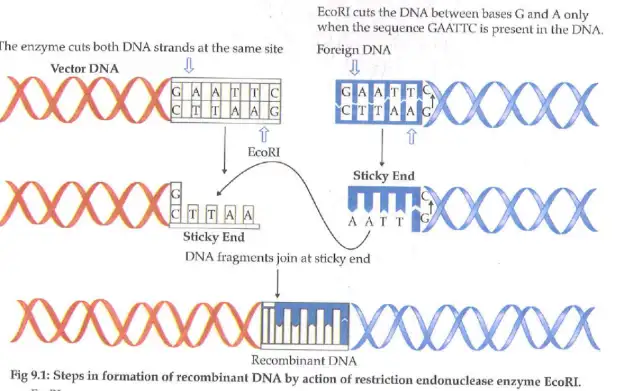
Restriction enzymes, or molecular scissors, cut DNA at specific palindromic sequences. The first restriction endonuclease, Hind II, was isolated in 1968. These enzymes recognize specific sequences and cut DNA leaving sticky ends, which facilitate joining with other DNA fragments by DNA ligase.
Naming and Types of Restriction Enzymes
Names indicate the genus and species of the prokaryotic cell source, e.g., EcoRI from Escherichia coli strain RY13. Restriction enzymes are nucleases, including exonucleases (remove nucleotides from DNA ends) and endonucleases (cut within DNA strands).
Sticky Ends and Palindromes
Restriction enzymes cut DNA to produce sticky ends—single-stranded overhangs that can hydrogen bond with complementary sequences. Palindromic sequences read the same 5' to 3' on both strands, e.g., 5'—GAATTC—3' and 3'—CTTAAG—5'.
Separation and Isolation of DNA Fragments
DNA fragments are separated by gel electrophoresis, where negatively charged DNA moves towards the anode through agarose gel. Smaller fragments move farther. DNA bands are visualized by staining with ethidium bromide and UV exposure. Desired fragments are cut from the gel and purified by elution for cloning.
Cloning Vectors
Cloning vectors are DNA molecules that carry foreign DNA and replicate inside host cells. Examples include plasmids and bacteriophages. Features include:
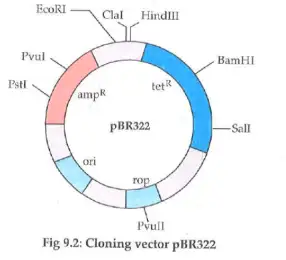
- Origin of replication (ori): DNA sequence where replication starts, controlling copy number.
- Selectable marker genes: Antibiotic resistance genes (e.g., ampicillin, tetracycline) to select transformants.
- Cloning sites: Specific restriction sites for inserting foreign DNA, e.g., BamHI site in pBR322 plasmid.
Recombinant plasmids lose resistance to one antibiotic due to DNA insertion, allowing selection of recombinants by plating on media with different antibiotics.
Vectors for Plants and Animals
Pathogen genetic tools are modified as vectors, e.g., Agrobacterium tumefaciens Ti plasmid for plants and retroviruses for animals, to deliver genes of interest.
Competent Host Cells
Competent cells can uptake DNA. Bacterial cells are made competent by treatment with divalent cations (e.g., calcium) to increase cell wall pore size. DNA uptake is facilitated by heat shock and incubation on ice.
Other DNA Introduction Methods
- Microinjection: Direct injection of DNA into animal cell nuclei.
- Biolistics (gene gun): Bombardment of cells with DNA-coated gold or tungsten particles, suitable for plants.
- Electroporation: Electric pulses create temporary membrane holes to allow DNA entry.
Isolation of Genetic Material
Cells are treated with enzymes (lysozyme, cellulase, chitinase) to break cell walls and release DNA. RNA and proteins are removed enzymatically. DNA precipitates with chilled ethanol.
Amplification Using Polymerase Chain Reaction (PCR)
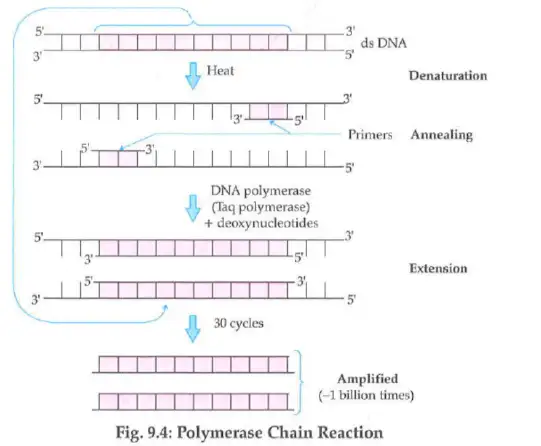
PCR synthesizes multiple copies of a DNA segment in vitro using primers and DNA polymerase (commonly Taq polymerase). The process involves denaturation, annealing, and extension repeated about 30 times, amplifying DNA approximately one billion-fold.
Insertion and Expression of Recombinant DNA
Recombinant DNA is introduced into host cells, which express the foreign gene to produce desired proteins. Cultures can be grown on small or large scales, with continuous culture systems maintaining active cells for higher yields.
Downstream Processing
After biosynthesis, products undergo separation, purification, formulation with preservatives, clinical trials, and quality control before marketing.
Bioreactors
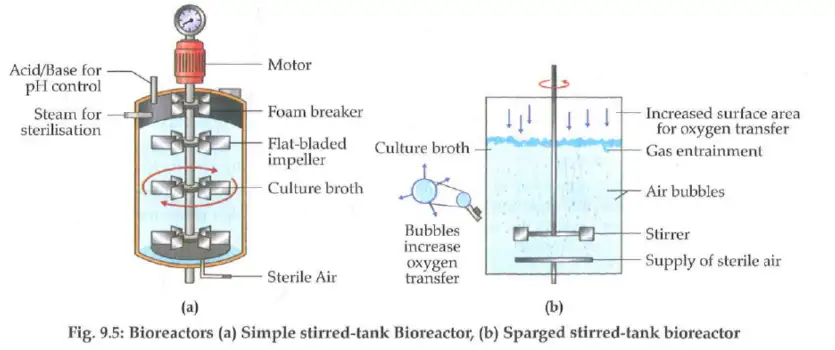
Bioreactors are vessels for large-scale biological production, providing optimal conditions (temperature, pH, oxygen) for microbial, plant, animal, or human cells. Types include simple stirred-tank and sparged stirred-tank bioreactors, which mix contents and supply oxygen for growth.
Solved Examples
Example 1
Describe the formation of recombinant DNA by the action of EcoRI.
Answer:
(a) EcoRI recognizes specific palindromic nucleotide sequences in DNA.
(b) It cuts DNA strands slightly away from the center of the palindrome, between the same two bases on opposite strands, creating single-stranded overhangs called sticky ends.
(c) Sticky ends form hydrogen bonds with complementary sequences, facilitating joining.
(d) DNA ligase then joins the sticky ends, forming recombinant DNA.
Example 2
Write the steps to obtain a foreign gene product.
Answer:
1. Insert desired DNA into a cloning vector to create recombinant DNA.
2. Multiply the recombinant DNA.
3. Provide optimized conditions to induce expression of the target gene.
4. Extract the desired product.
5. Purify the product using separation techniques.
Practice Set
Conceptual Questions
- Level 1: What is the role of restriction enzymes in recombinant DNA technology?
- Level 2: Explain the importance of selectable marker genes in cloning vectors.
Application-based Question
- Level 3: Describe how you would use the plasmid pBR322 to clone a gene of interest and select for recombinant bacteria.
Answer Key
Conceptual Questions
- Level 1: Restriction enzymes cut DNA at specific sequences to produce fragments with sticky ends, enabling the insertion of foreign DNA into vectors.
- Level 2: Selectable marker genes confer antibiotic resistance, allowing identification and selection of cells that have taken up the recombinant DNA.
Application-based Question
- Level 3: Cut both the plasmid pBR322 and the gene of interest with the same restriction enzyme. Ligate the gene into the plasmid at the restriction site within the tetracycline resistance gene. Transform bacteria with the recombinant plasmid. Plate bacteria on ampicillin-containing medium; only transformants grow. Then plate on tetracycline medium; recombinant bacteria with inserted gene will not grow due to inactivation of tetracycline resistance, allowing selection of recombinants.
Quick Reference Table
Restriction Enzymes: Molecular scissors cutting DNA at specific palindromic sequences producing sticky ends.
Cloning Vectors: DNA molecules like plasmids carrying foreign DNA with origin of replication and selectable markers.
Selectable Markers: Genes conferring antibiotic resistance used to select transformed cells.
Polymerase Chain Reaction (PCR): Technique to amplify DNA segments using denaturation, annealing, and extension steps.
Bioreactors: Vessels providing optimal conditions for large-scale microbial or cell culture growth.
Common Mistakes and Misconceptions
- Confusing restriction enzymes (cut DNA) with DNA ligase (joins DNA fragments).
- Mixing up plasmids (circular bacterial DNA) with bacteriophages (viruses infecting bacteria) as vectors.
- Confusing PCR (DNA amplification) with gel electrophoresis (DNA separation).
- Assuming all antibiotic resistance genes in vectors remain active after insertion; some are inactivated to select recombinants.
- Overlooking the need for competent cells to uptake recombinant DNA.
Glossary
Biotechnology: Use of living organisms or enzymes to produce useful products.
Recombinant DNA: DNA formed by joining DNA from different sources.
Restriction Enzyme: Enzyme that cuts DNA at specific sequences.
Sticky Ends: Single-stranded overhangs on DNA fragments that facilitate joining.
Plasmid: Small circular DNA molecule in bacteria used as cloning vector.
Selectable Marker: Gene used to identify cells containing recombinant DNA.
Polymerase Chain Reaction (PCR): Technique to amplify DNA segments.
Bioreactor: Vessel for growing cells under controlled conditions.