CLASS 12-PCB . BIOLOGY . BIOLOGY . HUMAN HEALTH-AND-DISEASE
Chapter 7 : Human Health And Disease
Ch 7
BIOLOGY
CLASS 12-PCB
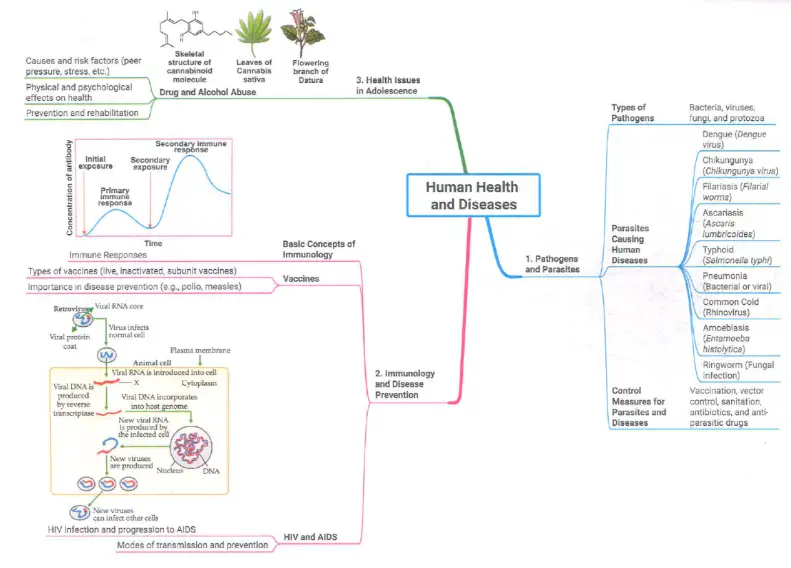
Human Health and Diseases
Types of Diseases
Diseases are conditions that cause discomfort, distress, or health problems. They can be congenital (present from birth) or acquired during life. Diseases are broadly classified into infectious and non-infectious types. Infectious diseases are caused by pathogens like bacteria, viruses, protozoa, helminths, and fungi.
Common Infectious Diseases
Bacterial Diseases: Typhoid caused by Salmonella typhi spreads through contaminated food and water, causing high fever and abdominal pain. Pneumonia caused by Streptococcus pneumoniae spreads via droplets and affects the lungs.
Viral Diseases: Common cold caused by rhinoviruses spreads through droplets. Dengue and chikungunya are transmitted by the bite of infected Aedes aegypti mosquitoes, causing fever and joint pain.
Protozoan Diseases: Malaria caused by Plasmodium species is transmitted by Anopheles mosquitoes. Amoebiasis caused by Entamoeba histolytica spreads through contaminated food and water.
Helminth Diseases: Ascariasis caused by Ascaris lumbricoides spreads through contaminated soil and causes intestinal blockage. Filariasis caused by filarial worms spreads through mosquito bites and causes swelling of limbs.
Fungal Diseases: Ringworm caused by fungi like Microsporum affects skin and nails, spreading through contact with contaminated objects.
Life Cycle of Plasmodium
The malaria parasite Plasmodium has a complex life cycle involving humans and female Anopheles mosquitoes. Sporozoites enter human blood through mosquito bites, multiply in liver cells, then infect red blood cells causing fever. Gametocytes develop in blood and are taken up by mosquitoes, where sexual reproduction occurs, producing new sporozoites to infect humans again.
Immune System
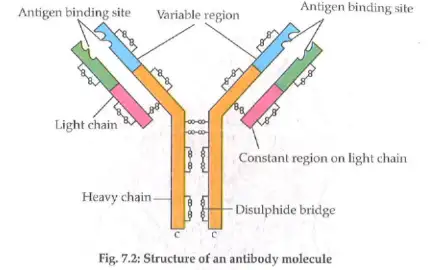
The immune system protects the body by recognizing and responding to foreign antigens. It includes lymphoid organs (bone marrow, thymus, spleen, lymph nodes), immune cells (B cells, T cells, macrophages), and antibodies. Immunity is innate (non-specific, present at birth) and acquired (specific, develops after exposure).
Immunity Types
Innate Immunity: Physical barriers like skin, physiological barriers like stomach acid, cellular barriers like phagocytes, and cytokines like interferons provide immediate defense.
Acquired Immunity: Develops after exposure to pathogens. B cells produce antibodies (humoral immunity), and T cells mediate cell-mediated immunity. It has memory for faster response upon re-exposure.
Immunisation
Immunisation involves active and passive methods. Active immunisation uses vaccines to stimulate antibody production and memory cell formation. Passive immunisation provides ready-made antibodies for immediate protection. Vaccines can be first-generation (live attenuated), second-generation (DNA recombinant), or third-generation (synthetic).
HIV/AIDS
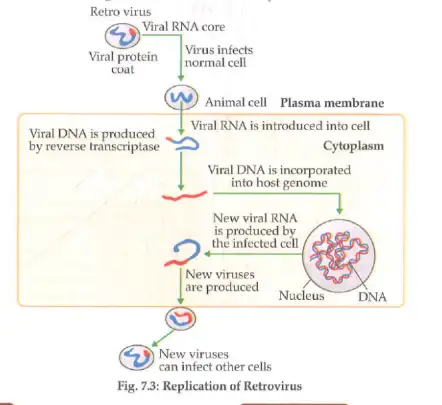
HIV is a retrovirus that infects helper T cells, weakening immunity and leading to AIDS, the advanced immune deficiency stage. Transmission occurs via sexual contact, blood transfusion, infected needles, and mother to child. Diagnosis includes ELISA and PCR tests. Treatment involves antiviral drugs to prolong life. Prevention includes safe sex, blood safety, and avoiding drug abuse.
Cancer
Cancer is uncontrolled cell growth forming tumors. Tumors can be benign (localized) or malignant (spread to other tissues). Types include carcinoma, sarcoma, melanoma, leukemia, and lymphomas. Causes include physical agents (radiation), chemical agents (tobacco smoke), and biological agents (oncogenic viruses). Diagnosis uses biopsy, imaging, and molecular techniques. Treatment includes surgery, radiotherapy, chemotherapy, and immunotherapy.
Solved Examples
Example 1
(i) Name any two helminths pathogenic to humans.
(ii) List two symptoms of diseases caused by one of them.
Solution:
(i) Two pathogenic helminths are Ascaris lumbricoides (causes Ascariasis) and Wuchereria bancrofti (causes Filariasis).
(ii) Symptoms of Ascariasis include internal bleeding, muscular pain, anemia, and intestinal blockage.
Example 2
(i) Give examples of graft rejections.
(ii) List two symptoms of diseases caused by one of them.
Solution:
Graft rejection occurs when the immune system attacks transplanted tissues. Examples include hyperacute rejection (ABO blood group incompatibility), acute rejection (skin graft rejection), and chronic rejection (heart transplant rejection).
Symptoms of acute rejection include inflammation, fever, and organ dysfunction.
Example 3
A team finds vials labeled with cannabinoids during sports practice.
(i) Should this be reported? Why?
(ii) Name a plant source of cannabinoids.
(iii) Describe effects of cannabinoids on the human body.
Solution:
(i) Yes, report to authorities because cannabinoids are drugs and their abuse is illegal.
(ii) Cannabinoids are obtained from Cannabis sativa.
(iii) Cannabinoids affect the brain's cannabinoid receptors and impact the cardiovascular system, potentially causing harmful side effects.
Practice Set
Conceptual Questions
- Level 1: What is the difference between innate and acquired immunity?
- Level 2: Explain the role of helper T cells and cytotoxic T cells in the immune response.
Application-based Question
- Level 3: Describe the life cycle of the malaria parasite and explain how understanding this cycle helps in controlling malaria.
Answer Key
Conceptual Questions
- Level 1: Innate immunity is non-specific and present at birth, providing immediate defense through barriers and cells. Acquired immunity is specific, develops after exposure to pathogens, and has memory for faster response.
- Level 2: Helper T cells activate other immune cells including B cells to produce antibodies, while cytotoxic T cells destroy infected cells directly.
Application-based Question
- Level 3: The malaria parasite's life cycle involves sporozoites entering human blood via mosquito bites, multiplying in liver cells, infecting red blood cells, and producing gametocytes taken up by mosquitoes. Understanding this helps target mosquito control and interrupt transmission.
Drugs and Adolescence
Types of Drugs
Drugs alter nervous system activity and mood. Common types include depressants (sedatives, tranquilisers), opiate narcotics (morphine, heroin), stimulants (cocaine, caffeine), hallucinogens (LSD, cannabinoids), and cannabinoids derived from Cannabis sativa.
Effects of Drug Abuse
Drug abuse causes mood changes, addiction, dependence, and health problems like respiratory failure, liver damage, and social issues. Alcoholism affects coordination, vision, and causes diseases like cirrhosis. Smoking causes cancers and respiratory diseases.
Addiction and Dependence
Addiction is psychological attachment requiring increasing doses. Dependence causes withdrawal symptoms like anxiety and nausea when drug use stops.
Prevention and Control
Prevent drug abuse by avoiding peer pressure, education, counseling, seeking help, and rehabilitation programs.
Solved Examples
Example 1
A student finds vials labeled with cannabinoids during sports practice.
(i) Should this be reported? Why?
(ii) Name a plant source of cannabinoids.
(iii) Describe effects of cannabinoids on the human body.
Solution:
(i) Yes, because cannabinoids are drugs and their abuse is illegal.
(ii) Cannabinoids come from Cannabis sativa.
(iii) They affect brain receptors and cardiovascular system, causing harmful effects.
Practice Set
Conceptual Questions
- Level 1: What are the main types of drugs and their general effects on the nervous system?
- Level 2: Explain the difference between addiction and dependence.
Application-based Question
- Level 3: Discuss the social and health consequences of alcoholism and suggest preventive measures.
Answer Key
Conceptual Questions
- Level 1: Main drug types include depressants (calm brain activity), stimulants (increase activity), hallucinogens (alter perception), and narcotics (pain relief).
- Level 2: Addiction is psychological craving needing more drug; dependence causes withdrawal symptoms when drug use stops.
Application-based Question
- Level 3: Alcoholism leads to health issues like liver disease, accidents, and social problems. Prevention includes education, counseling, and rehabilitation.
Quick Reference Table
Health: A state of complete physical, mental, and social well-being, not merely the absence of disease.
Disease: Any condition causing discomfort, distress, or health problems; classified as congenital or acquired.
Pathogens: Microorganisms causing infectious diseases, including bacteria, viruses, protozoa, helminths, and fungi.
Immunity: The body's ability to resist or fight infections, comprising innate and acquired types.
Innate Immunity: Non-specific defense present at birth, including physical, physiological, cellular, and cytokine barriers.
Acquired Immunity: Specific immunity developed after exposure to pathogens, involving B and T lymphocytes.
Vaccination: Introduction of antigenic material to stimulate active immunity and memory cell formation.
HIV: Human Immunodeficiency Virus that infects helper T cells, leading to immune deficiency.
AIDS: Acquired Immunodeficiency Syndrome, the advanced stage of HIV infection characterized by severe immune system failure.
Cancer: Uncontrolled cell growth forming tumors; types include benign and malignant.
Malaria: A protozoan disease caused by Plasmodium species, transmitted by Anopheles mosquitoes.
Drug Abuse: The harmful or hazardous use of psychoactive substances affecting health and behavior.
Addiction: Psychological attachment to drugs requiring increasing doses for effect.
Dependence: Physical or psychological need for a drug, with withdrawal symptoms upon cessation.
Common Mistakes and Misconceptions
Confusing Pathogen Types: Mixing up bacteria, viruses, protozoa, helminths, and fungi can lead to misunderstanding disease causes and treatments.
Immune Cell Functions: Confusing helper T cells (which activate immune responses) with cytotoxic T cells (which kill infected cells) can cause errors in understanding immunity.
Active vs Passive Immunity: Not distinguishing that active immunity involves antibody production by the body, while passive immunity involves receiving antibodies externally.
Transmission Modes: Mixing vector-borne diseases (e.g., malaria by mosquitoes) with direct transmission (e.g., tuberculosis via droplets) leads to incorrect prevention strategies.
HIV and AIDS: Confusing HIV (the virus) with AIDS (the disease condition) can cause misconceptions about disease progression and treatment.
Tumor Types: Assuming all tumors are cancerous ignores the difference between benign (non-spreading) and malignant (spreading) tumors.
Drug Effects: Overgeneralizing drug effects without recognizing specific impacts of depressants, stimulants, hallucinogens, and cannabinoids.
Withdrawal Symptoms: Confusing addiction (psychological craving) with dependence (physical withdrawal symptoms) can affect treatment approaches.
Glossary
Antibody: A protein produced by B cells that binds specifically to antigens to neutralize pathogens.
Antigen: A foreign substance that induces an immune response.
Bone Marrow: Primary lymphoid organ where blood cells and lymphocytes are produced.
Helper T Cells: T lymphocytes that activate other immune cells to mount a response.
Cytotoxic T Cells: T lymphocytes that destroy infected or abnormal cells.
Macrophages: Large white blood cells that engulf and digest pathogens and debris.
Vaccination: Administration of antigenic material to stimulate immunity.
Plasmodium: Protozoan parasite causing malaria.
Vector: An organism, such as a mosquito, that transmits a pathogen.
HIV: Human Immunodeficiency Virus causing immune system damage.
AIDS: Acquired Immunodeficiency Syndrome, the condition resulting from HIV infection.
Cancer: Disease characterized by uncontrolled cell growth and tumor formation.
Depressants: Drugs that reduce brain activity and induce relaxation or sleep.
Stimulants: Drugs that increase nervous system activity and alertness.
Hallucinogens: Drugs causing altered perceptions and hallucinations.
Cannabinoids: Chemicals from Cannabis sativa affecting brain receptors and cardiovascular system.
Addiction: Psychological dependence on a substance.
Dependence: Physical need for a substance with withdrawal symptoms upon cessation.
Immunisation: Process of inducing immunity through vaccination or antibody administration.