CLASS 12-PCB . BIOLOGY . BIOLOGY . MICROBES IN-HUMAN-WELFARE
Chapter 8 : Microbes In Human Welfare
Ch 8
BIOLOGY
CLASS 12-PCB
Microbes in Daily Life
Introduction to Microbes
Microbes are microscopic organisms that are found everywhere on Earth, including soil, water, air, and inside the bodies of animals and plants. They include bacteria, fungi, protozoa, and microscopic algae. Viruses, viroids, and prions are infectious agents but are not considered living organisms.
Types and Characteristics
Bacteria and fungi can be cultured on nutrient media to form visible colonies, which are useful for scientific studies. Viroids are small RNA molecules causing plant diseases, while prions are infectious proteins responsible for diseases like spongiform encephalopathies.
Role in Human Welfare
Some microbes are harmful and cause diseases, but many are beneficial and play important roles in food production, medicine, agriculture, and environmental management.
Solved Examples
Example 1
What are methanogens? How do they help to generate biogas?
Answer: Methanogens are bacteria that grow anaerobically on cellulosic material and produce methane (CH₄) along with carbon dioxide (CO₂) and hydrogen sulfide (H₂S). They are found in the rumen of cattle and in anaerobic sludge. Methanogens help break down cellulose in cattle digestion and produce biogas from cattle dung, which can be used as fuel.
Practice Set
- Level 1: Name two types of microbes that are beneficial in daily life and explain their roles.
- Level 2: Differentiate between viruses and bacteria in terms of their living status and role in human welfare.
- Level 3: Explain how microbes contribute to the production of curd and bread, highlighting the specific microbes involved.
Answer Key
- Level 1: Lactobacillus helps in curd formation by converting milk into curd; Saccharomyces cerevisiae (yeast) helps in bread making by fermenting dough.
- Level 2: Bacteria are living organisms that can grow and reproduce independently; viruses are non-living infectious agents that require host cells to reproduce. Bacteria can be beneficial or harmful, while viruses mostly cause diseases.
- Level 3: Lactobacillus converts milk into curd by producing lactic acid that coagulates milk proteins. Saccharomyces cerevisiae ferments dough producing carbon dioxide gas that makes bread rise.
Microbes in Household Products
Role of Microbes in Food Preparation
Lactic acid bacteria like Lactobacillus convert milk into curd by producing lactic acid, which coagulates milk proteins. Yeast (Saccharomyces cerevisiae) ferments dough to make bread rise by producing carbon dioxide gas.
Other Fermented Foods
Bacteria and fungi are used to ferment foods such as dosa, idli, cheese, and alcoholic beverages. For example, Propionibacterium shermanii produces carbon dioxide in Swiss cheese, creating holes, and Penicillium roqueforti is used to ripen Roquefort cheese.
Solved Examples
Example 2
Explain the role of Lactobacillus in curd formation.
Answer: Lactobacillus converts lactose in milk into lactic acid. The lactic acid coagulates the milk protein casein, turning milk into curd. A small amount of curd containing Lactobacillus is added to fresh milk to initiate this process.
Practice Set
- Level 1: What microbe is used in bread making and what gas does it produce?
- Level 2: Describe how bacteria contribute to the fermentation of dosa and idli batter.
- Level 3: Differentiate between the roles of yeast and Lactobacillus in food production.
Answer Key
- Level 1: Saccharomyces cerevisiae (yeast) is used in bread making; it produces carbon dioxide gas.
- Level 2: Bacteria ferment the batter anaerobically, producing carbon dioxide gas that makes dosa and idli soft and spongy.
- Level 3: Yeast ferments sugars producing carbon dioxide and alcohol, used in bread and alcoholic beverages; Lactobacillus produces lactic acid, used in curd and other fermented dairy products.
Microbes in Industrial Products
Fermentation in Industry
Microbes are grown in large vessels called fermenters to produce beverages, antibiotics, organic acids, enzymes, and other bioactive molecules on an industrial scale.
Antibiotics
Antibiotics are chemical substances produced by microbes that kill or inhibit harmful bacteria. Penicillin, discovered from the fungus Penicillium notatum, was the first antibiotic. Antibiotics are used to treat bacterial infections but must be used judiciously to prevent resistance.
Other Products
Microbes produce organic acids like citric acid (Aspergillus niger), acetic acid (Acetobacter aceti), and lactic acid (Lactobacillus). Enzymes such as lipases, pectinases, and proteases have industrial applications. Cyclosporin A is an immunosuppressive agent produced by Trichoderma polysporum, and statins produced by Monascus purpureus lower blood cholesterol.
Solved Examples
Example 3
What is the significance of Penicillin and how was it discovered?
Answer: Penicillin is an antibiotic that kills bacteria causing infections. It was discovered by Alexander Fleming in 1928 when he observed that the mold Penicillium notatum inhibited the growth of Staphylococci bacteria on culture plates.
Practice Set
- Level 1: Name two organic acids produced by microbes and their producing organisms.
- Level 2: Explain why antibiotics should be used judiciously.
- Level 3: Describe the industrial production process of antibiotics.
Answer Key
- Level 1: Citric acid produced by Aspergillus niger; acetic acid produced by Acetobacter aceti.
- Level 2: Overuse of antibiotics leads to antibiotic-resistant microbes and kills beneficial bacteria, causing side effects.
- Level 3: Microbes are grown in fermenters under controlled conditions to produce antibiotics, which are then extracted and purified for medical use.
Microbes in Sewage Treatment
Stages of Sewage Treatment
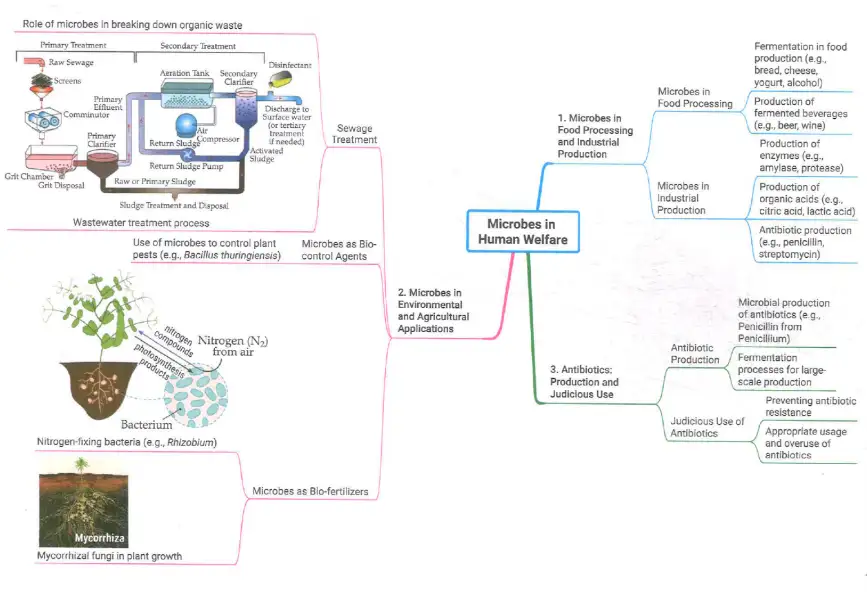
Sewage treatment involves primary, secondary, and tertiary processes to remove pollutants and make water safe for release or reuse.
Primary Treatment
This is a physical process that removes large particles, floating debris, and grit by filtration and sedimentation. The settled solids form primary sludge, and the liquid is called primary effluent.
Secondary Treatment
Primary effluent is treated biologically in aeration tanks where aerobic microbes form flocs that consume organic matter, reducing Biochemical Oxygen Demand (BOD). The activated sludge settles and is partly recycled; the rest is digested anaerobically producing biogas.
Tertiary Treatment
This physicochemical process removes remaining contaminants to further purify the water before release.
Biochemical Oxygen Demand (BOD)
BOD measures the amount of oxygen required by microbes to decompose organic matter in water. High BOD indicates high pollution.
Solved Examples
Example 4
What is the role of aerobic bacteria in secondary sewage treatment?
Answer: Aerobic bacteria grow in aeration tanks forming flocs that consume organic matter in sewage, reducing BOD and purifying the water.
Practice Set
- Level 1: What is primary sludge?
- Level 2: Explain the importance of reducing BOD in sewage treatment.
- Level 3: Describe the anaerobic digestion process in sewage treatment and its products.
Answer Key
- Level 1: Primary sludge is the solid matter that settles during primary treatment of sewage.
- Level 2: Reducing BOD lowers oxygen consumption in water bodies, preventing harm to aquatic life and pollution.
- Level 3: Anaerobic bacteria digest sludge in digesters producing biogas (methane, carbon dioxide, hydrogen sulfide) and reducing sludge volume.
Microbes in Biogas Production
Biogas Generation
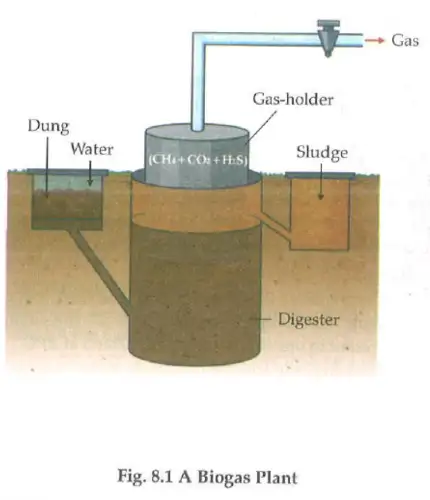
Biogas is a mixture of inflammable gases, mainly methane, produced by anaerobic microbial activity on organic waste such as cattle dung.
Methanogens
Methanogens are anaerobic bacteria that break down cellulose and produce methane gas. They are found in the rumen of cattle and in anaerobic sludge.
Biogas Plant Components
A biogas plant consists of a concrete tank (digester) where bio-waste is collected, a floating cover to collect gas, an outlet pipe to supply biogas, and an outlet for removing slurry used as fertilizer.
Energy Plantation
Plant species with high calorific value are grown to produce biomass for biogas production, known as energy plantations.
Solved Examples
Example 5
Describe the process of biogas production in a biogas plant.
Answer: Organic waste like cattle dung is mixed with water and placed in the digester. Anaerobic microbes break down the waste producing biogas (methane, carbon dioxide, hydrogen sulfide). The gas collects under the floating cover and is piped out for use. The leftover slurry is removed and used as fertilizer.
Practice Set
- Level 1: What is the main component of biogas?
- Level 2: Explain the role of methanogens in biogas production.
- Level 3: List the parts of a biogas plant and their functions.
Answer Key
- Level 1: Methane (CH₄) is the main component of biogas.
- Level 2: Methanogens break down organic matter anaerobically producing methane gas used as fuel.
- Level 3: Concrete tank (digester) collects waste; floating cover collects gas; outlet pipe supplies biogas; outlet removes slurry for fertilizer.
Microbes as Biocontrol Agents and Biofertilisers
Biocontrol Agents
Biocontrol uses biological methods to control plant diseases and pests, avoiding harmful chemical pesticides.
Microbial Biocontrol Agents
Bacillus thuringiensis (Bt): Produces toxins that kill insect larvae like caterpillars when sprayed on plants.
Trichoderma sp.: A fungus that controls plant pathogens in the root ecosystem.
Baculoviruses: Viruses that specifically attack insect pests without harming beneficial insects.
Biofertilisers
Biofertilisers are microbes that enrich soil nutrients, such as nitrogen-fixing bacteria and fungi.
Rhizobium: Symbiotic bacteria in legume root nodules that fix atmospheric nitrogen.
Azospirillum and Azotobacter: Free-living nitrogen-fixing bacteria in soil.
Mycorrhiza: Symbiotic association of fungi with plant roots that enhances nutrient absorption and plant growth.
Cyanobacteria: Autotrophic microbes like Anabaena and Nostoc that fix nitrogen and improve soil fertility, especially in paddy fields.
Solved Examples
Example 6
How do organic farmers control pests differently from conventional methods?
Answer: Organic farmers use microbial biocontrol agents like Bacillus thuringiensis and Trichoderma to control pests specifically without harming beneficial organisms, unlike chemical pesticides which are non-specific and polluting.
Practice Set
- Level 1: Name two microbial biocontrol agents and their targets.
- Level 2: What is the role of Rhizobium in agriculture?
- Level 3: Explain the benefits of mycorrhizal association for plants.
Answer Key
- Level 1: Bacillus thuringiensis targets insect larvae; Trichoderma controls fungal plant pathogens.
- Level 2: Rhizobium fixes atmospheric nitrogen in legume roots, enriching soil nitrogen content.
- Level 3: Mycorrhiza enhances phosphorus absorption, provides resistance to pathogens, and improves plant growth and tolerance to stress.
Quick Reference Table
Microbes and Their Uses:
- Lactobacillus: Converts milk into curd by producing lactic acid.
- Saccharomyces cerevisiae: Yeast used in bread making and alcoholic beverage production.
- Penicillium notatum: Produces antibiotic penicillin.
- Aspergillus niger: Produces citric acid.
- Bacillus thuringiensis: Biocontrol agent against insect larvae.
- Rhizobium: Nitrogen-fixing bacteria in legume roots.
- Mycorrhiza: Fungal association aiding nutrient absorption.
- Methanogens: Anaerobic bacteria producing methane in biogas plants.
Sewage Treatment Stages:
- Primary: Physical removal of solids.
- Secondary: Biological treatment by aerobic microbes.
- Tertiary: Physicochemical treatment for further purification.
Biogas Plant Components: Concrete tank (digester), floating cover, gas outlet, slurry outlet.
Common Mistakes and Misconceptions
- Confusing beneficial microbes like Lactobacillus with harmful pathogens like Escherichia coli.
- Mixing up yeast used in bread making with Lactobacillus used in curd formation.
- Assuming all microbes are harmful; many are essential for food production and environmental processes.
- Confusing aerobic bacteria used in sewage treatment with anaerobic bacteria used in biogas production.
- Using antibiotics indiscriminately leading to antibiotic resistance and killing beneficial gut bacteria.
- Believing chemical pesticides are always better than biocontrol agents; chemical pesticides cause pollution and harm non-target organisms.
Glossary
- Microbes: Microscopic organisms including bacteria, fungi, protozoa, and algae.
- Antibiotics: Medicines produced by microbes that kill or inhibit bacteria.
- Biocontrol: Use of living organisms to control pests and diseases.
- Biofertilisers: Microorganisms that enrich soil nutrient content.
- Biogas: Methane-rich gas produced by anaerobic microbial digestion of organic waste.
- Fermentation: Microbial process converting sugars into acids, gases, or alcohol.
- Activated Sludge: Microbial flocs used in secondary sewage treatment.
- Mycorrhiza: Symbiotic association between fungi and plant roots.
- Methanogens: Anaerobic bacteria producing methane gas.
- Biochemical Oxygen Demand (BOD): Measure of oxygen required by microbes to decompose organic matter in water.