SOLUTIONS
2026 BOARD EXAM
CBSE Class 12 PCB Biology Board Paper 2026 — Set 4 Solutions
2026
Biology
Class 12 PCB
CBSE EXAMINATION PAPER-2026
BIOLOGY
(Solved)
General Instructions :
Read the following instructions carefully and follow them :
- This question paper contains 38 questions. All questions are compulsory.
- This question paper is divided into 5 sections.
- Section A – questions number 1 to 2 are case based questions
- Section B – questions number 3 to 18 are multiple choice questions
- Section C – questions number 19 to 24 are very short answer
- Section D – questions number 25 to 32 are short answer
- Section E – questions number 33 to 38 are long answer
- There is no overall choice given in the question paper. However, an internal choice has been provided in few questions.
- Use of calculator is NOT allowed.
Section A
Read the following passage and answer the questions that follow :
Gene expresses itself in a cell system as a protein/enzyme. How an expression of gene occurs in a cell system, when it needs to occur and how the gene expression is regulated in prokaryotic cell system was studied by the combined efforts of Francois Jacob, a geneticist and Jacques Monod, a biochemist. For their work on lactose metabolism in E. coli and introducing the concept of ‘lac operon’, they were awarded the Nobel Prize in 1965.
(1) It is said that ‘lac operon’ has to be operational at a very low level in the bacterial cell all the time. Justify.
[1 Mark]The lac operon is kept operational at a very low level in bacterial cells to allow immediate response when lactose becomes available. This ensures that the enzymes needed for lactose metabolism can be synthesized quickly, helping the bacteria adapt efficiently to changes in the environment as described in the passage.
(2) How are the structural genes activated in the lac operon in E. coli ?
[1 Mark]In E. coli, the structural genes of lac operon are activated when lactose is present in the medium.
The lactose acts as an inducer and binds to the repressor protein, inactivating it.
This allows RNA polymerase to bind to the promoter and transcribe the structural genes.
Thus, gene expression occurs only when needed, as explained by Jacob and Monod in the lac operon model.
(3) Why is lac operon said to be a transcriptionally regulated system ?
[2 Marks]The lac operon is regulated based on the presence of lactose in the medium; when lactose is present, transcription of structural genes occurs to produce enzymes that metabolize lactose.
This regulation by the lac operon was the first example of gene regulation at the transcriptional level discovered by Jacob and Monod, as mentioned in the case passage.
Read the following passage and answer the questions that follow:
Immunity in our body is of two types (i) Innate immunity, and (ii) Acquired immunity. Innate immunity is a non-specific defence mechanism, whereas Acquired immunity is pathogen specific. Acquired immunity is characterised by memory. Antibodies are specific to antigens and there are four types of antibodies produced in our body — IgA, IgE, IgG and IgM. It shows primary response where it encounters the pathogen for the first time and secondary response during the subsequent encounters with the same antigen/pathogen. These immune responses are carried out with the help of two special types of lymphocytes present in the blood
(1) Name the two types of specialised cells which carry out the primary and secondary responses.
[1 Mark]The two specialised lymphocytes that carry out the primary and secondary immune responses are B-lymphocytes and T-lymphocytes. B-lymphocytes produce specific antibodies against pathogens, while T-lymphocytes help in destroying infected cells. These cells are responsible for the acquired immunity which has memory as described in the passage.
(2) Name any two barriers present in our body that provide innate immunity.
[1 Mark](3) How is active immunity different from passive immunity ? Write any two differences.
[2 Marks]Passive immunity is when ready-made antibodies are directly given to the body, providing immediate but short-term protection without memory. Thus, active immunity is slow and long-lasting, whereas passive immunity is fast-acting but temporary.
Section B
Choose the option that gives the correct number of pollen grains that will be formed after 325 microspore mother cells undergo microsporogenesis.
Each microspore mother cell undergoes meiosis during microsporogenesis to produce 4 microspores. Each microspore develops into a pollen grain. Therefore, from 325 microspore mother cells, the total number of pollen grains formed will be 325 × 4 = 1300.
A female undergoing IVF treatment has blocked fallopian tube. The technique by which the embryo with more than 8 blastomeres will be transferred into the female for further development is :
According to the context, embryos with more than 8 blastomeres are transferred into the uterus by the technique called Intra Uterine Transfer (IUT). Since the female has a blocked fallopian tube, transfer into the fallopian tube (as in ZIFT or GIFT) is not possible. Therefore, the correct technique for transferring embryos with more than 8 blastomeres in IVF treatment is IUT.
Select the correct statement.
All genes located on the same chromosome
Genes located on the same chromosome tend to be inherited together as a single linkage group because they do not assort independently. However, the strength of linkage depends on the distance between the genes — genes that are very close are tightly linked with low recombination, while those farther apart show higher recombination but still belong to the same linkage group. Therefore, all genes on the same chromosome form one linkage group.
Choose the correct statements:
(i) Polycistronic mRNA is generally found in eukaryotes.
(ii) The RNA polymerase II transcribes precursor of mRNA, the hn RNA.
(iii) The process of translation of mRNA begins when the mRNA encounters the large subunit of ribosomes.
(iv) Stop codons do not have any tRNAs
Statement (ii) is correct because RNA polymerase II transcribes the precursor of mRNA known as heterogeneous nuclear RNA (hnRNA). This is clearly mentioned in the context. Statement (iv) is also correct because stop codons do not code for any amino acid and therefore do not have any corresponding tRNAs; they signal termination of translation. Statement (i) is incorrect because polycistronic mRNA is generally found in prokaryotes, not eukaryotes. Statement (iii) is incorrect because translation begins when mRNA encounters the small subunit of the ribosome, not the large subunit.
Name the extinct ancestor of humans who ate only fruits and hunted with stone weapons.
Australopithecus lived about 2 million years ago in East African grasslands. Evidence shows they hunted with stone weapons but essentially ate fruits, making them the extinct ancestor described. Ramapithecus and Dryopithecus were earlier primates more ape-like or man-like but did not have the described behavior. Homo erectus likely ate meat and had a larger brain, differing from the characteristics given.
Nicotine affects blood pressure and heart rate due to release of certain adrenal hormones. Following are some of the adrenal hormones :
(i) Adrenaline
(ii) Cortisol
(iii) Noradrenaline
(iv) Aldosterone Select the correct option :
Adrenaline and noradrenaline are catecholamines secreted by the adrenal medulla. They are responsible for the 'fight or flight' response and increase heart rate and blood pressure. Cortisol and aldosterone are secreted by the adrenal cortex and do not directly affect heart rate and blood pressure in the way adrenaline and noradrenaline do. Therefore, the correct hormones affecting blood pressure and heart rate due to nicotine are adrenaline (i) and noradrenaline (iii).
Microbes used for biocontrol of pest butterfly caterpillars is :
Bacillus thuringiensis (Bt) is a bacterium used for the biocontrol of pest butterfly caterpillars. Bt produces toxins that are harmful to insect larvae but safe for other insects and humans. These toxins are released in the gut of the caterpillars when they ingest the bacteria, killing them effectively. Bt is commonly used in agriculture, for example Bt-cotton is a crop genetically engineered to contain Bt toxin genes, providing resistance against insect pests. Other options like Trichoderma are used against plant pathogens, and Streptococcus sp. and Saccharomyces cerevisiae are not used for this purpose.
The given diagram shows the skulls of two different mammals. Which of the following options accurately describes the differences between these skulls ?
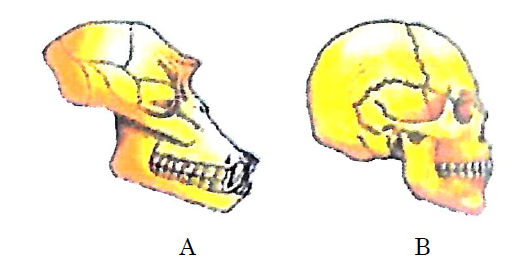
Based on the provided context, Skull A has a larger braincase, smaller jaw, and a flat face with a prominent chin, which are characteristics of a human skull. Skull B has a smaller braincase and a larger, projecting jaw, typical of an adult chimpanzee. Therefore, Skull A corresponds to a human and Skull B corresponds to an adult chimpanzee.
In RNAi, genes are silenced using which of the following biomolecules ?
RNA interference (RNAi) involves the silencing of specific mRNA molecules by complementary double-stranded RNA (dsRNA). The dsRNA binds to the target mRNA and prevents its translation, effectively silencing the gene. This method is used as a cellular defense mechanism in eukaryotic organisms. The context explains that dsRNA triggers RNAi by forming through complementary sense and anti-sense RNA strands, which then silence the expression of the target gene.
Connell’s elegant field experiments on the rocky seacoast of Scotland, found that larger barnacles Balanus dominated the intertidal area and removed the smaller barnacles Chathamalus. This happened due to :
Connell's field experiments showed that the larger barnacle Balanus, which is competitively superior, dominates the intertidal zone and excludes the smaller barnacle Chathamalus. This exclusion happens because both species compete for the same space and resources, and the superior competitor outcompetes the other species. This is an example of competition, where species struggle to gain limited resources, and one species excludes the other.
Protein encoded by gene Cry-I Ab controls the infestation of which of the following ?
According to the provided context, the protein encoded by gene cryIAb controls corn borer infestation. The context specifies that different cry genes from Bacillus thuringiensis target specific pests, and cryIAb specifically controls corn borer, whereas cryIAc and cryIIAb control cotton bollworms. Thus, the correct answer is Corn borer.
Assertion (A) : Cleistogamous flowers have assured seed set.
Reason (R) : Cleistogamous flowers are invariably autogamous and do not depend on any pollinating agents
Cleistogamous flowers are closed flowers that do not open and self-pollinate internally. This means they are invariably autogamous, ensuring pollination without the need for external pollinating agents. As a result, cleistogamous flowers have assured seed set since self-pollination occurs even in the absence of pollinators. Thus, both the assertion and reason are true, and the reason correctly explains the assertion.
Assertion (A) : The human blood group ‘AB’ exemplifies co-dominance.
Reason (R) : The gene for human blood group trait exists in three allelic forms IA, IB and i.
The human blood group 'AB' is an example of co-dominance because both IA and IB alleles are expressed equally when present together, resulting in the AB blood group. The gene controlling the ABO blood group has three allelic forms: IA, IB, and i. The presence of both IA and IB alleles leads to co-dominance, as both phenotypes appear simultaneously without one being dominant over the other. Thus, both the assertion and reason are true, and the reason correctly explains the assertion.
Assertion (A) : Nucleopolyhedrovirus are useful as they are good biocontrol agents.
Reason (R) : They are species-specific, narrow spectrum bioinsecticide
Nucleopolyhedroviruses belong to the genus Nucleopolyhedroviral, a group of baculoviruses that specifically infect certain insect species. These viruses are considered good biocontrol agents because they act as species-specific, narrow spectrum bioinsecticides. This specificity ensures that they target only the pest insects without harming plants, mammals, birds, fish, or beneficial non-target insects, making them environmentally friendly and effective for pest management.
Assertion (A) : The pyramid of biomass in a pond aquatic ecosystem is always inverted.
Reason (R) : The biomass of consumers like fishes far exceeds that of the producers like phytoplanktons
The pyramid of biomass in a pond aquatic ecosystem is often inverted because the biomass of producers (phytoplankton) at any given time is small due to their rapid reproduction and turnover, even though they support a larger biomass of consumers (like zooplankton and fishes). While it is true that the biomass of consumers like fishes can be greater than that of producers like phytoplankton, this fact alone does not fully explain why the pyramid is inverted. The key reason for the inversion is the high turnover rate of phytoplankton, not just the relative biomasses of fishes and phytoplankton.
Section C
How do ‘implants’ act as an effective method of contraception in human females ? Mention one advantage of implants over contraceptive pills
(b) One advantage of implants over contraceptive pills is that implants provide long-term protection against pregnancy without the need for daily intake, thus ensuring better convenience and compliance.
(a) Write one way by which apomictic seeds can be developed.
(b) Why do farmers prefer apomictic seeds over hybrid seeds ?
(b) Farmers prefer apomictic seeds over hybrid seeds because apomictic seeds produce offspring identical to the parent plant, maintaining desired traits without segregation. This saves farmers from buying hybrid seeds every year as the quality remains stable in subsequent generations, reducing cost and effort.
A laboratory assistant collected three water samples, namely river water, untreated sewage water and secondary effluent discharged from a sewage treatment plant. But the laboratory attendant did not note which was which. The samples were labelled A, B and C and subjected to a BOD test. The BOD values of the three samples A, B and C were recorded as 30 mg/L, 8 mg/L and 400 mg/L respectively.
(a) Which sample of the water is most polluted ?
(b) Can you assign the correct label to each, assuming the river water is relatively clean ?
(b) Since river water is relatively clean, it will have the lowest BOD value. Therefore, sample B with BOD 8 mg/L is river water. Untreated sewage water has the highest pollution and BOD, so sample C (400 mg/L) is untreated sewage. The remaining sample A with BOD 30 mg/L is the secondary effluent from the sewage treatment plant, which is partially treated water with reduced pollution.
Write the role of ‘ori’ and ‘restriction’ site in a cloning vector pBR322.
Restriction site: These are specific sequences recognized by restriction enzymes which cut the plasmid at precise points. They allow insertion of foreign DNA into the plasmid at desired locations during cloning.
Biodiversity must be conserved as it plays an important role in many ecosystem services that nature provides. Explain any two ecosystem services.
Purification of air and water: Forests and plants act as natural filters, cleaning the air by absorbing harmful gases and purifying water by filtering pollutants, thus maintaining a healthy environment.
(i) State, what does ‘standing crop’ of a trophic level represent.
(ii) List any two ways of measuring the standing crop of a trophic level.
(ii) Two ways to measure the standing crop of a trophic level are:
1. By measuring the biomass, either fresh weight or dry weight of the organisms.
2. By counting the number of individuals present per unit area.
Section D
Differentiate between wind-pollinated and insect-pollinated flowers. Give an example of each type.
1. Pollination Agent: Wind-pollinated flowers use wind to carry pollen from one flower to another, while insect-pollinated flowers rely on insects like bees to transfer pollen.
2. Pollen Characteristics: Wind-pollinated flowers produce large quantities of light and dry pollen to be easily carried by wind. Insect-pollinated flowers produce sticky and heavy pollen that sticks to insects.
3. Flower Structure: Wind-pollinated flowers usually have small, dull petals and exposed stamens and stigmas to catch pollen from the air. Insect-pollinated flowers have bright colored petals, scent, and nectar to attract insects.
4. Examples: An example of a wind-pollinated flower is grass or maize, and an example of an insect-pollinated flower is a rose or an orchid.
(a) Construct a complete transcription unit with promoter and terminator on the basis of the hypothetical coding strand given below:
(b) Write the RNA strand transcribed from the above transcription unit along with its polarity

Promoter - 5'-ATGCATGCATGCATGCATGCATGC-3' (coding strand) - Terminator
(b) The RNA strand is synthesized using the template strand which is complementary and antiparallel to the coding strand. Since the coding strand is 5'-ATGCATGCATGCATGCATGCATGC-3', the template strand is 3'-TACGTACGTACGTACGTACGTACG-5'. RNA polymerase reads the template strand from 3' to 5' and synthesizes RNA in 5' to 3' direction. The transcribed RNA sequence is complementary to the template strand and identical in sequence to the coding strand except that thymine (T) is replaced by uracil (U). Hence, the RNA strand is 5'-AUGCAUGCAUGCAUGCAUGCAUGC-3'. The polarity of the RNA strand is from 5' to 3'.
Explain the three different ways in which natural selection operates. Explain with the help of graphs.
(a) Stabilising Selection: In stabilising selection, natural selection favors the individuals with average traits. This makes the peak of the curve higher and narrower, meaning most individuals have traits closer to the average. Extremes are less common. For example, medium-sized babies have a higher survival rate than very small or very large babies.
(b) Directional Selection: Directional selection occurs when natural selection favors one extreme trait over the other. This causes the entire population curve to shift towards that extreme, either to the left or right on the graph. For instance, if larger size helps animals survive better, over time more bigger animals will be present.
(c) Disruptive Selection: Disruptive selection favors individuals at both extremes rather than average traits. This results in two peaks in the graph, showing two groups with extreme traits are more common, and the average becomes less common. An example is when both very small and very large seeds exist and birds with either very small or very large beaks survive better but not birds with medium-sized beaks.
(a) How do some viruses cause cancer in humans ?
(b) How do benign tumours turn malignant ? How do malignant tumours harm the human body ?
(b) Benign tumours turn malignant when they lose the property of being confined to their original location and begin to invade nearby tissues. Malignant tumours spread rapidly through the body by invading other organs or through the bloodstream and lymphatic system. Malignant tumours harm the human body by damaging tissues, interfering with normal organ functions, and spreading cancerous cells to other parts of the body, which can be life-threatening.
(a) How is insulin different from proinsulin ?
(b) Explain all the stages of how human insulin is produced through rDNA technology.
(b) Human insulin is produced through rDNA technology by the following steps:
1. The genes coding for A and B chains of human insulin are separately inserted into plasmids of E coli bacteria.
2. These recombinant plasmids are introduced into E coli which then expresses A and B chains separately.
3. The A and B chains are extracted and purified from bacterial cultures.
4. Chemically, the two chains are combined by forming disulfide bonds to produce active human insulin.
This method allows large scale insulin production identical to natural human insulin without immune reactions.
Study the graph given below and answer the questions that follow :
(i) Write the status of food and space in the curves a and b.
(ii) In the absence of predators, which one of the two curves would appropriately depict the prey population ?
(iii) ‘Time’ has been shown on x-axis and there is a parallel dotted line above it. Give the significance of this dotted line.
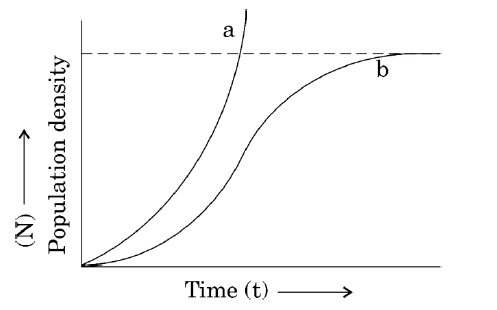
(b) In the absence of predators, curve a (exponential growth curve) would depict the prey population because without predators, the prey population can grow without limitation assuming food and space are sufficient.
(c) The parallel dotted line above the x-axis (time) indicates the carrying capacity or maximum population size that the environment can sustain due to limited resources like food and space. This line shows the level at which the population stabilizes in logistic growth.
Answer the following questions :
(i) Define ‘predation’.
(ii) Why is predation required in a community of different organisms ? Give any two points.
(iii) Why are predators ‘prudent’ in nature ?
(b) Predation is required in a community because: 1. It helps in controlling the population of prey species, preventing them from overpopulating and causing imbalance in the ecosystem. 2. It facilitates the transfer of energy from one trophic level to another, which is essential for the survival of higher organisms.
(c) Predators are ‘prudent’ in nature because if they consume their prey too efficiently, it could lead to the extinction of the prey species. This would result in the predator losing its source of food and eventually becoming extinct as well. Therefore, predators maintain a balance by not overexploiting their prey, ensuring the survival of both species in the ecosystem.
There are many animals, which have become extinct in the wild, but continue to be maintained in zoological parks. Answer the questions that follow:
(a) What type of bio-diversity conservation is observed in this case ?
(b) Explain any other two ways which help in this type of conservation.
(c) Besides zoological parks, mention one place that serves this purpose.
(b) Two other ways that help in ex situ conservation are:
1. Botanical gardens: These are special places where rare and endangered plants are grown and protected.
2. Cryopreservation: This technique involves preserving gametes or tissues at very low temperatures so that they can be used later for breeding or research.
(c) Besides zoological parks, botanical gardens also serve the purpose of ex situ conservation by protecting endangered plant species in a controlled environment.
Section E
Study the flow chart given below. Name the hormones involved at each stage and explain their functions.
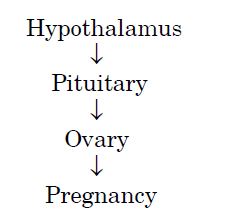
The flow chart represents the hormonal control involving the hypothalamus, pituitary gland, and target glands.
1. Hypothalamus:
The hypothalamus produces releasing hormones. For example, Gonadotropin Releasing Hormone (GnRH).
Function : GnRH stimulates the anterior pituitary gland to release specific hormones.
2. Anterior Pituitary Gland:
It secretes trophic hormones such as Follicle Stimulating Hormone (FSH) and Luteinizing Hormone (LH).
Function : FSH promotes the growth of ovarian follicles in females and sperm production in males.
LH triggers ovulation and stimulates production of estrogen and progesterone from ovaries or testosterone from testes.
3. Target Glands (Ovaries/Testes):
They produce sex hormones like estrogen, progesterone, and testosterone.
Function : These hormones regulate secondary sexual characteristics, reproductive cycles, and fertility.
Summary:
The hypothalamus releases GnRH which acts on the anterior pituitary to secrete FSH and LH. These pituitary hormones act on the gonads to release sex hormones that control reproduction and secondary sexual characteristics. This is a classical example of hormonal regulation through feedback mechanisms to maintain balance in the body.
(i) Draw a diagram of L.S. of maize grain and label its any six parts.
(ii) Differentiate between perisperm and endosperm giving one example of each.
1. Pericarp: The outermost protective layer of the maize grain.
2. Seed coat: A thin layer present just inside the pericarp that protects the seed.
3. Endosperm: The large food-storing tissue that provides nutrients to the developing embryo.
4. Embryo: The young plant inside the seed which will grow into a new maize plant.
5. Scutellum: Part of the embryo that absorbs food from the endosperm during germination.
6. Coleoptile: A protective sheath that covers the young shoot of the embryo.
(ii) Difference between Perisperm and Endosperm:
Perisperm: It is the nutritive tissue derived from the nucellus of the ovule. It is usually found surrounding the endosperm or embryo and stores food. An example of a seed having perisperm is black pepper.
Endosperm: It is the nutritive tissue formed as a result of fertilization and is triploid in nature. It provides food to the developing embryo. An example of a seed rich in endosperm is maize.
Write the types and locations of the genes causing thalassemia in humans. State the cause and symptoms of the disease. How is sickle-cell anemia different from this disease ?
(a) Types and locations of genes causing thalassemia in humans: Thalassemia is classified into two main types based on the affected globin chain: alpha (\u03b1) thalassemia and beta (\u03b2) thalassemia. \u03b1 Thalassemia is caused by mutations or deletions in the HBA1 and HBA2 genes located on chromosome 16. \u03b2 Thalassemia is due to mutations in the HBB gene on chromosome 11.
(b) Cause and symptoms of thalassemia: Thalassemia occurs due to defective or deficient synthesis of either the \u03b1 or \u03b2 globin chains of hemoglobin, leading to an imbalance in globin chain production. This results in anemia, fatigue, weakness, pale skin, slow growth, and enlargement of spleen and liver.
(c) Difference between sickle-cell anemia and thalassemia: Sickle-cell anemia is a qualitative disorder caused by a mutation in the HBB gene resulting in abnormal hemoglobin (HbS) which distorts red blood cells into a sickle shape. In contrast, thalassemia is a quantitative disorder characterized by reduced or absent production of one type of globin chain. Thus, thalassemia results from producing too few globin molecules, while sickle-cell anemia results from producing a structurally abnormal globin molecule.
(i) Enlist any four prime goals of the Human Genome Project (HGP).
(ii) List the two methodologies which were involved in the human genome project. Mention how they were used.
(iii) Expand ‘YAC’ and mention what it was used for
1. Identify all the approximately 20,000-25,000 genes in human DNA.
2. Determine the sequences of the 3 billion chemical base pairs that make up human DNA.
3. Store this information in databases accessible to researchers worldwide.
4. Develop tools for data analysis and address ethical, legal, and social issues arising from genome research.
(ii) The two main methodologies used in the Human Genome Project were:
1. Genetic Mapping: This involved locating genes on chromosomes by discovering their relative positions using markers.
2. Physical Mapping and DNA Sequencing: Physical maps determined the exact physical locations of genes, and DNA sequencing was used to read the order of nitrogen bases A, T, C, and G in the DNA.
Both methodologies together helped in identifying gene locations and reading their sequences.
(iii) YAC stands for Yeast Artificial Chromosome. It was used as a cloning vector to carry very large fragments of human DNA during the genome sequencing. This helped in organizing and analyzing large segments of DNA effectively.
(i) EcoR I has played a very important role in rDNA technology.
(a) Explain the convention for naming EcoR I.
(b) Write the recognition site of this endonuclease restriction enzyme.
(ii) Name the overhanging stretches of DNA produced by these restriction enzymes. Describe their role in the formation of rDNA.
(b) EcoRI recognizes the specific palindromic DNA sequence GAATTC and cuts between G and A on each strand.
(ii) EcoRI produces sticky ends which are single-stranded overhanging stretches of DNA after cutting. These sticky ends are complementary and can anneal with other DNA fragments cut by the same enzyme. This property is crucial in recombinant DNA technology as it allows foreign DNA to join easily with vector DNA to form rDNA, facilitating gene cloning and other molecular biology techniques.
(i) Insertional inactivation is a method to detect the recombinant DNA. Explain this method.
(ii) Name the commonly used vector for transferring genes in plants from bacteria.
(iii) How is this able to transform a normal plant cell into a tumour ?
(b) The commonly used vector for transferring genes in plants is the Ti plasmid of the bacterium Agrobacterium tumefaciens.
(c) The Ti plasmid of Agrobacterium tumefaciens has a segment called T-DNA, which integrates into the plant cell genome and causes production of plant hormones leading to uncontrolled cell division, forming a tumour or gall. This ability to induce tumours allows the plasmid to transfer genes into plant cells and modify them genetically.
Other Years — Biology