QUESTION PAPER
2026 BOARD EXAM
CBSE Class 12 PCB Biology Board Paper 2026 — Set 3
2026
Biology
Class 12 PCB
CBSE EXAMINATION PAPER-2026
BIOLOGY
(Solved)
General Instructions :
Read the following instructions carefully and follow them :
- This question paper contains 39 questions. All questions are compulsory.
- This question paper is divided into 5 sections.
- Section A – questions number 1 to 2 are case based questions
- Section B – questions number 3 to 18 are multiple choice questions
- Section C – questions number 19 to 26 are very short answer
- Section D – questions number 27 to 33 are short answer
- Section E – questions number 34 to 39 are long answer
- There is no overall choice given in the question paper. However, an internal choice has been provided in few questions.
- Use of calculator is NOT allowed.
Section A
Read the following passage and answer the question that follow :
The data below shows the concentration of nicotine smoked by a smoker taking 10 puffs/minute
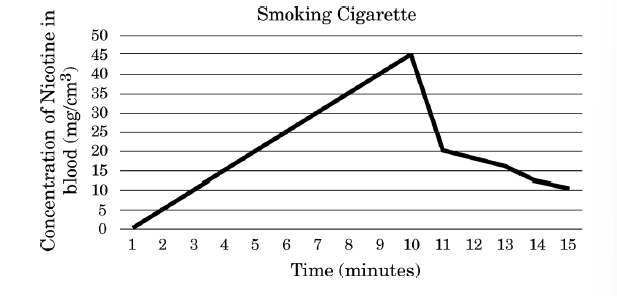
(1) With reference to the above graph, explain the concentration of nicotine in the blood at 10 minutes.
[1 Mark](2) How will this affect the concentration of carbon monoxide and haem-bound oxygen at 10 minutes ?
[1 Mark](3) To which class of compounds does nicotine belong ? Name one other drug from the same class.
[2 Marks]Read the following passage and answer the questions that follow:
India is one of the megadiverse countries housing around 8·1 per cent of global species diversity, although its land area is only 2·4 per cent of the world’s land area. Many of the species are highly threatened due to human activities like deforestation, mining and habitat fragmentation. Laws like Wildlife (Protection) Act, 1972 were enacted by the Government of India to preserve our biological wealth. Various conservation measures are being implemented to save the threatened species.
The following bar graph shows the number of species conserved under different biodiversity conservation methods.
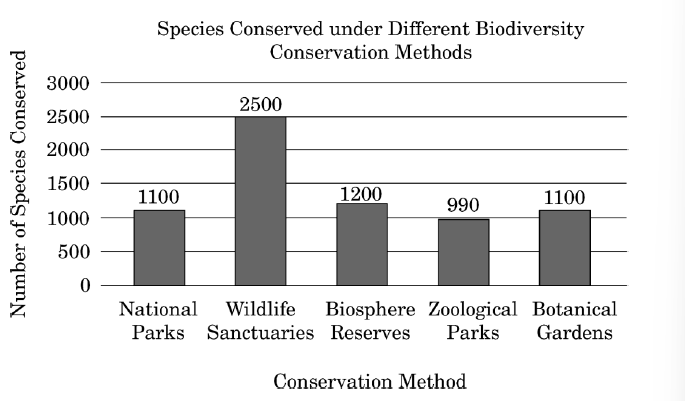
(1) Which method conserves the highest number of species ? Is it ex situ or in situ conservation
[1 Mark](2) Which other methods shown in the diagram are opposite to the one identified by you in question (a) ? How are these two conservation approaches different ?
[2 Marks](3) Write two features of Biodiversity hotspots
Section B
Foetal ejection reflex in human female triggers the release of which hormone ?
Which of the following is not a functional unit of an ecosystem ?
Match Column I with Column II and select the correct option
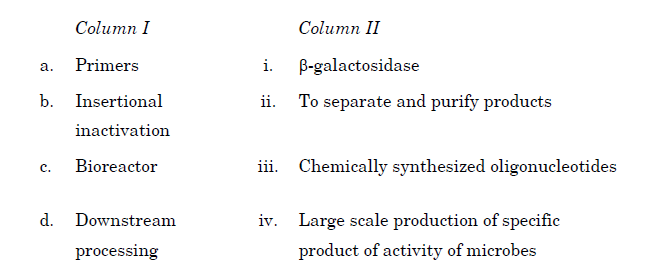
Golden rice is a promising transgenic crop. When released for cultivation, it will help in
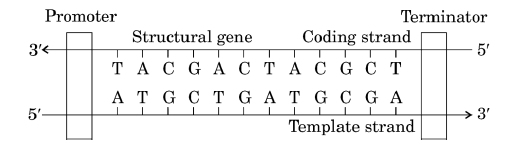
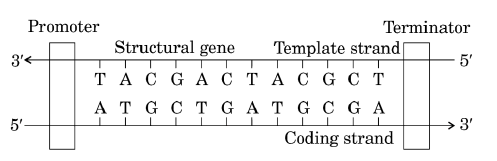
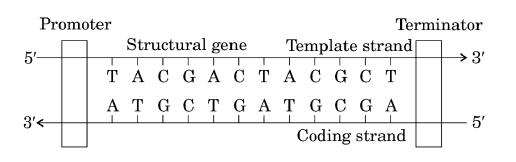
Four different transcription units are shown below. Choose the option with the correct image
-
(A) Option C
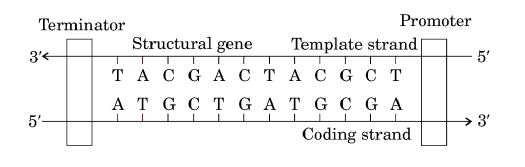
-
(B) Option D
-
(C) Option B
-
(D) Option A
Appearance of antibiotic-resistant bacteria is an example of evolution due to
Identify the statements that correctly describe Darwin’s Theory of Evolution
(i) Overproduction of organisms leads to competition.
(ii) Variation is inherited and causes evolution.
(iii) Acquired characters are inherited
(iv) Survival depends on favourable traits
(v) New species arise due to accumulation of favourable variations
Which of the following is not a symptom of Ascariasis ?
The smallest part of DNA molecule that can be changed by point mutation is :
Some statements regarding drugs and alcohol are given below: (i) Adolescents are more vulnerable to peer pressure. (ii) Drug addiction leads to increased tolerance level of the receptors present in our body. (iii) Alcohol affects the central nervous system. (iv) Excessive use of drugs helps to increase energy. (v) Anabolic steroids decrease aggressiveness Choose the option with correct statement(s).
Assertion (A) : Activated sludge contains large population of bacteria. Reason (R) : These bacteria help in anaerobic digestion of human waste in biogas plant
Assertion (A) : Ecosystems require a constant supply of energy to synthesize the molecules they require. Reason (R) : This is to counteract the universal tendency towards increasing disorderliness as per Second Law of Thermodynamics.
Section C
A person complains of persistent itching in the groin region and scalp. The person also shows dry and scaly lesions on skin, nails, etc.
(i) Identify the disease.
(ii) Name its two causative agents.
(iii) Mention its mode of transmission.
A girl develops sneezing, watery eyes and difficulty in breathing every time she visits a flower garden.
(i) Identify the condition.
(ii) Name the immune component responsible for this condition.
(iii) Name the chemical released.
(iv) State one medicine used to treat such a condition
(i) Mention any two characteristics of Neanderthal man that lived near East and Central Asia.
(ii) Identify the following hominids with respect to human evolution :
(I) Brain capacity 900 cc, probably ate meat.
(II) First human-like with brain capacity 650 – 800 cc
The allele for brown eyes (B) is dominant over blue eyes (b). In a population, 36% of individuals have blue eyes.
Assuming Hardy-Weinberg equilibrium, calculate
(i) Frequency of allele B
(ii) Percentage of heterozygous individuals
(iii) Percentage of individuals that are homozygous dominant
(working to be shown)
What did Henking observe in his experiments on insects that led to the discovery of sex chromosome ? How did his observation contribute to our understanding of sex determination
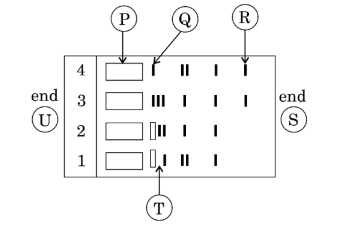
Given below is the schematic representation of the process of electrophoresis. Identify the alphabets representing the
(I) Anode end, and
(II) Lightest/Smallest DNA in matrix
(ii) What is Agarose gel and why is it used in this process ?
After performing gel electrophoresis, a student observes that DNA fragments are not visible.
(i) Suggest a reason for this and explain how fragments can be made visible.
(ii) Also explain how a specific DNA fragment can be collected from the gel for further use.
GEAC is a regulatory body under the Ministry of Environment, Forest and Climate Change in India.
(a) Write the full form of GEAC.
(b) Mention two of its important functions related to biotechnology
Section D
Answer the following questions:
(a) Explain the different ways by which apomictic seeds can be developed.
(b) Mention one advantage of apomictic seeds for farmers
(a) What is meant by translation in protein synthesis ?
(b) Explain charging of tRNA (aminoacylation of tRNA) and mention its importance in the process of translation.
(a) What is the carrying capacity of a species in a habitat ?
(b) Explain the growth curve that takes this capacity into account
In vitro fertilization (IVF) is a popular method these days that is helping childless couples to bear a child.
(a) Write the different steps that are carried out in this technique.
(b) Would you consider gamete intra fallopian transfer as a type of IVF ? Justify your answer.
Draw a neat diagram of a maize grain showing the internal structure and label any five parts.
Cow dung and water are mixed and fed into a biogas plant to allow digestion of biowastes. The person performing this process says that there is no need to provide an inoculum.
(a) Do you agree with him ? Justify your answer.
(b) What happens to the biowaste inside the digester ?
(c) Name the useful by-products obtained from this process and mention how they are used.
(a) Describe the experiment conducted by T.H. Morgan on Drosophila melanogaster involving eye colour and body colour.
(b) How did the results deviate from Mendelian inheritance pattern ?
(c) Explain the two genetic terms used by Morgan for his observations.
Section E
(i) Describe the series of experiments conducted by Frederick Griffith. Comment on the significance of the result obtained.
(ii) State the contribution of Avery, MacLeod and McCarty.
The following questions are based on haemophilia
(i) Work out the crosses between :
(a) Normal female and Haemophilic male
(b) Carrier female and Normal male
(c) Carrier female and Haemophilic male
(ii) Write the conclusions you draw from these crosses. Comment on the type of inheritance of the disease.
(Use : X – Normal, Xh – Haemophilic
(i) Explain any two basic principles/core techniques on which biotechnology is based.
(ii) Describe any three key tools used in Recombinant DNA technology.
‘‘Early and accurate diagnosis of diseases is vital in medical technology.’’
(i) Name the conventional methods of diagnosis and their disadvantages.
(ii) Which three diagnostic techniques have been developed through Biotechnology ? Explain how each one helps in detecting diseases.
Oogenesis is a discontinuous process that begins before birth and is completed after puberty.
(i) Trace the development of a gamete mother cell till its release from the ovary during ovulation.
(ii) Name the two pituitary hormones that play an important role in the process.
(i) Draw a labelled two-celled structure of male gametophyte of an angiosperm.
(ii) Name the three layers that surround the cytoplasm of a male gametophyte starting from innermost to outermost layer.
(iii) Which organic material makes the outermost layer ? Mention its advantage.
(iv) Why is the outermost layer of male gametophyte not continuous ?
Other Years — Biology