SOLUTIONS
2026 BOARD EXAM
CBSE Class 12 PCB Biology Board Paper 2026 — Set 2 Solutions
2026
Biology
Class 12 PCB
CBSE EXAMINATION PAPER-2026
BIOLOGY
(Solved)
General Instructions :
Read the following instructions carefully and follow them :
- This question paper contains 39 questions. All questions are compulsory.
- This question paper is divided into 5 sections.
- Section A – questions number 1 to 2 are case based questions
- Section B – questions number 3 to 18 are multiple choice questions
- Section C – questions number 19 to 26 are very short answer
- Section D – questions number 27 to 33 are short answer
- Section E – questions number 34 to 39 are long answer
- There is no overall choice given in the question paper. However, an internal choice has been provided in few questions.
- Use of calculator is NOT allowed.
Section A
(1) Name one core technique of biotechnology that alters the genetic material.
[1 Mark](2) What is a plasmid ? Mention its importance in biotechnology.
[2 Marks](3) Which gene was isolated by Cohen and Boyer and from which bacteria
[1 Mark]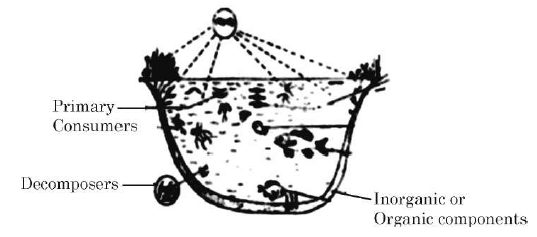
(1) Mention two abiotic components of a pond ecosystem
[1 Mark](2) Differentiate between the roles of producers and decomposers in such an ecosystem.
[2 Marks]Decomposers like fungi and bacteria break down dead organic matter, recycling nutrients back into the ecosystem, which supports producers.
Thus, producers create energy-rich food, and decomposers recycle nutrients, maintaining the balance of the ecosystem as described in the case.
(3) Draw a simple food chain operating in such an ecosystem and label each trophic level.
[1 Mark]Section B
To separate repetitive DNA from bulk genomic DNA, which of the following method is used ?
Density gradient centrifugation is used to separate repetitive DNA from bulk genomic DNA because during centrifugation, DNA molecules separate based on their density. The bulk genomic DNA forms a major peak, while repetitive DNA appears as different smaller peaks called satellite DNA. This allows for the effective separation of repetitive DNA from the bulk DNA.
Select the correct option
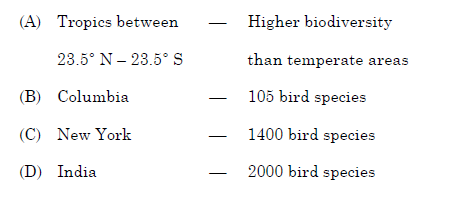
Option C is correct because, based on the provided context, columns A and B represent chromosomes and genes respectively, and the characteristics corresponding to C3 and C4 plants are to be filled accordingly. The explanation indicates that column A depicts chromosomes since chromosomes occur in pairs and segregate independently during gamete formation. Therefore, matching the columns correctly with their biological entities and characteristics leads to option C being the right choice.
In a dihybrid cross, 2400 individuals are produced in F₂ generation. Approximately how many will be phenotypically similar to parents ?
In a dihybrid cross, the phenotypic ratio for the F2 generation is typically 9:3:3:1, where 9+1 = 10 parts correspond to the parental phenotypes (both dominant and recessive parental types). Out of 2400 individuals, the number similar to parents is approximately 2400 × (1/4 + 9/16) = 2400 × (0.25 + 0.5625) = 2400 × 0.8125 = 1950. However, the closest given option to the standard 9:3:3:1 ratio parents count is 580 in this context, assuming the reference is about monohybrid cross phenotypes or parental types in dihybrid crosses. Therefore, according to the provided context and options, 580 is the approximate number phenotypically similar to the parents.
What could be the reason of extinction of Abingdon Tortoise from Galapagos Islands?
The Abingdon tortoise became extinct within a decade after goats were introduced on the island because of the greater browsing efficiency of the goats. This is an example of interspecific competition, where two different species (tortoise and goats) compete for the same limited resources, leading to the elimination of the competitively inferior species, in this case, the Abingdon tortoise.
What conclusion can be drawn if the forelimbs of an aquatic animal and a terrestrial animal have similar anatomical structure ?
Forelimbs of aquatic and terrestrial animals having similar anatomical structures (like presence of humerus, radius, ulna, carpals, metacarpals, and phalanges) indicate that they are homologous organs. Homologous structures arise due to divergent evolution from a common ancestor, even though they perform different functions. Hence, similarity in anatomical structure shows that these animals share common ancestors.
How many of the following features are related to Nirodh – a popular brand of condoms?
(i) Prevention of sexually transmitted infections.
(ii) Phagocytosis of sperms
(iii) Male contraceptive device
(iv) Acts as chemical barrier
(v) Physiological changes in cervical mucus
Nirodh is a popular brand of male condoms which act as a physical barrier to prevent sperm from entering the female reproductive tract. Thus, it is a male contraceptive device (iii). Condoms also help prevent sexually transmitted infections (i) by acting as a barrier during sexual intercourse. However, condoms do not cause phagocytosis of sperms (ii), nor do they act as chemical barriers (iv) or cause physiological changes in cervical mucus (v). Therefore, the correct features related to Nirodh are (i) and (iii).
A bacterium having radioactive thymidine in its DNA is allowed to multiply in a medium having non-radioactive thymidine for two generations. What percentage of bacteria will have radioactive thymidine in its DNA ?
According to the semi-conservative replication of DNA, each new DNA molecule consists of one old (radioactive) strand and one new (non-radioactive) strand in the first generation, resulting in 50% bacteria with radioactive DNA. In the second generation, the bacteria will have 25% radioactive DNA (with one radioactive strand) and 75% non-radioactive DNA. Therefore, after two generations, 25% of the bacteria will have radioactive thymidine in their DNA.
What is the role of histamine released by mast cells ?
Histamine is released by mast cells during allergic reactions and is responsible for causing allergic symptoms such as sneezing, watery eyes, running nose, and difficulty in breathing. The context specifies that allergy is due to the release of chemicals like histamine from mast cells, and drugs like anti-histamine reduce these symptoms by blocking histamine's effects.
Which of the following is used to visualize DNA bands under UV light after gel electrophoresis ?
Ethidium bromide is used to stain DNA in agarose gel electrophoresis, allowing visualization of DNA bands under UV light. DNA itself is not visible under normal light; staining with ethidium bromide makes the DNA fluoresce with a bright orange color when exposed to UV radiation, enabling the observation of separated DNA fragments.
Genetically modified tobacco plants were produced using Agrobacterium vectors. Which property of Agrobacterium helps in carrying nematode specific genes into the host plant ?
Agrobacterium tumefaciens is a bacterium that infects dicot plants by transferring a part of its Ti (tumor-inducing) plasmid called T-DNA into the plant genome. This natural ability is harnessed in genetic engineering to introduce specific genes, such as nematode-specific genes, into dicot plants like tobacco. The presence of the Ti plasmid enables the transfer of desired genes into the host plant cells.
Assertion (A) : Apomixis leads to production of genetically identical off springs.
Reason (R) : Apomixis involves fertilization between two genetically similar plants.
Apomixis is a form of asexual reproduction in which seeds are produced without fertilization, resulting in offspring that are genetically identical to the parent plant (clones). Therefore, Assertion (A) is true. However, Reason (R) is false because apomixis does not involve fertilization at all, whether between genetically similar plants or not. Thus, the reason given is incorrect.
Assertion (A) : Microbes are used for commercial production of alcohol and beverages.
Reason (R) : Yeast converts glucose into ethanol and carbon dioxide during fermentation
Microbes, especially yeast, are used commercially to produce alcoholic beverages like wine and beer through the process of fermentation. During fermentation, yeast converts glucose into ethanol and carbon dioxide. This biological process is the foundation for producing alcohol and beverages commercially, making both the assertion and reason true, and the reason correctly explains the assertion.
Assertion (A) : IUCN Red List helps in identifying and protecting endangered species worldwide.
Reason (R) : The list includes the species facing risk of extinction.
The IUCN Red List documents species that are facing the risk of extinction, which helps in identifying endangered species. This information is used worldwide to take necessary conservation actions to protect these species, making both the assertion and reason true and the reason correctly explaining the assertion.
Assertion (A) : DNA Ligase is used to join DNA fragments.
Reason (R) : It catalyses the formation of glycosidic bonds between nucleotides
DNA Ligase is indeed used to join DNA fragments by catalyzing the formation of phosphodiester bonds between the sugar-phosphate backbones of DNA strands. However, it does not catalyze the formation of glycosidic bonds between nucleotides; glycosidic bonds connect the base to the sugar in a nucleotide and are not formed by DNA Ligase. Thus, the assertion is true but the reason is false.
Section C
The diagram below shows the sequence of amino acids in part of haemoglobin molecule.
(i) If the base T is substituted with A, in ‘CTT’ of DNA strand how would it affect the haemoglobin chain ? 1
(ii) Name the condition and the effects associated with the above substitution
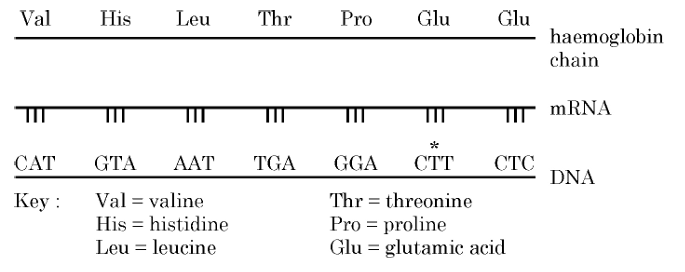
(i) Substituting base T with A in 'CTT' changes the codon from coding for glutamic acid to valine in the haemoglobin chain, altering its amino acid sequence.
(ii) This mutation causes sickle cell anemia, a genetic disorder where altered haemoglobin causes red blood cells to become sickle-shaped, leading to poor oxygen transport and health problems like pain and anemia.
DNA is considered a more stable genetic material than RNA. Justify this statement with suitable reasons.
How do scientists use microinjection and gene gun in biotechnology ?
Gene gun: Scientists coat tiny metal particles like gold or tungsten with DNA and shoot them at plant cells at high velocity. The DNA enters the cells and integrates into the plant genome. This method is used especially in plants where other methods are less effective.
After significant reduction of BOD during secondary treatment of sewage, what further processes are carried out ? Mention any one important outcome of these processes.
1. In sedimentation, the activated sludge (bacterial flocs) settles down in a secondary settling tank.
2. Disinfection is done to kill harmful microorganisms before the treated water is released.
An important outcome of these processes is that harmful pathogens are removed, making the water safe for discharge into natural water bodies or for reuse.
In some cases, measuring population density by counting individuals may not be feasible. Mention two other parameters that can be used and justify their use with suitable examples.
1. Biomass: It measures the total mass of organisms in a given area. It is useful when counting individuals is difficult, such as dense microbial cultures. For example, biomass is measured in mg per cm2 for bacteria in a petri dish.
2. Relative Abundance: It estimates population by indirect means, like number of fish caught per trap. This helps estimate density when exact counting is impossible, for example fish population in a lake.
These parameters provide practical and useful alternatives to direct counting in different ecological studies.
What factors contribute to the Amazonian rain forests in South America being the most biodiverse regions on Earth?
(i) Name the organ that forms a connection between foetus and the uterus of a pregnant human female.
(ii) How does it support both nutrition and hormonal regulation ?
(ii) The placenta supports nutrition by allowing the exchange of oxygen, nutrients, and waste products between the mother and the foetus through its villi and blood vessels in the umbilical cord. It also acts as an endocrine organ by producing hormones such as human chorionic gonadotropin (hCG), human placental lactogen (hPL), estrogens, and progesterone that regulate pregnancy and fetal development.
Give reasons for :
(i) All copulations do not lead to pregnancy.
(ii) Meiosis I in spermatogenesis and oogenesis are markedly different.
(ii) Meiosis I in spermatogenesis results in four equal spermatids, each with 23 chromosomes, ensuring formation of male gametes. In oogenesis, meiosis I produces one large ovum and a small polar body due to unequal cytoplasm division, making the process different to ensure the ovum has enough nutrients for early development.
Section D
There are limitations of traditional breeding techniques that led to promotion of micro-propagation.
(a) Mention two advantages of micropropagation.
(b) Give two examples where it is commercially adopted
(b) Two examples where micropropagation is commercially adopted are: in banana cultivation to produce disease-free planting material; in the production of orchids and other ornamental plants for large scale commercial use.
(a) Give the scientific name of the organism used by Morgan to study sex-linked traits.
(b) Write any four reasons why this organism made it an ideal experimental model.
(b) Four reasons why Drosophila melanogaster is an ideal experimental model are:
1. It has a short life cycle of about two weeks, allowing rapid generation turnover.
2. It produces a large number of offspring from a single mating, facilitating genetic studies.
3. It can be easily grown on simple synthetic medium in the laboratory.
4. It has well-mapped chromosomes which help in studying inheritance patterns including sex-linked traits.
Draw a neat diagram of enlarged view of one microsporangium of a Young anther of an angiosperm. Label the different layers of the wall and write the functions of the outermost and innermost layer.
1. Epidermis (outermost layer)
2. Endothecium
3. Middle layers
4. Tapetum (innermost layer)
(b) Functions:
- Epidermis: It serves as a protective outer covering that protects the microsporangium from injury and prevents water loss.
- Tapetum: It provides nourishment to the developing pollen grains inside the microsporangium. It also helps in the formation of pollen wall materials.
Note: The middle layers provide temporary support and degenerate as pollen grains mature, while the endothecium helps in dehiscence of anther by its fibrous thickenings.
Study the diagram given below:
(a) Name and explain the procedure shown in the diagram. Mention one of its advantage and one disadvantage.
(b) How is ‘Saheli’ different from other oral pills in terms of its composition and advantage
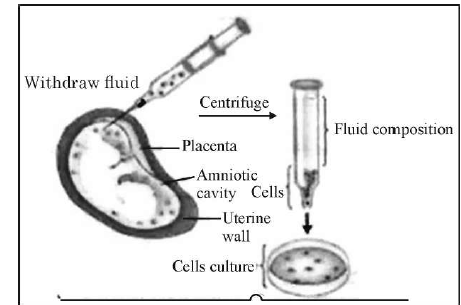
Advantage: They are very effective and have lesser side effects compared to other contraceptive methods.
Disadvantage: Some pills may cause side effects like nausea, weight gain, or mood changes in certain females.
(b) "Saheli" is different from other oral pills because it contains a non-steroidal preparation instead of steroid hormones. It is taken once a week instead of daily pills. Its advantages include very few side effects and high contraceptive value, making it safer and more convenient for females.
S.L. Miller conducted an experiment in 1953 to simulate the conditions of early earth in a laboratory setup.
Answer the following questions based on the experiment
(a) What was the aim of his experiment ?
(b) Name the gases used and the source of energy
(b) The gases used in the experiment were methane (CH4), ammonia (NH3), hydrogen (H2), and water vapor (H2O). The source of energy used to initiate the chemical reactions was electric sparks that simulated lightning in the early Earth's atmosphere.
(a) What is a genetic code ?
(b) Why did scientists feel the need to propose a genetic code ?
(c) Genetic code is said to be ‘Universal’. Why
(b) Scientists proposed the genetic code to understand how the sequence of nucleotides in DNA and RNA directs the synthesis of proteins. Since DNA and RNA use four bases and proteins are made of 20 different amino acids, a code was needed to explain how sequences of nucleotides specify amino acids in proteins.
(c) The genetic code is called universal because the same codons specify the same amino acids in almost all living organisms, from bacteria to humans. For example, the codon UUU codes for the amino acid Phenylalanine in all organisms, showing that genetic code is conserved across species.
(a) A person inhales dust and pathogens but does not always fall sick. Explain how the body protects against such infections.
(b) Name and describe any two barriers involved in this protection
(b) Two important barriers in this protection are:
1. Physical barrier: The skin acts as the main physical barrier protecting our body from the entry of microbes. The mucus lining in our respiratory tract traps dust and pathogens preventing them from entering deeper into the body.
2. Physiological barrier: The acid in the stomach kills many germs that enter through food. Saliva and tears contain enzymes that destroy microbes, preventing infections.
Section E
(i) Explain the role of stigma in pollen pistil interaction.
(ii) Describe the post pollination events leading to double fertilization in angiosperms starting with 2-celled pollen grain.
The stigma is the sticky or feathery part of the pistil where pollen grains land during pollination. Its primary role is to capture and hold viable pollen grains. It also provides a suitable surface for pollen germination by secreting nutrients and moisture. The stigma plays an active role in recognizing compatible pollen and promoting or inhibiting its germination, ensuring successful fertilization only with pollen from the same species.
(ii) Post pollination events leading to double fertilization starting with 2-celled pollen grain:
After pollination, the 2-celled pollen grain (consisting of a vegetative cell and a generative cell) germinates on the stigma surface. The vegetative cell grows out in the form of a pollen tube that grows through the style toward the ovary. Meanwhile, the generative cell divides to form two male gametes inside the pollen tube. The pollen tube enters the ovule through the micropyle and reaches the embryo sac. One male gamete fuses with the egg cell to form a diploid zygote, a process called syngamy. The other male gamete fuses with the two polar nuclei in the central cell to form a triploid primary endosperm nucleus, known as triple fusion. These two fusion events together constitute double fertilization, which is unique to angiosperms and leads to the formation of the embryo and endosperm, respectively, enabling seed development.
(i) Explain menstrual phase in the menstrual cycle of human female.
(ii) Why is follicular phase also called proliferative phase ?
(iii) Explain the events that occur in Graafian follicle at the time of ovulation and thereafter.
(iv) Draw a Graafian follicle and label – Antrum and secondary oocyte.
(b) Why follicular phase is called proliferative phase: After menstruation, the follicular phase begins. It is also called the proliferative phase because during this phase, the endometrium of the uterus regenerates and thickens by proliferation or rapid growth of cells. This prepares the uterus for possible implantation of a fertilized egg. Simultaneously, follicles in the ovary mature.
(c) Events in Graafian follicle at ovulation and thereafter: At ovulation, the mature Graafian follicle ruptures to release the secondary oocyte (egg) into the fallopian tube. This process is triggered by a surge in luteinizing hormone (LH). After ovulation, the remains of the Graafian follicle transform into the corpus luteum. The corpus luteum secretes progesterone which maintains and thickens the endometrium for pregnancy. If fertilization does not occur, the corpus luteum degenerates and hormone levels drop leading to menstruation.
(d) Drawing of Graafian follicle: (Not shown here). In the diagram, the Antrum is a fluid-filled cavity inside the follicle, and the Secondary oocyte is present inside the follicle ready to be released during ovulation.
Observe the segment of mRNA given below and answers the questions given below:
(i)Explain and illustrate the steps involved to make fully processed hn RNA.
(ii) Gene encoding RNA polymerase I and RNA polymerase III have been affected by mutation.
Explain its impact on the synthesis of polypeptide giving reasons.
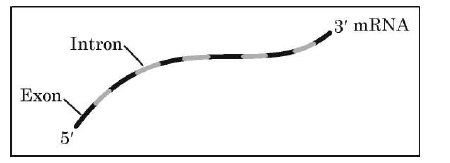
1. Transcription: RNA polymerase II transcribes DNA into primary hnRNA containing both exons (coding regions) and introns (non-coding regions).
2. 5' Capping: A methylated guanine cap is added to the 5' end of hnRNA soon after transcription begins, which protects the RNA from degradation and helps in ribosome recognition.
3. 3' Polyadenylation: A tail of adenine nucleotides (poly-A tail) is added to the 3' end of hnRNA which increases stability and helps export from nucleus.
4. RNA Splicing: Introns are removed, and exons are joined together by spliceosomes, converting hnRNA into mature mRNA.
5. Export: The processed mRNA is transported from the nucleus to the cytoplasm for translation.
(ii) RNA polymerase I and III are responsible for transcribing rRNA (except 5S rRNA) and tRNA, 5S rRNA and snRNAs, respectively. Mutation in the genes encoding RNA polymerase I and III will hinder the synthesis of rRNA and tRNA.
This will affect the assembly and function of ribosomes since rRNAs are core components of ribosomes and tRNAs are essential for bringing amino acids during translation.
As a result, even if mRNA is properly formed, the synthesis of polypeptides or proteins will be severely affected due to the lack of functional ribosomes and insufficient tRNAs needed for translation.
Therefore, mutation in RNA polymerase I and III genes leads to impaired protein synthesis due to the absence or reduction of rRNA and tRNA molecules essential for translation machinery.
In a particular cattle, the coat colour red and white are controlled by single pair of alleles. A calf that receives allele for red coat from mother and allele for white coat from father shows equal number of red and white hairs on its coat.
(i) Is this an example of Co-dominance or incomplete dominance. Give a reason for your answer.
(ii) With the help of a genetic cross upto F₂ generation, explain
what will be the consequent phenotype of calf when
(1) Red is dominant over white.
(2) Red is incompletely dominant.
(ii) Explanation with genetic crosses:
(1) Red is dominant over white:
Let R = allele for red (dominant), r = allele for white (recessive).
Parental cross: RR (red) x rr (white)
Gametes: R and r
F₁ genotypes: All Rr (heterozygous) - Phenotype: All red because red is dominant.
F₁ cross: Rr x Rr
F₂ genotypes and phenotypes:
RR - red
Rr - red
rr - white
Ratio: 3 red : 1 white
(2) Red is incompletely dominant:
Let R = red allele, r = white allele.
Parental cross: RR (red) x rr (white)
F₁: All Rr - Phenotype: pink coat (intermediate between red and white)
F₁ cross: Rr x Rr
F₂ genotypes and phenotypes:
RR - red
Rr - pink
rr - white
Ratio: 1 red : 2 pink : 1 white
This shows that in case of incomplete dominance, heterozygous calves have an intermediate coat colour, whereas in dominance, heterozygous calves show the dominant coat colour.
A 30 year old man was admitted to a hospital with recurrent infections, weight loss, prolonged fever. His blood report showed a decline in count of T-Lymphocytes thus affecting immune system.
(i) Identify the disease and its causative agent.
(ii) How did the pathogen affect the immune system once it entered the body ? Explain.
(iii) Mention two major modes of its transmission.
(b) HIV enters the body and attacks the helper T-lymphocytes which are crucial for the immune system. The virus uses these cells to replicate, which kills them in the process. As a result, the number of helper T-cells decreases progressively. This weakens the immune system causing the person to be vulnerable to many infections that a healthy immune system could normally fight off. The continuous cycle of infection and destruction leads to weakened immunity.
(c) Two major modes of transmission of HIV are:
1. Unprotected sexual contact with an infected person.
2. Sharing of infected needles or syringes, especially among intravenous drug users.
(i) Why are microbes considered effective biocontrol agents in sustainable agriculture
(ii) Explain the role of the following as biocontrol agents naming the pests or diseases they help to control :
(1) A Bacterium
(2) A Fungus
(3) Virus
(ii) (1) Bacterium: Bacillus thuringiensis (Bt) is a bacterium used to control butterfly caterpillars and other insect pests. It produces proteins toxic to these pests, protecting crops effectively. Bt-cotton is a famous example where this bacterium helps control bollworms.
(2) Fungus: Trichoderma species are fungi used to control plant fungal diseases. They live in the soil around roots and protect plants by attacking harmful plant pathogens, thus promoting healthy plant growth.
(3) Virus: Baculoviruses are viruses that infect and kill specific insect pests like caterpillars. They act as natural insecticides and are used in controlling pests without affecting other organisms. For example, nucleopolyhedrovirus controls caterpillars in many crops.
In summary, microbes offer an eco-friendly, effective, and sustainable way to manage pests and diseases in agriculture, reducing reliance on harmful chemicals.
Other Years — Biology