QUESTION PAPER
2026 BOARD EXAM
CBSE Class 12 PCB Biology Board Paper 2026 — Set 4
2026
Biology
Class 12 PCB
CBSE EXAMINATION PAPER-2026
BIOLOGY
(Solved)
General Instructions :
Read the following instructions carefully and follow them :
- This question paper contains 38 questions. All questions are compulsory.
- This question paper is divided into 5 sections.
- Section A – questions number 1 to 2 are case based questions
- Section B – questions number 3 to 18 are multiple choice questions
- Section C – questions number 19 to 24 are very short answer
- Section D – questions number 25 to 32 are short answer
- Section E – questions number 33 to 38 are long answer
- There is no overall choice given in the question paper. However, an internal choice has been provided in few questions.
- Use of calculator is NOT allowed.
Section A
Read the following passage and answer the questions that follow :
Gene expresses itself in a cell system as a protein/enzyme. How an expression of gene occurs in a cell system, when it needs to occur and how the gene expression is regulated in prokaryotic cell system was studied by the combined efforts of Francois Jacob, a geneticist and Jacques Monod, a biochemist. For their work on lactose metabolism in E. coli and introducing the concept of ‘lac operon’, they were awarded the Nobel Prize in 1965.
(1) It is said that ‘lac operon’ has to be operational at a very low level in the bacterial cell all the time. Justify.
[1 Mark](2) How are the structural genes activated in the lac operon in E. coli ?
[1 Mark](3) Why is lac operon said to be a transcriptionally regulated system ?
[2 Marks]Read the following passage and answer the questions that follow:
Immunity in our body is of two types (i) Innate immunity, and (ii) Acquired immunity. Innate immunity is a non-specific defence mechanism, whereas Acquired immunity is pathogen specific. Acquired immunity is characterised by memory. Antibodies are specific to antigens and there are four types of antibodies produced in our body — IgA, IgE, IgG and IgM. It shows primary response where it encounters the pathogen for the first time and secondary response during the subsequent encounters with the same antigen/pathogen. These immune responses are carried out with the help of two special types of lymphocytes present in the blood
(1) Name the two types of specialised cells which carry out the primary and secondary responses.
[1 Mark](2) Name any two barriers present in our body that provide innate immunity.
[1 Mark](3) How is active immunity different from passive immunity ? Write any two differences.
[2 Marks]Section B
Choose the option that gives the correct number of pollen grains that will be formed after 325 microspore mother cells undergo microsporogenesis.
A female undergoing IVF treatment has blocked fallopian tube. The technique by which the embryo with more than 8 blastomeres will be transferred into the female for further development is :
Select the correct statement.
All genes located on the same chromosome
Choose the correct statements:
(i) Polycistronic mRNA is generally found in eukaryotes.
(ii) The RNA polymerase II transcribes precursor of mRNA, the hn RNA.
(iii) The process of translation of mRNA begins when the mRNA encounters the large subunit of ribosomes.
(iv) Stop codons do not have any tRNAs
Name the extinct ancestor of humans who ate only fruits and hunted with stone weapons.
Nicotine affects blood pressure and heart rate due to release of certain adrenal hormones. Following are some of the adrenal hormones :
(i) Adrenaline
(ii) Cortisol
(iii) Noradrenaline
(iv) Aldosterone Select the correct option :
Microbes used for biocontrol of pest butterfly caterpillars is :
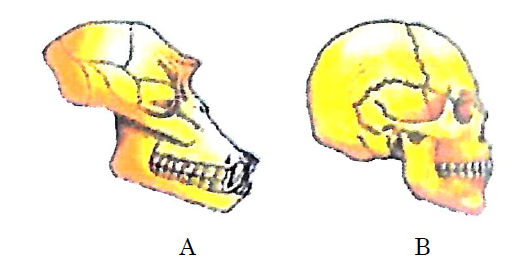
The given diagram shows the skulls of two different mammals. Which of the following options accurately describes the differences between these skulls ?
In RNAi, genes are silenced using which of the following biomolecules ?
Connell’s elegant field experiments on the rocky seacoast of Scotland, found that larger barnacles Balanus dominated the intertidal area and removed the smaller barnacles Chathamalus. This happened due to :
Protein encoded by gene Cry-I Ab controls the infestation of which of the following ?
Assertion (A) : Cleistogamous flowers have assured seed set.
Reason (R) : Cleistogamous flowers are invariably autogamous and do not depend on any pollinating agents
Assertion (A) : The human blood group ‘AB’ exemplifies co-dominance.
Reason (R) : The gene for human blood group trait exists in three allelic forms IA, IB and i.
Assertion (A) : Nucleopolyhedrovirus are useful as they are good biocontrol agents.
Reason (R) : They are species-specific, narrow spectrum bioinsecticide
Assertion (A) : The pyramid of biomass in a pond aquatic ecosystem is always inverted.
Reason (R) : The biomass of consumers like fishes far exceeds that of the producers like phytoplanktons
Section C
How do ‘implants’ act as an effective method of contraception in human females ? Mention one advantage of implants over contraceptive pills
(a) Write one way by which apomictic seeds can be developed.
(b) Why do farmers prefer apomictic seeds over hybrid seeds ?
A laboratory assistant collected three water samples, namely river water, untreated sewage water and secondary effluent discharged from a sewage treatment plant. But the laboratory attendant did not note which was which. The samples were labelled A, B and C and subjected to a BOD test. The BOD values of the three samples A, B and C were recorded as 30 mg/L, 8 mg/L and 400 mg/L respectively.
(a) Which sample of the water is most polluted ?
(b) Can you assign the correct label to each, assuming the river water is relatively clean ?
Write the role of ‘ori’ and ‘restriction’ site in a cloning vector pBR322.
Biodiversity must be conserved as it plays an important role in many ecosystem services that nature provides. Explain any two ecosystem services.
(i) State, what does ‘standing crop’ of a trophic level represent.
(ii) List any two ways of measuring the standing crop of a trophic level.
Section D
Differentiate between wind-pollinated and insect-pollinated flowers. Give an example of each type.
(a) Construct a complete transcription unit with promoter and terminator on the basis of the hypothetical coding strand given below:
(b) Write the RNA strand transcribed from the above transcription unit along with its polarity

Explain the three different ways in which natural selection operates. Explain with the help of graphs.
(a) How do some viruses cause cancer in humans ?
(b) How do benign tumours turn malignant ? How do malignant tumours harm the human body ?
(a) How is insulin different from proinsulin ?
(b) Explain all the stages of how human insulin is produced through rDNA technology.
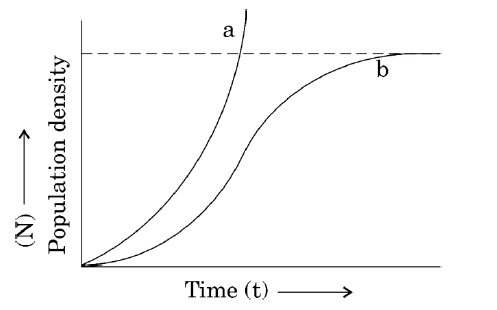
Study the graph given below and answer the questions that follow :
(i) Write the status of food and space in the curves a and b.
(ii) In the absence of predators, which one of the two curves would appropriately depict the prey population ?
(iii) ‘Time’ has been shown on x-axis and there is a parallel dotted line above it. Give the significance of this dotted line.
Answer the following questions :
(i) Define ‘predation’.
(ii) Why is predation required in a community of different organisms ? Give any two points.
(iii) Why are predators ‘prudent’ in nature ?
There are many animals, which have become extinct in the wild, but continue to be maintained in zoological parks. Answer the questions that follow:
(a) What type of bio-diversity conservation is observed in this case ?
(b) Explain any other two ways which help in this type of conservation.
(c) Besides zoological parks, mention one place that serves this purpose.
Section E
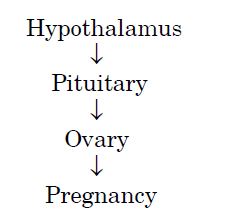
Study the flow chart given below. Name the hormones involved at each stage and explain their functions.
(i) Draw a diagram of L.S. of maize grain and label its any six parts.
(ii) Differentiate between perisperm and endosperm giving one example of each.
Write the types and locations of the genes causing thalassemia in humans. State the cause and symptoms of the disease. How is sickle-cell anemia different from this disease ?
(i) Enlist any four prime goals of the Human Genome Project (HGP).
(ii) List the two methodologies which were involved in the human genome project. Mention how they were used.
(iii) Expand ‘YAC’ and mention what it was used for
(i) EcoR I has played a very important role in rDNA technology.
(a) Explain the convention for naming EcoR I.
(b) Write the recognition site of this endonuclease restriction enzyme.
(ii) Name the overhanging stretches of DNA produced by these restriction enzymes. Describe their role in the formation of rDNA.
(i) Insertional inactivation is a method to detect the recombinant DNA. Explain this method.
(ii) Name the commonly used vector for transferring genes in plants from bacteria.
(iii) How is this able to transform a normal plant cell into a tumour ?
Other Years — Biology