CLASS 12-HUMANITIES . SOCIOLOGY . INDIAN SOCIETY . SUGGESTIONS FOR-PROJECT-WORK
Chapter 7 : SUGGESTIONS FOR PROJECT WORK
Ch 7
SOCIOLOGY
CLASS 12-HUMANITIES
Introduction to Practical Research Projects
This chapter introduces small practical research projects designed to provide hands-on experience in sociological research. Unlike merely reading about research methods, conducting actual research involves formulating questions, collecting evidence systematically, and analyzing data. This practical experience helps students understand both the excitement and challenges of sociological research. Students are encouraged to revisit Chapter 5, "Doing Sociology: Research Methods," from the Class XI textbook, Introducing Sociology, before proceeding.
The suggested projects are designed to be feasible for students in diverse school settings and contexts. While these projects offer a glimpse into research, real research requires more time and effort. Students are encouraged to develop their own ideas in consultation with teachers. Selecting an appropriate research method is crucial and depends on the research question, technical compatibility, and practical considerations such as time, resources, and context.
Exam Question
Q: Why is practical experience important in sociological research?
A: Practical experience allows students to understand the process of formulating questions, collecting evidence, and analyzing data, which helps them grasp the excitement and challenges of sociological research beyond theoretical knowledge.
Variety of Research Methods
Research methods must be chosen based on the research question and practical constraints. Common methods include surveys, interviews, and observation. Each method has advantages and limitations.
Survey Method
Surveys involve asking a large number of people a fixed set of questions, either through an investigator or self-administered questionnaires. Surveys can cover many people, making results representative. However, they lack flexibility, cannot follow up on interesting responses, and capture only a snapshot in time.
Exam Question
Q: What is a key advantage and a key limitation of the survey method?
A: The key advantage is that surveys can cover a large number of people, making results representative. The limitation is the fixed set of questions, which does not allow follow-up or clarification during data collection.
Interviews
Interviews are conducted in person with fewer participants and can be structured or unstructured. They allow flexibility to explore topics in depth and clarify responses. However, interviews cover fewer people and may not represent the larger population.
Exam Question
Q: How do interviews differ from surveys in sociological research?
A: Interviews involve fewer participants and allow flexible, in-depth exploration of topics, while surveys involve many participants with fixed questions and less flexibility.
Observation
Observation involves systematically watching and recording behavior in natural settings without pre-judging relevance. It can reveal important social patterns, including what does not happen. For example, observing how different social groups use public spaces can provide insights into social dynamics.
Exam Question
Q: What is an important consideration when conducting observation as a research method?
A: The researcher must carefully observe without pre-judging what is relevant and pay attention to both actions and absences in behavior.
Combinations of Methods
Combining methods, such as surveys with archival research, can provide a more comprehensive understanding of a research question by approaching it from different angles.
Exam Question
Q: Why is it recommended to combine research methods?
A: Combining methods allows researchers to approach a question from multiple perspectives, enhancing the depth and reliability of findings.
Possible Themes for Small Research Projects
Students can select from suggested themes or develop their own in consultation with teachers. Each theme requires formulating specific research questions and choosing suitable methods.
Public Transport
Research can explore the role of public transport in people's lives, dependency patterns, problems faced, historical changes, and social implications. For example, comparing co-educational and single-sex schools in terms of student happiness or performance can be a focused question.
Students in Delhi might study the Delhi Metro's current role and imagine its future evolution based on present conditions.

The image illustrates various modes of transport used for carrying goods, from manual carts to motorized vehicles, highlighting the diversity and practical considerations in transportation.
Exam Question
Q: What factors should be considered when choosing a research method for studying public transport?
A: Factors include the specific research question, available time and resources, the context of the study, and the suitability of the method to capture relevant data.
Role of Communication Media in Social Life
This theme involves studying mass media (newspapers, television, internet) and interpersonal communication media (phones, letters). Research can focus on changing media consumption patterns, preferences among different social groups, and the impact of new media technologies.

The collage shows the evolution of communication devices and media, illustrating technological progress and its social implications.
Exam Question
Q: How can observation and survey methods complement each other in studying communication media?
A: Observation can reveal actual usage patterns, while surveys can capture people's opinions and preferences, providing a fuller picture.
Household Appliances and Domestic Work
This topic explores the use of household devices, changes in domestic work, division of labor, and user perceptions. Research can examine gender roles, age-related tasks, and the impact of appliances on household work.
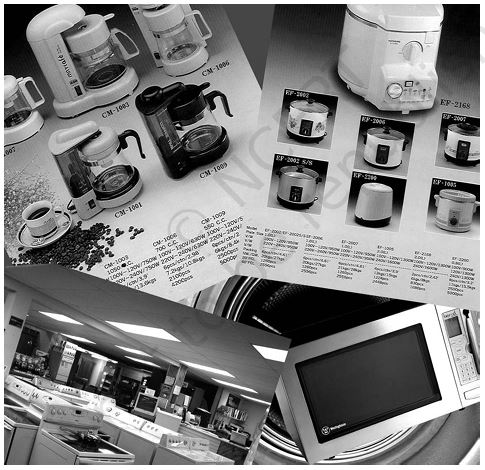
The image collage displays various kitchen appliances, their specifications, and real-life usage, highlighting technological advances in domestic work.
Exam Question
Q: What social aspects can be studied through research on household appliances?
A: Aspects include changes in division of labor, gender roles, user attitudes, and the impact on the nature of domestic work.
Use of Public Space
This research area examines how public spaces are used for commercial, social, and residential purposes, including conflicts arising from competing uses. Questions can focus on perceptions of different social groups and changes over time.
Exam Question
Q: Why is studying the use of public space important in sociology?
A: It reveals social dynamics, resource access, class relations, and potential conflicts within communities.
Changing Aspirations of Different Age Groups
This theme investigates how ambitions and goals change across age groups, genders, and backgrounds. Research can include school children and adults to identify patterns in aspirations.
Exam Question
Q: What can be learned by studying changing aspirations across age groups?
A: Insights into socialization, influence of environment, and developmental changes in goals and ambitions.
The Biography of a Commodity
Students can trace the life history of a household item, exploring its production, trade, social relations, and symbolic significance.

The collage illustrates daily life and objects, encouraging reflection on the social journey and meanings of commodities.
Exam Question
Q: What is the significance of studying the biography of a commodity?
A: It helps understand social relations, production processes, and cultural meanings attached to everyday objects.
Comparison of Research Methods
Tables compare observation and survey methods across various research topics, highlighting their suitability and challenges. Observation is effective for studying behavior and patterns, while surveys capture opinions and experiences. Archival research and interviews complement these methods by providing historical context and detailed personal views.
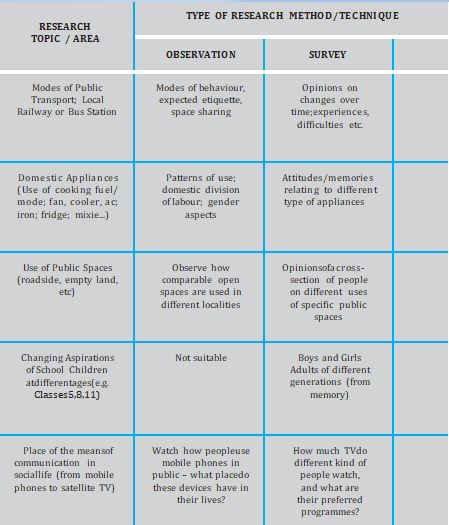
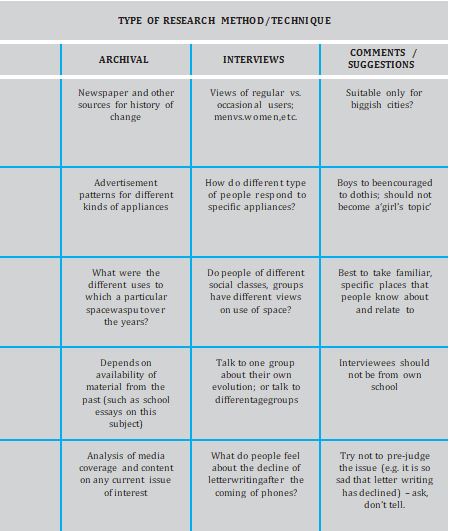
Exam Question
Q: How do archival research and interviews complement observation and surveys?
A: Archival research provides historical data, while interviews offer in-depth personal perspectives, enriching the understanding gained from observation and surveys.
Solved Examples
Example 1: Formulating a research question on public transport.
Question: How do students in co-educational schools perceive the quality of public transport compared to those in single-sex schools?
Method: Survey using questionnaires distributed to students in both school types.
Outcome: Analysis of responses to identify differences in perceptions.
Exam Question
Q: What steps are involved in conducting this research?
A: Formulate question, select method, design questionnaire, collect data, analyze results.
Practice Set
Easy
- Define the survey method and its main advantage.
- List two challenges faced during questionnaire distribution.
Moderate
- Explain how observation can be used to study the use of public spaces.
- Describe the difference between structured and unstructured interviews.
Challenging
- Design a small research project to study changing aspirations among different age groups using a combination of methods.
- Discuss the practical difficulties in conducting a survey in a school setting and how to overcome them.
Answer Key
Easy
- Survey method involves asking a fixed set of questions to many people; main advantage is representativeness.
- Challenges include obtaining permission and incomplete questionnaires.
Moderate
- Observation involves watching how people use public spaces to understand behavior patterns.
- Structured interviews follow fixed questions; unstructured are conversational and flexible.
Challenging
- Project design includes selecting age groups, formulating questions, combining surveys and interviews.
- Difficulties include time constraints, permissions, and non-response; solutions involve planning and follow-up.
Quick Reference
- Survey: Large sample, fixed questions, representative but inflexible.
- Interview: Small sample, flexible, in-depth but less generalizable.
- Observation: Direct watching, captures behavior, requires careful attention.
- Archival Research: Uses historical records to study change over time.
- Research Design: Formulate question, select method, collect data, analyze.
Glossary
- Assimilation
- A process where subordinate groups adopt the culture of the dominant majority, often incompletely.
- Authoritarianism
- A system of government not based on popular legitimacy or democracy.
- Capitalism
- A social system with private property, market economy, and class divisions between capitalists and wage laborers.
- Class
- An economic group sharing similar social and economic positions.
- Community
- A group connected by common culture, language, or kinship.
- Discrimination
- Unjust exclusion of groups from access to resources or opportunities.
- Ethnicity
- A group sharing a distinct cultural identity.
- Gender
- Socially and culturally produced differences between men and women.
- Kinship
- Connections between individuals through marriage or descent.
- Social Exclusion
- Structural deprivation preventing full participation in society.
- Stratification
- Hierarchical arrangement of social groups implying inequality.
- Survey
- A research method involving fixed questions to many respondents.