CLASS 12-HUMANITIES . SOCIOLOGY . SOCIAL CHANGE AND DEVELOPMENT IN INDIA . STRUCTURAL CHANGE
Chapter 1 : Structural Change
Ch 1
SOCIOLOGY
CLASS 12-HUMANITIES
Structural Change
Structural change refers to the transformation in the network of social relationships, including changes in caste, family, and kinship systems. It involves shifts in social institutions and patterns that shape society.
Understanding Colonialism
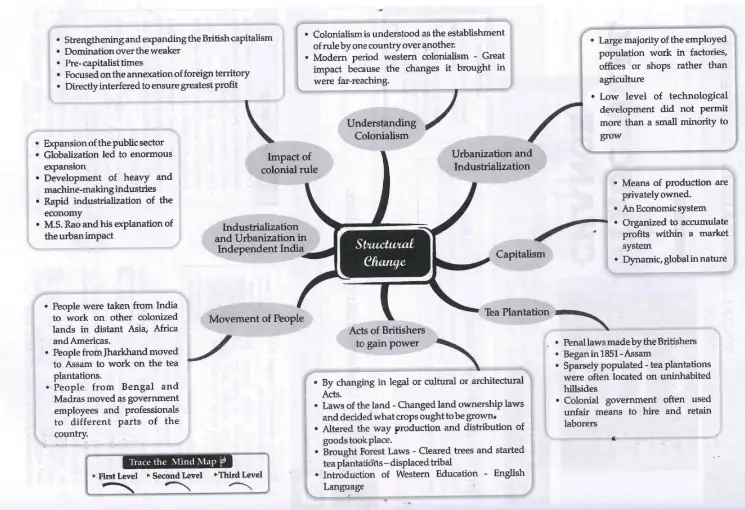
Colonialism is the establishment of rule by one country over another, exploiting its resources for economic growth. Western colonialism, especially British colonialism, brought deep and far-reaching changes in the colonized societies. The British colonial rule was based on capitalist principles aimed at strengthening British economic interests. It involved changes in land ownership laws, crop patterns, production, and distribution systems. The British also propagated Christianity and introduced Western education and the English language, intending to create a class of Indians to manage colonial administration. However, this also led to the rise of nationalist and anti-colonial movements.
Exam Question
Q: What were the main features of British colonialism in India?
A: British colonialism in India was capitalist in nature, focused on economic exploitation, changed land laws and crop patterns, introduced Western education and English, and led to nationalist movements.
Movement of People
During colonial times, people moved across regions for work and administration. Laborers from areas like Jharkhand were taken to Assam to work on tea plantations. A new middle class from Bengal and Madras moved as government employees and professionals to different parts of India. Indians were also sent to other colonies in Asia, Africa, and the Americas as indentured laborers.
Exam Question
Q: Describe the movement of people during British colonial rule in India.
A: People moved within India for jobs in plantations and government, and many were sent abroad as indentured laborers to other colonies.
Understanding Capitalism
Capitalism is an economic system where the means of production are privately owned and organized to accumulate profits within a market system. It is dynamic, global, and driven by growth, innovation, and technology. Western colonialism was closely linked to the growth of capitalism. The rise of capitalism also led to the emergence of nation-states with sovereign power and democratic ideas.
Exam Question
Q: What is capitalism and how was it connected to colonialism?
A: Capitalism is a profit-driven economic system with private ownership. Western colonialism helped expand capitalism by exploiting colonies economically.
Urbanization and Industrialization during the Colonial Time and Independent India
Industrialization involves machine-based production using power sources like steam and electricity. It created new jobs and shifted many people from agriculture to factories and offices. In India, British industrialization caused de-industrialization in some traditional sectors, leading to the decline of cities like Surat and Masulipatnam, while cities like Bombay and Madras grew as export centers. Industrialization also changed social structures and relationships. Tea plantations were established in Assam, often displacing tribal populations and exploiting laborers under harsh conditions. Independent India promoted industrialization to achieve growth and social equity, focusing on heavy industries, public sector expansion, and cooperative sectors. Urbanization continues to grow, with government initiatives like Smart Cities. Sociologist M.S.A. Rao noted varying impacts of urbanization on villages depending on their proximity and relations to cities.
Exam Question
Q: How did industrialization and urbanization affect India during colonial and post-independence periods?
A: Colonial industrialization led to decline of some traditional industries and growth of export cities. Post-independence, industrialization was promoted for growth and equity. Urbanization increased with new social changes and government initiatives.
Tea Plantations and Plight of Labourers
Tea plantations started in Assam in 1830, often on uninhabited hillsides. Laborers were recruited under harsh conditions, with the colonial government supporting planters' interests. Penal laws and unhealthy climates made life difficult for workers. The Transport of Native Labourers Act of 1863 regulated indentured labor recruitment. Laborers faced exploitation and poor living conditions.
Exam Question
Q: What were the conditions of laborers on tea plantations during British rule?
A: Laborers faced harsh recruitment, exploitation, penal laws, unhealthy climates, and poor living conditions under colonial planters.
Key Terms
- Structural Change: Transformation in social relationships such as caste, family, and kinship.
- Industrialization: Emergence of machine-based production using power sources like steam and electricity.
- Capitalism: Economic system with private ownership aimed at profit accumulation within a market.
- Colonialism: Rule by one country over another, exploiting resources and people.
- Urbanization: Increase in the proportion of people living in towns and cities, with lifestyle changes.
- Nation-State: A sovereign government within a defined territory with citizens having national identity and democratic rights.
Solved Examples
Example 1: Explain how British colonialism led to changes in Indian agriculture.
Answer: The British changed land ownership laws and decided which crops should be grown, often favoring cash crops like tea and indigo over food crops. This altered traditional agricultural practices and affected food security.
Example 2: Describe the impact of industrialization on Indian cities during colonial times.
Answer: Industrialization led to the growth of export centers like Bombay and Madras, while traditional manufacturing cities like Surat declined due to competition from British industries.
Practice Set
Easy
- Define colonialism.
- What is urbanization?
- What does capitalism mean?
Moderate
- Explain the movement of people during British colonial rule.
- Describe the changes in Indian agriculture under British rule.
- What were the effects of industrialization on Indian society?
Challenging
- Analyze the relationship between colonialism and the rise of capitalism.
- Discuss the social impact of urbanization and industrialization in India.
- Evaluate the conditions of laborers on tea plantations and the colonial government's role.
Answer Key
- Define colonialism: Rule by one country over another, exploiting its resources.
- What is urbanization? Increase in people living in towns and cities with lifestyle changes.
- What does capitalism mean? Economic system with private ownership aimed at profit.
- Movement of people: Laborers and professionals moved within India and abroad for work.
- Changes in agriculture: Land laws and crop patterns changed to favor British economic interests.
- Effects of industrialization: Growth of export cities, decline of traditional industries, social changes.
- Colonialism and capitalism: Colonialism expanded capitalist markets and production.
- Social impact of urbanization: New social groups, changes in social structure, migration.
- Laborers on tea plantations: Faced exploitation, harsh laws, poor conditions; government supported planters.
Quick Reference
- Structural Change: Social transformation in relationships and institutions.
- Colonialism: Foreign rule for economic gain.
- Capitalism: Profit-driven private ownership economy.
- Urbanization: Growth of towns and cities.
- Industrialization: Machine-based production.
- Nation-State: Sovereign political entity with national citizenship.
- Tea Plantations: Established by British, involved labor exploitation.
Glossary
- Structural Change
- Transformation in social relationships and institutions.
- Colonialism
- Control by one country over another for economic benefit.
- Capitalism
- Economic system based on private ownership and profit.
- Urbanization
- Increase in population living in urban areas.
- Industrialization
- Development of machine-based manufacturing.
- Nation-State
- A political entity with defined territory and sovereign government.
- Indentured Labourer
- Worker contracted to work for a fixed period, often under harsh conditions.
| Time Period / Year | Event / Change | Importance |
|---|---|---|
| 1830 | Start of tea plantations in Assam | Introduction of plantation economy and labor exploitation |
| 1863 | Transport of Native Labourers Act enacted | Regulated indentured labor recruitment |
| 1690 | Establishment of trading post by Job Charnock in Calcutta | Foundation of Calcutta as a colonial city |
| Post-Independence (1950s onwards) | Promotion of industrialization by Indian government | Economic growth and social equity focus |
| 21st Century | Smart City initiative launched | Modern urban development and infrastructure |