CLASS 12-HUMANITIES . SOCIOLOGY . SOCIAL CHANGE AND DEVELOPMENT IN INDIA . CHANGE AND-DEVELOPMENT-IN-RURAL-SOCIETY
Chapter 4 : Change and Development in Rural Society
Ch 4
SOCIOLOGY
CLASS 12-HUMANITIES
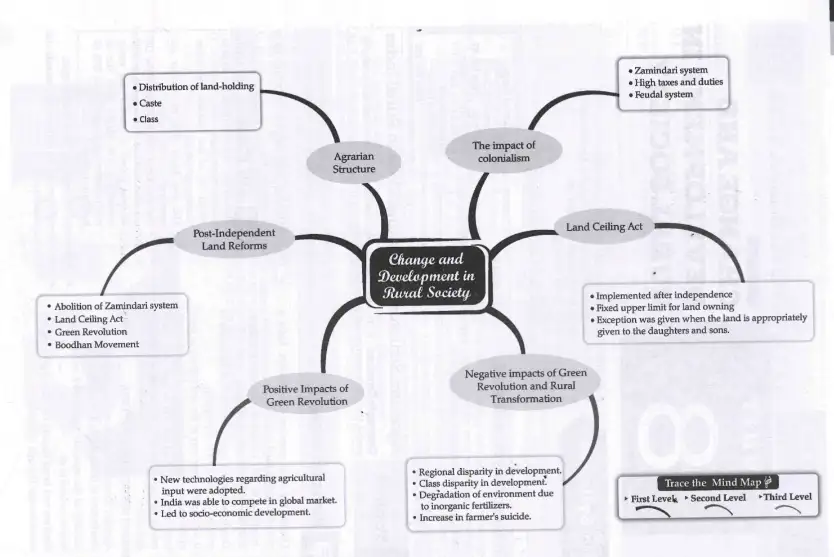
Agrarian Structure, Caste and Class in Rural India
India remains predominantly a rural society despite rapid urbanization, with about 67% of the population dependent on agriculture for livelihood as per the 2001 Census. Agricultural land serves as both a means of production and a form of property, deeply influencing rural life and culture, including festivals related to harvest and agricultural seasons.
Agrarian Structure and Class: This refers to the distribution and ownership of land in rural India. Most rural people own small plots or no land at all. Medium and large landowners earn sufficient income from cultivation, though profits depend on factors like monsoon. Agricultural labourers, often underpaid, work as tenants or daily wage labourers, paying a large share of profits to landowners. This creates a class division within rural society.
Agrarian Structure and Caste: Land ownership is also influenced by caste. Brahmins, though highest in caste hierarchy, are not major landowners. Castes like Shudras and Vaishyas hold most land. Dominant castes, as categorized by sociologist M. N. Srinivas, are economically and politically powerful. Landless groups mainly belong to Scheduled Castes (SCs), Scheduled Tribes (STs), and Other Backward Classes (OBCs). Dalits, traditionally untouchables, were historically denied land ownership and worked as labourers. The bonded labour system, where lower castes worked under hereditary or bonded conditions, has been legally abolished.
Exam Questions
Q1: What is meant by agrarian structure in rural India?
Answer: Agrarian structure refers to the pattern and distribution of land ownership in rural India, including the size of landholdings and the social relations connected to land.
Q2: How does caste influence land ownership in rural India?
Answer: Certain castes, known as dominant castes, hold most of the land and have economic and political power, while lower castes like Dalits are often landless and work as labourers.
Colonial Period and Its Impact on Rural Society
During British colonial rule, local administration was controlled through Zamindars who collected heavy taxes on agricultural land. Zamindars extracted maximum profits from labourers, leading to oppression, famines, and wars that affected rural populations. In some areas, the British implemented the Ryotwari system, where actual cultivators paid taxes directly, resulting in more reasonable taxes and incentives to invest in agriculture. These areas were relatively more prosperous and productive.
Exam Questions
Q1: What was the role of Zamindars in colonial India?
Answer: Zamindars acted as intermediaries who collected heavy taxes from peasants and extracted profits, often leading to exploitation and hardship for farmers.
Q2: How did the Ryotwari system differ from the Zamindari system?
Answer: In the Ryotwari system, actual cultivators paid taxes directly to the British government, which often resulted in more reasonable taxes and better incentives for farmers compared to the Zamindari system.
Independent Period: Land Reforms and Agricultural Changes
Post-independence, from the 1950s to 1970s, India implemented land reforms to reduce inequality and poverty. The Zamindari system was abolished, and the Land Ceiling Act was enacted to limit land ownership, with excess land redistributed to Scheduled Castes and Scheduled Tribes. The legislation also paved the way for daughters' property rights.
The Green Revolution (1960s-1970s) introduced modern agricultural technology such as high-yielding variety seeds, mechanized tools, irrigation, pesticides, and fertilizers. It was a government program supported by international agencies. Regions like Punjab, western Uttar Pradesh, coastal Andhra Pradesh, and parts of Tamil Nadu benefited first. The revolution increased crop production and wages for labourers but also led to increased class and regional inequalities, with some states remaining underdeveloped.
Exam Questions
Q1: What were the main objectives of land reforms after independence?
Answer: The main objectives were to reduce inequality, abolish the Zamindari system, impose land ownership limits, and redistribute excess land to marginalized groups.
Q2: What were the positive and negative impacts of the Green Revolution?
Answer: Positive impacts included increased agricultural production, modernization, and socio-economic growth. Negative impacts involved increased class and regional inequalities, environmental damage, and farmer distress.
Transformation in Rural Society and Circulation of Labour
Commercialization of agriculture led to growth in migrant agricultural labour. Traditional patronage bonds between labourers and landlords weakened, increasing seasonal demand for labour. In prosperous Green Revolution regions, seasonal migration became common, with workers moving between home villages and areas with higher wages. Inequalities forced many households to combine multiple occupations. Landless workers often lack rights and are underpaid, with wealthy farmers preferring migrant labour for lower wages. Maharashtra became notable for cotton production linked to global markets. Feminization of agriculture increased, but women were underpaid compared to men. These changes indicate a transition towards capitalist agriculture, characterized by separation of workers from land and reliance on wage labour.
Exam Questions
Q1: How did commercialization affect labour relations in rural India?
Answer: Commercialization increased migrant labour, weakened traditional bonds between labourers and landlords, and led to more wage-based employment and seasonal migration.
Q2: What is meant by feminization of agriculture?
Answer: It refers to the increased participation of women in agricultural work, often underpaid compared to men.
Globalization, Liberalization, and Rural Society
From the 1980s, India encouraged imports, exports, and foreign investments in cooperation with the World Trade Organization. This exposed farmers to global competition and reversed the policy of self-reliance in food grains. Contract farming became common for specialized crops like flowers, fruits, cotton, and oilseeds. Globalization increased the use of expensive agricultural inputs, forcing farmers to buy costly fertilizers. This process has also been linked to an increase in farmer suicides.
Exam Questions
Q1: How did globalization affect Indian agriculture?
Answer: Globalization exposed farmers to global markets, increased imports and exports, encouraged foreign investment, and led to contract farming and higher costs for agricultural inputs.
Q2: What are some negative consequences of globalization on rural farmers?
Answer: Negative consequences include increased financial pressure due to expensive inputs and a rise in farmer suicides.
Solved Examples
Example 1: Explain the impact of the Green Revolution on rural society.
Solution: The Green Revolution introduced modern technology and high-yield seeds, increasing agricultural production and wages. However, it also widened class and regional inequalities and caused environmental issues.
Example 2: Describe the role of Zamindars during the colonial period.
Solution: Zamindars acted as tax collectors for the British, extracting heavy taxes from peasants and often exploiting them, leading to rural distress.
Practice Set
Easy
- What percentage of India's population depends on agriculture?
- Who are considered dominant castes in rural India?
Moderate
- Explain the differences between the Zamindari and Ryotwari systems.
- What were the objectives of the Land Ceiling Act?
Challenging
- Discuss the social consequences of the Green Revolution in India.
- Analyze the impact of globalization on rural labour and agriculture.
Answer Key
Easy:
- About 67% of India's population depends on agriculture.
- Dominant castes are economically and politically powerful castes that hold most of the land in a village.
Moderate:
- Zamindari system involved intermediaries collecting taxes, often exploiting peasants; Ryotwari system had cultivators paying taxes directly, leading to more reasonable taxation.
- The Land Ceiling Act aimed to limit land ownership and redistribute excess land to marginalized groups.
Challenging:
- The Green Revolution increased production and wages but also caused class and regional inequalities, environmental damage, and farmer distress.
- Globalization exposed farmers to global markets, increased costs, led to contract farming, and contributed to farmer suicides.
Quick Reference
- Agrarian Structure: Distribution of land ownership and class relations in rural India.
- Dominant Castes: Castes holding most land and power in villages.
- Zamindari System: Colonial tax collection system via landlords.
- Ryotwari System: Direct tax payment by cultivators.
- Land Ceiling Act: Law limiting land ownership post-independence.
- Green Revolution: Agricultural modernization in 1960s-70s.
- Commercialization: Shift to market-oriented agriculture.
- Globalization: Integration of Indian agriculture with global markets.
Glossary
- Agrarian Structure: The pattern of land ownership and social relations in rural areas.
- Dominant Caste: A caste group that holds economic and political power in a village.
- Zamindar: A landlord who collected taxes during colonial times.
- Ryotwari System: A system where cultivators paid taxes directly to the government.
- Land Ceiling Act: Legislation to limit land ownership and redistribute land.
- Green Revolution: Introduction of modern agricultural techniques to increase production.
- Commercialization: The process of producing goods for the market rather than for personal use.
- Globalization: The process of integrating economies and cultures through trade and communication.
- Contract Farming: Agreement between farmers and companies to produce specific crops.
- Feminization of Agriculture: Increased participation of women in agricultural work.
| Time Period / Year | Event / Change | Importance |
|---|---|---|
| Colonial Period | Zamindari and Ryotwari systems introduced | Established land revenue systems; Zamindari led to exploitation |
| 1950s-1970s | Land reforms and abolition of Zamindari | Reduced inequality; redistributed land to marginalized groups |
| 1960s-1970s | Green Revolution | Modernized agriculture; increased production and inequalities |
| 1980s onwards | Globalization and liberalization | Opened markets; increased competition and farmer challenges |