CLASS 12-HUMANITIES . SOCIOLOGY . INDIAN SOCIETY . INTRODUCING INDIAN-SOCIETY
Chapter 1 : INTRODUCING INDIAN SOCIETY
Ch 1
SOCIOLOGY
CLASS 12-HUMANITIES
Introducing Indian Society
Sociology is the study of society, and everyone has some prior knowledge about society. This prior knowledge can be both an advantage and a disadvantage. While it makes sociology approachable, it often comes from common sense and personal social contexts, which can be incomplete or biased. Sociology teaches us to see society from multiple perspectives, not just our own.
Understanding Indian society involves mapping social groups and their relationships, much like a geographical map helps locate places. Sociology connects personal troubles with broader social issues, showing how individual experiences relate to larger societal patterns.
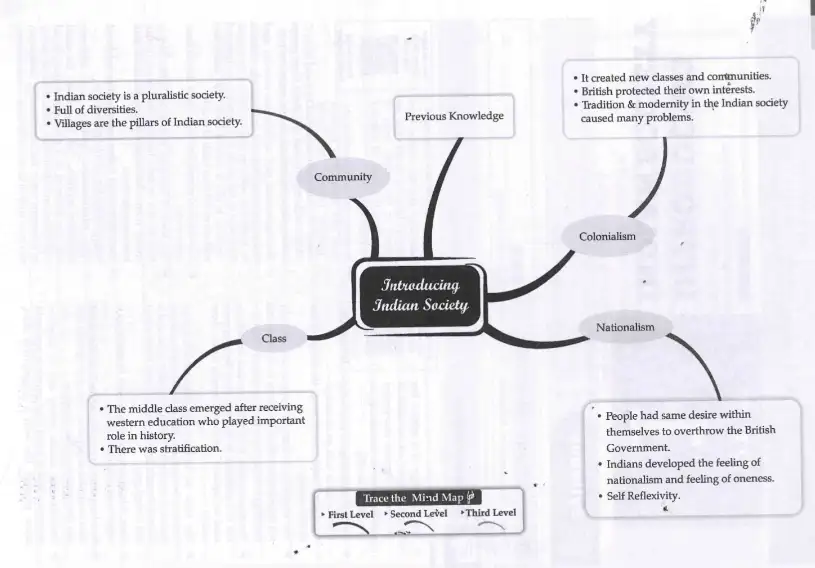
The emergence of Indian consciousness largely occurred during British colonial rule. Colonialism unified India politically and economically but also caused social exploitation. Paradoxically, it also sparked nationalism, the desire for independence.
What is the significance of studying Indian society from a sociological perspective?
Answer: It helps us understand society beyond common sense, recognize diverse social groups, and connect individual experiences to larger social issues.
Social Structure and Diversity in Indian Society
Indian society is pluralistic, characterized by diversity in language, region, religion, caste, and customs. Villages form the pillars of Indian society and culture. The social structure includes various classes and communities, some of which emerged or transformed during colonial rule.
The middle class arose with Western education and played a key role in challenging traditional social roles and leading nationalist movements. Indian society is moving towards modernization, influenced by values such as socialism, liberalism, secularism, democracy, and individual freedom.
How did colonialism affect the social structure of Indian society?
Answer: Colonialism created new social classes and communities, introduced Western education, and influenced social and economic changes that led to modernization and nationalism.
Processes of Social Change in Indian Society
During British rule, Indian society experienced various social changes. External processes included Westernization, modernization, secularization, and industrialization. Internal processes included Sanskritization and urbanization.
Modern institutions such as bureaucracy, legal systems, military, and formal education were introduced, preparing the background for modernization. Social reformers like Raja Ram Mohan Roy and Gandhi worked to abolish social evils such as sati, restrictions on widow remarriage, and untouchability.
What were the main social reform movements during British rule?
Answer: Movements aimed at abolishing social evils like the sati system, promoting widow remarriage, and fighting untouchability, led by reformers such as Raja Ram Mohan Roy and Gandhi.
Sociological Concepts and Terms
Key sociological terms include:
- Accommodation: Social interaction where individuals adjust within society.
- Ascriptive identities: Community identity based on birth rather than achievement.
- Class: Social or economic groups such as working class, middle class.
- Colonialism: Control of one country by another.
- Community: Group sharing religion, race, job, etc.
- Culture: Learned customs, language, and traditions.
- Globalisation: Worldwide interconnectedness affecting individuals and communities.
- Integration: Uniting different parts of society into a whole.
- Nation: People sharing culture, history, language in a geographical area.
- Nationalism: Desire for an independent country by a group sharing common traits.
- Social Map: An individual's social position based on age, region, religion, caste, and economy.
- Reflexivity: Ability to critically understand one's social position.
- Society: Group sharing culture and territory, feeling unified.
- Social structure: Organized patterns of social relationships and roles.
- Self-reflexivity: Deep introspection about oneself.
- Unity: Bringing different elements together to form a whole.
Why is reflexivity important in sociology?
Answer: Reflexivity allows individuals to critically examine their social position and understand society beyond personal biases.
Solved Examples
Example 1: Explain how colonialism contributed to the rise of nationalism in India.
Solution: Colonialism unified India politically and economically but also caused social exploitation. This experience of domination helped unify different social groups, leading to the rise of nationalism as a movement to end British rule.
Example 2: Describe the role of the middle class in Indian society during British rule.
Solution: The middle class emerged through Western education and challenged traditional social roles. It played a significant role in initiating nationalist movements and social reforms.
Practice Set
Easy
- Define sociology.
- What is a social map?
Moderate
- Explain the impact of British colonialism on Indian society.
- List two social reformers and the social evils they fought against.
Challenging
- Discuss the processes of social change in Indian society during the British period.
- How does sociology help in understanding the connection between personal troubles and social issues?
Answer Key
- Define sociology: The study of society and social behavior.
- What is a social map? A representation of an individual's social position based on factors like age, region, religion, caste, and economy.
- Impact of British colonialism: Created new social classes, introduced Western education, led to social reforms and nationalism.
- Social reformers and social evils: Raja Ram Mohan Roy - Sati system; Gandhi - Untouchability.
- Processes of social change: Westernization, modernization, secularization, industrialization, Sanskritization, urbanization.
- Sociology and personal troubles/social issues: Sociology links individual problems to larger social patterns and issues.
Quick Reference
- Sociology: Study of society.
- Pluralistic society: Society with diverse groups.
- Colonialism: Control by a foreign power.
- Nationalism: Desire for independence.
- Social reform: Efforts to change social evils.
- Social map: Individual's social position.
Glossary
- Accommodation
- Process of social interaction where individuals adjust within society.
- Ascriptive identities
- Community identity based on birth rather than achievement.
- Class
- Groups of people at similar social or economic levels.
- Colonialism
- Control of one country by another.
- Community
- Group sharing religion, race, job, or other traits.
- Culture
- Learned customs, language, and traditions passed through generations.
- Globalisation
- Worldwide interconnectedness affecting societies.
- Integration
- Bringing different parts of society together.
- Nation
- People sharing culture, history, language in a territory.
- Nationalism
- Desire for an independent country by a group.
- Social Map
- Representation of an individual's social position.
- Reflexivity
- Critical self-examination of one's social position.
- Society
- Group sharing culture and territory.
- Social structure
- Organized patterns of social relationships and roles.
- Self-reflexivity
- Deep introspection about oneself.
- Unity
- Bringing different elements together as one.